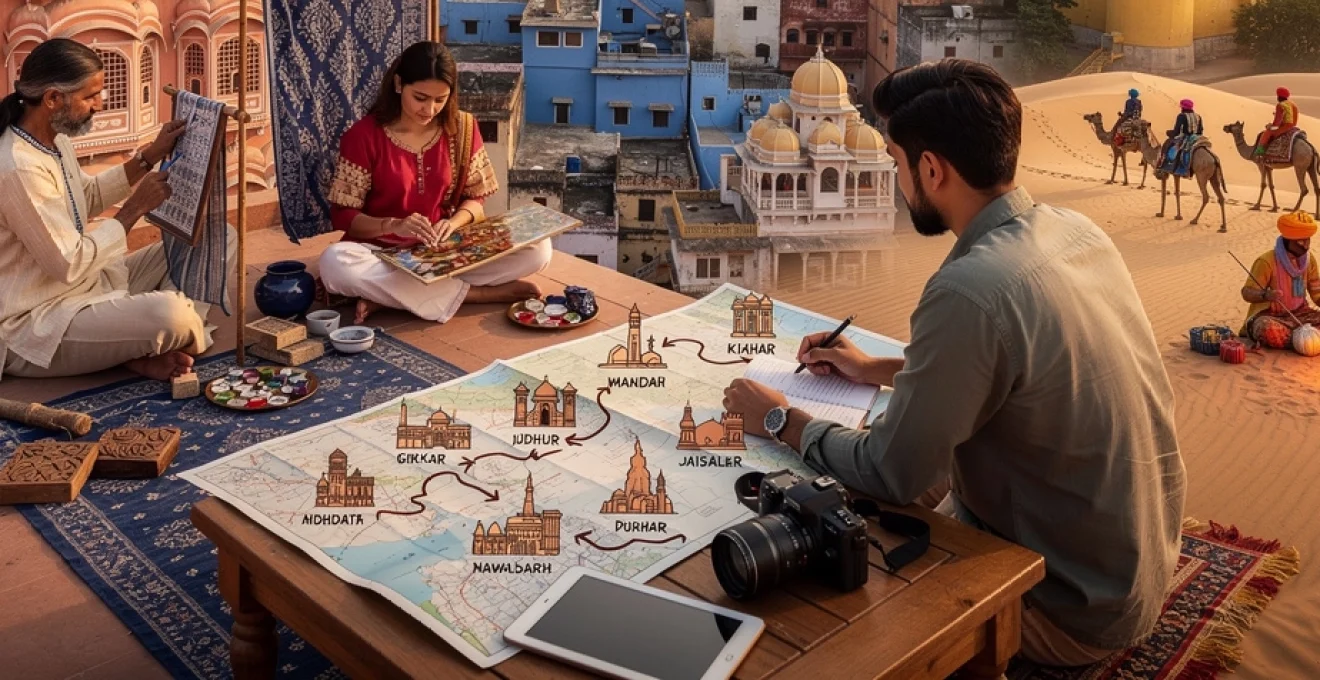
Rajasthan stands as India’s most captivating destination for cultural immersion, where centuries-old traditions flourish alongside magnificent architectural marvels. This desert state offers travellers an extraordinary opportunity to witness living heritage through its vibrant craft communities, spectacular festivals, and world-renowned palaces. From the pink sandstone streets of Jaipur to the golden ramparts of Jaisalmer, every corner reveals stories of royal dynasties, artistic excellence, and cultural continuity that spans over a millennium.
The key to experiencing authentic Rajasthan lies in moving beyond superficial tourist circuits to engage meaningfully with local artisans, participate in traditional workshops, and understand the cultural significance behind each monument and celebration. This approach transforms a standard holiday into a profound cultural exchange that benefits both visitors and the communities preserving these ancient traditions.
Strategic route planning through rajasthan’s golden triangle and desert circuits
Effective route planning across Rajasthan requires understanding the geographical distribution of cultural sites and seasonal accessibility factors. The state’s heritage attractions cluster around four main circuits, each offering distinct cultural experiences and architectural styles. Strategic planning ensures maximum cultural immersion while minimising travel fatigue and optimising weather conditions.
The most efficient approach involves selecting primary base locations that provide access to multiple heritage sites within day-trip distances. This strategy allows deeper exploration of each region’s unique cultural characteristics whilst maintaining comfortable accommodation standards and reducing constant packing and unpacking.
Jaipur-jodhpur-jaisalmer heritage corridor itinerary design
This classic route represents Rajasthan’s most iconic heritage corridor, connecting three UNESCO World Heritage sites through diverse landscapes and architectural styles. The journey from Jaipur’s Mughal-influenced palaces to Jaisalmer’s desert fortress architecture showcases the evolution of Rajput military and residential design over five centuries.
Optimal timing allocates four days in Jaipur for comprehensive exploration of Amber Fort, City Palace, and surrounding craft villages. The transition to Jodhpur requires a full day, allowing stops at Pushkar or Kishangarh for additional cultural experiences. Three days in Jodhpur provide sufficient time for Mehrangarh Fort exploration and blue city walking tours, whilst the final segment to Jaisalmer includes desert camping opportunities.
Udaipur-mount Abu-Chittorgarh royal lakes circuit navigation
Southern Rajasthan’s lake circuit offers a gentler cultural experience focused on romantic architecture and Jain temple artistry. Udaipur serves as the primary base, with its City Palace complex requiring at least two full days for thorough exploration. The surrounding lakes provide opportunities for traditional boat rides and sunset photography sessions.
Mount Abu’s Dilwara Jain temples represent some of India’s finest marble craftsmanship, requiring careful timing around restricted visiting hours and photography permissions. Chittorgarh’s massive fort complex demands a full day, combining historical storytelling with architectural appreciation. This circuit works particularly well during monsoon season when lakes reach their most photogenic levels.
Bikaner-mandawa-nawalgarh haveli heritage trail mapping
The Shekhawati region’s painted haveli trail offers intimate encounters with merchant family heritage and traditional fresco artistry. Unlike major palace complexes, these heritage sites require personal connections with local families who maintain ancestral properties. Advanced arrangements ensure access to private courtyards and family stories passed down through generations.
Bikaner anchors this route with its impressive Junagarh Fort and traditional sweet-making industries. The journey through Mandawa and Nawalgarh reveals outdoor art galleries where every building facade tells commercial and social stories from the 18th and 19th centuries. This circuit appeals particularly to photography enthusiasts and visitors interested in merchant culture heritage.
Pushkar-ajmer-kishangarh spiritual heritage route optimization
Central Rajasthan’s spiritual circuit combines Hindu pilgrimage sites with Mughal architectural influences and miniature painting traditions. Pushkar’s sacred lake and brahmin ghats create opportunities for spiritual reflection and photography, particularly during evening aarti ceremonies. The town’s narrow streets house traditional instrument makers and
ritual specialists who can explain the meaning behind devotional songs and temple ceremonies. A short drive away, Ajmer’s Ajmer Sharif Dargah introduces you to Sufi traditions, qawwali performances, and centuries of interfaith pilgrimage. Kishangarh completes the route with its distinctive school of miniature painting and the photogenic “floating” marble temple on Gundalao Lake, best visited at sunrise to avoid crowds and harsh light.
For optimal spiritual immersion, plan at least two nights in Pushkar and one in Ajmer or Kishangarh, allowing time to attend both morning and evening rituals. Dress modestly, carry a light scarf for head covering in shrines, and be prepared for close interaction with priests and devotees. When planning your Rajasthan spiritual heritage route, remember that religious festivals can transform the atmosphere completely—rewarding if you enjoy intensity, but challenging if you prefer quiet contemplation.
Architectural heritage documentation and palace access protocols
Navigating Rajasthan’s architectural heritage requires more than simply buying an entrance ticket; each major fort and palace operates under specific access rules, photography permissions, and guided tour systems. Understanding these protocols in advance will help you document Rajasthan’s heritage responsibly while respecting conservation norms and local regulations. For travellers interested in architectural photography, heritage documentation, or academic research, planning your visits with these frameworks in mind is essential.
Most major sites in Rajasthan are administered either by the Archaeological Survey of India (ASI) or royal trusts, and their policies can differ significantly. As you design your immersive Rajasthan itinerary, factor in ticket queues, guided tour schedules, and restricted zones where tripods or drones are not allowed. Think of it as entering a living archive: you are not just a visitor but a temporary custodian of how this heritage is represented and remembered.
Mehrangarh fort and umaid bhawan palace guided tour systems
Mehrangarh Fort in Jodhpur is widely regarded as one of India’s best-managed heritage sites, with an audio guide system that sets a benchmark for interpretive storytelling. Upon entry, you can rent multilingual audio devices that walk you through curated routes, explaining not only architectural features but also social and political history. For those wanting deeper insight, private guides approved by the Mehrangarh Museum Trust can be pre-booked for specialised themes such as armoury collections, courtly life, or conservation practices.
Umaid Bhawan Palace operates on a different model, as part of it remains an active royal residence and part has been converted into a luxury hotel. Public access is limited to the museum wing, where exhibits are organised around royal memorabilia and Art Deco architecture. Photography is usually permitted in outdoor areas but may be restricted around hotel sections, so it is wise to confirm rules at the entrance. If you are considering staying in the palace hotel, contact the property in advance to arrange heritage walks that access semi-private courtyards and provide richer context.
City palace jaipur and hawa mahal photography permissions
The City Palace complex in Jaipur is managed by the royal family’s trust, which offers layered access depending on the ticket you purchase. Standard tickets cover the principal courtyards and museum galleries, where handheld photography is generally allowed but flash and tripods are often prohibited to protect delicate textiles and manuscripts. Premium “royal experiences” sometimes include access to restricted chambers and rooftop viewpoints, with stricter rules about posting images or using them commercially, so always clarify if you plan to publish your work.
Hawa Mahal, or the Palace of Winds, presents a different dynamic: the most iconic photographs are often taken from cafés and terraces opposite the façade rather than from inside the monument. While interior photography is typically allowed with a regular ticket, the confined stairways and balconies make tripod use impractical and potentially unsafe. If you are planning a dedicated photography session, arrive early in the morning to avoid crowds and secure a vantage point from a rooftop café, where you can capture the honeycomb façade as the rising sun warms its pink sandstone.
Jaisalmer fort living heritage conservation areas
Jaisalmer Fort is unusual among Rajasthan’s major forts because it remains a living settlement, with residents, shops, and guesthouses operating within its walls. This living heritage status adds layers of complexity to access and documentation: while the outer ramparts and main temples are open to visitors, residential lanes are effectively private spaces. When photographing, always ask permission before capturing people in doorways or inner courtyards, and avoid pointing cameras directly into homes.
Conservation concerns are particularly acute here due to water seepage and unregulated construction, so responsible travellers can contribute by choosing businesses that support sustainable practices. Some heritage organisations offer guided walks focused on conservation, where you learn how tourism pressures are being managed and why restrictions on heavy vehicles or large tour groups exist. Treat this environment less like a static monument and more like an old town that happens to sit inside a fort—courtesy and discretion are part of the access protocol.
Chittorgarh fort UNESCO world heritage site navigation
Chittorgarh Fort, one of the largest fort complexes in India, is part of the UNESCO-listed Hill Forts of Rajasthan and sprawls across a vast plateau. Its scale means that effective navigation is key: internal distances between major points such as Vijay Stambh, Kirti Stambh, Rana Kumbha Palace, and Padmini Palace can be substantial. Hiring a local guide with a vehicle, or arranging an auto-rickshaw within the fort, allows you to cover more ground without exhausting yourself, especially in warmer months.
UNESCO status also implies stricter conservation rules, including limited commercial activities and designated viewpoints for photography. Drones are not permitted without special ASI clearance, and some shrines within the complex may restrict photography entirely. Plan at least half a day—ideally a full day—for Chittorgarh, allowing time not just for photo stops but for understanding the layered narratives of siege, sacrifice, and resilience that define its place in Rajasthan’s heritage.
Amber fort and jaigarh fort archaeological survey protocols
Amber Fort and Jaigarh Fort form an interconnected defence system overlooking Jaipur, with some sections linked by subterranean passages. Both fall under ASI jurisdiction, and their archaeological protocols emphasise structural safety and preservation of original materials. As a visitor, this translates into clear demarcations around fragile areas, railings that should not be leaned or sat on, and explicit prohibitions on scratching surfaces or leaving marks—behaviours that still, unfortunately, occur.
Tripod and drone usage are generally not allowed without prior written permission from the ASI, especially in busy areas such as the Sheesh Mahal (Mirror Palace) and main courtyards. If you are documenting Rajasthan’s forts for academic or professional purposes, begin your permission process several weeks in advance through ASI’s Jaipur circle office. For most travellers, official guides offer a practical balance: they know which vantage points provide the best views while keeping you within permitted zones and time windows.
Traditional craft workshops and artisan community engagement
One of the most powerful ways to experience Rajasthan beyond monuments is to engage directly with its craft communities. Hand-block printers, blue pottery artisans, miniature painters, and bandhani tie-dye experts are not just cultural symbols; they are working professionals navigating modern markets while preserving centuries-old techniques. When you participate in workshops or studio visits, you contribute to sustainable livelihoods and gain insights that no museum label can offer.
To ensure that your engagement is respectful and mutually beneficial, prioritise small-scale workshops and cooperatives over purely commercial showrooms. Ask in advance how long sessions last, what you will actually do with your hands, and how the fees are shared with artisans. Think of these experiences as collaborative learning spaces: you are there to learn, experiment, and support, not to rush through for a quick photo opportunity.
Blue pottery workshops in jaipur’s sanganer district
Jaipur is renowned for its distinctive blue pottery, a craft that uses a quartz-based body instead of traditional clay, resulting in a delicate yet durable finish. Sanganer and nearby areas host family-run studios where you can observe the full process: moulding, drying, hand-painting, glazing, and kiln firing. Many workshops now offer 2–3 hour introductory sessions, during which you can paint a small tile, coaster, or plate under the guidance of master artisans.
Because firing takes several hours or longer, finished pieces may need to be collected the next day or shipped to your home, so plan your Jaipur itinerary accordingly. Ask permission before taking close-up photographs of designs, as some patterns are proprietary or linked to specific family lineages. If you are particularly interested in heritage crafts tourism, you might also inquire about apprenticeship-style stays, where multi-day immersion provides deeper understanding of both technique and livelihood challenges.
Miniature painting schools of udaipur and nathdwara
Rajasthan’s miniature painting traditions vary by region, and Udaipur and Nathdwara stand out for their refined styles and devotional themes. In Udaipur’s old city, you will find small schools and ateliers where artists train apprentices in the painstaking techniques of brush preparation, pigment grinding, and gold leaf application. Short workshops introduce you to basic line drawing and colour infill, often using motifs such as elephants, peacocks, or palace scenes that encapsulate the region’s royal heritage.
Nathdwara, about an hour’s drive from Udaipur, is famous for its Pichwai paintings dedicated to Shrinathji, a form of Krishna. Here, workshops are often more devotional in tone, with artists explaining the ritual significance of each scene. If you are planning a Rajasthan art and culture tour, combining both cities offers an illuminating comparison between courtly and temple-centered art. As always, clarify whether you may film or photograph demonstrations, and consider purchasing directly from artists rather than from intermediary shops.
Block printing techniques in bagru and sanganer villages
Bagru and Sanganer, on the outskirts of Jaipur, are at the heart of Rajasthan’s hand-block printing traditions. Bagru is known for its earthy, natural dyes and mud-resist (dabu) techniques, while Sanganer specialises in fine-line floral patterns using brighter palettes. Visiting these villages allows you to witness each stage of production: block carving, dye preparation, fabric washing, printing, drying, and final finishing.
Many responsible tour operators and artisan-led initiatives now offer half-day or full-day workshops where you design and print your own scarf or table runner. Because these are working production spaces, it is important to follow instructions about where to walk and when to handle fabrics, as one misplaced step can ruin hours of work. When you purchase textiles, ask about fibre content, dye types, and washing instructions—this not only helps you care for your piece but also encourages transparency in the supply chain.
Bandhani tie-dye traditions in jodhpur’s sojati gate
Bandhani, or tie-dye, is another cornerstone of Rajasthan’s textile heritage, with Jodhpur’s Sojati Gate area serving as a major hub. Here, you will see artisans creating thousands of tiny knots on fabric, sometimes using patterns memorised over generations. The process can be almost meditative to watch, and a hands-on session will show you just how much patience and precision are required to achieve even a simple design.
Workshops typically begin with small sample pieces where you practice tying techniques before moving on to a larger stole or dupatta. Natural and synthetic dyes may both be in use, so if you prefer eco-friendly materials, specify this in advance. As you explore this neighbourhood, notice how bandhani is integrated into daily life—from turbans to sarees and wedding attire—illustrating how living culture in Rajasthan is woven, quite literally, into everyday clothing.
Cultural festival calendar and ceremonial event planning
Rajasthan’s cultural calendar is dense, with major festivals, regional fairs, and local temple anniversaries occurring throughout the year. Aligning your travel dates with key events such as the Pushkar Camel Fair, Jaipur Literature Festival, Desert Festival in Jaisalmer, or Teej and Gangaur processions in Jaipur can transform your trip into an immersive cultural journey. However, it also introduces logistical challenges: higher prices, limited accommodation, and intense crowds.
To plan effectively, start by identifying which type of event resonates most with you—do you prefer large-scale spectacles, intimate temple rituals, or craft-focused fairs? Then, work backward at least six to nine months to secure bookings, especially in smaller towns where capacity is limited. During festivals, arrive at venues early, carry water and sun protection, and always follow instructions from local authorities and organisers. Think of festival planning like navigating a complex performance: when you respect the script and the stage directions, your experience becomes far more rewarding.
Heritage accommodation selection and royal palace hotels
Where you stay in Rajasthan can be as culturally significant as the monuments you visit. Heritage havelis, royal palace hotels, and converted forts provide not only atmospheric architecture but also a living connection to local history and hospitality traditions. Choosing the right property is therefore a crucial step in designing an immersive Rajasthan heritage tour that aligns with your comfort level and budget.
When evaluating heritage accommodations, look beyond décor to consider ownership, restoration ethics, and community impact. Family-run havelis often offer more personal interaction and storytelling, while larger palace hotels deliver polished service and amenities suitable for longer stays or multigenerational trips. Ask about activities such as guided heritage walks, cooking demonstrations, or folk music evenings that are led by local performers rather than staged solely for tourists. In doing so, you transform your hotel into an extension of your cultural itinerary instead of just a place to sleep.
Desert safari expeditions and thar desert cultural immersion
No immersive Rajasthan journey is complete without time in the Thar Desert, where sand dunes, pastoral communities, and star-filled skies create a very different cultural landscape from the palace cities. Desert safaris around Jaisalmer, Osian, Bikaner, and even Pushkar range from simple camel treks with rustic camping to luxury tented resorts with en-suite facilities and curated cultural performances. The key is to balance comfort with authenticity, ensuring that local communities benefit fairly from your visit.
When planning a Thar Desert cultural immersion, consider travelling outside the absolute peak weeks to avoid overcrowded dunes and over-commercialised experiences. Choose operators who limit group size, respect carrying capacity of dune ecosystems, and employ local camel owners, cooks, and musicians. A well-designed desert expedition is not just about sunset photos; it can include village walks, conversations with herders, tastings of traditional Marwari cuisine, and night skies so clear that the Milky Way appears almost within reach. By approaching the desert with curiosity and care, you add a final, unforgettable chapter to your Rajasthan heritage journey.