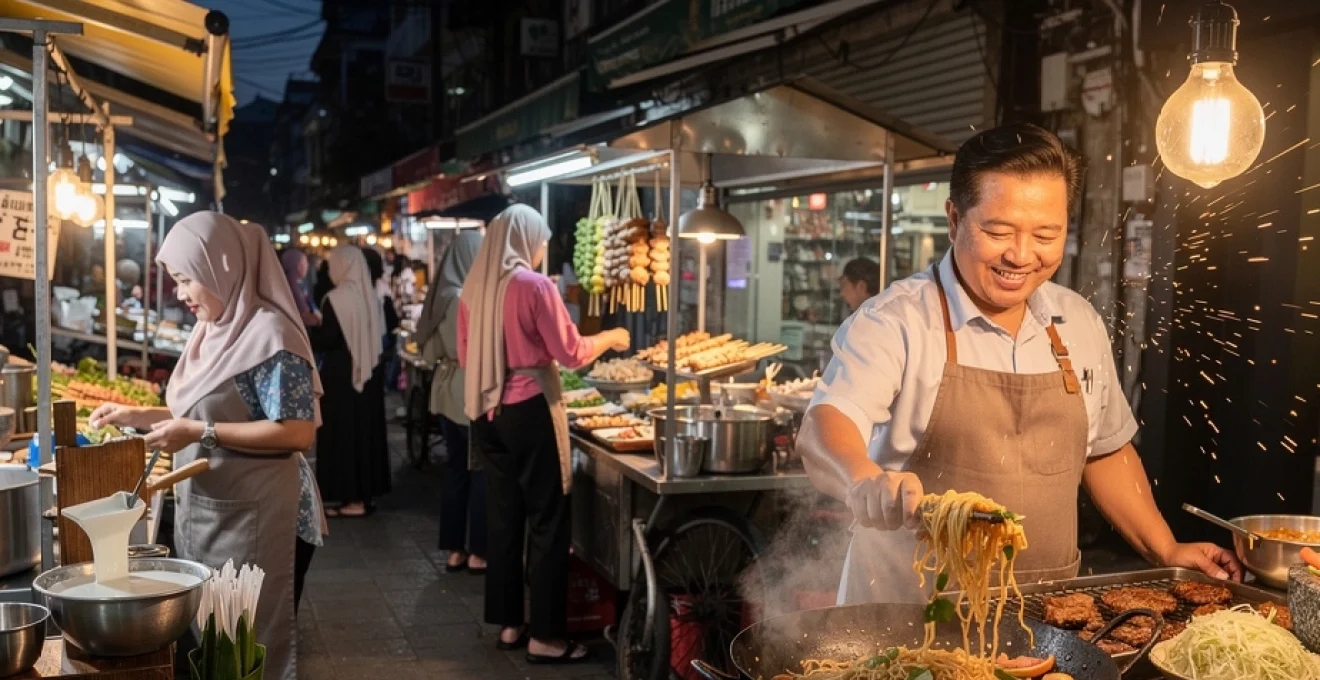
Bangkok’s street food culture represents one of the world’s most vibrant and authentic culinary experiences, where centuries-old traditions blend seamlessly with modern innovation. The bustling metropolis serves as a living testament to Thailand’s rich gastronomic heritage, offering an extraordinary array of flavours that have captivated food enthusiasts from across the globe. From the aromatic satay skewers grilling over charcoal flames to the complex curry preparations simmering in massive pots, Bangkok’s street food scene provides an unparalleled window into Thai culture and culinary artistry.
The significance of street food in Bangkok extends far beyond mere sustenance; it forms the social and economic backbone of daily life for millions of residents. Hawker stalls serve as community gathering points where office workers, students, and families converge to share meals and conversations. This democratic approach to dining has earned Bangkok recognition as one of the world’s premier street food destinations, attracting culinary tourists who contribute significantly to the local economy whilst experiencing authentic Thai flavours at their most pure and accessible form.
Historical evolution of bangkok’s hawker culture and wet market gastronomy
The origins of Bangkok’s street food culture trace back to the city’s establishment in 1782, when King Rama I moved the capital across the Chao Phraya River from Thonburi. Early settlers, primarily Chinese immigrants and local Thai communities, established floating markets and mobile vendors to serve the growing population. These pioneering food merchants laid the foundation for what would eventually become one of the world’s most sophisticated street food ecosystems.
The evolution from simple sustenance provision to culinary artistry occurred gradually over two centuries. During the late 19th and early 20th centuries, increasing urbanisation and the arrival of diverse immigrant populations introduced new cooking techniques, ingredients, and flavour profiles. Wet markets emerged as central distribution points for fresh produce, whilst hawker centres developed around transportation hubs, temples, and residential areas to serve the needs of Bangkok’s expanding populace.
Colonial influence on chatuchak weekend market’s culinary heritage
The colonial period brought significant changes to Bangkok’s food landscape, with European influences subtly integrating into traditional Thai cuisine. Chatuchak Weekend Market, originally established as a government initiative in the 1940s, showcases this cultural fusion through its diverse vendor offerings. The market’s culinary heritage reflects the adaptation of Western cooking methods alongside traditional Thai techniques, creating unique hybrid dishes that have become integral to Bangkok’s street food identity.
Portuguese traders introduced crucial ingredients such as chillies and tomatoes, whilst British colonial presence influenced presentation styles and certain preparation methods. These external influences didn’t replace traditional Thai cooking but rather enhanced it, creating the complex flavour profiles that characterise modern Bangkok street food. The integration of dairy products, different protein preparations, and new spice combinations expanded the culinary repertoire available to street vendors.
Chinatown’s yaowarat road: Century-Old recipe preservation techniques
Yaowarat Road stands as Bangkok’s most historically significant street food district, where Chinese immigrants established businesses that continue operating using century-old recipe preservation techniques. These establishments maintain their authenticity through oral tradition, with recipes passed down through generations of family members who guard their culinary secrets with remarkable dedication. The preservation methods extend beyond mere recipe maintenance to include traditional cooking equipment, ingredient sourcing protocols, and preparation timing.
The area’s food vendors utilise time-honoured techniques such as slow-braising in clay pots, hand-pulling noodles, and fermenting sauces using traditional methods. These practices ensure that flavours remain consistent across decades, creating a culinary time capsule that offers visitors authentic tastes from Bangkok’s past. Many vendors continue using original equipment pieces that have been maintained and repaired rather than replaced, contributing to the unique flavour profiles that modern equipment cannot replicate.
Royal court cuisine integration into modern street vendor practices
The influence of royal court cuisine on Bangkok’s street food represents a fascinating example of culinary democratisation. Traditional palace cooking techniques, once exclusive to royal kitchens, gradually filtered down to street-level vendors through former palace staff who established their own businesses. This transfer of knowledge introduced sophisticated flavour balancing
principles, meticulous decorative work, and complex multi-step preparations to everyday dishes. Techniques such as precise heat control, refined knife work for intricate garnishes, and the balancing of the five fundamental Thai tastes — sweet, sour, salty, bitter, and spicy — became embedded in how many vendors approach even simple noodle soups or grilled meats. As a result, visitors can encounter dishes like khao chae, miang kham, or elaborately carved fruit platters not only in fine-dining restaurants but also in modest stalls scattered across Bangkok’s older districts.
Many street vendors today consciously brand their food as inspired by royal recipes, drawing on published palace cookbooks and televised cooking programmes that have popularised aristocratic culinary traditions. While the street versions are often streamlined for speed and affordability, they retain signature characteristics such as aromatic herb pastes pounded by hand, layered sauces, and complex plating that belies their humble surroundings. This integration of royal court cuisine into the street food scene reinforces Bangkok’s reputation for offering gourmet-level flavours at accessible price points, further strengthening its appeal to culinary travellers.
Post-war economic migration impact on khlong toei food stalls
The post-World War II era saw rapid industrialisation in Bangkok, driving large-scale migration from rural provinces into the capital. Khlong Toei, situated near the port and major transport arteries, became a magnet for workers seeking employment and affordable housing. With this influx came a wave of regional cooking traditions, particularly from Isaan in the northeast and the central plains, which reshaped the character of local food stalls and wet markets.
As migrant communities settled, they established informal eateries and hawker carts to serve familiar dishes from home, from som tam and grilled chicken to herb-laden soups and sticky rice-based snacks. Over time, Khlong Toei Market evolved into a vital node in Bangkok’s street food network, supplying fresh produce, meat, and spices to thousands of vendors across the city. The area’s stalls became known for hearty, budget-friendly meals that reflect both economic necessity and the creativity of new arrivals adapting to urban life.
Today, Khlong Toei’s food scene offers a snapshot of Thailand’s internal migration history, where you can walk a few metres and pass flavours from Isaan, the north, and the deep south side by side. For visitors interested in the social history of Bangkok street food, Khlong Toei provides valuable insight into how economic shifts, urbanisation, and labour patterns directly influence what ends up in a bowl of noodles or on a plate of grilled pork. The district’s evolving stalls show how street food acts as both a survival strategy and a living archive of regional identities.
Iconic street food districts and their signature culinary specialities
Bangkok’s reputation as a street food capital is anchored in a constellation of distinctive districts, each with its own flavour profile, atmosphere, and culinary specialities. Rather than offering a uniform experience, the city presents a patchwork of neighbourhoods where local history, demographics, and urban development shape what appears on the menu. Understanding these street food areas helps you plan a more nuanced culinary stroll through Bangkok, moving beyond the most photographed spots to explore where locals actually eat.
From upscale enclaves experimenting with Thai fusion dishes to riverside markets that still wake before dawn to serve rice porridge, each district tells a different part of Bangkok’s gastronomic story. As you navigate these areas, you’ll notice how the city’s street food scene mirrors broader cultural trends: rising interest in sustainability, revival of heritage recipes, and the growing influence of global palates. Exploring several districts in a single visit allows you to compare techniques, ingredients, and price points, illustrating just how diverse Bangkok street food can be.
Thonglor’s gourmet night market: contemporary thai fusion innovations
Thonglor, long associated with Bangkok’s creative and nightlife scenes, has emerged as a hotspot for contemporary Thai fusion street food. While traditional hawker stalls once dominated the area, recent years have seen a proliferation of gourmet night markets and semi-permanent food courts where young chefs reinterpret classic recipes. Here, it’s common to find pad kra pao made with premium wagyu beef, artisanal ice creams infused with pandan and lemongrass, or tacos filled with moo ping and green papaya slaw.
These markets often operate as testing grounds for culinary entrepreneurs who may later open full-scale restaurants, making Thonglor an ideal district to sample emerging trends before they hit the mainstream. High-BTU gas burners sit beside sous-vide machines, and traditional clay charcoal grills coexist with sleek induction cooktops, reflecting a seamless blend of old and new. For street food travellers curious about where Thai cuisine is heading, a night in Thonglor offers a curated overview of modern Thai street food innovation, complete with craft beverages and design-forward communal seating.
Saphan phut market’s traditional breakfast culture and rice porridge variations
In contrast to Thonglor’s evening energy, Saphan Phut Market along the Memorial Bridge is best experienced in the early morning, when Bangkok’s traditional breakfast culture comes to life. Vendors here specialise in comforting rice-based dishes, especially jok and khao tom, which serve as the backbone of many locals’ daily routines. These rice porridges may seem simple at first glance, but subtle differences in grain texture, broth clarity, and topping selection reveal a sophisticated understanding of technique.
Stalls simmer large aluminium pots of porridge over low flames for hours, achieving a silky consistency that can be customised with minced pork balls, preserved egg, ginger slivers, or crispy fried garlic. Some vendors offer Teochew-influenced khao tom with whole fish or offal, while others highlight herbal broths believed to be restorative. If you’re looking to experience Bangkok street food at its most local and unhurried, joining office workers and elderly residents at plastic tables near Saphan Phut is an ideal way to start the day.
Ratchawat market’s seafood grilling techniques and isaan regional influences
Ratchawat Market, located in the Dusit district, is renowned for its grilled seafood and dishes that showcase strong Isaan influences. Walking through the evening market, you’ll encounter rows of stalls where cooks expertly manage charcoal grills, coaxing out smoky flavours from prawns, squid, river fish, and shellfish. Mastery of grilling here relies on experience-driven techniques: controlling the distance between seafood and coals, adjusting fan speed to modulate heat, and using aromatic herb marinades that prevent charring while enhancing flavour.
Alongside seafood, Ratchawat features a wealth of Isaan-style street food, from spicy larb and nam tok to various grilled chicken and pork skewers served with sticky rice. Vendors often pair seafood with intense dipping sauces rich in lime, roasted chilli, and toasted rice powder, creating a compelling contrast of textures and tastes. This marriage of central Thai seafood traditions with northeastern seasoning profiles makes Ratchawat a particularly rewarding stop for travellers seeking bold, layered flavours in a relatively low-key, residential setting.
For those interested in technique, watching vendors fan charcoal braziers, periodically baste shellfish, and time each item by instinct rather than timers offers insight into the craft of seafood grilling in Bangkok. It’s a reminder that behind a seemingly simple grilled prawn lies a finely tuned understanding of fuel, airflow, and ingredient freshness.
Wang thonglang district’s muslim quarter halal street food ecosystem
Wang Thonglang’s Muslim quarter presents a different facet of Bangkok’s street food, where halal practices and Thai-Muslim heritage shape a distinctive culinary ecosystem. Here, stalls and small shophouse eateries specialise in dishes like khao mok gai (Thai-style biryani), rich beef curries, spiced soups, and fragrant grilled meats marinated with South Asian and Middle Eastern–influenced spice blends. The aromas of cardamom, cinnamon, and star anise mingle with traditional Thai herbs, creating a sensory experience that feels both familiar and novel.
Vendors in this district adhere to strict sourcing and preparation standards to maintain halal certification, influencing everything from butcher selection to cooking oils used. The result is a cohesive network of suppliers, cooks, and families whose livelihoods depend on trust and consistent quality. For visitors, Wang Thonglang offers an opportunity to explore how halal street food in Bangkok integrates seamlessly with the broader culinary landscape while preserving its religious and cultural distinctiveness.
Because this district remains off the typical tourist trail, interactions here tend to be more personal and community-oriented. You may find yourself chatting with stall owners about family recipes that date back to provincial towns or nearby countries, providing a deeper understanding of how migration and faith inform Bangkok’s everyday food choices.
Huai khwang’s late-night som tam preparation methods and regional variations
Huai Khwang is one of Bangkok’s key late-night food districts, where the city’s appetite for som tam and other Isaan specialities continues well past midnight. Watching a skilled vendor prepare papaya salad here is like observing a short performance: unripe papaya is shredded to order, garlic and chillies are pounded in a mortar, and fish sauce, lime, and palm sugar are added with a practiced rhythm. The key lies in controlling the force and duration of pounding to bruise, rather than mash, the ingredients, ensuring a crisp texture and vibrant flavour.
Huai Khwang vendors often cater to a diverse clientele, from late-shift workers to night owls, so they offer an impressive range of regional som tam variations. You might see Isaan-style versions heavy on fermented fish sauce alongside milder central Thai interpretations or Laotian-influenced recipes that incorporate different herbs and noodles. Asking for your preferred spice level and style becomes an interactive part of the experience, and it’s common for vendors to adjust seasoning on the fly, almost like DJs remixing a familiar track to suit the crowd.
For travellers interested in how a single dish can express regional differences, ordering two or three types of som tam side by side in Huai Khwang is both instructive and delicious. The district exemplifies how late-night Bangkok street food serves not only hunger but social connection, with shared plates and plastic stools turning pavements into informal dining rooms.
Traditional thai street food preparation techniques and equipment mastery
Behind every memorable plate of Bangkok street food lies a foundation of specialised techniques and equipment that vendors have honed over years, if not decades. While the experience of eating may feel casual, the level of technical skill involved is often comparable to that of professional restaurant kitchens. Understanding these methods offers a deeper appreciation for why a seemingly simple stir-fry or skewer tastes so extraordinary when prepared on the streets of Bangkok.
Street vendors operate under constraints of space, budget, and time, which has driven them to master tools that are portable, durable, and efficient. Whether it’s a well-seasoned wok, a granite mortar and pestle, or a hand-cranked coconut grater, each piece of equipment plays a critical role in achieving the desired taste and texture. As you watch vendors work, you’ll see that technique and tool are inseparable — much like an artist and their preferred brush.
Wok hei achievement in high-btu gas burner configurations
One of the defining characteristics of Bangkok’s wok-based street food is the elusive quality known as wok hei, often translated as “breath of the wok.” Achieving this smoky, slightly charred aroma requires extraordinarily high heat, which is why many vendors rely on customised high-BTU gas burners or roaring charcoal stoves. These setups can reach temperatures far beyond most home kitchens, allowing ingredients to sear and caramelise in seconds without overcooking.
Vendors develop an intuitive understanding of how to manage this intense heat, tilting and lifting the wok to control temperature zones and tossing ingredients at just the right moment to prevent burning. Oil, aromatics, and proteins are added in a precise sequence, ensuring that garlic fragrances bloom without turning bitter and vegetables retain their crunch. If you’ve ever wondered why a plate of Bangkok pad thai or pad see ew tastes more complex than versions elsewhere, the answer often lies in this mastery of fire.
From a visitor’s perspective, standing close enough (but not too close) to feel the radiant heat and watch blue flames lick the sides of the wok is part of the street food theatre. It’s a reminder that Bangkok street food is as much about performance and timing as it is about recipes, and that high-heat stir-frying techniques are central to the city’s culinary identity.
Mortar and pestle granite selection for authentic som tam texture
The granite mortar and pestle is another cornerstone of Thai street food, particularly for dishes like som tam and curry pastes. In Bangkok, vendors are particular about the size, shape, and material of their equipment, as each variable affects the final texture. Granite mortars are preferred over clay for pounding papaya salad because they provide enough weight and friction to bruise ingredients without shattering them, creating a mix that is both juicy and crisp.
Experienced vendors often keep separate mortars for different preparations to prevent flavour transfer; a mortar used for pungent fermented fish som tam may not be used for milder salads. The pestle’s length and girth also matter, enabling the cook to control force with one hand while turning ingredients with a spoon in the other. Watching a vendor at work, you’ll see that the rhythm of pounding is almost musical — firm enough to release flavour, gentle enough to preserve structure.
For travellers who want to recreate authentic Bangkok street food at home, investing in a quality granite mortar and pestle can make more difference than any single ingredient. It’s the primary tool that transforms raw vegetables, aromatics, and condiments into cohesive dishes with the signature som tam street food texture you experience across Bangkok.
Banana leaf steaming methods for khao tom mat dessert production
Many of Bangkok’s traditional sweets rely on banana leaves as both cooking vessels and natural flavour enhancers, with khao tom mat — sticky rice with banana, often including black beans — being a prime example. Preparing this dessert begins with selecting pliable, unblemished banana leaves, which are briefly passed over an open flame or dipped in hot water to make them more flexible. Vendors then cut the leaves into rectangles and layer them to prevent tearing during steaming.
The sticky rice mixture, usually soaked and partially cooked, is placed onto the leaf, topped with a slice of ripe banana and sometimes beans, then folded into tight parcels and tied with strips of banana fibre. Steaming these bundles requires careful stacking to ensure even heat distribution and prevent condensation from diluting flavours. As the dessert cooks, subtle leaf aromas infuse the rice, adding depth that no synthetic wrapper could replicate.
Observing this process at a Bangkok wet market, you’ll see how banana leaf steaming techniques combine utility and sustainability. The leaves act as biodegradable packaging, impart flavour and colour, and visually signal tradition — a small but powerful example of how Thai street food balances practicality with sensory pleasure.
Coconut milk extraction processes using traditional kratai tools
Coconut milk plays a central role in many Bangkok street food dishes, from curries and desserts to savoury snacks. While commercial canned coconut milk is increasingly common, many traditional vendors still prefer to extract their own using a kratai, a low wooden stool fitted with a serrated metal blade that resembles a crouching rabbit. Fresh coconut halves are scraped against this blade to produce delicate shreds, which are then mixed with warm water and squeezed through cloth to yield rich, aromatic milk.
The quality of coconut milk depends on factors such as the maturity of the coconut, the fineness of the grating, and the pressure used during squeezing. First-press milk, thick and creamy, is typically reserved for finishing dishes or desserts, while subsequent presses create lighter milk suitable for simmering. Vendors learn to adjust proportions by feel and appearance rather than strict measurements, ensuring consistency despite natural variation in coconuts.
For travellers watching this process, the traditional coconut milk extraction method offers a clear illustration of how equipment and ingredient knowledge intersect. The kratai may look simple, but in skilled hands it helps produce a foundational element that elevates countless street foods — another reminder that some of Bangkok’s most refined flavours begin with time-intensive, hands-on preparation.
Modern food safety regulations and vendor licensing requirements
As Bangkok’s street food scene has grown in international prominence, authorities have placed greater emphasis on food safety and formal regulation. The Bangkok Metropolitan Administration (BMA) works with the Ministry of Public Health to implement hygiene standards and licensing requirements for vendors operating in designated zones. These regulations cover areas such as water supply, waste disposal, food storage temperatures, and personal hygiene, aiming to protect both residents and visitors without undermining the vibrancy of street food culture.
Vendors in many districts are now required to obtain permits, attend periodic training sessions, and submit to inspections that assess compliance with safety protocols. Programmes such as the “Clean Food Good Taste” campaign award visible certifications to stalls that meet high standards, helping diners quickly identify reputable options. While occasional crackdowns and street reorganisation efforts have sparked debate about the future of informal food economies, they have also driven improvements in cleanliness and infrastructure, such as better drainage, shared washing facilities, and clearer waste management.
For travellers, being aware of these Bangkok street food safety standards can offer additional peace of mind. Choosing busy stalls with high turnover, observing basic cleanliness cues, and favouring vendors displaying official certifications are practical strategies for enjoying the city’s culinary offerings confidently. The ongoing dialogue between regulators, vendors, and local communities continues to shape how street food operates, illustrating the delicate balance between preservation and modernisation.
Economic impact analysis of street food tourism on local communities
Street food is not just a cultural symbol in Bangkok; it is also a powerful economic engine that supports hundreds of thousands of livelihoods. According to tourism data from recent years, international visitors allocate a significant share of their budgets — often around 20% — to food and beverage consumption in Thailand, with Bangkok capturing a large portion of this spending. Much of this flows directly into the hands of small-scale vendors, suppliers, and ancillary businesses such as markets, transport operators, and equipment manufacturers.
At the neighbourhood level, clusters of food stalls can revitalise urban spaces, turning previously overlooked alleys into bustling micro-economies. A single busy vendor might employ several family members or local workers, purchase ingredients daily from nearby wet markets, and contract with local services for gas delivery, refrigeration maintenance, and waste collection. In this way, Bangkok street food tourism acts as a distributed economic network, spreading benefits widely rather than concentrating them in a few large enterprises.
There are, however, challenges embedded in this model. Rising rents, redevelopment projects, and shifts in pedestrian flows can threaten the stability of established vendors, while competition from chain restaurants and delivery platforms changes consumer behaviour. Policy makers and urban planners increasingly recognise that preserving street food is not only about culture but also about sustaining inclusive economic opportunities. For visitors, choosing to eat at locally owned stalls, joining responsible food tours that pay fair rates, and being mindful of waste can help ensure that street food tourism continues to support the communities that make it possible.
Seasonal ingredient sourcing and supply chain management for bangkok street vendors
Seasonality plays a more significant role in Bangkok street food than many visitors realise, influencing everything from mango sticky rice availability to the herbs used in daily curries. Vendors rely heavily on wet markets and wholesale hubs — such as Khlong Toei, Pak Khlong Talat, and various district markets — to source fresh produce, seafood, and meats. Their success often depends on cultivating long-term relationships with suppliers who can provide consistent quality at stable prices, even when weather patterns or fuel costs fluctuate.
For example, during the peak mango season, dessert vendors may expand their offerings to include multiple varieties and ripeness levels, while monsoon months might see greater emphasis on hearty soups and grilled items that are easier to prepare under covered stalls. Vendors must constantly adjust purchasing volumes to avoid spoilage, a task made more complex by the lack of extensive refrigeration and the unpredictable ebb and flow of customers. In many ways, managing ingredients in Bangkok’s heat is like conducting an orchestra where every section must be perfectly timed.
Supply chain resilience has become a growing concern, particularly during periods of global disruption or local regulatory change. Some vendors have responded by diversifying suppliers, participating in cooperative buying groups, or sourcing directly from peri-urban farms around Bangkok. These strategies not only reduce risk but can also improve traceability and freshness, enhancing the overall quality of seasonal Bangkok street food. For travellers who pay attention to these dynamics, asking vendors when certain dishes are “best in season” can lead to more rewarding and context-rich dining experiences.