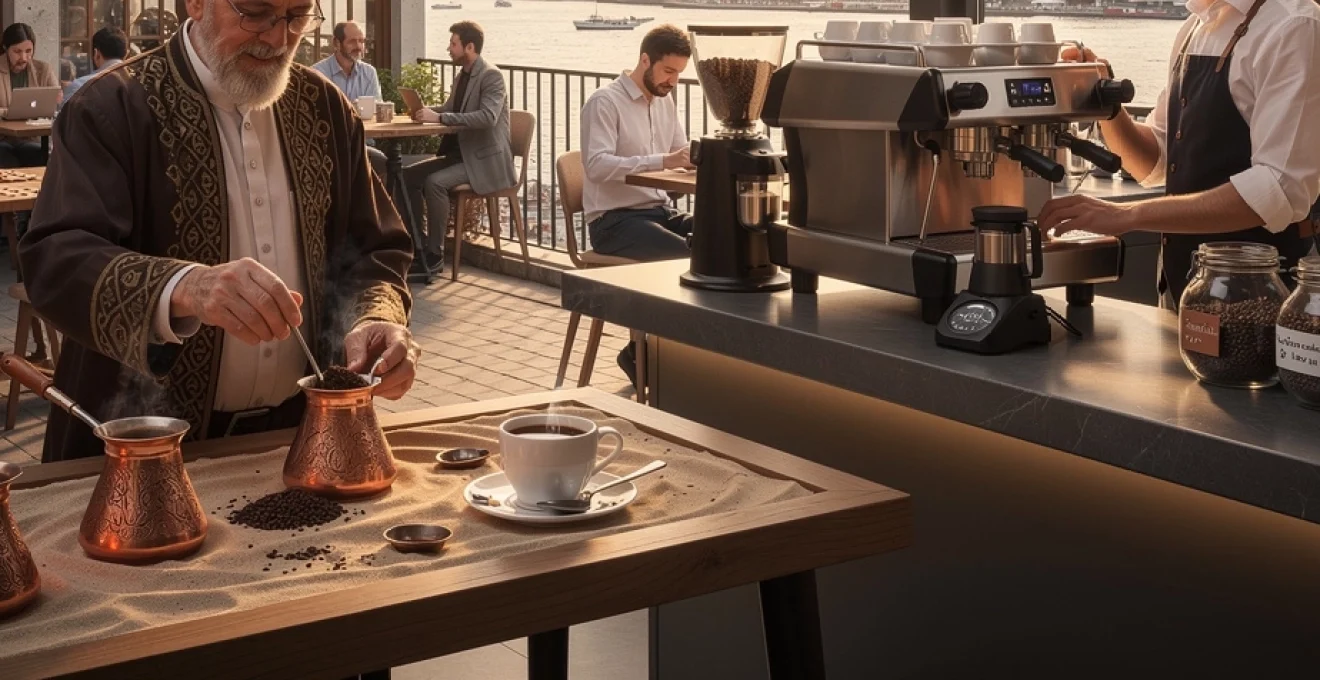
Istanbul’s coffee culture extends far beyond mere caffeine consumption, weaving together centuries of Ottoman tradition with contemporary innovation. The city’s relationship with coffee began in the 16th century when beans first arrived from Yemen, transforming not just daily habits but entire social structures. Today, from the historic kahvehanes of Sultanahmet to the specialty roasteries of Karaköy, Istanbul represents a unique confluence where traditional Turkish coffee preparation methods coexist with third-wave coffee movements. This cultural tapestry reflects the city’s position as a bridge between continents, where ancient brewing rituals persist alongside modern barista championships and where fortune-telling through coffee grounds remains as popular as precision-crafted single-origin espressos.
Ottoman empire turkish coffee legacy and UNESCO intangible heritage recognition
Imperial palace kahvehane brewing protocols and ceremonial practices
The Ottoman palace coffee culture established elaborate protocols that influenced Turkish coffee preparation for centuries. Within the walls of Topkapı Palace, specialized coffee attendants known as kahvecibaşı developed intricate ceremonies surrounding coffee service. These protocols required specific timing, temperature control, and presentation methods that distinguished palace coffee from common preparations. The brewing process involved carefully measured proportions, with each cup requiring precisely one heaped teaspoon of finely ground coffee per serving.
Palace ceremonies incorporated symbolic elements that extended beyond mere beverage service. The foam quality, serving order, and accompanying sweets carried social significance, communicating respect, hierarchy, and diplomatic intentions. These ceremonial practices established coffee as a diplomatic tool, with foreign ambassadors often introduced to Ottoman culture through elaborate coffee presentations. The palace influence spread throughout the empire, standardising preparation methods and establishing coffee as a marker of refinement and hospitality.
Traditional cezve copper craftsmanship in grand bazaar artisan workshops
Grand Bazaar copper artisans maintain centuries-old techniques for crafting traditional cezve brewing vessels. These skilled craftspeople understand that copper’s superior heat conductivity creates optimal brewing conditions for Turkish coffee, allowing for precise temperature control during the delicate foaming process. Master artisans hand-forge each cezve, considering factors such as wall thickness, handle placement, and spout design that affect brewing performance. The traditional ratio of one part tin to ten parts copper provides durability whilst maintaining thermal properties essential for proper coffee preparation.
Contemporary Grand Bazaar workshops continue producing authentic cezve using traditional tools and techniques passed down through family generations. These artisans recognise that machine-manufactured alternatives cannot replicate the subtle variations in metal thickness and surface texture that contribute to optimal brewing results. The handcrafted nature of traditional cezve means each vessel develops unique characteristics that experienced coffee preparers learn to utilise for consistent results. Workshop apprenticeships typically span several years, ensuring traditional knowledge transfers to new generations whilst adapting to modern quality standards.
Yeniçeri coffee corps integration into military and social hierarchies
The Janissary corps embraced coffee culture as both sustenance and social practice, integrating brewing rituals into military hierarchy and daily routines. Elite Janissary units appointed designated coffee preparers who understood the importance of maintaining morale through proper coffee service during campaigns and garrison duty. These military coffee specialists developed portable brewing techniques suitable for field conditions whilst preserving traditional preparation standards. The coffee service hierarchy within Janissary ranks reflected broader military organisation, with senior officers receiving first service and specific brewing preferences.
Janissary coffee houses became important social centres where military personnel could gather informally, discuss political matters, and maintain unit cohesion outside formal command structures. These establishments influenced broader Istanbul coffee house culture, establishing patterns of male social interaction that persisted for centuries. The military connection elevated coffee’s social status, associating the beverage with elite warrior culture and state service. This military integration helped spread coffee culture throughout the Ottoman Empire as Janissary units stationed in provincial centres introduced local populations to Istanbul brewing methods and coffee house traditions.
UNESCO 2013 inscription criteria and cultural preservation mandates
UNESCO’s recognition of Turkish coffee culture as Intangible Cultural Heritage acknowledged the practice’s deep integration into Turkish social life, ceremonial traditions, and community identity. The inscription specifically highlighted coffee’s role in hospitality rituals
as well as everyday practices such as holiday visits, engagement rituals, and neighbourhood gatherings. To qualify for inscription, the nomination demonstrated that Turkish coffee culture is transmitted informally within families and formally through craftsmanship, hospitality training, and cultural programming. UNESCO recognised not only the brewing technique but also the associated oral traditions, sayings, songs, and social etiquette that turn a small cup into a shared cultural script.
The listing came with clear cultural preservation mandates, encouraging Türkiye to safeguard traditional coffee house culture against rapid urban change and globalised coffee chains. This includes supporting artisan roasters and cezve makers, documenting regional variations in preparation, and promoting public education about the history of Turkish coffee. Municipalities in Istanbul have since incorporated coffee culture into festivals, museum exhibits, and tourism routes, ensuring young generations understand why a simple cup of coffee is treated as intangible heritage rather than a disposable commodity.
Speciality coffee roasting terroirs across bosphorus neighbourhoods
Karaköy third wave coffee movement and micro-roastery proliferation
Karaköy has emerged as one of Istanbul’s key hubs for the third wave coffee movement, where micro-roasteries sit just a short walk from historic Ottoman warehouses. Over the past decade, former dockside streets have filled with cafés that roast small batches on-site, highlighting single-origin beans and transparent sourcing. These venues treat coffee more like wine, talking about altitude, varietal and processing methods in a way that would have been unthinkable in the old kahvehane culture.
The area’s industrial architecture lends itself to open-plan roasteries, where you can watch beans tumbling in drum roasters while baristas dial in espresso recipes with digital scales and refractometers. Karaköy cafés often keep Turkish coffee on the menu, but position it alongside pour-over, cold brew, and espresso-based drinks. For visitors curious about how Istanbul bridges heritage and innovation, this is where you can drink a meticulously brewed Ethiopian light roast in the morning and a traditional Türk kahvesi after lunch without ever leaving the same street.
Kadıköy arabica bean sourcing networks and direct trade partnerships
Across the Bosphorus, Kadıköy has built a reputation for its independent roasters who emphasise direct trade partnerships with producers. Many of these Istanbul coffee shops publish details of their sourcing networks, listing the names of Colombian, Ethiopian or Kenyan farms on their bags. This transparency responds to a global demand for ethical coffee consumption, but it also echoes older Ottoman practices where trusted merchants and family ties guaranteed quality along trade routes.
Some Kadıköy roasteries visit origin countries annually, negotiating prices that support long-term sustainability rather than one-off purchases based solely on commodity market rates. They often prioritise 100% arabica beans and experiment with processing methods such as natural, honey, or anaerobic fermentation, each of which creates distinct flavour profiles in the cup. If you sit at a bar in Moda or around Kadıköy Bazaar, you are as likely to hear talk of soil composition and shade-grown lots as you are gossip about the latest Bosphorus café opening.
Beyoğlu single-origin processing methods and cupping score variations
Beyoğlu, with its layered history of embassies, theatres, and literary cafés, now hosts a dense cluster of coffee bars specialising in single-origin beans. Many of these shops organise regular cupping sessions, where enthusiasts taste different coffees side by side to understand how origin and processing influence acidity, body, and aroma. They often reference professional cupping scores—graded on a 100-point scale—to explain why a certain microlot sits at the top of the menu.
Processing methods are central to these discussions. Washed coffees are praised for clarity and bright acidity, while naturally processed beans from Ethiopia or Brazil can show intense fruit notes, sometimes surprising drinkers accustomed only to dark-roasted Turkish coffee. By hosting public tastings and workshops, Beyoğlu cafés invite locals and travellers to engage with coffee more analytically. Yet even here, the social aspect remains strong: cupping tables become modern versions of the old kıraathane, where people gather to learn, debate, and build networks over shared cups.
Nişantaşı premium coffee estate collaborations and altitude classifications
Nişantaşı, one of Istanbul’s most upscale districts, has embraced specialty coffee as part of its wider luxury retail scene. Cafés here frequently collaborate with premium estates and boutique importers, offering limited-release lots from farms in Panama, Costa Rica, or Rwanda. Menus highlight altitude classifications—1,600 metres, 1,800 metres and above—because higher-grown coffee cherries typically ripen more slowly, developing greater sweetness and complexity.
These establishments often use sleek, minimalist design to foreground the coffee itself, serving tasting flights that compare, for example, two Ethiopian coffees grown at different elevations. For the curious traveller, this is where you can experience how a change of just a few hundred metres in altitude can alter flavour, in the same way that vineyards distinguish between neighbouring slopes. While prices tend to be higher than in other neighbourhoods, Nişantaşı cafés treat each cup as an introduction to global coffee geology, bringing distant mountain terroirs into Istanbul’s urban fabric.
Contemporary kahvehane architecture and interior design evolution
Contemporary kahvehanes in Istanbul reveal how architecture and interior design have evolved to accommodate both tradition and modern lifestyles. Historic coffee houses were simple spaces with low stools, stone floors, and walls darkened by pipe smoke, designed for long conversations rather than quick turnover. Today, many venues blend these elements with softer lighting, modular seating, and charging outlets, responding to a clientele that arrives with laptops as often as with playing cards.
Designers frequently reference Ottoman motifs—geometric tiles, calligraphic panels, brass lamps—but reinterpret them with cleaner lines and lighter colour palettes. In some renovated venues, old wooden ceilings and original stone arches are left visible, while glass façades open the interior to the street, making the social life of the café part of the urban scenery. Acoustic planning has also become more sophisticated, with sound-absorbing materials used to keep the lively hum of conversation from turning into an overwhelming roar.
At the same time, there is a clear distinction between traditional neighbourhood kahvehane spaces and hybrid cafés catering to tourists and young professionals. In working-class districts, you still find men-only rooms filled with backgammon tables, fluorescent lighting, and wall-mounted televisions showing football matches. In central areas such as Karaköy and Galata, mixed-gender cafés encourage longer stays with layered seating zones: communal tables for groups, quiet corners for reading, and benches facing the street for people-watching. Have you noticed how quickly your own behaviour changes depending on whether you sit at a shared table or in a quiet alcove?
This architectural evolution mirrors wider shifts in Istanbul’s coffee culture. Where the classic kahvehane once functioned primarily as a male gathering place, new designs seek inclusivity and flexibility. Outdoor terraces, rooftop seating, and indoor plants soften the boundaries between public and private space, inviting you to linger. In many ways, the modern café is like a living room extended into the city, where design serves the same purpose as the coffee itself: to make conversation and connection easier.
Traditional turkish coffee fortune-telling tasseography methodologies
Fortune-telling with Turkish coffee grounds, known as kahve falı, remains one of Istanbul’s most distinctive rituals. After you finish your cup, you place the saucer on top, make a silent wish, and flip the set upside down, allowing the grounds to slide and form patterns. Once the cup cools, an experienced reader interprets these shapes, drawing on a symbolic vocabulary passed down through families and, increasingly, through books and online courses. It is less about predicting lottery numbers and more about framing emotions, hopes, and anxieties in story form.
Methodologies vary slightly between readers, but most divide the cup into zones that represent past, present, and future, as well as areas linked to love, work, or travel. Animals, letters, numbers and paths are common motifs: a bird can indicate incoming news, a fish may suggest prosperity, and a winding road can point to a difficult journey ahead. Readers also pay attention to shading, density of the grounds, and the “energy” they sense from the person whose cup they are reading. In practice, the process works a bit like a mirror; you hear your own concerns reflected back through symbolic language.
In Istanbul, you can experience this tradition in both intimate homes and commercial cafés. Some coffee houses in Beyoğlu and Kadıköy employ in-house fortune tellers who move from table to table, offering brief sessions for a set fee. Others have turned tasseography into a full experience, combining Turkish coffee, tarot cards, and even astrology charts. Digital platforms have also transformed the practice: popular apps invite users to upload photos of their cups and receive AI-assisted readings within minutes. Does this make the ritual less authentic, or simply prove how adaptable Istanbul’s coffee culture can be?
For many locals, kahve falı functions as a structured way to talk about sensitive topics—relationships, financial worries, career changes—with a trusted stranger. Like a friend who reads between the lines of your story, the fortune teller uses patterns in the grounds as prompts to ask deeper questions. Even if you remain sceptical about the supernatural side, the ritual offers a valuable pause for reflection. It shows that in Istanbul, coffee is not only something you drink; it is also a language you learn to read.
Galata and sultanahmet coffee house social networking dynamics
Galata and Sultanahmet, separated by the Golden Horn yet linked by centuries of shared history, showcase two distinct but interconnected models of coffee house social life. In Galata’s sloping streets, cafés attract a mix of freelancers, artists, and international visitors who treat them as co-working spaces and meeting points. Laptops share tables with sketchbooks, and it is common to overhear conversations in three or four languages at once. Informal networks form as people return to the same café each day, greeting baristas by name and exchanging tips on exhibitions, concerts, or new roasteries across the city.
Sultanahmet, by contrast, is anchored in heritage tourism, but its coffee houses still serve as important social nodes. Traditional kahvehane near the Grand Bazaar and the Blue Mosque welcome local tradespeople, guides, and shop owners who gather for morning Turkish coffee and evening tea. Here, conversation flows around business deals, neighbourhood news, and seasonal rhythms like pilgrimage traffic or cruise ship arrivals. While many tourists pass through for a quick cup and photo, those who linger see how coffee houses function as informal newsrooms and networking hubs for the local economy.
In both districts, social media amplifies these physical networks. A photograph of a foamy cup against Galata Tower or a sunlit courtyard in Sultanahmet can draw new visitors within hours, turning certain cafés into mini-brands. Some businesses actively cultivate this effect by designing “Instagram corners” with distinctive tiles or views, while others rely on word of mouth among long-time regulars. Either way, the café becomes a stage where personal and professional relationships are performed, documented, and sustained.
These dynamics highlight an important point: in Istanbul, coffee houses are less about silent solo consumption and more about active social participation. Whether you are a jewellery maker from the Grand Bazaar, a digital nomad in Karaköy, or a student from a nearby university, the café offers a neutral space to meet, negotiate, and belong. Think of it as the city’s unofficial networking platform, older than any app yet surprisingly compatible with them—since many collaborations, projects, and friendships still begin with the simple question, “Shall we meet for coffee?”
Modern istanbul barista championship standards and certification programmes
The rise of specialty coffee in Istanbul has gone hand in hand with a professionalisation of barista skills. National championships, often organised under the umbrella of the Specialty Coffee Association (SCA) Turkey chapter, now follow international standards for espresso extraction, milk texture, and sensory presentation. Competitors are judged on technical precision—such as shot time, brew ratio, and cleanliness—as well as on creativity and their ability to communicate the story behind the beans they use. These events attract growing crowds, turning what was once a behind-the-counter craft into a spectator sport.
To support this ecosystem, a range of certification programmes has emerged across the city. Training centres in districts like Şişli, Kadıköy, and Karaköy offer SCA-accredited courses that cover everything from green coffee basics and roasting theory to latte art and café management. Aspiring baristas learn to calibrate grinders, read refractometer results, and adjust recipes based on variables like water temperature and ambient humidity. For many young Istanbulites, these programmes provide a pathway into a global industry, opening doors to work in cafés from Berlin to Dubai while still grounding them in the traditions of Turkish coffee.
Championship standards have also influenced everyday café service. Even in venues that serve classic Turkish coffee alongside espresso, you can see the impact in details such as consistent dosing, careful tamping, and clear communication about flavour notes. Some shops list extraction parameters on the menu or invite customers to watch the brewing process, turning transparency into a form of hospitality. This marks a shift from the old model where coffee preparation happened out of sight in the kitchen; now, the bar itself is a kind of stage where skill and care are openly displayed.
At the same time, Istanbul’s best baristas are increasingly interested in bridging competition-level precision with local rituals. You might see a championship finalist preparing Turkish coffee on hot sand with the same attention they give to their signature drink, or offering guided tastings that pair a modern filter brew with a traditional fincan. The question they often ask themselves—and that you may find yourself asking too—is how to honour a 500-year-old coffee heritage while pushing standards forward. The evolving answer, visible in cafés across the city, suggests that in Istanbul, innovation and tradition are less rivals than partners sharing the same table.