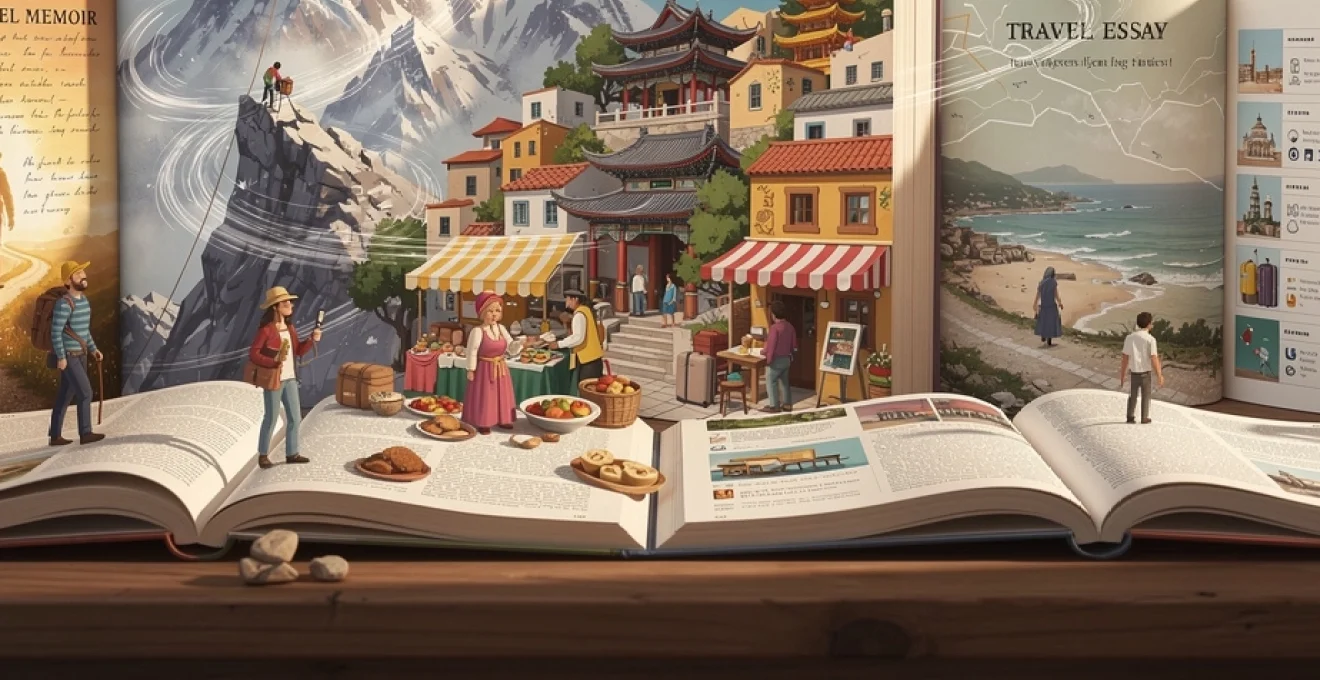
# Exploring the different genres of travel books and their unique styles
Travel literature has evolved into one of the most diverse and captivating literary genres, encompassing everything from raw adventure narratives to philosophical meditations on place and identity. The genre’s remarkable versatility reflects the countless ways humans experience and interpret their journeys across the globe. From Bill Bryson’s witty observations of small-town America to Jon Krakauer’s harrowing accounts of Everest expeditions, travel writing demonstrates an extraordinary range of stylistic approaches and thematic concerns. Understanding these distinct subgenres not only enriches your appreciation of travel literature but also helps you identify the specific type of travel narrative that resonates with your own wanderlust and reading preferences. Whether you seek practical guidance for your next adventure or profound reflections on the human condition, the world of travel books offers something for every reader.
Narrative travel memoir: crafting personal journey stories through literary techniques
The narrative travel memoir represents perhaps the most intimate form of travel writing, where the author’s internal transformation becomes as significant as the external journey. This subgenre prioritises emotional authenticity and personal vulnerability, inviting readers into the writer’s psychological landscape whilst simultaneously exploring physical territories. The most successful travel memoirs create a delicate balance between introspection and observation, ensuring that self-examination never overshadows the richness of place and cultural encounter. These works typically employ sophisticated literary devices borrowed from fiction—character development, dramatic arc, thematic resonance—whilst maintaining the fundamental truth contract that distinguishes non-fiction from imaginative literature.
Elizabeth gilbert’s eat pray love and the confessional memoir structure
Elizabeth Gilbert’s blockbuster memoir exemplifies the confessional approach to travel narrative, where personal crisis precipitates geographical movement. The tripartite structure—Italy for pleasure, India for spirituality, Indonesia for balance—provides a satisfying architectural framework that mirrors the protagonist’s quest for wholeness. Gilbert’s writing style combines conversational intimacy with moments of lyrical description, creating an accessible tone that invites readers to identify with her struggles. The confessional memoir structure requires writers to expose their vulnerabilities without indulgence, a balance Gilbert achieves through self-deprecating humour and genuine curiosity about the cultures she encounters. This approach has influenced countless travel memoirs, establishing a template where geographic displacement serves as a catalyst for psychological healing and self-discovery.
Paul theroux’s the great railway bazaar: Stream-of-Consciousness observation writing
Theroux pioneered a more observational, less overtly confessional approach to travel memoir through his railway journeys across Asia. His narrative style incorporates stream-of-consciousness elements, capturing the fragmentary nature of train travel where landscapes, conversations, and internal reflections blur together. The writing mirrors the rhythmic movement of rail travel itself—episodic, occasionally digressive, yet propelled forward by an underlying momentum. Theroux’s technique involves acute observation of fellow travellers, transformed into character sketches that reveal cultural attitudes and social hierarchies. His willingness to record unflattering observations and acknowledge his own biases creates a more complex, ambiguous portrait than traditional travelogues. This methodological honesty, combined with literary craftsmanship, establishes The Great Railway Bazaar as a masterclass in observational travel writing that prioritises atmospheric authenticity over romanticised depictions.
Cheryl strayed’s wild: interwoven timeline construction and emotional arc development
Strayed’s acclaimed memoir demonstrates sophisticated temporal structuring, weaving flashbacks throughout her Pacific Crest Trail journey to create thematic resonance between past trauma and present challenge. The physical hardship of long-distance hiking provides an objective correlative for psychological pain, allowing readers to experience emotional healing through concrete, physical metaphor. Strayed’s narrative technique involves presenting herself as both participant and observer, acknowledging her naivety and poor preparation whilst analysing how these deficiencies contributed to her transformation. The emotional arc develops through carefully calibrated revelations, with backstory emerging organically rather than through expository blocks. This interwoven timeline construction has become increasingly prevalent in contemporary travel memoirs, recognising that journeys rarely follow simple chronological progression but instead spiral through memory, anticipation, and present experience. The technique demands considerable structural planning to maintain narrative clarity whilst achieving thematic depth
for the reader, and it works particularly well in travel books because the external landscape can mirror the traveller’s inner journey. If you want to apply this in your own narrative travel memoir, think in terms of two parallel timelines: the journey on the ground and the emotional journey underneath. By mapping key trail moments against key life revelations, you can create a satisfying emotional arc rather than a simple A-to-B itinerary. This structure also helps avoid the common trap of “and then I went here” reporting, replacing it with a more novelistic sense of build, setback, and resolution that keeps readers engaged.
Bruce chatwin’s in patagonia: fragmentary prose and minimalist narrative style
Bruce Chatwin’s In Patagonia takes a very different approach to narrative travel memoir, using short, fragmentary chapters that often feel like self-contained vignettes. Rather than offering a continuous storyline, Chatwin assembles a mosaic of impressions, anecdotes, historical asides, and encounters that collectively evoke the mythic quality of Patagonia. This minimalist narrative style relies on implication rather than explanation; Chatwin rarely spells out his emotional state or motivations, inviting readers to infer meaning from what is left unsaid.
For writers interested in experimental travel literature, Chatwin’s technique demonstrates how fragmentation can actually enhance a sense of place. Each brief section functions like a postcard or photographic snapshot, and the gaps between them create space for reflection. The stripped-back prose, often free of overt introspection, allows the landscapes and people to stand in the foreground as characters in their own right. If you favour restraint over confession in your travel writing, a fragmentary structure can help you prioritise atmosphere, mystery, and open-ended interpretation while still conveying a coherent journey.
Adventure travel writing: expeditionary storytelling and risk narrative frameworks
Adventure travel writing foregrounds risk, endurance, and the confrontation with physical limits. In this genre, mountains, oceans, deserts, and polar ice fields are not just backdrops but antagonists that actively shape the story. The tension comes from uncertainty—will the team summit, cross, survive—and from the moral questions that arise when safety, ambition, and responsibility collide. Well-crafted expedition narratives use clear risk narrative frameworks, combining technical detail with human drama so that readers who have never clipped into a rope or boarded an icebreaker can still feel every slip and storm.
In a market where extreme adventure content competes with high-definition documentaries and social media clips, written adventure travel books succeed by going deeper into decision-making, fear, and consequence. They slow down the near-miss, revisit the turning point, and interrogate what “success” on an expedition really means. If you’re drawn to this form of travel literature, think of yourself not just as a storyteller of spectacular events, but as an analyst of risk—someone who can translate altitude, weather windows, and survival techniques into a compelling narrative about human vulnerability and resilience.
Jon krakauer’s into thin air: real-time disaster documentation methodology
Jon Krakauer’s Into Thin Air is a benchmark in disaster-focused adventure travel writing, in part because of its near real-time documentation. Krakauer was on Everest as a journalist, taking notes throughout the expedition, which later allowed him to reconstruct timelines, dialogue, and decisions with forensic precision. This methodology gives the book its relentless pacing: the reader is pulled up the mountain step by step, aware of the gathering storm long before the worst hits. The sense of inevitability amplifies the emotional impact.
Another defining feature of Into Thin Air is its willingness to interrogate responsibility, including Krakauer’s own role and hindsight biases. Rather than presenting himself as an infallible narrator, he acknowledges memory gaps and conflicting accounts, referencing other climbers’ testimonies and subsequent analyses. If you are writing about risky travel or outdoor disasters, this multi-perspective approach is crucial to maintaining credibility. Treat your narrative like an inquiry as much as a story: document sources, timelines, and alternative viewpoints so readers can understand both the facts and the ambiguities that remain.
Ranulph fiennes’ polar expedition chronicles: technical detail integration
Ranulph Fiennes’s polar expedition books, such as Mind Over Matter, demonstrate how to integrate substantial technical detail without losing narrative drive. Temperatures, frostbite stages, sled weights, calorie deficits, and navigation techniques are meticulously recorded, yet they are always tied back to concrete stakes: can the team keep moving, or will they be forced to turn back? Technical information becomes a tool for building tension, not an academic digression. For readers new to polar travel, this level of specificity fosters trust and immersion.
To emulate this style in your own adventure travel writing, think of technical detail as texture rather than decoration. Explain the function of each piece of gear or procedure only insofar as it impacts risk, decision-making, or interpersonal dynamics. An analogy can help: treat your technical passages like seasoning in a dish—vital for flavour, but overpowering if overused. When done well, this integration allows your travel book to educate as well as entertain, appealing both to armchair adventurers and to practitioners in the field.
Bear grylls’ survival narrative structure: action-driven sequential plotting
Bear Grylls’ survival-focused narratives use a straightforward, action-driven structure that mirrors the urgency of crisis situations. Events are told in tight chronological order—problem, improvisation, outcome—creating a series of escalating scenarios that read almost like linked short stories. Each chapter tends to revolve around a specific survival challenge, whether crossing a crevasse, building a shelter, or finding water, with minimal digression into backstory. This sequential plotting is ideal for readers who want adrenaline and practical takeaways in equal measure.
From a craft perspective, Grylls’ books show how to keep prose lean when the subject matter is already high-stakes. Sentences are short, verbs are active, and technical survival tips are embedded within the flow of the scene rather than presented as separate instruction. If you’re writing about high-risk travel environments, consider adopting a similar “scene-first” mindset: start with the immediate jeopardy, then layer in explanation and reflection afterwards. This approach not only sustains momentum but also mirrors how we experience danger in real life—instinct first, analysis later.
Cultural immersion travel literature: anthropological observation and ethnographic writing
Cultural immersion travel books shift the spotlight from the traveller’s inner world to the lived realities of local communities. While the author’s perspective still shapes the narrative, the emphasis is on observing, listening, and interpreting rather than performing or conquering. In many ways, this subgenre borrows from anthropology and ethnography: it values participant observation, careful note-taking, and ethical representation. For readers seeking more than sightseeing inspiration, these works can function as gateways into the textures of daily life—rituals, foodways, humour, and social norms that rarely make it into standard guidebooks.
To write compelling cultural immersion travel literature, you need patience and humility as much as descriptive skill. Long-term stays, language learning, and genuine relationships create the raw material for nuanced portrayal. At the same time, you must continually interrogate your own assumptions, asking: What am I projecting onto this place? How might locals describe this same scene? This reflexive stance helps prevent the genre from slipping into exoticism or simplistic “culture shock” anecdotes, and instead turns it into a more balanced, dialogic encounter.
Peter mayle’s A year in provence: seasonal framework and local custom documentation
Peter Mayle’s A Year in Provence is organised around the calendar, with each chapter devoted to a month of the year. This seasonal framework does double duty: it offers a clear narrative structure and allows readers to see how rural Provençal life is shaped by weather, agriculture, and recurring festivals. As we move from winter mistral winds to summer markets, Mayle documents local customs—from truffle hunts to bureaucratic quirks—with an amused but affectionate eye. The result is a travel book that feels like a slow unfolding rather than a rushed tour.
If you’re writing about long-term residence in a new culture, a similar temporal scaffolding can help you avoid repetition and give your narrative an organic rhythm. You might choose seasons, religious festivals, harvest cycles, or even school terms as your organising principle. Within each segment, focus on specific customs, conversations, and small domestic details that show how life is lived. Think of yourself as an archivist of the everyday: your task is not only to entertain but to preserve behaviours and atmospheres that might otherwise go unrecorded.
Frances mayes’ under the tuscan sun: sensory description and place-making techniques
Frances Mayes’ Under the Tuscan Sun elevates cultural immersion through luxuriant sensory description. The feel of sun-warmed stone, the smell of crushed tomatoes, the sound of swallows at dusk—all are rendered with an attention that turns a restored farmhouse into a fully realised world on the page. This is place-making in its most literal sense: through layered detail, the reader can almost inhabit the kitchen, vineyard, and village square alongside the author. The narrative slows down to savour meals and renovations, making process itself a form of travel.
For writers, Mayes’ approach is a reminder that “show, don’t tell” is particularly powerful in travel literature. Rather than declaring that a place is charming or authentic, you can invite readers to experience it through concrete, multi-sensory cues. A helpful analogy is to think like a cinematographer and sound designer at once: what would the close-up shot be in this scene, and what ambient noises would we hear? By layering these elements sparingly but consistently, you transform your travel book from a logbook of movements into an immersive environment.
Colin thubron’s shadow of the silk road: historical layering and contemporary juxtaposition
In Shadow of the Silk Road, Colin Thubron travels an ancient trade route while constantly juxtaposing its layered history with present-day realities. Ruins and caravanserais are never described in isolation; they are set against modern highways, political borders, and economic shifts. This historical layering gives the narrative a palimpsest-like quality, where past and present bleed into one another. Thubron’s reflective, often elegiac tone underscores how travel can reveal both continuity and loss.
If you are drawn to historically resonant routes—pilgrimage trails, former front lines, old imperial roads—this technique can deepen your travel writing enormously. Research archival sources, local oral histories, and prior travel accounts, then weave them into your on-the-ground experiences. The key is balance: history should illuminate your journey, not overwhelm it. Ask yourself, “What does knowing this past change about how we see this street or border today?” When you answer that on the page, your travel book becomes not just a record of movement, but an exploration of time.
Pico iyer’s video night in kathmandu: comparative cultural analysis methodology
Pico Iyer’s Video Night in Kathmandu takes a comparative approach, examining how Western popular culture interacts with and is reinterpreted by various Asian societies. Rather than focusing on scenic landscapes, Iyer zeroes in on video parlours, rock concerts, and mass media, using them as lenses to discuss globalisation and identity. His methodology is analytical as much as descriptive: each essay poses a question about cultural exchange, then investigates it through observed scenes and conversations.
For contemporary travel writers, this model is especially relevant in an era of mass tourism and digital connectivity. You might ask, for instance, how Instagram is reshaping pilgrimage sites, or how global coffee chains coexist with local cafés. To adopt Iyer’s comparative stance, develop a clear theme for your travel book—such as sport, fashion, or technology—and examine how it manifests across different locations. This turns your travel narrative into a kind of roaming case study, encouraging readers to think critically about the forces shaping the places they visit.
Guidebook and practical travel writing: informational architecture and user-centric content design
Guidebooks and practical travel writing prioritise usability over lyricism, but the best examples still demonstrate strong narrative judgement and voice. Their core challenge is architectural: how do you organise vast amounts of information so that a reader on the move can find what they need in seconds? This type of travel literature borrows heavily from user-experience design, using clear headings, icons, maps, and consistent formatting to reduce cognitive load. In a digital era where online reviews proliferate, print and long-form guides succeed by curating and contextualising rather than just listing.
If you’re considering writing practical travel content, thinking like a product designer is essential. Who is your primary user—budget backpackers, families, remote workers, or luxury travellers? Each group has distinct pain points, from visa logistics to Wi‑Fi reliability, and your content architecture should reflect those priorities. Remember that clarity is a form of respect: concise directions, transparent pricing estimates, and honest pros and cons can make your guide far more valuable than a glossy but vague overview.
Lonely planet’s modular content structure and POI categorisation systems
Lonely Planet popularised a modular content structure that still shapes much of practical travel writing today. Destinations are broken down into predictable sections—Top Experiences, Need to Know, Where to Stay, Getting Around—and each point of interest (POI) is presented with standardised details such as address, cost, and opening hours. This categorisation system enables quick scanning; travellers can flip to a city and immediately locate what matters to them without reading cover to cover. It is, in essence, a database rendered as a book.
For aspiring guidebook authors, adopting a modular structure has two clear advantages. First, it makes future updates easier, since each module can be revised independently as restaurants close or transport options change. Second, it accommodates different reading styles: some users will read narrative introductions, while others will dive straight into maps and lists. When designing your own POI categories, think in terms of user tasks: are readers trying to decide where to go, how to get there, or what to do on a rainy afternoon? Label and group your information accordingly.
Rick steves’ conversational instruction style and itinerary scaffolding
Rick Steves’ Europe-focused guides show how a strong narrative voice can coexist with practical detail. His tone is gently opinionated and highly conversational, as though an experienced friend is walking beside you explaining why one museum is worth your limited time and another can be skipped. Crucially, Steves excels at itinerary scaffolding: he offers suggested routes for one day, three days, or a week, helping overwhelmed travellers turn a mass of options into a coherent plan. This scaffold reduces decision fatigue, a real barrier for many would-be travellers.
To bring a similar sense of guidance to your practical travel writing, combine specific step-by-step suggestions with clear rationales. Don’t just say “visit this village”; explain what trade-off the reader is making in terms of time, money, or crowds. One effective technique is to include “if/then” branches: If you’re travelling with kids, prioritise X; if you love contemporary art, detour to Y. In this way, your travel book becomes an interactive tool rather than a static catalogue, acknowledging that different readers will customise your scaffolding to suit their own styles of travel.
Rough guides’ critical commentary integration and budget-tiered recommendations
Rough Guides distinguish themselves through a slightly edgier, more critical tone and a strong emphasis on value for money. Rather than presenting every attraction as a must-see, they are comfortable saying when something is overrated, overpriced, or ethically questionable. Many entries include budget-tiered recommendations—cheap eats, midrange stays, splurge options—allowing readers to calibrate their spending without feeling that lower-cost choices are second-class. This blend of candour and range fosters trust, particularly among independent travellers.
If you are building a practical guide, consider how honest you are willing to be about sponsored or heavily marketed experiences. Readers can often sense when travel writing has slipped into advertorial mode, and they will reward transparent commentary with loyalty. Structurally, you can borrow the budget-tiered model to make your content more inclusive: within each destination, highlight at least one free or low-cost activity, one midrange choice, and one premium option. This signals that your travel book welcomes different economic realities and helps readers quickly filter for what fits their circumstances.
Philosophical and reflective travel essays: introspective writing and place-based meditation
Philosophical and reflective travel books treat journeys less as events and more as occasions for thinking. Instead of focusing on logistics or dramatic incidents, they pause over questions: What does it mean to be a tourist? Why does certain scenery move us? How does walking, flying, or waiting in transit alter our perception of time? In this subgenre, place serves as a springboard for meditation on art, memory, politics, and the self. The tone is often essayistic—more meandering than plot-driven—but the best examples still maintain a subtle narrative thread to keep readers oriented.
Writing reflective travel literature demands a different kind of research: along with maps and timetables, you will be drawing on philosophy, psychology, and cultural theory. The challenge is to weave these references into concrete scenes so that ideas remain grounded. A useful analogy is to imagine your essay as a walk with a thoughtful companion: you notice something in the environment, it sparks an association or question, you explore it together for a while, and then you return to the path. Done well, this kind of travel writing can linger with readers long after the details of specific locations fade.
Alain de botton’s the art of travel: aesthetic theory application to journey experience
Alain de Botton’s The Art of Travel explicitly fuses aesthetic theory with everyday travel experiences. He pairs his own journeys—with their disappointments, flights, and hotel rooms—with the ideas of artists and philosophers such as Baudelaire, Ruskin, and Van Gogh. Instead of simply describing a landscape, he asks why we find certain scenes beautiful, and how art history has trained us to see them that way. This analytical overlay turns routine situations, like staring out of a plane window, into opportunities for reflection on desire and imagination.
If you wish to incorporate theory into your travel essays, de Botton’s approach offers a helpful template: start from a concrete experience, then introduce a thinker whose work illuminates it, and finally return to your scene with a fresh lens. The risk, of course, is drifting into abstraction, so keep the ratio of example to commentary generous. Ask yourself, “If the philosophical reference were removed, would the scene still stand?” If the answer is yes, you are more likely to produce a travel book that feels enriched by theory rather than propped up by it.
Rebecca solnit’s wanderlust: walking as epistemological framework
Rebecca Solnit’s Wanderlust uses walking not just as an activity but as an epistemological framework—a way of knowing the world and ourselves. Her essays braid together personal walks, historical accounts of pilgrimage and protest, and reflections on urban planning and public space. The act of putting one foot in front of the other becomes a method for thinking through issues of freedom, gender, and ecology. In this sense, travel is less about crossing borders than about inhabiting distance at a human pace.
For travel writers interested in slow travel or micro-exploration, Solnit’s work suggests that even familiar streets can yield rich inquiry when approached with sustained attention. You might choose a single mode of movement—walking, cycling, train travel—as your organising principle and ask what it reveals or conceals. How does moving at three miles an hour versus 500 miles an hour change the kinds of stories you can tell? By framing your travel book around a method rather than a destination list, you invite readers to reconsider their own default ways of moving through the world.
Robert macfarlane’s the old ways: psychogeography and landscape phenomenology
In The Old Ways, Robert Macfarlane explores ancient paths in Britain and beyond, combining meticulous description of terrain with a strong sense of mood and memory—what some critics call psychogeography. Landscapes are treated as repositories of stories; every path carries traces of past walkers, industries, and conflicts. Macfarlane’s phenomenological attention to texture—the crunch of chalk, the tilt of light, the feel of wind—invites readers to experience place with their whole bodies, not just their eyes.
To adopt similar techniques in your reflective travel writing, cultivate what Macfarlane has called “word-hoards” for landforms, weather, and ecological detail, especially local terms that risk disappearing. At the same time, remain attentive to how your own presence changes a place, even slightly. Psychogeographic travel books excel when they reveal the two-way relationship between humans and environments: we shape paths and cities, but they also shape our moods, habits, and myths. When you articulate this reciprocity, your travel narrative moves beyond description into interpretation.
Humorous travel writing: comedic timing, self-deprecation, and satirical observation techniques
Humorous travel writing thrives on the gap between expectation and reality—the missed train, the mispronounced phrase, the “authentic” meal that goes terribly wrong. Rather than glossing over these mishaps, comedic travel authors amplify them, using timing, exaggeration, and self-deprecation to turn frustration into entertainment. The traveller is usually the butt of the joke, not the locals, which helps keep the tone warm rather than mean-spirited. For many readers, this kind of travel book is reassuring: it acknowledges that things go wrong on the road and models how to laugh about it afterwards.
Crafting effective humour on the page requires more than simply recounting funny events. You need rhythm (the setup, pause, and punchline), specificity in your descriptions, and a keen awareness of power dynamics so that satire punches up rather than down. Ask yourself, “In this anecdote, who is the joke really on?” If the answer is “me, the traveller,” you’re generally on safe ground. When done well, humorous travel literature can smuggle in sharp cultural observations under the cover of comedy, making readers more receptive to critique and reflection.
Bill bryson’s notes from a small island: hyperbolic description and deadpan delivery
Bill Bryson’s Notes from a Small Island showcases how hyperbole and deadpan delivery can transform mundane scenes into comic set pieces. He often begins with a straightforward observation—a baffling hotel policy, an odd local habit—and then exaggerates its implications to absurd lengths, all while maintaining a faux-serious tone. This contrast between inflated scenario and flat narration generates much of the humour. Bryson also excels at piling up specific details until they become comically overwhelming, a technique that turns even a bus timetable into a potential punchline.
If you want to bring Bryson-esque humour into your travel book, focus on calibrating your exaggeration so that it feels playful rather than mocking. One way to do this is to direct your most outrageous comparisons at your own reactions (“I panicked like a man who’d just been asked to explain cricket rules”) rather than at local people. Remember, too, that silence can be part of comedic timing: a short, understated sentence following a long, elaborate complaint often lands as the funniest line in a paragraph.
Dave barry’s travel column style: absurdist scenario construction and exaggeration
Dave Barry’s travel columns lean into full-blown absurdism, taking real inconveniences—airport security, rental cars, theme parks—and stretching them into near-fantastical scenarios. He constructs chains of “what if” escalations, imagining the worst possible outcome at each step, then treating it as if it actually happened. The result feels like a cartoon version of travel, yet it resonates because it is rooted in recognisable annoyances. His liberal use of exaggeration and recurring motifs (such as his faux-official “Studies Have Shown”) gives the pieces a distinctive, almost stand-up-comedy cadence.
To borrow from Barry’s toolbox without losing credibility, you can clearly signal when you are entering an exaggeration zone—using phrases like “it felt as if” or “I was convinced that”—while still grounding your narrative in actual events. Think of absurdist travel humour as using a funhouse mirror: you warp reality to highlight truths about queues, bureaucracy, or family dynamics on the road. The key is ensuring that readers can trace the line back to something they have experienced themselves, even if only in milder form.
Tim moore’s french revolutions: physical comedy documentation and mishap amplification
In French Revolutions, Tim Moore attempts to cycle the route of the Tour de France despite minimal preparation, turning his own physical inadequacies into the main comedic engine. Hills, headwinds, and mechanical failures become recurring antagonists, and Moore narrates each mishap with gleeful self-laceration. The humour often emerges from the contrast between the heroic aura of professional cycling and the grubby, painful reality of his own ride. By documenting every wobble and cramp, he allows readers to share in both the suffering and the eventual satisfaction.
For travel writers, Moore’s approach is a reminder that vulnerability is fertile ground for comedy. Instead of editing out the moments when you got lost, overpacked, or misjudged your fitness, lean into them and describe the physical sensations in unvarnished detail. Just as a slapstick film uses falls and pratfalls to tell a story, a humorous travel book can use blisters, sunburn, and ill-timed rainstorms as narrative beats. When readers see you struggle and keep going, they not only laugh—they also feel more confident about facing their own imperfect journeys.