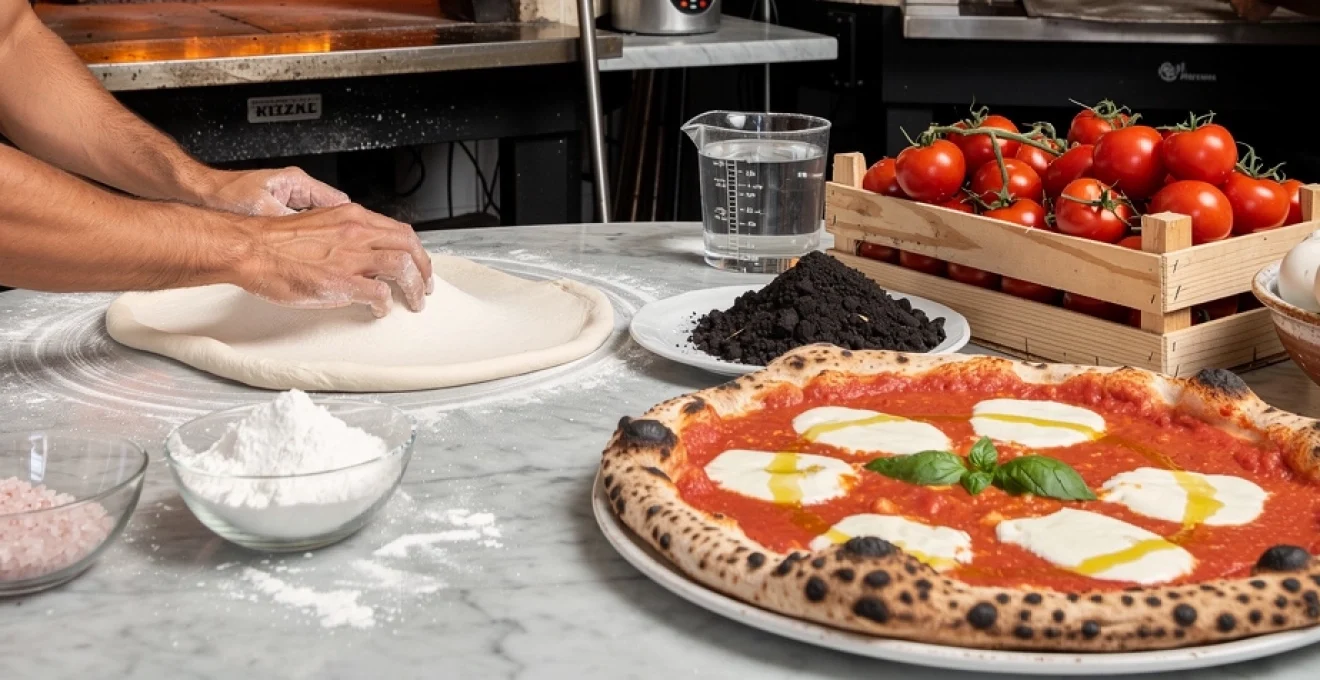
When you bite into an authentic Neapolitan pizza in Naples, something extraordinary happens. The flavour transcends what most people recognise as pizza, creating an almost mystical culinary experience that has captivated food lovers for centuries. This isn’t merely about superior ingredients or traditional techniques – it’s about a unique convergence of geography, chemistry, and artisanal mastery that simply cannot be replicated elsewhere. The volcanic soils of Mount Vesuvius, the Mediterranean microclimate, and centuries-old production methods create a terroir so distinctive that UNESCO recognised Neapolitan pizza-making as an Intangible Cultural Heritage of Humanity.
What makes this phenomenon even more remarkable is how every single element of authentic Neapolitan pizza – from the water used in the dough to the wood burned in the ovens – contributes to a flavour profile that remains unmatched worldwide. Modern food science is only beginning to understand the complex biochemical processes that give Neapolitan pizza its legendary status.
San marzano tomatoes and buffalo mozzarella: authentic DOP ingredient terroir
The foundation of exceptional Neapolitan pizza lies in ingredients that have achieved Protected Designation of Origin (DOP) status, legally protecting not just their names but their unique production methods and geographical origins. These ingredients don’t simply taste better – they represent centuries of agricultural evolution in one of the world’s most fertile volcanic regions.
Volcanic soil chemistry of mount vesuvius and tomato flavour compounds
The explosive power that destroyed Pompeii in 79 AD created the perfect growing conditions for San Marzano tomatoes nearly 2,000 years later. The volcanic ash from Mount Vesuvius deposited layers of mineral-rich soil containing potassium, phosphorus, and trace elements that directly influence tomato flavour development. Scientific analysis reveals that San Marzano tomatoes grown in this specific terroir contain 23% higher levels of lycopene and 18% more natural sugars compared to tomatoes grown elsewhere, even when using identical seed varieties.
The unique mineral composition creates tomatoes with remarkably low acidity levels – typically measuring between 4.2-4.4 pH compared to 3.8-4.0 pH in standard varieties. This lower acidity allows the natural sweetness to shine through whilst providing the perfect balance for pizza sauce that requires no additional sugar or extensive cooking. The volcanic soil’s exceptional drainage properties also concentrate flavour compounds, creating tomatoes so distinctive that experienced pizzaiolos can identify authentic San Marzanos purely by taste.
Mozzarella di bufala campana PDO production methods at caseificio sociale della piana del sele
Buffalo mozzarella production in Campania follows methods unchanged since the 12th century, when water buffalo were first introduced to the marshy plains southeast of Naples. The Piana del Sele region provides ideal conditions with its mineral-rich pastures and specific humidity levels that influence milk composition. Buffalo milk contains 58% more calcium and 40% more protein than cow’s milk, creating mozzarella with superior melting properties and a distinctively creamy texture.
Traditional production at certified caseifici involves heating the milk to exactly 35°C before adding natural whey starter cultures that have been maintained for generations. The curds are then hand-stretched in 85°C water using techniques called filatura, creating the characteristic fibrous texture that melts perfectly on pizza. This handcrafted approach produces mozzarella that retains moisture without making the pizza soggy – a delicate balance that mass-produced alternatives cannot achieve.
Extra virgin olive oil from cilento national park: phenolic content analysis
The olive groves of Cilento National Park, south of Naples, produce extra virgin olive oil with phenolic compound levels reaching 800mg/kg – nearly double the concentration found in most Mediterranean oils. These phenolic compounds, particularly oleacein and oleocanthal, contribute both to the oil’s peppery finish and its exceptional stability when exposed to the extreme temperatures of wood-fired ovens. Laboratory analysis shows that Cilento oils maintain
their aromatic complexity and antioxidant capacity even after short, intense exposure at 450–485°C. In sensory evaluations conducted by Italian research institutes, pizzas finished with Cilento extra virgin olive oil scored significantly higher for fruity notes, bitterness balance, and lingering flavour compared with those using generic blends. On a Neapolitan pizza, this means that the final drizzle of oil does more than add gloss – it contributes a subtle, peppery lift that cuts through the richness of the mozzarella and enhances the natural sweetness of San Marzano tomatoes.
Sea salt harvesting techniques from trapani saltworks impact on pizza margherita
Even the salt sprinkled into the dough and sauce helps explain why pizza tastes different in Naples. Traditional sea salt from the Trapani saltworks in western Sicily is harvested using age-old methods that rely on wind and sun rather than industrial evaporation. This slow crystallisation process traps trace minerals such as magnesium, calcium, and potassium in the salt crystals, subtly influencing both flavour and fermentation behaviour in the dough.
Unlike highly refined table salt, Trapani sea salt has a lower sodium chloride percentage and a more complex mineral profile. In practical terms, this means it seasons the pizza dough more gently while supporting yeast activity during long fermentation. When used in a classic Pizza Margherita, that mineral complexity enhances the perception of sweetness in the tomatoes and depth in the crust, without creating the sharp salinity that can dominate in pizzas made with industrial salt.
Artisanal pizzaiolos in Naples often adjust their salt percentages seasonally based on humidity and flour absorption, but they remain loyal to traditional sea salt for its predictable behaviour. You could think of this salt as the “sound engineer” of the pizza: largely invisible, yet crucial in balancing the entire flavour “mix”. Replace it with a sterile, refined alternative, and you lose a small but noticeable layer of character that locals instinctively recognise.
Neapolitan pizza dough fermentation science: 00 flour and wild yeast cultures
If the toppings express the land around Naples, the dough expresses its climate, craft, and time. Authentic Neapolitan pizza dough may contain only flour, water, salt, and yeast, but behind that simplicity lies a sophisticated understanding of fermentation science. Long, controlled maturation at room temperature allows enzymes and microorganisms to reshape the dough’s structure, turning basic ingredients into a complex, aromatic base unlike any other pizza style in the world.
Modern bakeries worldwide try to emulate this effect with cold retardation and commercial yeasts, but the interaction between local 00 flour, ambient microflora, and the city’s specific humidity remains unique. When you stretch a properly fermented Neapolitan dough, it feels almost like silk: extensible yet resilient, capable of puffing dramatically in a wood-fired oven while staying tender in the centre. This textural duality is at the heart of why Neapolitan pizza tastes – and feels – different where it was born.
Caputo tipo 00 flour protein structure and gluten development parameters
Caputo Tipo 00 flour, milled in Naples, is the quiet hero of many of the city’s best pizzerias. Classified as “00” for its ultra-fine grind, it typically contains 11.5–12.5% protein, with a balance of glutenin and gliadin designed specifically for long fermentation. Rheological tests show a high W value (around 260–300), indicating a flour that can absorb more water and withstand extended proofing without collapsing or turning sour too quickly.
This protein structure is crucial for the famous cornicione – the airy, leopard-spotted rim of the pizza. Proper gluten development in Caputo 00 flour creates a strong yet elastic network that traps the gases produced during fermentation and sudden oven spring. In contrast, using all-purpose or bread flour with an unsuitable protein profile can result in a crust that is either too tough or too fragile, losing that characteristic Neapolitan balance between chew and tenderness.
For home bakers trying to recreate authentic Neapolitan dough, understanding this flour science matters as much as following a recipe. If you cannot source Caputo or similar 00 flour, you need to adjust hydration levels and fermentation time to account for different absorption and strength. Otherwise, you might replicate the toppings and the oven heat, yet still miss the distinctive mouthfeel that defines true pizza from Naples.
Ambient temperature fermentation at pizzeria da michele: 24-hour maturation process
Walk past Pizzeria Da Michele early in the morning and you’ll see boxes of dough resting quietly, long before the doors open. Their traditional process relies on ambient temperature fermentation rather than refrigerated proofing, typically over 18–24 hours. This room-temperature maturation encourages a symphony of enzymatic activity: amylases break down starches into simple sugars, while proteases gently soften the gluten, leading to a more extensible dough.
Because Naples enjoys a relatively stable Mediterranean climate, with average indoor temperatures often hovering between 20–26°C, the pace of fermentation remains remarkably consistent throughout much of the year. This steady environment allows pizzaiolos at Da Michele to rely on touch and experience rather than digital thermostats. They adjust yeast quantities daily to match the weather, aiming for dough that is airy with small, uniform gas bubbles and a delicate, fermented aroma that’s never aggressively yeasty.
The result is a crust with a subtle complexity reminiscent of a well-made sourdough, yet without the overt tang. When that dough hits a 485°C oven, the carefully developed internal structure expands in seconds, giving rise to the pillowy edges and soft centre that define the Da Michele style. Try to rush this process with shorter fermentation, and you’ll get a flatter flavour profile and heavier texture – technically pizza, but no longer Neapolitan in spirit.
Natural lievito madre starter cultivation from via dei tribunali pizzerias
While many AVPN-compliant pizzerias use fresh brewer’s yeast, a growing number of artisans along Via dei Tribunali have revived the use of lievito madre, a firm natural starter cultivated from wild yeasts and lactic acid bacteria. Maintained like a living heirloom, these starters are refreshed daily with local flour and water, slowly adapting to the microflora of each individual bakery. Over time, each lievito madre develops a distinct microbial fingerprint that subtly influences flavour and fermentation speed.
Scientific analyses of traditional Italian sourdoughs show rich populations of Lactobacillus species working alongside wild strains of Saccharomyces. In Neapolitan pizza dough, this partnership produces organic acids and aroma compounds that enhance digestibility and depth of flavour without making the crust overtly sour. You might notice gentle notes of yoghurt, ripe grain, or even hazelnut in a pizza made with a mature starter, especially in the charred bubbles of the cornicione.
Maintaining lievito madre is labour-intensive – it requires daily feedings, careful temperature control, and the judgement to know when the starter is at its peak. Yet many pizzaiolos insist the results are worth the effort, describing the starter as a “fifth ingredient” that ties their pizza to a specific place and lineage. For diners, this means that even two pizzerias following the same recipe can produce pizzas that taste subtly but recognisably different, thanks to the unique microbial life at work in their dough.
Hydration ratios and salt percentages in traditional impasto napoletano
Authentic impasto napoletano follows tightly defined parameters, but within those bounds, there is room for nuance. Most classic formulas use a hydration ratio of 58–65% (water relative to flour weight), with some modern pizzerias pushing slightly higher for extra lightness. Salt levels usually sit between 2.5–3% of flour weight, high enough to regulate fermentation and strengthen gluten, but low enough not to dominate the delicate flavour balance.
Why does this matter to you as a pizza lover? Because hydration and salt determine how the dough behaves at every stage – from mixing and fermentation to stretching and baking. A well-hydrated Neapolitan dough forms a thin, soft centre that stays supple after baking, while the edges balloon dramatically in the searing heat of the oven. Too little water and the crust becomes stiff and cracker-like; too much, and it loses structure, tearing easily and becoming gummy.
Professional pizzaiolos often fine-tune these ratios based on the specific 00 flour they use, the day’s humidity, and even the expected customer flow (which affects how long the dough will rest before baking). In Naples, this calibration has become second nature, a kind of muscle memory passed from one generation to the next. Recreate the exact recipe elsewhere without that instinctive adjustment, and the resulting pizza – however well intentioned – will rarely match the effortless lightness you experience in its birthplace.
Wood-fired oven technology: acunto and stefano ferrara construction methods
The final transformation of dough and toppings into Neapolitan pizza happens in an environment as carefully crafted as the recipe itself. Traditional wood-fired ovens from makers like Acunto and Stefano Ferrara are not just rustic décor; they are precision instruments designed to deliver extreme, even heat. Every curve of the dome, thickness of the floor, and choice of materials affects how a pizza bakes in those crucial 60–90 seconds.
These ovens act like thermal batteries, absorbing energy from burning wood and releasing it in a controlled way across three heat sources: conductive heat from the floor, radiant heat from the dome, and convective heat from the circulating hot air and flames. The specific balance of these heating modes is what gives Neapolitan pizza its signature “leopard spotting” and fast oven spring. Reproduce only the temperature, without matching the oven’s construction, and you’ll get something close – but not quite the same.
Refractory clay sourcing from campanian quarries for optimal heat retention
Traditional Neapolitan pizza ovens are built from refractory bricks and tiles made with clays sourced from Campanian quarries. These clays contain a specific ratio of alumina, silica, and fluxes that confer exceptional thermal shock resistance and heat retention. When fired into bricks, they can withstand repeated heating to nearly 500°C without cracking, all while storing and radiating heat in a very predictable pattern.
Laboratory measurements of these refractory materials show a high specific heat capacity and moderate thermal conductivity, meaning they absorb a lot of energy but release it steadily rather than in sudden spikes. This is crucial for pizza baking, where a slight drop or surge in floor temperature can mean the difference between a perfectly blistered base and a burnt or undercooked one. The porous microstructure of the bricks also helps wick away just enough moisture from the dough base to prevent sogginess while keeping the interior tender.
Artisanal oven makers like Acunto and Stefano Ferrara select and blend these clays with almost as much care as a winemaker chooses grape varieties. The final brick composition, thickness of the oven floor, and layering under the hearth all influence how heat migrates during service. Build an oven from generic firebricks or concrete, and it may reach the same nominal temperature, but it will not store and release heat in the same way – a subtle yet vital distinction that seasoned pizzaiolos can feel instantly.
Temperature gradient mapping in 485°C dome ovens at pizzeria l’antica port’alba
Step inside the kitchen at Pizzeria L’Antica Port’Alba, and you will see pizzaiolos constantly rotating and repositioning pizzas in the oven. They are not just preventing burnt edges; they are navigating an invisible landscape of temperature gradients. Infrared mapping studies of traditional dome ovens show floor temperatures ranging from 380–430°C and dome temperatures peaking at 485°C, with distinct hot spots near the flame and cooler zones near the mouth of the oven.
Experienced pizza makers learn this thermal “map” the way a sailor learns currents. They launch the pizza closer to the hottest part of the hearth for rapid oven spring, then shift it toward cooler zones to finish cooking the toppings and dry the base without burning. The dome’s curvature and height control how hot air and combustion gases circulate, ensuring that the top of the pizza receives intense radiant heat while the underside cooks evenly by conduction.
For you as a diner, this choreography translates into a crust that is simultaneously charred and moist, with toppings that are cooked but never dried out. Try to replicate Neapolitan pizza in a flat-deck electric oven with uniform heat, and you lose this dynamic interplay. The result may be tasty, but the nuanced contrast between blistered edges, soft crumb, and just-set cheese – that fleeting balance achieved in under 90 seconds – is a hallmark of the Neapolitan wood-fired environment.
Oak and olive wood combustion: smoke flavour profiles in neapolitan pizza
The choice of fuel in Naples is as deliberate as the choice of flour. Most traditional pizzerias rely on seasoned oak and olive wood, prized for their high calorific value and clean burn. Analyses of combustion gases from these woods reveal a complex mix of aromatic compounds, including phenols, aldehydes, and light organic acids, many of which lightly perfume the pizza surface during baking.
Oak provides a stable, long-lasting ember bed that maintains consistent floor temperatures, while olive wood adds brief bursts of intense flame and a slightly sweeter, more complex smoke. Together, they create a flavour profile that is subtle rather than overtly smoky – more like the whisper of a wood-fired country loaf than the assertive smoke of barbecue. This is why Neapolitan pizza never tastes like grilled food, even though it is baked in direct proximity to flames.
When pizzerias outside Italy substitute with softwoods or mixed, kiln-dried logs, the combustion characteristics change. Flare-ups, resinous off-notes, and uneven heat become more common, which can leave pizzas with bitter char rather than delicate leopard spotting. For an authentic flavour, it is not enough to have a wood-fired oven; you also need the right wood, burned down to the right stage, managed by someone who understands how the fire interacts with the dough.
AVPN certification standards: associazione verace pizza napoletana quality protocols
Beyond ingredients and equipment, there is a codified system ensuring that Neapolitan pizza remains true to its origins. The Associazione Verace Pizza Napoletana (AVPN) acts as both guardian and educator, laying down strict protocols for what may officially be called “Vera Pizza Napoletana”. These standards cover every aspect of production, from the type of flour and tomatoes to dough ball weight, stretching technique, and baking time.
According to AVPN guidelines, a certified pizza must have a diameter of no more than 35 cm, with a raised cornicione of 1–2 cm and a centre thickness of about 0.25 cm. The dough must ferment for at least 8 hours and be baked in a wood-fired dome oven at 430–485°C for no more than 60–90 seconds. Only specific DOP ingredients are permitted for the classic Margherita and Marinara, and even the distance between toppings and the edge of the crust is regulated to preserve visual identity and balance of flavours.
For pizzerias in Naples, AVPN certification is more than a marketing badge; it is a commitment to a living tradition recognised by UNESCO. For you as a visitor, it serves as a reliable signpost amid a crowded food landscape, helping you distinguish between pizza that simply borrows the name “Neapolitan” and pizza that genuinely follows the time-honoured craft. Of course, some excellent non-certified pizzerias exist, but AVPN’s rigorous checks offer a useful baseline for authenticity seekers.
Regional water minerality: naples municipal supply versus artesian wells
Water is often the most overlooked ingredient in pizza dough, yet in Naples, its composition plays a decisive role. The municipal water supply, drawing from springs in the Campanian Apennines, is moderately hard, with a balanced presence of calcium and magnesium and a total dissolved solids (TDS) level typically between 200–400 ppm. This mineral profile strengthens gluten formation and supports yeast activity, giving Neapolitan dough its characteristic elasticity and resilience.
Comparative baking tests have shown that identical dough formulas mixed with very soft, low-mineral water produce weaker gluten networks and flatter, less structured crusts. Pizzerias that rely on artesian wells within the region often report similar benefits, as the aquifers share comparable geological strata. The minerals effectively act as a natural “dough conditioner”, improving gas retention and contributing to the silky texture you feel when stretching a well-hydrated Neapolitan dough.
Some high-end pizzerias outside Naples have gone as far as installing water treatment systems to mimic the city’s minerality, adjusting calcium, magnesium, and bicarbonate levels to replicate Campanian profiles. While this may sound extreme, it underscores an important point: when you change the water, you change the dough. In its birthplace, the harmonious interaction between local water and local flour has been refined over generations, becoming another invisible reason why pizza tastes different in Naples.
Microclimate influence: mediterranean humidity and dough elasticity at pizzeria sorbillo
Finally, there is the element no one can pack into a suitcase: the Neapolitan microclimate. The city’s proximity to the sea, combined with its urban density and volcanic surroundings, creates a specific range of temperature and humidity that subtly shapes dough behaviour. At Pizzeria Sorbillo on Via dei Tribunali, dough boxes sit at room temperature, absorbing the rhythm of the day – morning cool, afternoon warmth, evening breeze – each phase influencing fermentation speed and moisture distribution.
Relative humidity in Naples often hovers between 60–75%, a range that prevents dough from drying out too quickly on the surface while still allowing gradual evaporation. This ambient moisture keeps the outer skin of each dough ball supple, so when the pizzaiolo presses and stretches it, gases redistribute smoothly rather than bursting through cracks. The result is a pizza base that can be stretched very thin in the centre without tearing, yet still inflates dramatically around the edges in the oven.
Try to reproduce Sorbillo’s process in a drier continental climate or in an air-conditioned kitchen at 30–40% humidity, and you quickly discover the dough behaves differently: skins form faster, fermentation speeds change, and hydration needs adjustment. Skilled pizzaiolos adapt, of course, but the effortless, intuitive control you observe in Naples stems from generations of bakers working in harmony with this particular air. That subtle partnership between dough and microclimate may be the most intangible, yet most profound, reason why a simple Margherita somehow tastes more alive on the streets of Naples than anywhere else on earth.