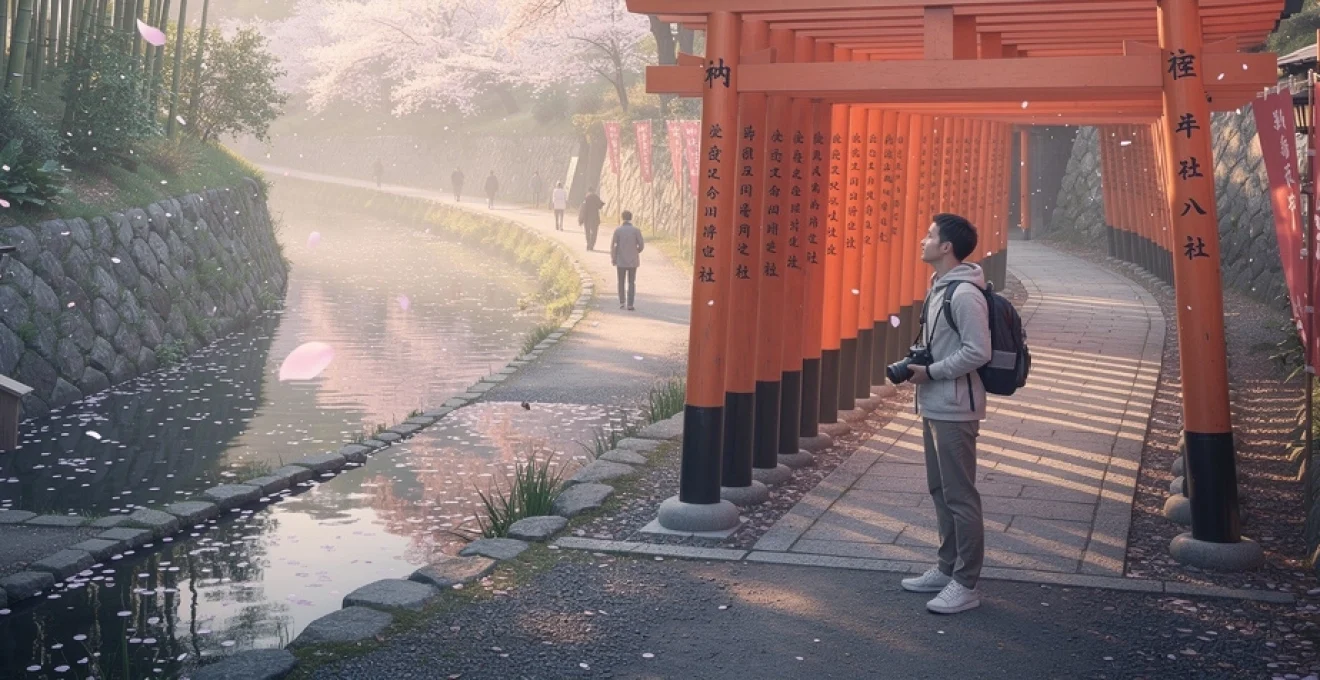
Travel transforms us in unexpected ways, but few destinations possess the power to fundamentally reshape how we approach exploration itself. Kyoto, Japan’s ancient capital, offers something increasingly rare in modern tourism: the opportunity for genuine contemplation amid cultural magnificence. During an unplanned early morning walk through this historic city, a profound shift occurred—one that challenged years of hurried itinerary-following and superficial sightseeing. The quiet streets revealed a truth many travellers never discover: that the quality of travel experiences depends less on how many destinations you tick off a list, and more on the depth of presence you bring to each moment.
This realisation didn’t arrive through dramatic revelation, but through the simple act of stepping outside before dawn, when Kyoto belongs not to tourists but to itself. The city’s temples, gardens, and pathways take on entirely different characteristics when experienced without crowds—revealing layers of meaning and aesthetic subtlety that remain hidden during peak visiting hours. What began as an attempt to avoid tourist congestion evolved into a masterclass in mindful exploration, one that continues to influence how destinations are approached long after returning home.
Dawn at fushimi inari taisha: when solitude transforms sacred spaces
Fushimi Inari Taisha stands as one of Kyoto’s most photographed landmarks, its thousands of vermillion torii gates creating tunnels of saturated colour against mountainous greenery. Yet these same pathways, mobbed by mid-morning with selfie-taking visitors, reveal an entirely different character when approached at first light. Arriving at 5:30 AM on a September morning meant experiencing the shrine complex in near-total solitude—a rare privilege that fundamentally altered the nature of the visit itself.
Navigating the senbon torii gates before tourist saturation
The famous senbon torii—literally “thousands of torii gates”—form winding corridors up Mount Inari’s slopes. During daylight hours, these passages become congested bottlenecks where photography requires patience and compromise. At dawn, however, they transform into meditative walkways where footsteps echo against wooden pillars and morning light filters through gaps in the orange canopy above. The experience shifts from visual consumption to sensory immersion.
Walking alone through these gates reveals architectural details easily missed in crowds: the weathering patterns on older torii, the inscriptions indicating corporate and individual donors, the subtle gradations in vermillion pigment across different installation periods. More significantly, solitude permits the psychological space necessary for genuine reflection—allowing the spiritual intention behind these structures to communicate without interference from modern tourism’s performative pressures.
The psychology of temporal displacement in heritage site visitation
Research in environmental psychology demonstrates that crowding significantly diminishes visitor satisfaction at cultural heritage sites, but the impact extends beyond mere annoyance. Dense crowds fundamentally alter how the brain processes spatial and aesthetic information, shifting mental state from contemplative to reactive, from absorptive to defensive. Early morning visits create what researchers term “temporal displacement”—experiencing a space during off-peak hours to access more authentic engagement.
At Fushimi Inari before dawn, this displacement effect proved profound. Without other visitors in the visual field, attention naturally expanded to encompass environmental details: the forest sounds beyond the torii, the temperature differential between shaded and open sections, the architectural rhythm created by repeating gate structures. The site’s intended function as a sacred threshold between mundane and spiritual realms became experientially apparent rather than intellectually understood.
Photographic intimacy: capturing vermillion pathways without human interference
Photography at popular landmarks typically involves strategic patience—waiting for momentary gaps in human traffic to capture “empty” scenes. This approach, while producing cleaner images, fundamentally misrepresents the actual visitor experience and reinforces unrealistic travel expectations. Early morning photography at Fushimi Inari offered something different: authentic documentation of genuine solitude rather than artificially constructed absence.
The quality of light at dawn also dramatically enhanced visual documentation. Low-angle sunlight illuminated the torii gates from behind, creating rim-lighting effects that emphasised their dimensional presence while casting long shadows across stone pathways. This natural lighting revealed texture and depth
along the wooden surfaces that are usually flattened by midday glare. Being able to work slowly, reposition the tripod, and experiment with compositions without feeling in anyone’s way created a kind of photographic intimacy with the space. Rather than chasing iconic shots you have already seen on social media, you begin searching for personal perspectives: a single gate catching the light differently, a weathered base stone, the convergence point of receding lines. In that quiet, photography stops being proof that you were there and becomes a way of paying attention.
Shinto atmospheric immersion through strategic timing
Perhaps the most striking difference between a dawn visit and a midday one is the way the shrine’s Shinto character reveals itself. In Shinto tradition, shrines function as places where the boundary between human and spirit worlds thins. Before sunrise, when vendors are still setting up and the city has yet to fully wake, this liminal quality feels almost tangible. The air is cooler, the smell of cypress sharper, and the soundscape limited to rustling leaves, distant crows, and the occasional soft ring of a bell.
Strategic timing, in this sense, becomes less about beating other travellers and more about aligning yourself with the shrine’s original rhythms. Priests move through their morning rituals, caretakers sweep stone paths free of leaves, and votive candles from the previous night burn low. You witness the shrine as a living place of practice, not merely a backdrop for travel photography. For anyone interested in cultural immersion in Kyoto, choosing these early hours allows Shinto concepts like kami (spirits) and purification to be felt rather than simply explained on an information board.
The arashiyama bamboo grove at first light: redefining mindful travel practices
Later that same morning, the quiet at Fushimi Inari set the tone for another early visit: the Arashiyama Bamboo Grove. By the time most day-trippers are boarding the train from Kyoto Station, the grove’s main path can resemble a moving queue—beautiful, but frenetic. Experiencing Arashiyama at first light, however, transforms it into something closer to an open-air meditation hall. The towering stalks become a living architecture of green, and the simple act of walking in a straight line feels newly intentional.
Chronobiological advantages of pre-dawn departure from gion district
Leaving the Gion district before dawn for Arashiyama might sound extreme, yet from a chronobiological perspective, it makes intuitive sense. Human alertness and mood are strongly influenced by circadian rhythms, and studies in travel health suggest that exposure to natural morning light can significantly improve both jet lag recovery and cognitive performance. By timing your departure so that you arrive in Arashiyama with the first usable daylight, you are effectively syncing your own internal clock with Kyoto’s slowest, quietest hours.
Practically, this pre-dawn departure from central Kyoto also reduces cognitive overload. Train platforms are quieter, navigation feels less pressured, and there is more mental bandwidth to absorb your surroundings. Instead of rushing to keep pace with a tour group, you notice small details: a local commuter reading in silence, the gradual lightening of the sky over the Katsura River, the way shop shutters in Arashiyama are still half-closed when you arrive. By the time you step into the bamboo grove, your nervous system has already shifted into a calmer state—an ideal baseline for mindful travel in Kyoto.
Acoustic ecology: wind-through-bamboo soundscapes versus crowd noise pollution
Arashiyama’s beauty is not only visual; it is acoustic. At first light, before the main influx of visitors, an entirely different soundscape emerges. Soft wind moves through dense bamboo, creating a layered rustle that feels almost like distant ocean waves. Occasional bird calls punctuate the silence, and your own footsteps on the gravel path become part of the composition. Environmental psychologists refer to this kind of environment as a “restorative soundscape,” one that lowers stress indicators and improves attention span.
As more people arrive, this subtle ecology is gradually overwritten by crowd noise pollution—voices echoing, camera shutters clicking, tour leaders calling instructions. The same path, experienced just an hour or two later, can feel strangely compressed, as though the bamboo has lost some of its depth. Encountering the grove first in near-silence makes this contrast stark. You realise how profoundly sound influences your perception of place, and how often travel itineraries neglect this dimension. For travellers seeking deeper nature immersion near Kyoto, protecting the early hours becomes as important as choosing the right destination.
Monozukuri philosophy applied to intentional journey design
Japan’s concept of monozukuri—often translated as “the art of making things with soul”—typically refers to craftsmanship and manufacturing. But standing in the bamboo grove, it occurred to me that the same philosophy can be applied to how we design our journeys. Instead of assembling a day from disconnected attractions, we can treat an itinerary like a crafted object: purposeful, balanced, and built with care.
In Arashiyama, this meant pairing the sensory intensity of the bamboo grove with quieter, complementary experiences: a stop at a small riverside café before it opened fully, a detour to a lesser-known temple rather than the most famous lookout point, a deliberate decision to walk rather than take a rickshaw back toward the station. Intentional journey design asks you to consider the emotional “texture” of your day—fast against slow, crowded against solitary, effort against rest—much like a craftsman considers the grain of wood or the tension of a ceramic form. When we approach travel with this mindset, even simple movements between sites become part of the meaningful whole.
Kiyomizu-dera temple precinct: architectural appreciation through slow travel methodology
By the time I reached Kiyomizu-dera later in the trip, the quiet lessons of that first morning had accumulated into a different way of moving through Kyoto. Kiyomizu-dera is rarely empty; as one of the city’s most iconic temples, it draws constant streams of visitors. Yet even in the midst of this activity, applying a slow travel methodology made the experience feel surprisingly intimate. Instead of rushing straight to the famous wooden stage overlooking the city, I allowed my route to meander, pausing often and doubling back with no particular urgency.
This slower pace revealed the temple’s architecture as something closer to choreography than static structure. The raised wooden walkways direct your gaze outward toward the forested hillside, then inward toward small shrines and incense altars. Changes in flooring—from stone to wood to tatami—cue subtle shifts in behaviour and volume, as if the building itself were teaching you how to move. When you are not racing a checklist, you start noticing joinery details in the massive pillars, the way the veranda’s supports rise from the slope without nails, and the careful framing of distant mountains through seemingly incidental openings. Kiyomizu-dera stops being just a view point and becomes a three-dimensional textbook of traditional Japanese architecture.
Slow travel in Kyoto also changes how you relate to the crowds themselves. Rather than seeing other visitors as obstacles, you begin observing their rhythms: schoolchildren lining up in bright uniforms, couples tossing coins and clapping before a shrine, local families moving with a familiarity you do not yet possess. In this context, waiting your turn at a popular photo spot feels less like an inconvenience and more like participating in a shared ritual. The question subtly shifts from “How do I avoid people?” to “How can I inhabit this space thoughtfully alongside others?”
Philosopher’s path contemplative walking: from ginkaku-ji to nanzen-ji
Nowhere in Kyoto embodies quiet, everyday beauty quite like the Philosopher’s Path, the stone walkway that traces a canal between Ginkaku-ji (the Silver Pavilion) and Nanzen-ji. Named after Kyoto University philosopher Nishida Kitarō, who is said to have used this route for daily meditative walks, the path invites a different kind of sightseeing—one in which the journey is not a corridor between headline attractions, but the main experience itself. Walking it after that formative morning, I approached the route less as a shortcut and more as a moving meditation.
Shinrin-yoku principles along the canal of lake biwa
The canal that runs beside the Philosopher’s Path channels water from Lake Biwa, Japan’s largest freshwater lake, into the city. Lined with cherry trees, maples, and modest stone bridges, it creates a narrow ribbon of nature running parallel to residential streets. This setting is ideal for shinrin-yoku, or “forest bathing”—a Japanese practice that involves mindfully immersing yourself in natural environments to reduce stress and improve health. Research from Japan’s Forestry Agency has shown that even short walks in green spaces can lower blood pressure and cortisol levels.
Applying shinrin-yoku principles along the canal is surprisingly simple. You slow your pace to half what it would normally be. You notice the scent of damp earth after a light rain, the intricate moss patterns on stone walls, the way koi surface briefly in the water then disappear. You let your gaze soften instead of snapping from sight to sight. In doing so, the Philosopher’s Path stops being just a pretty route between temples and becomes a kind of linear garden designed for mental restoration. For travellers dealing with long-haul fatigue or information overload from museum visits, this kind of gentle, unstructured time in nature can be more regenerative than another attraction.
Seasonal mono no aware: cherry blossom ephemerality and travel perspective shifts
Walking the Philosopher’s Path during early spring, when cherry blossoms are just beginning to appear, offers a living lesson in mono no aware—the Japanese aesthetic appreciation of impermanence. Unlike autumn foliage, which slowly deepens in colour, cherry blossoms move quickly from bud to full bloom to scattered petals. If you arrive a week early, the trees are bare; a week late, and the ground is carpeted with fading pink. It is a reminder that no matter how carefully we plan our itineraries, we are ultimately guests of timing we cannot fully control.
This awareness can subtly transform how you experience travel. Instead of feeling disappointed when you miss the “perfect” moment—peak bloom, ideal weather, clear views—you begin to value the particular version of Kyoto that appears during your stay. Perhaps the buds are still tight, promising a future you won’t see, or perhaps a strong wind has already knocked many petals into the canal, creating fleeting patterns on the water’s surface. Like a musician catching a specific improvisation in a jazz solo, you realise that your trip is one unrepeatable variation among many. Accepting this ephemerality can make each small detail—an early blossom, a drifting leaf—feel strangely precious.
Meditative pace versus instagram-driven itinerary construction
On the Philosopher’s Path, the tension between meditative walking and Instagram-driven travel is easy to spot. Every few metres, there is a bench, a side street, or a small shrine that invites lingering. At the same time, you can often hear snippets of conversation about “getting to the next spot” or “finding the best angle” for photos. Both impulses are understandable, but they lead to very different experiences of the same place. One treats the path as an item on a list; the other, as a corridor of unscripted time.
Choosing a meditative pace does not mean leaving your phone behind or refusing to document your journey. It simply means letting your attention lead and your camera follow, rather than the reverse. You might take a photo after ten quiet minutes watching carp ripple the canal’s surface, rather than interrupting that moment to capture it prematurely. You might stop at a neighbourhood café halfway along—not because it is “must-visit Kyoto coffee,” but because you like the smell drifting from the doorway. In this way, you begin to construct an itinerary that serves your nervous system and curiosity rather than an algorithm.
Traditional machiya guesthouse experience: cultural immersion through architectural intimacy
Returning each day to a traditional machiya guesthouse amplified everything those early mornings had taught me about presence. Machiya—Kyoto’s historic wooden townhouses—are long, narrow structures that stretch back from the street, often with inner gardens and sliding paper doors. Staying in one is not like staying in a modern hotel; it is more like borrowing a small, living piece of the city’s fabric. The floors creak softly, sound travels easily between rooms, and the boundary between indoors and outdoors feels thinner than in Western architecture.
This architectural intimacy naturally slows you down. You move more carefully across tatami to avoid damaging the woven surface. You become attuned to the temperature fluctuations between street-facing rooms and those wrapped around the interior garden. Morning light doesn’t burst through glass panes but filters gradually through shoji screens, turning the space into a soft lantern. In such a setting, typical hotel habits—turning on the television, working from the bed—feel oddly out of place. Instead, you find yourself sitting at the low table with a cup of tea, listening to the faint sounds of bicycles and footsteps outside.
From a cultural immersion perspective, a machiya stay also subtly reshapes your daily rhythm in Kyoto. Many guesthouses provide simple Japanese-style breakfasts or recommend nearby neighbourhood eateries that open early. You begin your days not with the anonymity of a hotel buffet, but with a bowl of miso soup, rice, and pickles in a space that feels both domestic and historic. Practical routines—hanging laundry on a small balcony, sliding the wooden door closed at night, placing slippers neatly at the genkan—become tiny rituals of participation in local life. Over time, you stop feeling like an observer looking in and more like a temporary resident moving carefully within an inherited structure.
Nishiki market sensory engagement: culinary anthropology at dawn
The final piece of this quiet-morning puzzle came at Nishiki Market, Kyoto’s famous “kitchen.” Most visitors encounter Nishiki at its midday peak, when narrow aisles are packed and every stall seems surrounded by people photographing skewers, snacks, and seafood. Arriving just as vendors are opening changes everything. Instead of a moving wall of tourists, you find a corridor of preparation: fish being sliced, pickles arranged, shutters rattling open one by one. The market reveals itself not just as a place to eat, but as a living system that sustains Kyoto’s culinary traditions.
Tsukemono vendor interactions and locavore travel ethics
One of the most enlightening encounters came at a tsukemono (pickled vegetable) shop near the market’s centre. With few customers around, the vendor had time to explain—in a mix of simple English, gestures, and occasional translation app prompts—the differences between salt pickling, rice bran pickling, and sake lees pickling. Each barrel held vegetables sourced from nearby farms, many of which have been supplying the same families for generations. Sampling these pickles before the rush of the day, you taste not just intense sourness or crunch, but layers of technique and seasonality.
These kinds of early interactions gently nudge you toward a more locavore style of travel. Rather than treating food as entertainment or mere fuel, you start asking where ingredients come from, how they are preserved, and who is involved along the way. Buying a small packet of pickles or locally made miso becomes less about acquiring a souvenir and more about participating—however briefly—in Kyoto’s food ecosystem. For travellers concerned with sustainable tourism in Kyoto, this shift in mindset is as important as any formal certification: it changes consumption into conversation.
Matcha preparation rituals at ippodo tea since 1717
Just a short walk from Nishiki Market, Ippodo Tea has been specialising in Japanese green tea since 1717. Arriving soon after opening, when the tatami-matted tea room is still quiet, allows you to observe matcha preparation as a practiced ritual rather than a performance hurried for a waiting crowd. The staff’s movements are precise but unhurried: scooping the bright green powder, adding carefully measured hot water, and whisking in a controlled, rhythmic motion until a fine foam appears on the surface.
Watching this up close, you begin to understand why matcha in Kyoto tastes so different from the quick lattes we drink at home. The temperature of the water—usually around 80°C rather than boiling—the quality of the tea leaves, the shape of the bowl, and even the speed of the whisk all influence flavour and mouthfeel. When you drink the finished bowl, holding it with both hands as is customary, the experience feels almost like a continuation of the earlier temple visits: a small, contained moment of focus. For anyone interested in slow travel in Kyoto, taking time for a traditional tea experience like this can be as revealing as visiting another landmark.
Kaiseki appreciation through ingredient sourcing observation
Ending the day with a kaiseki meal—a multi-course dining experience that showcases seasonal ingredients in carefully orchestrated progression—took on new meaning after those early market hours. Having seen crates of river fish arrive on ice, watched vendors trim seasonal bamboo shoots, and learned how pickles are made, each course at a neighbourhood kaiseki restaurant felt less abstract. The translucent slice of sashimi was no longer just “fresh”; it was part of the same supply chain I had watched setting up that morning.
Many Kyoto kaiseki chefs source ingredients directly from Nishiki Market and surrounding producers, often visiting themselves rather than delegating completely to suppliers. When you pay attention to this connection, kaiseki stops being simply “fine dining in Kyoto” and instead reads like an edible map of the region. You taste the mountain in the delicate sansai (wild vegetables), the nearby sea in the grilled fish, and the patient work of fermentation in miso-based dishes. Observing ingredient sourcing first, then experiencing the composed meal, is like seeing the draft sketches before the finished painting—you gain a deeper respect for the artistry involved.
In the end, it was not one single temple, garden, or meal that changed how I experience travel, but the cumulative effect of meeting Kyoto in its quiet hours. Dawn at Fushimi Inari, first light in Arashiyama, contemplative walks along the Philosopher’s Path, evenings in a creaking machiya, and early conversations at Nishiki Market together formed a different template for exploration—one that values timing as much as location, and depth over speed. Once you have felt what a truly unhurried morning in Kyoto can do to your perception of a place, it becomes difficult to go back to travelling any other way.