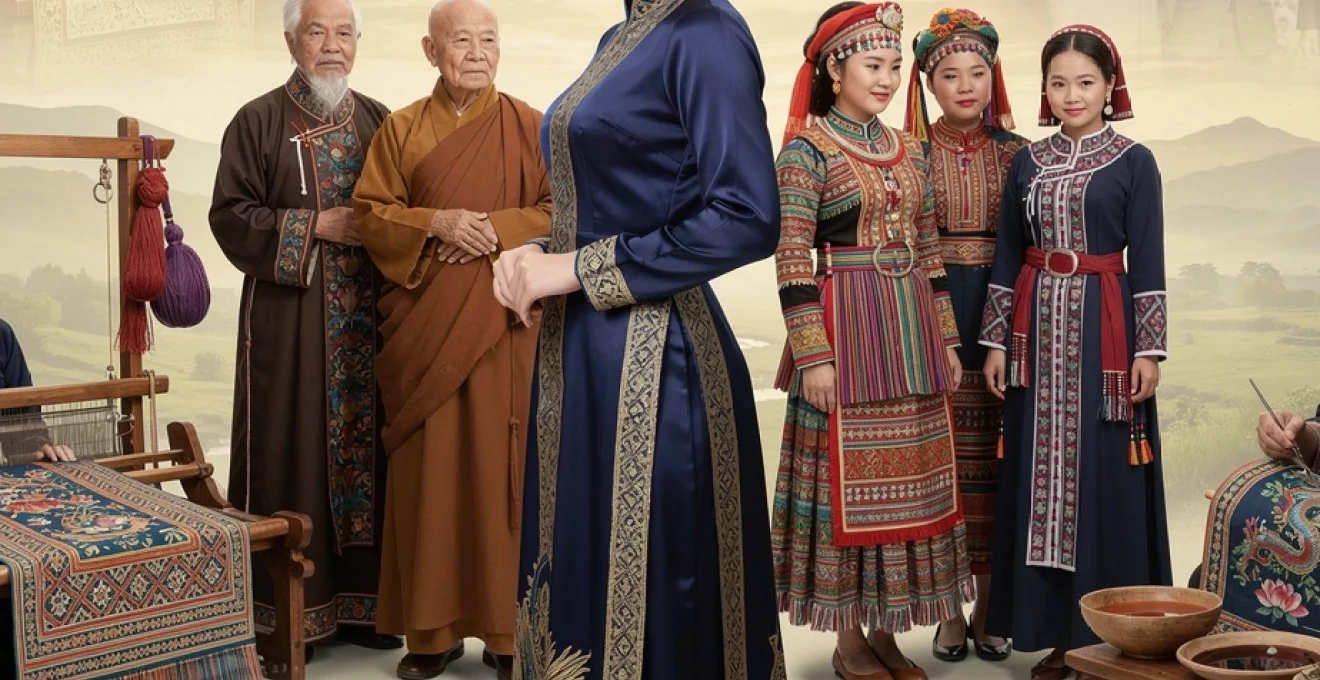
Vietnamese traditional dress serves as a powerful visual language, communicating stories of cultural heritage, social status, and regional identity across centuries of evolution. From the elegant silk panels of the áo dài flowing through Hanoi’s ancient streets to the intricate embroidery adorning ethnic minority ceremonial robes in the northern highlands, each garment carries profound meaning that extends far beyond mere aesthetics. These textiles represent a sophisticated system of cultural expression, where colour choices, fabric selections, and decorative motifs convey messages about the wearer’s background, beliefs, and place within Vietnamese society.
The relationship between clothing and identity in Vietnam reflects the nation’s complex history of cultural synthesis, colonial influence, and regional diversity. Traditional garments function as repositories of collective memory, preserving ancient techniques whilst adapting to contemporary social needs. Understanding how Vietnamese dress communicates identity requires examining the intricate interplay between historical development, craftsmanship traditions, and the ongoing negotiations between cultural preservation and modernisation that characterise contemporary Vietnamese society.
Historical evolution of vietnamese traditional garments and cultural symbolism
The evolution of Vietnamese traditional dress mirrors the nation’s journey through dynasties, colonial periods, and modern state formation. Each historical epoch has left distinctive marks on Vietnamese sartorial culture, creating a complex tapestry of influences that continues to inform contemporary fashion choices and cultural expressions.
Áo dài development from nguyễn dynasty court attire to modern adaptations
The áo dài’s transformation from the five-panelled áo ngũ thân of the 18th century represents one of the most significant developments in Vietnamese fashion history. Lord Nguyễn Phúc Khoát’s 1744 decree mandating distinctive dress for his subjects established the foundation for what would become Vietnam’s most recognisable garment. The original design incorporated Confucian symbolism, with five panels representing the fundamental virtues of kindness, propriety, wisdom, faithfulness, and uprightness.
During the Nguyễn Dynasty (1802-1945), court regulations dictated specific colours and decorative elements based on hierarchical positions. Imperial yellow remained exclusively reserved for the emperor, whilst various shades of purple, red, and blue indicated different ranks within the mandarin system. The transformation accelerated during the 1930s when Vietnamese artist Nguyễn Cát Tường, known by his French name Le Mur, revolutionised the silhouette by creating a more form-fitting design with extended panels reaching the ankles.
This modernisation faced initial resistance, as traditional Vietnamese society valued modesty and conservative dress codes. However, when Queen Nam Phương, wife of Emperor Bảo Đại, embraced the new style, urban women began adopting the contemporary áo dài. The garment’s evolution continued through the revolutionary period, when Hồ Chí Minh’s 1947 essay criticising the áo dài’s impracticality for manual labour led to its relegation to formal occasions and ceremonial use.
Ethnic minority textiles: hmong, dao, and tày ceremonial dress traditions
Vietnam’s 54 recognised ethnic minorities have developed sophisticated textile traditions that encode complex cultural information within their ceremonial dress. The Hmong people, concentrated in the northern highlands, create elaborate costumes that vary significantly between sub-groups, with the Black Hmong, White Hmong, and Flower Hmong each maintaining distinct aesthetic traditions.
Hmong women’s pleated skirts require months of preparation, involving the cultivation of hemp, the extraction of indigo dye from local plants, and the intricate batik techniques that create geometric patterns laden with spiritual significance. Each motif carries specific meanings: spiral designs represent the cyclical nature of life, whilst animal patterns invoke protective spirits. The heavy silver jewellery accompanying these garments often constitutes a family’s wealth, with pieces passed down through generations.
Dao (Yao) ceremonial dress demonstrates equally sophisticated symbolic systems, with red headscarves indicating marital status and embroidered tunics displaying clan affiliations. The coins and silver ornaments decorating Dao women’s clothing serve both aesthetic and practical purposes, representing economic security and spiritual protection. Tày traditional clothing, characterised by indigo-
Tày traditional clothing, characterised by indigo-dyed tunics and simple straight-cut silhouettes, communicates a different kind of identity: one of modesty, harmony with nature, and agricultural life. Women typically wear long blouses over straight skirts, accented with subtle embroidery along hems and cuffs that reference local flora, rivers, and rice terraces. Unlike the highly ornamental Hmong or Dao outfits, Tày garments often highlight restraint and practicality, yet small details such as silver necklaces or patterned belts quietly indicate marital status, prosperity, and village affiliation. Together, these ethnic minority textiles form a living archive of belief systems, environmental knowledge, and community history, where each stitch functions like a line in an unwritten chronicle.
Colonial french influence on vietnamese sartorial identity formation
French colonial rule from the mid-19th century to 1954 reshaped Vietnamese clothing in profound ways, particularly in urban centres such as Hanoi, Huế, and Saigon. Exposure to Western tailoring, corsetry, and Parisian fashion magazines encouraged Vietnamese designers to experiment with body-conscious silhouettes and new fabric cuts. The modernised áo dài of the 1930s, with its narrow waist and flowing ankle-length panels, directly reflects this contact, blending the vertical lines of traditional robes with the streamlined elegance of French couture.
At the same time, clothing became a subtle arena of political negotiation and identity assertion. Western suits and dresses were often associated with modernity, education, and collaboration with colonial authorities, whilst traditional garments signalled resistance, patriotism, or attachment to Confucian values. Many Vietnamese intellectuals and artists adopted a hybrid wardrobe, pairing European-style jackets with traditional trousers or mixing French accessories with the national costume. This sartorial code-switching allowed them to navigate elite colonial spaces while quietly maintaining a distinct Vietnamese identity.
French textile imports such as wool, lace, and fine cotton also transformed local production, introducing new textures into Vietnamese wardrobes. Tailor shops in Hanoi’s Old Quarter and Saigon’s commercial districts began advertising “Indochine chic” styles, marrying Western cuts with Vietnamese motifs like lotus flowers or stylised bamboo. In this sense, colonial fashion influence worked like a double-edged sword: it challenged older hierarchies and dress codes, yet it also provided tools for Vietnamese designers to reimagine traditional dress as a modern, cosmopolitan marker of national identity.
Regional variations: northern kinh, central huế, and southern mekong delta clothing distinctions
Even within the ethnic Kinh majority, regional variations in traditional dress reveal how climate, economy, and local history shape identity. In the cooler northern plains around Hanoi and the Red River Delta, older generations favoured darker, heavier fabrics such as thick silk and cotton to withstand winter chills. Traditional outfits often included long brown or black tunics (áo tứ thân or four-panel gowns), headscarves, and layers of undergarments, projecting an image of agricultural diligence and Confucian modesty.
Central Vietnam, particularly Huế, developed a more formal and refined sartorial culture due to its long status as imperial capital. Here, the áo dài took on especially graceful, slender lines, with muted yet luxurious colours that mirrored royal aesthetics. Silk garments in soft pastels or deep jewel tones, worn with matching turbans, signalled the wearer’s connection to courtly etiquette and literati ideals. Even today, Huế’s áo dài designs tend to emphasise classic minimalism and subtle embroidery, expressing a regional identity rooted in royal heritage and poetic sensibility.
In contrast, the tropical Mekong Delta in the south encouraged lighter, more practical attire suited to riverine life and year-round heat. The iconic áo bà ba—a simple, collarless, button-down blouse paired with loose trousers—became synonymous with southern identity, symbolising openness, informality, and adaptability. Bright colours and floral prints reflect the region’s fertile orchards and bustling floating markets, while shorter hemlines and breathable fabrics accommodate daily work on boats and in rice fields. When you compare these three regions side by side, it becomes clear how traditional dress acts like a topographical map of Vietnam’s social and environmental diversity.
Fabric technology and traditional vietnamese textile production methods
Behind every piece of Vietnamese traditional clothing lies an intricate world of textile technology, where farmers, weavers, dyers, and embroiderers collaborate across generations. Understanding how these garments are made helps us see why they carry such cultural weight: each áo dài or ceremonial skirt is not just a fashion item but the final link in a long chain of specialised knowledge. From silk sericulture in Hà Đông to indigo dye vats in mountain villages, fabric production itself becomes a core element of Vietnamese cultural identity.
Silk sericulture techniques in hà đông and vạn phúc villages
Hà Đông District, particularly Vạn Phúc Village just outside Hanoi, has long been synonymous with Vietnamese silk production. Here, sericulture begins with the careful cultivation of mulberry trees, whose leaves feed silkworms raised in specialised wooden houses. Farmers monitor temperature, humidity, and feeding schedules with remarkable precision; a single misstep can reduce the quality of the resulting cocoons, and by extension, the lustre of the finished fabric. This patient care illustrates how deeply local livelihoods and traditional clothing are intertwined.
Once the silkworms spin their cocoons, artisans carefully unwind the fine filaments in a process known as reeling, twisting strands together to form strong silk threads. These threads are then woven on handlooms into textiles that range from sheer, gauzy lụa to heavier brocades suitable for ceremonial áo gấm robes. Vạn Phúc silk is particularly prized for its soft sheen and durability, making it a preferred choice for high-quality áo dài and wedding outfits. When you see a luminous silk panel catch the light in a traditional dress, you are witnessing the culmination of an entire village’s specialised ecosystem.
In recent decades, Vạn Phúc and neighbouring villages have adapted to modern demands while trying to maintain heritage techniques. Some households now use semi-mechanised looms to increase output for export markets, but many still preserve hand-weaving practices for premium products. Visitors can tour workshops, observe different loom types, and even commission custom fabrics, turning these craft villages into living museums of Vietnamese textile technology. This balance between innovation and preservation shapes how contemporary Vietnam presents its traditional clothing to both domestic and international audiences.
Natural dye extraction from cây chàm indigo and lá cẩm plants
Colour has always been a crucial part of how traditional dress reflects identity in Vietnam, and much of that colour historically came from natural dyes. One of the most important sources is cây chàm (indigo), widely cultivated by Hmong, Dao, and Tày communities in the northern highlands. Farmers harvest the leaves and ferment them in water-filled vats, allowing pigments to oxidise and transform into a rich, deep blue. The process is slow and requires careful timing—much like brewing a fine tea—highlighting the patience embedded in traditional textile production.
Another key plant is lá cẩm, used particularly in the northern and central regions to create purple and magenta hues. Leaves are boiled to release their pigments, and fabrics are soaked repeatedly to achieve the desired intensity. These natural dyes do more than simply colour cloth; they bind clothing to local landscapes and agricultural rhythms. Wearing indigo-dyed garments, for example, signifies not just aesthetic preference but also a community’s relationship with its surrounding fields, forests, and rivers.
Compared to synthetic dyes, natural dyes often produce subtler, more variable shades that change over time, giving traditional Vietnamese clothing a living, evolving character. In recent years, eco-conscious designers have revived these methods, marketing naturally dyed áo dài and ethnic-inspired garments to global consumers seeking sustainable fashion. This revival raises important questions: can traditional dye practices be scaled up without exhausting local resources, and how might increased demand affect the communities that guard this knowledge?
Hand-weaving practices: khăn piêu scarves and thổ cẩm brocade production
Hand-weaving remains one of the most distinctive markers of ethnic identity in Vietnam, particularly in the production of khăn piêu scarves and thổ cẩm brocade. The khăn piêu, associated mainly with Thai and related groups in the northwest, is a rectangular headscarf woven on a backstrap loom, then embellished with elaborate end-patterns. These motifs often depict mountains, rivers, and mythical creatures, encoding local cosmology into a portable, wearable form. A young woman’s skill in weaving khăn piêu traditionally signalled her readiness for marriage and her ability to contribute to the household economy.
Thổ cẩm brocade, produced by groups such as the Hmong, Dao, and Ê Đê, is characterised by dense, colourful patterns achieved through supplementary weft techniques. Unlike printed fabrics, every motif is painstakingly inserted by hand, sometimes taking weeks or months to complete a single panel. Common designs include zigzags representing mountains, diamonds symbolising fertility, and stylised animal figures linked to protective spirits. In this way, a thổ cẩm skirt or sash operates almost like a visual autobiography, recording clan identity, regional origin, and personal artistry.
Today, handwoven textiles are under pressure from cheap machine-made imitations, yet they also enjoy new visibility through tourism and ethical fashion initiatives. Visitors to villages in Sapa, Mai Châu, or the Central Highlands often purchase thổ cẩm products as souvenirs, sometimes without fully understanding the labour and symbolism involved. As consumers, when we learn to distinguish handwoven patterns from factory prints, we not only support artisans more fairly but also help sustain the cultural ecosystems that give Vietnamese traditional clothing its depth and meaning.
Embroidery craftsmanship: thêu tay hand-stitching and symbolic motif integration
Embroidery, or thêu tay, adds yet another layer of identity to Vietnamese garments by transforming plain fabric into narrative surfaces. In villages such as Văn Lâm in Ninh Bình or Quất Động near Hanoi, artisans specialise in fine silk embroidery that decorates áo dài, altar cloths, and festival banners. Using satin stitch, stem stitch, and couching techniques, they create detailed images of lotuses, cranes, dragons, and pagodas—each selected for its symbolic resonance. A lotus, emerging clean from muddy water, suggests purity and resilience; a pair of cranes denotes longevity and marital harmony.
On ethnic minority clothing, embroidery often combines with batik and weaving to produce dense, multi-layered designs. Hmong women, for example, use cross-stitch to outline geometric mazes believed to confuse malevolent spirits, protecting the wearer’s soul. Dao artisans integrate small, repeated patterns along collars and sleeve edges that function almost like signatures, indicating clan affiliation and region. In both Kinh and minority communities, these motifs are rarely random; they are part of a shared visual vocabulary that children learn through observation and practice from a young age.
In the context of modern fashion, hand embroidery faces both challenges and opportunities. Mass-produced embroidered garments may dilute traditional meanings, yet collaborations between village artisans and contemporary designers can give old motifs new life on global runways. When a hand-stitched dragon winds across the back of a silk jacket in Paris or New York, it carries with it centuries of Vietnamese myth and craftsmanship. The key question is how to ensure that the communities who originated these designs benefit from their renewed visibility, preserving both artistic integrity and economic sustainability.
Contemporary vietnamese fashion identity in globalised cultural contexts
As Vietnam integrates more deeply into the global economy, traditional clothing has taken on new roles in negotiating national and personal identity. Urban youth in Hanoi, Ho Chi Minh City, and Đà Nẵng frequently blend streetwear, Korean pop-inspired styles, and Western brands with traditional elements such as áo dài-inspired tunics or thổ cẩm accessories. This hybrid fashion language allows them to signal both cosmopolitan belonging and pride in Vietnamese heritage. You might see a student pairing sneakers with a modernised áo dài at graduation, or a designer incorporating Hmong motifs into minimalist, monochrome collections.
Vietnamese fashion designers have increasingly looked to traditional dress for inspiration on international stages. Brands showcased at Vietnam International Fashion Week and regional events often reinterpret áo dài, áo bà ba, and ethnic textiles through contemporary silhouettes, sustainable materials, and gender-fluid cuts. This process is similar to remixing a classic song: the core melody—cultural symbolism and craft techniques—remains recognisable, but the rhythm and instrumentation shift to suit new audiences. For travellers and observers, these designs provide a vivid illustration of how traditional dress reflects identity in a rapidly globalising Vietnam.
At the same time, global tourism and diaspora communities have turned garments like the áo dài into powerful tools of soft power. Vietnamese flight attendants, hotel staff, and diplomats often wear national dress as a visual shorthand for hospitality and cultural refinement. Overseas Vietnamese communities in the United States, France, and Australia also maintain áo dài traditions during Tết and community festivals, using clothing to anchor a sense of belonging across distances. Yet this global visibility raises complex questions: how can Vietnam protect traditional designs from cultural appropriation, and how might mass-market reproduction affect local artisans?
Digital media further accelerates these dynamics. Social platforms showcase áo dài photo shoots in Hoi An, ethnic fashion influencers in Sapa, and behind-the-scenes footage from silk villages, making traditional clothing more accessible than ever. For many young Vietnamese, scrolling through these images becomes a way of rediscovering heritage and re-evaluating what “modern” Vietnamese style can look like. In this fluid environment, traditional dress is no longer confined to museums or special occasions; it becomes a flexible toolkit for self-expression, negotiation, and connection, both at home and abroad.
Ceremonial dress protocols and social hierarchy expression systems
Throughout Vietnamese history, ceremonial clothing has functioned as a carefully regulated code that reveals social hierarchy, spiritual beliefs, and communal values at a glance. Whether at a royal court audience, a village wedding, or a New Year festival, observers could once “read” rank and role simply by noting colours, fabrics, and accessories. While contemporary life is less rigid, many of these protocols still inform how Vietnamese people dress for significant events, shaping everything from wedding photography to temple visits.
Wedding attire: áo gấm ceremonial robes and five-element colour symbolism
Vietnamese weddings provide one of the clearest examples of how traditional dress reflects both personal and family identity. Historically, elite families dressed the bride and groom in richly woven áo gấm—heavy brocade robes often featuring dragon and phoenix motifs, symbols of power and harmonious union. Colours were chosen according to the Five Elements philosophy (ngũ hành): wood, fire, earth, metal, and water, each associated with specific hues and personality traits. A red áo dài might emphasise fire, representing passion and prosperity, while gold accent threads invoke earth and stability.
In many regions, families still consult astrologers or elders to select auspicious colour combinations based on the couple’s birth years and elemental compatibilities. Outfits for the engagement ceremony, ancestor altar rituals, and wedding banquet may differ slightly, subtly marking shifts in ritual focus from family negotiation to spiritual blessing and public celebration. Guests, too, participate in this visual choreography by avoiding solid white or black—colours associated with mourning—and opting instead for soft pastels or jewel tones that signal joy and respect.
Modern weddings often blend these traditional codes with contemporary fashion trends. It is common to see brides change from an embroidered red áo dài for the tea ceremony into a Western-style white gown for the reception, embodying a dialogue between global romance imagery and Vietnamese heritage. Grooms might pair a classic brocade áo dài for family photos with a tailored Western suit later in the day. In each case, clothing serves as a bridge between generations, allowing couples to honour ancestral expectations while expressing their own tastes and identities.
Festival clothing: tết nguyên đán and Mid-Autumn festival dress codes
During Tết Nguyên Đán, the Lunar New Year, traditional clothing becomes a key medium through which Vietnamese people express hopes, gratitude, and family solidarity. Many families purchase new outfits specifically for the first days of the year, believing that fresh garments will attract good fortune. Bright red, yellow, and pink dominate, chosen for their associations with luck, happiness, and renewal. Children often wear miniature áo dài, turning family visits and temple outings into colourful processions that visually reinforce generational continuity.
In urban areas, you will frequently see entire families coordinating their Tết outfits for studio or outdoor photo sessions, sometimes in historical districts or flower markets. These images circulate widely on social media, reaffirming traditional aesthetics in a modern, digital context. In rural communities, festival dress may be more closely tied to local customs: ethnic minorities bring out their most elaborate embroidered costumes for spring celebrations, harvest festivals, or buffalo sacrifices, reaffirming their unique identities within the broader national fabric.
The Mid-Autumn Festival (Tết Trung Thu) offers another window into ceremonial dress, particularly for children. Although there is no strict dress code, many parents choose traditional-style outfits—silk tunics, lion-dance costumes, or stylised áo tứ thân—for lantern parades and school performances. These playful garments help familiarise younger generations with traditional silhouettes and motifs, turning cultural heritage into a source of enjoyment rather than obligation. In this way, festival clothing acts like a seasonal reminder of shared stories and values, renewing cultural identity year after year.
Religious garments: buddhist temple attire and confucian scholar robes
Religious and philosophical traditions have also left distinct marks on Vietnamese dress. In Buddhist temples, monks and nuns wear simple robes in muted colours such as grey, brown, or saffron, signalling detachment from worldly desires and commitment to spiritual practice. Lay visitors are expected to dress modestly when entering pagodas—shoulders covered, hemlines below the knee, and slogans or flashy jewellery avoided. Although these guidelines may appear purely practical, they also communicate respect, humility, and an awareness of shared sacred space.
Confucianism, which shaped Vietnam’s educational and bureaucratic systems for centuries, produced its own sartorial archetype: the scholar-official in flowing robes and formal headgear. Traditional scholar robes typically featured wide sleeves and layered panels, enabling wearers to move gracefully during rituals and examinations. Colours and accessories varied according to rank, yet all emphasised composure, self-discipline, and moral rectitude. Paintings and statues of historical literati still influence how Vietnamese people visualise intellectual authority and cultural refinement today.
In contemporary Vietnam, echoes of these religious garments appear in ceremonial contexts. During ancestor worship, some families don simple brown or dark áo dài reminiscent of monk’s robes, signalling a contemplative mood. At temple festivals, ritual leaders may wear robes inspired by Confucian scholar attire, blending local folk elements with classical forms. These outfits remind participants that religious and philosophical values are not abstract doctrines but embodied practices, inscribed quite literally onto the fabric of communal life.
Occupational dress markers: mandarin court officials and artisan guild uniforms
Historically, occupational dress in Vietnam functioned as a kind of visual bureaucracy, making it immediately clear who held authority, who provided specialised services, and who belonged to which guild. Mandarin court officials under the Nguyễn Dynasty wore robes with embroidered insignia patches (phù hiệu) depicting specific animals—cranes, tigers, dragons—corresponding to their rank and administrative function. The cut, colour, and headgear of these outfits transformed clothing into a portable identity card, leaving little ambiguity about status in public ceremonies.
Artisan guilds in urban centres such as Hanoi’s Old Quarter also developed distinctive uniforms or accessories. Silk merchants might wear particular headscarves and tunics, while guild leaders displayed badges or sashes during processions and festivals. These markers reinforced professional pride and solidarity, much as logos and branded workwear do today. In some villages, blacksmiths, carpenters, or water puppet performers still don traditional outfits for public events, visually connecting modern practitioners to their craft ancestors.
In the contemporary era, occupational dress has shifted towards modern uniforms—áo dài for flight attendants, tailored suits for office workers, and standardised outfits for hotel staff or tour guides. Yet even these updated uniforms often incorporate traditional elements, such as mandarin collars, frog buttons, or motifs inspired by ancient guild symbols. For visitors, learning to recognise these subtle cues can make everyday encounters—checking into a hotel, boarding a plane, or visiting a workshop—feel like small windows into Vietnam’s layered history of work and status.
Gender expression through vietnamese traditional clothing architecture
Vietnamese traditional clothing has long been a key site where ideas about gender are articulated, reinforced, and sometimes contested. Architecturally, garments such as the women’s áo dài emphasise vertical lines and gentle curves, combining a high, modest collar with side slits that allow free movement and subtly trace the body’s form. This blend of concealment and revelation has often been interpreted as embodying idealised Vietnamese femininity: graceful, resilient, and understated. For many women today, choosing to wear an áo dài to work or on special occasions becomes a conscious expression of pride in this cultural script, even as they pursue modern, independent lives.
In contrast, the men’s áo dài typically features a straighter cut and more reserved palette, communicating sobriety, dignity, and intellectual focus rather than sensual appeal. Historically, male scholar-officials wore loose, layered robes that de-emphasised the body, aligning with Confucian ideals of self-control and moral cultivation. Yet it would be a mistake to see these garments as purely conservative; within the boundaries of protocol, colour choices, fabric quality, and subtle embroidery allowed men to project personal style and social aspirations, much as suits do today.
Interestingly, some regional garments blur strict gender distinctions. The southern áo bà ba, for instance, is worn by both men and women with only minor modifications, highlighting shared labour in rice fields and markets rather than rigidly separated spheres. In many ethnic minority groups, both genders wear richly decorated textiles, with differences expressed more through accessories and hair than through basic garment architecture. This suggests that, while certain ideals of masculinity and femininity are deeply rooted, Vietnamese clothing traditions also contain flexible spaces where individuals can play with, or even gently subvert, conventional gender expectations.
In recent years, younger designers have pushed these boundaries further by creating gender-neutral áo dài or reimagining traditional shapes in androgynous silhouettes. Runway shows sometimes feature male models in flowing áo dài-inspired tunics or female models in updated versions of scholar robes, challenging viewers to reconsider which bodies “belong” in which garments. For you as a traveller or observer, paying attention to these evolving designs can offer valuable insight into how contemporary Vietnam is rethinking gender roles—not through abstract debate, but through the everyday act of getting dressed.
Cultural preservation initiatives and UNESCO intangible heritage protection
As globalisation and mass production transform how people dress, Vietnam has increasingly turned to cultural preservation initiatives to safeguard the traditional clothing practices that reflect its diverse identities. Government agencies, museums, and local communities collaborate to document weaving techniques, dye recipes, and ceremonial protocols before they disappear. The Vietnamese Women’s Museum in Hanoi, for example, curates extensive collections of áo dài and ethnic costumes, accompanied by oral histories from the artisans who made and wore them. These institutions function like cultural memory banks, ensuring that future generations can access detailed knowledge even if everyday use declines.
On the international stage, UNESCO’s Intangible Cultural Heritage framework provides another layer of protection and recognition. While the áo dài itself has not yet been inscribed, several related elements—such as certain festivals, craft villages, and performing arts that rely on traditional costumes—have received attention or are being documented for potential nomination. When a practice is recognised as intangible heritage, it does more than gain prestige; it often attracts funding, tourism, and educational support that help sustain the communities responsible for it. In this sense, UNESCO acts like a global amplifier for local voices, highlighting why traditional dress matters beyond its visual appeal.
Local initiatives are equally important. Craft villages like Vạn Phúc, Văn Lâm, and brocade-weaving communities in the Central Highlands have established cooperatives and training programmes to transmit skills to younger generations. Some partner with ethical fashion brands to ensure fair wages and long-term orders, while others create community festivals where traditional garments are showcased in fashion shows, dance performances, and craft demonstrations. These events transform preservation from a static task into a dynamic, participatory experience, inviting both locals and visitors to engage.
However, cultural preservation also faces real challenges. As young people migrate to cities or overseas, fewer may choose to learn time-consuming crafts like hand-weaving or natural dyeing. Tourism-driven demand can risk oversimplifying or commodifying complex traditions, turning sacred symbols into generic souvenirs. This is where informed choices by travellers and consumers make a difference. By seeking out authentic, fairly traded textiles, asking about the stories behind patterns, and respecting local dress codes at religious and ceremonial sites, you contribute—however modestly—to the living continuum of Vietnamese traditional clothing.