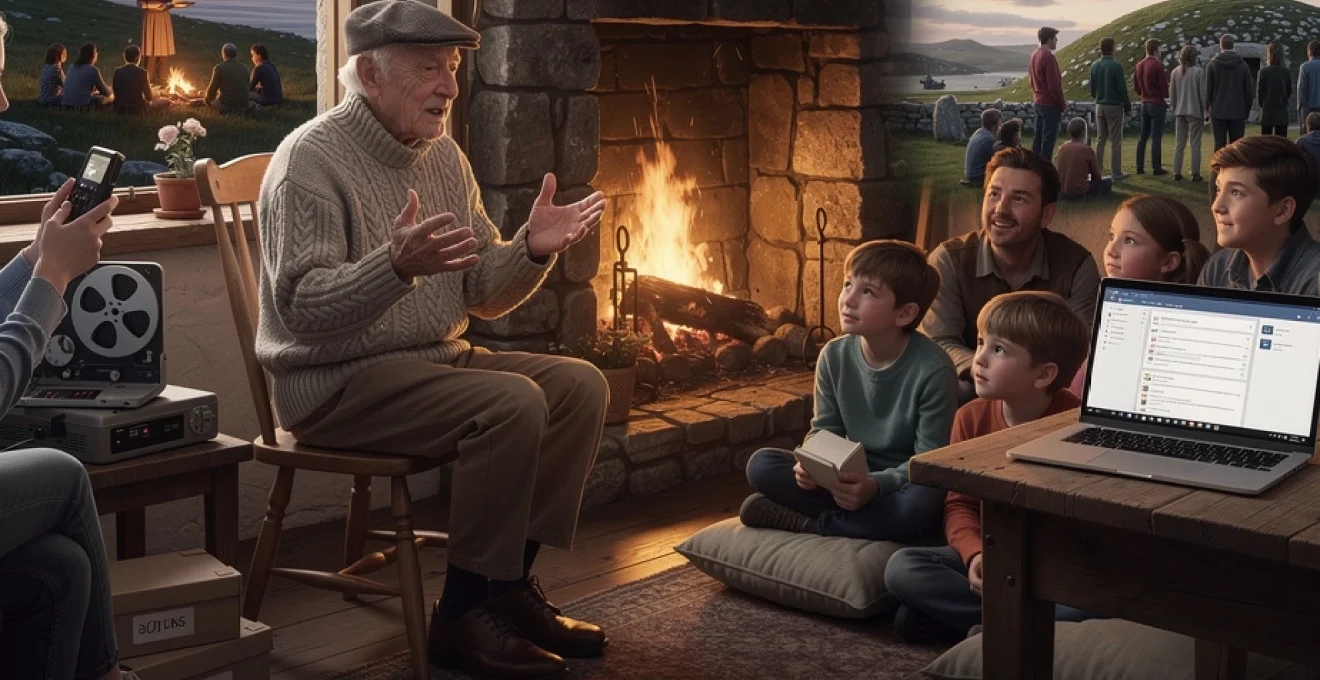
Ireland’s storytelling tradition represents one of the world’s most enduring cultural practices, stretching back over two millennia through an unbroken chain of oral transmission. In an era dominated by digital screens and fleeting attention spans, the question of how this ancient art form survives becomes increasingly compelling. The answer lies not in resistance to modernity, but in a remarkable fusion of traditional preservation methods and innovative contemporary approaches. From the windswept shores of Cape Clear to the digital archives at University College Dublin, Ireland has developed a multifaceted ecosystem that ensures the seanchaí tradition—the custodianship of story, history, and collective memory—continues to thrive. This preservation effort involves dedicated individuals, institutional frameworks, educational programmes, and surprisingly, the very technology that once threatened to eclipse oral culture altogether. The resilience of Irish storytelling offers lessons in cultural adaptation that extend far beyond the Emerald Isle.
The seanchaí tradition: oral narrative preservation in contemporary ireland
The seanchaí (pronounced “shan-a-key”) once held a position in Irish society second only to chieftains, serving as living libraries who committed genealogies, land histories, and mythological cycles to memory. These custodians of tradition could recite ancestral lineages spanning generations and deliver epic tales that lasted entire evenings. Whilst the formal role diminished following the destruction of Gaelic civilization in the 17th century, the practice evolved rather than disappeared. Contemporary Ireland maintains this heritage through a network of professional storytellers who have professionalized the ancient craft whilst preserving its essential character.
Modern seanchaithe operate in radically different contexts than their predecessors. Rather than traveling between isolated rural communities in exchange for food and shelter, today’s storytellers navigate festival circuits, educational institutions, and digital platforms. Yet the core competencies remain unchanged: the ability to hold an audience through voice modulation, gesture, pacing, and the artful weaving of suspense. Jack Lynch, chair of Aos Scéal Éireann (Storytellers of Ireland), exemplifies this continuity. He describes wearing stories “like jackets,” emphasizing the need for storytellers to inhabit their narratives so completely that they become second nature. This embodiment allows for the spontaneous adaptation that characterizes living oral tradition—responding to audience energy, adjusting length based on context, and incorporating contemporary resonances whilst maintaining narrative integrity.
Eddie lenihan and the protection of fairy fort folklore
Eddie Lenihan, often described as Ireland’s last traditional seanchaí, demonstrates how storytelling preservation intersects with landscape conservation. Based in County Clare, Lenihan has spent decades collecting fairy lore from rural elders, particularly stories concerning fairy forts—ancient ringforts believed to house the síde (fairy folk). His most famous intervention occurred in 1999 when he successfully campaigned to reroute a planned motorway that would have destroyed the Latoon fairy bush in Clare. Engineers initially dismissed concerns about disturbing a fairy dwelling, but Lenihan’s advocacy—grounded in documented local belief and the cultural significance of such sites—ultimately prevailed.
This episode illustrates how storytelling heritage preservation extends beyond mere tale-telling into landscape literacy. Lenihan’s work demonstrates that traditional narratives encode relationships between communities and their environments, preserving ecological knowledge and place-based wisdom. His extensive recordings and publications ensure that stories which might otherwise vanish with their elderly tellers remain accessible. Yet he insists on maintaining the performative dimension—storytelling must remain a live, interpersonal exchange rather than merely archived text. His school visits and public performances create intergenerational transmission chains, ensuring young listeners encounter tales in their proper medium: human voice, shared space, and collective imagination.
Éamon de buitléar’s audio archive documentation methods
The pioneering work of naturalist and folklorist Éamon de Buitléar established methodologies for capturing oral tradition whilst preserving its authentic character. Throughout the mid-20th century, de Buitléar traveled extensively with recording equipment, documenting not just the content of traditional stories but the manner of their telling. His approach recognized that paralinguistic elements—pauses, vocal inflection, regional dialect features—constitute integral components of oral narrative, carrying meaning that transcription alone cannot capture.</p
In practice, this meant capturing the ambient sounds of a storyteller’s kitchen, the crackle of the fire, or the reaction of listeners gathered around. These contextual details help future generations understand not just what was said, but how storytelling functioned socially. De Buitléar’s archive also showcases regional variants of the same tale, highlighting how the storytelling heritage of Ireland shifts subtly from county to county. His methods—field recordings, meticulous cataloguing, and respect for the storyteller as co-creator—have influenced today’s digital folklore projects, which continue to balance scholarly rigour with cultural sensitivity. For anyone asking how oral storytelling can survive in a digital age, his work provides a blueprint: treat recordings as living performances, not just data.
Storytelling circles at the international storytelling festival cape clear
On Cape Clear Island off the coast of West Cork, storytelling heritage is kept alive each autumn through the Cape Clear International Storytelling Festival. Established in 1994, this three-day gathering transforms the island into an open-air theatre where traditional and contemporary stories mingle. Instead of the old fireside, storytellers now perform in community halls, on boats, and even by the harbour, but the dynamic remains recognisably ancient: a teller, a circle of listeners, and the shared creation of an imagined world. The festival invites seanchaithe from Ireland and around the globe, exposing local audiences to an array of narrative traditions while grounding the event in Irish folklore.
Storytelling circles during the festival are carefully curated to encourage participation rather than passive consumption. Sessions often begin with a seasoned teller before opening the floor to emerging voices, echoing the informal “rambling house” gatherings of rural Ireland. Listeners are not mere spectators; their laughter, gasps, and silences actively shape the rhythm of each tale. Workshops and children’s events ensure that the techniques of scéalaíocht—use of repetition, call-and-response, and vivid metaphor—are passed on in practical, memorable ways. In this way, Cape Clear functions as both a celebration and a training ground, reinforcing the idea that storytelling heritage survives when people feel invited to “step into the circle” themselves.
The national folklore collection at university college dublin
While festivals and live performances sustain the practice of storytelling, Ireland’s National Folklore Collection (NFC) at University College Dublin safeguards its memory at scale. Housing over 4 million pages of manuscripts, 500,000 index cards, and tens of thousands of sound recordings, the NFC is one of the largest folklore archives in the world. Much of its material was gathered during the Irish Folklore Commission’s intensive collecting campaigns of the 20th century, including the famous 1930s “Schools’ Collection,” where primary school children recorded stories from older relatives. This project alone produced some 740,000 handwritten pages—evidence that storytelling heritage was once embedded in everyday domestic life.
Today, the NFC functions as both a research institution and a public resource. Scholars use the archive to trace how motifs like the banshee or the “fairy forts” have evolved over time, while community groups and contemporary storytellers mine it for inspiration. Crucially, the collection is not a static museum of dead tales; it is actively being digitised and made accessible through platforms such as Dúchas.ie (discussed below). By combining rigorous cataloguing systems—classifying stories by theme, region, and time period—with modern search tools, the NFC allows us to see Irish storytelling heritage as a living network of narratives rather than a random assortment of curiosities. For anyone crafting tours, educational resources, or performances, it is a treasure trove of authentic material grounded in real voices.
Gaeltacht immersion programmes and irish-language narrative transmission
If archives store the stories, the Gaeltacht regions—Irish-speaking communities primarily along the west coast—keep their language and idiom alive. Storytelling heritage in Ireland is intimately tied to the Irish language; many tales lose their full flavour when stripped of native rhythms, idioms, and wordplay. Gaeltacht immersion programmes therefore play a vital role in narrative transmission, offering structured opportunities for learners and native speakers to share stories in Irish. Rather than treating language classes as abstract grammar lessons, many providers weave scéalaíocht directly into their curricula.
These programmes often recreate elements of the traditional fireside setting: evening céilí sessions, informal chats over tea, and guided walks where local guides recount place-lore (dinnseanchas) in Irish. Participants not only practice vocabulary but also absorb the cultural codes that underpin Irish storytelling—indirectness, humour, and a fondness for the “tall tale.” In a world where minority languages can seem fragile, this approach reframes Irish as a vibrant medium for contemporary expression. It also answers a pressing question: how do you make heritage relevant to younger generations? By letting them live it, rather than only read about it.
Oideas gael’s residential storytelling workshops in donegal
Located in Gleann Cholm Cille, County Donegal, Oideas Gael is renowned for its immersive Irish-language courses that integrate storytelling as a core learning tool. Participants stay on-site for residential programmes, creating an environment where Irish is not confined to the classroom but spills into mealtimes, walks, and evening events. Dedicated storytelling workshops invite local seanchaithe and visiting performers to share tales in Irish, sometimes with subtle code-switching to help learners follow along. This blend of linguistic challenge and supportive explanation allows students to experience the music of the language without feeling excluded.
From a heritage perspective, Oideas Gael’s model is particularly powerful because it marries structured pedagogy with organic transmission. Learners might study a traditional Ulster folktale in the morning—examining vocabulary, idioms, and structure—and then hear a different version performed live that evening. This mirroring of “text” and “performance” helps people grasp that Irish storytelling is not a fixed script but a flexible pattern. For tourism providers or educators designing similar experiences, the key lesson is clear: embed stories into the daily rhythm of an immersion programme, rather than tacking them on as occasional entertainment.
Connemara’s scéalaíocht summer schools and youth engagement
In Connemara, Gaeltacht summer schools (coláistí samhraidh) have long attracted teenagers eager to improve their Irish—and, often, their social lives. Increasingly, these programmes are recognising storytelling as a powerful way to make the language feel alive rather than obligatory. Evening scéalaíocht sessions give local storytellers a platform to share myths of Fionn mac Cumhaill, tragic love stories, and humorous village anecdotes entirely in Irish. Young people listen, laugh, and sometimes even take the mic themselves, trying out newly acquired phrases and expressions.
Some summer schools now include mini “story slams” where participants prepare short narratives—true or fictional—to tell their peers. This format, influenced by global spoken-word trends, meets teens where they are while grounding them in Irish oral forms like the scéal grinn (funny story) or scéal béaloidis (folklore tale). The result is a kind of narrative bilingualism: students learn to move comfortably between TikTok-era storytelling and centuries-old motifs. For parents and policymakers concerned about language decline, this youth engagement is crucial. When a teenager can make a roomful of friends laugh in Irish, the language stops being an exam subject and becomes a social asset.
TG4 broadcasting and scéalta ón mblascaod documentary series
Broadcast media also play a strategic role in sustaining storytelling heritage in the Gaeltacht and beyond. TG4, the Irish-language television channel, has built a substantial body of programming that showcases scéalaíocht in accessible formats. One notable series is Scéalta ón mBlascaod (“Stories from the Blasket”), which revisits the rich narrative traditions of the Great Blasket Island community off the Kerry coast. Drawing on memoirs, archival recordings, and re-enactments, the series brings to life the voices of island storytellers like Peig Sayers and Muiris Ó Súilleabháin, whose works are foundational to Irish-language literature.
By combining documentary techniques with dramatic storytelling, TG4 demonstrates how television can honour oral heritage without flattening it into mere “content.” Programmes include interviews with contemporary seanchaithe and academics, linking historic narratives to current questions of identity, migration, and environmental change. Viewers see that storytelling is not just something that happened “back then” in remote cottages, but a lens for understanding the present. For those designing cultural products—whether museum exhibits or guided tours—TG4’s approach offers a valuable analogy: treat traditional tales as living scripts that can be reinterpreted for new media while preserving their emotional core.
Digital archival platforms: dúchas.ie and meitheal storytelling database
Digital technology, once perceived as a threat to oral culture, has become an indispensable tool for preserving and sharing storytelling heritage in Ireland. The flagship example is Dúchas.ie, an online portal that gives public access to large portions of the National Folklore Collection. Users can browse scanned pages of the Schools’ Collection, read transcriptions, and search for stories by theme, county, or storyteller. The interface allows descendants to find tales contributed by their grandparents, while researchers can trace how specific motifs—such as changelings or holy wells—appear across regions. In effect, Dúchas turns what was once accessible only to specialists into a communal resource.
Complementing Dúchas are collaborative databases often described under the umbrella of “meitheal” (the Irish term for cooperative labour). These digital storytelling platforms invite users to upload recordings, tag themes, and share local legends, mirroring the communal work days of rural Ireland in a virtual space. Like neighbours gathering to bring in the hay, contributors collectively build a living archive. For community groups or heritage centres, participating in such platforms offers three distinct benefits: safeguarding fragile stories, reaching diaspora audiences, and generating material for tours, exhibitions, and educational packs. The challenge, of course, lies in ensuring that digital preservation does not replace live performance. Successful projects therefore encourage users not only to listen online but to bring stories back into kitchens, classrooms, and community halls.
Literary festivals as storytelling transmission venues
Ireland’s literary festivals increasingly function as bridges between written literature and oral storytelling. While book launches and panel discussions dominate many programmes, a growing number of festivals now include dedicated narrative performance strands. These events reinsert the live storyteller into spaces once reserved for authors alone, underscoring that Irish storytelling heritage encompasses both page and stage. Audiences who come to hear novelists read often find themselves equally captivated by a seanchaí spinning a folk tale without a single note in hand.
This convergence has practical advantages for heritage preservation. Festival programmes typically highlight themes—migration, identity, climate—which storytellers can address through traditional material reframed for contemporary concerns. When a folk tale about a disappearing lake is juxtaposed with a climate fiction panel, listeners grasp that oral narratives can be tools for thinking through modern crises. For organisers looking to deepen audience engagement, integrating storytelling sessions is a low-cost, high-impact way to add emotional resonance and local texture to otherwise abstract discussions.
Cuirt international festival of literature’s narrative performance programme
The Cúirt International Festival of Literature in Galway provides a clear example of this integration in action. Alongside readings by poets and novelists, Cúirt regularly programmes storytelling nights, bilingual performances, and collaborations between writers and seanchaithe. These events might take place in intimate venues like city pubs or arts centres, creating a relaxed atmosphere where the boundary between “performer” and “audience” softens. Listeners are encouraged to respond, ask questions, and sometimes share short anecdotes of their own, echoing the convivial spirit of traditional Irish gatherings.
For emerging storytellers, Cúirt’s narrative performance strand functions as a showcase and a training platform. Sharing a bill with established literary figures raises the profile of oral storytelling, positioning it not as a quaint relic but as an equally valid art form. For tourism and cultural practitioners, the key takeaway is that storytelling can be woven into broader cultural offerings without losing its distinctive character. When done well, it adds depth to the visitor experience, turning a standard festival programme into a journey through both contemporary writing and inherited oral traditions.
Listowel writers’ week and the seanchaí competition format
Listowel Writers’ Week in County Kerry has gone a step further by formalising storytelling heritage through dedicated seanchaí competitions. Participants are invited to tell a story—often with a strong local or historical element—within a set time limit, judged on narrative structure, delivery, and engagement with the audience. This competitive format may sound modern, but it echoes traditional practices where reputation was built on a teller’s ability to hold the floor in crowded kitchens or public houses. The difference is that now, the applause is supplemented by prizes and national recognition.
The competition has two major impacts on preservation. First, it incentivises research into local lore, as competitors dig into family archives or interview elders to unearth distinctive material. Second, it validates storytelling as a serious craft: participants rehearse, refine their timing, and think carefully about how to balance humour, pathos, and suspense. For communities considering similar initiatives, a seanchaí competition can act as both a celebration and a catalyst, encouraging younger generations to see storytelling not just as something “the older people do” but as an art they can excel in themselves.
Féile na bealtaine’s integration of traditional tale-telling
On the Dingle Peninsula, Féile na Bealtaine—an arts festival marking the beginning of summer—embeds storytelling within a wider programme of music, visual art, and theatre. Traditional tale-telling sessions might take place in small cafés, on cliffside walks, or in the shadow of early Christian sites, tying narratives directly to the surrounding landscape. Stories of saints, fishermen, and fairies resonate differently when told within earshot of the Atlantic or beneath an ancient stone cross. This spatial integration reminds audiences that Irish storytelling heritage is profoundly place-based.
Féile na Bealtaine also highlights the bilingual reality of many Gaeltacht communities, with stories often shifting fluidly between Irish and English. This code-switching allows visitors with varying language skills to follow along while still hearing key phrases and punchlines in Irish. For festival organisers elsewhere, Dingle’s example shows how storytelling can reinforce a “sense of place” far more effectively than brochures or interpretive panels alone. A single well-told story can anchor a visitor’s memory of a location for years, turning a beautiful view into a meaningful site.
Institutional education: primary school curriculum integration of scéalaíocht
One of the most quietly powerful mechanisms for keeping storytelling heritage alive in Ireland is its integration into the primary school curriculum. Within the Irish-language component of the curriculum, scéalaíocht is not only encouraged but structurally embedded: children are expected to listen to, discuss, and gradually perform stories in Irish. Teachers draw on traditional folktales, fables, and legends, often simplified or adapted to suit different age groups. In English classes, too, oral storytelling exercises develop confidence, memory, and narrative thinking—skills that are foundational for both literacy and cultural continuity.
Many schools participate in initiatives that echo the 1930s Schools’ Collection, sending pupils home with questionnaires for older relatives about local customs, place-names, and supernatural beliefs. When pupils bring these stories back into the classroom, they become both collectors and tellers, strengthening intergenerational bonds in the process. For educators, the practical benefits are clear: storytelling activities improve speaking and listening skills, foster empathy, and make abstract language learning more tangible. For the broader culture, these classroom practices ensure that children grow up seeing Irish storytelling not as a museum piece, but as something they do—in the playground, at school assemblies, and in local competitions like Feis and Scór.
Heritage centres and interactive narrative experiences
Beyond schools and festivals, heritage centres across Ireland are reimagining how visitors encounter stories in situ. Rather than relying solely on static displays or text-heavy panels, many sites now use interactive narrative experiences to communicate history and folklore. The goal is not just to impart information, but to make visitors feel as though they have stepped into a living story. This approach is especially powerful for non-local visitors with limited time; a compelling narrative can quickly convey the emotional and cultural significance of a place that might otherwise appear as “just another ruin.”
Techniques range from live guided tours and costumed interpreters to immersive audio guides and projection mapping. Crucially, these experiences often blend archaeological or historical facts with mythological layers, reflecting the way local communities themselves have always understood their surroundings. For operators of arts, culture, and heritage tourism, thinking like a storyteller—developing characters, arcs, and strong openings and endings—can transform a site visit from a checklist item into a memorable encounter.
The burren storytelling centre’s archaeological mythology connection
In County Clare, the Burren region’s stark limestone landscape provides fertile ground for weaving together archaeology and mythology. At dedicated storytelling events and interpretive centres in the area, guides use tales of giants, warrior queens, and shape-shifters to animate megalithic tombs and ringforts. Rather than presenting these structures solely as objects of scientific curiosity, they are framed as stages on which legendary events allegedly unfolded. Visitors hear how a particular dolmen might be linked in local lore to the deeds of Diarmuid and Gráinne or to battles between rival clans.
This narrative layering accomplishes several things at once. It helps non-specialists remember complex information about timelines and functions by anchoring them in story. It honours the perspectives of past generations who interpreted these sites through a mythic lens. And it fosters respect for the landscape, as listeners come to see hills, caves, and stones as participants in a grand narrative rather than inert backdrops. For those designing interpretive programmes elsewhere, the Burren model illustrates how storytelling can serve as a bridge between academic archaeology and popular imagination.
Newgrange visitor centre’s mythological interpretation techniques
At Brú na Bóinne—home to the Neolithic passage tomb of Newgrange in County Meath—the visitor experience similarly blends hard evidence with mythological interpretation. Guided tours explain the precise astronomical alignment that illuminates the inner chamber at winter solstice, supported by archaeological research and laser surveys. Yet they also invite visitors to consider how ancient communities might have understood this phenomenon through story: as a rebirth of the sun, a gateway to the Otherworld, or a reunion with ancestral spirits.
Interpretive media at Newgrange use evocative lighting, soundscapes, and reconstructed interiors to simulate the solstice effect, placing visitors at the heart of a narrative about death, renewal, and cosmic order. Tales from medieval manuscripts, such as the story of the god Dagda and the river goddess Bóinn, are woven into explanations of the surrounding landscape, showing how later storytellers retrofitted myth onto existing monuments. This dual approach respects both scientific inquiry and indigenous imagination. It demonstrates that storytelling heritage is not in conflict with historical accuracy; instead, it offers complementary ways of making meaning from the same stones and stars.
Galway city museum’s claddagh community oral history exhibits
In Galway City, storytelling heritage takes a more contemporary turn at the Galway City Museum, particularly in its exhibits on the Claddagh fishing community. Instead of focusing solely on artefacts—nets, boats, and clothing—the museum foregrounds the voices of former residents through recorded interviews, photographs, and short film clips. Visitors hear elders describe childhoods spent on the quays, superstitions about fishing luck, and the gradual transformation of the area from a tight-knit village to a tourist hotspot.
These oral histories function as modern-day folktales, carrying the same elements of character, conflict, and resolution found in older myths. They also highlight a key point about how storytelling heritage is kept alive in Ireland today: not all important stories are ancient. By treating the memories of 20th-century Claddagh residents with the same respect afforded to medieval sagas, the museum affirms that every generation contributes to the evolving narrative of place. For communities and institutions elsewhere, this approach offers a practical template: record your elders, curate their stories thoughtfully, and present them not as footnotes but as central threads in the tapestry of local identity.