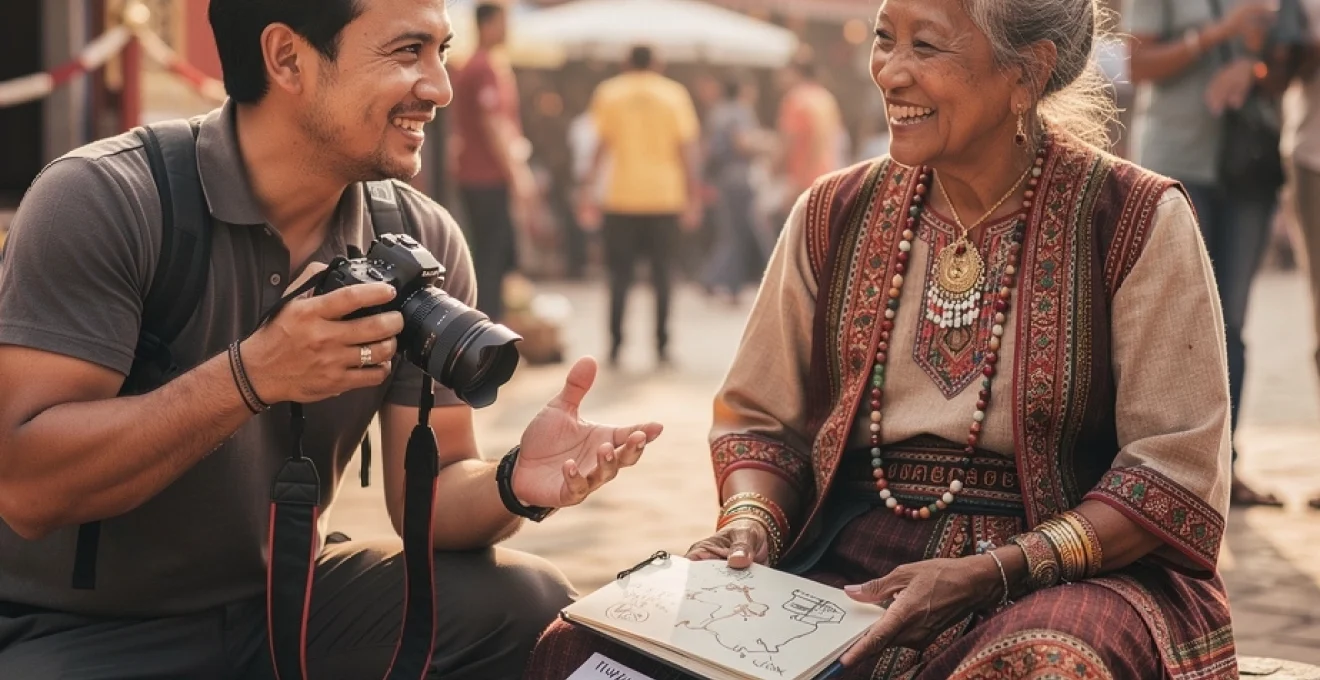
Travel photography has evolved far beyond capturing landmarks and landscapes. The most compelling travel narratives emerge when photographers successfully document the human element—the faces, gestures, and genuine moments that define a culture. Yet authentic portraiture whilst travelling remains one of the most challenging aspects of documentary photography. The difference between exploitative tourist snapshots and meaningful cultural documentation lies in your approach, technical preparation, and ethical framework. When you master these elements, your images transform from visual souvenirs into powerful storytelling tools that honour the dignity and complexity of the people you encounter.
Creating authentic portraits during your travels requires a delicate balance between technical proficiency and cultural sensitivity. Many photographers struggle with this equilibrium, either producing sterile, overly posed images or capturing candid shots that feel invasive. The most successful travel portraitists understand that authentic representation begins long before the camera shutter clicks—it starts with research, continues through genuine human connection, and extends beyond the photograph itself into how images are processed, shared, and licensed.
Pre-journey research techniques for cultural photography context
Successful cultural photography begins in your home country, not at your destination. The photographers who capture the most authentic and respectful portraits invest considerable time understanding the societies they plan to document. This preparation transforms you from an outsider with a camera into an informed visitor who approaches photography with contextual awareness and cultural intelligence.
Research should encompass multiple dimensions of the culture you’ll encounter. Start with contemporary social dynamics rather than historical stereotypes. Read current news sources, follow local photographers on social media, and watch documentary films produced by indigenous filmmakers. This approach provides a nuanced understanding of how communities wish to be represented, which differs dramatically from outsider perspectives that often dominate travel media.
Analysing regional body language and gesture protocols
Non-verbal communication varies dramatically across cultures, and misinterpreting these cues can sabotage your attempts at authentic connection. In some societies, direct eye contact signals confidence and honesty; in others, it represents aggression or disrespect. Similarly, the meaning of smiles, hand gestures, and personal space boundaries shifts across cultural contexts. Before your departure, study the specific non-verbal communication patterns of your destination region.
Consider how physical proximity affects interpersonal dynamics. Mediterranean and Latin American cultures typically favour closer conversational distances than Northern European or East Asian societies. Understanding these preferences helps you gauge appropriate camera-to-subject distances that feel natural rather than intrusive. Research conducted by cross-cultural communication specialists indicates that photographers who match local proximity preferences establish rapport 40% faster than those who maintain their home culture’s spatial norms.
Studying traditional dress codes and symbolic attire elements
Clothing serves as a complex visual language, communicating social status, religious affiliation, marital status, and regional identity. When you understand the symbolism embedded in traditional attire, you can make informed decisions about what to photograph and how to frame these elements. Certain garments or accessories may hold sacred significance that makes them inappropriate subjects for casual photography, regardless of how visually striking they appear.
Research the distinction between everyday clothing and ceremonial dress. Many travellers photograph indigenous people in elaborate traditional costumes without realising these outfits are worn exclusively for tourist entertainment rather than authentic cultural practice. Whilst there’s nothing inherently wrong with documenting cultural performances, authentic portraiture requires distinguishing between staged representations and genuine daily life. Seek to photograph people in contexts where their clothing choices reflect personal expression rather than commercial expectation.
Understanding sacred spaces and photography restriction zones
Religious and spiritual sites often enforce photography restrictions that range from complete bans to specific limitations on subject matter or flash usage. These rules aren’t arbitrary obstacles to your creative vision—they reflect deeply held beliefs about the relationship between image-making and spiritual practice. Some faiths consider photography a form of idolatry; others believe cameras capture or disturb spiritual energy.
Beyond official restrictions, informal cultural norms govern photography in many sacred spaces. A temple may technically permit photography whilst local worshippers find the practice disrespectful. Research these nuances through travel forums frequented by long-term residents rather than short-term tourists. When uncertain, observe how local photographers behave in these spaces, or simply ask permission from religious authorities before raising your camera
When you cannot find reliable information about sacred spaces online, err on the side of restraint. Put the camera away during active ceremonies, avoid photographing individuals in visible states of prayer, and never shoot from behind someone kneeling or bowing unless they have explicitly invited you to document the moment. Remember that no photograph—no matter how striking—is worth undermining trust between travellers and local communities.
Mapping festival calendars and cultural celebration periods
If your goal is to portray the people you meet while traveling in an authentic way, understanding the rhythm of local festivals, holidays, and seasonal rituals is invaluable. Many of the most powerful environmental portraits emerge during these periods, when communities gather in public spaces, traditional dress appears organically, and everyday routines temporarily shift. Before you book your flights, consult national tourism boards, local event calendars, and region-specific blogs to map out major and minor celebrations.
Once you know what is happening and when, research the social and spiritual significance of each event. Some festivals are exuberant, participatory, and welcoming of cameras; others are solemn, grief-focused, or restricted to insiders. Ask yourself: is this a time when my presence as a photographer will contribute to or detract from the atmosphere? When you do choose to photograph festivals, aim to arrive early or stay late. Quiet preparation and aftermath moments often reveal more about a culture than the peak spectacle, offering chances to document individuals rather than anonymous crowds.
Establishing genuine human connection before camera contact
Authentic travel portraiture depends less on what camera you carry and more on how you behave before you even touch the shutter. People are not visual resources to “capture” but individuals with stories, boundaries, and emotional weather of their own. The photographers who create the most honest images are often those who are willing to spend time talking, listening, and simply being present without any guarantee that a photograph will result. Connection first, camera second: this simple sequence changes everything about how your subjects look and feel in the final frame.
Mastering non-verbal communication and eye contact etiquette
In many travel situations, your body language speaks long before your words. A relaxed posture, open hands, and a genuine smile signal that you are there to connect, not to extract content. Avoid approaching people from behind, moving too quickly, or looming over children or elders with large equipment, as these actions can feel predatory even when your intentions are kind. Instead, match the physical energy of the space—move slowly in calm environments and more dynamically in busy markets, always giving people time to see you coming.
Eye contact is one of the most powerful tools you have, but its meaning shifts across regions. In some cultures, sustained eye contact while smiling is seen as a sign of warmth; in others, it can be read as flirtatious or confrontational. Pay attention to how locals interact with one another: do they glance briefly and look away, or maintain steady eye contact in conversation? When in doubt, use short, soft eye contact paired with a small nod or gesture towards your camera, allowing the other person to either invite you in or signal disinterest without words.
Learning essential local phrases in indigenous languages
Even a handful of local phrases can dramatically change how people respond to your presence. When you greet someone in their own language, you signal respect and a willingness to meet them on their terms rather than expecting them to adapt to yours. Prioritise learning basic greetings, “please,” “thank you,” “may I take your photo?”, and “beautiful” or “handsome” in the local tongue. These simple phrases, delivered with sincerity, often trigger smiles, laughter, and a softening of initial suspicion.
In regions with indigenous languages that differ from the national tongue, learning a few words in the local dialect can be especially meaningful. You will not become fluent overnight, but the attempt itself becomes a bridge. Think of language like a small gift: it may not be expensive or perfect, but it shows that you have invested time and thought before showing up with your camera. You may be surprised how often someone responds to your imperfect phrase with patient corrections, expanded conversation, and eventually, a willingness to be photographed.
Practising the three-conversation rule before requesting portraits
One practical way to ensure you are prioritising relationship over image-making is to adopt what many documentary photographers call the “three-conversation rule.” Rather than asking for a portrait the moment you meet someone, commit to having at least three natural exchanges first. These conversations do not have to be deep or lengthy. They might be as simple as asking about a dish they are preparing, commenting on a football team logo on their shirt, or inquiring about how long they have worked at the market.
By the time you reach the third interaction, the other person has had time to assess you, decide if they feel comfortable, and perhaps become curious about your project. At this point, asking, “Would you mind if I took a photo of you at work? Your hands are doing something really interesting,” feels like a continuation of an existing relationship instead of a sudden extraction. You will notice that portraits created after this three-step process tend to feel more relaxed, with subjects showing a fuller range of expression rather than stiff, guarded smiles.
Offering reciprocal value through photo-sharing commitments
Authentic representation is not a one-way transaction. If you are photographing people while traveling, think carefully about how you can offer something in return beyond a quick “thank you.” In many communities, a printed photograph is still a rare and treasured object, especially in rural areas where people may not own cameras or smartphones. When possible, carry a small portable printer, or note down email addresses, WhatsApp numbers, or postal details so you can send images later.
Be specific with your promises. Instead of vaguely saying, “I’ll send you the photos,” tell them, “I will email these this week,” or “I’ll WhatsApp them to you tonight.” Then follow through. This simple act of reciprocity not only honours the time and trust your subjects have given you but also shifts your role from consumer to collaborator. Over time, you may find that returning images leads to ongoing relationships, repeat visits, and even invitations into homes or workplaces that radically deepen the stories you are able to tell.
Technical camera settings for natural environmental portraiture
Once you have established trust and cultural understanding, technical choices become the tools that either support or undermine authenticity. Natural, environmental portraiture thrives when your gear and settings are configured to be responsive, discreet, and adaptable rather than flashy or intimidating. Think of your camera setup as a well-tuned instrument: the more familiar you are with it, the less you have to think about the mechanics, leaving you free to focus on the human being in front of you.
Implementing available light photography in candid scenarios
Available light—sunlight, window light, street lamps, or even the glow of a market stall—usually feels more honest than intrusive flashes, particularly when you are trying to portray everyday life. To work effectively with existing light, get comfortable shooting in aperture-priority or manual mode and raising your ISO higher than you might be used to. Modern camera sensors handle ISO 1600–6400 with surprising grace, especially when files are processed carefully later, and the grain you gain is often preferable to the harsh, flattened look of on-camera flash.
Pay attention to the direction and quality of light as you move through a scene. Side light falling through a doorway can sculpt a person’s face and hands, while soft overcast skies create flattering, low-contrast portraits in open streets. Ask yourself: where would this person naturally turn or stand without my intervention? Instead of staging them in dramatic but unnatural light, position yourself so that you can catch authentic gestures in the existing illumination. This approach not only preserves the integrity of the scene but also keeps your presence subtle and non-disruptive.
Selecting prime lenses for unobtrusive street documentation
Lens choice has a direct impact on how people experience you in their space. Large telephoto zooms create physical and emotional distance, often reinforcing a tourist–spectator dynamic. Compact prime lenses—such as 35mm or 50mm equivalents—encourage you to step closer, interact, and build rapport. They are also lighter, less intimidating, and usually offer wider maximum apertures, which help in low light and when you want gentle background separation.
A 35mm lens is particularly versatile for environmental portraits while traveling. It allows you to include enough of the surroundings to tell a story without significant distortion when used at a respectful distance. A 50mm, meanwhile, offers a slightly more intimate perspective that is flattering for head-and-shoulders portraits. Choosing one or two primes and sticking with them simplifies your technical decisions and keeps your kit discreet. The goal is to blend into the flow of daily life, not to announce your presence with a heavy, constantly zooming rig.
Configuring silent shutter modes and discrete shooting techniques
The louder your camera, the more you influence what happens in front of it. Many modern mirrorless cameras offer electronic or “silent” shutter modes that eliminate the click completely. While these can introduce issues such as banding under certain artificial lights, they are invaluable for quiet environments like small shops, religious ceremonies (where photography is permitted), or intimate home visits. If your camera does not have a silent mode, get used to half-pressing the shutter and timing your shots during louder ambient sounds.
Discretion is about more than technology. Avoid rapid-fire bursts that feel like you are “spraying” at a subject, which can make people self-conscious or exploited. Instead, compose thoughtfully, wait for meaningful expressions or gestures, and take a small number of purposeful frames. Lower your camera between shots so that you can maintain eye contact and conversation. This rhythm—camera up, image, camera down, connection—helps your subject feel that the portrait is a mutual creation rather than a one-sided extraction.
Balancing shallow depth-of-field with environmental storytelling
Shallow depth-of-field is a popular way to create visually striking portraits, but in travel contexts it can sometimes strip away the very environment you set out to document. If the background dissolves into an anonymous blur, you lose clues about place: the script on a sign, the pattern of tiled walls, the type of tools on a workbench. To portray people authentically within their context, consider using apertures in the f/2.8–f/5.6 range rather than shooting wide open all the time.
Think of depth-of-field like a volume knob rather than an on/off switch. How much of the surrounding story do you want visible while still giving prominence to your subject? Try focusing on the eyes while allowing secondary elements—like hands, tools, or nearby objects—to remain partially in focus. This creates layers of meaning in a single frame. When you review your images, ask yourself: if someone who has never been here saw this portrait, could they infer something true about the subject’s daily environment and culture? If the answer is yes, you are using background detail effectively.
Compositional strategies for contextual storytelling
Composition is where your technical skill and ethical intent converge into a single frame. Authentic travel portraits are not just close-ups of faces; they are carefully arranged windows into a person’s world. Rather than chasing perfection in symmetry or geometry alone, prioritise arrangements that communicate relationship: between subject and space, individuals and community, tradition and change. Your composition should invite viewers to ask, “Who is this person, and what might their life be like here?” rather than, “Where did the photographer stand?”
One effective strategy is to think in layers. Place your main subject in one plane—often the middle ground—and allow foreground and background elements to subtly reinforce the story. A blurred market stall in the front, a vendor in focus at centre, and passing customers behind, for example, tell a richer story than a single isolated portrait. Use leading lines from architecture or streets to guide the viewer’s eye toward your subject, but let those lines emerge from real structures rather than artificially staging the scene. When appropriate, step back and include multiple people interacting, capturing a moment that feels more like a scene from a film than a posed studio shot.
Ethical image licensing and subject rights management
Authenticity does not end once the photo is taken; it extends into how you publish, sell, and license your work. The people you meet while traveling are more than visual content for your portfolio or social feed. Before monetising any images, consider whether your subjects understood how their portraits might be used. Did they consent only to a casual snapshot, or did you clearly explain that the images could appear in magazines, exhibitions, or commercial campaigns? In many jurisdictions, model releases are required for commercial use, but even where the law is ambiguous, ethical practice should guide you.
Develop a simple consent workflow that matches your style of travel photography. This might include carrying printed model release forms translated into the local language, or using a mobile app where subjects can sign digitally. When photographing vulnerable groups—children, refugees, or people in medical settings—apply an even higher standard. Ask yourself if the image could expose them to stigma, danger, or unwanted attention. If the answer is uncertain, it is usually wiser to keep the photograph private or anonymise it significantly before sharing.
Post-processing workflows that preserve cultural authenticity
Post-processing is where many well-intentioned travel portraits lose their authenticity. Heavy filters, aggressive skin-smoothing, and dramatic colour shifts can distort reality to the point where the culture you documented becomes unrecognisable—even to the people who live there. A responsible editing approach aims to correct technical flaws (like exposure or white balance) while preserving the genuine tone, texture, and atmosphere of the original scene. Think of editing as polishing a documentary rather than directing a fantasy film.
Start by calibrating your white balance to reflect real-world colours. Skin tones should look believable, clothing should retain its true hues, and environmental elements—like the warm cast of streetlights or the cool shade of a temple interior—should feel accurate to memory. Avoid manipulating facial features or body shapes. Small adjustments to contrast, clarity, and saturation can help an image “breathe” on screen or in print, but when in doubt, err on the side of subtlety. You are translating an encounter, not reinventing it.