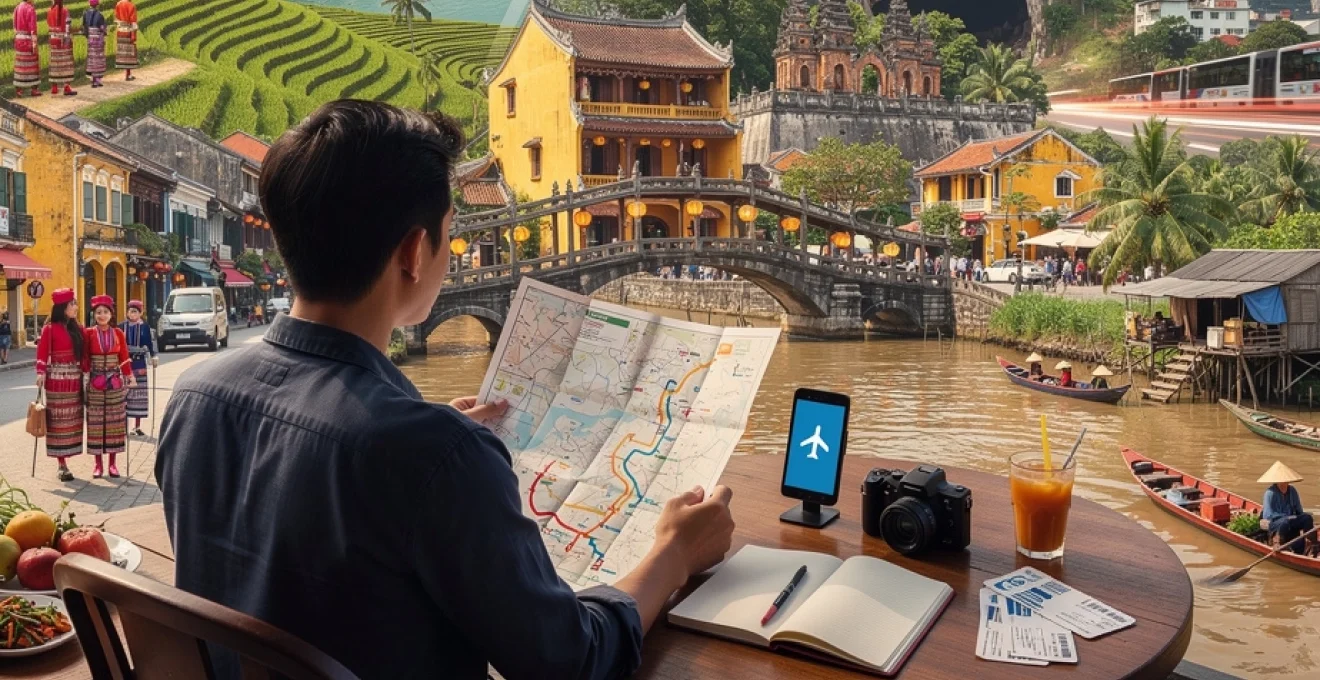
Vietnam’s extraordinary diversity unfolds across 1,650 kilometres of coastline, encompassing everything from mist-shrouded mountain peaks to bustling metropolitan centres and pristine beaches. The challenge lies not in finding remarkable destinations, but in crafting an itinerary that captures the essence of this multifaceted nation within a fortnight. From the French colonial elegance of Hanoi’s Old Quarter to the floating markets of the Mekong Delta, Vietnam offers travellers an intricate tapestry of experiences that reward careful planning and strategic route selection.
The key to maximising your Vietnamese adventure lies in understanding the country’s geographical logic and seasonal variations. Think of Vietnam as a serpentine corridor connecting three distinct regions, each offering unique cultural, historical, and natural attractions. The northern highlands showcase ethnic diversity and dramatic landscapes, whilst central Vietnam serves as an archaeological treasure trove of imperial cities and ancient trading ports. Meanwhile, the southern region combines modern economic dynamism with traditional rural life, creating a fascinating juxtaposition of old and new.
Pre-departure planning: regional distribution and logistical framework
Successful Vietnam travel hinges on strategic planning that accounts for both geographical constraints and seasonal weather patterns. The country’s elongated shape creates natural travel corridors, but also presents logistical challenges that require careful consideration of transport connections and timing. Most experienced travellers recommend following either a north-to-south or south-to-north trajectory, avoiding backtracking that wastes precious time and resources.
Weather patterns play a crucial role in determining your starting point and travel direction. Northern Vietnam experiences its most pleasant weather from October to April, whilst central regions enjoy optimal conditions between February and July. Southern Vietnam maintains consistently warm temperatures year-round, though the dry season from December to April offers the most comfortable travelling conditions. Understanding these patterns allows you to position yourself in each region during its most favourable weather window.
Northern vietnam circuit: hanoi, sapa, and ha long bay time allocation
Northern Vietnam demands approximately 5-6 days to experience its primary attractions without feeling rushed. Hanoi deserves 2-3 days for proper exploration of its ancient streets, colonial architecture, and vibrant street food scene. The capital serves as an excellent base for understanding Vietnamese history and culture before venturing into more remote areas. Allow adequate time for museum visits, temple exploration, and evening wanderings through the atmospheric Old Quarter.
Sapa requires 2 days minimum to appreciate its terraced landscapes and ethnic minority cultures properly. This mountain destination offers some of Vietnam’s most spectacular scenery, but accessing remote villages and completing meaningful treks requires overnight stays in the region. Ha Long Bay justifies 1-2 days, with most visitors opting for overnight cruise experiences that provide sunset and sunrise views over the limestone karsts.
Central vietnam corridor: hoi an, hue, and da nang transit scheduling
Central Vietnam represents the cultural and historical heart of the country, requiring 4-5 days to explore adequately. Hue merits 1-2 days for its imperial citadel complex and royal tombs, whilst Hoi An deserves 2-3 days to experience its ancient trading port atmosphere, culinary traditions, and surrounding countryside. The proximity of these destinations allows for efficient travel, with Da Nang serving as the primary aviation hub for the region.
The central corridor benefits from excellent infrastructure connecting major sites. High-speed rail links Hue and Da Nang, whilst road connections to Hoi An remain straightforward and scenic. This region also provides access to My Son Sanctuary, requiring a half-day excursion from Hoi An, and Phong Nha-Ke Bang National Park, which demands a full day or overnight trip from Hue.
Southern vietnam hub: ho chi minh city and mekong delta integration
Southern Vietnam requires 3-4 days to balance urban exploration with rural experiences. Ho Chi Minh City deserves 2 days minimum to explore its historical sites, bustling markets, and vibrant nightlife scene. The city’s complex history, from French colonial influences to wartime significance, requires sufficient time for museum visits and guided tours. Modern Saigon also offers excellent culinary experiences and shopping opportunities that
reward some unstructured time as well. The bustling café culture, rooftop bars, and contemporary arts scene reveal a very different side of Vietnam compared to Hanoi or Hue, and are worth at least one evening of exploratory wandering.
To integrate the Mekong Delta into a two-week Vietnam itinerary, allocate 1–2 days. A single long day trip lets you experience key highlights such as Cai Be or Ben Tre’s canals, while an overnight excursion to Can Tho or My Tho allows you to witness early-morning floating markets and rural river life at a slower pace. When time is tight, many travellers prioritise one full day in the Mekong Delta combined with two nights in Ho Chi Minh City for a balanced southern Vietnam circuit.
Internal flight routes: vietnam airlines and jetstar pacific booking strategies
Internal flights are the backbone of a time-efficient two-week Vietnam itinerary, especially if you want to cover all three regions without spending full days on buses or trains. The main domestic carriers—Vietnam Airlines, Vietjet Air, and Bamboo Airways (previously Jetstar Pacific operated many low-cost routes)—connect Hanoi, Da Nang, Hue, Nha Trang, and Ho Chi Minh City with frequent daily services. Typical flight times are under 90 minutes on the north–central–south axis, making it entirely feasible to wake up in Hanoi and have dinner in Hoi An or Saigon.
When planning your internal flight routes, anchor your search around three key domestic legs: Hanoi–Da Nang (or Hue), Da Nang–Ho Chi Minh City, and optionally Hanoi–Ho Chi Minh City if you fly in and out of the same international hub. Booking 4–8 weeks in advance usually yields the best balance between price and flexibility, with many one-way fares falling in the USD 30–80 range excluding checked baggage. Early morning or late evening departures can help you maximise sightseeing hours in each destination, though you should always allow buffer time for potential delays when connecting to international flights.
From a strategic standpoint, it is often more efficient to purchase a multi-city international ticket (for example, flying into Hanoi and out of Ho Chi Minh City) and fill in the middle with one or two domestic flights. This approach reduces backtracking and can be cheaper than two separate return flights, particularly during peak seasons such as Tet and summer holidays when domestic prices spike. Consider using regional low-cost carriers for the shorter hops and Vietnam Airlines for tight connections or routes where on-time performance and baggage handling are more critical.
Northern vietnam immersion: cultural heritage and natural landscapes
Hanoi old quarter navigation: 36 ancient streets walking circuit
Hanoi’s Old Quarter forms the cultural and logistical anchor of any northern Vietnam itinerary. The famed “36 ancient streets” were historically organised by craft guilds, each specialising in a particular trade—from silverwork and herbal medicine to lacquerware and bamboo products. Today, these streets still retain their specialised character to varying degrees, making the Old Quarter a living, breathing commercial museum where centuries-old shop houses coexist with modern cafés and boutique hotels.
An efficient walking circuit begins at Hoan Kiem Lake, where you can cross the iconic red bridge to Ngoc Son Temple before diving north into the maze of streets. You might follow Hang Dao (the traditional silk street) towards Dong Xuan Market, then loop back along Hang Ma and Hang Buom, observing how the goods on display shift from ceremonial paper offerings to contemporary nightlife venues. Navigating this area is less about ticking off individual sights and more about absorbing the sensory overload—honking scooters, sizzling street food, and the rhythmic call of street vendors.
To make the most of your time, consider structuring your Old Quarter exploration into themed segments: one morning dedicated to temples and historical sites, one afternoon focusing on food alleys and cafés, and an evening walk when the weekend night market transforms the area into a pedestrian-friendly festival. Many travellers find that a guided walking tour or food tour on their first day pays dividends, providing orientation, safety tips for crossing traffic, and insider recommendations that you can revisit independently later in your stay.
Sapa terraced rice fields: muong hoa valley trekking routes
Sapa’s dramatic terraces and cool mountain climate offer a stark contrast to Hanoi’s urban density, making it an essential component of a diverse Vietnam route. The heart of most trekking itineraries is the Muong Hoa Valley, where rice paddies cascade down steep hillsides and ethnic minority villages dot the landscape. Whether you choose a half-day walk or a two-day trek with homestay, the valley rewards you with sweeping panoramas, suspension bridges, and intimate glimpses of rural life.
For travellers on a tight two-week schedule, a common pattern is an overnight train or sleeper bus from Hanoi to Lao Cai, followed by 1–2 nights in Sapa and surrounding villages. Popular Muong Hoa trekking routes include Sapa–Y Linh Ho–Lao Chai–Ta Van, which passes through Hmong and Giay communities, and the more challenging path towards Giang Ta Chai, where you encounter waterfalls and deeper forest sections. Trek difficulty ranges from easy to moderate, but trails can become slippery during the rainy season, so appropriate footwear and trekking poles are advisable.
When choosing between self-guided and guided treks, consider your comfort with route-finding and cultural etiquette. Local guides, often from the Hmong or Red Dao communities, not only prevent navigational mishaps but also act as cultural interpreters, explaining agricultural practices, local customs, and the significance of traditional clothing. In a compressed itinerary, their presence can transform a scenic walk into a meaningful cultural exchange, making your limited time in Sapa far more impactful.
Ha long bay limestone karst exploration: cat ba island overnight cruising
Ha Long Bay’s limestone karsts are one of Vietnam’s most recognisable images, but the broader Gulf of Tonkin area actually comprises three connected bays: Ha Long, Bai Tu Long, and Lan Ha. For travellers who prefer a slightly quieter experience within a two-week Vietnam itinerary, basing yourself around Cat Ba Island and cruising Lan Ha Bay can be an excellent alternative to the more crowded Ha Long port. The landscapes are equally dramatic—jagged peaks, hidden lagoons, and floating fishing villages—but boat traffic is generally lighter.
An overnight cruise allows you to experience the bays at their most atmospheric, particularly at sunrise and sunset when the light softens and day-tripper boats return to shore. Typical itineraries include kayaking through limestone arches, visiting caves such as Hospital Cave or Trung Trang on Cat Ba, and swimming off secluded beaches. Onboard activities might range from cooking classes and squid fishing to tai chi at dawn, offering a comfortable balance between relaxation and exploration.
To integrate Ha Long or Lan Ha Bay without sacrificing too much of your schedule, plan on 1–2 nights away from Hanoi, factoring in 2.5–3.5 hours of transfer time each way by highway shuttle or private car. Many cruise operators now offer direct transfers to or from Hanoi’s airport, allowing you to connect your bay experience with a flight to central or southern Vietnam without returning to the capital. This reduces backtracking and keeps your overall itinerary streamlined.
Ethnic minority villages: hmong and red dao cultural encounters in lao cai
Beyond the scenery, northern Vietnam’s true richness lies in its ethnic diversity, particularly in Lao Cai province where Hmong, Red Dao, Tay, and other groups live in close proximity. Incorporating respectful visits to minority villages into your Sapa or Bac Ha segments can deepen your understanding of the region’s cultural fabric. However, such encounters require sensitivity; tourism is both an opportunity and a pressure point for these communities.
In and around Sapa, villages such as Ta Phin (Red Dao) and Cat Cat (Hmong) are popular introductions to minority culture, offering handicraft workshops, herbal baths, and homestays. For a less commercial experience, consider visiting markets in Bac Ha or Coc Ly, where villagers from outlying areas gather weekly to trade livestock, textiles, and household goods. These markets can feel more like community events than tourist showcases, especially if you arrive early before larger tour groups.
When planning ethnic minority visits, prioritise locally owned homestays and guide services that channel tourism income directly into the community. Simple gestures—asking before taking photos, purchasing crafts at fair prices, and learning a few words of local greetings—go a long way in building mutual respect. Think of these encounters not as “human safaris,” but as opportunities for cultural exchange, where you are both guest and learner in someone else’s home territory.
Central vietnam archaeological corridor: UNESCO world heritage integration
Hoi an ancient town: japanese covered bridge and chinese assembly halls
Hoi An sits at the crossroads of trade routes that once linked China, Japan, and Europe, and its compact Old Town remains one of the best-preserved examples of a Southeast Asian trading port. A well-structured two-week Vietnam itinerary typically assigns 2–3 days here, allowing you to explore the Japanese Covered Bridge, Chinese assembly halls, and merchant houses at an unhurried pace. The Old Town ticket system grants access to a curated selection of heritage sites, which you can visit over a 24-hour period, making it easy to cluster your cultural sightseeing into one or two focused sessions.
The Japanese Covered Bridge, with its distinctive roof and small shrine, symbolises Hoi An’s historic links with Japan and acts as a convenient starting point for self-guided walking loops. From there, you can wander towards the Fujian and Cantonese assembly halls, which showcase ornate courtyards, dragon mosaics, and incense-filled altars. Interspersed among these monuments are family-run tailor shops, lantern studios, and tea houses that carry forward the town’s commercial traditions in modern form.
Evenings in Hoi An are best reserved for slow riverfront strolls and lantern-lit boat rides, when the heat recedes and the town takes on a festival-like atmosphere. To avoid turning your stay into a checklist of photo stops, build in time for experiential activities: a lantern-making workshop, a cooking class focused on regional dishes such as cao lầu, or a bicycle ride into the surrounding rice fields. These experiences connect the finely preserved façade of the Old Town with the rhythms of everyday life that still sustain it.
Imperial city of hue: forbidden purple city and royal tombs complex
Hue, once the seat of the Nguyen emperors, anchors the central Vietnam archaeological corridor with its impressive citadel and royal tombs. The Imperial City, encircled by moats and fortified walls, houses the remains of palaces, temples, and administrative buildings that formed the political heart of the dynasty. While wartime damage and subsequent neglect have taken their toll, ongoing restoration efforts continue to reveal the site’s former grandeur, particularly in areas such as the Thai Hoa Palace and the restored sections of the Forbidden Purple City.
A well-planned day in Hue often divides into two segments: a morning within the Imperial City complex and an afternoon visiting selected tombs along the Perfume River, such as those of emperors Minh Mang, Khai Dinh, or Tu Duc. Each tomb reflects a distinct architectural style and personal philosophy, ranging from the harmonious garden landscapes of Tu Duc to the almost baroque exuberance of Khai Dinh’s hillside mausoleum. Hiring a local guide here can provide essential context, turning names and dates into compelling narratives of power, intrigue, and decline.
Logistically, Hue fits neatly between Hoi An and Phong Nha-Ke Bang on many itineraries, with train and bus connections passing over the scenic Hai Van Pass. If you have only one full day, prioritise the Imperial City and one or two tombs, perhaps combined with a sunset boat ride on the Perfume River. With two days, you can add pagodas such as Thien Mu and explore more deeply into the citadel’s lesser-visited corners, gaining a more nuanced sense of Vietnam’s imperial past.
My son sanctuary: cham hindu temple ruins archaeological site
My Son Sanctuary, located about an hour’s drive from Hoi An, offers a window into the Cham civilisation that once dominated central Vietnam’s coastal plains. The temple complexes, dedicated primarily to the Hindu god Shiva, were constructed between the 4th and 13th centuries and served as both religious centre and royal burial ground. Although extensive bombing during the Vietnam War destroyed many structures, enough towers and bas-reliefs remain to convey the site’s former spiritual and political significance.
Incorporating My Son into your Vietnam itinerary typically requires a half-day, with early-morning departures recommended to avoid both heat and crowds. Upon arrival, a small museum introduces the Cham art and iconography you will see in the ruins, from lingams and yonis to dancing apsaras. The main groups of towers are connected by signposted paths, and a loop through the key clusters can be completed in 1.5–2 hours at a moderate pace.
To deepen your understanding, consider booking a guided tour that includes historical commentary and, ideally, a stop at a local village en route back to Hoi An. Some itineraries also offer boat returns along the Thu Bon River, which not only break up the road journey but also help you visualise how My Son linked by water to coastal trade networks. In the context of a two-week trip, My Son serves as a crucial counterpoint to both Hue’s imperial architecture and Hoi An’s mercantile heritage, rounding out your grasp of central Vietnam’s layered past.
Phong nha-ke bang national park: son tra cave system underground exploration
Phong Nha-Ke Bang National Park, a UNESCO World Heritage site, contains one of the world’s most spectacular karst cave systems, including record-breaking caverns such as Son Doong. For most travellers on a two-week Vietnam itinerary, however, the focus is on more accessible but still awe-inspiring caves like Phong Nha, Paradise, and Dark Cave. These sites offer a range of experiences, from family-friendly riverboat cruises into illuminated chambers to adventurous zip-lining and mud bathing.
Reaching Phong Nha typically involves a bus or train ride to Dong Hoi, followed by a 45–60 minute transfer inland to the park gateway. Given the travel time, allocating at least one night—preferably two—is advisable if you choose to include this region. A popular pattern is to base yourself in Phong Nha village and dedicate one day to a combination of Phong Nha and Paradise Caves, then use a second day for more physical activities such as trekking or Dark Cave’s obstacle course and underground river swims.
Because the cave systems are sensitive environments, responsible operators limit group sizes and follow strict conservation protocols. When comparing tours, look beyond price to consider environmental impact and guide training. If your overall schedule cannot easily accommodate Phong Nha, do not feel that you have “failed” your Vietnam itinerary; think of it instead as a reason to return, perhaps on a future trip dedicated more heavily to adventure travel.
Southern vietnam economic metropolis: modern development and rural traditions
Southern Vietnam’s narrative is one of rapid urban growth juxtaposed with deeply rooted rural traditions. Ho Chi Minh City, with its skyline of glass towers and constant construction, functions as the country’s financial engine, while the Mekong Delta remains Vietnam’s “rice bowl,” producing a significant portion of the nation’s agricultural output. Structuring 3–4 days here allows you to experience both extremes: high-energy city life and the slower rhythms of riverside communities.
In Ho Chi Minh City, District 1 serves as the practical base for most travellers, placing you within walking distance or a short ride of key sites such as the War Remnants Museum, Reunification Palace, Central Post Office, and Notre Dame Cathedral. A typical day might blend historical exploration with culinary discovery, perhaps starting with a visit to the museum and ending with a guided street food tour through Districts 3 or 4. This mix reflects the city’s dual identity as both historical flashpoint and contemporary culinary capital.
To balance the urban intensity, integrate a full-day or overnight trip into the Mekong Delta, focusing on hubs like Ben Tre, Vinh Long, or Can Tho. Here, canals replace streets and daily life unfolds on and along the water—boats carry produce to market, children commute to school by ferry, and farmers tend orchards of durian, rambutan, and coconut. Whether you opt for a simple sampan ride through palm-lined waterways or a homestay on a family-run farm, these experiences reveal the agrarian backbone that underpins Vietnam’s modern development.
Culinary journey mapping: regional specialities and street food circuits
Designing a two-week Vietnam itinerary without a culinary framework is a bit like reading a novel while skipping every third chapter—you will still follow the plot, but you will miss much of the richness. Vietnam’s cuisine varies dramatically by region, and structuring your days around key dishes and street food circuits ensures that you taste this diversity as you travel. In the north, flavours tend to be more delicate and broth-driven, exemplified by Hanoi’s pho bo, bun cha, and egg coffee. Central Vietnam favours bolder, spicier notes in dishes like Hue’s bun bo Hue and Hoi An’s cao lầu, while the south leans sweeter and herb-heavy, with banh xeo and countless variations of noodle soups.
One practical strategy is to assign each major destination a “must-try” list of three to five local specialities and to seek them out early in your stay, rather than waiting until your final night. In Hanoi, that might mean planning a morning at a renowned pho shop, an afternoon snack of banh cuon, and an evening at a bun cha stall. In Hoi An, you could structure a walking loop that passes vendors for cao lầu, banh mi, and white rose dumplings, allowing you to sample multiple dishes without long detours.
Street food tours can act as culinary “accelerators,” particularly in your first 24–48 hours in a new region. By following a guide through markets and back alleys, you quickly learn how to decode menus, spot high-turnover stalls, and order confidently even when language barriers exist. Think of these tours as both meals and training sessions: they not only satisfy immediate hunger but also equip you to eat well and safely for the rest of your trip, maximising the gastronomic dimension of your two-week Vietnam itinerary.
Transportation infrastructure: inter-regional connectivity and local mobility solutions
Vietnam’s transportation network has expanded rapidly in the past decade, giving travellers multiple options for moving between regions and within cities. For inter-regional connectivity, the main pillars are domestic flights, the north–south railway (often called the Reunification Express), and an extensive network of long-distance buses. Domestic flights are the most time-efficient choice for the typical two-week itinerary that spans Hanoi, central Vietnam, and Ho Chi Minh City, reducing what might be 15–20 hours of overland travel to 1–2 hour hops.
That said, trains and buses still play a valuable role, especially for night-time segments that double as accommodation. An overnight train between Hanoi and Lao Cai, for instance, allows you to arrive in Sapa’s gateway region at dawn, ready to start trekking without losing a full day to transit. Similarly, daytime train journeys along the Hue–Da Nang corridor reward you with coastal and mountain views that you would miss from the air. For those who value slower, more scenic travel, integrating one or two such rail segments can add depth to your Vietnam route without compromising overall efficiency.
At the local level, mobility solutions vary by destination but share common patterns. In major cities, ride-hailing apps like Grab have largely replaced the need to negotiate with taxi drivers, offering transparent pricing and route tracking that many visitors appreciate. In smaller towns such as Hoi An or Ninh Binh, bicycles and scooters become practical tools for exploring nearby rice fields, temples, and beaches, provided you are comfortable with local traffic norms and hold appropriate licences where required. For travellers who prefer not to drive, hotel-arranged shuttles, guided day tours, and private drivers remain widely available and surprisingly affordable.
Ultimately, the most successful two-week Vietnam itinerary treats transportation not as dead time, but as an integral part of the experience. A sunrise train pulling into Lao Cai, a sampan gliding through Mekong canals, or a motorbike ride over the Hai Van Pass can all become highlight moments in their own right. By matching each leg of your journey to the most suitable mode—fast flights between regions, scenic trains along the coast, bicycles in the countryside—you craft not just a route across Vietnam, but a coherent travel narrative that ties its diverse regions together.