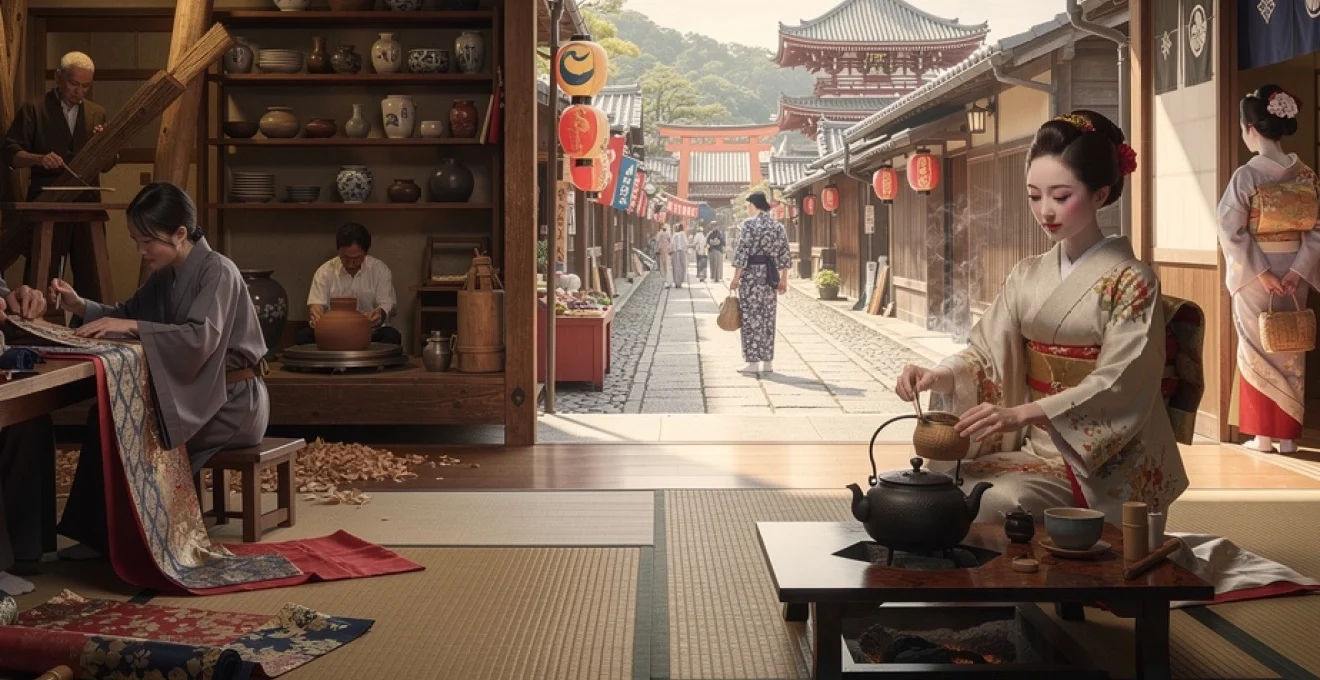
Kyoto stands as a testament to the profound difference between preservation and practice. Unlike museums where artefacts gather dust behind glass cases, this ancient capital pulses with the rhythms of traditions that have evolved organically for over a millennium. The city’s cultural heritage isn’t locked away for occasional display—it flows through the daily lives of its residents like water through carefully tended gardens. From the precise movements of a tea ceremony master to the delicate brush strokes of a kimono artist, Kyoto demonstrates how authentic cultural transmission occurs not through documentation alone, but through the continuous act of living these practices.
The distinction between a preserved tradition and a living one becomes immediately apparent when you witness a craftsman’s hands shaping clay on a potter’s wheel, following techniques passed down through thirty generations. This dynamic relationship between past and present creates an environment where innovation emerges naturally from deep understanding, ensuring that ancient wisdom remains relevant to contemporary life.
Living heritage: kyoto’s immersive cultural practices in daily life
The concept of living heritage in Kyoto transcends the typical museum approach to cultural preservation. Here, traditional practices remain embedded in the fabric of everyday existence, creating an ecosystem where cultural knowledge transfers through direct participation rather than passive observation. This immersive approach ensures that each generation doesn’t merely inherit static customs but actively interprets and adapts them to contemporary circumstances whilst maintaining their essential character.
The city’s approach to cultural continuity reflects a sophisticated understanding that traditions must breathe and evolve to survive. Rather than freezing practices in time, Kyoto’s communities allow their heritage to respond organically to changing social conditions. This dynamic preservation method has enabled the city to maintain its cultural identity whilst embracing modernity, creating a unique synthesis that attracts visitors from around the world seeking authentic cultural experiences.
Tea ceremony continuity through urasenke and omotesenke schools
The tea ceremony schools of Urasenke and Omotesenke exemplify how traditional practices maintain their vitality through continuous engagement. These institutions don’t simply teach historical procedures; they cultivate a living philosophy that adapts to contemporary needs whilst preserving essential principles. Students learn not just the mechanics of tea preparation but the deeper aesthetic and spiritual dimensions that make the ceremony relevant to modern life.
Within these schools, the transmission of knowledge occurs through embodied learning, where students develop muscle memory and intuitive understanding through repeated practice. This approach ensures that the tea ceremony remains a lived experience rather than a performance, with each practitioner bringing their own understanding to the ancient forms whilst respecting the underlying principles that have guided the practice for centuries.
Kimono craftsmanship within nishiki market artisan communities
The artisan communities surrounding Nishiki Market demonstrate how traditional craftsmanship thrives within commercial environments. These workshops maintain centuries-old techniques whilst adapting to contemporary fashion sensibilities and global markets. The craftspeople don’t view themselves as mere preservationists but as active participants in an evolving tradition that responds to current aesthetic preferences and practical requirements.
The integration of traditional kimono craftsmanship with modern retail environments creates opportunities for cultural exchange that benefit both artisans and consumers. Visitors can observe the creation process, understand the complexity of traditional techniques, and appreciate the skill required to produce these garments. This transparency fosters genuine appreciation for the craft whilst providing economic sustainability for the artisan communities.
Traditional carpentry techniques in machiya townhouse restoration
Machiya restoration projects showcase how traditional building techniques adapt to contemporary urban planning requirements whilst maintaining their essential character. These narrow wooden townhouses, characteristic of Kyoto’s historical districts, require specialised carpentry skills that have been refined over generations. The restoration process involves not just technical expertise but deep understanding of how these structures function within their urban context.
The craftsmen working on machiya restoration projects must balance historical accuracy with modern building standards and contemporary functionality. This challenge requires creative problem-solving that draws on traditional knowledge whilst incorporating new materials and techniques where necessary. The result preserves the visual and structural integrity of these important cultural artefacts whilst making them suitable for modern use.
Seasonal festival participation across gion and pontocho districts
The seasonal festivals celebrated throughout Gion and
Pontocho offer vivid examples of how Kyoto’s annual cycle remains anchored in community participation rather than staged performances for tourists. During Gion Matsuri in July, for instance, the streets fill with locals in yukata helping to assemble towering wooden floats using traditional joinery techniques, while neighbourhood associations prepare food, music, and decorations. This participation isn’t a side-show to the festival; it is the festival, with roles and responsibilities handed down through families and local guilds.
Even in quieter seasons, smaller festivals and monthly observances weave tradition into the rhythm of daily life. In Pontocho, theatre performances, seasonal illuminations, and riverside events continue long after most visitors have gone home, reminding us that Kyoto’s festive energy is sustained from within. For travellers eager to experience authentic Kyoto festivals, the most meaningful approach is to attend respectfully, follow local etiquette, and recognise that you are stepping into a living communal ritual rather than a curated attraction.
Artisan preservation methods: master-apprentice transmission systems
If Kyoto’s streets are the visible face of tradition, its workshops are the beating heart. Across the city, master-artisan and apprentice systems quietly sustain complex crafts that would be impossible to document fully in books or videos. These transmission systems rely on long-term relationships, mutual trust, and years of repetitive practice, where subtle hand movements and intuitive judgments are absorbed through proximity rather than explicit instruction.
This method can appear demanding in an era that values rapid learning and instant results. Yet it is precisely this slow, deliberate transmission that maintains the integrity of Kyoto’s traditional industries. By embedding education within real production cycles—from pottery studios to Nishijin weaving houses—Kyoto ensures that its heritage crafts are not only remembered, but continuously refined and economically viable.
Kiyomizu-yaki pottery workshop lineages and knowledge transfer
Kiyomizu-yaki, the distinctive pottery associated with the Kiyomizu area, exemplifies how workshop lineages act as living archives of technique and design. Many studios trace their origins back several centuries, with family names and kiln marks that appear in museum catalogues yet remain active on modern streets. Apprentices typically commit to multi-year training, beginning with basic tasks like clay preparation and kiln cleaning before gradually advancing to throwing, glazing, and firing.
This progression mirrors a carefully designed curriculum, even if little of it is written down. A master potter may correct an apprentice with a simple gesture or a brief phrase, but behind that comment lies decades of embodied knowledge about the clay’s moisture, the heat of the kiln, or the behaviour of a particular glaze. As you handle a Kiyomizu-yaki tea bowl in a small studio, you are holding not just an object, but the distilled experience of countless firings—and the continuity of a lineage that lives on in today’s Kyoto pottery workshops.
Nishijin textile weaving guild apprenticeship programmes
In the Nishijin district, famed for its intricate silk textiles, guild-based apprenticeship programmes provide a structured framework for preserving advanced weaving techniques. These guilds coordinate training across multiple workshops, ensuring that skills such as tsuzure-ori tapestry weaving or gold-brocade production do not disappear as older artisans retire. Apprentices might spend years mastering loom setup alone before touching the most complex patterns that define Nishijin-ori fabrics.
Interestingly, some guilds now collaborate with design schools and universities, inviting young creatives to learn traditional weaving while contributing fresh pattern ideas. This fusion of heritage technique and contemporary design keeps Nishijin textiles relevant for high-fashion houses, interior designers, and collectors worldwide. For visitors interested in Nishijin textile culture, guided workshops and open-atelier events offer rare glimpses into these apprenticeship systems, making it possible to appreciate how patience, precision, and community support underpin every bolt of cloth.
Buddhist temple construction techniques through miyadaiku craftsmen
Few traditions illustrate Kyoto’s commitment to long-term thinking as clearly as the work of miyadaiku, carpenters specialised in temple and shrine architecture. These craftsmen preserve joinery techniques that allow wooden structures to withstand earthquakes, humidity, and centuries of use—often without a single metal nail. Their knowledge covers not only cutting and fitting timber, but also reading the “life” of the wood: its grain, internal stresses, and response to weather over time.
Transmission in miyadaiku circles often spans multiple temples and regions, as master carpenters take on apprentices who will one day move on to lead their own teams. Large restoration projects in Kyoto—at temples such as Nanzen-ji, Kennin-ji, or smaller neighbourhood shrines—serve as open-air classrooms. When you see scaffolding around a hall or pagoda, you are witnessing a living school of architecture, where each chisel mark carries techniques refined over centuries and adjusted subtly to today’s building standards and seismic research.
Kaiseki culinary arts succession in kikunoi and yoshikawa establishments
Kyoto’s culinary heritage is preserved with similar care in its renowned kaiseki restaurants, where succession plans are as deliberate as the dishes themselves. At establishments like Kikunoi or Tempura Yoshikawa, generations of chefs have honed a philosophy of seasonal dining that goes far beyond recipes. Apprenticeships can last a decade, beginning with washing rice and preparing stock before advancing to knife work, plating, and finally menu design.
The transmission of kaiseki technique intertwines taste, aesthetics, and ethics: how to source ingredients responsibly, how to express the current micro-season on a single plate, how to host guests with unobtrusive hospitality. Successor chefs often train abroad or in more casual kitchens before returning, bringing new perspectives to a deeply rooted tradition. This balance between heritage and innovation explains why Kyoto remains a global reference point for kaiseki fine dining, where every meal becomes a living lesson in cultural continuity.
Sacred space integration: religious practices in contemporary kyoto
Walking through Kyoto, it becomes clear that sacred spaces are not confined to distant mountaintops or isolated compounds. Shrines and temples are woven into the city’s everyday geography, functioning as spiritual waypoints for residents commuting to work, students preparing for exams, or shopkeepers marking the change of seasons. Rather than existing apart from modern life, these sacred sites anchor it, offering moments of reflection amid the steady hum of urban activity.
This integration is particularly visible during peak times such as New Year’s, exam season, or major festivals, when streams of locals visit to offer prayers, draw fortunes, or participate in rituals. For visitors interested in Kyoto spiritual culture, understanding how everyday people use these spaces—rather than treating them solely as photogenic backdrops—can transform a sightseeing itinerary into a more meaningful engagement with the city’s religious fabric.
Shinto ritual performance at fushimi inari taisha shrine complex
Fushimi Inari Taisha, with its iconic tunnel of red torii gates, is often photographed as a scenic hiking route. Yet at its core, it remains a working Shinto shrine complex, where rituals for prosperity, safe travel, and business success play out daily. Priests conduct purification rites and blessings in wooden halls near the main entrance, while smaller sub-shrines along the mountain path receive offerings of rice, sake, and fox statues.
For Kyoto residents, a visit to Fushimi Inari might involve commissioning a prayer for a new shop, a family milestone, or the well-being of a community group. As we walk under the gates, we are literally passing through accumulated layers of gratitude and petition. Observing quietly from the side—rather than treating ceremonies as performances—allows us to sense how Shinto practice in Kyoto remains woven into business cycles, agricultural calendars, and personal life transitions.
Zen meditation practices within daitoku-ji temple grounds
In northern Kyoto, the sprawling Daitoku-ji temple complex offers another lens on living spirituality through the practice of Zen meditation. Beyond its famed rock gardens and ink paintings, Daitoku-ji houses active monastic communities where daily routines revolve around zazen (seated meditation), chanting, and mindful work. Some sub-temples periodically open to the public for meditation sessions, giving visitors a structured way to participate rather than merely observe.
The discipline of Zen in Daitoku-ji is less about escaping the world and more about sharpening awareness within it. Sitting in silence before a raked gravel garden, you begin to notice how small shifts in light, sound, or posture can change your perception. In an era of constant digital distraction, these practices offer a powerful reminder that Kyoto’s temples are not relics—they are laboratories of attention, refining approaches to mental clarity that resonate strongly with contemporary concerns about well-being.
Purification ceremonies at kiyomizu-dera temple’s otowa waterfall
Kiyomizu-dera, one of Kyoto’s most visited temples, is renowned for its dramatic stage overlooking the city. Yet down a short flight of steps lies Otowa Waterfall, where an older rhythm of purification continues with quiet persistence. Visitors line up to drink from three streams of spring water, each associated with different blessings such as longevity, success in studies, or fulfillment in love, using long-handled ladles designed to maintain cleanliness.
It would be easy to see this as a simple tourist ritual, but for many Japanese visitors it carries deep symbolic weight. The act of rinsing hands, cleansing the mouth, and choosing a single stream encourages self-reflection: What do I truly seek at this moment in my life? In this way, Otowa Waterfall exemplifies how Kyoto purification ceremonies transform simple physical acts into vehicles for intention-setting and gratitude.
Buddhist sutra chanting traditions in nanzen-ji monastery
At Nanzen-ji, a former imperial villa turned Zen monastery, sutra chanting weaves daily discipline with sonic beauty. Monks gather in wooden halls to recite texts in unison, their voices rising and falling in patterns that have resonated through Kyoto for centuries. The experience for a listener is both grounding and otherworldly, akin to hearing the city’s spiritual memory voiced aloud.
Some temples associated with Nanzen-ji’s network offer opportunities for laypeople to participate in abbreviated chanting sessions or to copy sutras by hand. These practices invite you to move from spectator to participant, if only briefly. As you trace characters with a brush or join a simple refrain, you contribute your own breath and focus to Kyoto’s ongoing tradition of Buddhist chanting culture, adding a new layer to an ancient chorus.
Geisha culture sustainability: ochaya teahouse ecosystem dynamics
Few aspects of Kyoto’s heritage are as emblematic—or as misunderstood—as geisha culture in districts such as Gion, Pontocho, Miyagawa-cho, Kamishichiken, and Gion Higashi. Rather than existing as isolated performers, geiko (Kyoto’s term for geisha) and maiko (apprentice geisha) are part of a finely balanced ecosystem centred on ochaya (teahouses), okiya (geisha houses), traditional arts schools, kimono and hairdressers, and local patrons. This ecosystem functions much like a living organism: if one part weakens, the entire system feels the strain.
Training for maiko typically begins in the late teens and spans several years, encompassing dance, shamisen, tea ceremony, conversation skills, and etiquette. Ochaya owners act as cultural curators, matching guests and geiko for ozashiki banquets where songs, dances, and conversation unfold in an intimate setting. Historically, access to these teahouses required introductions, preserving a sense of trust and continuity. Today, carefully designed experiences and cultural programmes allow more visitors to engage while protecting the dignity and working conditions of the performers.
The sustainability of Kyoto geisha culture hinges on a delicate balance between visibility and privacy. On one hand, increased global interest brings financial support and new apprentices; on the other, intrusive behaviour—such as chasing maiko for photos or blocking narrow lanes—threatens the very atmosphere that allows the culture to thrive. As travellers, choosing guided experiences, respecting photography rules, and supporting licensed venues rather than unregulated imitations helps ensure that this living art form can continue evolving on its own terms.
Seasonal rhythm maintenance: traditional calendar observance practices
Underpinning much of Kyoto’s cultural life is a seasonal awareness shaped by both the modern calendar and older systems like the 24 sekki (solar terms) and 72 micro-seasons. Rather than treating spring, summer, autumn, and winter as broad categories, Kyoto’s traditions recognise subtle shifts—plum blossoms before cherries, early autumn mists before full red leaves—and adjust rituals, menus, and clothing accordingly. This attention to detail is part of what makes Kyoto seasonal culture feel so immersive.
For example, confectioners design wagashi sweets that mirror the exact stage of seasonal change, from delicate snow motifs in late winter to maple leaves just beginning to turn. Tea rooms switch hanging scrolls and flower arrangements to reflect new themes, while households visit shrines and temples for specific dates such as Setsubun (the eve of spring), Tanabata, or Obon. This calendar-conscious lifestyle encourages residents and visitors alike to ask: What is unique about today, in this place, at this time of year?
For travellers planning a Kyoto itinerary by season, aligning your visit with particular observances—such as the Gion Matsuri floats in July, the Arashiyama Hanatouro illuminations in winter, or the quieter plum blossom season in late February—can deepen your sense of connection. Even simple choices, like ordering the seasonal special at a neighbourhood café or joining locals at a small shrine festival, allow you to participate in Kyoto’s living calendar rather than merely observing it from a distance.
Heritage tourism impact: balancing authenticity with cultural accessibility
As Kyoto welcomes tens of millions of visitors each year, the city faces a complex question: how can it share its cultural treasures widely without diluting the very qualities that make them special? The answer lies in a nuanced approach to sustainable heritage tourism in Kyoto, where preservation, local quality of life, and visitor experience are treated as interdependent goals rather than competing interests. Achieving this balance requires cooperation between city officials, community groups, artisans, and travellers.
One visible strategy is the promotion of “hidden gem” areas—such as Ohara, Takao, Keihoku, or Fushimi—to distribute foot traffic beyond marquee sites like Kiyomizu-dera and Arashiyama. By encouraging visitors to explore morning and evening time slots, use public transport, and observe local etiquette, Kyoto aims to reduce pressure on overcrowded districts while showcasing its broader cultural landscape. At the same time, signage, multilingual information, and cultural orientation campaigns help visitors understand how to behave respectfully in residential streets, sacred sites, and geisha districts.
For individual travellers, contributing to Kyoto’s cultural sustainability can be surprisingly straightforward. Choosing to stay in locally run ryokan or machiya lodgings, joining small-group workshops with certified artisans, and supporting community-led festivals all channel resources back into the ecosystems that maintain living traditions. Simple actions—speaking quietly in temple grounds, asking permission before taking close-up photos, or learning a few phrases of polite Japanese—signal that you recognise Kyoto not as a theme park, but as a city where people work, worship, and create every day.
Ultimately, the real impact of heritage tourism in Kyoto will be measured not only in economic statistics, but in the continuity of practices like tea ceremony, miyadaiku carpentry, Nishijin weaving, and geiko arts. When we view ourselves as temporary participants in a long-running cultural story rather than as passive consumers of “experiences,” we help ensure that in Kyoto, traditions will continue not merely to be preserved—but to be lived.