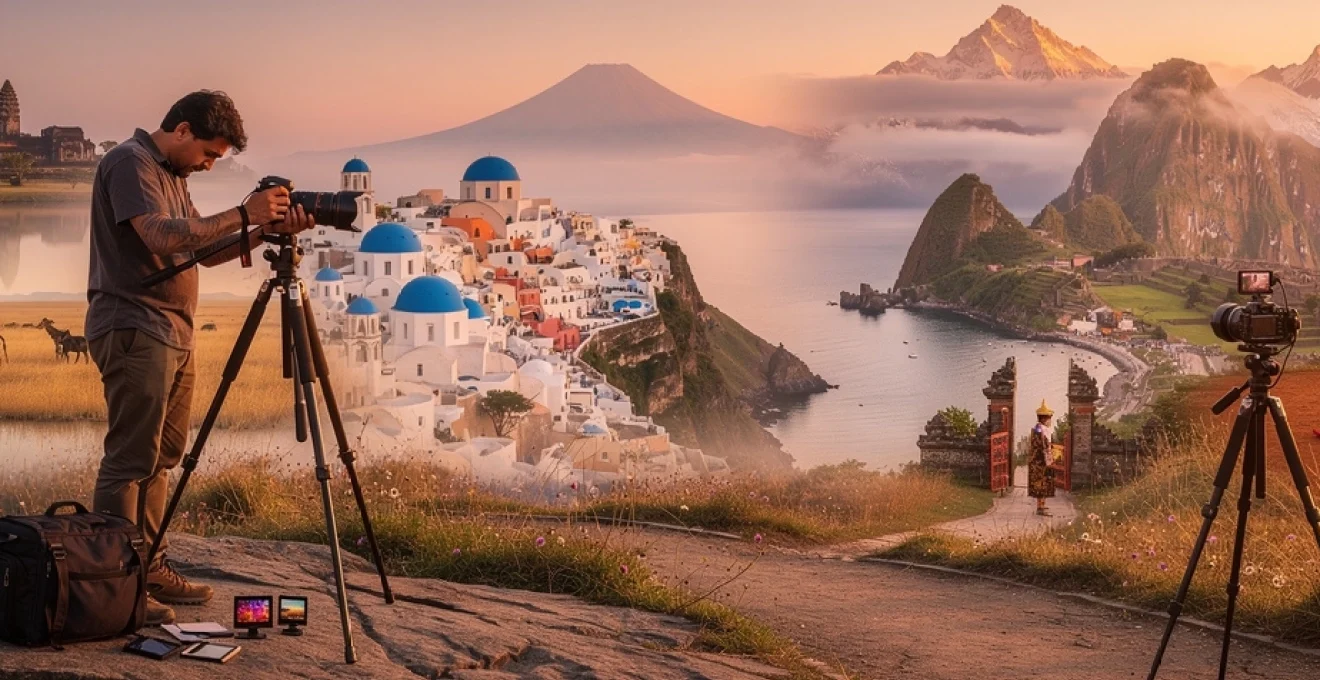
There’s something profoundly transformative about witnessing the world emerge from darkness into light. Dawn doesn’t merely mark the beginning of a new day—it reveals landscapes, cultures, and experiences in ways that daylight obscures. From the misty valleys of Vietnam where clouds hunt through highland ridges to the sacred waters of the Ganges in Varanasi, sunrise creates moments that fundamentally alter how you perceive a destination. These early morning hours offer access to a parallel world where local traditions unfold, wildlife awakens, and photography captures light at its most dramatic. The difference between visiting a place and truly experiencing it often lies in those precious minutes when the sun breaks the horizon.
Golden hour photography techniques for capturing transformative dawn landscapes
Mastering sunrise photography requires understanding how light behaves differently in those precious moments before and after the sun appears. The quality of light during dawn creates opportunities for capturing images that convey the emotional impact of these transformative moments.
Camera settings optimisation for Low-Light sunrise conditions
Successful sunrise photography begins with understanding your camera’s capabilities in challenging lighting conditions. ISO settings between 400-1600 typically provide the best balance between image quality and light sensitivity for most modern cameras. Aperture settings around f/8 to f/11 ensure sufficient depth of field whilst maintaining sharpness across the frame. Shutter speeds require careful consideration—too fast and you’ll underexpose the scene, too slow and you risk camera shake or motion blur from moving elements like clouds or water.
Manual mode gives you complete control over exposure, allowing you to anticipate how the light will change as the sun rises. Bracketing exposures becomes essential when dealing with extreme contrast between the bright sky and darker foreground elements. Many photographers find that shooting in RAW format provides the greatest flexibility for post-processing these challenging lighting conditions.
Compositional strategies using leading lines and natural foreground elements
Dawn landscapes benefit enormously from strong compositional elements that guide the viewer’s eye through the frame. Rivers, shorelines, mountain ridges, and pathways create natural leading lines that draw attention towards the sunrise itself. Positioning these elements to flow from the bottom corners of your frame towards the light source creates visual movement and depth.
Foreground elements become particularly important in sunrise photography because they’re often silhouetted against the brighter sky. Rocks, trees, buildings, or even people can serve as powerful silhouettes that provide context and scale. The key lies in positioning these elements to complement rather than compete with the main subject—the sunrise itself.
Post-processing workflows for enhancing atmospheric colour gradients
The subtle colour transitions that occur during sunrise often require careful enhancement to match what your eyes experienced. Graduated filters in post-processing software allow you to selectively adjust exposure across different areas of the image. The sky might need brightness reduction whilst the foreground requires lifting shadows to reveal detail.
Colour grading plays a crucial role in conveying the mood of dawn. Warm tones in the highlights emphasise the golden quality of early morning light, whilst cooler tones in the shadows create contrast and depth. Vibrance adjustments tend to work better than saturation increases, as they protect skin tones and prevent colours from becoming oversaturated.
Essential filtration systems for balancing exposure dynamics
Neutral density graduated filters remain one of the most effective tools for managing the extreme contrast inherent in sunrise photography. These filters darken the bright sky whilst leaving the foreground unaffected, allowing you to capture detail in both areas within a single exposure. Polarising filters can enhance colour saturation and reduce atmospheric haze, though their effect varies depending on your position relative to the sun.
Variable neutral density filters provide flexibility for controlling shutter speeds, enabling creative effects like smooth water or cloud movement. The key lies in understanding how different filter strengths affect your exposure and planning accordingly. Many photographers carry multiple graduated filters of varying strengths to handle different lighting scenarios they encounter during their travels.
Iconic sunrise viewpoints that redefine destination perception
Certain locations around the world have achieved legendary status among sunrise enthusiasts, not merely for their beauty, but for how dramatically they transform your understanding of the
place you’re visiting. These iconic sunrise viewpoints reveal layers of history, wildlife behaviour, and geography that you may completely miss later in the day.
Angkor wat temple complex dawn illumination experiences
Watching sunrise at Angkor Wat is often described as a travel milestone, and for good reason. Arriving around 4:30–5:00 a.m. allows you to navigate the causeway by torchlight and secure a position by the reflecting pool before the crowds build. As the sky moves from deep indigo to soft magenta, the distinct silhouette of the temple towers gradually separates from the darkness, a visual reminder of how dawn can literally reshape your perception of a place.
To make the most of your Angkor Wat sunrise photography, position yourself slightly off-centre from the main reflection point to avoid lens flare and overlapping silhouettes. Use a tripod and begin with a slower shutter speed to capture the temple reflected in the still water, then adjust as the light intensifies. You’ll often get the most dramatic colour gradients 10–20 minutes before the sun actually appears above the horizon, so resist the urge to pack away your camera too quickly.
Masai mara savannah wildlife migration golden hour encounters
On Kenya’s Masai Mara, sunrise transforms the savannah from a flat, grey expanse into a textured canvas of golden grasses and long shadows. Early game drives typically depart before first light, placing you on the plains just as the sun crests the horizon. Predators are still active, herbivores are on the move, and the famous migration routes glow with warm light that accentuates dust trails and silhouettes.
For photographers, the low angle of the sun during this golden hour is ideal for backlighting animals and capturing atmospheric images with rim-lit manes or horns. A telephoto lens in the 200–400mm range lets you isolate wildlife behaviour without disturbing the animals or your fellow travellers. Always remember that ethics come first: follow your guide’s instructions, avoid pressuring wildlife for a “better shot,” and embrace the unpredictability that makes sunrise wildlife encounters so compelling.
Santorini oia village caldera sunrise positioning strategies
While Santorini’s Oia is famous for sunsets, sunrise is when the caldera feels most intimate and authentic. With far fewer people in the streets, you can move freely between viewpoints and capture the whitewashed buildings and blue-domed churches bathed in soft, directional light. The sun rises behind the island’s inland ridge, so the village gradually brightens from shadow to gentle glow, revealing textures and colours hidden at midday.
To optimise your sunrise positioning in Oia, scout locations the afternoon before and note where stairways, rooftops, and church domes intersect with potential leading lines. Arrive at least 30–45 minutes before first light to set up on a quieter terrace or path, and aim for compositions that include both architectural details and the sweeping caldera view. Because dynamic range is often limited at this hour, sunrise photography here rewards careful exposure and the use of subtle bracketing for post-processing flexibility.
Mount fuji five lakes region optimal viewing coordinates
The Five Lakes region (Fujigoko) offers some of the most iconic sunrise perspectives of Mount Fuji. Each lake—Kawaguchi, Yamanaka, Saiko, Shoji, and Motosu—provides different angles, but for mirror-like reflections at dawn, Lake Kawaguchi and Lake Shoji are particularly renowned. On calm mornings between late autumn and early spring, cold air keeps the water still, allowing the mountain to appear almost perfectly duplicated on the surface.
Planning your sunrise here means more than just picking a lake. You’ll want to check wind forecasts, humidity levels, and cloud cover the night before, as even light breezes can disrupt reflections. Position yourself low and close to the water’s edge to emphasise symmetry, and include a small boat, pier, or shoreline grasses in the foreground to provide scale. As light increases, Fuji’s snow-capped summit often catches the first warm tones, creating a striking contrast with the cooler hues of the lake and sky.
Machu picchu huayna picchu summit early morning access protocols
At Machu Picchu, sunrise is less about watching the sun itself and more about witnessing ancient stonework emerge from the mist. For a truly elevated perspective, many travellers opt to climb Huayna Picchu, the steep peak that overlooks the citadel. Access is strictly controlled, with limited tickets and timed entry slots, so securing an early morning permit months in advance is essential if you want to align your climb with dawn light.
The trail to Huayna Picchu is steep and narrow, often slick with humidity, so give yourself ample time to ascend at a steady pace without rushing. As you climb, you’ll see the ruins and surrounding mountains gradually illuminated, with low clouds drifting through the valleys like slow-moving rivers. Pack a headlamp for the earliest slots, wear grippy footwear, and remember that conditions can change quickly—if you’re flexible and patient, you may be rewarded with shafts of light piercing through mist, one of the most atmospheric sunrise scenes in the Andes.
Psychological impact of dawn light on travel memory formation
Experiencing sunrise while travelling does more than create beautiful photographs; it fundamentally shapes how you remember a destination. Studies in environmental psychology suggest that novel, emotionally charged experiences—such as watching a city or landscape wake up—are encoded more deeply in long-term memory. Because sunrise experiences are often quieter, more intentional, and require effort to witness, your brain tags them as meaningful events rather than everyday moments.
Dawn light itself plays a powerful role. The gradual shift from darkness to colour-rich hues stimulates your visual system in a way that feels both calming and energising, similar to slowly turning up a dimmer switch rather than flicking on a harsh overhead light. Melatonin levels decline, cortisol rises, and your circadian rhythm receives a clear signal that a new cycle is beginning. When you tie these biological shifts to a specific place—a temple, desert, or harbour—you create an emotional anchor that makes that location feel “new” each time you recall it.
There’s also a psychological effect that stems from being awake when most others are not. Standing on a ridge line or city rooftop at sunrise can feel like having backstage access to a destination, as if you’ve stepped behind the curtain to see its inner workings. This sense of privilege and quiet discovery strengthens your emotional connection to the place, making sunrise memories more vivid than similar scenes captured at busier hours. Over time, these early-morning experiences often become the stories you share most enthusiastically when you return home.
Meteorological factors affecting sunrise quality and visibility
Understanding basic meteorology dramatically improves your chances of catching a memorable sunrise when you travel. Cloud cover is the most obvious factor: complete overcast often mutes colour, whereas partial cloud—particularly high and mid-level clouds like cirrus and altostratus—can scatter sunlight into vibrant reds and oranges. In many coastal and mountain regions, a forecast of 30–60% cloud cover around dawn is often ideal for dramatic sunrise photography.
Atmospheric particles also influence sunrise quality. After rain or a cold front, the air is typically clearer, reducing haze and increasing contrast in distant landscapes. In contrast, humidity, pollution, or dust can soften the sun’s edges and create more pastel tones. Temperature inversions in valleys, such as those in Vietnam’s Da Lat or Peru’s Sacred Valley, can trap fog near the ground, producing “cloud seas” that photograph beautifully from higher viewpoints. Checking local forecasts for fog or mist can help you decide whether a mountaintop or riverside location will offer the best experience.
Wind speed and direction affect both comfort and image quality. Strong winds can strip clouds from the sky or push them out of your chosen composition just as the light peaks. Yet a light breeze over water might be enough to create ripples that catch reflections in an interesting way. Before your trip, familiarise yourself with seasonal patterns in your chosen destination—monsoon onset, dry-season clarity, or shoulder-season storms—so you can align your sunrise plans with the most promising conditions rather than relying on luck alone.
Cultural sunrise rituals and local community engagement opportunities
In many destinations, sunrise is not only a visual spectacle but also a deeply rooted cultural moment. By aligning your dawn photography with local rituals, you gain a more layered understanding of the places you visit. Instead of simply watching the sky change colour, you may find yourself sharing temple grounds with worshippers, listening to traditional music, or observing age-old practices that rarely appear in standard itineraries.
Participating respectfully in these sunrise rituals requires research and sensitivity. Learn basic greetings, dress codes, and behavioural expectations in advance, and consider hiring local guides who can act as cultural interpreters. When you approach dawn experiences as a guest rather than an observer—asking permission, avoiding intrusive behaviour, and supporting local communities through donations or responsible tour choices—you transform your sunrise photography into a more meaningful, mutually beneficial exchange.
Balinese hindu purnama ceremony dawn participation guidelines
In Bali, the full moon, or Purnama, is an especially auspicious time, often marked by temple ceremonies that begin at dawn. Villagers dressed in white and gold make offerings of flowers, fruit, and incense, while gamelan music drifts across the courtyards. For visitors, witnessing a Purnama sunrise at a sea temple like Tanah Lot or a mountain temple such as Lempuyang can be one of the most profound cultural experiences on the island.
To participate respectfully, wear a sarong and sash, keep your shoulders covered, and follow any instructions given by temple staff or your guide. Photography is usually tolerated in outer temple areas, but avoid blocking pathways or photographing people in the middle of prayer without clear consent. When in doubt, step back, lower your camera, and simply observe; sometimes the strongest sunrise travel memories come from moments when you choose connection over capturing the “perfect shot.”
Aboriginal dreamtime storytelling during uluru sunrise experiences
Sunrise at Uluru in Australia’s Red Centre is inseparable from the cultural narratives of the Anangu, the Traditional Owners of this sacred site. As the rock shifts from deep purple to fiery red under the first rays of sun, local guides may share Tjukurpa—often translated as Dreamtime—stories that describe how the landscape was formed and how people should live in balance with it. These stories are not mere myths; they are living law and cultural frameworks passed down across countless generations.
Joining a sunrise tour led by Anangu or Aboriginal-owned operators ensures that your visit supports community livelihoods and respects cultural protocols. Listen attentively, refrain from climbing or entering restricted areas, and ask consent before sharing images or stories online. When you pair the visual drama of dawn over Uluru with the depth of Dreamtime storytelling, the destination becomes more than a backdrop—it becomes a teacher, and your sunrise experience evolves into a deeper understanding of place.
Japanese hatsuhinode new year sunrise observation traditions
In Japan, the first sunrise of the year, known as Hatsuhinode, is a cherished tradition that blends spirituality, hope, and community. On 1 January, people gather on coastal headlands, mountain summits, and city rooftops to watch the sun rise and to pray for good fortune in the coming year. Popular spots include coastal cliffs in Chiba, viewpoints around Mount Takao near Tokyo, and seaside shrines in Kyushu and Shikoku.
If your travels coincide with New Year, joining a Hatsuhinode gathering offers a unique perspective on Japanese culture and the psychological power of sunrise. Dress warmly, arrive early, and be prepared for a festive yet contemplative atmosphere—some locations organise special trains or cable cars that operate through the night to bring people to high viewpoints. Rather than treating it as a simple photo opportunity, take a moment to reflect on your own intentions for the year ahead, aligning your personal journey with the collective energy of those around you.
Tibetan buddhist morning prayer ceremonies at everest base camp
In the high Himalayas, sunrise is often accompanied by the sound of Tibetan Buddhist prayers and the flutter of prayer flags catching the first light. At monasteries near the Everest region and in camps en route to Everest Base Camp, monks and local residents gather for early morning puja ceremonies. Butter lamps are lit, mantras are chanted, and offerings are made, seeking protection for climbers and blessings for the day.
When you stay in lodges or base camps that organise sunrise pujas, you’re often welcome to observe from the edges of the gathering. Dress modestly, remove your hat when appropriate, and keep your movements quiet and considerate. The combination of thin, crystalline air, towering peaks, and low, rhythmic chanting creates a powerful sensory experience that many travellers describe as one of their most memorable moments in the mountains. Photographs captured here feel secondary to the emotional imprint of being present as the world’s highest peaks awaken.
Logistical planning framework for multi-destination sunrise photography tours
Designing a multi-destination sunrise photography tour is as much about logistics as it is about creativity. Because you’re working with narrow time windows and often remote locations, careful planning helps ensure you arrive rested, prepared, and in position when the light peaks. Start by mapping your route around seasonal sunrise patterns: research average sunrise times, weather conditions, and tourism peaks for each destination, then build in buffer days to account for unexpected cloud cover or travel delays.
Consider grouping locations by altitude and climate to avoid abrupt transitions that can disrupt your sleep cycle and adaptation. For example, moving from tropical sea level to high-altitude mountain viewpoints in a single day can increase fatigue and reduce your motivation to wake before dawn. Instead, structure your travel so that you gradually ascend or alternate demanding sunrise hikes with easier, urban or coastal viewpoints. Think of your tour plan like a well-paced piece of music, balancing crescendos of activity with quieter interludes so you don’t burn out partway through.
Equipment choices also play a crucial role in successful sunrise-focused itineraries. A lightweight but sturdy tripod, a small selection of versatile lenses, and a compact filtration kit will serve you far better than a heavy, exhaustive gear list that becomes a burden on pre-dawn hikes. Pack extra batteries and memory cards where they’re easily accessible—cold temperatures and long shooting sessions can drain power faster than expected. Wherever possible, back up your sunrise images daily to a portable drive or cloud storage; losing a once-in-a-lifetime dawn sequence to a corrupted card is a risk you can mitigate with simple habits.
Finally, build ethical and safety considerations into your framework from the outset. Check local regulations about access hours, drone usage, and protected areas, and work with local guides whenever terrain, wildlife, or cultural protocols are unfamiliar. Arriving early in the dark can mean navigating unfamiliar paths, so always carry a headlamp, basic first-aid supplies, and a way to communicate in case of emergency. When you combine thoughtful logistics with an appreciation of light, culture, and weather, your sunrise photography tour becomes more than a list of locations—it becomes a coherent journey through the world’s most transformative hours of the day.