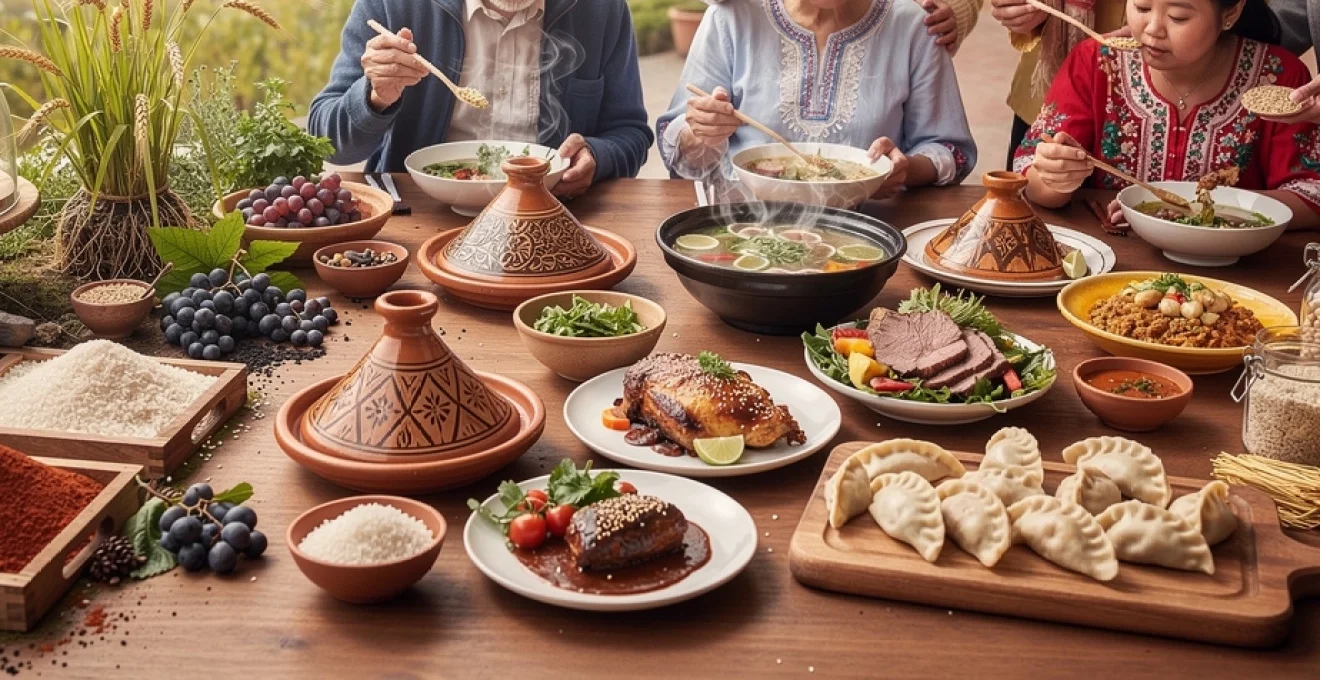
Food transcends mere sustenance—it embodies centuries of cultural evolution, geographical adaptation, and communal memory. Every national dish carries within it the DNA of a civilization: the agricultural practices shaped by climate, the trade routes that brought exotic spices, the religious observances that dictated ingredient selection, and the communal rituals that transformed cooking into ceremony. When you taste authentic mole poblano in Oaxaca or share a steaming bowl of Vietnamese pho on a Hanoi street corner, you’re not simply consuming calories; you’re participating in an edible narrative that connects you to generations of cooks, farmers, and storytellers who’ve refined these recipes through trial, error, and tradition.
The pursuit of understanding nations through their signature dishes has evolved from casual tourism into a legitimate anthropological methodology. Culinary historians now recognize that food systems reveal more about societal structures, economic hierarchies, and cultural priorities than many written documents. The ingredients a culture prizes, the cooking methods it perfects, and the dishes it designates as “national” all provide windows into collective identity. This approach to cultural understanding—eating your way through a country’s heritage—offers insights that conventional tourism often misses, revealing the intimate, everyday practices that define how people actually live rather than how they’re portrayed in guidebooks.
Culinary anthropology: understanding national identity through traditional gastronomy
The concept of national dishes as identity markers emerged relatively recently in human history, coinciding with the rise of nation-states in the 18th and 19th centuries. Before this period, food cultures aligned more closely with regional geography and local ecosystems than political boundaries. The designation of certain dishes as “national” often reflects deliberate cultural construction—a process whereby governments, cultural institutions, and popular movements select particular recipes to represent collective identity. Thailand’s promotion of pad thai during the 1930s and 1940s exemplifies this phenomenon; the dish was actively marketed by Prime Minister Plaek Phibunsongkhram as part of a nationalist campaign to unify diverse regional cuisines under a single Thai identity.
Examining these constructed identities through food reveals fascinating tensions between authenticity and invention. Italy’s carbonara, now synonymous with Roman cuisine, likely emerged in its current form only after World War II, possibly influenced by American bacon and egg rations. Yet it has achieved such iconic status that variations on the recipe spark fierce debates about culinary purity. These passionate discussions about “correct” ingredients and techniques demonstrate how quickly invented traditions can become deeply meaningful cultural touchstones. The fervor with which people defend traditional recipes—whether it’s the proper protein for carbonara or the acceptable vegetables in a true ratatouille—reflects deeper anxieties about cultural preservation in an era of globalization.
Food anthropologists have documented how migration patterns inscribe themselves onto national cuisines, creating layered palimpsests of culinary influence. British curry culture illustrates this phenomenon brilliantly: dishes like chicken tikka masala represent not Indian cuisine per se, but rather the negotiation between South Asian cooking techniques and British palates, ingredients, and dining contexts. This hybrid creation has become so integral to British food culture that Foreign Secretary Robin Cook once declared chicken tikka masala “a true British national dish” in 2001. Such examples demonstrate that national cuisines are never static repositories of unchanging tradition but rather dynamic systems that continuously absorb, adapt, and transform influences from outside their borders.
The ritual dimensions of national dishes extend beyond their ingredients and preparation methods to encompass the social contexts in which they’re consumed. Ethiopian injera serves not just as bread but as communal plate, utensil, and social mediator—the practice of eating from a shared platter with your hands creates bonds of trust and intimacy that separate utensils and individual portions cannot replicate. Similarly, the Japanese tea ceremony surrounding matcha preparation transforms beverage consumption into a meditation on mindfulness, seasonality, and interpersonal harmony. These ritualized eating practices reveal cultural values around hospitality, hierarchy, gender roles, and spiritual practice that might otherwise remain invisible to outsiders. When you participate in these food rituals, you’re granted temporary membership in a cultural system with its own logic and aesthetics.
Regional terroir and geographical indications in authentic cuisine
The French concept of terroir—
originally used to describe how soil, climate, topography, and even local know-how imprint themselves on wine—has expanded into a powerful framework for understanding authentic cuisine. When we speak of terroir in food, we are really talking about place made edible: the way a valley’s humidity shapes its cheeses, how a coastal breeze influences salt production, or how volcanic soil infuses crops with distinctive mineral notes. For travelers tasting a country one dish at a time, terroir explains why the same recipe, replicated with scientific precision in another region, still tastes subtly different. You can follow a grandmother’s instructions to the letter, yet if your tomatoes, wheat, or olives come from a different landscape, the resulting dish will carry a different accent.
Modern geographical indication systems formalize this relationship between land and flavor. Legal frameworks in the European Union, India, and beyond attempt to protect products whose characteristics are inseparable from their origin, codifying centuries of empirical knowledge farmers and artisans once transmitted informally. While these protections often serve economic and marketing goals, they also function as cultural safeguards, resisting the homogenizing forces of global food distribution. When you deliberately seek out these geographically anchored foods, you are not just buying ingredients; you are voting for the survival of distinct culinary ecologies.
Protected designation of origin (PDO) products and their cultural significance
Protected Designation of Origin (PDO) labels—alongside related schemes like Protected Geographical Indication (PGI) and Traditional Speciality Guaranteed (TSG)—signal that a food is produced, processed, and prepared in a specific region according to recognized methods. Think of Parmigiano-Reggiano from Emilia-Romagna, Roquefort ripened in the caves of southern France, or Prosciutto di Parma cured in a narrow part of Italy’s Po Valley. These are not generic commodities; they are edible archives, storing information about animal breeds, pasture grasses, climate patterns, and human techniques refined across generations. By regulating who can use these names, PDO systems aim to keep these archives intact.
From a cultural perspective, PDO products often become emblems of regional pride and negotiation points within national identity. A wheel of Comté in France or a round of Manchego in Spain can symbolize rural resilience in the face of urbanization and industrial agriculture. Communities stage festivals around harvest seasons and maturation milestones, inviting visitors to witness and taste the continuity of local traditions. For culinary travelers, seeking out PDO foods in situ—tasting Stilton in an English village pub or feta in a Greek mountain town—offers a deeper form of authenticity than buying the same label abroad. You are not only consuming the product but also the landscape of conversations, rituals, and livelihoods that sustain it.
There is, however, an ongoing tension between protection and innovation. Strict PDO rules can sometimes ossify a living tradition, freezing it at a particular historical moment and marginalizing alternative practices from nearby areas that do not fit bureaucratic definitions. Artisans who want to experiment with new aging methods or cross-regional blends may find themselves outside the legal boundaries of the name, even when their work is culturally rooted. As eaters, being aware of this complexity allows us to honor both the official canon and the vibrant, sometimes rebellious, experiments that keep food cultures evolving.
Microclimate influence on indigenous ingredients: from basmati rice to Parmigiano-Reggiano
Microclimates—the localized variations in temperature, rainfall, wind, and sunlight within a broader region—shape indigenous ingredients more than we often realize. Consider basmati rice grown along the Himalayan foothills: cool nights, specific irrigation practices, and particular soil structures contribute to the grain’s elongated shape and signature aroma. Move those same seeds to a different plain and you can still cultivate rice, but you may lose that ethereal fragrance that defines true basmati. Similarly, Parmigiano-Reggiano relies on milk from cows grazed on pastures with particular grasses and wildflowers, influenced by Emilia-Romagna’s unique weather patterns and seasonal rhythms.
These microclimatic nuances ripple through national dishes. The tang of a Greek feta, the sweetness of a Japanese mikan, or the oil content of Sicilian almonds all depend on these hyperlocal environmental scripts. When a chef in another country attempts to recreate an iconic dish with globally sourced ingredients, the result can be delicious yet subtly out of tune—like playing a familiar song on a different instrument. As travelers and home cooks, paying attention to microclimate encourages us to ask more precise questions: not just “What cheese?” but “From which valley?”; not only “What rice?” but “From which river basin?” Such questions transform recipe-following into a form of geographic inquiry.
Climate change adds a new layer of urgency to this discussion. Rising temperatures and shifting rainfall patterns are already affecting yields and flavor profiles in wine regions, coffee-growing highlands, and coastal fisheries. Dishes that once tasted a certain way may evolve as farmers adapt to new conditions or switch crops entirely. When you taste a country one dish at a time over many years, you are also tasting these subtle climate narratives—comparing not just cultures, but versions of the same landscape across time.
Seasonal harvesting cycles and their impact on traditional recipe development
Before refrigeration, seasonal harvesting cycles dictated what people could cook and when, imprinting calendars directly onto culinary repertoires. Many of the world’s most beloved national dishes began as creative solutions to scarcity or sudden abundance: preserving a glut of summer vegetables in pickles, transforming spring milk into long-aged cheeses, or curing autumn pork to last through winter. Italian cucina povera, Japanese shun (seasonal eating), and Scandinavian preservation traditions all arose from this intimate negotiation with the seasons. Recipes became mnemonic devices, encoding when certain ingredients were at their peak and how best to transform them into sustaining meals.
Even in an era of year-round supermarket abundance, traditional seasonal recipes still carry cultural authority. In Japan, cherry blossom sweets signal spring; in Mexico, chiles en nogada appear around Independence Day, using ingredients that peak in late summer; in Eastern Europe, hearty stews and fermented vegetables dominate winter tables. When you align your cooking or travel with these cycles, you tap into deeper layers of meaning: you are not just eating a dish, but participating in an annual ritual shared by millions. Have you ever noticed how strawberries taste different when eaten in June at a local farm versus in January from a distant greenhouse? That contrast reveals why seasonality remains such a powerful axis of authenticity.
For culinary travelers, planning itineraries around harvest seasons—olive pressing in Greece, truffle hunts in Italy, monsoon-driven rice harvests in Southeast Asia—can turn a meal into an immersive cultural event. At the same time, global demand for iconic foods sometimes pressures producers to stretch or simulate seasonality, using cold storage, greenhouses, or imports to meet tourist expectations. Being open to what is truly in season, rather than what guidebooks or social media promise year-round, is one of the most respectful ways to taste a country through its food.
Soil composition and mineral content in locality-specific flavour profiles
Soil composition—its mix of clay, sand, silt, organic matter, and minerals—functions like an underground seasoning cabinet, quietly shaping the flavor of crops. Grapevines grown in limestone-heavy soils often yield wines with pronounced acidity and minerality, while volcanic soils can endow tomatoes, peppers, and grapes with an intensity that borders on the dramatic. The iron-rich terroirs of certain Spanish and Italian regions influence the color and flavor of legumes and leafy greens, which in turn affect the depth of broths, stews, and sauces. When you savor a bowl of lentil soup in Umbria or grilled vegetables in Santorini, you are implicitly tasting geological history.
Scientists increasingly use tools like spectroscopy and isotope analysis to trace how mineral content influences flavor, but farmers have intuited these relationships for centuries. Many traditional proverbs and planting practices encode empirical knowledge about which crops “like” which soils. In national cuisines, these preferences crystallize into distinctive dish patterns: buckwheat in poor mountain soils, rice in alluvial plains, root vegetables in colder, heavy clays. Each combination of soil and staple creates its own culinary grammar, shaping textures and tastes that diners come to associate with “home.”
For the curious eater, thinking of soil as an ingredient reframes how we approach iconic foods. The same variety of potato will behave differently when grown in the loamy fields of Peru versus the peaty soils of Ireland, which helps explain why each place developed its own signature preparations. Paying attention to these subterranean factors turns each dish into a kind of geological map. The next time you bite into crusty country bread or sip a mineral-driven white wine, you might ask: what rocks, sediments, and ancient seas are I actually tasting?
Signature dishes as cultural markers: case studies from five continents
While terroir and geography provide the stage, signature dishes are the plays performed upon it, condensing national narratives into a single, recognizable plate. These dishes often emerge at the crossroads of historical upheavals—colonization, migration, technological change—and carry traces of those encounters in their ingredients and techniques. By analyzing how a few emblematic dishes developed, we can see how culinary anthropology works in practice. Each case study becomes a lens, revealing how political power, trade networks, and local ingenuity combine to produce what we now regard as classic national flavors.
Of course, no single dish can fully represent the complexity of a nation, and the very idea of a “national dish” can obscure regional diversity and minority traditions. Yet these emblematic recipes still matter because they function as shorthand in global conversations: when we say “Mexico,” many people picture mole; when we say “Vietnam,” they imagine pho. Understanding the layered histories behind these icons helps us move beyond stereotypes, transforming simplistic associations into starting points for deeper inquiry. As we taste our way through these stories, we are reminded that what seems timeless on the plate is often the product of recent, sometimes turbulent change.
Mole poblano: pre-columbian techniques and spanish colonial fusion in mexican heritage
Mole poblano, often associated with the city of Puebla, exemplifies how pre-Columbian techniques intersected with Spanish colonial ingredients to create a complex national symbol. At its core, mole is a sophisticated sauce, built through labor-intensive roasting, grinding, and slow simmering of chilies, seeds, nuts, and spices—methods that predate European contact by centuries. Indigenous cooks used metates (grinding stones) to transform maize, cacao, and local chilies into velvety, aromatic pastes, leveraging a deep understanding of how heat and friction release volatile compounds. These techniques survived colonization and became the backbone of later hybrid sauces.
Spanish rule introduced new ingredients—almonds, sesame seeds, cinnamon, cloves, and sometimes bread—as well as domesticated animals like chickens and pigs. Over time, these additions melded with indigenous bases to create the rich, layered flavor profile now associated with mole poblano, often served over poultry and sprinkled with sesame seeds. The inclusion of chocolate, frequently misunderstood outside Mexico as a sweet addition, actually builds on pre-Hispanic uses of cacao as a bitter, aromatic backbone rather than a sugary treat. The result is a sauce that tastes like a palimpsest: each spoonful reveals traces of different eras and empires.
Today, mole anchors both everyday meals and ceremonial feasts, appearing at weddings, baptisms, and national celebrations like Cinco de Mayo, which has particular resonance in Puebla. Families guard their mole recipes as fiercely as heirlooms, and regional variations—black, red, green—speak to micro-histories within Mexico itself. For travelers tasting a country through its food, seeking out mole in a home-style restaurant or a local market stall offers a way to engage with living history. You are not just sampling a “must-try” dish; you are entering into a centuries-long dialogue between indigenous resilience and colonial adaptation.
Pho bo: vietnamese street food evolution and french culinary colonialism
Pho bo, the iconic Vietnamese beef noodle soup, arose from a different colonial encounter—this time between Vietnamese culinary traditions and French colonial appetites. Before French arrival, large-scale beef consumption was limited; cattle were more valuable as draft animals than as meat. The French, however, brought a taste for beef and techniques for extracting flavor from bones via long-simmered stocks. Vietnamese cooks adapted these methods, marrying them with rice noodles, local herbs, and the aromatic spice blends of northern Vietnam to produce the early forms of pho. The very word “pho” may derive from the French pot-au-feu, though linguists continue to debate this link.
Over the 20th century, pho evolved from a regional specialty in the north to a national symbol, particularly after mass migrations during and after the Vietnam War carried different variants across the country and abroad. Northern broths tend to be clearer and more delicate, while southern versions are often richer, accompanied by abundant fresh herbs, bean sprouts, and lime. Street vendors refined the art of balancing sweetness, saltiness, umami, and aroma, turning each bowl into a masterclass in harmony. As urbanization accelerated, pho became both breakfast fuel for workers and a comfort food for families, bridging class and regional divides.
Internationally, pho has become shorthand for Vietnamese cuisine, sometimes simplified into a generic “noodle soup” in global food courts. Yet when you slurp pho at a Hanoi sidewalk stall, perched on a low plastic stool as scooters weave by, the dish acquires layers that cannot be replicated in a sanitized setting. The broth reflects the local water and bones, the herbs come from nearby fields, and the choreography of service—condiments on the table, steam-clouded glasses—ties the bowl to its urban ecosystem. Understanding this colonial and postcolonial journey helps us taste pho not just as comfort, but as text.
Tagine cooking: berber earthenware technology and north african spice route history
The North African tagine refers both to a slow-cooked stew and to the conical earthenware vessel in which it is traditionally prepared. This technology, with deep Berber roots, exemplifies how material culture shapes flavor. The tagine’s design traps steam, allowing tough cuts of meat, root vegetables, and dried fruits to braise gently in minimal liquid over low heat. In regions where fuel was historically scarce and water precious, this efficient system allowed cooks to coax maximum flavor and tenderness from modest ingredients. The clay itself, porous and slightly rough, helps regulate temperature and subtly affects the texture of the finished dish.
Layered onto this indigenous technique is the history of the trans-Saharan and Mediterranean spice routes. Cumin, coriander, saffron, ginger, cinnamon, and preserved lemons—all hallmarks of Moroccan tagines—testify to centuries of trade linking North Africa to the Middle East, sub-Saharan Africa, and Europe. Each caravan and merchant ship carried not only spices but also cooking ideas, which local cooks then adapted to available meats and vegetables. The resulting stews, often garnished with almonds or olives, embody a cosmopolitan history filtered through village clay pots.
For visitors, eating a tagine in a Moroccan riad or roadside café can feel almost timeless, but the dish continues to evolve. Contemporary chefs experiment with new proteins, vegetarian adaptations, and modern plating, while tourism encourages some standardization of flavor profiles for international palates. Still, when you see a tagine simmering over charcoal in a market stall, you are witnessing a living technology that has withstood centuries of political change. It is a reminder that sometimes, the “national dish” is as much about the vessel and method as about the ingredients themselves.
Pierogi variations: slavic agricultural traditions and eastern european preservation methods
Pierogi, the dumplings beloved across Poland and neighboring Slavic countries, illustrate how agricultural patterns and preservation needs shape comfort foods. At their simplest, pierogi consist of unleavened dough wrapped around a filling, then boiled and sometimes pan-fried. Yet within this basic structure lies a whole agricultural calendar: potatoes, cabbage, mushrooms, cheese, buckwheat, and preserved fruits all find their way into pierogi, reflecting what was available and storable in cold climates with long winters. The dumpling format efficiently packages modest ingredients into portable, satisfying meals for farmworkers and travelers.
Preservation techniques—fermentation, drying, smoking—also leave their mark on pierogi culture. Sauerkraut pierogi rely on cabbage fermented in autumn to provide vitamin-rich fillings during the snowbound months, while dried forest mushrooms rehydrated for holiday pierogi bring the woods to the winter table. Sweet versions filled with preserved plums or berries speak to the brief abundance of summer, captured in jars and dough. In many households, large-scale pierogi-making sessions become intergenerational events, with grandparents teaching children how to pinch the edges just so, turning a practical preservation strategy into a ritual of belonging.
Across the diaspora, pierogi have adapted to new soils and markets, incorporating fillings like cheddar cheese, jalapeños, or even kimchi in North American cities. Purists may balk, but such variations continue the dumpling’s long history of improvisation within constraints. When you seek out pierogi at a church festival in Chicago or a milk bar in Warsaw, you are tasting not only flour and potatoes, but a story of peasant resilience, migration, and the quiet power of starch to carry memory.
Fermentation science and ancestral food preservation techniques
Long before refrigeration, fermentation was one of humanity’s most ingenious solutions to the problem of preserving food while enhancing flavor and nutrition. At its core, fermentation is a microbial collaboration: beneficial bacteria, yeasts, and molds transform raw ingredients into more stable, complex products, often producing acids or alcohols that inhibit spoilage organisms. What may look like rot to the untrained eye is in fact a carefully managed ecosystem. Across cultures, people learned—through trial and error—which conditions encouraged desirable microbes, turning kitchens and storage pits into early laboratories.
Today, the science of fermentation helps us appreciate these ancestral techniques on a new level. We now know that many fermented foods support gut health by fostering diverse microbiomes, and that fermentation can increase bioavailability of nutrients in grains, legumes, and vegetables. Yet the appeal of fermented foods is not purely functional; their addictive tang, umami, and textures are central to many national cuisines. When you explore a country one dish at a time, you will find fermentation lurking everywhere—from ubiquitous condiments to festival specialties—quietly binding past and present through invisible organisms.
Kimchi lacto-fermentation: korean seasonal kimjang and probiotic development
Korean kimchi is perhaps the world’s most famous example of vegetable lacto-fermentation, and its importance extends far beyond the dinner table. Traditionally, families gathered in late autumn for kimjang, a communal event where large quantities of napa cabbage, radishes, and other vegetables were salted, seasoned with chili, garlic, ginger, and fish sauce, and packed into jars or onggi (earthenware crocks). Buried underground or stored in cool cellars, these vessels fermented slowly through winter, providing a vital source of vitamins and flavor when fresh produce was scarce. In 2013, UNESCO recognized kimjang as Intangible Cultural Heritage, underscoring its role in social cohesion and identity.
From a microbiological perspective, kimchi fermentation is driven by lactic acid bacteria, primarily species like Lactobacillus and Leuconostoc. As they metabolize sugars in the vegetables, they produce lactic acid, which lowers the pH and creates an environment hostile to pathogens while yielding the characteristic sourness. Recent studies have highlighted kimchi’s potential probiotic benefits, suggesting it may support digestive health and immune function. Yet it is crucial to remember that these health benefits emerged as by-products of a preservation strategy, not as the original goal. The science simply illuminates why these traditions have been so resilient.
For visitors, tasting kimchi in different regional contexts—seaside towns that favor brinier versions, mountain villages where radish dominates, modern Seoul restaurants experimenting with white, non-spicy varieties—reveals how a “single” national dish can diversify. Trying your hand at making kimchi at home can feel intimidating, but it also offers a tangible way to connect with Korean food culture. With basic attention to salt concentration, temperature, and cleanliness, you can invite the same microbial cast into your own kitchen, transforming humble cabbage into a vibrant ambassador of place.
Sourdough starter cultures: wild yeast strains from san francisco to auvergne
Sourdough bread, made from a living starter of wild yeasts and lactic acid bacteria, offers another compelling example of how microbes, place, and tradition intertwine. Unlike commercial baker’s yeast, which consists of a single, highly selected strain, sourdough starters are complex microbial communities shaped by local flours, water chemistry, and ambient air. Famous “mother” starters—like those treasured in San Francisco or France’s Auvergne region—carry regional signatures in their proportions of yeasts and bacteria, which influence everything from flavor and aroma to crumb structure and shelf life.
Historically, maintaining a starter was a daily or weekly ritual, as essential to household survival as tending the hearth. Bakers passed portions of their starter to apprentices, family members, or neighboring villages, creating invisible microbial lineages that sometimes lasted for decades or even centuries. The tangy flavor associated with San Francisco sourdough, for example, has been linked to specific strains of Lactobacillus sanfranciscensis, nurtured by the region’s cool, foggy climate. In mountain regions of Europe, differing temperatures and wheat or rye varieties led to distinct sourness levels and textures, each adapted to local preferences and uses.
For the modern traveler or home baker, working with sourdough can feel like adopting a pet that reflects its environment back to you. Feed the same starter in a different city with different flour, and over time its microbial composition will subtly shift, adapting to the new conditions. This dynamic quality challenges simplistic notions of “authenticity”: is a loaf only truly San Franciscan if baked in that city, or can the technique and story travel even as the microbes evolve? By asking such questions, we come to see sourdough not as a static product but as a living process, one that invites us into a slow, tactile relationship with grain and place.
Miso and koji inoculation: japanese aspergillus oryzae cultivation methods
In Japan, the quiet work of a mold called Aspergillus oryzae—known as koji—lies behind many foundational flavors, from miso and soy sauce to sake and mirin. Koji-making is a precise art: steamed rice, barley, or soybeans are inoculated with carefully propagated spores, then incubated under controlled humidity and temperature so the mold can grow. As it spreads, koji produces enzymes that break down starches into sugars and proteins into amino acids, setting the stage for subsequent fermentations. The deep umami and subtle sweetness of miso paste, for instance, arise from these enzymatic transformations combined with years of slow aging.
Traditional koji-ya (koji houses) and miso producers function like temples of controlled decay, where artisans monitor aroma, texture, and temperature with extraordinary sensitivity. The knowledge required to judge when a batch has reached its ideal state is often transmitted through apprenticeship rather than written instructions, making this a prime example of intergenerational culinary knowledge. Regional variations in koji strains, substrate choices, and aging conditions yield a spectrum of misos—from light, sweet shiro miso to dark, robust hatcho miso—each associated with particular dishes and local climates.
In recent years, chefs around the world have embraced koji as a versatile tool, using it to cure meats, transform vegetables, and develop novel condiments. This global adoption illustrates both the universality and specificity of fermentation science: the underlying microbial principles are shared, but the cultural logics of how, when, and why to use them differ. When you stir miso into a bowl of soup in Kyoto or taste aged miso-marinated fish in a Tokyo izakaya, you are experiencing a uniquely Japanese articulation of microbial potential, shaped by centuries of careful observation and aesthetic refinement.
Charcuterie curing processes: italian salumi and spanish jamón ibérico ageing protocols
Charcuterie—curing and preserving meat through salting, drying, and sometimes smoking—developed worldwide as a practical response to the challenges of storing animal protein. In Europe, Italian salumi and Spanish jamón ibérico represent highly refined expressions of this craft, where environmental conditions and strict protocols collaborate to produce intense, nuanced flavors. The process typically begins with salting, which draws out moisture and inhibits bacterial growth, followed by carefully controlled drying and aging in cellars or specialized curing rooms. Temperature, humidity, and air circulation must be managed with precision; too fast and the exterior hardens while the interior spoils, too slow and harmful molds may take hold.
Italian products like prosciutto, culatello, and finocchiona each utilize specific cuts, spice blends, and regional climates. Mountain air in the Apennines, sea breezes in Parma, or the damp fogs along the Po River all play roles in shaping the final aroma and texture. In Spain, jamón ibérico de bellota relies on pigs that roam oak forests, feasting on acorns rich in oleic acid, which contributes to the ham’s marbling and flavor. The subsequent aging, often for several years, allows enzymes and benign molds to break down muscle fibers and fats, concentrating umami and generating the nutty, almost cheese-like notes prized by aficionados.
From a scientific point of view, these processes represent controlled oxidative and enzymatic transformations, but from a cultural perspective they mark seasonal cycles, feasts, and rural economies. Slicing a paper-thin piece of aged ham becomes an act of reverence for the animal, the land, and the artisans who stewarded the meat through months or years of waiting. For travelers, visiting curing cellars or small-scale producers offers insight into the patience and risk embedded in traditional foods. You begin to see that behind each translucent slice lies a delicate negotiation with time, microbes, and climate.
Street food ecosystems and urban gastronomic tourism
Street food scenes, from Bangkok’s neon-lit alleys to Mexico City’s bustling plazas, act as open-air laboratories where national cuisines evolve in real time. Vendors operate within a dense ecosystem of supply chains, informal regulations, and neighborhood loyalties, often relying on the same wholesalers, family recipes, and cooking equipment for decades. Because overheads are lower than in formal restaurants, street stalls can specialize in a narrow range of dishes, refining a single soup, skewer, or pastry to remarkable heights. When you taste a country one dish at a time through its street food, you are sampling not just low-cost snacks but the cutting edge of urban culinary creativity.
Urban gastronomic tourism has increasingly recognized the value of these ecosystems. Food tours that guide visitors through local markets and roadside stands can provide economic support to vendors while helping travelers navigate hygiene concerns and language barriers. At the same time, tourism can strain fragile street food systems: rising rents, stricter regulations, and gentrification sometimes push out the very vendors that made an area attractive. How can we enjoy and photograph a perfect taco al pastor or plate of pad kra pao without contributing to the displacement of the people who created them?
One practical approach is to seek out tours and guides that prioritize ethical engagement, emphasizing locally owned businesses, fair pricing, and respect for vendor consent around photography. Eating where locals queue, rather than where only tourists gather, often leads to more authentic experiences and spreads demand more evenly. It is also worth remembering that street food is work, not performance; taking time to learn a few words in the local language, paying promptly and fairly, and returning trays and dishes when appropriate helps sustain the social fabric that allows these vibrant foodscapes to persist.
Heirloom recipes and intergenerational culinary knowledge transfer
Behind every national dish that appears in cookbooks or on restaurant menus, there is usually a quieter lineage of heirloom recipes passed down within families. These recipes rarely exist as fixed texts; instead, they live in gestures, sensory cues, and improvised adjustments—“add flour until it feels right,” “cook until it smells done.” Grandparents teach children not just how to assemble ingredients, but how to interpret the sounds of frying onions, the resistance of dough under the palm, the color of caramel just before it burns. This embodied knowledge, often transmitted in kitchens rather than classrooms, forms the backbone of culinary continuity.
In many cultures, specific dishes are strongly associated with particular family members or life events: a grandfather’s New Year stew, an aunt’s festival sweets, a mother’s convalescence soup. As migration, urbanization, and changing work patterns disrupt multi-generational households, there is a growing risk that this tacit knowledge may be lost. Some families respond by writing down recipes or recording video tutorials; others host intergenerational cooking days where elders and youth collaborate. For travelers and diasporic communities alike, participating in such sessions—whether in a homestay, community kitchen, or online workshop—can be more illuminating than any fine-dining reservation.
Digital platforms now play an ambivalent role in this process. On one hand, social media and food blogs democratize recipe sharing, allowing a grandmother in Lagos or Lima to reach audiences far beyond her neighborhood. On the other, algorithmic pressures can encourage simplification and standardization, flattening regional nuances in favor of “viral” formats. As you build your own repertoire of international dishes, you might ask: which recipes feel like living links to specific people and places, and which are more generic? Treating certain dishes as heirlooms—annotating your copies with stories, dates, and variations—can help preserve not just techniques, but context.
Ultimately, tasting a country one dish at a time is not only about collecting experiences; it is about entering into an ongoing chain of transmission. Every time you learn a recipe from someone, adapt it in your own kitchen, and perhaps teach it to another person, you become part of that chain. In this sense, food is both archive and invitation: a way of holding onto the past while continually making room at the table for new stories, new palates, and new interpretations.