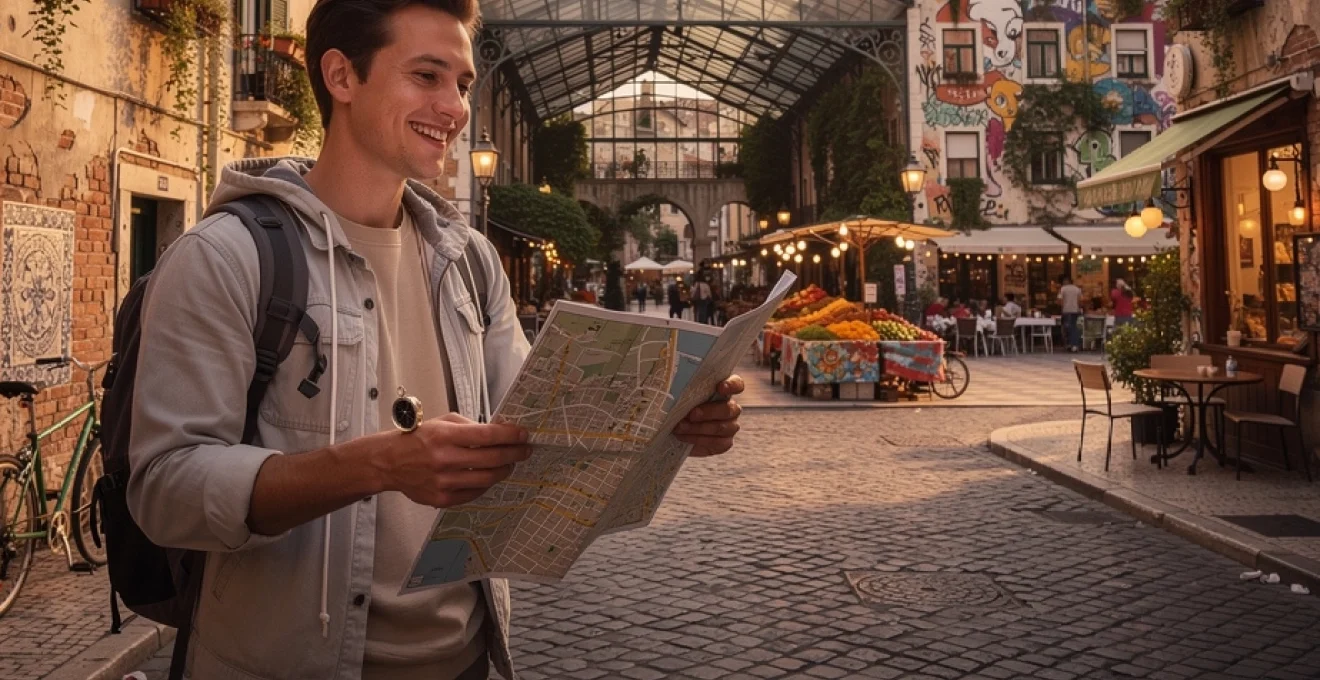
There’s something profoundly transformative about finding yourself disoriented in an unfamiliar city, where street names blur into incomprehensible symbols and your internal compass spins uselessly. In an era dominated by GPS navigation and algorithmically-optimised travel itineraries, the experience of genuine urban disorientation has become increasingly rare—and consequently, more valuable. When you deliberately set aside your smartphone and surrender to the uncertainty of unmapped streets, you open yourself to a form of travel that engages not just your sense of direction, but your capacity for spontaneity, cultural immersion, and self-discovery. This isn’t about careless wandering or reckless abandon; rather, it’s about cultivating a deliberate vulnerability that allows cities to reveal themselves on their own terms, beyond the carefully curated highlights of guidebooks and social media feeds.
Psychological mechanisms behind urban wayfinding and spatial disorientation
Understanding why getting lost can be both distressing and exhilarating requires examining the cognitive processes that underpin our navigation abilities. The human brain possesses remarkable spatial intelligence, yet this same capability can create unexpected psychological responses when confronted with environmental uncertainty.
Cognitive mapping theory and environmental legibility in unfamiliar territories
Your brain continuously constructs mental maps of spaces you navigate, a process first articulated by psychologist Edward Tolman in the 1940s. These cognitive maps aren’t simply visual representations—they incorporate sensory information, emotional associations, and spatial relationships that help you understand and predict your environment. In familiar territory, these maps operate seamlessly, allowing you to navigate almost unconsciously. However, in foreign cities, particularly those with low environmental legibility (unclear visual cues and confusing layouts), your cognitive mapping system struggles to establish coherent spatial frameworks. This cognitive strain triggers both stress responses and heightened attention, creating the paradoxical experience of feeling simultaneously anxious and intensely present.
The role of dopamine and Novelty-Seeking behaviour in exploratory navigation
When you encounter novel environments, your brain releases dopamine, the neurotransmitter associated with reward anticipation and motivation. Research conducted at University College London found that exploration of unfamiliar spaces activates the same neural circuits associated with reward processing, explaining why getting lost can feel strangely satisfying despite initial anxiety. This novelty-seeking behaviour is hardwired into human cognition, an evolutionary adaptation that encouraged our ancestors to explore new territories for resources. Modern urban exploration taps into this ancient drive, providing psychological rewards that sedentary, predictable routines cannot match. The uncertainty of not knowing what lies around the next corner creates anticipation that keeps your attention fully engaged with your surroundings.
Stress reduction through deliberate dérive and psychogeographic wandering
The Situationist concept of dérive—meaning “drift” in French—describes purposeless wandering guided by emotional responses to urban landscapes rather than practical destinations. Studies on walking meditation and mindful movement demonstrate that unstructured ambulatory activities significantly reduce cortisol levels and activate parasympathetic nervous system responses. When you adopt a dérive approach to urban exploration, you essentially engage in a moving meditation, where the act of walking becomes more important than arriving anywhere specific. This psychological reframing transforms potential stress into opportunity, converting navigation anxiety into exploratory curiosity. The key distinction lies in intentionality: choosing to be temporarily lost differs fundamentally from accidentally becoming disoriented.
Flow state achievement during unstructured urban exploration
Psychologist Mihaly Csikszentmihalyi’s concept of “flow”—complete absorption in an activity—typically requires clear goals and immediate feedback. Interestingly, urban wandering can induce similar states despite lacking conventional objectives. When you’re navigating unfamiliar streets without digital assistance, your attention narrows to environmental reading: interpreting architectural cues, observing pedestrian patterns, and making continuous micro-decisions about direction. This sustained, moderate-level cognitive challenge creates conditions conducive to flow states, particularly when you’ve released attachment to specific outcomes. The result is a form of active meditation where consciousness merges with the experience of movement through space, producing the paradoxical sensation of being simultaneously lost and found.
Architectural morphology and street design that encourage spontaneous discovery
The sensation of getting lost in a foreign city is never just about your internal sense of direction; it is also shaped by the city’s physical form. Street patterns, block sizes, sightlines and even pavement textures quietly influence how you move, where you pause, and what you notice. Urban morphology—the study of how cities are physically structured—helps explain why some places feel like endless mazes while others seem almost impossible to get lost in. When we talk about the quiet joy of urban disorientation, we are often talking about the interplay between your cognitive map and the city’s underlying design.
Medieval quarter labyrinthine patterns in barcelona’s gothic district and venice’s calli
Medieval districts such as Barcelona’s Gothic Quarter or Venice’s calli exemplify street networks that almost invite you to surrender control. Their irregular, pre-modern layouts were shaped less by top-down planning than by centuries of incremental building, land subdivision and defensive needs. Narrow alleys, sudden dead ends and surprising little plazas create a constantly shifting field of visual information, forcing your brain to update its cognitive map with every turn. This type of labyrinthine pattern naturally slows you down, enhances sensory engagement, and increases the likelihood of stumbling upon hidden courtyards, local bodegas or a quiet campo where children are playing football.
In Venice, the absence of cars amplifies this effect: your pace becomes human rather than vehicular, and the city’s acoustic character—lapping water, distant church bells, snippets of conversation—becomes part of your wayfinding system. You might navigate by the smell of fresh pastries or the sound of a vaporetto horn rather than by any formal street hierarchy. In Barcelona’s Gothic District, the contrast between shadowed, almost tunnel-like alleys and sudden shafts of sunlight in open squares creates strong emotional waypoints. Even if you are technically lost, these sensory markers become anchors in your mental representation of the city, making the unfamiliar feel progressively more legible without ever fully losing its mystery.
Organic growth urban planning versus grid systems: tokyo’s shibuya and manhattan’s contrast
If medieval quarters are the archetypal maze, modern grid systems like Manhattan’s seem, at first glance, to be the opposite: rational, predictable, almost impossible to get lost in. Numbered streets and avenues, clear cardinal alignment and consistent block sizes support extremely efficient navigation. You can calculate distances, anticipate intersections and recover your bearings with a single glance at a street sign. Yet this same clarity can flatten the experience of wandering; the city becomes a spreadsheet rather than a story. Getting lost in Manhattan is less about not knowing where you are and more about deliberately ignoring the optimal route in favour of side streets, pocket parks and unplanned detours.
By contrast, districts like Shibuya in Tokyo embody a hybrid condition. The wider city may have structured arteries and rail hubs, but at street level Shibuya’s organic patchwork of lanes, staircases and layered commercial spaces feels more like a vertical labyrinth. Multiple levels of transport infrastructure, underground malls and second-floor cafés create a three-dimensional puzzle for your cognitive map. You might exit a train station on one side, re-enter on another, and emerge someplace entirely unexpected, even if you have visited before. This blend of partial order and local chaos generates a particularly rich environment for exploratory navigation, where you can feel both reassured by frequent signage and pleasantly disoriented by the fine-grain complexity just beyond the main crossroads.
Pedestrian-friendly infrastructure and walkability indices in copenhagen and amsterdam
While street pattern matters, so does how easily you can move through it on foot. Cities like Copenhagen and Amsterdam consistently rank high on global walkability indices due to their dense networks of sidewalks, cycle lanes and traffic-calmed streets. For a traveller, this pedestrian-friendly infrastructure lowers the perceived risk of getting lost. When you know that almost any route you choose will be safe, well-lit and accessible, you feel more comfortable deviating from the main path. The joy of getting lost in a foreign city is closely tied to this baseline of safety and comfort.
In Copenhagen, for example, generous pavements, clear crossings and a human-scale built environment make strolling without a tight plan feel natural. You can drift from lakeside paths to side streets lined with bakeries and design shops, confident that you will eventually encounter a metro stop or a recognisable landmark like the Round Tower. Amsterdam’s canal belts create a different but equally distinctive navigational logic: concentric water rings and radial streets function almost like a topographic contour map. Even when you are disoriented, you intuitively understand whether you are moving inward toward the historic core or outward toward quieter residential areas. This combination of legible macro-structure and fine-grain pedestrian priority sets ideal conditions for low-stress, high-reward urban wandering.
Hidden courtyards, passageways and architectural surprises in paris’s passages couverts
Some of the most memorable experiences of being lost arise not from the main street network but from semi-hidden layers: courtyards, covered passages and back alleys. Paris’s passages couverts—19th-century glass-roofed arcades—are a perfect example. Often tucked behind unassuming façades, they function as parallel micro-cities, with their own rhythms of light, sound and commercial life. Stepping into one from a busy boulevard can feel like entering a time capsule, where second-hand bookshops, antique print sellers and old cafés coexist under a canopy of coloured glass. These liminal spaces gently detach you from both the outside grid and your mental schedule, encouraging lingering rather than linear movement.
Architecturally, passages and courtyards disrupt straightforward wayfinding by offering alternate routes that may or may not reconnect with the main streets. Yet this very uncertainty is what makes them so potent for travellers seeking deeper immersion. When you choose a nondescript doorway or follow a set of worn steps “just to see where they go,” you practise a form of micro-adventure. Over time, your cognitive map expands not as a tidy diagram but as a layered palimpsest of shortcuts, sheltered spots and personal landmarks. In this sense, architectural surprises are not just picturesque backdrops; they are active participants in how you lose and find yourself in the city.
Digital detox strategies and analogue navigation techniques for deeper immersion
In many contemporary cities, the greatest barrier to the experience of being lost is not urban design but the smartphone in your pocket. Real-time GPS mapping, step-by-step directions and algorithmic recommendations reduce uncertainty to near zero. While these tools are undeniably useful, they can also insulate you from the subtle cues that make a foreign city feel alive. Intentional digital detox strategies—especially around navigation—can restore a sense of presence, curiosity and vulnerability. By relearning analogue wayfinding skills, you transform getting lost from a failure of planning into a conscious travel technique.
Paper map reading skills and topographic orientation methods
Unfolding a paper map in a foreign city is almost an act of rebellion in the age of GPS. Yet this analogue tool encourages a different relationship with space. Instead of following a blue dot along a dictated route, you see the entire district at once: rivers, parks, main avenues and side streets. This birds-eye perspective supports topographic orientation, where you understand not just how to get from A to B, but how neighbourhoods connect and how the city is structured as a whole. You begin to notice patterns—like how certain streets parallel a canal or how hills cluster in one direction—that never appear on a small phone screen.
Practically, reading a paper map in a foreign city involves a few simple but powerful habits. First, orient the map to match your surroundings, rotating it so that what is “up” on the page corresponds to what is in front of you. Second, use prominent features such as rivers, major squares or railway lines as fixed reference points. Finally, treat the map as a strategic tool rather than a constant crutch: consult it at junctions or during short breaks, then put it away and allow yourself to walk several blocks without checking. This alternating rhythm of planning and free movement balances security with serendipity.
Compass-based wayfinding and cardinal direction awareness
Most of us rely on visual landmarks, but cultivating cardinal direction awareness adds an extra layer of resilience to your sense of place. A simple, inexpensive compass—or even the compass function on your phone used offline—can help you maintain a basic orientation even when streets twist unpredictably. Knowing that your accommodation lies roughly northwest, for example, gives you a general heading to drift toward, even as you detour through markets or side alleys. This macro-directional awareness reduces the fear that you might be walking in circles, making it psychologically easier to explore unfamiliar routes.
You can strengthen this skill by paying attention to environmental cues: the position of the sun, prevailing wind patterns, or the flow of traffic on major roads. In many cities, rivers also provide a directional anchor; in Budapest, for instance, simply knowing which bank of the Danube you are on significantly narrows down your possible location. Over time, this habit of cross-referencing internal and external cues trains your brain to build richer, more stable cognitive maps. Instead of being passively guided, you become an active navigator, even when your goal is, paradoxically, to remain a little bit lost.
Landmark recognition memory and visual anchoring techniques
One of the most practical analogue navigation techniques is deliberate landmark recognition. Rather than letting your gaze drift aimlessly, you consciously select distinctive features—an Art Deco cinema sign, a café with a bright yellow awning, a mural, a fountain—as visual anchors. On the way out, you store these details as waypoints; on the way back, you look for them as confirmation that you are retracing or intersecting your path. This technique transforms an intimidatingly anonymous streetscape into a sequence of memorable scenes, each tied to a particular turn or decision.
To strengthen landmark memory, you can use small mental hooks. Turn the green pharmacy cross into “the corner where the old man was reading a newspaper,” or the cracked stucco façade into “the house with the ivy that looks like a dragon.” These narrative associations are easier to recall than purely geometric information like distance and angle. They also enrich your travel experience: by noticing and naming details, you become more attuned to local textures, colours and everyday life. In effect, you are building your own personalised guidebook as you walk, one anchored not in ratings or algorithms but in lived, embodied experience.
Serendipitous encounters and authentic cultural immersion through aimless wandering
When you loosen your grip on precise navigation, space opens up not only in your schedule but in your social and cultural experience. Aimless wandering creates conditions for serendipitous encounters—the unplanned conversations, tastes and observations that rarely make it into itineraries but often define our most vivid memories of a foreign city. Without the constant pressure to “get to the next thing,” you become more available to what is already happening around you. How often, while following a blue line on a screen, have you walked straight past the most interesting part of the street?
Local market discovery in istanbul’s kadıköy and mexico city’s mercado de la merced
Traditional markets are some of the richest environments for authentic cultural immersion, and they are frequently discovered not by targeted search but by following sounds, smells and clusters of people. In Istanbul’s Kadıköy district, you might begin with the vague intention of reaching the ferry terminal, only to be drawn sideways by the call of fishmongers, the clatter of plates in a lokanta, or the glitter of spice mounds under bare light bulbs. The market streets unfurl gradually, revealing cheese stalls, olive sellers, pickled vegetables and narrow cafés where locals linger over tea. Getting lost here is less about physical disorientation and more about willingly surrendering your original plan in favour of sensory exploration.
Similarly, Mexico City’s Mercado de la Merced is vast enough that any first-time visitor will inevitably lose track of their exact route. Hall after hall of fruits, chiles, household goods and street food create a labyrinth of colour and noise. Yet this complexity facilitates micro-experiences that no guidebook can choreograph: sampling a fruit you cannot name, watching a butcher at work, or being taught the difference between several varieties of mole. By moving slowly, asking questions where language allows, and accepting that you may exit the market far from where you entered, you allow the city’s food culture to imprint itself on your senses and memory.
Neighbourhood cafés and third space interaction in melbourne’s laneways
Urban sociologist Ray Oldenburg described “third places”—informal social spaces like cafés and bars—as vital to community life. For travellers, these third spaces are also crucial for meaningful, low-stakes interaction with locals. Melbourne’s laneways illustrate how aimless wandering can lead you into exactly such environments. Often hidden between larger streets, these narrow corridors are packed with small coffee shops, street art and tiny eateries. You might duck into one simply to escape the wind and end up chatting with a barista about neighbourhood history or getting recommendations that no generic “top 10 list” would ever include.
Because third spaces are designed for lingering rather than rushing, they support the kind of unhurried curiosity that getting lost fosters. Sitting alone at a corner table, you can observe local rituals: how long people take for coffee, what they order, how they greet the staff. Perhaps someone asks where you are from, or you ask about the mural visible from the window. These seemingly small interactions create a sense of connection that formal tours rarely replicate. The city shifts from being a stage set you walk through to a social ecosystem you briefly, respectfully inhabit.
Street art trails and graffiti clusters in berlin’s kreuzberg and buenos aires’s palermo
Street art thrives in the in-between spaces of cities—on the backs of warehouses, along railway lines, down side streets away from commercial storefronts. Neighbourhoods like Kreuzberg in Berlin or Palermo in Buenos Aires are famous for their murals and graffiti clusters, yet the most interesting works are often off the main routes. Deliberately choosing not to follow a prescribed “street art tour” can lead you to unexpected courtyards, community gardens, or abandoned industrial structures repurposed as cultural centres. Each mural or tag becomes both a piece of visual culture and a navigational breadcrumb.
Engaging with street art also nudges you into a different kind of attentiveness. Instead of scanning for shops or attractions, your gaze lifts to upper walls, underpasses and doorways. You begin to notice stylistic signatures, recurring characters, political messages layered over each other like palimpsests. In this way, getting lost turns into a participatory reading of the city’s unofficial narratives. You may never learn the full story behind a particular piece, but the very act of searching for and noticing it deepens your relationship with the neighbourhood, grounding you in its evolving creative life rather than its fixed monuments.
Spontaneous festival participation and community events in lisbon’s alfama district
Temporal serendipity—stumbling into events you did not know were happening—is another reward of unscripted exploration. Lisbon’s Alfama district, with its steep alleys and intimate squares, becomes especially alive during local festivals such as the Festas de Lisboa in June. You might set out simply to reach a viewpoint over the Tagus and find yourself instead following the sound of live fado, the smell of grilled sardines, or the glow of coloured lanterns strung across staircases. Without a fixed timetable, you are free to pause, listen, eat and talk, effectively weaving yourself into the festival’s fabric, even if only for an evening.
These spontaneous participations reveal aspects of local culture that scheduled sightseeing often misses: how neighbours interact, how traditions are maintained, how music and food shape communal identity. They also gently challenge the notion that “authenticity” can be planned. You did not come to Alfama to tick off an item called “experience local festival”; you came to walk, and the festival found you. In that sense, getting lost acts as a quiet act of trust—trust that if you give up a bit of control, the city will offer you something meaningful in return.
Temporal dimensions of urban exploration and chronotopic variations
Being lost in a foreign city is not just a spatial experience; it is also profoundly temporal. The same street can feel like an entirely different world depending on the time of day, the season, or even the weather. Literary theorist Mikhail Bakhtin used the term chronotope to describe how time and space intersect in narrative; something similar happens in cities. Morning markets, midday office crowds, twilight promenades and late-night gatherings each generate distinct atmospheres. By varying when you wander—not only where—you expand the range of urban moods you inhabit.
Golden hour wandering and natural light effects on architectural perception
The period just after sunrise or before sunset—often called the “golden hour”—is famed among photographers for its warm, angled light. For urban explorers, this time offers more than pretty photos; it fundamentally alters how you perceive architecture and streetscapes. Long shadows emphasize textures in stone and brick, narrow alleys glow with reflected colour, and even anonymous façades gain depth. If you allow yourself to get lost during golden hour, you may discover that a neighbourhood you found unremarkable at noon becomes suddenly cinematic, like a film set waiting for its characters.
Light also acts as a natural guide. Sunlit streets feel inviting, while darker ones recede, subtly shaping your route choices without the need for conscious planning. This can lead you into residential areas just as people are returning home, or toward waterfronts where locals gather to watch the sunset. Have you ever noticed how much easier it is to approach a viewpoint or linger on a bench when the light feels gentle rather than harsh? By aligning your unstructured walks with these daily light cycles, you not only see cities at their visual best, you also synchronise your internal rhythm with their diurnal pulse.
Night-time navigation and nocturnal urban transformation in marrakech’s jemaa el-fnaa
Some urban spaces reveal their true character only after dark. Marrakech’s Jemaa el-Fnaa, for instance, undergoes a dramatic nocturnal transformation. What may seem like an open, relatively quiet square in the late afternoon becomes, by night, a dense, pulsating theatre of food stalls, storytellers, musicians and crowds. Getting a little lost in the alleys feeding into the square—while maintaining sensible safety precautions—can be one of the most immersive ways to experience this shift. The sensory overload of smoke, drums, lantern light and overlapping voices challenges your usual navigational cues, forcing you to rely on sound, smell and crowd movement as much as on visual landmarks.
Navigating at night also introduces a different emotional palette. Without the clarity of daylight, even familiar streets can feel mysterious, perhaps slightly uncanny. This ambiguity is not inherently negative; in measured doses, it can heighten awareness and make small discoveries—a quiet courtyard, a late-opening bakery, a group of neighbours chatting on a stoop—feel particularly intimate. The key is to calibrate your level of risk: stick to areas with sufficient lighting and foot traffic, let someone know your general plans, and trust your instincts. When done thoughtfully, night-time wandering can reveal layers of urban life that remain invisible under the sun.
Seasonal variations and weather-dependent route selection
Seasonality exerts a powerful influence on how and where you choose to wander. In winter, you may seek covered passages, arcades and cosy cafés, turning bad weather into an excuse to explore interior public spaces such as galleries, train stations or indoor markets. In summer, shaded streets, riverside promenades and parks suddenly become more appealing. The very routes you select are thus co-authored by temperature, rainfall and wind, adding an extra dimension of unpredictability to your urban experience. A sudden shower might push you into a small museum you had never heard of, or a heatwave might steer you down a tree-lined canal path instead of a busy avenue.
These weather-driven detours are not just practical adjustments; they also shape mood and memory. A snow-dusted square, a foggy riverside, a street glittering with reflections after rain—each etches a different emotional tone into your cognitive map. Over time, your recollection of the city becomes seasonal, like chapters aligned with specific climates: “the January of fog,” “the April of sudden storms,” “the September of dry heat.” By embracing, rather than resisting, these meteorological influences, you allow the city to surprise you not only in where you end up, but also in how it feels to be there.
Safety protocols and situational awareness during unplanned urban routes
Romanticising the joy of getting lost should not obscure the reality that some forms of disorientation can be unsafe, especially in unfamiliar environments. The goal is not reckless abandonment of caution, but a calibrated openness supported by clear safety protocols. With a few simple habits, you can protect yourself while still leaving room for serendipity. Think of it as setting the parameters for a safe experiment: within those boundaries, you can afford to explore more freely.
First, research basic safety information about neighbourhoods before you arrive, using multiple sources rather than relying on a single review or forum. Note any areas that locals advise avoiding after dark, and respect that advice even if you are curious. Second, share your general plans and accommodation details with someone you trust, and keep a physical copy of your address in case your phone battery dies. Third, pay attention to the “energy” of a street: if shops are shuttered, lighting is poor and you feel watched rather than simply noticed, consider turning back or choosing a busier parallel route. Your intuition is a valuable tool; if something feels off, you do not need to justify changing course.
On a more practical level, carry only what you need for the day, keep valuables close to your body, and avoid displaying expensive cameras or jewellery in areas known for petty theft. If you do become seriously disoriented, step into a café, hotel lobby or shop to regroup rather than standing on a deserted corner with your map. Asking for directions from staff in such semi-public spaces is usually safer than flagging down the first passer-by. Finally, consider setting digital “guardrails”: download offline maps before you go, and use them only as a backup when necessary, so that you can experiment with analogue navigation without being vulnerable if you truly lose your bearings.
Reflective documentation methods: photography, journaling and memory consolidation
The experiences you have while lost in a foreign city gain depth when you take time to process and record them. Reflective documentation—through photography, journaling, sketching or audio notes—helps consolidate memories and make sense of the emotions stirred up by spatial disorientation. It is one thing to feel a moment of awe or anxiety in a hidden alley; it is another to revisit that moment later and understand what it revealed about your relationship to uncertainty, control and curiosity. In this way, getting lost becomes not just an episode but a source of long-term personal insight.
Photography can serve both as a creative outlet and as a subtle mapping tool. Instead of chasing postcard-perfect shots, you might photograph the small details that helped you navigate: the corner bakery where you turned left, the peculiar balcony that marked your shortcut, the street art that signalled you were close to your guesthouse. Later, reviewing these images allows you to reconstruct your route and re-experience the day’s wanderings. Journaling, whether on paper or in a notes app, complements this visual record by capturing impressions that cannot be photographed: snippets of conversation, smells, sounds, fleeting fears and quiet satisfactions.
To deepen the reflective process, you might occasionally sketch a rough map of where you think you walked, then compare it to an actual map afterwards. Where did your perception exaggerate distances, compress them, or distort directions? Noticing these discrepancies is like peeking under the hood of your own cognitive mapping system. Over time, recurring themes may emerge in your notes: perhaps you are repeatedly drawn to riverfronts, markets or high vantage points; perhaps you often feel anxious at first and then gradually relax. Recognising these patterns can inform how you design future trips, helping you strike your own balance between safety and spontaneity, structure and surrender.
Ultimately, the quiet joy of getting lost in a foreign city lies not only in the moment of wandering, but in the stories and self-knowledge that crystallise afterwards. By taking the time to document and reflect, you ensure that those aimless afternoons and unexpected detours become part of your internal landscape—a personal atlas not just of places visited, but of the person you were while you walked them.