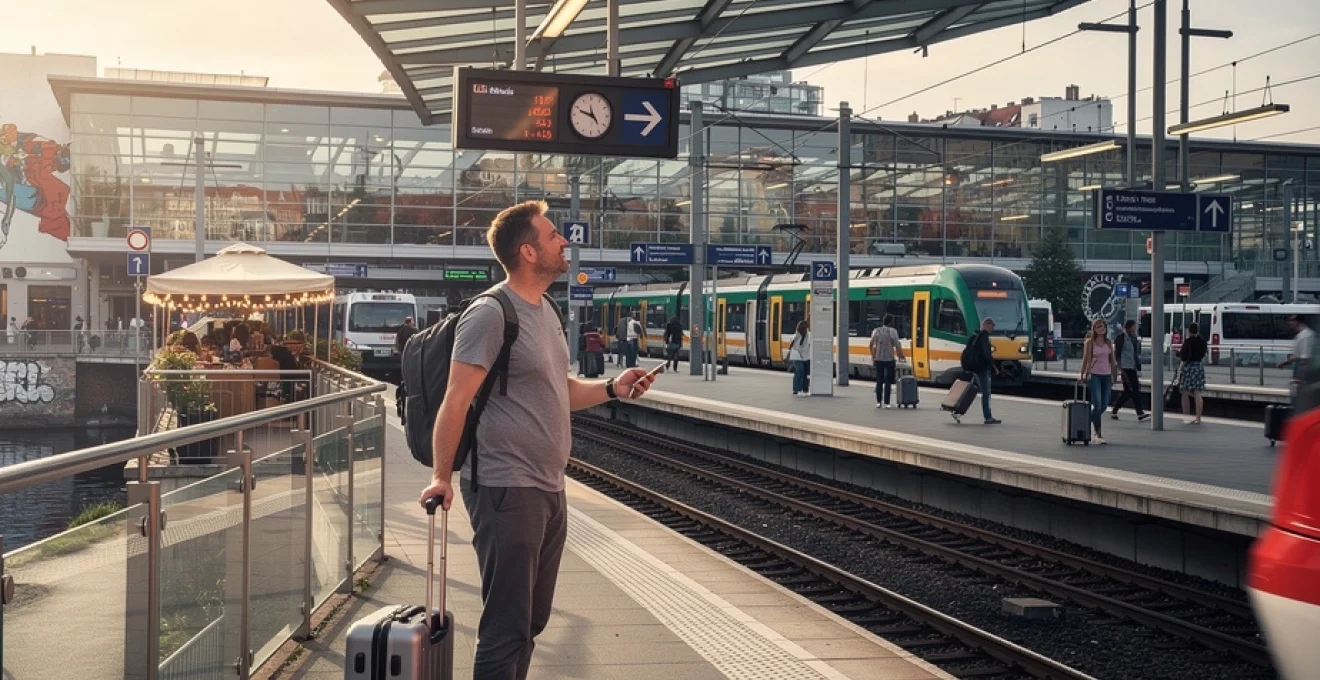
Standing on Platform 7 at Berlin’s Schlesischer Bahnhof, watching the RE1 to Potsdam pull away without you aboard, triggers an instant cascade of emotions. Your heart races, your mind immediately calculates the cost of this mishap, and you feel that familiar grip of anxiety tightening around your chest. Yet what begins as a seemingly catastrophic moment can transform into one of the most valuable lessons in modern travel philosophy. The art of slow travel isn’t merely about choosing trains over planes or spending weeks rather than days in a destination; it’s fundamentally about recalibrating your relationship with time, expectations, and the unexpected detours that invariably reshape our journeys. This single missed connection in Germany’s capital became a turning point that challenged deeply ingrained assumptions about efficiency, productivity, and what it truly means to experience rather than simply traverse a place.
The schlesischer bahnhof incident: how missing the RE1 to potsdam changed my travel philosophy
The morning started with meticulous planning. The journey from Schlesischer Bahnhof to Potsdam had been mapped out with Germanic precision, allowing exactly seven minutes for platform transfer and train boarding. Deutsche Bahn’s reputation for punctuality had fostered a false sense of security. When the U-Bahn from Friedrichshain arrived three minutes late due to signal delays, those carefully calculated margins evaporated instantly. By the time you reach the platform, breathless from sprinting up stairs with luggage, the red tail lights of the RE1 are already disappearing toward Charlottenburg.
What happened next defied every instinct cultivated through years of modern travel culture. Instead of immediately checking the DB Navigator app for the next connection, instead of calculating lost time and missed appointments, there was a moment of surrender. This wasn’t resignation or defeat, but rather an unexpected release from the tyranny of the timetable. The next RE1 departure wouldn’t be for another forty-three minutes. Suddenly, nearly an hour of unscheduled, unplanned, gloriously empty time materialised in the middle of a carefully orchestrated itinerary.
This incident crystallised a fundamental truth about contemporary travel: our obsession with optimisation often eclipses the very experiences we journey to find. Travel content creators and guidebooks promote maximising every moment, seeing every landmark, and extracting maximum value from minimum time. Yet this approach transforms exploration into an exhausting checklist. The missed train forced a confrontation with this productivity mindset, revealing how much anxiety accompanies our attempts to control and schedule spontaneity itself. The irony is profound: in our determination to experience more, we often experience less.
Psychological triggers of travel anxiety: understanding the urgency mindset at berlin hauptbahnhof
Major transportation hubs like Berlin Hauptbahnhof function as pressure cookers for travel anxiety. The architectural grandeur of Europe’s largest railway station, with its glass cathedral ceiling and multiple levels of platforms, creates a disorienting environment where thousands of travellers navigate complex itineraries simultaneously. Understanding the psychological mechanisms that amplify stress in these environments provides insight into why a missed connection feels so catastrophic.
Time pressure psychology in Multi-Modal transport hubs
Research in environmental psychology demonstrates that large transit facilities activate specific stress responses through sensory overload and spatial complexity. Berlin Hauptbahnhof handles over 300,000 passengers daily across fourteen platforms spanning three levels. This architectural complexity triggers what psychologists call “cognitive load,” where your brain must process multiple information streams simultaneously. Departure boards flash constantly changing information, multilingual announcements echo through vast spaces, and the visual chaos of crowds moving in different directions creates a baseline anxiety that makes any disruption feel more severe than it objectively is.
The FOMO effect: why travellers rush through deutsche bahn connections
The Fear of Missing Out transcends social media and permeates physical travel experiences. When you miss a scheduled train, you’re not just losing transportation; you’re potentially sacrificing experiences you’ve anticipated, planned for, and invested in emotionally. This psychological phenomenon intensifies in destination-rich environments like Berlin, where guidebooks promise unmissable experiences at every corner. The Brandenburg Gate, the Reichstag, Museum Island,
Island, and the East Side Gallery become symbols of what you’re supposedly losing with every delayed departure.
This FOMO effect is exacerbated by the way many of us now structure our trips. We stack tightly scheduled walking tours, time-stamped entry tickets, and restaurant reservations into an intricate puzzle that leaves little margin for improvisation. When one piece—like a train from Schlesischer Bahnhof—falls out of place, the entire structure feels threatened. You are not just late; you feel as though you are failing at travel itself. In this mindset, every minute spent waiting on a platform at Berlin Hauptbahnhof feels like a minute stolen from the “real” experiences beyond the station walls.
Cortisol response patterns during missed transport scenarios
Physiologically, the body responds to travel disruptions much like it responds to other perceived threats. When you realise the RE1 doors are closing without you, your hypothalamus signals your adrenal glands to release cortisol and adrenaline. This stress cocktail sharpens focus in the short term but also narrows your perspective, making it harder to see alternative routes or creative options. You become locked into tunnel vision, fixated on the one train you’ve missed rather than the network of possibilities still available.
Studies on commuter stress in European capitals show that unexpected delays can raise cortisol levels by up to 50% compared with baseline commuting days. In a bustling node like Alexanderplatz or Berlin Hauptbahnhof, this hormonal surge interacts with noise, crowding, and spatial confusion, compounding the feeling of crisis. The result is a psychological spiral where you catastrophise minor setbacks, imagining ruined weekends, wasted tickets, or awkward explanations to friends waiting in Potsdam. Recognising that much of this reaction is biochemical—not rational—is the first step toward reclaiming calm on the platform.
Cultural conditioning: Anglo-Saxon punctuality versus continental flexibility
Layered onto this physiological response is a powerful cultural script about time and punctuality. Travellers from Anglo-Saxon cultures—particularly the UK, US, Canada, and Australia—often internalise an almost moral attachment to timeliness. Being “on time” is equated with respect, professionalism, and competence, while delays feel like personal failings. When such travellers encounter more flexible attitudes to time on the continent, the clash of expectations can generate disproportionate frustration.
Germany complicates this dynamic because its stereotype of clockwork precision masks a more nuanced reality. While Deutsche Bahn aims for punctuality, its long-distance trains have hovered around 65–75% on-time performance in recent years, meaning delays are far from rare. In southern Europe, where a five- or ten-minute delay may barely raise an eyebrow, Anglo-Saxon travellers can feel as though their entire worldview is being challenged. The crucial mental shift is to recognise that no one culture has a monopoly on “correct” timekeeping. When you miss a connection at Schlesischer Bahnhof, you are not failing; you’re being invited—albeit unwillingly—into a different relationship with time.
Spontaneous itinerary restructuring: turning transport failures into discovery opportunities
Once the initial wave of cortisol and cultural guilt recedes, a missed train reveals an alternative reality: an unexpected pocket of time embedded in the urban fabric. In Berlin, this often means you are within walking distance—or a short BVG ride—of neighbourhoods you might otherwise speed past underground. What if, instead of treating delays as dead time, you approached them as prompts for micro-adventures? The day you miss the RE1 to Potsdam can become the day you finally explore Kreuzberg’s canals or Friedrichshain’s side streets.
Spontaneous itinerary restructuring does not mean abandoning all plans or embracing chaos for its own sake. Rather, it means adopting a flexible framework where core objectives remain, but routes and timing can adapt to circumstances on the ground. This approach turns you from a passive victim of disruptions into an active co-creator of your journey. It is the difference between sitting rigidly on a bench, counting minutes, and wandering out of the station to discover a café, a courtyard, or a riverside promenade you will remember long after the exact train time has faded.
Alternative routes through kreuzberg and friedrichshain districts
Schlesischer Bahnhof and nearby Ostbahnhof sit at a fascinating junction between Friedrichshain and Kreuzberg, two districts that encapsulate Berlin’s layered identity. Miss the RE1, and suddenly alternative routes open up: the S-Bahn to Warschauer Strasse, a tram along Mühlenstrasse, or a leisurely walk across the Spree via the Oberbaumbrücke. Each detour transforms a simple transfer into an unplanned urban exploration of East Berlin’s creative heart. Instead of a sterile wait, you find yourself threading through graffiti-lined underpasses and leafy canal paths.
From Warschauer Strasse, you might wander into the side streets of Friedrichshain, where pre-war Altbau façades hide record shops, vintage stores, and third-wave coffee roasters. Cross the bridge into Kreuzberg, and the aesthetic shifts: Turkish bakeries, smoky kebab stands, and co-working spaces fill the streets between Görlitzer Park and the Landwehr Canal. The beauty of re-routing through these districts is that you still move toward your destination—Potsdam or elsewhere—while layering your day with unexpected vignettes. A missed forty-minute connection becomes a lived geography lesson in Berlin’s post-reunification evolution.
Leveraging BVG local transit for unplanned urban exploration
Berlin’s BVG network—U-Bahn, S-Bahn, buses, and trams—offers a powerful antidote to the helplessness you may feel standing beside a departed regional train. With a standard AB or ABC ticket in your pocket, your mobility is rarely as constrained as it first appears. Instead of refreshing your Deutsche Bahn app every thirty seconds, you can pivot: an S-Bahn to Ostkreuz, a U1 ride along Skalitzer Strasse, or a tram skimming past the Spree. Each option is an invitation to treat the city itself as your destination, not just the place you pass through on the way to somewhere “more important.”
One practical strategy is to maintain a short mental (or written) list of low-effort micro-destinations near major transfer hubs. At Ostbahnhof, that might mean a stroll along the riverfront; at Alexanderplatz, a detour into the Nikolaiviertel; at Gesundbrunnen, a quick climb up to Humboldthain’s Flak Tower viewpoint. When delays arise, you already have a menu of short, self-contained explorations that fit into 30–60 minute windows. Suddenly, local transit disruptions stop being obstacles and start functioning as prompts for tiny, improvisational adventures that anchor your travel memories.
Stumbling upon markthalle neun: when delays lead to culinary serendipity
One of the most vivid examples of this improvisational mindset unfolded on a rainy Thursday after yet another missed connection. With forty minutes to spare and nothing but a BVG day ticket in hand, a spontaneous U1 detour to Görlitzer Bahnhof led to a short walk through backstreets and, unexpectedly, into the warmth of Markthalle Neun. This 19th-century market hall in Kreuzberg has become a focal point of Berlin’s contemporary food culture, hosting weekly events like Street Food Thursday and regional produce markets. Walking in dripping from the rain, the stress of the platform dissolved in the hum of conversation and the smell of baking bread.
Sitting at a communal table with a plate of handmade Maultaschen and a local craft beer, it was hard not to reflect on how often we deny ourselves such serendipity by clinging rigidly to timetables. Would you ever have carved out an hour for Markthalle Neun if everything had gone “according to plan”? Probably not. Yet that unplanned stop—not the eventual arrival in Potsdam—became the day’s defining memory. Culinary detours like this remind us that travel value cannot be measured only in checked-off landmarks or perfectly executed itineraries. Often, the most resonant moments emerge from the spaces between our scheduled activities.
Photography opportunities at the east side gallery during unexpected layovers
Another advantage of missed trains in Berlin is their proximity to one of the city’s most photogenic open-air museums: the East Side Gallery. Stretching 1.3 kilometers along the Spree between Ostbahnhof and Warschauer Strasse, this preserved segment of the Berlin Wall is covered in murals by artists from around the world. If you find yourself with half an hour to spare due to a delayed RE1 or S-Bahn disruption, a short walk from Schlesischer Bahnhof delivers you to a living canvas of historical memory and contemporary expression. For travel photographers, this is the kind of unscripted bonus that can transform a frustrating layover into a creative field session.
The shifting light along the river, reflections in puddles after rain, and the interplay of tourists, locals, and street performers create endlessly variable compositions. Because you did not plan this visit, you often arrive without the pressure of capturing specific “Instagram-famous” angles. Instead, you can wander, experiment, and respond to the scene as it unfolds, practicing a slower, more mindful approach to travel photography. In this sense, every missed connection becomes a potential invitation to sharpen your eye, deepen your historical understanding, and collect images that are both aesthetically compelling and emotionally anchored in the experience of delay.
The slow travel movement: principles from paul theroux and pico iyer applied to modern transit disruptions
The philosophy underpinning these improvised detours aligns closely with what writers like Paul Theroux and Pico Iyer have long advocated. Slow travel is not simply about moving at a reduced physical speed; it is about cultivating a deeper psychological presence in each stage of the journey. Theroux, famous for chronicling long-distance train journeys, often frames delays and discomfort not as inconveniences but as the raw material of narrative. The missed connection, the overcrowded carriage, the interminable wait in a border town station—these are the spaces where observation sharpens and character reveals itself.
Pico Iyer, meanwhile, writes about “the art of stillness” and the value of going nowhere. Applied to modern transit disruptions, his ideas encourage us to treat station platforms and airport gates as legitimate parts of the journey rather than empty interludes. When you miss the RE1 at Schlesischer Bahnhof, you can either rage against the schedule or accept this enforced pause as a chance to look more closely: at the architecture, at your fellow travellers, at your own internal monologue about time and control. In this way, slow travel becomes less about how far or how fast you move and more about the quality of attention you bring to each moment—especially the unplanned ones.
In an era of hyper-optimised city breaks and algorithmically generated itineraries, adopting Theroux and Iyer’s principles can feel almost countercultural. Yet they offer concrete benefits for modern travellers dealing with strikes, delays, and rerouted connections. You begin to plan journeys with built-in cushions, not just as insurance against missed trains but as deliberate spaces for wandering and reflection. You accept that unpredictability is not a flaw in the system but an intrinsic feature of travel. And perhaps most importantly, you shift your metric of success from “How much did I fit in?” to “How deeply did I experience what I encountered?”
Mindfulness techniques for transportation mishaps: adapting stoic philosophy in transit zones
If the slow travel movement offers a macro-level philosophy, mindfulness and Stoic thought supply the micro-level tools for dealing with real-time disruptions. Station platforms, departure halls, and cramped regional trains are not the environments we typically associate with meditation or reflective practice. Yet these liminal spaces are precisely where our beliefs about control, time, and self-worth come under pressure. How you respond in these moments can either reinforce a cycle of anxiety or initiate a new, more spacious relationship with travel uncertainty.
Stoic philosophers like Epictetus and Marcus Aurelius emphasised the distinction between what is within our control and what is not. Train timetables, signal failures, and sudden platform changes sit squarely in the second category. Your preparation, your breathing, your interpretation of events—those remain yours to shape. When you miss a connection at Berlin Hauptbahnhof, you are being presented with a laboratory for Stoic practice: can you accept the external fact of the missed train while retaining sovereignty over your internal narrative?
Viktor frankl’s meaning framework applied to travel setbacks
Viktor Frankl, the Austrian psychiatrist and Holocaust survivor, articulated a framework that dovetails powerfully with both Stoicism and mindful travel. In Man’s Search for Meaning, he argues that our primary human drive is not pleasure or power but meaning. Even unavoidable suffering, he suggests, can be transformed when we discover a purpose within it. Applied to travel mishaps, Frankl’s insight invites a simple but transformative question: “Given that this delay is happening and I cannot change it, what meaningful use can I make of this time?”
This reframing moves you from rumination (“Why does this always happen to me?”) to agency (“How might I grow or learn from this?”). Perhaps the meaning lies in observation: using the extra minutes to sketch, journal, or photograph the station environment. Perhaps it lies in connection: striking up a conversation with a fellow traveller or helping a confused visitor navigate the labyrinthine signage of Berlin Hauptbahnhof. Or perhaps the meaning is more inward: finally sitting still long enough to notice how tightly you have been gripping your schedule and asking whether that grip serves you. In each case, the missed train becomes not just an inconvenience but a small arena for practicing Frankl’s core insight about freedom of attitude.
Breathing exercises for platform stress at alexanderplatz station
Of course, philosophical reframing is easier to consider once the body’s acute stress response has softened. Simple breathing exercises can bridge this gap, offering practical tools you can deploy on a crowded platform at Alexanderplatz or in the echoing concourse of Hauptbahnhof. One accessible technique is the “4-6 breath”: inhale gently through the nose for a count of four, then exhale slowly through the mouth for a count of six. Extending the exhale stimulates the parasympathetic nervous system, counteracting the fight-or-flight surge triggered by a missed departure.
Another option, especially effective in noisy environments, is box breathing: inhale for four counts, hold for four, exhale for four, hold empty for four, then repeat. You can perform this while standing with your luggage, eyes resting on the departure board or the architectural grid of steel and glass above you. Within a few cycles, your heart rate begins to slow, your peripheral vision widens, and options that felt invisible a minute earlier come back into view. Breathing exercises do not change the timetable, but they change your capacity to navigate it with clarity and composure.
Cognitive reframing: from schedule adherence to experience maximisation
Once your nervous system is more settled, cognitive reframing becomes both possible and powerful. Most travel anxiety at Schlesischer Bahnhof or Alexanderplatz arises from an implicit equation: “Being on schedule = successful travel; being off schedule = failure.” Cognitive behavioural approaches invite you to challenge and rewrite such equations. What if, instead, your metric for success became “maximising meaningful experience within given constraints”? Suddenly, a 40-minute delay is not an empty void but an open bracket waiting to be filled.
One practical reframing technique is to ask, “If I had intentionally scheduled this extra time here, how would I choose to spend it?” Maybe you would walk out to the banks of the Spree, read a chapter of a book you’ve been neglecting, or simply sit and people-watch as cyclists weave through the forecourt outside Hauptbahnhof. This thought experiment shifts your stance from reluctant victim to deliberate curator of the moment. Over time, as you practice this mental pivot across multiple journeys, the grip of rigid schedule adherence loosens. You become more adaptable, less reactive, and more capable of harvesting meaning from whatever circumstances arise.
Long-term behavioural shifts: how single transit events reshape future travel planning strategies
A single missed RE1 at Schlesischer Bahnhof might seem trivial compared with the grand arc of a multi-country itinerary. Yet such incidents often function as catalysts, prompting lasting adjustments in how we plan and inhabit future journeys. Once you have tangibly experienced the upside of an unplanned wander through Friedrichshain or a serendipitous meal at Markthalle Neun, it becomes harder to justify itineraries that leave no room for similar discoveries. The memory of that initial panic softening into curiosity becomes a quiet argument in favour of building elasticity into your travel design.
Behaviourally, this might look like adding generous transfer buffers between Deutsche Bahn connections, not only to hedge against delays but to create potential windows for micro-explorations around major stations. You may start prioritising fewer destinations per trip, accepting that depth of experience in Berlin or Potsdam outweighs the bragging rights of ticking off an extra city. Budget-wise, you might allocate a small contingency fund explicitly labelled “serendipity”—money earmarked for the unexpected café, gallery, or ferry ride that appears when plans shift. These are not merely planning hacks; they are manifestations of a new travel philosophy that treats time as a medium for experience rather than a constraint to be conquered.
On a psychological level, repeated practice with reframing delays can recalibrate your baseline response to uncertainty, both on the road and at home. The same skills you use to navigate missed trains in Berlin—breath awareness, Stoic acceptance, meaning-making in small moments—translate to flight cancellations, traffic jams, and even workplace disruptions. Over months and years, you may notice a quieter ego around punctuality, a greater willingness to say, “We’ll get there when we get there, and we’ll make something of where we are now.” In this sense, that morning on Platform 7 becomes more than a minor travel anecdote. It becomes a hinge moment, nudging you toward a slower, more attentive way of moving through both foreign cities and familiar routines.