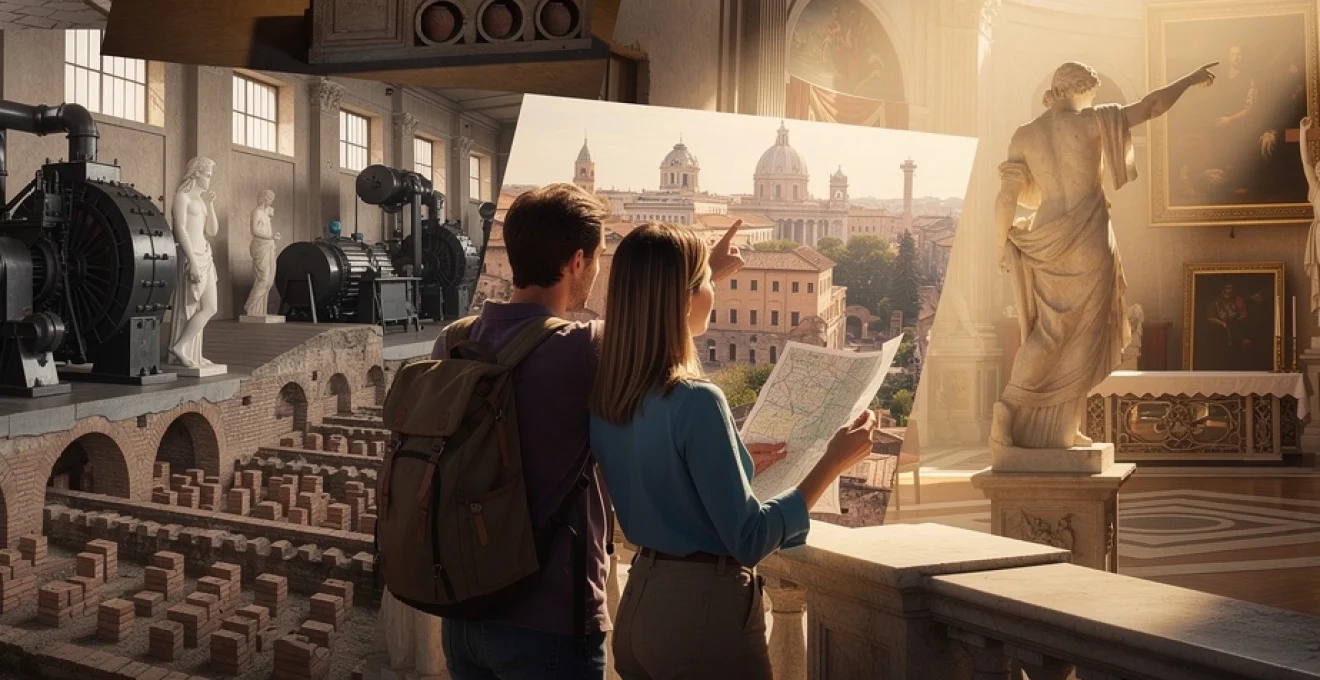
Rome presents an extraordinary paradox for first-time visitors. While millions flock to the Colosseum, Trevi Fountain, and Vatican Museums each year, they often bypass equally magnificent treasures hidden in plain sight throughout the Eternal City. The challenge isn’t finding things to see—Rome overflows with historical wealth—but rather discovering the authentic experiences that transform a standard tourist visit into genuine cultural immersion. Beyond the selfie queues and tour group bottlenecks lies a Rome where ancient engineering marvels sit beneath modern power stations, where Caravaggio masterpieces hang in quiet churches, and where traditional Roman cuisine survives in neighbourhood trattorias untouched by mass tourism.
Understanding what most visitors overlook requires recognising a fundamental truth about Rome: the city’s greatest assets aren’t always its most promoted attractions. First-time visitors typically allocate their limited time following well-worn paths, unaware that stepping slightly off these routes reveals experiences far more memorable than photographing yet another crowded monument. This isn’t about avoiding major landmarks—the Sistine Chapel and Roman Forum absolutely deserve their reputations—but rather about supplementing these obligatory stops with discoveries that provide deeper insight into Rome’s layered history and living culture.
Lesser-known ancient roman sites beyond the colosseum and forum
The Roman Forum and Colosseum rightfully dominate ancient Rome itineraries, but focusing exclusively on these sites means missing archaeological treasures that offer equally compelling glimpses into Roman civilisation. These overlooked locations frequently provide advantages beyond their historical significance: smaller crowds, more contemplative viewing conditions, and often superior preservation of original architectural details and decorative elements.
Centrale montemartini: industrial archaeology meets classical sculpture
Centrale Montemartini represents one of Rome’s most innovative museum concepts, housing Greek and Roman sculptures within a decommissioned early-20th-century power plant. The juxtaposition creates an unexpectedly harmonious dialogue between industrial and classical aesthetics. Marble statues of gods and emperors stand against massive diesel engines and steam turbines, their white forms contrasting dramatically with the dark machinery. This branch of the Capitoline Museums receives a fraction of the visitors that crowd the main building, allowing you to appreciate exceptional pieces—including the colossal statue of Fortuna from Largo Argentina—in near-solitude.
The exhibition design brilliantly exploits the industrial setting’s scale and lighting. Former engine rooms now serve as galleries where statues occupy positions that would be impossible in conventional museum spaces. The building itself tells an important story about Rome’s modernisation during the fascist era, providing context often absent from purely archaeological sites. Unlike the main Capitoline Museums, where navigating crowds can become exhausting, Centrale Montemartini offers a contemplative environment where you can genuinely study the craftsmanship of Roman sculpture without jostling for viewing space.
The baths of caracalla’s underground hypocaust system
Most visitors who venture to the Baths of Caracalla walk through the massive ruins of the bathing halls without realising that the most fascinating engineering lies beneath their feet. The hypocaust system—the ancient underfloor heating network—represents Roman engineering at its most sophisticated. Virtual reality headsets available at the site now allow you to visualise how this enormous thermal complex functioned when operational, transforming confusing ruins into comprehensible spaces where Romans socialised, exercised, and conducted business.
The scale of Caracalla becomes apparent only through this underground perspective. Networks of service tunnels beneath the main floors housed furnaces that heated water and air, which circulated through terracotta pipes embedded in walls and floors. Slaves tended these furnaces continuously, maintaining temperatures that allowed Romans to move between frigidarium (cold bath), tepidarium (warm bath), and caldarium (hot bath). The VR experience reconstructs the decorative splendour—marble columns, mosaic floors, and frescoed ceilings—that made these public baths the social heart of imperial Rome. This technological enhancement transforms what might seem like just another ruin into an immersive historical experience that clarifies Roman daily life far more effectively than any textbook.
Domus aurea: nero’s golden house subterranean frescoes
Hidden beneath a modern park opposite the Colosseum, Nero’s Domus Aurea offers one of the most atmospheric archaeological experiences in Rome. Access is strictly by guided tour and hard hat is mandatory, which already sets a very different tone from the typical walk-through ruin. As you descend into the cool, dimly lit corridors, you begin to understand why Renaissance artists like Raphael and Michelangelo risked their lives to be lowered by rope into these chambers for inspiration. The frescoes—once blindingly bright with mineral pigments and gold leaf—now survive as ghostly fragments, but even in this faded state they reveal the luxurious fantasy world Nero created after the great fire of 64 AD.
What most first-time visitors never realise is how experimental the architecture of the Domus Aurea was. Octagonal rooms with oculi, complex vaulting systems, and innovative uses of natural light all prefigure later imperial projects, including the Pantheon. On the modern tour, projected reconstructions and virtual reality headsets help you imagine ceilings dripping with stucco reliefs, walls covered in delicate “grotesque” decorations, and artificial lakes reflecting porticos and gardens above. If you want to grasp how radically different Nero’s Rome looked from the more sober, brick-and-marble city of later emperors, this subterranean palace is essential.
Ostia antica’s thermopolium and ancient roman street planning
While Pompeii tends to dominate conversations about preserved Roman towns, Ostia Antica—Rome’s ancient port—offers an equally compelling, far less crowded alternative just 30–40 minutes from the city centre by train. Walking through its grid of paved streets, you can trace everything from warehouse districts to apartment blocks, bath complexes, and religious shrines. The urban planning is remarkably clear: decumanus and cardo streets intersect at right angles, and insulae (apartment buildings) reveal how ordinary Romans lived in multi-storey housing. Because the site is so extensive, you can often explore entire neighbourhoods with only a handful of other people in sight.
One highlight that first-time visitors almost always miss is the thermopolium, an ancient snack bar that looks uncannily like a modern café. Stone counters are inlaid with amphorae once filled with wine or hot food, while wall paintings advertise what was on offer. It’s a concrete example of Roman street food culture, centuries before the word “takeaway” existed. Combined with mosaic floors depicting merchants’ guilds at the nearby Piazzale delle Corporazioni, the thermopolium brings to life the commercial, everyday side of Roman civilisation that monumental sites like the Colosseum only hint at. Arrive early, bring water, and plan at least half a day to wander slowly—Ostia rewards unhurried exploration.
Hidden renaissance and baroque masterpieces in overlooked churches
Rome’s museums are world-famous, but some of the city’s most important Renaissance and Baroque works are still housed in the churches for which they were originally created. Because entry is usually free and the buildings function as active places of worship, you can experience masterpieces in their intended spiritual and architectural context rather than behind glass. Surprisingly, many first-time visitors walk right past these facades without realising what hangs inside. With a bit of planning, you can see works by Caravaggio, Michelangelo, and lesser-known but brilliant artists within a compact area of the historic centre.
San luigi dei francesi: caravaggio’s st matthew cycle in situ
Steps from Piazza Navona, the national church of France in Rome, San Luigi dei Francesi, contains one of the city’s most powerful artistic ensembles: Caravaggio’s cycle depicting the life of St Matthew. Tucked in the Contarelli Chapel, these three canvases—The Calling of Saint Matthew, The Inspiration of Saint Matthew, and The Martyrdom of Saint Matthew—show how revolutionary Caravaggio’s use of light, shadow, and ordinary models really was. Instead of idealised saints, you see rough-faced tax collectors and labourers illuminated by a single shaft of light, as if a stage spotlight suddenly hits a backroom tavern.
Because the church is free to enter and rarely overcrowded outside peak hours, you can stand in front of the paintings long enough to notice details that often vanish in reproductions: the bare feet, the coins scattered on the table, the almost photographic gestures of surprise. Bring a one-euro coin to illuminate the chapel’s timed lighting box; it’s one of the best-value “tickets” to high art anywhere in Rome. To avoid tour groups, aim for early morning or late afternoon when the atmosphere is quieter and more contemplative.
Santa maria sopra minerva’s michelangelo risen christ
Just behind the Pantheon, Santa Maria sopra Minerva is one of the few Gothic churches in Rome and often overlooked by visitors who stop for photos of the elephant-obelisk outside but never step inside. Those who do enter discover a cool, blue-vaulted interior that feels strikingly different from the city’s baroque excess—and, more importantly, one of Michelangelo’s lesser-known sculptures. His Risen Christ, placed near the main altar, depicts a muscular, nude Christ holding the cross with an almost classical serenity that scandalised some contemporaries.
Although later modesty required the addition of a bronze drapery, you can still see Michelangelo’s distinctive treatment of anatomy and marble surface. Unlike the crowded scene around the Pietà in St Peter’s, here you often share the space with only a few other visitors, allowing time to walk around the statue and observe it from multiple angles. The church also houses the tombs of famous Dominicans and important frescoes, but for sculpture lovers, the chance to encounter a Michelangelo work at eye level, without barriers or extreme security, makes this a must on any Rome itinerary that goes beyond the obvious stops.
Sant’ignazio di loyola’s trompe-l’œil ceiling by andrea pozzo
From the outside, the Jesuit church of Sant’Ignazio di Loyola looks relatively understated, but step inside and your perception of space will be completely challenged. Andrea Pozzo’s trompe-l’œil ceiling transforms a flat vault into an illusory dome that seems to open straight into heaven. Figures tumble through painted architecture, columns rise where none exist, and clouds swirl above a fictional second level of the church. It’s a masterclass in Baroque illusionism—like a 17th-century version of virtual reality, using only paint and perspective.
To fully appreciate the effect, look for the marked disk on the floor near the centre of the nave and stand there; from this precise spot, the distortions cohere into convincing three-dimensional space. A second marker near the front reveals another of Pozzo’s tricks: an entirely painted “dome” that visually competes with the real domes elsewhere in Rome. Because Sant’Ignazio is just a few minutes’ walk from the Trevi Fountain yet rarely crowded, it’s an ideal place to take a break from the chaos outside, rest on a pew, and reflect on how artists used visual deception to reinforce religious messages during the Counter-Reformation.
Santa prassede’s 9th-century byzantine mosaics
For an experience that predates the Renaissance altogether, seek out Santa Prassede, a small basilica tucked behind Santa Maria Maggiore. Its exterior is so modest you might walk past without a second glance, but inside you’ll find some of the most stunning Byzantine-style mosaics in Rome. Commissioned by Pope Paschal I in the 9th century, the apse and side chapel shimmer with gold tesserae that depict Christ, saints, and angels in a rich, timeless iconographic style. The Chapel of Saint Zeno, often called a “Byzantine jewel box,” is particularly breathtaking.
Standing beneath these mosaics, you’re reminded that Rome’s religious art did not begin with the Renaissance but has roots reaching back to early Christian and Eastern traditions. The faces are stylised, the spaces abstract, yet the emotional impact is immediate—like stepping into a luminous, otherworldly space. Because Santa Prassede remains a working parish church, be respectful of services, but don’t be shy about visiting between Masses; you’ll often find the chapel nearly empty, giving you space to contemplate details that tourists packed into larger basilicas rarely have time to notice.
Roman culinary traditions: trattorie vs tourist-trap osterias
Ask any Roman where first-time visitors most often go wrong and you’ll likely hear the same answer: food. In a city famous for its cuisine, it’s paradoxically easy to eat badly if you stay within a few streets of major landmarks. Understanding the difference between a genuine neighbourhood trattoria and a tourist-trap “osteria” with laminated multilingual menus can transform your experience of Roman cuisine. Instead of generic bowls of pasta, you’ll encounter dishes tied to specific neighbourhoods, markets, and even social classes.
Testaccio market’s quinto quarto offal specialities
The Testaccio district, just south of the Aventine, has long been associated with Rome’s working-class food traditions, particularly the so-called quinto quarto or “fifth quarter” of the animal—the offal left over after prime cuts were sold. Today, Testaccio Market showcases this heritage alongside contemporary food stalls and fresh produce vendors. Butchers still prepare cuts like tripe, oxtail, and sweetbreads, while some lunch counters serve classic dishes such as coda alla vaccinara (oxtail stew) or tripe in tomato sauce.
Even if you’re not an adventurous eater, walking through the market helps you understand how resourcefulness shaped Roman cuisine. Offal here isn’t a novelty; it’s the foundation of many beloved recipes born from necessity. If you do want to taste these specialities, look for stalls with mostly Italian customers, handwritten menus, and a limited daily selection—always a sign that the food is cooked fresh and in small batches. Visiting around midday, then taking your plate to a communal table, offers a slice of everyday Roman life that glossy restaurants near Piazza Navona can’t match.
Cacio e pepe preparation techniques at flavio al velavevodetto
Cacio e pepe—pasta with pecorino romano cheese and black pepper—seems deceptively simple, yet it’s one of the easiest dishes for tourist restaurants to get wrong. At Flavio al Velavevodetto in Testaccio, you can taste a benchmark version that shows why technique matters as much as ingredients. Rather than drowning the pasta in cream (a common shortcut in tourist areas), the kitchen relies on emulsifying starchy pasta water with finely grated cheese to create a glossy, clinging sauce.
Watching the process, either at the pass or in an open kitchen, is like observing a chemistry experiment: too little heat and the sauce doesn’t bind, too much and the cheese separates into clumps. When done properly, each strand of tonnarelli is coated in a silky, pepper-flecked sauce that feels rich but not heavy. If you want to recreate it at home, note the key steps: cook the pasta very al dente, reserve plenty of cooking water, remove the pan from direct heat when adding cheese, and stir vigorously. In Rome, order this dish in places where it’s a speciality rather than a token menu item; locals will often queue for the best bowls.
Supplì al telefono: roman street food architecture
No exploration of Roman food culture is complete without supplì al telefono, the city’s answer to arancini. These are oblong rice croquettes filled with mozzarella and ragù (or sometimes just cheese and tomato), breaded, and deep-fried. When you bite into a hot supplì and pull it apart, the melted mozzarella stretches in a long strand—hence the nickname “al telefono,” like an old-fashioned telephone line. From an architectural perspective, it’s a perfect piece of street food: a crisp shell, starchy interior, and gooey centre, all engineered to be eaten with your hands while walking.
You’ll find some of the best versions at dedicated friggitorie and pizzerias by the slice, especially around Trastevere, Testaccio, and the historic centre. Look for spots where supplì are fried in small batches and displayed in modest quantities rather than piled high; this usually indicates high turnover and freshness. Trying one before a sit-down meal gives you a literal “taste test” of a place’s standards—if they care about getting the supplì right, the pizzas and pastas are often better too. It’s a delicious, low-cost way to connect with a centuries-old Roman snacking tradition.
Underutilised museum collections and gallery wings
Rome’s blockbuster museums—like the Vatican Museums and Capitoline Museums—can feel overwhelming, both in scale and crowd density. Yet within the city limits sit collections of equal scholarly importance that receive only a fraction of the visitors. Even within larger institutions, quieter wings house masterpieces that many people never reach because they’re exhausted by the time they finish the “greatest hits.” If you’re willing to plan strategically, you can have entire galleries almost to yourself.
Palazzo massimo alle terme’s republican-era frescoes
Part of the National Roman Museum complex, Palazzo Massimo alle Terme sits near Termini station and is often bypassed by travellers rushing to catch trains. Inside, however, you’ll find some of the most beautiful ancient frescoes and mosaics in Rome, including wall paintings from the Villa of Livia and the Farnesina house. These late Republican and early Imperial frescoes preserve delicate garden scenes, architectural fantasies, and mythological figures with a freshness that rivals much later works.
The museum also houses extraordinary bronze sculptures, coin collections, and sarcophagi, but it’s the fresco rooms that tend to linger in visitors’ memories. Because climate-controlled galleries recreate the original layout of the painted walls, you can step into reconstructed rooms and feel enveloped by colour and pattern—a far more immersive experience than viewing fragments in isolation. For anyone interested in how ancient Romans decorated their homes, or in the continuity between classical and Renaissance painting, Palazzo Massimo is indispensable and often pleasantly quiet even in high season.
Galleria doria pamphilj’s velázquez portrait of innocent x
While the Galleria Doria Pamphilj is mentioned in some guidebooks, its central masterpiece—Velázquez’s portrait of Pope Innocent X—remains underappreciated by many first-time visitors. The painting’s subject, a shrewd and formidable 17th-century pope, reportedly disliked the portrait because it captured his character too accurately. Today, art historians consider it one of the finest psychological portraits ever painted. Standing a few feet away from the canvas in the family’s private gallery, you can study the pope’s penetrating gaze, the subtle play of light on his crimson robes, and the almost photographic rendering of textures.
What makes the experience so powerful is the setting: a still privately owned palace whose rooms are themselves works of art, full of mirrors, gilded frames, and ceiling frescoes. Unlike crowded blockbuster museums, the Doria Pamphilj often allows you to linger in front of the Velázquez without being hurried along. The excellent audio guide, narrated by a member of the family, provides context not just about the paintings but about the history of the palace itself, deepening your sense of how art patronage shaped Baroque Rome.
Keats-shelley house archives at piazza di spagna
Just beside the Spanish Steps, in a building most people photograph without understanding, the Keats-Shelley House preserves a remarkable collection of Romantic-era manuscripts and memorabilia. This small museum occupies the apartment where John Keats spent his final months before dying of tuberculosis in 1821 at the age of 25. Today, its quiet rooms house letters, rare editions, and personal items connected not only to Keats but also to Percy Bysshe Shelley, Lord Byron, and other writers of the period.
For literature lovers, this archive offers a rare chance to stand where poems were written and read, and to see handwriting that shaped English literature. Even if you’re not a specialist, the juxtaposition of the bustling piazza outside and the stillness inside creates a moving contrast: Rome as a stage for both public spectacle and private tragedy. Exhibitions are well curated but compact, so you can comfortably visit in under an hour—an ideal cultural pause between shopping on Via Condotti or climbing the Trinità dei Monti. Check opening times in advance, as hours can vary seasonally.
Strategic timing for accessing major landmarks without crowds
Even if your main goal is to “see the big sights,” when and how you visit them can dramatically alter your experience. Arriving at the wrong time can mean shuffling through rooms shoulder to shoulder, barely glimpsing masterpieces; with a bit of planning, you can often enjoy these same landmarks in relative calm. Think of Rome’s visitor flow like a tide: patterns repeat daily and weekly, and learning to read them lets you swim against the current rather than being carried along with everyone else.
Vatican museums’ first-entry wednesday morning strategy
The Vatican Museums welcome over six million visitors a year, and most first-timers arrive mid-morning, following a late hotel breakfast. To avoid the densest crowds, consider booking a first-entry ticket or guided tour that enters right at opening time, typically around 8:00 am. Wednesday mornings can be particularly advantageous on weeks when the Papal Audience in St Peter’s Square draws many visitors outside rather than inside the museum complex.
By starting early, you can move swiftly through the initial galleries and reach the Sistine Chapel before it becomes shoulder-to-shoulder. This not only improves your view of Michelangelo’s ceiling but also allows you to linger in less famous but equally fascinating sections—like the Raphael Rooms or the Gallery of Maps—once the initial wave disperses. Always book timed-entry tickets in advance and aim to arrive at least 20–30 minutes before your slot to account for security checks. A well-planned Vatican morning can free up your afternoon for quieter neighbourhoods, rather than leaving you drained and overwhelmed.
Borghese gallery’s two-hour timed-entry system
Unlike many museums, the Galleria Borghese limits visitor numbers through a strict two-hour timed-entry system, which, when used wisely, works in your favour. Reservations are mandatory, and each slot gives you a defined window to explore what is essentially a jewel-box of Renaissance and Baroque masterpieces. Because numbers are capped, you can approach works by Bernini, Caravaggio, and Canova without the intense crowd pressure often found elsewhere.
To make the most of your visit, decide in advance whether you’d prefer the first morning slot (usually the quietest) or an early afternoon session that you can pair with a walk through Villa Borghese park. Inside, prioritise the ground floor’s sculptures—especially Bernini’s Apollo and Daphne and The Rape of Proserpina—before moving upstairs to the paintings. Think of the two-hour limit as a focused tasting menu rather than a buffet; you may not see every label, but you’ll appreciate your selections more deeply.
St peter’s basilica dome climb: pre-opening queue dynamics
Climbing the dome of St Peter’s Basilica offers one of the most iconic views of Rome and the Vatican, but timing is crucial if you want to avoid spending most of your morning in line. The ticket office for the dome typically opens slightly after the basilica itself, which means that arriving 30–45 minutes before opening time puts you near the front of both queues. As security procedures have tightened in recent years, mid-morning and early afternoon waits can easily stretch past an hour.
By joining the line early, you move through security quickly and can head straight to the dome ticket counter, choosing between stairs-only or lift-plus-stairs options. The climb itself is narrow and can feel claustrophobic in sections, so going up before the passages fill with people also improves the experience. Once at the top, you’ll have more space to enjoy the panorama rather than jostling for a spot at the railing. Afterwards, you can descend into the basilica proper while many visitors are still queuing outside, effectively reversing the usual crowd pattern.
Roman transportation networks: integrating metro archaeology stations
Navigating Rome efficiently isn’t just about saving time; it can also add unexpected archaeological layers to your trip. Several modern metro stations double as mini-museums, displaying artefacts uncovered during construction. Learning to use the public transport system—especially the metro and integrated ATAC tickets—allows you to move between distant neighbourhoods, reach the Appian Way, and stumble upon exhibits you’d never see from the window of a tour bus or taxi.
San giovanni metro station’s amba aradam archaeological display
San Giovanni, an interchange between metro lines A and C, is one of Rome’s most remarkable “underground museums.” During the excavation of the new line, archaeologists uncovered layers of ancient history, including agricultural tools, amphorae, and parts of Roman houses. Instead of removing everything to distant storage, designers integrated many finds directly into the station’s architecture, creating display cases and panels along the escalators and platforms.
As you descend, chronological diagrams and artefacts tell the story of the area from prehistoric times through the modern era—essentially turning your commute into a crash course in urban archaeology. The planned Amba Aradam station (still under development at the time of writing) will expand this concept even further, with sections of a Roman military barracks on display. If you’re staying near the historic centre, it’s worth planning at least one journey via San Giovanni simply to experience this innovative blend of transport and museum culture.
Spagna station access to via condotti luxury quarter
Spagna station on metro line A isn’t just a convenient stop for the Spanish Steps; it also places you at the gateway to Via Condotti, Rome’s luxury shopping artery. Emerging from the station, you’re a short walk from flagship boutiques of Italian and international fashion houses, historic cafés, and quieter side streets filled with small artisans’ shops. Even if high-end shopping isn’t your priority, this area offers fascinating people-watching and a sense of how contemporary Rome balances global brands with local traditions.
Because the Spanish Steps can become extremely crowded in the afternoon, using the metro allows you to time your visit for early morning or evening, when the staircase and Trinità dei Monti above are at their most atmospheric. You can, for example, start your day with a stroll along Via Condotti before the shops open, then head down to Spagna station to connect to other parts of the city. Thinking of metro stops not just as transport hubs but as anchors for specific neighbourhood experiences helps you structure your days more efficiently.
ATAC integrated ticketing for appian way regional buses
Reaching the Appian Way and its catacombs may sound daunting, but Rome’s integrated ATAC ticketing system makes it surprisingly straightforward. The same tickets you use for metro and trams are valid on most city buses, including the 118 route that connects central Rome (near the Circus Maximus or Colosseum) with key stops along the Appia Antica. A standard 100-minute ticket allows you to combine a metro ride with a bus journey, as long as you validate it at the start and don’t exceed the time limit.
For a full day exploring the Appian Way, consider a 24-hour or 48-hour pass, which gives you maximum flexibility to hop on and off buses or combine public transport with walking and cycling. Remember that services can be less frequent on Sundays and public holidays, so always check the latest schedules. By mastering ATAC’s integrated network, you not only save money compared to taxis but also gain access to areas—like the aqueduct parks and suburban archaeological zones—that many first-time visitors never reach, revealing yet another layer of Rome beyond the standard postcard views.