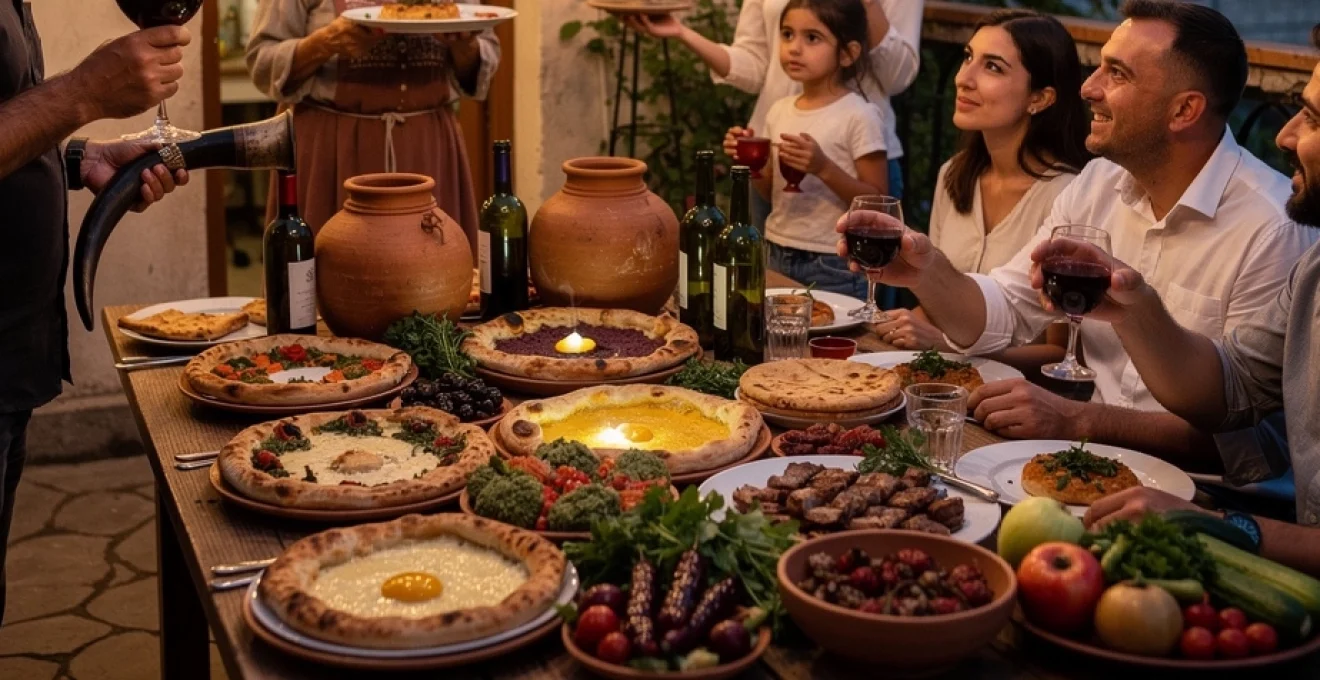
The ancient cobblestone streets of Tbilisi have witnessed countless feast gatherings, where strangers transform into family members through the sacred act of breaking bread together. Georgia’s capital city offers one of the world’s most profound culinary immersion experiences, where traditional hospitality customs create intimate connections that transcend cultural boundaries. The Georgian table serves as more than just a dining space—it becomes a cultural classroom where centuries-old traditions unfold through carefully orchestrated meal rituals.
Georgian dining culture operates on principles that challenge Western individualistic approaches to food consumption. Each shared meal represents a microcosm of Georgian society, complete with established hierarchies, ceremonial protocols, and spiritual undertones that reflect the nation’s complex historical identity. The transformative power of participating in authentic Georgian meal customs extends far beyond culinary appreciation, offering insights into Orthodox Christian influences, Caucasian social structures, and the deeply rooted concept of stumari—the sacred guest-host relationship.
Traditional georgian supra culture: decoding the ceremonial feast hierarchy
The Georgian supra represents far more than a festive dinner—it constitutes a sophisticated social institution governed by ancient protocols that have remained largely unchanged for centuries. This ceremonial feast structure creates an intricate web of relationships, responsibilities, and cultural expressions that define Georgian communal identity. Understanding the supra’s complexity requires appreciation for its role as both religious ceremony and social governance system.
The hierarchical nature of Georgian feast culture becomes immediately apparent through seating arrangements, speaking orders, and toast sequences that follow predetermined patterns. Age and social status determine positioning around the table, while gender roles influence participation levels in various ceremonial aspects. The feast serves multiple functions simultaneously: honouring guests, celebrating occasions, maintaining family bonds, and preserving cultural continuity across generations.
Tamada role and toast protocol in authentic tbilisi households
The tamada, or toastmaster, holds supreme authority during Georgian feast gatherings, wielding power comparable to a ceremonial judge or spiritual leader. This individual bears responsibility for orchestrating the evening’s emotional journey through carefully crafted toast sequences that address themes of friendship, family, homeland, and spiritual devotion. The tamada’s selection reflects community trust and recognition of oratorical skills, cultural knowledge, and social sensitivity.
Toast protocols follow established sequences that honour different aspects of Georgian life and values. The first toast traditionally celebrates peace, followed by acknowledgments of deceased family members, homeland devotion, and guest appreciation. Each toast requires unanimous participation, with wine consumption serving as symbolic agreement with expressed sentiments. The tamada’s ability to navigate complex family dynamics, political sensitivities, and religious observances determines the gathering’s success.
Khachapuri varieties: distinguishing adjarian, imeretian, and megruli preparations
Georgia’s beloved cheese-filled bread serves as a cultural identifier across different regions, with each variation telling stories of local traditions, available ingredients, and historical influences. Adjarian khachapuri, shaped like a boat with raw egg and butter added before serving, represents the Black Sea coastal region’s abundance and maritime connections. The preparation ritual involves precise timing to achieve the perfect egg consistency while maintaining optimal cheese texture.
Imeretian khachapuri showcases western Georgia’s dairy traditions through its closed-circle design filled with fresh imeruli cheese. This variation requires specific cheese aging processes and dough preparation techniques that local families guard as treasured secrets. Megruli khachapuri combines Imeretian-style filling with additional cheese layered on top, representing Samegrelo region’s agricultural prosperity and generous hospitality philosophy.
Georgian wine rituals: qvevri aging process and local vineyard selections
Georgian winemaking represents one of humanity’s oldest continuous viticultural traditions, with archaeological evidence supporting 8,000 years of wine production in this region. The qvevri method involves fermenting and aging wine in large clay vessels buried underground, creating unique flavour profiles impossible to replicate through modern techniques. This ancient process produces wines with distinctive characteristics that reflect Georgia’s diverse microclimates and indigenous grape varieties.
Local Tbilisi households maintain strong connections with specific vineyard
relationships, often purchasing directly from small family-owned wineries rather than commercial brands. During shared meals in Tbilisi, I repeatedly heard the same names of trusted vineyards in Kakheti, Kartli, and Imereti, each associated with a particular grape variety such as Saperavi, Rkatsiteli, or Mtsvane. Choosing the right wine for a supra is never random; it reflects the season, the food being served, and even the emotional tone of the gathering. You quickly learn that in Georgian culture, asking, “Where is this wine from?” is less about connoisseurship and more about acknowledging the families and landscapes behind each bottle.
Participating in these rituals revealed how deeply wine is woven into Georgian identity. A qvevri-aged amber wine, with its tannic grip and earthy aroma, tastes almost like a distilled memory of clay, sun, and grape skins. Locals explained that UNESCO’s recognition of traditional Georgian qvevri winemaking as intangible cultural heritage in 2013 was not just a label— it felt like an international validation of something they had always known. When you drink qvevri wine with Tbilisi locals, you are not just sampling a beverage; you are entering a living archive of history, migration, and survival.
Proper kantsi horn drinking etiquette and social positioning
At some supras, especially in more traditional households and during major celebrations, the glass is replaced by a kantsi—a drinking horn made from polished ox or ram horn. The kantsi is not a casual prop; it is a powerful symbol of honour and courage, and how it passes around the table reveals subtle social hierarchies. Typically, the tamada or a specially honoured guest drinks from the largest horn, often required to finish it in one continuous sip. This expectation can feel intimidating, yet refusing a horn without a strong reason would be seen as breaking the invisible contract of trust and respect.
Over time, I learned that horn etiquette follows an unwritten but precise script. The tamada announces who will receive the kantsi and why, turning each pour into a mini-ceremony. Younger guests or newcomers might be offered smaller horns as a sign of welcome rather than trial, while elders receive the horn to acknowledge their wisdom and life experience. If you are unsure how to hold or tilt the horn, no one laughs; instead, several hands will guide yours, demonstrating how Georgian hospitality is both demanding and deeply supportive at the same time.
Neighbourhood culinary immersion: vake, sololaki, and old tbilisi districts
Although Georgian supra culture has a shared backbone across the country, your experience of Tbilisi food culture shifts dramatically from one neighbourhood to another. Walking from the leafy boulevards of Vake to the ornate balconies of Sololaki feels like moving through different chapters of the same culinary book. Each district offers a distinct way to share meals with locals, from courtyard gatherings to modern fusion restaurants. To understand what I learned from dining with Tbilisi residents, it helped to treat each neighbourhood as its own micro-laboratory of Georgian hospitality.
Neighbourhood choice in Tbilisi often dictates not just what you eat, but how you eat and with whom. Do you want to join a multi-generational family under a grapevine trellis, or sample experimental takes on khinkali and pkhali in a stylish bistro? Food in Tbilisi is hyper-local: the same lobio (bean stew) will taste earthier in a Sololaki courtyard than in a glass-fronted restaurant on Rustaveli Avenue. By exploring multiple districts, you begin to see how Tbilisi’s culinary map mirrors its social and architectural evolution.
Sololaki courtyard dining: accessing historic residential feast traditions
Sololaki, with its crumbling Art Nouveau facades and winding side streets, is one of the best places to taste what Tbilisi family life once looked like. Many residential buildings open into shared courtyards where neighbours still gather around long tables during holidays and milestones. Being invited into such a courtyard feast felt like stepping into a living museum of Georgian food sharing traditions. The aroma of mtsvadi (grilled meat skewers) and homemade wine often drifts across the balconies hours before guests arrive.
Gaining access to these historic courtyard feasts rarely happens through formal reservations; instead, it emerges organically from conversations, friendships, or homestay arrangements. You might be renting an apartment, and your host suddenly knocks with a plate of freshly baked khachapuri, quickly followed by an invitation to “just join for a little while” downstairs. Once seated, you realise there is no such thing as “a little while” at a Sololaki table. Toasts stretch into the night, dishes keep arriving—badrijani nigvzit (eggplant with walnut paste), pkhali made from beet or spinach, and pickled vegetables that cut through the richness like a precise, culinary scalpel.
These courtyard gatherings showed me how communal living still structures everyday interactions in Tbilisi. Children run between tables, balancing plates; elders sit at the head of the table near the tamada; neighbours share gossip, politics, and recipes with equal passion. For a visitor, it can feel chaotic at first, but if you relax into the rhythm, you realise that everything—where you sit, how food is passed, when tea replaces wine—communicates belonging. Sololaki’s courtyards function as intimate theatres where Georgian hospitality is performed without an audience, only participants.
Vake modern georgian fusion: contemporary interpretations of classic recipes
In contrast, Vake represents Tbilisi’s more contemporary, aspirational side, where modern Georgian fusion restaurants reinterpret classic recipes for a younger, cosmopolitan crowd. Here, I tasted khinkali filled with wild mushrooms and truffle oil, chakapuli reimagined as a delicate stew with reduced tarragon jus, and desserts that paired churchkhela components with French pastry techniques. This is where Tbilisi’s chefs negotiate a delicate balance: how far can they innovate without losing the soul of Georgian cuisine?
Sharing meals with locals in Vake revealed how food can act as a bridge between tradition and global trends. Many Tbilisi residents in their twenties and thirties choose these venues for business meetings, dates, or casual gatherings, switching fluidly between Georgian and English as they discuss wine pairings and seasonal menus. You might see a qvevri-aged Rkatsiteli served in elegant stemware alongside dishes plated with minimalist precision. At first glance, it looks like any modern European food scene, but the toasts, the emphasis on the stumari, and the stories behind each dish firmly anchor the experience in Georgian soil.
For visitors wondering how to eat “authentically” in Tbilisi, Vake offers an important lesson: authenticity is not frozen in time. Observing how locals embrace both grandmother recipes and chef-driven tasting menus helps you understand Georgian culture as evolving rather than static. When a Vake-born friend dips lobiani into a reduction sauce instead of simple adjika, she is not betraying tradition; she is adding another verse to the ongoing culinary song of Tbilisi. The best way to honour that process is to taste both the old and the new with equal curiosity.
Old town basement restaurants: hidden cellar dining experiences
The labyrinthine streets of Old Tbilisi hide another dimension of the city’s food sharing culture: basement restaurants and brick-vaulted cellars that seem carved out of time. Descending a narrow staircase beneath a wooden balcony, you might find a low-lit room lined with qvevri, long communal tables, and shelves full of dusty wine bottles. These spaces often blend restaurant service with the feel of a private supper club, especially when run by families who live upstairs. Sound carries differently in these stone-walled rooms, making every toast resonate like a small echo of history.
Some of my most memorable meals in Tbilisi took place in such underground spaces. A host might join the table to pour homemade chacha (grape brandy) and recount how their grandparents sheltered neighbours there during difficult times, turning the cellar into both refuge and dining room. Eating in these hidden restaurants, you sense that food has long been a survival strategy in Georgia— a way to anchor community even during war, occupation, or economic hardship. The simplicity of dishes like lobio in a clay pot or khashlama (boiled beef) contrasts with the emotional depth of the stories that accompany them.
From an outsider’s perspective, Old Town cellars offer a more curated “traditional Georgian restaurant” experience, yet the intimacy can still be very real. When locals choose these venues for birthdays or reunions, the setting encourages longer meals, deeper conversations, and more elaborate toasts. You might start the evening as a tourist at the far end of the table and end it being called “chveni” (ours) as plates of leftover pkhali are wrapped for you to take home. In that moment, you realise that Tbilisi’s basement restaurants are not just tourist attractions; they are continuation points of the city’s underground history of resilience.
Rustaveli avenue food scene: bridging traditional and tourist gastronomy
Rustaveli Avenue, the city’s main artery, offers yet another angle on Tbilisi food culture: a busy blend of traditional eateries, coffee chains, and tourist-friendly restaurants. At first, it is tempting to dismiss this area as “too central” or “not authentic enough,” but shared meals here taught me something different. Rustaveli serves as a bridge between local habits and the expectations of international visitors. It is where you are most likely to see menus in multiple languages, mixed groups of locals and foreigners, and dishes designed to introduce Georgian cuisine in a more accessible way.
For example, you might find sampler platters of khinkali, grilled meats, and salads that allow first-time visitors to try many flavours in a single sitting. Local friends often suggested meeting on or near Rustaveli because it was convenient and neutral territory, especially when bringing together people from different parts of the city. Over time, I realised that sharing a meal here offered a unique vantage point to observe how Georgians explain their food to outsiders. You hear simplified descriptions—“this is like dumplings,” “this is our version of lasagna”—but then watch as the conversation deepens into discussions of family recipes, regional conflict, and migration.
Rustaveli’s food scene illustrates how Tbilisi negotiates its dual role as both home and destination. For travellers, it can be a practical starting point before venturing into more residential districts like Sololaki or Vake. For locals, it is a stage where they consciously present Georgian cuisine to the world, sometimes adjusting spice levels or portion sizes without diluting the spirit of hospitality. If you pay attention to these small negotiations, you begin to see shared meals on Rustaveli not as generic tourist experiences, but as active sites of cultural translation.
Language barriers and cultural navigation through food sharing
One of the most surprising lessons I learned in Tbilisi is how little you actually need shared vocabulary when you have shared meals. In some households, no one spoke fluent English, and my Georgian was limited to greetings, gratitude, and a handful of food words. Yet around the table, communication flowed. A raised glass, a nod from the tamada, a hand over the heart after tasting a dish—these gestures formed a parallel language that guided the rhythm of the evening.
Of course, language barriers can still create moments of confusion. Was the toast about ancestors or future children? Did that invitation mean “stay for dessert” or “stay the night”? In such situations, food became our translator. Hosts would point to dishes, mime preparation techniques, or compare tastes using universal references—“like lemon,” “like honey,” “strong, careful.” Over time, I realised that the shared experience of tasting, passing plates, and reacting together often conveyed more nuance than literal translations could capture.
Practically speaking, learning a few key phrases dramatically improves your experience of sharing meals with locals in Tbilisi. Words like “madloba” (thank you), “gamarjoba” (hello), and “gaumarjos” (cheers) act as small keys that unlock deeper warmth. Even mispronounced attempts are met with laughter and encouragement, not irritation. Just as importantly, you learn to read nonverbal cues: when a host insists “eat, eat” with their hands, or gently covers your wine glass to give you a break, they are conveying care in a vocabulary older than any written script.
Georgian hospitality philosophy: understanding stumari concept in practice
If there is one concept that threads together all these Tbilisi meal experiences, it is stumari—the sacred status of the guest. Georgians often explain that a guest is “sent by God,” a phrase that initially sounds metaphorical but reveals its literal depth at the table. Whether you are staying in a homestay, visiting friends of friends, or joining a supra in a rural relative’s apartment, your role as stumari shapes everything from portion sizes to seating arrangements. Understanding this philosophy is crucial to making sense of why Georgians insist on giving you the last piece of meat or walking you home after midnight.
From a Western perspective, Georgian hospitality can feel overwhelming, even excessive. You might quietly worry about how much your host is spending or how much effort they are investing. However, declining too strongly or repeatedly insisting they “shouldn’t have” risks unintentionally rejecting their identity as good hosts. Over several meals, I realised that accepting Georgian hospitality graciously—while offering small gestures in return—honours not just individuals but an entire cultural worldview that sees generosity as a moral duty.
Host-guest reciprocity dynamics in georgian meal settings
At first glance, the host-guest relationship during a Georgian meal appears one-sided: the host offers, the guest receives. Yet beneath this surface lies a more reciprocal dynamic. As a guest, your responsibility is to contribute emotionally—through attentive listening, active participation in toasts, and genuine appreciation of the food. When you raise your glass and toast to the health of your hosts, their parents, or their children, you are returning a type of spiritual currency that Georgians value as much as any gift.
Reciprocity also shows up in small, practical ways. You might help clear plates between courses, bring a dessert or bottle of wine from a local market, or share photos and stories from your own country. These gestures do not balance the scales—Georgian hosts pride themselves on giving more than they receive—but they signal respect and engagement. I found that when I asked for recipes or cooking tips, hosts lit up; they saw this curiosity as a sign that their culture would continue to live beyond that single evening, carried onward by someone else’s kitchen.
Religious influence: orthodox fasting periods and feast adaptations
Religion subtly shapes when and how Georgians share meals, even among people who do not attend church regularly. The Georgian Orthodox calendar includes multiple fasting periods, most notably Great Lent and the weeks before major religious holidays. During these times, many households adjust their menus to exclude meat, dairy, and sometimes oil. At first, I assumed fasting meant simpler or less abundant meals, but Tbilisi quickly proved me wrong.
Instead, I encountered lavish spreads of plant-based dishes: walnut-rich pkhali, bean stews thickened with herbs, pickled vegetables, and breads fresh from the tone (clay oven). Hosts proudly explained how fasting menus allow them to showcase a different side of Georgian cuisine, one that aligns with global interest in vegetarian and vegan Georgian food. If you join a meal during a fasting period, you might not even realise it, unless someone points out that the feast contains “no products of animal origin.” The discipline of fasting coexists with the joy of hosting, illustrating how Georgian culture weaves spiritual practice into everyday pleasure.
These religious rhythms also affect the emotional tone of meals. Festive supras following major fasts often feel particularly exuberant, like pressure released from a sealed vessel. Wine flows more freely, meat returns to the table in generous portions, and toasts celebrate both spiritual renewal and physical abundance. Sharing these cycles with locals deepens your understanding of Tbilisi life: food is not merely sustenance; it is a calendar, a theology, and a communal diary written in flavours.
Generational recipe transmission: babushka cooking methods
In many Tbilisi households I visited, the true guardians of culinary knowledge were the grandmothers—affectionately called “babushka” or “bebia,” depending on the family. Watching them cook was like observing a living textbook without page numbers or precise measurements. A handful of flour here, a splash of water there, a quick glance at dough elasticity: these were the metrics by which recipes were judged. When I asked for specific quantities, I often received a smile and a shrug, followed by, “you will feel it with your hands.”
Recipe transmission in Tbilisi tends to be embodied rather than written. Younger family members stand beside their grandmothers, rolling out dough for khachapuri, folding pleats into khinkali, or grinding walnuts with a heavy mortar. Stories accompany each movement—about harvests, winters without electricity, Soviet-era scarcity, and post-independence adaptations. In this way, every dish becomes an edible archive of Georgian history. When you eat at these tables, you are tasting not just ingredients but accumulated trial and error passed down through decades.
For visitors eager to “cook like a local,” the biggest lesson is patience. Georgian grandmothers rarely separate technique from context; their methods are tailored to specific flour types, local herbs, and family tastes. Still, most are delighted to show you how to crimp a pastry edge or season a pot of beans, sometimes insisting you take video so you “do not forget back home.” This intergenerational exchange reminds you that sharing meals in Tbilisi is as much about preserving knowledge as it is about filling plates.
Authentic ingredient sourcing: tbilisi markets and local producers
No exploration of shared meals in Tbilisi is complete without a visit to the city’s markets, where the ingredients of Georgian hospitality begin their journey. Central markets like Dezerter Bazaar hum with a sensory overload of colours, smells, and sounds. Stalls overflow with fresh herbs—tarragon, coriander, purple basil—stacked like edible bouquets. Nearby, vendors sell house-made adjika, sun-dried spices, and baskets of nuts destined for churchkhela and pkhali. Shopping here with locals, I realised that market conversations often last longer than the actual purchases.
Regular customers and vendors exchange news, haggle politely, and trade tips about which farmer has the sweetest tomatoes or most aromatic utsko-suneli (blue fenugreek). When a host takes you along, your role as stumari is subtly introduced to producers: “This is our guest; they are visiting from abroad.” The reaction is often a warm discount, an extra bunch of herbs slipped into the bag, or a spontaneous tasting of homemade cheese. Watching these interactions, you see how deeply trust and reputation shape the local food system, much more than branding or packaging.
If you hope to cook Georgian dishes yourself while staying in Tbilisi, markets are the ideal classroom. Ask vendors how to choose nadughi (fresh curd), or which beans work best for lobio, and you will probably receive not just an answer but a three-step cooking tutorial. For travellers used to anonymous supermarket aisles, this level of engagement can feel almost intimate. Yet it reflects the same ethos that underpins shared meals: food is a relationship, not a commodity. By sourcing ingredients where locals shop, you participate in the first half of the Georgian hospitality cycle, long before anything reaches the table.
Cross-cultural communication through georgian table customs
Ultimately, what I learned from sharing meals with locals in Tbilisi is that Georgian table customs function as a sophisticated form of cross-cultural communication. The supra, the toasts, the insistence on feeding you beyond comfort—these are not merely quaint traditions but structured ways of saying, “You are safe here. You belong here, at least for tonight.” When you raise your glass after the tamada and add your own short toast—however hesitant—you are not just participating in dinner; you are entering into a temporary social contract.
Georgian table etiquette may seem complex at first, yet it actually simplifies interaction across language, class, and nationality. The order of toasts creates a roadmap for conversation topics, moving from peace and family to more personal hopes and fears. The shared dishes encourage collaboration: someone carves the meat, another refills glasses, a third translates key phrases. In this way, the table becomes a microcosm of how diverse societies might function—structured but flexible, guided by tradition yet open to new voices.
For travellers, recognising these customs as communicative tools rather than mere curiosities changes how you behave at the table. Instead of worrying about performing everything perfectly, you can focus on the underlying message: show respect, remain present, and contribute what you can—stories, gratitude, attentive listening. In return, Tbilisi will likely offer you something far more lasting than a meal: a sense of having been momentarily woven into the city’s living fabric, one shared dish at a time.