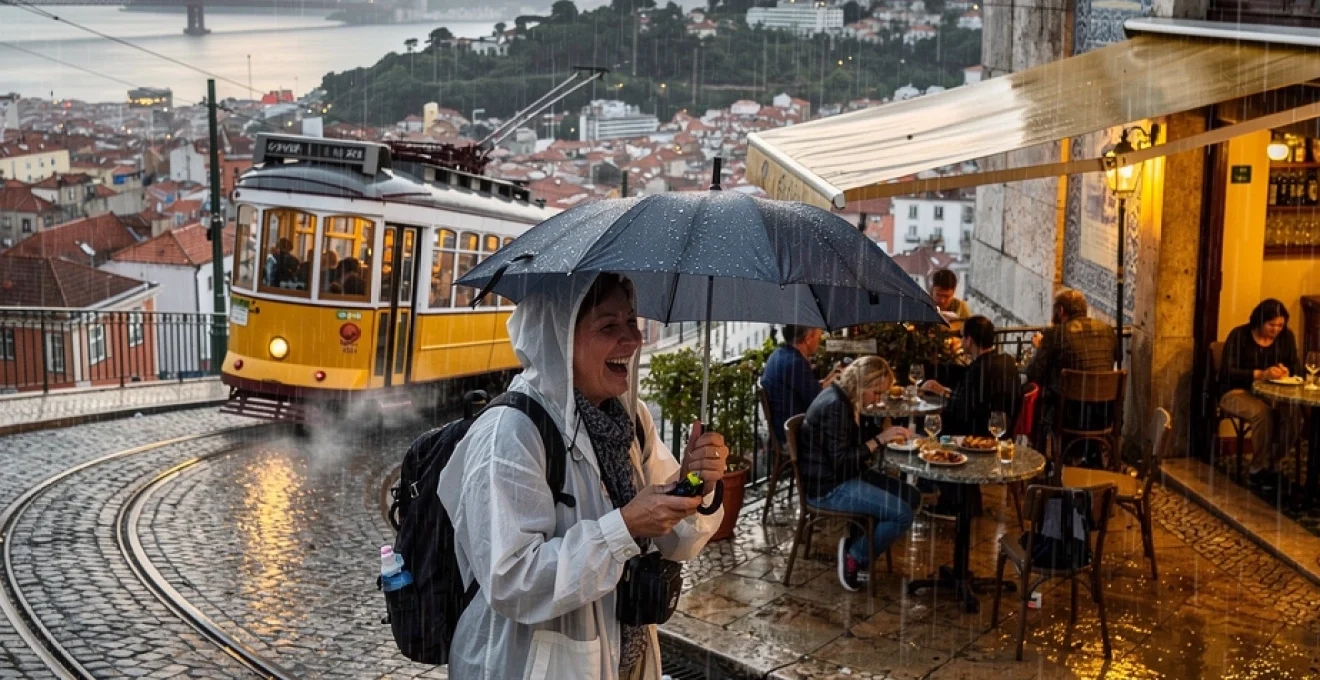
Travel plans rarely unfold as anticipated, particularly when Portuguese skies decide to unleash their Atlantic temperament upon unsuspecting visitors. What begins as a meticulously crafted itinerary can transform into something entirely unexpected—and often more memorable—when weather intervenes. The Portuguese capital possesses a unique ability to reveal its most intimate character during periods of precipitation, offering experiences that sunny days simply cannot deliver. Rather than viewing rain as an obstacle, seasoned travellers have learned to embrace these atmospheric shifts as opportunities for deeper cultural immersion and authentic local discovery.
Atmospheric conditions and microclimate phenomena in lisbon’s urban geography
Lisbon’s geographical positioning creates a complex meteorological environment that significantly influences visitor experiences throughout the year. The city’s location at 38.7°N latitude places it within the Mediterranean climate zone, yet its proximity to the Atlantic Ocean introduces oceanic characteristics that moderate temperatures and contribute to distinctive precipitation patterns. Understanding these atmospheric dynamics helps travellers appreciate why rainy days in Lisbon often produce such dramatic and memorable conditions.
Atlantic ocean influence on precipitation patterns in greater lisbon
The Atlantic Ocean serves as the primary driver of Lisbon’s weather systems, with maritime air masses carrying moisture inland throughout the year. These oceanic influences create precipitation events that typically arrive in waves rather than sustained downpours, resulting in the characteristic intermittent showers that allow for strategic timing of outdoor activities. The ocean’s thermal mass also moderates temperature extremes, ensuring that rainy periods remain relatively comfortable for urban exploration, with average temperatures rarely dropping below 10°C during winter months.
Coastal proximity generates unique atmospheric phenomena, including sea breezes that can rapidly disperse cloud formations and create dramatic lighting conditions. These meteorological shifts produce some of the most photogenic moments in the city, as sunlight breaks through storm clouds to illuminate Lisbon’s colourful facades and terracotta rooftops with extraordinary intensity.
Tejo river basin impact on local weather systems
The Tejo River estuary creates its own microclimate effects, particularly during transitional seasons when temperature differentials between land and water masses influence local wind patterns. The wide expanse of the river acts as a moisture source, contributing to fog formation during cooler months and creating atmospheric conditions that enhance the city’s already considerable visual drama. These river-influenced weather patterns often produce morning mist that gradually lifts throughout the day, revealing spectacular panoramic views from the city’s elevated neighbourhoods.
Urban heat island effects interact with river proximity to create convective processes that can trigger afternoon thunderstorms during summer months. These localised weather events, whilst brief, provide welcome relief from heat and create opportunities for experiencing Lisbon’s indoor cultural offerings during peak tourist seasons.
Seven hills topography effects on rainfall distribution
Lisbon’s famous seven hills create orographic effects that influence precipitation distribution across different neighbourhoods. Elevated areas such as Bairro Alto and Principe Real often experience different weather conditions compared to lower-lying districts like Cais do Sodré or Alcântara. These topographical variations mean that rain may be falling in one area whilst remaining dry in another, providing opportunities for flexible itinerary adjustments based on real-time conditions.
The steep terrain also affects drainage patterns, with cobblestone streets becoming temporary waterways during heavy downpours. This creates both challenges and opportunities for visitors, as the reflective wet surfaces produce enhanced visual effects whilst requiring careful navigation of historic stone pavements.
Sintra-cascais natural park weather convergence zones
The nearby Sintra-Cascais Natural Park creates convergence zones where different air masses meet, often producing localised weather phenomena that can differ significantly from conditions in central Lisbon. These microclimatic variations offer strategic advantages for day trip planning, as weather conditions in Sintra may remain favourable when Lisbon experiences precipitation, or vice versa.
The forested areas of Sintra generate their own moisture cycles, creating atmospheric conditions that contribute to the region’s mystical reputation. Understanding these patterns allows for better timing of visits to Pena Palace or Quinta da Regaleira, maximising opportunities to experience these locations under optimal conditions.
Spontaneous itinerary adaptation strategies for
Spontaneous itinerary adaptation strategies for rainy weather tourism
When the first heavy drops began to strike the hotel window that morning, it became clear that my original list of outdoor miradouros and waterfront walks would have to wait. Rather than forcing a sun-dependent plan onto a rain-soaked city, I began to treat the weather forecast as a flexible framework rather than a fixed limitation. This shift in mindset is essential for anyone wondering what to do in Lisbon on a rainy day: instead of cancelling experiences, you simply rearrange them, placing indoor cultural spaces and covered routes at the centre of your urban navigation.
Lisbon rewards travellers who are willing to improvise with their itinerary as clouds roll in and out. The city’s compact geography and dense network of public transport make it surprisingly easy to pivot from an exposed viewpoint to a museum, from a windswept praça to a sheltered café. With a basic understanding of the local microclimates and a shortlist of rainy day alternatives, you can transform adverse weather conditions into a catalyst for deeper, slower encounters with Lisbon’s cultural fabric.
Indoor cultural heritage sites: museu nacional de arte antiga and museu calouste gulbenkian
My first strategic adjustment was to prioritise two of Lisbon’s most important indoor collections: the Museu Nacional de Arte Antiga and the Museu Calouste Gulbenkian. Both spaces offer ideal answers to the question of what to do in Lisbon when it rains, combining shelter, temperature-controlled comfort and an extraordinary density of artistic heritage. As the rain intensified over the Tagus, I boarded a tram toward Santos, watching droplets trace diagonal lines across the windows while the river disappeared behind a silver curtain.
The Museu Nacional de Arte Antiga, housed in a seventeenth-century palace, feels almost designed for wet days. Thick walls, polished stone floors and tall windows overlooking the grey river create an atmosphere of contemplative calm. Inside, Portuguese altarpieces glow with gold leaf that seems to absorb the dim light, while Namban folding screens testify to centuries of maritime exchange. You move from room to room at your own pace, letting the sound of the rain on the roof become a distant percussion accompanying your journey through medieval triptychs and Renaissance portraits.
Later, as showers eased into a steady drizzle, I continued my rainy day in Lisbon at the Gulbenkian Museum, reached easily by metro under covered corridors. If the National Museum of Ancient Art is a baroque salon, the Gulbenkian is a modern sanctuary: glass, concrete and gardens designed with almost Japanese restraint. Here, the collection is curated like a narrative, moving from Egyptian antiquities to Islamic ceramics, from Lalique jewellery to impressionist canvases. Outside, the museum gardens glistened with rain, moss darkening between stones as ducks traced gentle ripples across the pond. Inside, everything was precise, ordered, almost meditative—proof that a well-chosen museum can turn even the bleakest forecast into an unexpectedly restorative day.
From a practical perspective, these two institutions are particularly valuable when you plan what to do in Lisbon on rainy days because they are large enough to occupy several hours without feeling overwhelming. Buying tickets online allows you to skip outdoor queues, and combining each visit with a café stop inside or nearby grants you a complete half-day itinerary sheltered from the elements. It is the cultural equivalent of stepping into a perfectly timed train just as a storm breaks overhead.
Traditional tascas and petiscos culture in bairro alto district
Of course, even the most refined museum eventually gives way to a more immediate, human need: hunger. As late afternoon approached and the rain resumed with renewed determination, I shifted my focus from galleries to gastronomy, heading uphill toward Bairro Alto in search of a traditional tasca. Narrow streets curved upward like wet ribbons, their calçada pavements shining under the streetlights that had flickered on earlier than usual, surrendering to the storm-darkened sky.
Stepping into a tasca on a rainy day in Lisbon is a bit like slipping into a warm, familiar sentence in a book you have not yet finished. Conversations blur into a low hum, glasses clink, and the smell of garlic, olive oil and grilled fish wraps itself around you like a blanket. I found a small, wood-panelled place where condensation fogged the windows and handwritten menus listed daily specials in looping Portuguese script. The owner nodded toward a table near the back, where my umbrella could drip harmlessly onto old tiles patched from decades of use.
Rainy weather seems to invite a slower approach to petiscos, the Portuguese cousin of tapas. Instead of rushing through a quick meal, you order plates in stages: first a caldo verde soup to chase away the chill, then bolinhos de bacalhau, then perhaps queijo with a drizzle of honey and rosemary. Each dish arrives unpretentiously, yet together they form a culinary map of Portugal, from Minho to Alentejo. Outside, gutters overflow and car tyres hiss through puddles; inside, you are held in a pocket of warmth where time stretches and contracts according to the rhythm of the kitchen.
For anyone planning what to do in Lisbon when it rains at night, this tasca culture in Bairro Alto offers one of the most satisfying solutions. Many establishments open only for dinner and remain cosy well into the evening, often within walking distance of fado houses and small wine bars. The key is to embrace the unhurried pace: allow the meal to expand, accept the extra glass of red wine, and treat each downpour not as an interruption but as confirmation that you have chosen exactly the right place to be.
Covered market exploration at mercado da ribeira time out market
The next morning, the forecast still showed shifting bands of rain sweeping in from the Atlantic, which made a covered market the obvious starting point. Mercado da Ribeira, home to both the historic municipal market and the modern Time Out Market Lisbon, is a textbook answer to what to do in Lisbon on a rainy day when your appetite is as strong as your curiosity. The building’s iron structure and high ceilings shelter a dynamic microcosm of the city’s culinary life, from early morning fishmongers to late-night dessert stands.
Arriving just as a fresh shower began, I slipped under the market’s broad entrance and into a maze of stalls. On one side, local residents examined gleaming fish laid out on crushed ice—sea bream, octopus, sardines—while vendors called out prices over the rhythmic thud of knives on cutting boards. On the other, the food hall buzzed with the clatter of trays and the low murmur of travellers comparing notes on what to order. It is the kind of place where you can assemble an improvised tasting menu without ever stepping back into the rain: a bifana sandwich from one stand, a pastel de nata from another, then perhaps a glass of vinho verde from a bar tucked into a corner.
What makes Mercado da Ribeira especially effective for rainy day tourism in Lisbon is its versatility. You can linger over coffee while waiting for a passing shower to end, use the free Wi-Fi to reconfigure your afternoon plans, or people-watch from a communal table as groups negotiate which petiscos to share. The sheer variety under one roof turns meteorological uncertainty into an advantage; instead of choosing a single restaurant and hoping the weather cooperates, you have an entire ecosystem of flavours at your disposal, protected by a century-old roof that has seen many storms come and go.
From an itinerary planning perspective, pairing the Time Out Market with nearby indoor attractions—such as the Museu do Oriente or a wine tasting in Cais do Sodré—creates a seamless, weather-resilient route along the riverfront. You move in short, manageable bursts between covered spaces, always with the reassurance that you can retreat quickly to the market’s shelter if the sky suddenly darkens again. It is urban adaptability in its most delicious form.
Historic tram 28 route optimisation during precipitation
By the time the rain had settled into a lighter, more intermittent pattern, it felt safe to return to one of Lisbon’s most iconic experiences: the historic Tram 28. On paper, joining a packed wooden tram on slick rails during a storm might seem counterintuitive. Yet, when approached thoughtfully, the 28E line can become one of the most atmospheric responses to what to do in Lisbon when it rains, allowing you to traverse multiple neighbourhoods while staying largely protected from the elements.
The key lies in timing and boarding location. Rather than joining the longest queues at the most famous stops, I walked to a less crowded point on the line, umbrella in hand, watching the tracks reflect the yellow tramcars like a mirrored ribbon. Boarding at the beginning or end of the route, ideally earlier in the day, increases your chances of securing a seat rather than standing in the aisle—a small but significant advantage when the tram jolts and sways around tight corners on wet cobblestones.
As we climbed toward Graça and then descended through Alfama, the rain on the windows turned the city into a moving watercolour. Tiled façades blurred into streaks of blue and white; laundry lines, weighed down by moisture, hung motionless over narrow streets; pedestrians navigated puddles with improvised choreography. From inside the tram, you witness Lisbon’s seven hills assemble and rearrange themselves, all while remaining dry and comfortably seated. It feels almost like watching a documentary where the city plays itself, unscripted and unconcerned with your camera.
For travellers wondering what to do in Lisbon on a rainy day without spending all their time indoors, Tram 28 offers a hybrid experience. You are technically outside, moving through open streets, yet shielded by glass and wood, participating in the urban landscape without having to battle the weather at every step. By combining the ride with targeted stops—perhaps disembarking near a favourite miradouro if the rain briefly pauses, or stepping into a nearby church when showers intensify—you can weave a flexible route that balances exposure and shelter with almost cinematic precision.
Architectural shelter discovery through lisbon’s distinctive building styles
As the day unfolded, I began to notice how Lisbon’s architecture itself seemed to conspire with the weather, offering unexpected forms of shelter at every turn. Arcades, recessed doorways and narrow lanes create micro-pockets of dryness where you can pause, adjust your scarf and reorient yourself. In many European cities, rain simply falls on buildings; in Lisbon, it actively interacts with façades, tiles and stone, revealing textures and colours that remain subdued under direct sun.
Pombaline buildings in the Baixa district, rebuilt after the 1755 earthquake, are particularly effective in this regard. Their regular arcades and continuous façades form natural corridors that soften the impact of wind and rain. Standing beneath one such arcade on Rua Augusta, I watched passers-by navigate with a practiced choreography—some crossing open sections with a quick dash, others lingering under balconies as they checked messages or consulted maps. The black-and-white wave patterns of the calçada Portuguesa shone like polished marble, transforming a familiar pedestrian zone into something almost theatrical.
Elsewhere, in neighbourhoods like Alfama and Mouraria, shelter appears in more improvised forms: clotheslines strung between windows, fabric awnings stretched over doorways, or tiny cafés wedged into corners barely wider than their counters. These architectural details may seem trivial on a sunny day, but under rain they function as survival tools—a reminder that Lisbon’s building styles evolved not only for beauty but also for climatic resilience. Even the ubiquitous azulejos, those blue-and-white ceramic tiles, play their part by protecting masonry from moisture while reflecting what little light filters through heavy clouds.
For a traveller intent on making the most of a rainy day in Lisbon, paying attention to these micro-shelters can transform the way you move through the city. Instead of plotting only major attractions, you begin to read the built environment as a network of potential refuges, each with its own character: a church vestibule here, a tram stop there, a bookstore with a deep entrance just around the corner. Over time, this awareness creates a subtle sense of partnership between you and the city’s architecture, as though the buildings themselves were guiding you from one dry haven to the next.
Authentic local interaction dynamics during adverse weather conditions
One of the most surprising outcomes of that rainy day in Lisbon was how quickly the weather softened social boundaries. There is something about sharing a sudden downpour under the same awning or waiting out a storm in the same café that invites conversation in a way that bright, busy days rarely do. As the sky grew heavier, locals and visitors alike were pushed into closer proximity, their trajectories funnelled toward the same indoor spaces, their small inconveniences suddenly aligned.
At a corner pastelaria near Rossio, I watched as umbrellas were folded and shaken at the door in a quiet ritual of entry, droplets forming small constellations on the floor. The woman behind the counter, clearly accustomed to these meteorological migrations, moved with choreographed efficiency, delivering bicas and pastéis de nata to an impromptu mix of soaked tourists, office workers and elderly regulars. When I hesitated over which pastry to choose, she smiled, recommended her favourite and commented on the “tempo maluco” outside. That simple phrase broke the ice, and soon we were comparing notes on Lisbon’s autumn storms and the best neighbourhoods to live in if you dislike strong winds.
Rainy weather changes the tempo of urban life, slowing people down just enough to notice one another. In tascas, neighbours linger a little longer over their coffee; in bookshops, customers ask for recommendations instead of rushing out; on trams, someone might offer a seat to an older passenger with an umbrella and a grateful smile. For you, as a visitor trying to decide what to do in Lisbon on a rainy day, these micro-interactions can become the most vivid memories, anchoring the city not in monuments but in fleeting, human moments.
There is also a practical dimension to these encounters. When the forecast turns unpredictable, locals become invaluable sources of real-time advice: which museum is less crowded when it pours, which streets flood more quickly, which viewpoint still offers shelter and a decent espresso. Asking a simple question—“Where would you go on a day like this?”—often yields responses far more insightful than any guidebook, leading you to small galleries, hidden cloisters or family-run restaurants that you might otherwise have walked past without noticing.
Sensory travel experience documentation through multi-modal engagement
As the day progressed, I realised that the rain was not just reshaping my itinerary; it was also heightening every sensory impression of the city. Visual details became sharper against the grey sky—the cobalt of azulejos, the mustard yellow of tramcars, the deep green of tiled vestibules darkened by moisture. Sounds, too, shifted: the staccato rhythm of raindrops on café awnings, the gentle roar of tyres crossing wet cobblestones, the muted chime of church bells filtered through low clouds. Even smell took on a central role, from the petrichor rising from stone steps to the rich aroma of coffee escaping through half-open doors.
To capture this complexity, I began documenting my rainy day in Lisbon not only through photos, but through notes and short audio clips. A quick recording of tram brakes on a slick descent through Graça; a description of how the Tagus looked from Miradouro das Portas do Sol when the horizon blurred into a single band of silver; a list of words overheard in cafés as people commented on the weather. Engaging multiple senses in this way turned the city from a series of postcard images into a layered, almost tactile memory that I could revisit long after the forecast had cleared.
Have you ever noticed how certain journeys return to you more vividly than others when you close your eyes? Often, it is because you engaged more than one mode of perception at the time—sight, yes, but also sound, touch, taste, even temperature. Rainy days, by their very nature, encourage this multi-modal awareness. The feel of damp cuffs, the warmth of a ceramic cup between cold hands, the sudden gust of wind as a door opens—each of these sensations writes itself into your internal map of the city with greater persistence than a generic sunny panorama.
From a practical standpoint, intentionally documenting a rainy day in Lisbon through different senses also helps reframe it as something to be appreciated rather than endured. Instead of simply asking “What can I do in Lisbon when it rains?” you begin to ask “What can I notice here that I would completely miss on a clear day?” The answer might be as simple as the way neon reflections smear across puddles on Avenida da Liberdade, or as complex as the changing acoustics inside a church nave when rain intensifies on the roof. Either way, you emerge with a richer, more personal archive of the city.
Psychological travel memory formation and emotional geography mapping
By the time the clouds finally began to lift and a pale stripe of blue appeared over the Tejo, I understood why that particular rainy day in Lisbon would become one of my favourite travel memories. Psychologists often note that we remember experiences not for their perfection, but for their emotional intensity and narrative arc—the way a day surprises us, challenges us, or invites us to rewrite our expectations. Weather, with its inherent unpredictability, is a powerful author of such narrative twists.
In cognitive terms, the brain tends to encode memories more strongly when they deviate from routine. A standard sequence of sun-drenched attractions can blur into a pleasant but indistinct collage, whereas a day shaped by unexpected showers, unplanned detours and improvised solutions stands out with sharper contours. The decision to seek shelter in a particular church, to share a table with strangers in a crowded tasca, or to ride Tram 28 through a sudden downpour becomes a series of choice points that you can trace back later, like stepping stones across a river.
This is where the idea of “emotional geography” becomes relevant. As the rain guided me from Baixa to Santos, from Bairro Alto to Alfama, each district acquired an emotional tone coloured by the conditions in which I experienced it. The Gulbenkian Garden, glistening under a soft drizzle, now lives in my memory as a place of quiet introspection; the Time Out Market, buzzing with damp umbrellas and steam rising from hot plates, carries an association of convivial resilience; a narrow alley in Mouraria, where I briefly huddled with two local women under a balcony while waiting for the worst of a shower to pass, is charged with a sense of shared humour and fleeting community.
Is it any wonder, then, that when I think of Lisbon, it is not the clear postcard images that come first, but the reflections of streetlights in puddles, the sound of fado drifting through mist, the feeling of pushing open a heavy wooden door and stepping from wind into warmth? Rain, far from ruining the city, had drawn a more intricate, emotionally resonant map in my mind—one in which each sheltered doorway, fogged café window and rain-slicked staircase marked a meaningful point of connection between myself and the urban landscape.
In retrospect, that rainy day answered my original question—what to do in Lisbon on rainy days—in a way no itinerary ever could. You adapt your plans, yes. You choose museums over miradouros, tascas over terraces, trams over long walks. But more importantly, you allow the weather to co-author your experience, to introduce you to people and places you might never have encountered under a flawless blue sky. And when you eventually leave, carrying damp shoes and a phone full of blurred yet beautiful photographs, you discover that the city has inscribed itself on you not in spite of the rain, but precisely because of it.