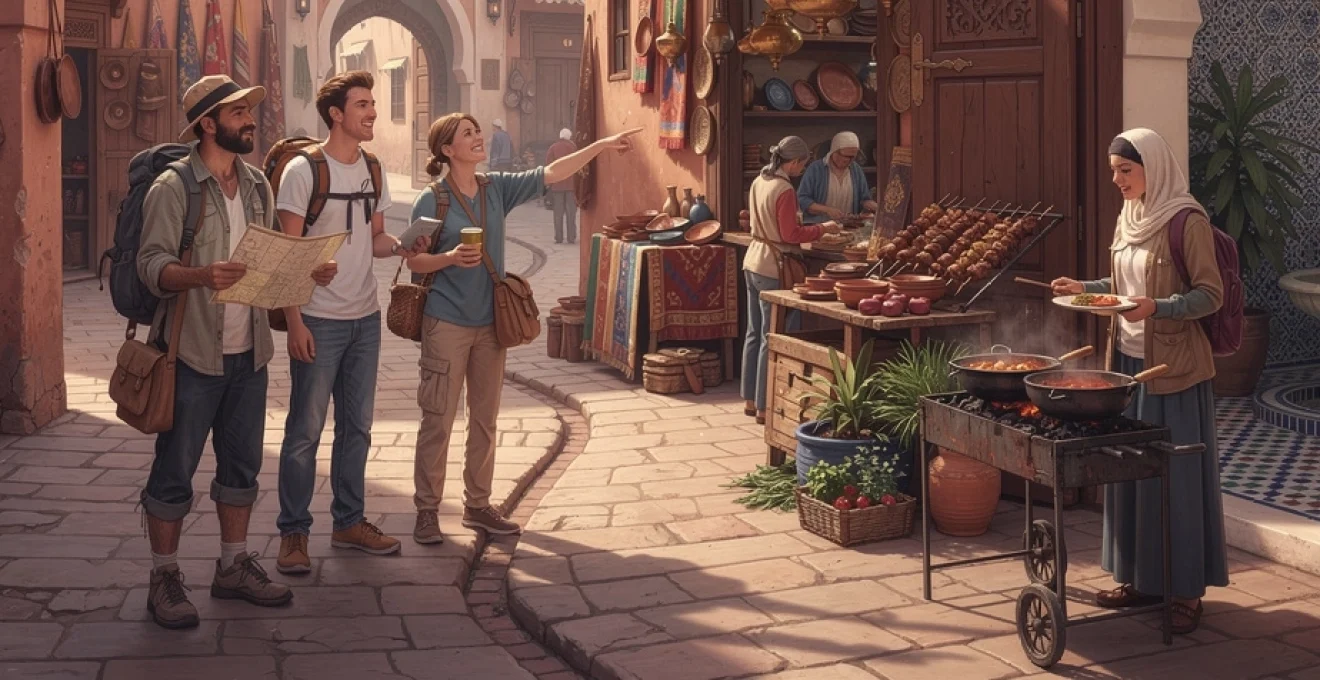
The ancient medina of Marrakech defies every modern traveller’s instinct for control and navigation. Within its labyrinthine walls, GPS signals falter, street signs disappear, and the very concept of linear movement dissolves into something far more profound. This UNESCO World Heritage site, established nearly a millennium ago, operates on principles that predate our digital dependency on precise navigation. The medina’s maze-like structure isn’t a design flaw—it’s an invitation to experience travel in its purest form, where the journey itself becomes the destination and disorientation transforms into discovery.
For travellers accustomed to mapped routes and calculated journeys, the medina presents a radical alternative. Here, wandering without purpose reveals hidden artisan workshops, centuries-old architectural marvels, and authentic cultural encounters that no guidebook could capture. The act of getting lost becomes a form of active meditation, forcing visitors to engage with their immediate surroundings rather than rushing towards predetermined objectives.
Navigating marrakech’s medina labyrinth: understanding the urban morphology of ancient islamic city planning
The architectural complexity of Marrakech’s medina reflects sophisticated Islamic urban planning principles developed during the Almoravid dynasty in the 11th century. Unlike European cities with their grid-based Roman foundations, the medina evolved organically around religious, commercial, and residential nuclei. This organic growth created a three-dimensional puzzle where vertical elements—overhanging upper floors, covered passages, and rooftop terraces—interact with horizontal pathways to create spatial disorientation that serves multiple purposes.
The medina’s design prioritises community privacy, climate control, and defensive capabilities over navigational clarity. Narrow passages create cooling microclimates through the venturi effect, where accelerated airflow between buildings provides natural air conditioning. These same narrow paths, combined with irregular intersections and dead ends, historically deterred invading forces while encouraging residents to develop intimate knowledge of their neighbourhood’s geography.
Derb network architecture: how traditional alleyway systems create natural wayfinding challenges
The derb system—Marrakech’s network of residential alleyways—creates intentional navigational complexity through irregular widths, sudden turns, and hierarchical pathway structures. Primary derbs connect major neighbourhood arteries, while secondary and tertiary passages branch into increasingly private residential zones. This branching pattern resembles organic growth more than planned construction, with pathways narrowing from 4-metre-wide main derbs to barely shoulder-width residential passages.
Traditional Islamic privacy principles influence derb design, creating visual barriers that prevent outsiders from observing private family life. Angled entrances, offset doorways, and strategically placed walls ensure that even when doors open, interior courtyards remain hidden from public view. These privacy features contribute to spatial confusion for visitors, as visual reference points disappear around corners and familiar landmarks become obscured by architectural screening.
Riads and douars: private courtyards as spatial anchors within the maze
Traditional riads and douars provide essential spatial orientation within the medina’s otherwise confusing layout. These inward-facing courtyard houses create distinctive architectural rhythms that experienced navigators learn to recognise. The courtyard principle—where buildings turn their backs to the street while opening onto central gardens—generates a consistent pattern of blank exterior walls punctuated by ornate doorways, creating subtle visual cues for navigation.
Modern restoration projects have transformed many historic riads into boutique hotels and restaurants, inadvertently creating new navigation landmarks for visitors. The contrast between restored properties with their polished tadelakt walls and traditional paint finishes provides contemporary wayfinding assistance while maintaining historical architectural integrity.
Souk quarter zoning: commercial districts from jemaa el-fnaa to souk semmarine
The medina’s commercial zones follow traditional Islamic market organisation, with related trades clustering together in specialised quarters. This zoning system creates distinct sensory environments—the metalworking souk resonates with hammering sounds, while the spice markets overwhelm visitors with aromatic intensity. Each commercial quarter develops its own navigational characteristics, from the covered passages of Souk Semm
marine, where textiles, leather goods, and tourist-focused shops cluster in dense formations.
As you move away from Jemaa el-Fnaa, the zoning of the souks becomes even more apparent. You might pass from Souk el Attarine, with its perfumers and oils, into Souk Haddadine, where blacksmiths forge metalwork using techniques unchanged for centuries. This functional zoning once allowed locals to navigate by trade rather than by street name, and you can still use it as an intuitive navigation system today. If you listen for the rhythm of hammer on metal or follow the scent of freshly tanned leather, you begin to orient yourself not by maps, but by senses.
Bab gate system: strategic entry points from bab agnaou to bab debbagh
The medina’s fortified walls are punctuated by monumental gates, or bab, that historically controlled access and trade. Each gate occupies a specific role in Marrakech’s urban morphology, linking the interior maze to regional caravan routes and rural hinterlands. Bab Agnaou, with its ornate sandstone façade, once served as the ceremonial entrance for dignitaries approaching the royal Kasbah. In contrast, Bab Debbagh connects directly to the tanneries, channelling raw materials and finished leather in and out of the city.
For the modern traveller trying to navigate Marrakech’s medina maze, these gates function as macro-level anchors. If you know which gate you entered—say, Bab Doukkala or Bab el Khemis—you can always orient yourself in relation to the city beyond the walls. Think of the bab system like the edges of a puzzle: once you find one, you can reconstruct your mental map from the outside in. When you inevitably get lost inside the derb network, simply asking locals for the nearest gate can reset your internal compass and gently guide you back toward your riad or the main square.
Psychogeographical benefits of unplanned urban exploration in north african medinas
Beyond its architectural intrigue, getting lost in Marrakech offers powerful psychogeographical benefits. Psychogeography, a term popularised by mid-20th-century urban theorists, explores how geographic environments influence our emotions and behaviour. In a world dominated by straight roads, efficient commutes, and turn-by-turn navigation, the medina’s seemingly chaotic layout provides an intentional disruption. This disruption creates a mental state where your usual cognitive shortcuts no longer work, compelling you to engage with place in a more mindful, embodied way.
Wandering aimlessly through the medina can feel unsettling at first, especially if you are used to “optimised” routes and constant digital guidance. Yet studies on urban exploration suggest that controlled disorientation can enhance creativity, reduce rumination, and even improve long-term memory. When you stop worrying about the fastest way to get somewhere and instead surrender to the environment, Marrakech stops being a backdrop and becomes an active participant in your journey. In that sense, psychogeographical exploration in North African medinas is less about seeing the sights and more about letting the city change the way you see.
Cognitive mapping theory: how spatial disorientation enhances memory formation
Cognitive mapping theory, widely studied in environmental psychology and neuroscience, explains how our brains build internal representations of space. When you walk the same predictable route every day, your cognitive map stabilises and becomes efficient but also relatively shallow. In contrast, navigating an unfamiliar, irregular environment like Marrakech’s medina forces your hippocampus—the brain region associated with memory and navigation—to work harder. Recent research using fMRI scans shows that complex, varied routes stimulate more robust neural activity than simple, linear paths.
What does this mean for your trip to Marrakech? Put simply, getting lost—within reasonable safety limits—helps you remember your experience more vividly. Each unexpected turn, surprising courtyard, or chance encounter becomes a “landmark” in your cognitive map. Instead of remembering Marrakech as a blur of guided tours, you recall specific doorways, tiled fountains, and shaded alleyways because you actively had to solve the puzzle of where you were. It is like the difference between watching a city from a bus window and tracing your own footsteps through its streets: the latter imprints itself far more deeply.
Serendipitous discovery mechanisms: chance encounters with artisan quarters
One of the greatest joys of getting lost in Marrakech is the opportunity for serendipitous discovery. In behavioural science, serendipity refers to positive, unexpected outcomes that occur without deliberate planning. The medina’s irregular street pattern, lack of clear sight lines, and shifting sounds act like a real-world “shuffle” button, constantly presenting you with new and unplanned scenes. You might step out of a dim, quiet alley and suddenly find yourself in a sunlit square filled with woodworkers, or follow the clatter of looms into a hidden weaving cooperative.
These chance encounters rarely happen if you move strictly along main tourist corridors or follow a rigid itinerary. Authentic artisan quarters—where locals still produce brass lamps, handwoven rugs, or intricate leatherwork—are often tucked behind unmarked doors or down unassuming side streets. By allowing yourself to drift, you access what sociologists sometimes call the “long tail” of urban experience: all the small, hyper-local moments that never make it into guidebooks. Ask yourself: would you rather tick off a checklist of famous spots, or stumble upon a fourth-generation carpenter who invites you to watch him work for a few minutes?
Stress response patterns: cortisol levels during controlled vs uncontrolled navigation
Of course, not all forms of getting lost feel good. Research on stress and navigation suggests that uncontrolled disorientation in threatening environments can spike cortisol levels, the body’s primary stress hormone. However, when people explore complex spaces under perceived safe conditions—daylight, visible social activity, and a general sense that help is nearby—their nervous systems respond differently. The result is often a state of alert curiosity rather than panic, similar to the mild adrenaline rush you might feel during a scavenger hunt.
Marrakech’s medina naturally lends itself to this “safe uncertainty” if you approach it with the right mindset and a few practical precautions. Staying aware of your surroundings, noting a few major landmarks, and carrying the address of your riad written in Arabic and French create a safety net that keeps anxiety at bay. Within that net, your short-term spikes of disorientation can actually sharpen focus and make your experiences feel more intense and alive. Think of it as interval training for your sense of direction: short bursts of getting a bit lost, followed by the relief of finding your way again.
Cultural immersion depth: authentic interactions beyond tourist corridors
Psychogeographical exploration is not just an internal process; it also shapes how deeply you connect with local culture. When you stay on signposted, tourist-heavy routes, your interactions often remain transactional—brief, rehearsed exchanges that skim the surface of local life. Step a few alleys away from the main arteries, however, and the social fabric changes. You may see children walking home from school, neighbours chatting at doorways, or elders playing cards in the shade of a small square.
By wandering respectfully through these quieter residential pockets, you open space for unscripted encounters. Perhaps a shopkeeper offers you mint tea while you ask about his family’s craft, or a passerby helps you find your way and ends up recommending a favourite local bakery. Many travellers report that these micro-interactions become the most meaningful memories of their time in Marrakech. In essence, the deeper you allow yourself to drift beyond the obvious, the more the city rewards you with glimpses of its everyday soul.
Traditional craft discovery through spontaneous exploration: from tanneries to zellige workshops
Marrakech is a living museum of traditional craftsmanship, and getting lost in the medina is often the most effective way to discover it. While organised tours can take you to curated demonstrations, spontaneous exploration reveals working ateliers where artisans are focused on production rather than performance. You might follow the pungent scent of curing hides to the famed tanneries near Bab Debbagh, where workers stir vats of natural dyes under the open sky. Or you might be drawn by the sharp clicking of chisels to a small courtyard where craftsmen carve zellige tiles, assembling intricate geometric patterns piece by piece.
These workshops often exist in clusters, forming informal “micro-districts” of craft specialisation that are easy to miss if you move only along main commercial axes. By turning down side streets or following your senses—sound, smell, texture—you can trace the production chain from raw material to finished object. Have you ever held a hand-embossed leather bag in a market and wondered how it was made? In Marrakech, getting lost is your best chance of watching that process unfold in real time, from dyeing and cutting to stitching and polishing.
When you do stumble upon these craft spaces, approach with sensitivity. Many artisans are happy to let you observe for a few minutes or explain their techniques if you show genuine interest, ask permission before taking photos, and avoid blocking their work. Buying directly from these workshops, even something small, helps sustain traditional skills that face pressure from mass-produced imports. In this way, your aimless wandering becomes a form of responsible tourism, where each unexpected discovery contributes to the continuation of centuries-old craft traditions.
Culinary archaeology: finding hidden food culture in marrakech’s residential quarters
The idea of “culinary archaeology” might sound academic, but in Marrakech it simply means digging beneath the surface of obvious restaurant choices to uncover deeper layers of food culture. The medina’s tourist-facing eateries, especially around Jemaa el-Fnaa and major souks, offer accessible introductions to Moroccan cuisine—tagines, couscous, brochettes, and fresh orange juice. Yet the most revealing food experiences often lie a few alleys away, in residential quarters where small bakeries, community ovens, and family-run snack stalls serve locals going about their daily lives.
As you wander without a rigid plan, keep an eye out for subtle signs of everyday gastronomy. A line of schoolchildren outside a kiosk might lead you to freshly fried sfenj (Moroccan doughnuts), still warm from the oil. The smell of baking bread could guide you to a ferran, a communal oven where neighbours bring trays of dough or slow-cooking dishes to be baked. These places rarely appear on maps or restaurant lists, yet they offer some of the most authentic and affordable bites in the city. In a sense, you are excavating living layers of Marrakech’s food history, guided more by curiosity than by reviews.
For travellers interested in food culture, getting lost becomes a research method rather than an inconvenience. Try exploring different quarters at varying times of day: early morning for bakeries and markets setting up, late afternoon for snack vendors, and evenings for families picking up bread or pastries. Ask yourself: what are people in this neighbourhood eating on a Tuesday, not just what visitors are eating on a Saturday night? By tuning into these rhythms, you gain insight into how food structures daily life in Marrakech—from the practical logistics of communal ovens to the social rituals of sharing tea and sweets.
Digital detox tourism: smartphone-free navigation strategies in pre-gps urban environments
In an era where most trips are mediated by smartphones, Marrakech’s medina offers a rare opportunity for digital detox tourism. Choosing to explore without constant reference to a screen is not just a nostalgic gesture; it fundamentally changes how you experience the city. Studies on digital wellbeing consistently show that reducing reliance on smartphones during travel improves presence, reduces anxiety, and increases satisfaction with the overall trip. When you put your phone away in the medina, you reclaim the simple act of looking up, making eye contact, and absorbing details that no app can capture.
Of course, going completely offline can feel daunting, especially in a maze-like environment. Rather than a strict ban, consider a hybrid approach: use your phone at your riad to orient yourself and note a few key reference points, then pocket it once you step into the streets. Rely on analogue tools—paper maps, hand-drawn sketches from your host, or even mental notes about landmarks like minarets and distinctive doors. You might be surprised by how quickly your internal navigation skills sharpen when you remove the digital crutch. After all, cities like Marrakech functioned perfectly well long before GPS was invented.
Practical strategies can make smartphone-free navigation enjoyable rather than stressful. Agree with your travel companions on a simple rule: walk in one general direction for a set amount of time, then gradually arc back toward a known landmark like Jemaa el-Fnaa or the Koutoubia Mosque. Carry the name and address of your accommodation on a card so you can always ask locals or a taxi driver for help if needed. Most importantly, reframe “being lost” as “being in discovery mode.” When you stop treating every wrong turn as a problem to fix and start seeing it as an opportunity, Marrakech’s medina transforms from an obstacle course into a playground for the senses.