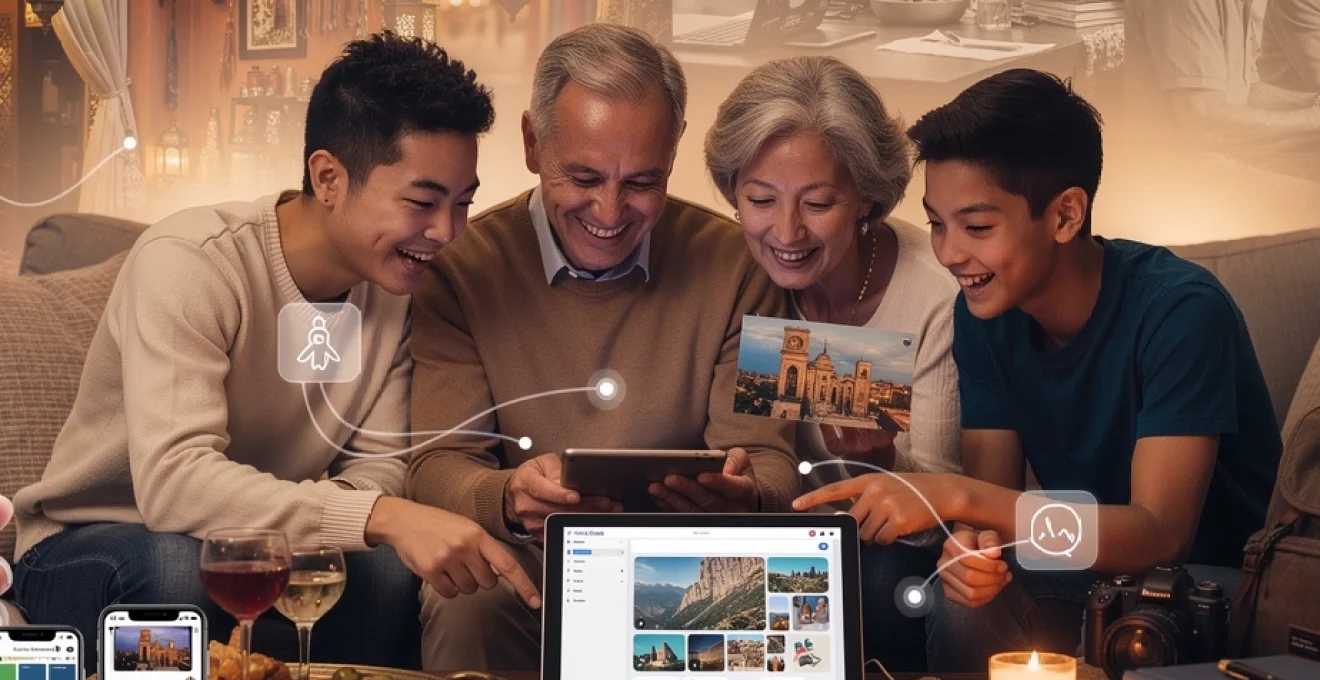
Every traveller returns home with more than photographs and souvenirs. Embedded in the experience are narratives waiting to be shared—tales of mishaps in Moroccan medinas, profound conversations with strangers in Kyoto, or the simple beauty of watching sunrise over Patagonian peaks. These stories, when shared with those closest to you, do far more than document where you’ve been. They fundamentally reshape and strengthen the relationships that matter most, creating bonds that transcend physical distance and time zones.
The act of sharing travel experiences isn’t merely social nicety or post-holiday ritual. Research from neuroscience, psychology, and sociology reveals that narrative exchange activates specific brain regions, releases bonding hormones, and creates shared memory structures that reinforce interpersonal connections. For families separated by continents and friendships maintained across oceans, these shared stories become the threads that weave relationships together, transforming individual adventures into collective experiences that everyone can treasure.
Neurological impact of narrative sharing on interpersonal bonding
When you recount your experiences from a recent journey, your brain doesn’t simply retrieve stored information—it recreates the experience at a neurological level. Brain imaging studies demonstrate that storytelling activates multiple neural networks simultaneously, engaging sensory processing regions, emotional centres, and social cognition areas. This comprehensive activation pattern explains why listening to a vivid travel narrative can feel almost as immersive as being there yourself.
Oxytocin release through storytelling and emotional reciprocity
The biochemistry of connection reveals itself most clearly through oxytocin, often termed the “bonding hormone.” When you share emotionally resonant travel stories—particularly those involving vulnerability, challenge, or profound beauty—both storyteller and listener experience measurable increases in oxytocin levels. This neurochemical response isn’t accidental; it’s an evolutionary mechanism that strengthens social bonds through shared emotional experiences.
Research published in social psychology journals shows that authentic emotional disclosure during storytelling triggers reciprocal vulnerability in listeners. When you describe the fear you felt navigating Bangkok’s chaotic streets alone or the unexpected kindness from a stranger in rural Italy, you’re inviting others into your emotional landscape. This invitation prompts listeners to lower their own defences, creating opportunities for deeper connection. The oxytocin released during these exchanges promotes trust, empathy, and a sense of closeness that can persist long after the conversation ends.
Interestingly, the oxytocin response isn’t limited to in-person exchanges. Video calls that allow facial expression observation and voice tone detection can trigger similar, though slightly diminished, bonding effects. Even text-based narratives, when sufficiently detailed and emotionally honest, can stimulate oxytocin production in readers who feel connected to the storyteller.
Mirror neuron activation during travel anecdote exchange
Mirror neurons represent one of neuroscience’s most fascinating discoveries for understanding human connection. These specialised brain cells fire both when you perform an action and when you observe someone else performing that same action. During travel storytelling, mirror neurons allow listeners to simulate your experiences in their own neural architecture, creating a form of vicarious travel that feels remarkably real.
When you describe the sensation of street food flavours in Vietnam or the physical exhaustion after trekking Machu Picchu, your listener’s motor cortex and sensory regions activate as though they were experiencing these sensations themselves. This neural mirroring explains why particularly vivid travel narratives can leave listeners feeling as though they’ve travelled alongside you. The shared neural patterns created through this process establish common ground at a neurological level, literally aligning brain activity between storyteller and audience.
The implications for relationship maintenance are profound. Families separated by distance can maintain intimacy through regular travel narrative exchanges that keep their neural patterns synchronised. Friends who cannot travel together can still create shared reference points through detailed storytelling that activates similar brain regions in both parties.
Memory consolidation through social verbalisation of experiences
The act of transforming experiences into narratives serves a dual purpose: it strengthens your own memories whilst simultaneously creating memory traces in your listeners’ minds. Psychologists call this “collaborative recall,” and it’s remarkably powerful for
strengthening both individual and shared recollection. When you tell your family about getting lost in the labyrinthine streets of Fez or missing a train in Germany, you are not just replaying an event—you are encoding it more deeply. Studies on autobiographical memory show that putting experiences into words helps transfer them from short-term storage into long-term memory, especially when those stories are retold over time. As loved ones ask questions, add their reactions, and relate your story to their own experiences, a collective version of the memory emerges. Your solo trip to Iceland, for example, becomes a shared narrative your entire circle can recall and reference, even if they never left home.
For relationships, this matters because shared memories are the raw material of intimacy. When you and your siblings reminisce about the story you told of getting caught in a monsoon in Sri Lanka, you’re not only recalling facts—you are reactivating the emotions, laughter, and sense of connection associated with that conversation. Each retelling works like reinforcing a path through a forest; the more you walk it together, the clearer and easier it becomes to follow. Over time, these reinforced narrative pathways form the backbone of your relational history, giving you “we stories” rather than just “my stories.”
Psychological safety and vulnerability in travel narrative disclosure
Not all travel stories are light-hearted. Some involve fear, loneliness, cultural misunderstanding, or regret. Choosing to share these more vulnerable narratives with family and friends can significantly strengthen bonds because they signal trust. Psychologists refer to the sense that we can express ourselves without fear of ridicule or rejection as psychological safety. When you admit you felt anxious navigating a foreign hospital or embarrassed by a language mistake, you are implicitly asking, “Is it safe to be imperfect with you?”
When loved ones respond with empathy rather than judgement—offering understanding, curiosity, or simply presence—they help build a relational environment where emotional honesty is rewarded. This, in turn, encourages further vulnerability, deepening closeness over time. Travel has a unique way of creating these moments because it pushes us beyond familiar roles. The usually confident professional might confess feeling small in a new culture, or the reserved sibling might share a moment of unexpected joy while dancing at a local festival. These departures from the everyday script create powerful opportunities for re-negotiating how we see each other.
Of course, vulnerability must be calibrated. You do not need to share every distressing detail of a difficult trip with every acquaintance. A useful rule of thumb is to match the depth of your travel narrative to the depth of the relationship. With close family and trusted friends, lean into honesty about struggles as well as highlights. With more distant contacts, you might choose lighter or more general reflections. In all cases, remember that vulnerability is reciprocal: listening openly to others’ stories about their own travels (or even their day-to-day lives at home) is just as important as sharing your own.
Digital storytelling platforms that amplify relationship quality
In an age where much of our communication is mediated by screens, the way you share your travel stories online can either dilute or deepen connection. Digital platforms are tools; their impact depends on how intentionally you use them. When approached thoughtfully, Instagram stories, private WhatsApp groups, personal travel blogs, and shared photo albums can extend the psychological benefits of travel storytelling to friends and family across the globe. Instead of feeling like passive spectators of your adventures, your loved ones can become active participants in an ongoing narrative.
Instagram stories and ephemeral content for real-time connection
Instagram Stories, Snapchat, and other ephemeral formats mimic the fleeting nature of in-person conversation. Their 24-hour lifespan encourages you to share small, imperfect moments rather than only polished highlight reels. This real-time window into your journey can make family and friends feel like they are right there with you—watching the sunrise from a hostel rooftop, hearing the street musicians in Lisbon, or laughing at your attempt to order coffee in a new language.
From a relationship perspective, these short travel updates create frequent touchpoints that keep you “top of mind” for your network. Micro-interactions—quick reactions, short replies, or inside jokes in response to a story—may seem trivial, but research on social media suggests that these small exchanges can significantly contribute to perceived closeness. To enhance this effect, try using captions that invite engagement: ask questions, run small polls about what you should eat next, or share dilemmas about which museum or hike to choose. When you frame your travel content as an ongoing conversation instead of a one-way broadcast, you maintain a sense of shared decision-making and connection.
At the same time, be mindful of over-sharing or curating a version of your trip that feels more like performance than presence. If you find yourself capturing every moment for the camera, ask: “Is this strengthening my connection with the people I care about, or am I drifting into pure self-promotion?” A balanced approach—sharing a few meaningful stories per day and saving deeper reflections for longer formats—often works best for real-time relationship strengthening.
Private WhatsApp groups versus public facebook posts for intimacy
While public posts on Facebook, Instagram, or TikTok can reach a wide audience, they are not always ideal for deepening close relationships. Private channels like WhatsApp, Signal, or Telegram groups offer a more intimate setting for travel storytelling. In a small family chat or friend group, you can share unfiltered impressions, funny mishaps, or even moments of doubt without worrying about how they might be perceived by colleagues or distant acquaintances.
This more contained audience changes the psychology of sharing. You are no longer editing your travel stories for public consumption; instead, you are talking directly to people who already know your backstory. This allows for richer context—references to childhood memories, shared jokes, or ongoing family narratives. For example, sending a voice note from a bustling market, complete with ambient noise, can instantly transport your parents or siblings into your world. They, in turn, might reply with questions, encouragement, or their own related memories, transforming your travel update into a genuine dialogue.
In contrast, public posts tend to invite shorter, more generic responses—likes, emojis, or brief comments—that, while pleasant, rarely lead to substantive exchange. One practical strategy is to use public platforms for broad updates and curated photos, while reserving private groups for the kinds of personal reflections that truly strengthen emotional intimacy. Ask yourself: “Who really needs to see this specific moment?” and choose your channel accordingly.
Long-form travel blogs on medium and substack for deep engagement
Not all travel stories fit into a caption or a 15-second video. Some experiences demand more space—space to explore your inner shifts, cultural observations, or ethical reflections. Long-form travel blogs on platforms like Medium, Substack, or a personal website allow you to slow down and craft narratives that invite deep engagement from those who care about you. For family and close friends, reading a 1,500-word essay about your month volunteering in Nepal or your road trip across Eastern Europe can be an intimate experience, almost like sitting down for an extended conversation.
Long-form storytelling supports connections in several ways. First, it allows you to integrate context, emotion, and reflection, helping your loved ones understand not just what you did, but how the journey changed you. Second, comments, email replies, or follow-up calls in response to these pieces often lead to richer discussions than quick social media interactions. You might find that a friend resonates with a particular paragraph about loneliness or joy and shares their own story in return, creating a two-way exchange of vulnerability.
If you decide to start a travel newsletter or blog, consider writing with specific people in mind rather than an abstract audience. Address questions your parents have asked you, respond to concerns a friend expressed, or expand on a moment that came up in a previous conversation. This gives your writing a sense of relational orientation, turning what could be a generic “travel content” piece into a personalised letter that strengthens your existing connections.
Collaborative google photos albums for asynchronous participation
Visual storytelling remains one of the most powerful ways to share travel experiences with family and friends. Collaborative albums on platforms like Google Photos, iCloud, or Amazon Photos let you go beyond one-way sharing by inviting others to contribute. Instead of simply dropping hundreds of images into a folder, you can curate selections, add captions that explain context, and encourage loved ones to react, comment, or even upload their own related photos—perhaps from past trips or similar locations.
This asynchronous participation is particularly valuable when you and your loved ones live in different time zones or have conflicting schedules. Your parents might explore the album over morning coffee, leaving comments you respond to later that night. A sibling might add GIFs, stickers, or side-by-side comparisons with your childhood holidays, weaving your new experiences into your shared family story. The album becomes less of a static archive and more of a living document of connection.
To avoid overwhelming your audience, consider creating themed albums (for example, “Street Food in Mexico City” or “Hikes in New Zealand”) rather than dumping everything into a single folder. Select photos that tell a story—beginning, middle, and end—rather than repeating similar shots. Think of yourself as a curator of a small exhibition for the people you love. The more intentional you are, the easier it becomes for them to step into your journey and feel genuinely connected to it.
Ethnographic storytelling techniques that deepen cultural empathy
Beyond sharing what you did, the way you describe where you’ve been can shape how your family and friends perceive other cultures. When travel stories move past stereotypes and surface-level observations, they can act as informal ethnography—offering nuanced, humanising portraits of people and places. This not only strengthens your connection with your listeners but also expands their worldview, creating shared values of curiosity, respect, and cultural empathy within your relational network.
Sensory details from marrakech souks and tokyo izakayas
Ethnographic storytelling starts with the senses. Instead of saying, “The market in Marrakech was busy,” you might describe the cinnamon and cumin hanging in the air, the texture of handwoven rugs under your fingers, or the calls of vendors echoing through narrow alleys. Similarly, talking about a Tokyo izakaya can go far beyond, “We had great food.” You can evoke the clink of tiny ceramic cups, the sizzling sound from the open kitchen, and the warmth of shared plates passed around a crowded table.
These sensory-rich travel narratives do more than entertain; they help your listeners feel embodied in a culture they’ve never visited. Neuroscience research on mental imagery shows that detailed descriptions activate many of the same brain regions that real experiences would engage. In other words, when you tell your child about the smoky aroma from a Marrakech grill or the soft lantern light in a Kyoto side street, you are helping them build an internal library of cross-cultural experiences. Over time, this fosters empathy and reduces the psychological distance between “us” and “them.”
If you want to strengthen connections through this kind of storytelling, pause before recounting a moment and ask yourself: “What did this place really feel like?” Then bring at least one smell, one sound, and one tactile detail into your narrative. You don’t need to be a novelist to do this; even simple phrases like “my shoes stuck slightly to the tiled floor, still wet from the rain” can transport your listener much more effectively than abstract descriptions.
Character-driven narratives featuring local encounters in patagonia
Another powerful ethnographic technique is to foreground people rather than places. Instead of framing Patagonia only as dramatic mountains and vast skies, you might tell the story of the hostel owner who brewed you maté and explained local traditions, or the bus driver who shared family photos on a long ride. When your travel stories are character-driven, your friends and family come to associate destinations with individuals rather than clichés.
Character-based narratives also encourage compassion. As you describe a conversation with a shopkeeper in a small Chilean town or a guide who spoke about climate change’s impact on glaciers, you are inviting your listeners to connect emotionally with real lives and concerns. This helps dismantle the idea of foreign cultures as abstract “others” and instead positions them as communities with joys, challenges, and dreams not so different from your own.
To adopt this approach, try structuring your stories around three elements: who you met, what they cared about, and how the encounter affected you. For example, “I met a fisherman in Puerto Natales who talked about how the sea has changed in his lifetime, and it made me rethink how I use plastic at home.” When you consistently anchor your travel experiences in human relationships, you model a relational way of seeing the world for the people you care about.
Conflict and resolution arcs in solo backpacking through southeast asia
Good stories, including travel stories, often involve some kind of conflict and resolution. This does not mean manufacturing drama but acknowledging the real tensions and turning points in your journey. When you share how you navigated a misunderstanding in a Bangkok hostel, overcame fear while motorbiking in Vietnam, or resolved a logistical nightmare catching a ferry in the Philippines, you are revealing both the challenges of travel and your capacity to adapt.
Structuring your storytelling around a simple arc—setup, challenge, response, and outcome—helps listeners stay engaged and offers them a narrative they can emotionally invest in. It also creates space for you to reflect on what you learned. Did a missed bus lead to a meaningful conversation with a stranger? Did an argument with a travel companion teach you something about communication or boundaries? Sharing these arcs with family and friends turns your trip into a shared growth story, not just a sequence of picturesque backdrops.
Such narratives can be particularly powerful for younger family members or friends considering their own journeys. Hearing how you handled a difficult night in a hostel in Laos or navigated illness on the road in Cambodia can provide them with both inspiration and realistic expectations. It reassures them that travel is not about being perfect but about responding creatively and compassionately when things go wrong—skills that are equally valuable in everyday life.
Intergenerational knowledge transfer through travel memoirs
When you document your journeys in more permanent forms—journals, scrapbooks, photo books, or formal travel memoirs—you are doing more than preserving your own memories. You are creating resources for intergenerational knowledge transfer. Children, grandchildren, nieces, and nephews can one day read about how you navigated border crossings, budget travel, or cultural misunderstandings, gaining insights not only into distant places but also into who you were at different stages of your life.
Families often have unofficial “keepers of the stories”—people who remember who moved where, who travelled when, who met whom abroad. Transforming your travel stories into accessible formats ensures that this knowledge does not vanish when memory fades. It also allows younger relatives to see you as a whole person rather than only in the role you occupy now (parent, aunt, grandparent). Reading about your backpacking adventures in your twenties or your first solo trip later in life can help them relate to you on a more equal, human level.
Practically, intergenerational travel storytelling does not require a published book. A simple digital document with dated entries, a printed photo book with captions, or audio recordings of you describing key trips can all serve as informal memoirs. You might even invite older relatives to share their own past travel stories, recording them for posterity. In doing so, you create a family archive of journeys across time, reinforcing a sense of continuity and shared identity that can anchor relationships through change.
Vicarious travel experiences and their role in relationship maintenance
Not everyone in your circle will have the time, resources, or health to travel as much as they might like. For them, your travel stories can become a meaningful source of vicarious experience. Far from being a consolation prize, vicarious travel can offer genuine psychological benefits—sparking imagination, reducing feelings of isolation, and providing topics for engaging conversation. When handled with sensitivity, your narratives can make loved ones feel included rather than left behind.
Parasocial engagement through detailed destination descriptions
Parasocial relationships—one-sided connections people form with media figures—illustrate how powerful detailed storytelling can be. While you are not a celebrity to your family and friends, the principle is similar: when you share richly detailed accounts of your trip to the Amalfi Coast or a remote village in Peru, listeners can feel emotionally invested in places they have never seen. They may start following local news, reading about the culture, or daydreaming about visiting one day.
To foster positive parasocial-like engagement rather than envy or distance, focus on inclusivity in your descriptions. Instead of saying, “You had to be there,” invite questions: “If you were here, which of these desserts would you try?” or “This reminded me of the stories Grandma used to tell about growing up by the sea.” Connect what you are seeing now to stories and preferences already familiar within your relationships. This turns your travel tales into bridges rather than barriers, helping loved ones feel that your adventure is, in some small way, also theirs.
Conversational currency and social capital accumulation
Travel stories also function as “conversational currency”—topics you can draw on to keep interactions interesting and meaningful over time. When you return from a trip with a repertoire of anecdotes, observations, and reflections, you bring fresh material into your relationships. This can be especially valuable for long-distance friendships or family members you do not see often; shared discussion of your travels can become a recurring thread that keeps the dialogue alive.
In social networks, people who tell engaging, thoughtful stories often become informal hubs for connection. Friends may introduce you to others who love travel, or relatives may ask you to speak to younger family members about studying abroad or working overseas. This accumulation of social capital is not about status so much as it is about usefulness: your experiences give you resources—information, perspectives, and encouragement—you can offer to others. When you share these generously and without ego, you strengthen your role as a trusted, valued member of your community.
However, it is important to balance your travel tales with genuine curiosity about others’ lives. If every conversation circles back to your latest trip, you risk turning your stories into a barrier rather than a bridge. A helpful practice is to treat each travel anecdote as an invitation: after sharing, ask, “Has anything like that ever happened to you?” or “What is a place, even close to home, that made you feel the way I felt there?” This keeps the conversational currency flowing both ways.
Empathetic listening skills developed through travel story reception
Listening to other people’s travel stories can be as relationship-strengthening as telling your own. When you pay close attention to how a friend describes their pilgrimage route in Spain or how a sibling talks about a stressful work trip, you practice empathetic listening. This involves tuning into the emotions behind the words, asking open-ended questions, and resisting the urge to immediately compare or one-up their experience.
Travel often intensifies emotions—excitement, frustration, awe, homesickness—which makes it a rich context for practicing these skills. As you listen, you might notice where someone glosses over a painful moment or lights up when mentioning a particular encounter. Reflecting these observations back—”It sounds like that moment on the cliffside really stayed with you”—can make the storyteller feel deeply seen. Over time, this kind of attentive listening fosters mutual trust and a sense that your relationship is a safe place to process meaningful experiences.
Developing this skill also makes you a better storyteller. The more you notice what engages you in others’ narratives—specific details, emotional honesty, thoughtful reflection—the more you can bring those qualities into your own travel stories. In this way, every shared journey, yours or someone else’s, becomes part of a continuous loop of learning and connection.
Ritual practices of travel story sharing across cultures
Humans have always used rituals to make sense of journeys and to bring travellers back into the fold of their communities. From welcome-home dinners to slide shows in living rooms, these practices provide structure for transforming individual experiences into shared narratives. Understanding and embracing these rituals can help you turn your own post-trip storytelling into a powerful tool for strengthening family and friendship bonds.
Italian aperitivo traditions and holiday debriefing sessions
In many Italian families, returning from a trip is naturally followed by an aperitivo—a relaxed gathering over drinks and small bites before dinner. This informal setting, with its mix of food, conversation, and unhurried time, creates an ideal space for travel debriefing. Instead of a formal “presentation,” stories emerge organically as relatives ask where you went, what you ate, and who you met.
You can recreate this kind of ritual regardless of where you live. Invite friends or family over for a simple spread of snacks inspired by your destination—a plate of tapas after Spain, olives and cheese after Greece, or tea and sweets after Morocco. Let the food act as a sensory anchor for your stories, prompting questions and memories. This transforms travel storytelling from a monologue into a shared cultural experience, even if no one else has visited the same place.
Over time, these debriefing sessions can become a recurring tradition that everyone looks forward to: not just a chance to see your photos, but a reliable moment of connection woven into the rhythm of your relationships. The predictability of the ritual—”When someone comes back from a trip, we gather and listen”—signals that each person’s experiences matter to the group.
Japanese omiyage gift-giving paired with experience narratives
In Japan, travellers customarily bring back omiyage—thoughtfully chosen regional gifts—for colleagues, friends, and family. These are not random souvenirs but items that represent the place visited: local sweets, speciality snacks, or small crafts. The exchange of omiyage is often accompanied by brief stories about where and how the gift was purchased, turning each object into a tangible fragment of the journey.
Adopting an omiyage-inspired approach to your own travels can enrich your relationships in subtle but powerful ways. Rather than grabbing generic keychains at the airport, you might choose a spice blend from a market in Istanbul and share how the vendor taught you to use it, or a handmade bookmark from a bookstore in Lisbon along with the story of getting lost in its maze-like aisles. The gift becomes a physical anchor for the narrative, something your loved one can touch, taste, or smell as you recount your experience.
This practice does not have to be expensive or elaborate. Even a postcard with a handwritten anecdote on the back can serve as a mini-omiyage, especially for relatives who may not be online often. Over time, a collection of such items can form a kind of relational museum of your journeys, each piece reminding both you and your loved ones of the stories you’ve shared.
Scandinavian hygge gatherings and slideshow presentations
In Nordic countries, the concept of hygge—cosy togetherness—often shapes how people gather, especially in long winter months. Imagine combining this ethos with travel storytelling: dimmed lights, candles or a warm lamp, blankets, hot drinks, and a simple slideshow projected on a TV or laptop. Rather than rushing through hundreds of images, you select a limited set and linger on each one, using it as a prompt for deeper conversation.
This style of sharing transforms what many people dread (“another endless vacation slideshow”) into an intimate, shared experience. You might group photos by theme—”people we met,” “moments of surprise,” “things that went wrong and turned out okay”—rather than strictly chronological order. Between images, allow space for questions, tangents, and the stories of those listening. Perhaps a photo of a ferry prompts an aunt to tell a story about her own sea crossing decades ago, or an image of a mountain sparks a friend’s memory of a childhood hike.
By framing your travel presentation as a hygge gathering, you emphasise comfort, connection, and mutual exchange rather than performance. The goal is not to impress but to connect—to wrap your new experiences in the warmth of existing relationships and, in doing so, to strengthen the fabric of your shared life.