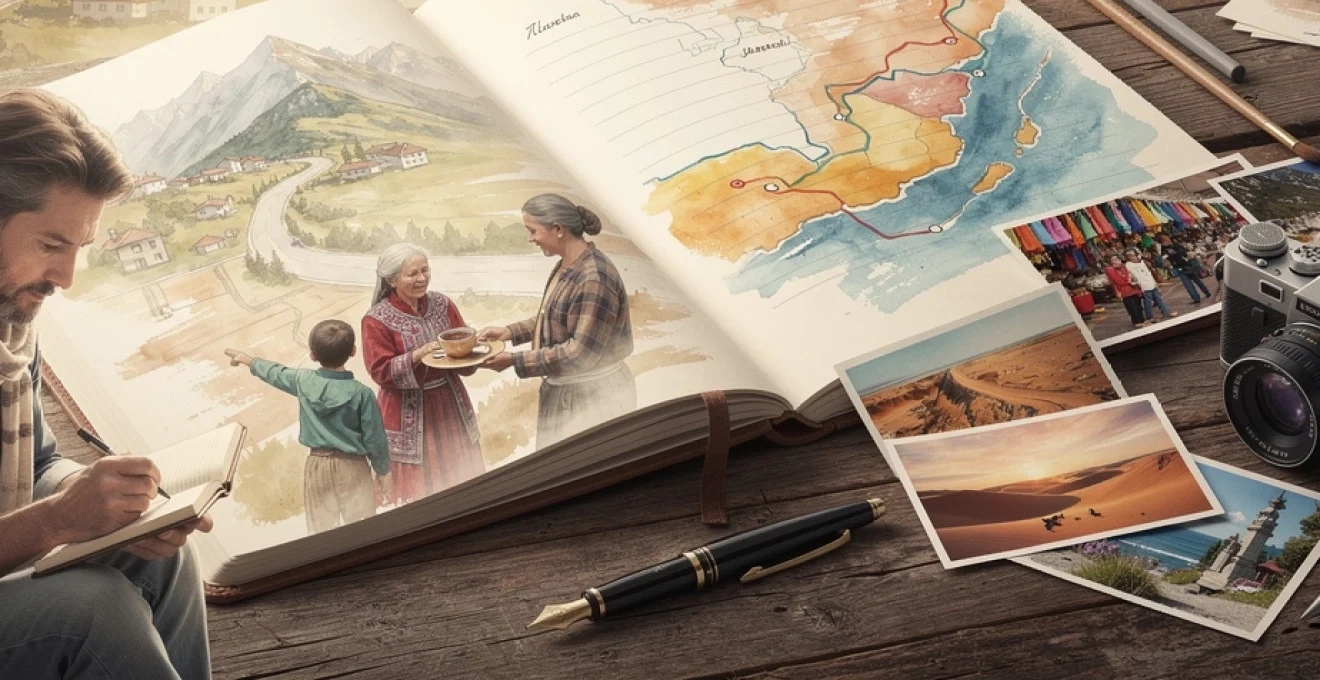
Travel books occupy a unique position in the literary landscape, straddling the boundary between factual documentation and artistic expression. Unlike traditional guidebooks that merely list attractions and practical information, literary travel writing transforms the journey experience into a sophisticated narrative art form. This genre combines the observational precision of journalism with the emotional depth of memoir, creating works that resonate far beyond their geographical boundaries.
The dual nature of travel literature stems from its ability to function simultaneously as historical record and creative expression. When authors like Paul Theroux or Bill Bryson craft their travel narratives, they’re not simply documenting places and experiences—they’re creating literary landscapes that exist as much in the imagination as they do on any map. This artistic dimension elevates travel writing from mere reportage to a form of cultural commentary that captures the zeitgeist of both the places visited and the era in which the journey occurs.
Literary characteristics and narrative techniques in travel writing
The literary sophistication of travel books emerges through their sophisticated deployment of narrative techniques traditionally associated with fiction. These works employ complex structural elements including temporal shifts, character development, and thematic unity that transform simple journey accounts into compelling literature. The best travel writers understand that their role extends beyond that of mere observer; they become interpreters of cultural experience, translating the foreign and unfamiliar into accessible yet profound insights.
First-person narrative voice and subjective experience documentation
The first-person narrative serves as the cornerstone of travel literature’s literary identity, creating an intimate connection between reader and journey. This perspective allows authors to blend personal reflection with cultural observation, establishing a unique voice that distinguishes literary travel writing from objective reportage. The subjective lens becomes a literary device that filters experience through individual consciousness, creating layers of meaning that extend beyond surface-level description.
Contemporary travel writers like Cheryl Strayed in “Wild” demonstrate how personal narrative can transform a physical journey into a metaphorical exploration of self-discovery. The first-person voice enables writers to examine not just external landscapes but internal ones, creating dual narratives that operate on multiple levels simultaneously. This technique allows readers to experience both the literal journey and the psychological transformation that accompanies it.
Descriptive prose and sensory writing methods in bruce chatwin’s “in patagonia”
Bruce Chatwin’s masterwork exemplifies how descriptive prose elevates travel writing to literary art. His approach demonstrates that effective travel literature requires more than factual accuracy—it demands the ability to recreate sensory experience through language. Chatwin’s technique involves layering precise geographical details with evocative imagery that captures the essence of place rather than merely its appearance.
The power of sensory writing in travel literature lies in its capacity to transport readers beyond their immediate environment. Chatwin achieves this through carefully constructed passages that engage all five senses, creating immersive experiences that rival the most sophisticated fiction. His descriptions of Patagonian landscapes don’t simply inform readers about geography—they create emotional landscapes that resonate with universal themes of isolation, wonder, and human resilience.
Temporal structure and Non-Linear storytelling in pico iyer’s works
Pico Iyer’s approach to travel writing demonstrates how non-linear narrative structure can enhance the literary dimensions of the genre. Rather than following chronological journey progression, Iyer weaves together past and present, memory and observation, creating complex temporal tapestries that reflect the actual experience of travel. This technique acknowledges that meaningful travel involves not just forward movement through space but backward movement through time and memory.
The use of fragmented chronology in travel literature mirrors the way human consciousness processes new experiences. Iyer’s works show how present observations trigger memories, associations, and reflections that enrich the immediate travel experience. This layered approach creates texts that reward multiple readings, as each encounter reveals new connections and deeper meanings previously hidden beneath the surface narrative.
Character development and cultural encounter narratives
Sophisticated travel literature treats encountered individuals not as exotic specimens but as fully realised characters whose interactions drive narrative development. The best travel writers understand that meaningful cultural exchange requires genuine engagement rather than superficial observation. These encounters become pivotal moments that challenge preconceptions and facilitate genuine understanding between different worldviews.
Through dialogue, conflict, and moments of shared vulnerability, travel books use character development to reveal how cultures meet, misunderstand, and ultimately influence one another. We watch hosts, guides, fellow passengers, and chance acquaintances evolve from background figures into co-protagonists whose values, fears, and hopes complicate the traveller’s initial assumptions. This emphasis on character-driven cultural encounter shows why the travel book is considered a literary genre as much as a documentary one: it relies on the same narrative sophistication and emotional nuance that we associate with the modern novel.
Metaphorical language and symbolic representation in travel literature
Another key reason travel books are viewed as literary works lies in their use of metaphor and symbolic imagery. Skilled travel writers rarely present the journey as a mere sequence of landscapes; instead, they treat roads, borders, bridges, deserts, and oceans as symbols that stand in for psychological or social states. The frequently invoked metaphor of the “border crossing,” for example, functions both as a literal movement between nations and a symbolic passage between identities, values, or life stages.
In many influential travel narratives, cities become living organisms, trains become veins or arteries, and airports are liminal spaces where identities are temporarily suspended. This metaphorical richness transforms geographical settings into narrative symbols that carry thematic weight. Just as in literary fiction, the setting in travel literature is charged with meaning: a mountain might represent an inner obstacle, a monsoon season the turbulence of personal crisis. When we read travel books through this symbolic lens, it becomes clear that they participate in the same artistic tradition as the novel and the lyric essay.
Metaphorical language also helps travel authors articulate complex intercultural experiences that might otherwise resist straightforward description. How do you describe the disorientation of hearing five languages at once in a market, or the uncanny feeling of recognition in a country you have never visited? By leaning on analogy—likening a souk to an orchestra tuning up, or a remote village to “a pause in time”—writers turn elusive impressions into vivid, shareable images. This is where the artistic dimension of travel writing is most obvious: it does not merely report reality; it invents new ways of seeing it.
Visual arts integration and aesthetic expression in travel books
If the narrative techniques of travel writing confirm its literary status, its visual components underscore why it is also considered an artistic genre. Historically and today, many travel books are conceived as hybrid objects, where text, image, design, and even materials work together to create an integrated aesthetic experience. From hand-tinted engravings in nineteenth-century expedition accounts to contemporary photo essays and illustrated atlases, the travel book has long been a gallery as much as a library.
This visual dimension is not mere decoration; it shapes how we interpret both place and narrative voice. Maps guide not only our sense of geography but our sense of structure. Photographs inflect the tone, suggesting intimacy, distance, or critique. Typography and layout direct our reading rhythm, deciding which passages we savour and which we scan. For anyone interested in why travel books sit at the crossroads of literature and art, examining these visual strategies is as important as analysing plot or character.
Cartographic artistry and hand-drawn map illustrations
Maps have always been central to travel writing, but in many travel books they are more than functional diagrams; they are cartographic artworks. Hand-drawn maps, in particular, highlight the inherently subjective nature of travel. By exaggerating certain routes, compressing distances, or adding whimsical icons for memories and encounters, the illustrator reveals that every journey is partly an act of interpretation. We do not simply move through space; we redraw it in our own image.
In literary travel books, these maps often mirror the structure of the narrative itself. A fragmented or looping map might correspond to a non-linear storyline, while a meticulous, grid-like layout may signal a more documentary approach. Some contemporary publishers encourage writers to sketch their own itineraries, resulting in pages where shaky lines, marginal notes, and crossed-out paths become a visual record of uncertainty and discovery. For the reader, such maps deepen immersion and underscore the idea that the travel book is both a work of geography and a work of artistic self-mapping.
From an artistic standpoint, hand-drawn maps also function as an interface between text and image. They invite us to move back and forth between narrative passages and visual reference, building a mental map that is both cognitive and emotional. When you trace a protagonist’s path through the mountains with your finger on the page, the travel book becomes almost performative—you are, in a small but real way, re-enacting the journey yourself.
Photography as narrative enhancement in steve McCurry’s travel portfolios
Photography has become one of the most powerful tools for expanding the artistic dimension of travel literature, and few names are as emblematic of this fusion as Steve McCurry. McCurry’s travel portfolios—famous for their saturated colours and emotionally charged portraits—often accompany or inspire textual narratives. In such projects, photographs do not merely illustrate the written word; they shape the reader’s emotional response and sometimes even serve as narrative anchors around which chapters are built.
In photo-driven travel books, each image functions like a condensed story. A single frame of a Kabul street, a monsoon-soaked marketplace, or a desert caravan carries layers of history, politics, and personal experience. When paired with reflective prose, these photographs create a dialogue between visual and verbal storytelling. The writer might use an image as a starting point for a memory, an ethical question, or a meditation on beauty and suffering. In this way, the travel book becomes a polyphonic artwork, where text and image comment on and complicate each other.
For readers, this interplay can radically alter the experience of place. A description of a remote village may conjure a vague mental image, but a carefully composed photograph can fix that image in our minds and raise questions: Who is standing just outside the frame? What stories are not being told? By foregrounding such questions, visually rich travel books remind us that representation is always partial—and that both literary and visual choices carry ethical and artistic implications.
Typography design and layout aesthetics in contemporary travel publications
Typography and layout might seem like purely technical concerns, but in contemporary travel publications they contribute significantly to the genre’s artistic identity. The choice of typeface, line spacing, margin width, and chapter openings all affect how we experience narrative tempo and mood. A clean, minimalist design can suggest analytical distance and modernity, while more ornate or handwritten fonts evoke intimacy, nostalgia, or craft.
Many high-end travel books now treat design as a storytelling tool in its own right. Pull quotes might be enlarged and set in contrasting fonts to highlight epiphanies or turning points. Section dividers may incorporate motifs drawn from local textiles or architectural patterns, visually echoing the cultures depicted in the text. Some publishers experiment with colour-coded sections—blue for sea journeys, ochre for desert travel—subtly guiding the reader’s expectations before a chapter even begins.
From a practical perspective, thoughtful typographic design also shapes readability and reader engagement, especially in long-form travel narratives. Breaks in the text, generous white space, and carefully placed images help us absorb dense descriptive passages without fatigue. When all these elements work together, the travel book approaches the status of an art object, crafted not just to convey information but to orchestrate a specific aesthetic and emotional journey for the reader.
Watercolour sketching and field drawing traditions following edward lear
Long before mass-market photography, travellers like Edward Lear used watercolour sketching and field drawing to capture their journeys. This tradition persists today in many artist-travelers’ journals, sketchbooks, and hybrid graphic travelogues. Watercolour, with its fluid washes and translucent layers, is particularly suited to conveying the fugitive qualities of travel—changeable light, distant mountains, misted harbours, and the quick impression of a city square.
When incorporated into travel books, these sketches serve several functions. Aesthetically, they lend a sense of immediacy and intimacy; you can almost see the artist working on a roadside, balancing sketchbook and palette. Conceptually, they foreground the subjective nature of seeing: a sketch is not a neutral record but a chosen emphasis, a decision about what to leave in and what to leave out. Compared to photographs, which many readers associate with realism, watercolours underscore that the travel narrative is a personal translation of reality rather than a transparent window onto it.
This field-drawing tradition also aligns travel writing with broader practices of visual art and reportage. Many contemporary travel books now include illustrated spreads, comic-style sequences, or mixed-media collages that echo Lear’s legacy while appealing to modern sensibilities. For readers, following a hand-drawn line of rooftops or a quick study of a café interior can foster a deeper sense of presence, as though we are peeking into the artist’s notebook, sharing not only what they saw but how they saw it.
Historical evolution of travel writing as dual literary-artistic medium
The idea of the travel book as both literature and art did not emerge overnight; it has evolved over centuries, alongside changing technologies of travel, print, and image-making. Early pilgrim narratives and merchant logs prioritised information—routes, dangers, trade opportunities—but even these “practical” texts often contained stylised descriptions, moral allegories, and embellished anecdotes. As printing became cheaper and literacy expanded in early modern Europe, publishers began to package travel accounts with engraved illustrations and decorative maps, recognising their commercial and aesthetic appeal.
By the eighteenth and nineteenth centuries, travel writing had become a central vehicle for both scientific exploration and popular entertainment. Expeditions sponsored by states or learned societies returned with crates of specimens and sheaves of journals, which were edited into sumptuous volumes mixing technical reports with vivid storytelling and often orientalist imagery. In parallel, more personal travel narratives—Grand Tour diaries, Romantic wanderings, later colonial travelogues—routed the journey through the lens of individual sensibility. The tension between documentary ambition and artistic self-expression, already present in these works, laid the groundwork for the modern conception of travel literature as a hybrid genre.
The twentieth century saw further shifts. The rise of mass tourism and affordable rail and air travel democratised mobility, while modernist and postmodernist aesthetics encouraged experimental forms. Writers such as Graham Greene, Rebecca West, and later Bruce Chatwin and Pico Iyer blurred genre boundaries, mixing reportage, memoir, essay, and fiction-like techniques. Visual technologies also transformed the landscape: from early travel photography to colour printing and, eventually, digital imaging, each innovation invited new fusions of word and image. Today’s travel books, often produced with high production values and strong visual identities, are the inheritors of this long evolution—a history that helps explain why we now so readily read them both as literary texts and as designed art objects.
Cross-cultural documentation and anthropological literature convergence
Another reason the travel book is considered a serious literary and artistic form lies in its deep connections with anthropology and cross-cultural documentation. Many classic travel accounts have served as primary sources for historians, anthropologists, and sociologists, capturing everyday life, rituals, and social structures that might otherwise have gone unrecorded. At the same time, these works do far more than list customs; they interpret them, often weaving personal reflection, ethical questioning, and narrative craft into the descriptive fabric.
The boundary between travel writing and ethnography has always been porous. Early anthropologists were, in effect, professional travellers whose field notes sometimes read like polished travelogues. Conversely, many travel writers adopt ethnographic techniques: participant observation, careful attention to language and gesture, and sensitivity to power dynamics between observer and observed. When such accounts foreground their own positionality—the writer’s cultural background, biases, and blind spots—they not only inform but also invite critical reflection. This reflexive stance is one hallmark of both contemporary anthropology and sophisticated travel literature.
Yet this convergence also raises challenges. How do writers avoid exoticising or oversimplifying the societies they describe? How do they balance narrative momentum with accuracy and respect? The most compelling travel books approach these questions head-on, acknowledging the limitations of an outsider’s gaze while still pursuing the kind of thick, textured description that makes cultures come alive on the page. In doing so, they operate as works of art and as ethically engaged documents—another reason they command growing attention in academic fields as diverse as postcolonial studies, cultural geography, and media studies.
Contemporary digital travel narratives and multimedia storytelling platforms
The digital age has not diminished the importance of the travel book; instead, it has expanded what we mean by “travel writing” and how literary and artistic elements combine. Blogs, social feeds, podcasts, interactive ebooks, and virtual reality experiences all contribute to a new ecosystem of multimedia travel narrative. In this environment, text often coexists with photography, video, audio, and interactive design, allowing creators to craft layered stories that engage multiple senses and learning styles.
For readers and travellers, this transformation offers both opportunities and responsibilities. On one hand, you can now follow a journey in almost real time, with embedded maps, soundscapes, and behind-the-scenes commentary deepening your sense of presence. On the other, the speed and volume of digital content can work against the reflective, crafted approach that defines literary travel writing at its best. The challenge—and the promise—lies in harnessing new tools without sacrificing depth, nuance, or ethical awareness.
Instagram travel literature and visual storytelling methodologies
Instagram and similar platforms have given rise to a new form of what we might call micro–travel literature, where images and short captions work together to convey place and mood. At first glance, a grid of beach sunsets and latte art might seem far removed from the rich narratives of a traditional travel book. Yet many creators use the platform’s constraints as a literary challenge, experimenting with serial storytelling across posts, reflective long-form captions, and visual motifs that develop over time.
In this context, each image functions like a paragraph, and the profile grid becomes a kind of non-linear table of contents. Hashtags, geotags, and stories add further layers, allowing readers to navigate by theme or location, almost as if browsing an interactive index. When handled thoughtfully, this approach can produce surprisingly cohesive travel narratives, in which recurring characters, running jokes, and evolving perspectives mirror the techniques of longer travelogues—albeit compressed into bite-sized, visually driven installments.
Of course, the aesthetics of social media also introduce pressures: the drive for the most “Instagrammable” shot can flatten complex places into clichés. For creators who want to treat their feed as a genuine artistic and literary project, the key is intentionality: pairing striking images with honest reflection, acknowledging what lies outside the frame, and sometimes using the caption space to complicate or even critique the visual surface. When you do this, your travel account becomes less a highlight reel and more a curated, ongoing travel book in miniature.
Interactive travel books and augmented reality integration
Interactive ebooks and augmented reality (AR) applications push the travel book even further into multimedia territory. Imagine pointing your phone at a printed page and watching a historical map animate into trade routes, or tapping a location in an ebook to hear ambient street sounds recorded on-site. These technologies turn reading into a participatory act, in which the user-cum-reader actively chooses which pathways to explore and which sensory layers to activate.
From a literary perspective, this interactivity raises fascinating questions. How do you maintain narrative coherence when readers can jump between maps, galleries, and side stories at will? How can you structure choice without losing thematic focus? Many experimental travel publications respond by building modular narratives—short, self-contained scenes or essays linked by overarching motifs, such as migration, climate, or memory. AR elements then function as footnotes come to life, deepening context without replacing the central role of the written word.
For publishers and creators, these tools also open up new possibilities for collaboration between writers, designers, coders, and local communities. A single project might weave together oral histories, archival images, animated infographics, and the author’s own reflections. When done well, the result is a truly hybrid artwork that honours the travel book’s documentary roots while embracing the creative potential of digital design.
Podcast travel narratives and audio-visual publishing formats
Podcasting has emerged as another powerful medium for travel storytelling, reinforcing the idea that travel literature is not confined to the printed page. In audio series that follow a journey over multiple episodes, narrative voice, sound design, and interview techniques combine to create a cinema for the ears. The hum of a train, the call to prayer at dawn, the echo of footsteps in a museum corridor—all these sonic details provide an immediacy that text alone can struggle to match.
Many successful travel podcasts adopt literary strategies familiar from written travel books: carefully structured arcs, recurring motifs, reflective monologues, and character development through conversations with locals or fellow travellers. At the same time, they draw on techniques from radio documentary and film, such as musical scoring and cross-cutting between scenes. The end product is an art form that sits squarely at the intersection of journalism, memoir, and sound art.
For listeners, podcasts can serve as a gateway into deeper reading. You might discover a destination or theme through an audio series and then seek out longer-form travel books for context and analysis. Conversely, some authors now produce companion podcasts for their books, using audio to extend or complicate the printed narrative. In both cases, the travel story becomes a multi-platform experience, further reinforcing its status as a flexible, evolving artistic genre.
Virtual reality travel experiences and immersive literary techniques
Virtual reality (VR) represents the cutting edge of immersive travel storytelling, enabling users to “stand” in spaces they may never physically visit. While many VR travel experiences focus on visual spectacle, the most innovative projects are increasingly literary in their ambitions, integrating narrative voice-overs, interactive diaries, and branching storylines. Instead of passively observing a 360-degree panorama, you might follow an audio guide that reads like a poetic essay, or unlock fragments of a traveller’s journal by exploring certain digital locations.
In such contexts, literary technique becomes crucial. How do you evoke interiority when the user, not the author, controls the gaze? Some creators respond by using second-person narration—“You walk along the harbour; you feel the wind”—to fuse the user’s experience with a scripted emotional arc. Others embed written texts within the VR environment: notes pinned to walls, subtitles drifting across the sky, or pop-up passages that appear when you focus on an object for long enough. These experiments suggest that even in a fully virtual landscape, the kinds of reflective, metaphor-rich language that define travel literature remain central.
For the broader field of travel writing, VR is less a replacement for the travel book than an extension of its artistic possibilities. It invites us to think of journeys not only as lines on a map but as narrative architectures that can be walked through, listened to, and read all at once. Whether or not VR becomes a mainstream medium for travel storytelling, it already demonstrates how flexible and resilient the core idea of literary travel remains.
Critical analysis framework for evaluating travel books as literary art
Given this rich interplay of narrative, visual, and digital elements, how can we systematically evaluate travel books as works of literary art? One productive approach is to consider four interlocking dimensions: narrative craft, aesthetic design, ethical engagement, and cultural insight. By asking targeted questions in each area, we can move beyond vague praise of “beautiful writing” and towards a clearer understanding of what makes certain travel works enduring and influential.
On the level of narrative craft, we might examine the sophistication of structure (linear, non-linear, episodic), the depth of characterisation (including the self-portrait of the narrator), and the effective use of metaphor, tone, and voice. Does the travel book merely recount events, or does it transform them into a compelling story with tension, development, and resonance? Does the prose invite re-reading, offering new layers of meaning each time?
In terms of aesthetic design, we consider how typography, layout, images, maps, and other visual elements contribute to or detract from the overall experience. Are visuals integrated thoughtfully with the text, or do they feel like afterthoughts? Does the book’s materiality—paper quality, format, digital interface—support its thematic concerns, perhaps by echoing the textures or colours of the places described?
The dimension of ethical engagement is especially crucial in cross-cultural travel writing. We can ask: How does the author position themselves in relation to the people and places they depict? Do they acknowledge historical and political contexts, especially inequalities of power and mobility? Are local voices represented, quoted, or collaborated with, rather than merely observed from a distance? A travel book that aspires to artistic seriousness must grapple with these questions, not sidestep them.
Finally, we assess cultural insight—not in terms of how many facts the book provides, but in the subtlety with which it illuminates both “Other” and “Self.” Does it challenge stereotypes and simplistic binaries, or does it reinforce them? Does it show how the journey changes the traveller’s understanding of home as well as abroad? When a travel book succeeds across these dimensions, we recognise it not just as a document of movement through space, but as a crafted work of literary and artistic exploration—proof that the travel book, at its best, belongs firmly among the major genres of world literature.