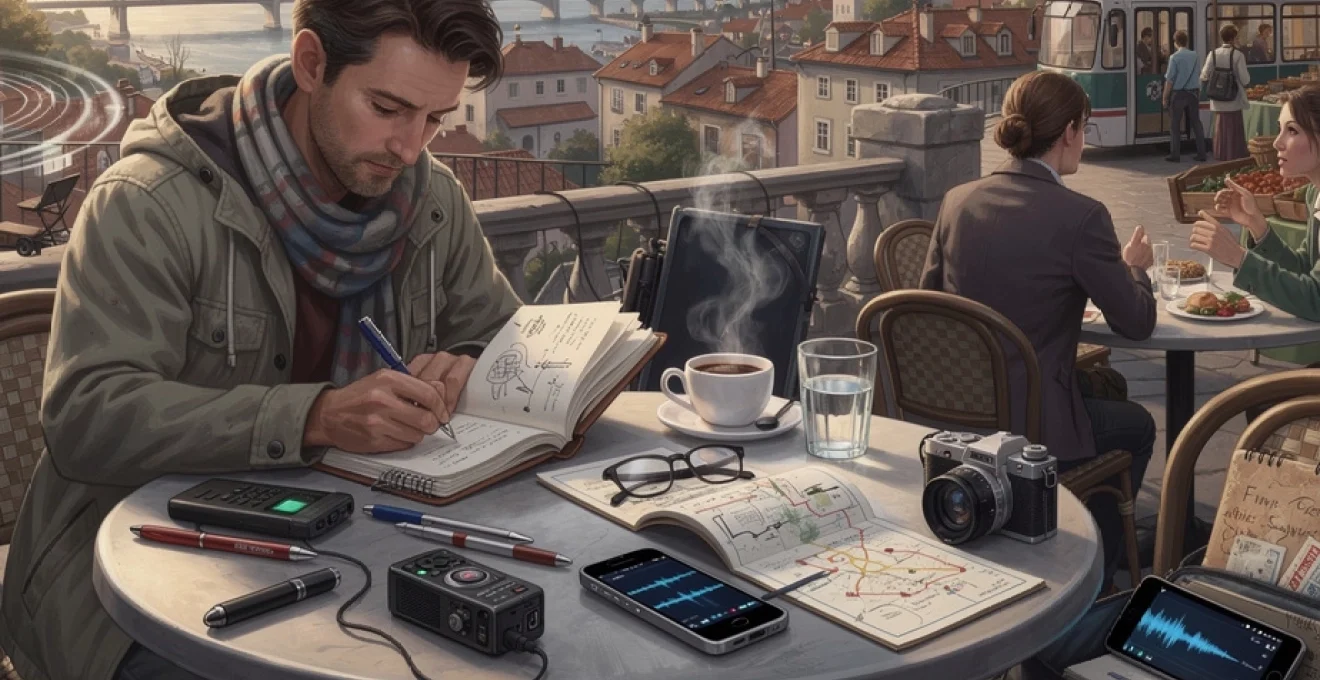
The weight of a notebook in your backpack might seem insignificant compared to the camera equipment, travel guides, and emergency supplies you’re carrying. Yet that simple collection of bound pages holds the key to transforming fleeting travel experiences into compelling narratives that resonate with readers years after you’ve returned home. When Leon McCarron cycled from New York to Los Angeles, he diligently recorded his journey, only to discover later that his notes were maddeningly vague—”Met a man called Mike” tells us nothing about the conversation that followed. This common pitfall illustrates why meticulous documentation during travel isn’t merely helpful; it’s essential for authentic storytelling. The human brain, remarkable as it is, distorts memories within hours of formation, smoothing rough edges and filling gaps with convenient fabrications. Writers who rely solely on memory return home with homogenised recollections that lack the sensory richness and specificity that make travel writing come alive on the page.
How Real-Time documentation captures sensory details that memory distorts
Neuroscientific research reveals that memories undergo significant transformation almost immediately after formation. Your brain doesn’t function like a video recorder, capturing events with perfect fidelity. Instead, it reconstructs memories each time you access them, introducing subtle alterations with every retrieval. This reconstructive process means that the sunset you witnessed in Broome three weeks ago isn’t the same sunset you remember today. Your brain has already begun smoothing out the irregular colour transitions, simplifying the complex interplay of light and shadow, and potentially merging elements from other sunsets you’ve experienced. When you write down observations in the moment, you create an external memory store that bypasses these neurological distortions, preserving the granular details that give your storytelling texture and authenticity.
The act of writing itself forces a level of attention that casual observation cannot match. When you commit to describing the marketplace sounds in Darwin, you must listen more intently than you would if simply walking through. This heightened awareness transforms passive tourism into active research, turning you from a spectator into an investigator of your own experience. You’ll notice the vendor’s particular inflection when calling out prices, the rhythmic pattern of footsteps on different surface materials, and the way conversations shift in volume and tone as you move through different sections of the market. These observations, captured immediately, become the building blocks of scenes that transport readers directly into the moment alongside you.
Olfactory and gustatory triggers: recording taste and smell before neural adaptation
Your olfactory system adapts to sustained smells within minutes—a phenomenon called olfactory fatigue that allows you to function in environments with strong persistent odours. This adaptive mechanism poses a significant challenge for travel writers because the most striking smells you encounter often fade from conscious awareness before you’ve had time to properly catalogue them. The pungent combination of fish, diesel, and tropical fruit that hits you when entering a Southeast Asian wet market becomes background noise within fifteen minutes. If you wait until evening to record your impressions, you’ll struggle to recall the specific aromatic profile that made the experience distinctive.
Immediate documentation combats this neural adaptation by forcing you to articulate sensory experiences while they’re still sharp and distinct. Writing “smells like fish” captures almost nothing useful for future storytelling. Writing “sharp ammonia tang of dried shrimp overlaying sweet rot of overripe durian, cut through with kerosene fumes from portable generators” provides material you can work with months later. The same principle applies to taste, which fades even more rapidly from memory than smell. That complex interplay of sweet, sour, and umami in the soup you ate for lunch becomes a vague recollection of “really good flavour” by dinner time unless you’ve recorded the specific taste sensations while your palate still held them.
Proprioceptive awareness: documenting physical sensations in extreme environments
Proprioception—your body’s awareness of its position and movement in space—provides crucial storytelling material that disappears from memory faster than almost any other sensory data. The particular strain in your calves as you climb a steep mountain path, the way your balance shifts when walking on loose scree, the pressure points where your backpack straps dig into your shoulders—these embodied experiences help readers feel the
ache in their own muscles. Yet these signals are precisely the ones your brain discards first, replacing them with a bland summary like “the hike was tough.” By noting down physical sensations in real time—numb fingertips on a glacial ridge, sand grinding between your toes in a desert, the sticky humidity gluing your shirt to your spine—you create a record of what the journey actually felt like in your body, not just what it looked like to your eyes. This level of proprioceptive awareness is what turns a generic “long bus ride” into a vivid account of knees pressed against plastic seats, the subtle sway of the suspension on potholes, and the dull throb in your lower back at hour eight.
One practical technique is to carry a tiny card or use your phone to jot down three quick notes every time your bodily state changes significantly: temperature, tension, and texture. “Temperature” might be the chill of mist settling into the fibres of your clothes; “tension” could be the tightness in your jaw when you step into a police checkpoint; “texture” might be the grain of a wooden bench under your palms as you wait for a delayed train. These shorthand notes may seem trivial in the moment, but later they help you reconstruct a scene from the inside out, grounding your storytelling in physical reality instead of abstract summary.
Chromatic accuracy: writing down colour palettes before memory homogenisation
Colour is another casualty of memory homogenisation. Days or weeks after a trip, your mind often paints different locations with the same broad strokes: “blue sea,” “green jungle,” “red sunset.” Yet in the moment, the world presents you with highly specific colour palettes—a harbour that runs from bottle-green shallows to slate-grey depths, or a city street where peeling turquoise shutters clash with sun-faded terracotta walls. If you don’t write these palettes down while you’re there, your brain will blend them into something more generic and far less useful for evocative travel storytelling.
A simple way to preserve chromatic accuracy is to think like a painter. Instead of writing “blue sky,” try to name or approximate the exact shade: “powder blue like old postcards,” “deep cobalt streaked with bruised purple,” or “white-hot glare that bleaches the sky to almost silver.” You can also create quick lists of colours you see in a single scene: the plastic chairs at a street stall, the vendor’s shirt, the currency notes in someone’s hand. These micro-inventories of colour not only sharpen your visual memory, they also give you ready-made descriptive phrases when you sit down to craft your travel narrative later.
Auditory landscapes: cataloguing ambient soundscapes through phonetic transcription
Soundscapes are among the first elements to vanish from memory, yet they are some of the most powerful tools you have for immersive travel storytelling. A city at dawn does not sound like a city at midnight, and a coastal village carries a different acoustic signature from a mountain monastery. When you document in real time, you can capture these auditory landscapes with a level of detail that would be nearly impossible to reconstruct from memory alone. The hiss of espresso machines, the overlapping calls to prayer, the irregular slap of flip-flops on wet pavement—each contributes to the texture of place.
Phonetic transcription can help you preserve sounds that are hard to describe with standard spelling. You might imitate the rhythm of a train—”ka-THUNK, ka-THUNK, ka-THUNK”—or the staccato chatter of a language you don’t understand. Note not only the sounds themselves, but also their layering and timing: what forms the constant background hum, what cuts through it like a knife, and what appears only once and never again. When you later write your travel story, these recorded soundscapes function like a film’s soundtrack, setting mood and pace long before your readers are consciously aware of it.
Dialogue preservation techniques for authentic character development
Memorable travel narratives rarely hinge on scenery alone; they live or die on the people you meet and the conversations you share. Yet our brains are notoriously bad at preserving dialogue accurately. Within hours, phrasing blurs, punchlines soften, and we replace real speech with how we wish people had spoken. If you want authentic character development in your travel writing, you need systems for capturing dialogue in the wild without stepping out of the moment. Done well, real-time documentation of speech can turn a fleeting chat with a stranger into the spine of an entire chapter.
Think of your conversations as raw data. You don’t need to record every word to improve your storytelling, but you do need to retain the distinctive features—rhythm, vocabulary, unexpected turns of phrase—that make a person sound like themselves. The goal isn’t to become a courtroom stenographer; it’s to create enough of a record that you can later reconstruct the emotional truth and linguistic flavour of the encounter. With a few deliberate techniques, you can do this discreetly and ethically, even on a crowded bus or in a noisy café.
Verbatim transcription methods: capturing dialectical variations and colloquialisms
Verbatim transcription is your most precise tool for preserving how people actually speak. When someone uses a turn of phrase you’ve never heard before, or drops an idiom that encapsulates their worldview, write it down as closely as you can to the original wording. Don’t “tidy up” grammar or swap local slang for standard English. Those dialectical variations and colloquialisms are often what make a character leap off the page later. A fisherman who says “the sea, she decides” tells you far more about his relationship to the ocean than one who declares “the sea is unpredictable.”
In practical terms, you can develop shorthand marks or abbreviations to speed up your note-taking without derailing the conversation. Some writers carry a small notebook and jot down key lines as soon as there’s a natural pause; others excuse themselves to the restroom and quickly capture the most important quotes before they fade. You might also type fragments into your phone’s notes app under the table, using initials instead of names for privacy. The key is to focus on memorable sentences and distinctive word choices rather than trying to reproduce ten minutes of small talk. As a rule of thumb, if a phrase makes you smile, frown, or stop to think, it probably deserves to be written down.
Para-linguistic notation: recording gesture, cadence, and vocal timbre
Words alone rarely tell the whole story of how someone communicates. Gesture, cadence, and vocal timbre—what researchers call para-linguistic features—carry enormous emotional weight. A line delivered in a flat monotone reads very differently from the same words spoken with a rising lilt and a half-smile. This is where your travel writing can start to resemble a director’s script: you’re not just reporting dialogue, you’re staging it. When you capture para-linguistic details, you give yourself the raw material to recreate the full performance of a conversation, not just its transcript.
In your notes, you might annotate speech with quick descriptors: “laughs midway,” “whispers last word,” “draws out vowels,” “speaks in bursts, lots of pauses.” You can also use arrows or underlines to indicate rising or falling intonation, or note physical gestures that accompany key lines—hands clasped behind the back, eyes fixed on the horizon, napkin shredded between fingers. These details may feel excessive in the moment, but later they help you show rather than tell. Instead of writing “he was nervous,” you can write “he never stopped folding and refolding his ticket as he spoke,” a line made possible only because you wrote the behaviour down as it happened.
Context-embedded conversation mapping: linking speech patterns to environmental triggers
Dialogue never occurs in a vacuum; it unfolds in a specific time and place, and those conditions shape what people say and how they say it. Context-embedded conversation mapping means recording not just the words, but also the triggers and surroundings that frame them. Did the café owner lower her voice only when she mentioned politics? Did the train conductor’s tone soften when a child walked by? Did the fisherman pause every time a wave crashed, as if listening for something only he could hear? These connections between speech and environment are gold for character-driven travel storytelling.
One method is to draw a simple map or timeline in your notebook that links notable lines of dialogue to specific environmental cues: a song starting on the radio, a storm cloud moving in, a police car passing. You can jot, for example, “He tells story about 1998 flood right as rain starts again.” Later, such notes help you build scenes with natural narrative tension and symbolic resonance, rather than retrofitting meaning after the fact. They also guard against the temptation to exaggerate or invent neat coincidences; when you’ve documented them in real time, you can trust that you’re reporting what truly happened, not what would make a tidy plot twist.
Sequential Micro-Observations that construct narrative tension
Many travellers remember only the highlights of a journey—the breathtaking viewpoint, the near-miss on the highway, the night in the unfamiliar guesthouse. But effective storytelling often depends on everything that happened in between: the slow build-up, the tiny frustrations, the half-noticed anomalies that, in hindsight, were signposts. Sequential micro-observations are those small, time-stamped notes that seem insignificant alone but, lined up, form a living timeline of your emotional and physical experience. They are the breadcrumbs that let you reconstruct narrative tension later with accuracy instead of guesswork.
Without these moment-by-moment records, it’s tempting to compress an entire day into a single paragraph: “After a long, stressful journey, we finally arrived.” Real-time documentation lets you see where the stress actually came from and how it escalated. Was it the missed connection, the language barrier at the ticket office, the heat, your own lack of sleep—or all of the above in slow accumulation? When you capture micro-shifts in your environment and your mindset, you gain material to build travel stories that feel both structured and truthful, much like a good novel where tension rises in clearly traceable steps.
Temporal granularity: documenting minute-by-minute emotional shifts
Temporal granularity is the practice of noticing and recording how your emotional state changes over short intervals. Instead of labeling a day as “amazing” or “awful,” you track the fluctuations: the sudden spike of anxiety when your passport isn’t where you thought it was, the brief relief when you find it, the dull annoyance of another queue, the quiet joy of a perfect cup of tea. These shifts often happen within minutes, and your memory tends to smooth them into a single, flattened verdict. Writing them down as they occur preserves the emotional contour of your experience, which is critical for shaping narrative tension later.
A practical approach is to jot a quick emotional status at natural breaks—arrivals, departures, meals, weather changes. You don’t need long reflections; even a two-word tag like “jittery hopeful” or “bone-tired but curious” can anchor a scene’s emotional tone. Over a day, these tiny entries form a data set you can later interpret much like a heart-rate monitor. Where did your mood spike or crash? Which external events coincided with those swings? When you build your travel story, you can then mirror this emotional rhythm on the page, drawing readers along a path that feels psychologically accurate rather than arbitrarily dramatic.
Foreshadowing through incidental details: recording anomalies that gain significance later
Some of the best moments of foreshadowing in travel writing come from details that felt meaningless when you first noticed them. A casually mentioned road closure in the morning becomes a major obstacle by nightfall. A half-seen warning sign in a foreign language turns out to have spelled out the danger you later encounter. But you can only use these as foreshadowing if you documented them when they first appeared. Otherwise, adding them retroactively risks feeling contrived, both to you and to your readers.
As you move through your trip, train yourself to note any detail that makes you think, “That’s odd,” even if you don’t understand why. A shop with all its windows boarded up, a dog that refuses to cross a particular alley, a local’s quick glance at the sky before answering your question—these anomalies often fade quickly from conscious awareness if you don’t capture them immediately. Later, when you see how events unfolded, you can sift back through your notes to find these early markers and use them to plant subtle hints, building narrative tension in a way that is faithful to what actually happened.
Pattern recognition in recurring motifs: tracking symbolic elements across multiple locations
Travel has a way of presenting you with recurring motifs—objects, phrases, animals, colours—that pop up in different cities and countries like echoing themes in a piece of music. You might keep noticing blue doors, stray cats, or the same song playing in distant cafés. At the time, each instance may seem random, but together they can acquire symbolic weight in your story. However, our brains are notoriously inconsistent at recognising these patterns after the fact. Unless you track them deliberately, you might miss the very motifs that could give your travel narrative coherence and depth.
In your notebook, consider dedicating a small corner to a running list of recurring elements. Each time you see that motif again—a particular bird, a proverb, a type of street food—add a quick note with location and context. Over weeks, you’ll start to see patterns you couldn’t have designed in advance. Perhaps every major decision moment on your trip happened near water, or each turning point came with the sound of church bells. When you later outline your story, these documented repetitions can guide your structure and themes, allowing you to weave a sense of inevitability and meaning without resorting to heavy-handed symbolism.
Atmospheric pressure points: noting environmental changes that mirror internal conflict
Good narratives often align external conditions with internal conflict: storms break as tempers flare, heatwaves accompany exhaustion, sudden silences mirror moments of doubt. It’s easy to believe these parallels are purely artistic choices made in revision, but in travel writing many of them occur naturally. The challenge is noticing and documenting them in real time so you can later decide which to highlight. Atmospheric pressure points are those moments when the environment seems to lean in on your experience, amplifying what you’re already feeling.
Whenever you feel a strong internal shift—fear, relief, anger, wonder—pause to note what’s happening around you physically. Has the light changed? Did the wind pick up? Did the crowd noise swell or fade? You might write, “Argument with guide just as clouds swallowed last sunlight,” or “Sense of dread grew as tunnel became colder and damper.” Years later, these tiny observations serve as anchors, letting you reconstruct scenes where setting and emotion intertwine. Used judiciously, they help you avoid cliché (“it was a dark and stormy night”) while still harnessing the real atmospheric conditions that shaped your journey.
Field notation systems used by travel writers like paul theroux and pico iyer
If all this sounds like a lot to juggle while you’re on the move, you’re not alone. Even veteran travel writers wrestle with how to capture enough detail without turning every day into an administrative chore. Studying their field notation systems can offer practical models you can adapt. Paul Theroux, for instance, has spoken about keeping meticulous train notes—times, distances, overheard remarks—while Pico Iyer has described using compact notebooks to record impressions in tight, almost telegraphic prose. Their methods differ, but they share a core principle: write during the experience, not just after.
Many professionals rely on layered note-taking. At the base layer are rapid jottings: single words, half-sentences, quick sketches of a room’s layout or a stranger’s face. On top of that, they add slightly longer reflections at natural pauses in the day—on a train, over lunch, before bed. Some also use symbols to mark different types of data (D for dialogue, S for smell, M for mood), making it easier to scan later. The specific system matters less than its consistency; your brain learns to trust that certain kinds of observations will always be captured in the same way, freeing you to stay present while still documenting what you need for future storytelling.
Converting raw travel notes into Three-Act story architecture
Real-time documentation is only the first half of the process. The second is transforming your chaotic field notes into a structured travel story that keeps readers turning pages. One effective approach is to map your material onto a three-act story architecture—the same basic framework used in novels and films. In Act I, you establish your normal world and the inciting incident that propels you into motion. Act II follows the complications, discoveries, and escalating stakes of the journey. Act III brings some form of resolution or transformation. Your raw notes provide the building blocks; the three-act structure helps you arrange them into a coherent narrative arc.
Practically, you can start by reading through your notebook with a few coloured pens or digital tags. Mark entries that feel like beginnings (first impressions, decisions, departures) in one colour, moments of complication or crisis in another, and instances of insight or closure in a third. You’ll often find that what felt like random events at the time form clear clusters when viewed through this lens. Perhaps several weeks of minor hassles around border crossings all belong to your central “conflict,” while a brief conversation with a stranger at a hostel becomes the turning point that reorients your perspective. By aligning your notes with a three-act pattern, you can build a travel narrative that feels satisfying without sacrificing authenticity.
Neurological evidence: why written encoding strengthens episodic memory retrieval
Underneath all these techniques lies a simple neurological truth: writing things down changes how your brain stores and retrieves experiences. Cognitive psychologists refer to this as “encoding specificity”—the idea that the way you encode a memory affects how easily you can access it later. When you write during your trip, you’re engaging multiple systems at once: motor, visual, linguistic, and emotional. This multi-channel encoding strengthens the neural pathways associated with that moment, making it far more likely you’ll recall it with clarity months or years down the line.
Studies on journaling and note-taking show that people who write by hand retain more episodic detail than those who rely solely on photos or mental recall. One reason is that writing forces you to select, organise, and label your experience in real time, a bit like compressing raw video footage into searchable clips. Another is that the physical act of forming letters activates brain regions involved in spatial processing and procedural memory, giving your experiences an additional “hook” to hang on. For travel storytellers, this means your notebook isn’t just a passive record; it’s an active tool for sculpting how your journeys live in your mind.
So when you pause on a crowded street to scribble down the exact colour of the sky or the cadence of a stranger’s laugh, you’re doing more than stockpiling content for a future article. You’re telling your brain, “This matters. Keep this.” Over time, this practice trains you to notice more, remember more, and ultimately write travel stories that feel vivid, specific, and alive—because they are built on a foundation of real-time, written experience rather than the hazy blur of unrecorded memory.