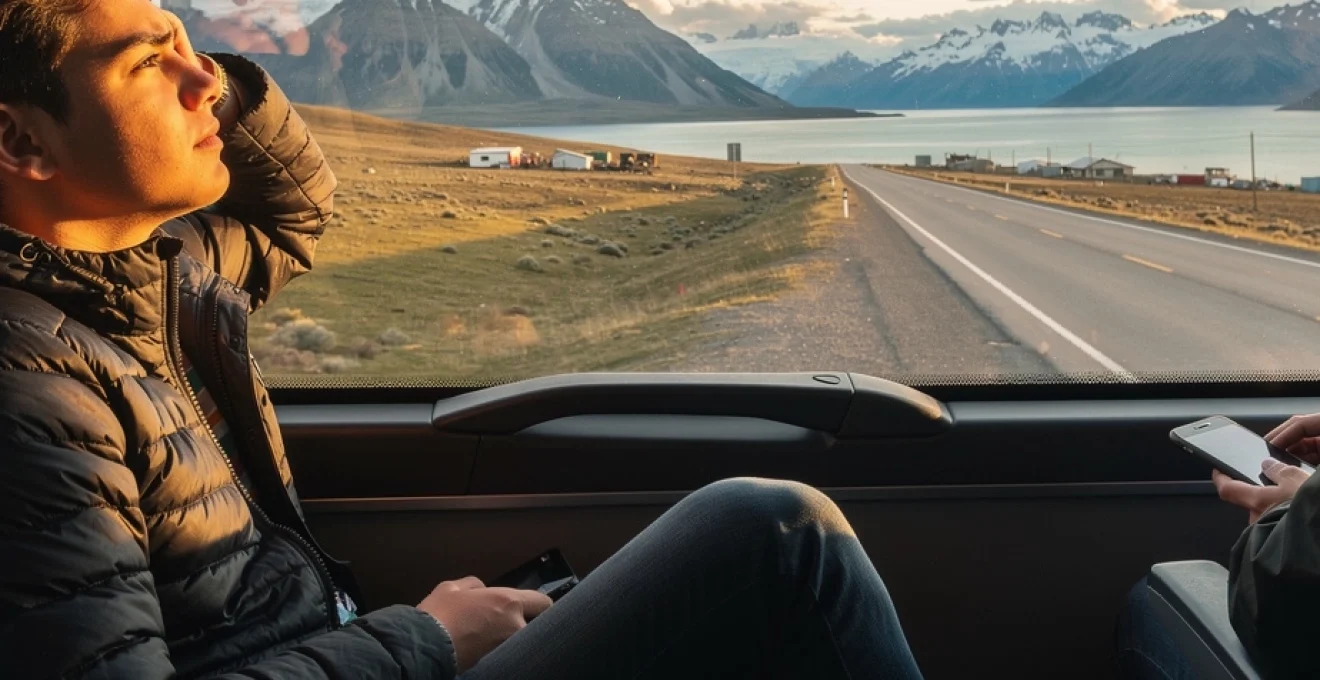
In an era dominated by rapid transit and instant gratification, the concept of deliberately choosing the slowest possible route through one of Earth’s most spectacular landscapes might seem counterintuitive. Yet, the transformative experience of traversing Patagonia by bus offers something increasingly rare in modern travel: the profound opportunity to disconnect from digital distractions and reconnect with the contemplative rhythms that once defined human journeying. The vast expanse of Argentine Patagonia, stretching over 3,200 miles from the northern borders to the windswept shores of Ushuaia, provides the perfect laboratory for understanding how extended overland travel can fundamentally alter our relationship with both landscape and consciousness.
This dramatic shift from hurried tourism to deliberate slow travel represents more than a simple change in transportation method. The neurological and psychological benefits of extended bus journeys through remote wilderness areas have begun to attract attention from researchers studying the effects of digital detox and mindful travel practices on human wellbeing.
Ruta 40 through argentine patagonia: engineering the ultimate slow travel experience
The legendary Ruta 40 represents one of the world’s most ambitious overland routes, spanning the entire length of Argentina alongside the Andes Mountains. This 5,000-kilometre highway serves as the backbone for an extraordinary slow travel experience that transforms the conventional notion of efficient transportation into something approaching spiritual pilgrimage. The route’s engineering challenges and logistical complexities create natural pause points that force travellers to embrace the rhythm of the landscape rather than fighting against it.
The psychological impact of committing to such an extended overland journey cannot be understated. Modern travellers, accustomed to compressing continents into brief flight segments, find themselves confronting the true scale of geographical distance in ways that fundamentally alter their perception of space and time. The 48-hour bus segments that characterise Patagonian travel become meditation chambers on wheels, offering sustained periods of contemplation impossible to achieve through conventional tourism.
Torres del paine to ushuaia route planning and distance calculations
The route from Torres del Paine National Park to Ushuaia encompasses approximately 1,200 kilometres of some of the world’s most challenging and rewarding overland terrain. This journey typically requires multiple bus transfers and strategic overnight stops, with the entire passage taking between 24 to 36 hours depending on border crossings and weather conditions. The distance calculations reveal the true magnitude of Patagonian geography, where the concept of “neighbouring” destinations takes on entirely new meaning.
Strategic route planning becomes essential when navigating the limited bus schedules that serve this remote region. The seasonal variations in service frequency mean that travellers must often adjust their expectations and embrace flexibility as a core component of the journey experience. The unpredictability of weather-related delays transforms potential frustrations into opportunities for extended contemplation and unexpected encounters with fellow travellers.
Andesmar and via bariloche Long-Distance coach services analysis
The major bus operators serving Patagonian routes have evolved sophisticated systems for managing the unique challenges of extreme-distance overland travel. Andesmar, with its extensive network covering the southern cone, offers semi-cama and cama ejecutiva services that transform overnight journeys into surprisingly comfortable experiences. The spacious seating configurations and onboard amenities recognise that these journeys represent more than simple transportation—they constitute immersive travel experiences in their own right.
Via Bariloche specialises in the scenic mountain routes that connect the lake district with the deeper reaches of Patagonia. Their scheduling philosophy embraces the natural rhythms of the landscape, with departure times designed to maximise daylight viewing opportunities of key scenic highlights. The company’s approach to customer service reflects a deep understanding that passengers are seeking transformative experiences rather than merely efficient transit.
Rio gallegos and el calafate strategic stopover optimisation
Rio Gallegos functions as the crucial hub for travellers navigating the final approaches to Ushuaia and the penguin colonies of the Falkland Current region. This windswept city offers essential services and connections, but more importantly, it provides a psychological waystation where the magnitude of the Patagonian experience begins to crystallise. The strategic importance of this stopover extends beyond mere logistics to encomp
asses the subtle psychological shift that occurs when travellers recognise how far they have come and how remote they truly are. Forced layovers in Rio Gallegos, whether due to sold-out buses or weather delays in the Strait of Magellan, invite an unplanned immersion into the art of waiting—an essential component of slow travel that modern itineraries often try to eliminate.
El Calafate, by contrast, operates as Patagonia’s gleaming showcase destination, anchoring visits to the Perito Moreno Glacier and the Southern Patagonian Ice Field. From a strategic standpoint, incorporating a two- or three-night stopover here transforms a purely functional bus journey into a multi-layered travel experience, blending logistics with world-class natural encounters. The town’s well-developed infrastructure, from grocery stores to hostels accustomed to irregular arrival times, provides a soft landing between long-haul segments while preserving the sense of wilderness at the edges of town.
When optimising stopovers along Ruta 40 and its connecting arteries, travellers benefit from thinking like transport planners rather than tourists. Aligning bus schedules with daylight hours for glacier visits, allowing buffer days for high-wind closures, and clustering activities within walking distance of accommodation all contribute to a calmer, more resilient itinerary. In this way, Rio Gallegos and El Calafate become not just pins on a map but carefully engineered pauses that protect both your energy and your capacity to appreciate the immensity of Patagonia.
Patagonian weather patterns and seasonal route accessibility
Any discussion of long-distance bus travel in Patagonia must reckon with the region’s notoriously volatile weather systems. The same katabatic winds that sculpt the glaciers also dictate whether a bus can safely cross exposed stretches of highway or board a ferry across the Strait of Magellan. Between October and March—the Southern Hemisphere’s high season—service frequency increases, but so does the probability of wind-related closures and delays, particularly in open steppe regions and high passes near the Andes.
Route accessibility in winter introduces a different set of constraints. Snow and ice can temporarily close sections of Ruta 40, especially around high-altitude passes and less-developed gravel segments. Operators like Andesmar and Via Bariloche adjust timetables accordingly, sometimes rerouting services via coastal highways or consolidating departures to ensure critical connections are maintained. For the slow traveller, these seasonal patterns are less an inconvenience and more a built-in reminder that Patagonia operates on its own temporal logic, indifferent to the tight connection windows valued in urban transport networks.
Planning a long bus ride through Patagonia, therefore, involves reading weather charts as carefully as timetables. Monitoring local forecasts, allowing 24–48 hours of flexibility around key crossings, and travelling with layered clothing for temperatures ranging from 3°C to 30°C all help transform potential disruptions into manageable variations. When we accept that the sky, not the schedule, is the true timekeeper in Patagonia, the journey becomes less about control and more about participation in a dynamic, living landscape.
Neuroscientific mechanisms behind contemplative travel and digital detox benefits
Extended bus journeys through Patagonia do more than reposition us geographically; they quietly rewire how our brains process time, attention, and reward. Neuroscientists studying contemplative states and digital detox have begun to identify clear mechanisms through which unstructured, low-stimulus environments support mental restoration. A 2019 study in Nature Human Behaviour, for instance, found that even brief breaks from screen-based multitasking improved working memory and emotional regulation; when we extrapolate that to 24 hours on a bus with limited connectivity, the potential for cognitive reset becomes evident.
Patagonia’s long bus segments create ideal conditions for what psychologists call “soft fascination”—gentle, naturally varying stimuli such as passing landscapes, changing light, and occasional roadside settlements. Unlike the rapid, high-intensity cues of social media feeds, this slow visual rhythm allows the brain’s attentional systems to rest and recalibrate. The result is a kind of mental exhalation: intrusive thoughts loosen, creative associations strengthen, and the constant itch to check notifications begins to fade.
Default mode network activation during extended transit periods
The brain’s default mode network (DMN) activates when we are not focused on specific tasks—during daydreaming, mind-wandering, or quiet reflection. In everyday life, we often crowd out DMN activity with podcasts, emails, and endless scrolling; on a ten-hour bus ride across the Patagonian steppe, there is finally enough silence for this network to fully engage. Far from being “doing nothing,” these stretches of apparent idleness enable deeper processing of memories, emotions, and long-term goals.
Research using functional MRI has shown that DMN activation correlates with autobiographical thinking and perspective-taking—abilities that underpin personal growth and empathy. When you find yourself staring out the window, replaying your recent trek in Torres del Paine or reconsidering life back home, you are essentially running an internal systems audit. Long-distance bus travel functions like a moving meditation hall, giving the DMN extended, undisturbed time to reorganise experiences into coherent narratives.
This is where the beauty of doing nothing on a bus journey reveals its neuroscientific foundation. By stepping off the treadmill of constant stimulation, we create space for the brain to perform maintenance tasks that our hyper-connected lifestyles routinely postpone. In practical terms, travellers often report returning from such journeys with clearer priorities, renewed creative ideas, and a more grounded sense of self—outcomes increasingly supported by cognitive neuroscience.
Dopamine regulation through reduced smartphone and social media exposure
The modern attention economy is powered by intermittent dopamine hits—those small bursts of reward we get from notifications, likes, and new content. On a Patagonia bus with patchy reception, your phone suddenly loses much of its power to hijack your reward system. After the initial discomfort of withdrawal, dopamine levels begin to stabilise, shifting from rapid spikes to slower, more sustainable patterns triggered by real-world stimuli such as a changing horizon or a meaningful conversation with a fellow traveller.
Emerging research from behavioural neuroscience suggests that sustained breaks from digital reward loops can recalibrate our baseline sensitivity to pleasure. In other words, when you spend a day or two without the constant drip of digital novelty, simple experiences regain their richness: the taste of a roadside empanada, the first glimpse of Fitz Roy on the skyline, or the warmth of sun through the bus window feels disproportionately satisfying. This recalibration is one reason why slow travel often feels more vivid and memorable than tightly scheduled, screen-saturated trips.
From a practical standpoint, you can support this dopamine reset by deliberately limiting offline distractions as well. Downloading a single audiobook instead of ten, keeping your music playlist short, or committing to hours of silent observation reinforces the shift from compulsive consumption to intentional attention. Over time, this change in how you experience reward can influence choices far beyond travel, from how you work to how you rest.
Circadian rhythm synchronisation in natural light environments
One underappreciated advantage of overland travel in Patagonia is the extended exposure to natural light cycles. Unlike air travel, which compresses time zones and disrupts circadian rhythms with artificial cabin lighting, bus journeys progress gradually through dawns, afternoons, and long twilight evenings. This continuity allows your internal clock to stay aligned with local solar time, supporting deeper sleep and more stable energy levels.
Studies on circadian biology have consistently shown that natural light is the primary external cue for synchronising our 24-hour body clock. When you spend an entire day watching the angle and colour of light shift across the Patagonian sky, you are effectively giving your nervous system a masterclass in temporal coherence. Simple habits—like avoiding bright screens after sunset, opening the bus curtain at first light, or stepping outside during stops—amplify these benefits.
For travellers arriving from different hemispheres or time zones, this gradual adjustment can be especially helpful. Instead of the abrupt time shift associated with long-haul flights, you ease into Patagonia’s rhythm one kilometre at a time. By the time you reach El Calafate or Ushuaia, your sleep-wake cycle is often more stable than when you left home, setting the stage for more restorative nights in remote refuges or hostels.
Cortisol reduction patterns in unstructured time allocation
Chronic stress is closely linked to elevated cortisol levels, often driven by rigid schedules, constant alerts, and the pressure to maximise every minute. Long bus rides through Patagonia invert this logic: you have hours that cannot be accelerated, tasks that cannot be added, and landscapes that unfold at a fixed pace regardless of your productivity. This enforced unstructuring of time creates ideal conditions for cortisol to gradually decrease.
Psychological studies on “time affluence”—the subjective feeling of having enough time—show strong correlations with higher wellbeing and lower stress markers. On Ruta 40, time affluence is less a mindset and more a physical reality; there is literally nothing you can or should be doing except being present to the journey. As the days progress, many travellers report a sensation similar to the first days of a silent retreat: initial restlessness gives way to a calm, unhurried attention to small details.
To support this hormonal unwinding, it can be helpful to treat your bus itinerary as a loose container rather than a strict schedule. Instead of trying to fill every moment with activity, you might alternate between short periods of reading, gentle stretching at rest stops, and long stretches of simply looking out the window. This intentional under-planning allows the physiological benefits of unstructured time—reduced cortisol, slower heart rate, improved mood—to emerge naturally.
Glacial landscapes and geological formations along the patagonian bus corridor
While the psychological journey unfolds inside the bus, the exterior narrative is written in ice, rock, and wind. The Patagonian corridor linking Bariloche, El Chaltén, El Calafate, and Río Gallegos traces the ghost footprints of ancient ice sheets that once covered much of the region. Each long bus segment offers a moving cross-section through geological time, from U-shaped valleys carved by retreating glaciers to sedimentary layers revealing millions of years of uplift and erosion.
Near El Calafate, the route skirts the vast turquoise expanse of Lago Argentino, a glacial lake fed by the Southern Patagonian Ice Field—the world’s second-largest contiguous body of ice outside the poles. As the bus crests gentle moraines, travellers catch glimpses of distant white walls: the Perito Moreno, Upsala, and Spegazzini glaciers advancing and calving into frigid waters. Even if you never step onto a glacier, the simple act of tracing their margins by road connects you viscerally to planetary-scale processes usually confined to textbooks or documentaries.
Further north, around El Chaltén and the Fitz Roy massif, the bus enters a realm of jagged granite spires and sculpted cirques. Here the landscape tells a different geological story: that of intrusive igneous rock forced up through older sedimentary layers and then sharpened by relentless glacial erosion. Watching these peaks appear and disappear as the bus navigates bends in the road is like turning the pages of an illustrated atlas—each new angle reveals another clue about how ice and stone negotiate over millennia.
Even the seemingly monotonous steppe between Río Gallegos and Comodoro Rivadavia carries glacial signatures. Low drumlins, erratic boulders marooned far from their source, and faint shorelines from ancient proglacial lakes hint that this sparse grassland was once a frozen frontier. Recognising these subtle features turns a “boring” bus segment into an open-air geology lecture, accessible to anyone willing to look closely and ask: how did this place come to be?
Mindfulness practice applications in extended overland transportation
Long bus rides through Patagonia lend themselves naturally to mindfulness, even for travellers with no prior meditation experience. The gentle rocking of the coach, the soft hum of the engine, and the repetitive rhythm of passing fence posts provide a sensory backdrop that encourages focused attention. Instead of fighting boredom with endless entertainment, you can use these conditions as a mobile retreat—an opportunity to strengthen awareness, patience, and presence.
One simple practice is breath-based observation. As you sit in your seat, feel the weight of your body, the contact points with the upholstery, and the rise and fall of your chest. Choose a landmark outside—a mountain, a lake, or even a distant wind farm—and use it as a visual anchor. Each time your mind drifts to emails, to-do lists, or the next destination, gently guide your attention back to the physical sensations of breathing and the slow motion of the landscape.
Another effective method is mindful listening. Close your eyes for a few minutes and catalogue the layers of sound: the murmur of fellow passengers, the subtle changes in engine pitch as the bus climbs or descends, the rush of wind against the windows. Rather than labelling these sounds as pleasant or annoying, treat them as neutral data points arising and fading in your awareness. Over time, this non-judgemental stance can spill over into how you relate to travel delays, cramped seats, or unexpected itinerary changes.
For many travellers, journaling on the bus becomes a bridge between inner and outer mindfulness. Instead of simply recording events, you might note physical sensations, emotional responses, and fleeting thoughts as they arise. How does your body feel after eight hours of stillness? What emotions surface as the landscape becomes more remote? Which worries lose their grip after a full day without Wi-Fi? Approached this way, a Patagonia bus ride becomes both a geographical and psychological map-making exercise.
Economic and environmental sustainability of slow tourism in remote patagonia
Choosing buses over planes in Patagonia is not only a philosophical statement about the value of slow travel; it is also a tangible contribution to more sustainable tourism patterns in a fragile region. From an environmental standpoint, long-distance coaches typically emit significantly less CO2 per passenger-kilometre than domestic flights, especially when operating at high occupancy. When we stretch our journeys overland rather than hopping between distant airports, we effectively reduce the carbon intensity of our itineraries while gaining a deeper understanding of the spaces in between.
Economically, slow tourism disperses spending across multiple communities instead of concentrating it in a few gateway cities. Every bus change in Río Gallegos, meal in a terminal cafeteria, or overnight stay in a family-run hostel contributes to local livelihoods that might otherwise be bypassed entirely by fly-in, fly-out visitors. This distributed revenue model is particularly important in regions like Patagonia, where small towns can struggle to balance economic opportunity with environmental protection.
Of course, slow travel is not impact-free. Increased interest in iconic routes such as Ruta 40 can strain waste management systems, water resources, and fragile trails if not carefully managed. The challenge—and opportunity—for travellers is to pair their choice of overland transit with low-impact behaviours on the ground: refilling water bottles instead of buying single-use plastic, choosing operators that adhere to safety and environmental standards, and respecting seasonal closures designed to protect wildlife and ecosystems.
In this context, the long bus ride through Patagonia becomes a microcosm of a more sustainable tourism ethic. By accepting distance rather than denying it, by valuing the journey as much as the destination, and by using unstructured time to reflect on our relationship with the planet, we align our travel choices more closely with the landscapes that inspire us. The beauty of doing nothing on those endless straight roads is, in the end, an invitation to reconsider how—and why—we move through the world at all.