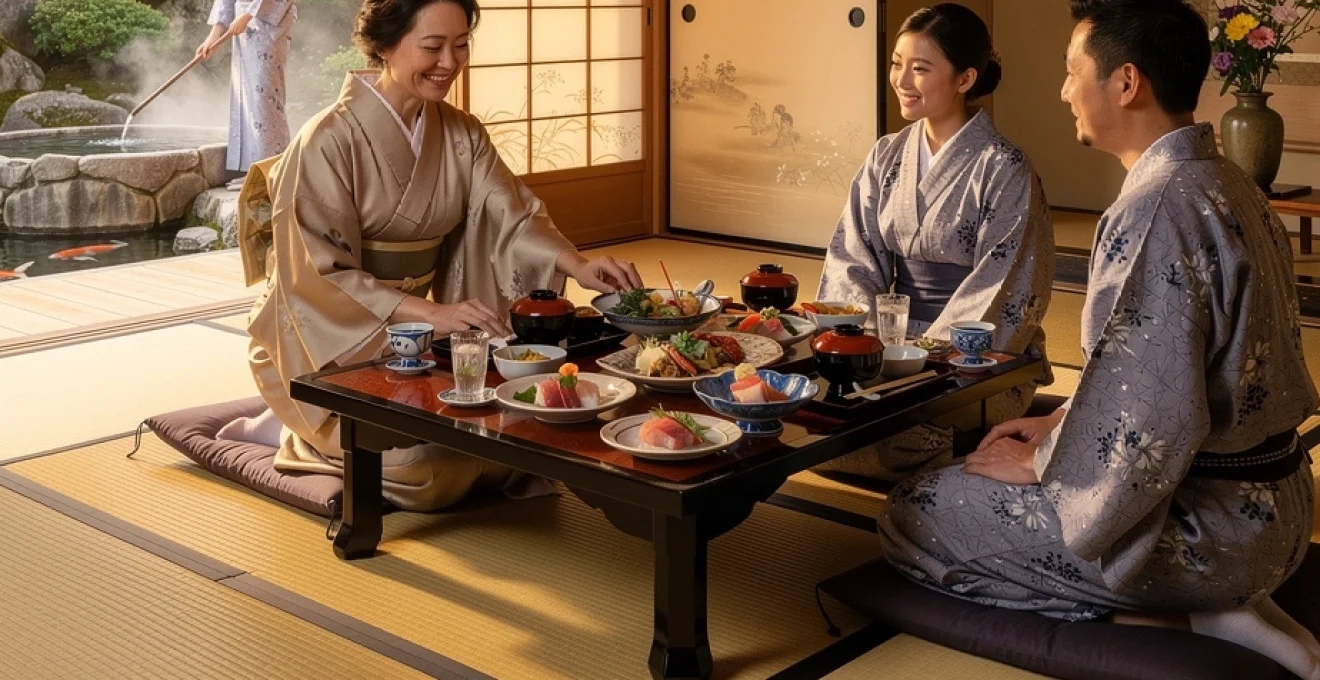
Japanese culture has perfected the art of transforming simple accommodation into a profound cultural experience. While Western hotels focus on efficiency and standardized comfort, traditional ryokans offer something fundamentally different: an immersion into centuries-old hospitality traditions where every gesture, every meal, and every architectural detail serves a deeper purpose. These establishments, which originated during the Nara period as modest rest stops for weary travelers, have evolved into sanctuaries where the philosophy of omotenashi reaches its fullest expression. For anyone seeking to understand Japan beyond its modern metropolises, spending a night in a ryokan provides insights that no museum or guidebook can match. The experience challenges conventional notions of hospitality, replacing transactional service with anticipatory care that borders on the intuitive.
Defining omotenashi: the philosophy behind japanese ryokan hospitality
The concept of omotenashi represents far more than excellent customer service—it embodies a philosophy of selfless hospitality that anticipates needs before they’re expressed. This principle, deeply rooted in tea ceremony traditions, manifests in every interaction at a traditional ryokan. Unlike Western service models based on explicit requests and responses, omotenashi operates on silent observation and intuitive understanding. Your nakai-san (room attendant) will notice if you prefer hot or cold beverages, whether you sleep late or rise early, and adjust their service accordingly without you uttering a single word.
This hospitality philosophy creates a reciprocal relationship between guest and host that transcends commercial transaction. When you receive service imbued with omotenashi, you’re experiencing centuries of cultural refinement that values harmony, respect, and sincere care for another’s comfort. Research from the Japan Tourism Agency indicates that international visitors consistently rate ryokan experiences as the most memorable aspect of their journeys, with omotenashi cited as the distinguishing factor. The practice requires extraordinary attention to detail: staff members undergo years of training to master the choreography of serving meals, preparing rooms, and interacting with guests in ways that feel effortless yet deeply considered.
What makes omotenashi particularly distinctive is its foundation in ichigo ichie—the concept that each encounter is unique and unrepeatable. This mindset infuses every interaction with significance, transforming routine tasks into meaningful exchanges. When your nakai-san bows deeply as she presents your evening meal, she’s acknowledging not just your presence but the singular nature of this specific moment. According to hospitality studies, this approach generates emotional connections that conventional service models cannot replicate, explaining why guests often describe ryokan stays as transformative rather than merely comfortable.
Architectural elements and spatial design of traditional ryokans
Traditional ryokan architecture represents a sophisticated spatial philosophy that prioritizes harmony with nature, flexibility of space, and aesthetic restraint. These buildings typically feature low-slung wooden structures with deeply overhanging eaves, designed to blend seamlessly with their surroundings rather than dominate them. The architectural language speaks of impermanence and natural beauty—concepts central to Japanese aesthetics. Unlike Western buildings that emphasize permanence through stone and concrete, ryokan construction celebrates wood’s organic qualities, allowing structures to breathe, age gracefully, and maintain connection with the seasons.
The spatial organization follows principles established centuries ago, creating environments that encourage contemplation and social connection. Public areas flow naturally into private spaces through carefully calibrated transitions marked by changes in flooring materials, ceiling heights, and lighting levels. This graduated privacy allows guests to move from communal bathing areas to semi-private dining spaces and finally to intimate sleeping quarters without jarring transitions. Studies of traditional Japanese architecture reveal that these spatial sequences influence guests’ psychological states, promoting gradual relaxation as they move deeper into private zones.
Tatami mat flooring systems and room configuration standards
Tatami mats define Japanese interior space with mathematical precision. These woven rush grass mats, standardized at approximately 180cm by 90cm, serve as both flooring and measurement unit for room sizes. A typical ryokan room measures six to eight tatami mats (roughly 10-13 square meters), though luxury establishments may offer suites of twelve mats or more. The
arrangement of these mats is never random. Each tatami layout follows established configuration standards that avoid four-corner intersections, believed to bring bad luck, and instead create flowing L-shaped joints. This grid subtly guides how you move, sit, and even place your luggage, encouraging you to occupy the room with more intention. You sit on zabuton cushions at a low table in the center, then later the same floor becomes your sleeping area once the futon is laid out. This flexible use of space means a single tatami room can serve as living room, dining room, and bedroom over the course of a day, embodying the ryokan ideal of elegant simplicity.
For first-time guests, the absence of a fixed bed or sofa might feel disorienting at check-in, but this minimalist configuration is deliberate. It supports a more mindful rhythm where activities are not separated by walls but by time and subtle rearrangements. Hospitality researchers note that such adaptive spaces can reduce visual clutter and mental fatigue, making them surprisingly restful compared with heavily furnished Western rooms. When you roll up your futon in the morning or watch staff transform the room during dinner, you participate in a quiet daily ritual that connects you to centuries of Japanese domestic life.
Fusuma sliding doors and shoji screen functionality
The boundaries in a traditional ryokan are rarely fixed; instead, they are mediated by fusuma and shoji. Fusuma are opaque sliding doors made of wood frames covered with thick paper or cloth, often decorated with ink paintings or subtle patterns. They act as movable walls, allowing rooms to expand for group dining or contract for intimate sleeping arrangements. Shoji, by contrast, are translucent lattice screens covered with thin washi paper that diffuse natural light. They filter harsh sunlight into a soft glow, creating a sense of calm that artificial lighting struggles to replicate.
This sliding-door system gives ryokan architecture a remarkable spatial flexibility. Corridors, guest rooms, and alcoves can be reconfigured according to season or occupancy, much like a stage set that adapts to each performance. In practical terms, this means you may wake to find that a once-enclosed room now opens to a larger salon or corridor as staff discreetly adjust partitions. From an acoustic perspective, fusuma provide modest sound insulation while still allowing a gentle awareness of life beyond your room—footsteps in the hallway, the distant clink of dishes—which reinforces a feeling of shared retreat rather than total isolation.
Tokonoma alcoves and seasonal ikebana display traditions
One of the most distinctive features of a ryokan guest room is the tokonoma, a shallow decorative alcove typically found opposite the entrance. This space is never used for storage or seating; instead, it serves as a miniature stage for seasonal expression. You will often find a hanging scroll (kakemono) paired with a simple flower arrangement or a single ceramic piece. The selection changes throughout the year to reflect the current season—plum blossoms in late winter, irises in early summer, or autumn grasses in October. Like a carefully curated museum display, the tokonoma invites you to pause and contemplate.
According to traditional etiquette, guests do not sit with their back to the tokonoma or place luggage within it; doing so would be akin to obscuring a work of art. Instead, the alcove becomes a visual focal point that sets the emotional tone of your stay. Scholars of Japanese aesthetics often compare the tokonoma to a “window into time,” because it anchors you in a particular moment of the seasonal cycle. For you as a traveler, this means that even a short one-night stay in a ryokan becomes tied to a specific chapter of the year, reinforcing the idea that hospitality is not just about comfort but also about situating you within nature’s rhythm.
Engawa verandas and garden integration principles
Many classic ryokans feature an engawa, a narrow wooden veranda that runs along the exterior of the building, blurring the boundary between inside and outside. Often slightly raised above a gravel path or moss garden, the engawa functions as a liminal zone where you can sit in your yukata, sip tea, and watch the rain or falling snow without fully stepping outdoors. From a design perspective, it acts like a lens that frames the garden view, much as a camera frame focuses your attention on a particular composition. The sliding shoji or glass panels behind you can be opened or closed to modulate air flow, temperature, and sound.
Garden integration is central to ryokan architecture, especially in onsen towns or rural regions where natural scenery is the main draw. Landscaping follows principles of borrowed scenery (shakkei), where distant mountains, riverbanks, or forest edges are visually incorporated into the garden composition. As you walk along the engawa, the view shifts in a carefully choreographed sequence: a stone lantern comes into focus, then a koi pond, then a maple tree whose leaves change dramatically with the season. For guests accustomed to sealed, climate-controlled hotels, this continuous dialogue between interior and landscape can be transformative, encouraging slower movement, quieter conversation, and a more meditative mindset.
Kaiseki ryori: multi-course dining protocols in ryokan settings
If the architecture of a ryokan is a quiet conversation with nature, its cuisine—especially kaiseki ryori—is a full-length poem about the seasons. Kaiseki is the refined multi-course dining style that many traditional ryokans serve for dinner, often included in the room rate. While it may resemble haute cuisine tasting menus in the West, its philosophical foundation is different. Rather than showcasing the chef’s ego, kaiseki aims to highlight the natural character of each ingredient at its seasonal peak. Dishes arrive in a deliberate progression that moves from light to rich, from raw to cooked, mirroring the arc of a tea ceremony.
Understanding basic kaiseki protocols can help you appreciate the experience on a deeper level. Courses are served in a set order, and the tableware, garnishes, and even the direction in which a leaf points are chosen with intention. You are not expected to identify every element, but approaching the meal with curiosity—smelling the broth before tasting it, noting how the texture of a ceramic bowl complements a particular dish—can make the evening feel less like “just dinner” and more like a cultural workshop. Recent surveys by Japan National Tourism Organization suggest that over 60% of international guests list kaiseki dinner as a primary reason for choosing a ryokan over a Western hotel, underscoring its central role in the overall experience.
Seasonal ingredient selection and shun culinary philosophy
At the heart of kaiseki lies the concept of shun—the precise moment when an ingredient is at its best. Rather than relying on year-round availability made possible by global logistics, ryokan kitchens plan menus around local harvest cycles. Spring dinners might feature bamboo shoots, mountain vegetables (sansai), and young greens, while autumn brings chestnuts, matsutake mushrooms, and oily seasonal fish like sanma. This focus on seasonality is not just aesthetic; nutritionists point out that foods eaten in their natural season tend to be more flavorful and nutrient-dense, making the kaiseki experience both pleasurable and health-conscious.
For you as a guest, shun means that the same ryokan can feel entirely different if you visit in May versus November. The sashimi selection changes, the simmered vegetables shift in color palette, and even the garnishes—maple leaves, cherry blossoms, or sprigs of pine—signal the current stage of the year. It is a bit like attending a concert where the score is similar but the instrumentation changes with each performance. To make the most of this seasonal cuisine, consider planning your ryokan stay around ingredients that interest you: spring for cherry blossoms and delicate flavors, autumn for mushrooms and robust broths, or winter for hot pots and rich seafood.
Hassun and mukozuke course presentation techniques
Two of the most emblematic kaiseki courses you are likely to encounter at a ryokan are hassun and mukozuke. Hassun, typically served early in the meal, sets the seasonal theme using a selection of small bites artfully arranged on a single tray. You might see grilled fish, pickled vegetables, and a tiny square of sesame tofu, each representing an element of mountain, field, or sea. The plate itself often incorporates natural materials like bamboo leaves or stones, almost like a miniature landscape that invites you to explore it piece by piece. In this way, hassun acts as an edible introduction, telling you “this is the season, and this is this place.”
Mukozuke usually refers to the sashimi course, presented with a level of precision that borders on sculptural. Knife cuts vary according to the type of fish to maximize texture, and garnishes like freshly grated wasabi, shiso leaves, or edible flowers are placed with millimeter accuracy. At many ryokans, the chef will source fish from nearby ports in the early morning, meaning what arrives at your table in the evening may have been in the sea at sunrise. When you take a moment to appreciate how slices are fanned, stacked, or layered, you begin to see mukozuke not just as raw fish but as a careful study of color, line, and form.
Lacquerware and ceramic vessel selection for each course
In kaiseki, the choice of plate or bowl is almost as important as the food it holds. Ryokans often maintain sizable collections of lacquerware, porcelain, stoneware, and glass vessels, each reserved for specific dishes and seasons. A clear glass bowl might be used for a chilled summer appetizer, evoking coolness, while a heavy, dark ceramic pot suits a winter simmered dish. The tactile quality of each vessel—smooth lacquer, rough clay, or delicately cracked glaze—adds a layer of sensory engagement that goes beyond taste.
This meticulous matching of food and tableware reflects the Japanese principle of yo no bi, or beauty in everyday objects. You may notice that no two consecutive courses arrive in similar shapes or colors, a deliberate strategy to keep your senses alert. Some high-end ryokans collaborate with local potters, turning the dining room into an informal gallery of regional craftsmanship. As a guest, you do not need to know the names of glazes or kiln traditions; simply paying attention to how each vessel feels in your hands or how it frames the contents can deepen your appreciation of the meal’s artistry.
In-room dining service choreography and timing standards
One of the defining differences between a ryokan and a Western hotel is where and how dinner is served. In many traditional establishments, kaiseki is brought directly to your tatami room by your dedicated nakai-san. Rather than placing all dishes on the table at once, she will enter and exit in a carefully timed sequence, clearing empty plates and introducing new courses so that nothing sits too long. This choreography is designed to match the natural tempo of eating, allowing hot dishes to arrive steaming and cold ones still chilled.
From your perspective, the service may feel almost invisible. Knock patterns and sliding-door etiquette ensure that your conversation is not abruptly interrupted, and staff often move soundlessly on tabi-clad feet. Industry studies of ryokan operations reveal that timing standards can be precise to within a few minutes, especially for dishes like tempura that lose quality quickly. If you have dietary restrictions or a slower dining pace, communicating this at check-in allows the kitchen and service staff to adjust the sequence without diminishing the experience—another example of omotenashi in action.
Onsen bathing rituals and rotenburo experience at ryokans
For many travelers, the highlight of staying in a traditional ryokan is access to an onsen, the natural hot spring baths that are central to Japanese bathing culture. Whether indoors or outdoors, these baths are more than simple amenities; they form a kind of communal sanctuary where social hierarchies soften and daily stress dissolves in mineral-rich water. Geologists note that Japan has over 27,000 hot spring sources, and many ryokans are strategically built near them, integrating the onsen into the architectural and experiential core of the property. The contrast with a standard hotel shower or bathtub could not be greater.
Entering an onsen for the first time can feel intimidating, especially if you are unfamiliar with bathing etiquette. Yet once you understand the basic rituals, the experience becomes deeply relaxing, even meditative. The sequence of undressing, washing, soaking, and cooling down follows a rhythm that encourages you to slow your breathing and release tension. Outdoor baths—rotenburo—add another dimension, allowing you to feel cold air on your face while your body remains enveloped in warmth, a sensation many guests describe as uniquely memorable.
Communal bathing etiquette: pre-bath cleansing procedures
Japanese onsen culture is built on the principle that you do not enter shared water until you are completely clean. At a ryokan, this means that after you leave your yukata and large towel in the changing area, you proceed to a row of washing stations equipped with stools, handheld showers, and toiletries. Seated on the stool, you thoroughly wash your entire body and hair using soap and shampoo, rinsing carefully so that no residue remains. This pre-bath cleansing is not a quick rinse; think of it more like a detailed reset, comparable to preparing a canvas before painting.
Once you are clean, you may enter the onsen with only a small towel in hand, which you can use for modesty while walking but should never immerse in the water. Many first-time visitors wonder: is everyone really bathing naked together? The answer is yes, in gender-separated baths, and after a few minutes most people report that self-consciousness fades as the shared focus shifts to relaxation. Keeping your voice low, avoiding splashing, and not swimming are all part of showing respect for other bathers. These unspoken rules ensure that the space remains tranquil, allowing everyone to enjoy the therapeutic qualities of the spring water.
Private kashikiri-buro reservations and facilities
While communal bathing is traditional, many ryokans now offer kashikiri-buro, private baths that can be reserved by couples, families, or individuals seeking solitude. These facilities are especially helpful if you have visible tattoos—still restricted in some public baths—or simply feel more comfortable in a private setting. Reservations are often made at check-in or through a simple sign-up board indicating available time slots, typically 30 to 50 minutes per session. Some kashikiri-buro draw directly from the same hot spring source as the main onsen, providing identical water quality in a more intimate space.
From a design perspective, private baths can be some of the most architecturally interesting corners of a ryokan. You may find cedar or cypress tubs on small terraces, stone baths partially enclosed by bamboo fencing, or even semi-open-air rooms that frame a single tree or rock as a focal point. Because capacity is limited, the overall atmosphere tends to be quiet and contemplative. If you are planning a ryokan stay and know that communal bathing will be challenging, checking in advance for kashikiri options is a practical way to ensure you can still participate in this cornerstone of Japanese hospitality.
Yukata robes and tanzen jackets: post-bath attire protocols
After bathing, slipping into a clean yukata is one of the small pleasures that define the ryokan experience. The yukata, a lightweight cotton robe, functions as both loungewear and informal public attire within the premises. Properly worn, the left panel wraps over the right—a detail worth remembering, as the reverse is reserved for dressing the deceased at funerals. A simple cloth belt (obi) secures the robe at the waist, and many ryokans provide matching tabi socks and sandals for walking through corridors or to the dining room.
In cooler seasons, you may also receive a thicker over-robe known as a tanzen or hanten, which adds warmth without sacrificing mobility. Walking through the ryokan in coordinated yukata and tanzen creates a sense of communal equality; regardless of your profession or background, everyone becomes just another guest at rest. From a practical standpoint, this dress code simplifies packing—no need for elaborate outfits—and encourages you to fully enter “ryokan mode,” leaving the outside world behind for a night. Many visitors enjoy purchasing a yukata as a souvenir, bringing a tangible reminder of this slower, more mindful way of staying.
Notable ryokans: nishimuraya honkan, hoshi ryokan, and asaba
While thousands of ryokans across Japan offer authentic stays, a handful have become benchmarks for excellence in traditional hospitality. Properties such as Nishimuraya Honkan in Kinosaki Onsen, Hoshi Ryokan in Ishikawa, Asaba in Shuzenji, and Gora Kadan in Hakone are frequently cited in travel journals and academic studies alike. They serve as living case studies of how architecture, cuisine, and omotenashi can be woven together at the highest level. Even if your own trip leads you to more modest, family-run inns, understanding these flagship examples can help you recognize echoes of the same values wherever you stay.
What unites these renowned ryokans is not merely luxury—though many are indeed luxurious—but continuity. Some are operated by the same family for dozens of generations, passing down intangible know-how that cannot be replicated overnight. When you read that Hoshi has been in business for more than 1,300 years or that Asaba traces its roots to a temple lodging, you begin to see your overnight stay as a fleeting moment in a much longer story. This awareness can deepen your appreciation of even simple gestures, like the way tea is poured or futons are laid out.
Hoshi ryokan: 1,300-year heritage in komatsu, ishikawa prefecture
Located in the Awazu Onsen area of Komatsu, Hoshi Ryokan is often mentioned among the world’s oldest continuously operating hotels. Founded in 718 CE according to temple records, it has been managed by the same family for over 46 generations. The property has expanded and modernized in measured ways, but its core remains faithful to classical ryokan design: low wooden buildings, carefully maintained gardens, and a network of indoor and outdoor baths fed by local hot springs. Staying here is sometimes described as “sleeping inside a history book,” where each corridor hints at centuries of accumulated stories.
Guests at Hoshi can experience many of the elements discussed earlier—tatami rooms, kaiseki dinners, communal onsen, and personalized service by experienced nakai-san. Yet what sets it apart is the palpable sense of continuity. The family’s long stewardship is not merely a marketing point; it informs everyday decisions about maintenance, guest interaction, and even menu planning. For travelers interested in the deep history of Japanese hospitality, a night at Hoshi functions almost like fieldwork, offering firsthand insight into how traditional practices adapt to contemporary expectations without losing their essence.
Asaba’s contemporary interpretation in shuzenji onsen
Asaba, set in the tranquil hot spring town of Shuzenji on the Izu Peninsula, offers a more contemporary interpretation of the ryokan ideal while still grounded in tradition. The property is renowned for its stunning central pond, over which a Noh stage appears to float, and for architecture that feels at once minimalist and warm. Large windows, clean lines, and subtle lighting are paired with classic materials like wood, paper, and stone. The result is a space that might remind you of a modern art museum in one view and a 17th-century teahouse in the next.
Culinary and service standards at Asaba are equally elevated. Kaiseki meals feature local seafood and mountain vegetables presented with artistic restraint, and the pace of service is calibrated to encourage lingering conversation. Onsen facilities include both indoor and outdoor baths that overlook the water garden, reinforcing the feeling that nature is an equal partner in the hospitality equation. For guests looking for a ryokan stay that feels timeless but not old-fashioned, Asaba demonstrates how Japanese inns can evolve while retaining the spirit of omotenashi.
Gora kadan’s former imperial villa status in hakone
Gora Kadan in Hakone occupies the grounds of a former imperial family villa, and that pedigree is evident from the moment you enter. The architecture blends early 20th-century aristocratic design with classic ryokan features, creating a refined atmosphere that still feels intimate rather than imposing. Many suites offer private open-air baths with views of mountains or meticulously landscaped gardens, allowing you to enjoy the onsen experience without leaving your room. Inside, tatami rooms coexist with subtle Western touches such as low platform beds and discreet climate control.
Service at Gora Kadan exemplifies high-end ryokan hospitality: staff effortlessly arrange transportation, adapt menus to dietary needs, and time activities so that guests can enjoy both in-house amenities and Hakone’s surrounding attractions. For travelers who might be hesitant to forgo certain Western comforts, this ryokan offers a gentle bridge—a place where you can sleep on tatami one night and on a mattress the next, all while experiencing the same level of seasonal cuisine and meticulous care. In this way, Gora Kadan showcases how the ryokan model can meet modern luxury expectations without abandoning its cultural roots.
Nakai-san service standards and guest interaction choreography
Behind every memorable ryokan stay is a team of professionals whose work is as carefully choreographed as a stage performance. Central among them is the nakai-san, the room attendant who serves as your primary point of contact throughout your visit. Unlike hotel staff who may handle only check-in or housekeeping, a nakai’s responsibilities span multiple domains: welcoming you, serving meals, preparing futons, answering questions, and anticipating needs. This continuity allows for a level of personalized service that can feel almost uncanny—like dining in a fine restaurant where the server remembers your preferences after a single course.
Training for nakai-san is rigorous and can last several years, combining practical skills with education in etiquette, regional dialects, and local history. Many learn to read subtle cues in body language and speech, adjusting their level of formality or conversational engagement accordingly. If you appear tired after a long journey, they might shorten explanations; if you show curiosity, they may share stories about the building or nearby sights. This ability to calibrate interaction is a hallmark of omotenashi: service is neither intrusive nor distant but tuned to what you seem to need in that particular moment.
The choreography of guest interaction extends beyond individual staff members to the entire operation. For example, while you are at dinner, housekeeping staff may enter to lay out futons, ventilate the room, and adjust lighting so that you return to a space subtly transformed for sleep. In the morning, the reverse occurs as bedding is cleared away while you are at breakfast, restoring the room to its daytime configuration. These transitions are timed to minimize overlap with your presence, creating the illusion that the room “reshapes itself” without visible effort. For visitors used to more transactional hotel service, this seamless coordination can feel almost magical.
Morning routines: asa-gohan breakfast service and checkout rituals
Morning at a ryokan unfolds with the same attention to rhythm and detail that defines the rest of your stay. After an early soak in the onsen—many guests swear that a pre-breakfast bath is the best way to start the day—you return to find your room or dining space prepared for asa-gohan, the traditional Japanese breakfast. Rather than a hurried buffet, you are presented with a curated tray or low table setting that typically includes steamed rice, miso soup, grilled fish, pickles, a small salad, and perhaps a soft-boiled egg or tofu dish. Nutritionists often point out that this combination of protein, complex carbohydrates, and fermented foods makes for a balanced, sustaining start, especially if you plan to spend the day sightseeing or hiking.
Breakfast service, like dinner, follows subtle protocols. Dishes are arranged so that rice is placed closest to you, soup to the right, and side dishes radiating outward. Green tea is poured at a gentle pace, and staff check in unobtrusively to see if you need extra rice or miso. If you have indicated a preference for Western-style breakfast, many ryokans will provide bread, eggs, and coffee, but still present them with the same care for proportion and layout. This final meal reinforces the idea that every interaction—from the first welcome tea to the last cup of miso—is an opportunity to practice omotenashi.
Checkout rituals at a ryokan also differ from those at standard hotels. Rather than dropping a key card in a box and leaving unnoticed, you typically settle your bill at the front desk while staff confirm that your stay went smoothly and ask about your onward journey. In many establishments, several team members will come to the entrance to see you off, bowing deeply as you depart. Some will remain outside until your taxi or shuttle is out of sight, a gesture that may feel surprising if you are used to more casual farewells. This final act of respect closes the circle of the stay, reminding you that, for the ryokan and its staff, your visit was treated as a singular encounter—ichigo ichie—rather than just another booking in the system.
As you leave, you may find that the memories which stay with you are not only of hot springs and elaborate meals, but of these small, carefully considered moments. The way slippers were always turned to face the right direction, the quiet knock before each course, the garden view framed just so at breakfast—all of these details embody the art of hospitality in Japan. Understanding them turns a simple overnight stay in a traditional ryokan into a lasting lesson in how space, ritual, and sincere attention can transform travel into something deeper than mere tourism.