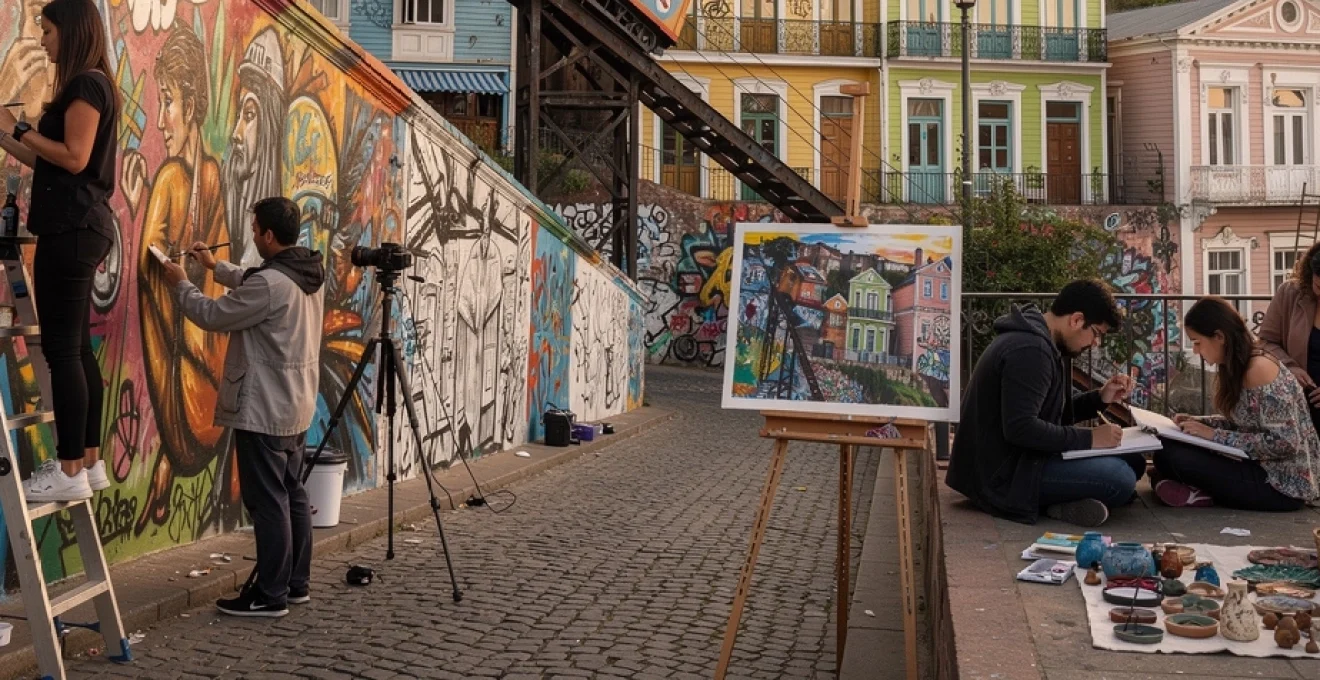
Perched on the Pacific coastline of Chile, Valparaíso stands as one of South America’s most visually striking urban landscapes, where vibrant street art transforms weathered colonial architecture into an open-air gallery of extraordinary proportions. This port city’s labyrinthine hillsides showcase an unparalleled fusion of artistic expression, architectural heritage, and maritime culture that has captivated visitors and residents alike for generations. The city’s commitment to preserving its creative legacy whilst embracing contemporary artistic movements has established Valparaíso as a global destination for cultural tourism and urban art appreciation.
The interplay between organised chaos and creative brilliance manifests itself through every cobblestone street and painted façade, creating an environment where artistic innovation thrives alongside historical preservation. From the iconic funicular railways that scale impossibly steep inclines to the sprawling murals that tell stories of political resistance and cultural identity, Valparaíso represents a living testament to the power of community-driven artistic expression.
UNESCO world heritage street art movements in valparaíso’s historic quarter
The designation of Valparaíso as a UNESCO World Heritage Site in 2003 marked a pivotal moment in the recognition of street art as a legitimate form of cultural expression deserving of international protection and promotion. This acknowledgement has fundamentally transformed how urban art movements operate within the historic quarter, establishing frameworks for both preservation and innovation that balance respect for architectural heritage with support for contemporary artistic practices.
The historic quarter encompasses approximately 23 hills, each presenting unique topographical challenges and artistic opportunities that have shaped the evolution of street art techniques and themes. Artists working within this protected zone must navigate complex regulations while maintaining the spontaneous creativity that defines authentic street art culture. The result has been the development of sophisticated collaborative processes between municipal authorities, property owners, and artistic collectives that prioritise cultural value alongside regulatory compliance.
Cerro alegre and cerro concepción mural conservation projects
The conservation initiatives on Cerro Alegre and Cerro Concepción represent pioneering efforts in the preservation of ephemeral art forms within urban environments. These projects employ advanced photographic documentation techniques, chemical analysis of pigments, and climate monitoring systems to understand how street art ages and deteriorates in Valparaíso’s unique maritime climate. Conservation specialists work closely with original artists to develop maintenance protocols that preserve artistic integrity whilst acknowledging the inherently temporary nature of street-based works.
Recent conservation efforts have focused on protecting large-scale murals from salt air corrosion, a particular challenge given the city’s coastal location. Innovative sealant applications and protective barrier systems have been developed specifically for Valparaíso’s conditions, extending the lifespan of significant works whilst maintaining their visual impact and accessibility to public viewing.
Graffiti documentation techniques at museo a cielo abierto
The Museo a Cielo Abierto, or Open Sky Museum, serves as a living laboratory for advanced documentation methodologies that capture not only the visual elements of street art but also its cultural context and community significance. High-resolution 3D scanning technology creates detailed digital archives of murals, enabling researchers to study artistic techniques, colour degradation patterns, and the relationship between artworks and their architectural settings with unprecedented precision.
Documentation efforts extend beyond mere visual recording to include oral history projects that preserve the stories and motivations behind individual works. These comprehensive archives serve multiple purposes: supporting academic research, informing conservation decisions, and providing educational resources for visitors seeking to understand the deeper cultural significance of Valparaíso’s street art movement.
CUAV collective’s impact on contemporary urban art preservation
The Corporación de Amigos de Valparaíso (CUAV) has emerged as a crucial intermediary between artistic communities and institutional preservation efforts, developing innovative funding models and community engagement strategies that ensure street art conservation remains economically sustainable. Their work demonstrates how grassroots organisations can effectively advocate for artistic preservation whilst supporting the livelihoods of working artists in economically challenging urban environments.
CUAV’s preservation initiatives encompass both direct conservation work and educational programmes that train local residents in basic mural maintenance techniques. This community-based approach ensures that preservation efforts remain
locally rooted and resilient, rather than dependent solely on external expertise. By transforming residents into custodians of their own streetscapes, CUAV helps ensure that Valparaíso’s most photographed murals do not become isolated attractions, but remain part of an evolving, lived-in neighbourhood fabric that visitors can experience over time rather than in a single snapshot.
Inti castro and mono gonzález: pioneering local street artists
Among the most influential figures shaping Valparaíso’s street art movements, Inti Castro and Alejandro “Mono” González stand out as pivotal bridges between political muralism and contemporary urban art. Inti, whose monumental works now appear in cities from Paris to Beirut, began painting in Chilean port towns, drawing on Andean iconography, Catholic imagery, and pre-Columbian motifs to create what many describe as a visual folklore of the streets. His large-scale characters, often rendered in warm ochres and deep violets, have become emblematic of Valparaíso’s global street art identity.
Mono González, a founding member of the historic Brigada Ramona Parra, brings a different but complementary lineage to the hills of Valparaíso. His bold, graphic compositions emerged during the Popular Unity government of Salvador Allende and continued, often clandestinely, under the Pinochet dictatorship, making him a living archive of Chile’s muralist resistance. Today, collaborations between Mono and younger artists can be seen across the city’s historic quarter, visually weaving together generations of Chilean social struggle and creative experimentation.
The presence of both artists has also influenced how institutions approach urban art preservation in this UNESCO site. Murals by Inti and Mono are frequently prioritised in conservation plans, not simply because of their aesthetic appeal, but due to their documentary value in narrating Chile’s recent political and cultural history. For visitors, seeking out these works in Valparaíso becomes a way to engage with the city’s layered past, turning a casual mural walk into a deeper exploration of local memory and identity.
Architectural polychromy and victorian heritage building restoration
Beyond its street art, Valparaíso’s architectural polychromy—its kaleidoscope of painted façades—plays a central role in defining the city’s visual identity. Many of the port’s 19th-century buildings, once clad in corrugated iron imported as ballast by merchant ships, now display carefully chosen colour schemes that reference both Victorian-era palettes and contemporary design sensibilities. This interplay between heritage conservation and chromatic experimentation has become a core focus of urban planning and façade restoration programmes throughout the historic quarter.
Restoration specialists working in Valparaíso must balance international conservation standards with the city’s long-standing tradition of self-painted houses and artist-led interventions. Rather than imposing a uniform aesthetic, recent projects tend to embrace controlled diversity, allowing residents to retain expressive freedom while protecting key Victorian and Neo-Baroque details. The result is an urban landscape where restored heritage buildings and contemporary murals coexist in a visually dense, yet surprisingly coherent, streetscape.
Ascensor artillería’s mechanical engineering and cultural significance
Few structures capture Valparaíso’s blend of engineering ingenuity and cultural symbolism quite like the historic funiculars, and Ascensor Artillería is among the most iconic. Opened in 1893, this funicular system connects the bustling Plan (lower city) with the Artillería hilltop, where panoramic views of the bay and port await. Technically, the ascensor operates on a counterweight principle, with two wooden cars linked by steel cables running along a 175-metre inclined track at gradients that would be impractical for standard road traffic.
From a mechanical engineering perspective, preservation efforts focus on maintaining original elements—such as cast-iron pulleys, braking mechanisms, and manually operated control systems—while retrofitting essential safety upgrades. Regular inspections of cable tension, track alignment, and car chassis integrity are required under Chilean transport regulations, adding a layer of complexity to heritage conservation. Engineers and historians work side by side to ensure that any modernisation does not erase the tactile, historical character that makes a ride on Ascensor Artillería feel like stepping back into the early 20th century.
Culturally, this funicular is much more than a transport system; it is a moving viewpoint and a daily ritual for locals. For many residents, the ascensor offers a democratic access point to some of the best harbour vistas, avoiding long climbs up steep staircases. Visitors who use Ascensor Artillería as part of a wider Valparaíso itinerary gain not only a memorable experience, but also an understanding of how engineering solutions shaped the city’s social geography, linking working-class port areas with residential and military districts on the hills.
Palacio baburizza Neo-Baroque façade colour analysis
Palacio Baburizza, perched on Paseo Yugoslavo, is a key reference point for understanding how colour theory and heritage conservation intersect in Valparaíso. Built in 1916 by Italian architects for a Croatian magnate, the Neo-Baroque villa combines ornate timber detailing, turrets, and stained glass windows, all of which require careful chromatic planning during restoration. Conservation teams have undertaken detailed pigment analysis, using microscopic sampling and archival photographs to identify original hues before decades of repainting and weathering altered the façade.
Recent restoration campaigns have favoured a restrained, historically informed palette that highlights architectural details without competing with surrounding street art. Soft creams, muted greens, and earth tones now dominate the exterior, creating a visually calm anchor within an otherwise riotously colourful urban canvas. This approach demonstrates how heritage buildings can maintain their individuality and elegance even as they coexist with nearby murals and hand-painted houses.
For travellers interested in architectural photography or urban colour theory, Palacio Baburizza serves as an instructive case study. Standing on its terrace, you can compare the villa’s refined Neo-Baroque façade colours with the more experimental chromatic schemes of neighbouring buildings on Cerro Alegre and Cerro Concepción. This contrast illustrates how Valparaíso negotiates the line between preserving historical authenticity and embracing its reputation as one of the world’s most colourful cities.
Funicular railway systems: ascensor el peral technical specifications
Ascensor El Peral, inaugurated in 1902, is another essential component of Valparaíso’s heritage funicular network and a practical connector between Plaza Sotomayor and Cerro Alegre. Its track stretches approximately 70 metres, rising at an average gradient of around 48%, and is powered by an electric motor system that replaced the original steam-driven machinery in the early 20th century. The two passenger cars, built with timber frames and metal reinforcements, are designed to hold small groups, offering an intimate and slightly nostalgic journey up the hillside.
From a technical standpoint, current maintenance guidelines require periodic non-destructive testing of cables, axles, and braking systems to ensure reliable operation in a seismically active region. Engineers must factor in the impact of sea air, corrosion, and intense usage during peak tourist seasons, making the ascensor a challenging, yet rewarding, preservation project. Modern control systems have been discreetly integrated into the original operator cabins, maintaining the visual authenticity that visitors expect from a century-old railway.
For those exploring Valparaíso’s street art and historic architecture, Ascensor El Peral offers a practical shortcut between the lower port district and the mural-rich streets of Cerro Alegre. Using the funicular instead of road transport reduces traffic pressure on narrow hillside streets and contributes to more sustainable tourism flows. In many ways, the system operates like a vertical public square, where locals and visitors briefly share space and stories as the car glides up and down the slope.
19th-century british colonial architecture pigment studies
Valparaíso’s role as a strategic port during the 19th century attracted significant British, German, and other European merchant communities, leaving a lasting mark on the city’s built environment. Terraced houses, commercial warehouses, and consular buildings from this period often display a hybrid of Victorian and vernacular styles, with decorative woodwork and iron balconies adapted to steep terrain. Pigment studies carried out on these façades have revealed a surprising variety of original colours, ranging from deep oxblood reds and Prussian blues to more subdued stone greys.
Conservation scientists use techniques such as stratigraphic paint analysis and spectrophotometry to identify these historical colour layers, much like archaeologists unearthing strata of urban memory. Once documented, this chromatic data informs municipal guidelines that encourage property owners to select repainting schemes inspired by 19th-century palettes, while still allowing for individual expression. The result is an architectural polychromy that feels rooted in history rather than randomly applied.
For visitors walking through districts like Barrio Puerto and along the old commercial streets near the port, these pigment-informed restorations offer a subtle, yet powerful, narrative. You might notice how a restored British-style warehouse, painted in historically accurate tones, sits adjacent to a contemporary mural that comments on global trade or workers’ rights. This juxtaposition exemplifies Valparaíso’s unique ability to layer past and present, using colour as a connective thread between heritage architecture and living street art.
Pablo neruda’s valparaíso literary geography and creative inspiration
The literary geography of Valparaíso is inseparable from the presence of Pablo Neruda, whose house La Sebastiana crowns one of the city’s hills with ship-like windows and eclectic interiors. For Neruda, Valparaíso was both refuge and muse; its tangled streets, harbour lights, and incessant sea sounds seep into many of his poems and prose pieces. Walking through the city today, you can still trace the routes he once took, from the port taverns and bookshops up to his hillside study overlooking the Pacific.
In a sense, Valparaíso itself functions as a sprawling poem: verses of staircases, stanzas of rusted roofs, and refrains of gulls circling above container ships. Literary scholars have increasingly mapped Neruda’s references onto real urban locations, creating a form of “poetry tourism” that complements the more visible street art trails. When you stand on a mirador and read a line about “Valparaíso, what an absurdity you are,” the city’s colour and chaos become the living context for the words, anchoring abstract metaphors in concrete vistas.
Beyond Neruda, other Chilean writers such as Roberto Bolaño and Manuel Rojas have also woven Valparaíso into their narratives, often portraying it as a liminal space where creativity and marginality coexist. Contemporary cultural tours now incorporate readings, literary anecdotes, and visits to cafés and bars associated with these authors, transforming the city into an open-air library. For visitors who value both visual and written culture, exploring Valparaíso’s literary geography offers a richer, multi-layered understanding of how place can shape creative imagination.
Port of valparaíso maritime commerce dynamics and urban development
While art and literature dominate many impressions of Valparaíso, the port’s economic engine remains central to its identity and urban form. As one of Chile’s primary container terminals, the Port of Valparaíso handles millions of tonnes of cargo annually, linking the Andean hinterland to global trade routes across the Pacific and Atlantic. This constant flow of goods—grain, copper, manufactured products—has historically financed much of the city’s infrastructure, from roads and warehouses to public buildings and transport systems.
Modernisation of port facilities over the past two decades has reshaped the waterfront, introducing larger container yards, automated cranes, and logistics hubs. These changes have created tensions and opportunities: while they improve efficiency and support national export growth, they also place pressure on historic dockside neighbourhoods and limit public access to the sea. Urban planners now face the complex task of mediating between maritime commerce dynamics and heritage preservation, ensuring that the working port and UNESCO-listed areas can coexist.
For visitors, the port’s presence adds a distinctive industrial rhythm to the surrounding hills. From many miradores, you can watch container ships manoeuvre with the help of tugboats, or see cranes stacking colourful boxes that visually echo the patchwork houses above. This visual analogy—cargo containers as horizontal counterparts to hillside homes—underscores how trade and everyday life are interwoven. Understanding Valparaíso’s role in maritime logistics thus deepens our appreciation of how its economy, architecture, and street culture evolved together.
Contemporary cultural production hubs and artistic entrepreneurship
Today, Valparaíso’s creative energy extends well beyond murals and historic funiculars, manifesting in a growing ecosystem of cultural production hubs and artistic entrepreneurs. Former industrial spaces and traditional markets have been repurposed as studios, galleries, co-working spaces, and performance venues, attracting designers, filmmakers, illustrators, and musicians. This shift reflects broader trends across Latin America, where mid-sized cities with strong cultural identities are becoming incubators for creative economies.
Artistic entrepreneurship in Valparaíso often operates at the intersection of tourism, education, and community development. Many muralists, for example, supplement their practice by leading street art tours, offering workshops, or collaborating with local businesses on branding and interior design. This diversification not only generates income, but also embeds creative work more deeply into the city’s social and economic fabric. As you explore, you’ll notice how cafés, hostels, and independent shops function as micro-galleries, showcasing rotating exhibitions of local art.
La sebastiana museum’s role in modern poetry tourism
La Sebastiana, now a house-museum managed by the Pablo Neruda Foundation, plays a pivotal role in anchoring Valparaíso’s poetry tourism circuit. The museum preserves Neruda’s idiosyncratic collections—nautical maps, ship wheels, coloured glass bottles—and offers visitors a glimpse into the domestic environment that nurtured some of his most celebrated works. Audio guides and interpretive panels situate the house within both Neruda’s personal biography and the broader history of the port city.
From a tourism perspective, La Sebastiana serves as a gateway experience that often prompts visitors to seek out additional literary and artistic sites in Valparaíso. The panoramic views from its windows, framing the bay and undulating hills, allow guests to immediately connect the poet’s words with the real landscape outside. For many travellers, the visit becomes a catalyst for further exploration: wandering down the hill to discover murals, independent bookshops, and small theatres that continue the city’s tradition of creative expression.
The museum also supports contemporary cultural production through readings, temporary exhibitions, and educational programmes aimed at local schools and universities. By linking Neruda’s legacy with current poetic voices, La Sebastiana helps ensure that Valparaíso’s reputation as a literary city remains dynamic rather than purely nostalgic. In doing so, it strengthens the network of cultural attractions that collectively sustain year-round cultural tourism.
Mercado puerto artisan craft production networks
Mercado Puerto, historically the hub for fresh seafood and local produce, has in recent years become an important node in Valparaíso’s artisan craft networks. While traditional market stalls still operate, sections of the building and surrounding streets now host makers of ceramics, textiles, jewellery, and graphic prints, many of whom draw direct inspiration from the city’s street art and maritime heritage. This hybrid marketplace allows visitors to encounter both everyday local life and curated creative products in a single visit.
For artisans, proximity to the port and tourist routes provides valuable visibility and direct access to international customers, supporting small-scale export and online sales. Cooperative models are common: groups of makers share workshop space, marketing costs, and even raw materials, reducing individual risk and encouraging collaboration. If you’re interested in supporting sustainable cultural tourism, seeking out crafts labelled with local origin stories and fair pricing structures is a simple, concrete way to contribute.
These artisan networks also play a quiet role in preserving intangible heritage, translating traditional techniques—such as weaving, wood carving, or metalwork—into contemporary designs. A hand-painted ceramic tile might echo a famous Valparaíso mural, while a textile pattern could reference the outlines of the city’s funicular tracks. In this way, Mercado Puerto functions not just as a shopping destination, but as a living archive of the city’s evolving aesthetic vocabulary.
Universidad de playa ancha fine arts faculty community engagement
The Universidad de Playa Ancha (UPLA), particularly its Fine Arts Faculty, operates as a key institutional driver of community-engaged art in Valparaíso. Situated within reach of several working-class neighbourhoods and heritage hills, the university regularly collaborates with residents on mural projects, public installations, and participatory workshops. These initiatives often address social themes—such as housing rights, environmental concerns, or migration—using visual arts as a platform for dialogue.
Students and faculty from UPLA frequently contribute to the city’s street art scene, blurring the line between academic practice and grassroots creativity. Field-based courses might involve documenting existing murals, conducting interviews with local artists, or designing site-specific works that respond to particular urban challenges. For visitors, the impact of this engagement is most visible in areas slightly off the main tourist routes, where you might discover community-led murals co-signed by neighbourhood organisations and university collectives.
By embedding artistic training within real-world contexts, UPLA helps cultivate a generation of practitioners who understand both the aesthetic and social dimensions of urban creativity. This approach strengthens Valparaíso’s position as a “learning city,” where experimentation, critique, and collaboration are part of everyday life rather than confined to galleries or lecture halls. Over time, such university–community partnerships contribute to a more inclusive cultural ecosystem, ensuring that the benefits of creative regeneration are shared beyond the most visited hills.
Festival internacional de cine de valparaíso economic impact analysis
The Festival Internacional de Cine de Valparaíso (FICValparaíso) adds yet another layer to the city’s creative profile, showcasing independent films from Chile and abroad in historic theatres and unconventional venues. While the festival’s artistic value is evident in its curated programmes and discussions with filmmakers, its economic impact on the city is equally noteworthy. During festival periods, local hotels, restaurants, and cultural spaces report significant increases in bookings and foot traffic, illustrating how cultural events can diversify tourism beyond peak summer months.
Preliminary studies by regional development agencies suggest that each edition of the festival generates a multiplier effect across the local economy, as visiting professionals and audiences spend on accommodation, dining, transport, and cultural experiences. Importantly, many screenings and workshops are held in neighbourhood cinemas and community centres, directing some of this spending to areas that typically see fewer tourists. This decentralised model mirrors Valparaíso’s broader commitment to distributing cultural opportunities across its hills rather than concentrating them in a single district.
For creative entrepreneurs—such as graphic designers, sound technicians, and event producers—the festival offers contract work, networking opportunities, and international exposure. It also encourages crossovers with other art forms; for instance, some editions have included street art interventions, live music, and literary events tied to film themes. In this way, FICValparaíso functions as both a showcase and a catalyst, reinforcing Valparaíso’s reputation as a city where colour, chaos, and creativity intersect not only on its walls, but across its screens, stages, and everyday streetscapes.