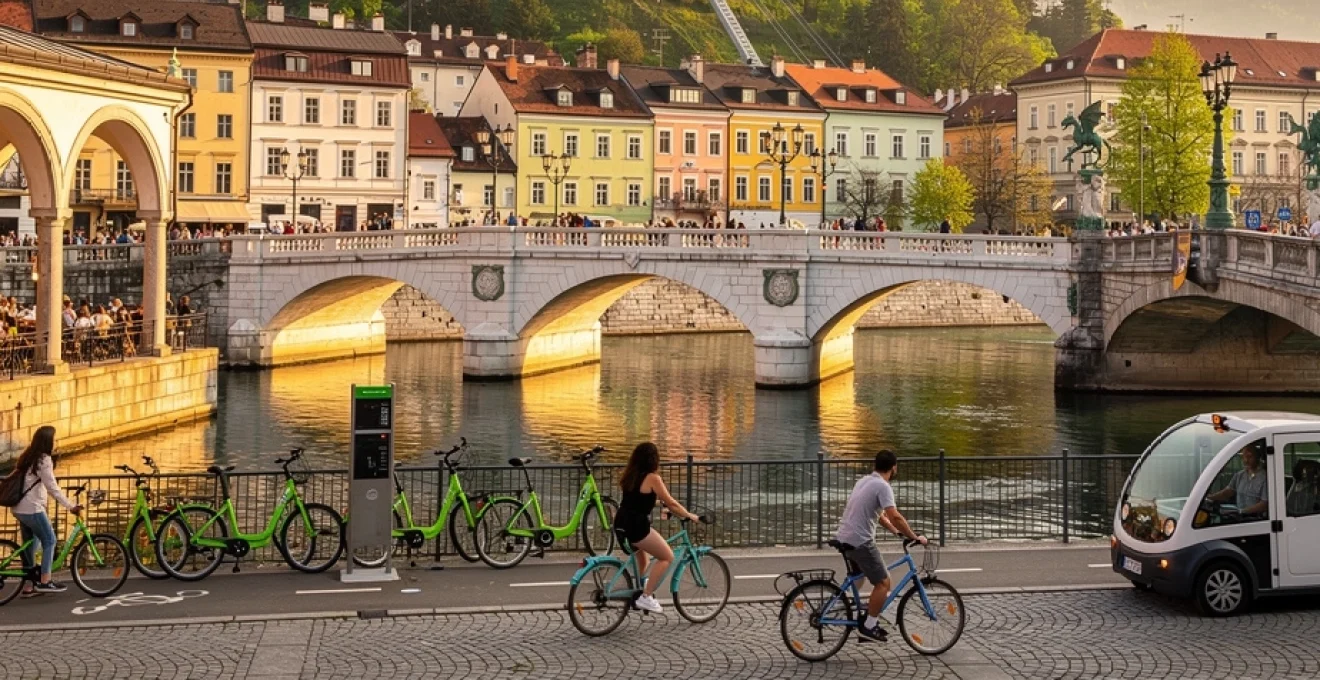
When you imagine Europe’s great capital cities, your mind likely conjures images of London’s bustling streets, Paris’s grand boulevards, or Berlin’s imposing architecture. Yet tucked between the Julian Alps and the Adriatic coast lies a capital that defies conventional metropolitan expectations. Ljubljana, Slovenia’s political and cultural heart, demonstrates that urban excellence isn’t measured in square kilometres or population statistics. With merely 300,000 residents, this compact capital has achieved what many larger cities struggle to accomplish: creating an urban environment that prioritises human wellbeing, environmental sustainability, and architectural heritage without sacrificing economic vitality or cultural richness.
The city’s transformation from a post-Yugoslav industrial centre to Europe’s green capital exemplifies progressive urban planning at its finest. Ljubljana’s pedestrianised historic core, innovative transport solutions, and commitment to preserving its architectural legacy have positioned it as a model for mid-sized European cities. This achievement becomes particularly remarkable when considering that Slovenia only gained independence in 1991, giving Ljubljana barely three decades to establish its identity as a national capital whilst simultaneously reinventing itself for the 21st century.
Ljubljana’s compact urban planning model: 57,000 residents per square kilometre
Ljubljana’s urban density presents a fascinating case study in efficient spatial organisation. The city centre concentrates approximately 57,000 residents per square kilometre within its historic core, creating a vibrant pedestrian environment without the overwhelming congestion typical of larger European capitals. This density supports local businesses, reduces transportation needs, and fosters the neighbourhood atmosphere that residents and visitors consistently praise.
The city’s manageable scale allows you to traverse the entire historic centre on foot within thirty minutes, yet this compactness doesn’t translate to monotony. The Ljubljanica River meanders through the urban fabric, creating natural districts that each possess distinct characters. The right bank features the medieval Old Town with its narrow cobblestone streets and Baroque facades, whilst the left bank showcases Art Nouveau buildings and Habsburg-era squares. This diversity within a walkable radius provides the cosmopolitan variety of much larger cities without the exhausting distances.
Slovenia’s unique demographic situation amplifies Ljubljana’s intimacy. With a national population of just over two million, Ljubljana houses roughly fifteen per cent of all Slovenians, creating an unusual dynamic where the capital feels more like an extended community than an anonymous metropolis. This scale enables governance innovations and infrastructure projects that would prove impossible in larger cities. When Ljubljana introduced its car-free zone in 2008, consultation with affected residents and businesses remained manageable due to the limited numbers involved.
The surrounding metropolitan area extends Ljubljana’s influence across 275 square kilometres, incorporating satellite communities within a cohesive urban region. This arrangement preserves green corridors and forest connectivity whilst accommodating suburban growth. Slovenia’s remarkable statistic of being more than 60% forested extends into Ljubljana’s boundaries, with Tivoli Park, Rožnik Hill, and Šiška Hill providing substantial woodland areas within the urban envelope. These green spaces aren’t merely recreational amenities; they function as ecological corridors supporting biodiversity and regulating the urban microclimate.
Jože plečnik’s architectural legacy transforming ljubljana’s identity
No discussion of Ljubljana’s character can proceed without acknowledging Jože Plečnik, the visionary architect whose interwar projects fundamentally reshaped the city’s identity. Between 1921 and 1957, Plečnik created an architectural ensemble that transformed Ljubljana from a provincial Habsburg town into a distinctive capital with coherent aesthetic vision. His philosophy of architecture as urban poetry manifests in bridges, markets, churches, and public spaces that prioritise human scale and classical proportions whilst incorporating modernist functionality.
Plečnik’s approach contrasted sharply with the modernist orthodoxy of his contemporaries. Whilst Le Corbusier advocated demolishing historic city centres and Bauhaus architects championed industrial aesthetics, Plečnik developed a distinctive architectural language that respected historical context whilst creating unquestionably contemporary works. His buildings combine classical columns and local limestone with reinforced concrete and modern spatial planning, producing structures that feel simultaneously ancient and modern. This temporal ambiguity has aged remarkably well, with Plečnik’s work appearing fresher today than many purely modernist projects from the same era.
UNESCO recognised Plečnik’s comprehensive
sites of “The works of Jože Plečnik in Ljubljana” in 2021, confirming what residents have long understood: the architect did not merely design individual buildings; he orchestrated an entire urban composition. As you walk through the city today, it becomes clear that Ljubljana’s most photogenic spots are not isolated monuments but interconnected spaces, each one leading gracefully to the next.
Triple bridge and slovenian national library: masterpieces of interwar architecture
The Triple Bridge (Tromostovje) may be the most photographed symbol of Ljubljana, yet its genius lies in how subtly it solves a practical problem. Originally, a single 19th-century stone bridge linked Prešeren Square with the Old Town. Facing increasing traffic in the 1920s, Plečnik rejected the idea of a wide, utilitarian crossing. Instead, he flanked the central bridge with two pedestrian-only side spans, turning a potential bottleneck into a theatrical entrance to the medieval core.
Walking across the Triple Bridge today, you move through a carefully choreographed sequence. The low stone balustrades open views to the Ljubljanica River, while the slight angle of the side bridges guides you gently towards either riverbank. At night, subtle lighting highlights the bridge’s rhythm of pillars and lanterns, transforming it into a stage set for evening promenades. What could have been a purely technical intervention became a landmark of interwar architecture and a masterclass in human-centred urban design.
Just a ten-minute walk away, the Slovenian National and University Library (Narodna in univerzitetna knjižnica) showcases a very different side of Plečnik’s creativity. Completed in 1941, this monumental building deliberately evokes the idea of a “temple of knowledge”. The exterior façade alternates rugged stone blocks with smooth brick, echoing Roman walls and Slovenian vernacular architecture. Many first-time visitors are surprised by how fortress-like it appears from the outside, almost defensive in its massing.
Step inside, however, and you enter a dim, almost monastic ground floor that gradually gives way to light. A grand central staircase, lined with dark stone columns, leads you up to the main reading room, where large windows flood the space with daylight. This deliberate progression from shadow to brightness is not incidental; Plečnik conceived it as an architectural metaphor for the journey from ignorance to enlightenment. For those interested in architectural history, the library offers one of Europe’s most compelling examples of interwar classicism reinterpreted for a modern national identity.
Plečnik’s market colonnade along the ljubljanica river
North of the Triple Bridge, Plečnik continued his transformation of the riverfront with the Market Colonnade. Running parallel to the Ljubljanica, this elongated structure replaces former wooden stalls with a more permanent, dignified market complex. At first glance, it reads as a continuous arcade of tall Ionic columns, yet closer inspection reveals a playful rhythm of open loggias, glazed sections, and small circular windows.
The colonnade’s design solves several challenges at once. By extending the market along the river, Plečnik preserved uninterrupted public access to the water while sheltering vendors and customers from rain and sun. Large arches in the façade frame views of the river and the opposite embankment, reminding you constantly of Ljubljana’s aquatic spine. Small details—a carved capital here, a decorative urn there—bring a tactile richness that invites slow exploration rather than hurried consumption.
From an urban planning perspective, the colonnade links two key public spaces: the Cathedral area and the Butchers’ Bridge. This continuous sequence encourages you to wander rather than march from sight to sight. On market days, the area buzzes with life as locals shop for seasonal produce, artisan cheeses, and flowers. For visitors interested in sustainable urban tourism in Ljubljana, the colonnade exemplifies how built heritage, local food systems, and daily commerce can coexist harmoniously.
Dragon bridge: art nouveau engineering and mythological symbolism
A short stroll downstream brings you to the Dragon Bridge (Zmajski most), where mythology meets early 20th-century engineering. Completed in 1901, this was one of the first reinforced concrete bridges in Europe and a showpiece of modern technology for the then-Austro-Hungarian city. Its Art Nouveau design combines a clean structural form with elaborate decorative elements, most notably the four iconic dragon statues that guard each corner.
The dragon motif draws on Ljubljana’s legendary association with Jason and the Argonauts, who, according to myth, slew a dragon in the marshes where the city now stands. Over time, the creature evolved into the city’s unofficial mascot. Today, the dragons are among Ljubljana’s most photographed residents, their wings poised mid-beat, their mouths open in a silent roar. It is hard to imagine a more effective example of branding through infrastructure—how many other bridges have turned into city-wide symbols so completely?
From a technical point of view, the bridge’s reinforced concrete structure was pioneering at the time of its construction. Instead of disguising the new material, the designers allowed the smooth, sweeping arches to express their structural logic. The combination of innovation and ornament makes Dragon Bridge a key stop for anyone interested in Art Nouveau engineering in Central Europe. As you cross, pause midway and turn towards the castle hill; the composition of bridge, river, and skyline captures Ljubljana’s scale and charm in a single frame.
Central market renovation: integrating medieval walls with modern commerce
Behind the riverside colonnade, the Central Market extends across a wide open square that has long served as Ljubljana’s commercial heart. Rather than sweeping away the area’s medieval remnants, Plečnik chose to integrate them into his redesign. Sections of the old city walls and bastions were preserved and subtly incorporated into the market’s layout, creating a layered experience where past and present coexist.
Today, you can trace those layers as you move between outdoor stalls piled with local fruit and vegetables, the covered fish market, and the riverfront arcades. The market square remains flexible: on weekdays it functions as a grocery hub for residents; on weekends, it often hosts craft markets, events, or festivals. This adaptability is central to Ljubljana’s approach to urban space—squares are not monumental voids but working rooms of the city.
For visitors, the Central Market offers more than photo opportunities. It is one of the best places to sample Slovenian regional products in a single location, from Karst prosciutto and Tolminc cheese to pumpkin seed oil and seasonal wild mushrooms. If you are interested in experiencing Ljubljana like a local, plan your visit in the morning when the market is at its liveliest. You will quickly notice how the architectural backdrop, with its hints of medieval fortifications and classical colonnades, elevates everyday shopping into a subtly ceremonial act.
Car-free zone implementation in ljubljana’s historic centre since 2008
Ljubljana’s architectural treasures would feel very different if they were choked by traffic fumes and constant honking. Recognising this, city authorities took a bold step in 2008 by implementing a comprehensive car-free zone in the historic centre. Rather than a token pedestrian street or two, the plan removed most motorised traffic from a large contiguous area, prioritising walking, cycling, and public transport.
The transition was not without controversy. Many business owners initially feared that restricting car access would reduce footfall. Yet the opposite occurred: as pavements widened, noise levels dropped, and café terraces expanded, the historic core became more attractive both to residents and visitors. Retail turnover in the area increased, and property values rose. In urban planning terms, Ljubljana demonstrated that removing cars from central districts does not necessarily “kill” commerce; it can, when carefully managed, breathe new life into it.
The car-free zone also had measurable environmental benefits. According to municipal reports, traffic through the city centre dropped by around 70% in the years following implementation, contributing to lower emissions and improved air quality. For travellers seeking low-impact city breaks in Europe, Ljubljana’s compact, walkable centre offers a refreshing alternative to car-dominated capitals. The question many visiting planners now ask themselves is simple: if Ljubljana can manage this with limited resources, why can’t larger cities follow?
Kavalir electric vehicle network: zero-emission tourist mobility
Of course, not everyone can or wants to walk everywhere, especially in summer heat or winter rain. To ensure accessibility without reintroducing private cars, Ljubljana launched the Kavalir electric vehicle network. These small, slow-moving, zero-emission shuttles circulate through the pedestrian zone, offering free rides primarily for the elderly, people with reduced mobility, and anyone needing assistance.
Kavalir vehicles operate almost like a friendly neighbourhood taxi service. You can flag them down in the street or call a dedicated number to request pick-up. Their 100% electric propulsion means they glide almost silently, contributing neither to local pollution nor to the acoustic chaos that plagues many city centres. The fleet has expanded over the years, illustrating strong public acceptance of this unconventional solution to last-mile urban mobility.
For visitors, the Kavalir network provides a convenient way to move between key sights—such as the Central Market, Prešeren Square, and the base of the castle funicular—without breaking the spell of the car-free environment. Think of it as the urban equivalent of a moving bench, designed to keep the historic centre inclusive while preserving its calm, walkable character. If you are travelling with older relatives or heavy luggage, it can make all the difference between a tiring day and an enjoyable one.
Pedestrianisation of čopova ulica and stari trg streets
While riverfront promenades often steal the limelight, streets such as Čopova Ulica and Stari Trg show how deeply pedestrianisation has reshaped Ljubljana’s daily life. Čopova, a key link between the main railway station area and Prešeren Square, used to function as a busy traffic corridor. Today, it is a broad pedestrian avenue lined with shops, bookstores, and cafés, constantly animated by street musicians and informal gatherings.
Stari Trg, by contrast, preserves a more intimate, medieval scale. Its gently curving alignment, narrow width, and historic townhouses create a natural “shared living room” for locals. Without parked cars or passing vehicles, children play more freely, restaurant terraces spill into the street, and you can actually hear the church bells and snippets of conversation. It is easy to forget that, until relatively recently, these same streets were dominated by through-traffic.
From the perspective of urban tourism in Ljubljana, this network of pedestrian streets creates a coherent experience. You are not constantly interrupted by dangerous crossings or deafened by engines as you move between attractions. Instead, walking becomes the default mode of exploration, much like browsing rooms in a museum rather than rushing down a highway. If you are planning a short city break, basing yourself near Čopova or Stari Trg allows you to explore almost everything on foot.
Cycling infrastructure: 270 kilometres of dedicated paths and BicikeLJ bike-sharing
Complementing the pedestrian core is an impressive cycling infrastructure network. Ljubljana now offers around 270 kilometres of dedicated or shared-use cycling paths, radiating from the centre to outer districts and neighbouring suburbs. For a city of its size, this represents a significant investment in active mobility, supported by clearly marked lanes, traffic-calming measures, and secure bike parking.
Central to this ecosystem is BicikeLJ, the city’s public bike-sharing scheme. Launched in 2011, it quickly became one of Europe’s most successful systems per capita, with thousands of daily trips during peak seasons. Stations are densely distributed throughout the central area, meaning you are rarely more than a few hundred metres from the nearest docking point. The pricing model encourages short, frequent rides—ideal for hopping between the train station, Tivoli Park, and the riverside cafés.
For visitors, using BicikeLJ is an inexpensive way to experience Ljubljana’s green mobility strategy first-hand. Registration is straightforward, and the compact urban footprint makes navigation easy even for less confident cyclists. If the idea of cycling in a foreign city feels intimidating, remember that much of Ljubljana’s centre is either fully car-free or has very low traffic volumes. In practice, riding here can feel closer to exploring a large park than braving a congested capital.
European green capital 2016: sustainability initiatives that reshaped urban tourism
Ljubljana’s efforts in pedestrianisation, cycling, and public transport culminated in a major milestone: being named European Green Capital 2016 by the European Commission. This award recognised not a single project but a comprehensive strategy touching waste management, green spaces, water quality, and sustainable mobility. For a relatively small city with a modest budget, the achievement sent a strong signal that ambition and consistent planning can rival sheer financial power.
One of the most impressive statistics behind the award is Ljubljana’s transformation of its waste system. Over the past decade, the city has achieved high levels of separate waste collection, with recycling rates regularly surpassing those of many larger Western European capitals. The Barje landfill, once a looming environmental issue, has been progressively rehabilitated, while a modern waste management centre focuses on reduction, reuse, and recycling rather than simple disposal.
Green space protection formed another pillar of the Green Capital programme. Nearly three-quarters of Ljubljana’s municipal territory is composed of green areas, forests, and agricultural land. Within this framework, the city has actively protected the Ljubljana Marshes (Ljubljansko barje), a unique wetland ecosystem south of the urban core. For eco-conscious travellers, this means that hiking trails, birdwatching sites, and cycling routes through natural landscapes are accessible with minimal travel time from the city centre.
The Green Capital title also accelerated the shift towards sustainable urban tourism in Ljubljana. Many hotels introduced eco-certifications, water-saving measures, and local sourcing policies. Tour operators began to highlight walking tours, cycling excursions, and day trips by public transport rather than private coaches. As a visitor, you benefit in two ways: not only is it easier to keep your environmental footprint low, but the experiences on offer often feel more authentic and grounded in local life.
Ljubljana castle funicular and medieval fortress restoration project
Looming above the city on a wooded hill, Ljubljana Castle functions as both a historical symbol and a contemporary cultural venue. In the late 20th century, the fortress was in danger of becoming a neglected relic, but a long-term restoration project has gradually transformed it into one of the city’s most dynamic attractions. Central to this revitalisation was the introduction of a glass funicular railway in 2006, linking the Old Town directly to the castle courtyard.
The funicular has both practical and symbolic significance. Practically, it makes the steep ascent accessible to visitors of all ages and fitness levels, including those with reduced mobility. Symbolically, its transparent cabins and minimalist design contrast with the stone walls and towers, embodying Ljubljana’s broader philosophy of layering contemporary interventions onto historic structures. The short ride—less than a minute—offers a rapidly unfolding panorama of roofs, river, and hills that sets the stage for exploring the fortress itself.
Inside the castle complex, restoration has followed a careful balance between conservation and adaptation. Original walls, chapels, and defensive towers have been stabilised and partially reconstructed, while modern elements such as glass walkways, elevators, and exhibition spaces have been inserted with a light touch. For travellers interested in medieval architecture in Slovenia, the castle offers an instructive example of how to repurpose heritage sites without freezing them in time.
Viewing tower panorama: julian alps to Kamnik-Savinja alps visibility
One of the highlights of any visit to Ljubljana Castle is climbing the restored viewing tower. From the top, you gain a 360-degree panorama that dramatically reinforces the city’s relationship with its natural surroundings. On clear days, you can see not only the urban fabric below but also the distant white peaks of the Julian Alps to the northwest and the Kamnik-Savinja Alps to the north.
This sweeping view helps you understand Ljubljana’s strategic historical position at the crossroads of Central Europe and the Balkans. Medieval rulers chose the hill for its defensive advantages; modern visitors appreciate it for orientation and photography. You can trace the curve of the Ljubljanica River, identify landmarks such as the Triple Bridge and Tivoli Park, and observe how quickly the dense centre gives way to fields and forests. In a single glance, the idea of a small, green capital city stops being an abstraction and becomes a tangible landscape.
If you are visiting in high season, consider timing your ascent for early morning or late afternoon to avoid crowds and harsh midday light. The tower steps are relatively narrow, but the climb is broken into manageable sections. For those less keen on heights, the lower terraces and courtyard still provide satisfying views over the rooftops.
Virtual castle experience: augmented reality historical narratives
Recognising that not everyone engages with history in the same way, Ljubljana Castle has embraced digital storytelling through a Virtual Castle Experience. Using augmented reality (AR) and multimedia installations, this interactive route overlays historical narratives onto the physical spaces of the fortress. As you move from room to room, projections, audio guides, and AR devices reconstruct different periods—from Roman foundations and medieval sieges to Habsburg administration and 20th-century re-use.
For families and younger visitors, this approach turns what might have been a dry sequence of exhibits into a vivid, almost cinematic journey. You might see ghostly soldiers marching along the walls, hear the clatter of a medieval banquet, or watch maps morph to show the shifting borders of empires. For those already familiar with European history, the experience offers a chance to situate Ljubljana’s story within wider regional dynamics.
From a broader perspective, the virtual experience illustrates how digital innovation in heritage tourism can enrich small capitals without overwhelming them. Rather than building new monuments, Ljubljana has chosen to reinterpret existing ones through technology. If you are sceptical about AR, consider it less as a gimmick and more as an additional lens—much like a guidebook or a knowledgeable local, but responsive to your movements and curiosity.
Cultural programming at grajska kavarna and summer theatre
Ljubljana Castle is not only a daytime attraction; it also serves as a vibrant cultural venue, particularly in the warmer months. The Grajska Kavarna (Castle Café) and various terraces host concerts, film screenings, and literary events that draw both locals and visitors. In summer, an open-air cinema transforms the courtyard into one of the most atmospheric screening rooms in the city, with the illuminated walls providing a dramatic backdrop.
The castle’s Summer Theatre programme typically includes a mix of classical music, jazz, world music, and contemporary performances. If you time your visit to coincide with an evening event, you can combine panoramic views at sunset with high-quality cultural programming. It is an excellent way to experience how Ljubljana integrates heritage sites into its everyday cultural life rather than treating them purely as static museums.
Even if you simply stop at Grajska Kavarna for coffee or a glass of local wine, you will notice how the space has been designed for lingering. Comfortable seating, subtle lighting, and a relaxed pace encourage you to slow down and absorb the surroundings. For travellers interested in combining culture and relaxation in Ljubljana, an evening at the castle can be one of the most memorable parts of the trip.
Ljubljanica river embankment: open-air café culture and heritage preservation
Back down in the valley, the Ljubljanica River continues to shape daily life in ways both practical and poetic. Over the past two decades, its embankments have been progressively redesigned as continuous promenades that prioritise pedestrians, cyclists, and seating areas. What was once a functional waterway hemmed in by parked cars now feels like an elongated living room—part park, part café terrace, part open-air gallery.
Many visitors’ most enduring memories of Ljubljana involve sitting at a riverside table, watching reflections of façades and bridges ripple in the water. Cafés and restaurants line both banks, but strict regulations keep signage, lighting, and terrace layouts relatively restrained. This prevents the kind of visual clutter that can overwhelm historic waterfronts elsewhere. The result is a coherent ensemble where open-air café culture in Ljubljana complements, rather than competes with, the architectural backdrop.
Importantly, the embankment redesigns have always paid close attention to heritage preservation. Original stone steps and mooring rings, remnants of the city’s trading past, have been retained where possible. New balustrades and seating areas echo Plečnik’s design vocabulary without mimicking it slavishly. In some stretches, lower-level terraces bring you almost to water level, creating intimate spaces for reading, sketching, or quiet conversation away from the busier upper paths.
For urban planners and curious travellers alike, the Ljubljanica offers a compelling lesson: when you treat a river as a central public space rather than a back-of-house service corridor, it can dramatically enhance a city’s liveability. Whether you choose to explore by foot, by bicycle, or on a slow-moving boat tour, the embankments provide a constantly shifting perspective on Ljubljana’s blend of history, nature, and contemporary life. In a capital this small, the river is never far away—and perhaps that is precisely why the city leaves such a lasting impression.