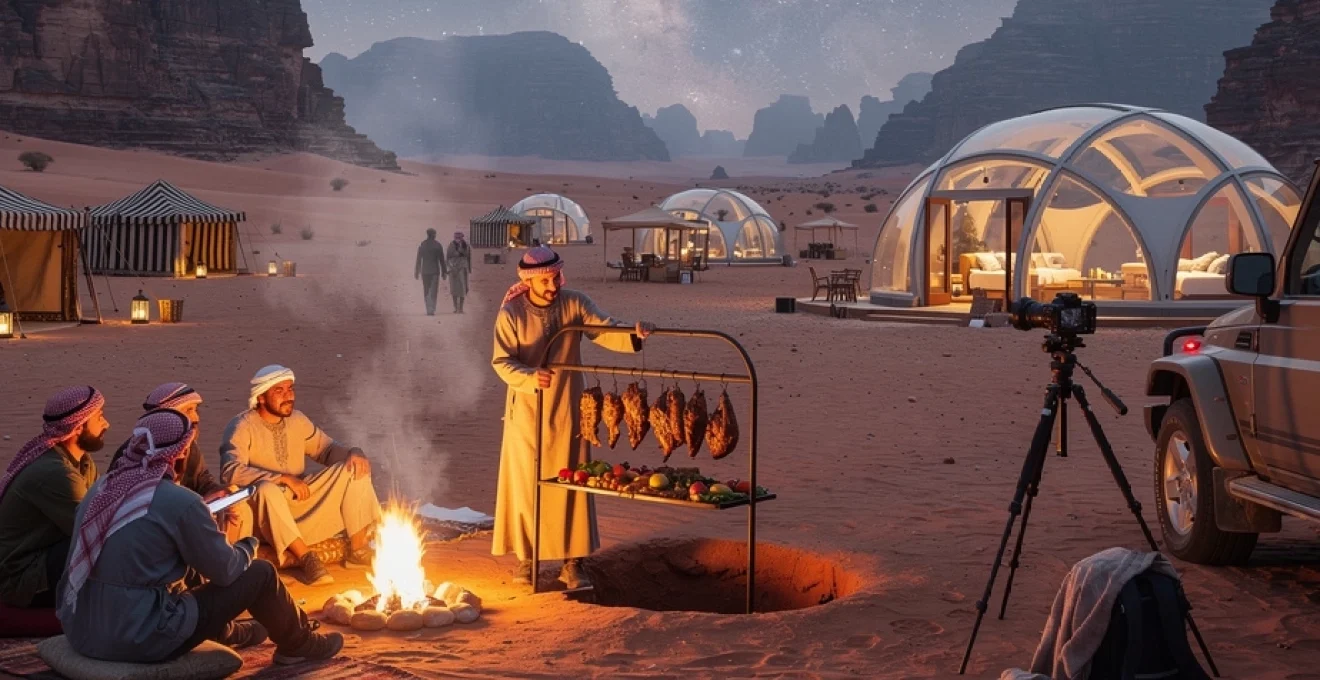
The crimson sands of Wadi Rum stretch endlessly beneath a canopy of stars so dense that the Milky Way appears as a luminous river flowing across the night sky. This extraordinary desert landscape in southern Jordan offers one of the most authentic wilderness experiences available anywhere on Earth. When darkness falls over the sandstone massifs and the temperature drops, you’ll discover why Bedouin communities have chosen to sleep beneath these same stars for countless generations. The experience transforms a simple overnight stay into something profoundly memorable—a connection with nature that modern life rarely permits.
Wadi Rum’s remoteness from urban centres creates exceptional conditions for stargazing, whilst its dramatic geological formations provide shelter and stunning backdrops for desert camping. Whether you choose a traditional goat-hair tent at a Bedouin camp or opt to sleep directly on the desert floor with nothing between you and the cosmos, this region delivers an experience that resonates long after you’ve returned home. The desert’s silence, broken only by crackling campfires and distant winds, provides a counterpoint to our technology-saturated existence.
Wadi rum protected area: UNESCO world heritage desert landscape
Designated as a UNESCO World Heritage Site in 2011, Wadi Rum Protected Area encompasses approximately 74,000 hectares of pristine desert wilderness. The site’s inscription recognises both its natural beauty and cultural significance, acknowledging the continuous human presence spanning over 12,000 years. Archaeological evidence reveals rock art, inscriptions, and architectural remains that document humanity’s long relationship with this challenging environment. The protected area status ensures that development remains carefully controlled, preserving the desert’s character for future generations whilst allowing sustainable tourism that benefits local Bedouin communities.
The Jordanian government’s management approach balances conservation with traditional land use rights. Bedouin families who have called Wadi Rum home for centuries continue to graze livestock, operate camps, and guide visitors through landscapes their ancestors knew intimately. This arrangement maintains cultural continuity whilst generating income that reduces pressure on natural resources. Visitor numbers have grown steadily—reaching approximately 150,000 annually in recent years—yet the desert’s vastness absorbs this influx remarkably well when dispersed across authorised camping locations.
Geological formation and sandstone massifs of the valley of the moon
Wadi Rum’s dramatic topography resulted from millions of years of geological processes. The towering sandstone and granite formations that define the landscape began as sedimentary deposits laid down when this region lay beneath ancient seas. Tectonic uplift raised these layers, whilst erosion carved the spectacular canyons, natural arches, and isolated jebels (mountains) visible today. The distinctive red and ochre colouration comes from iron oxide within the sandstone, creating hues that shift throughout the day as sunlight angles change.
Wind and occasional rainfall continue sculpting the landscape, creating smooth curves on exposed rock faces and accumulating sand into vast dunes between the massifs. Some formations feature differential weathering patterns where harder rock layers resist erosion whilst softer layers recede, creating the mushroom-shaped rocks and overhangs that provide natural shelter. These geological processes operate on timescales that dwarf human civilisation, yet remain visible in the desert’s ever-changing contours.
Bedouin heritage and traditional nomadic culture in southern jordan
The Bedouin communities of Wadi Rum belong primarily to several tribes, with the Zalabia being particularly prominent in the region. Traditional Bedouin culture emphasises hospitality, knowledge of desert survival, and deep connections to specific territories. Whilst full nomadism has largely ceased, many families maintain seasonal movement patterns and continue raising camels, goats, and sheep. The shift toward tourism-based income represents a significant cultural adaptation, yet many traditional practices persist in modified forms.
Bedouin guides possess invaluable knowledge about navigating the desert, locating water sources, reading weather patterns, and identifying edible plants. This expertise, passed through generations via oral tradition, proves essential for safely conducting overnight desert experiences. When you join a campfire circle to drink sweet tea prepared over open flames, you’re participating in a hospitality ritual that has welcomed desert travellers for centuries. The
stories you hear around the fire often carry lessons about resilience, generosity, and respect for the desert itself. Sleeping under the stars in Wadi Rum is therefore not only a nature experience, but also an introduction to a living culture whose traditions are still very much present in daily life.
Jebel rum and jebel umm ad dami: jordan’s highest peaks
Two of Jordan’s most notable summits rise from the Wadi Rum Protected Area: Jebel Rum and Jebel Umm ad Dami. Jebel Rum, at around 1,734 meters above sea level, dominates the central landscape and offers steep climbing routes that attract experienced mountaineers. Jebel Umm ad Dami, slightly farther south near the Saudi border, is Jordan’s highest peak at approximately 1,854 meters. From its summit on a clear day, you can see deep into both Jordan and Saudi Arabia, with the desert stretching in every direction like a rippling sea.
Guided hikes and scrambles up these peaks can be integrated with camping and sleeping under the stars, turning a simple overnight stay into a multi-day mountain and desert adventure. Ascents usually take several hours and require a reasonable level of fitness, but technical sections are normally kept to a minimum on standard routes. Your Bedouin guide will select paths suited to your ability and to current weather conditions, which can change quickly at higher altitudes. Climbing Jebel Rum or Jebel Umm ad Dami gives you a literal overview of the Valley of the Moon, and watching sunset or sunrise from a high vantage point adds another layer of wonder to your desert night.
Lawrence of arabia film locations and historical significance
Wadi Rum is often described as otherworldly, and this cinematic quality drew filmmakers long before mass tourism arrived. David Lean used the area extensively in the 1962 classic Lawrence of Arabia, and many of the sweeping desert panoramas you see in the film were shot among these very sandstone massifs. More recently, Wadi Rum has served as a stand-in for Mars and distant planets in films like The Martian, Rogue One, and Dune, further cementing its reputation as a landscape that feels unearthly yet intensely real. Sleeping under the stars here, you might recognise familiar rock silhouettes from the screen, now transformed by moonlight.
The cinematic story overlays a deeper historical connection: T.E. Lawrence actually passed through this region during the Arab Revolt in the early 20th century. Several landmarks, such as Lawrence’s Spring and the remains of so-called Lawrence’s House, commemorate his presence, even if some associations are more romantic than strictly factual. Guides often share tales that blur the line between history and legend, adding narrative richness to your evening by the fire. As you lie back on your mattress or sleeping mat and gaze at the sky, it is easy to imagine caravans, forces of the revolt, and earlier traders using the same routes under the same canopy of stars.
Types of desert camps: from basic bedouin tents to luxury martian domes
The way you sleep under the stars in Wadi Rum can vary dramatically depending on the type of camp you choose. From simple Bedouin tents and back-to-basics open-air bivouacs to high-end dome structures with panoramic windows, there is an option for almost every travel style and budget. The key is understanding what each category offers so you can match your expectations to the reality on the ground. Do you prefer a hot shower and a real bed, or are you most excited by the idea of sleeping directly on the sand under a star-filled sky?
Because the Wadi Rum Protected Area restricts permanent construction, most accommodation remains relatively low-rise and sympathetic to the landscape. Camps are generally clustered along the boundary of the protected area or tucked into sheltered valleys between rock formations. Many providers offer flexible arrangements: you might spend one night in a tent with facilities and the next night completely outside, far from any artificial light. When comparing Wadi Rum desert camps online, pay close attention to what “under the stars” really means—sometimes it refers to glass or plastic domes, and sometimes to a simple mattress beneath the open sky.
Traditional goat hair beit al-sha’ar accommodation
At the heart of authentic Bedouin camping in Wadi Rum stands the beit al-sha’ar, the traditional goat-hair tent. These long, low structures are woven from dark goat hair that naturally repels rain and provides shade while allowing some ventilation. During the day, the black tents absorb warmth, and at night they help retain it, making them surprisingly effective in the desert’s variable temperatures. When you stay in a beit al-sha’ar, you experience the same architectural solution that supported nomadic life across Arabia for centuries.
Inside, you’ll usually find simple yet comfortable mattresses laid on carpets, along with blankets and pillows. Walls between guest sleeping areas may be formed by fabric partitions, maintaining a degree of privacy while preserving the communal feel of a shared tent. Many travellers choose this type of Wadi Rum desert camp because it feels closer to traditional Bedouin life than modern bungalows or domes. You may wake to the smell of cardamom coffee and fresh bread baking on the fire outside, hearing the soft sounds of camels or goats nearby.
Sleeping in a beit al-sha’ar typically goes hand in hand with shared facilities such as bathrooms and showers located a short walk from the sleeping tents. Electricity is often available for limited lighting and charging devices, usually powered by solar panels or generators. For those who want an authentic atmosphere yet still appreciate the comfort of a defined sleeping space, this option strikes a good balance. Think of it as staying in a rustic cabin, but with fabric walls that can be rolled up to reveal the stars at night.
Sun city camp and rum stars camp: mid-range options
Travellers seeking a comfortable yet not overly extravagant Wadi Rum desert camp often gravitate toward mid-range operations such as Sun City Camp or Rum Stars Camp. These camps typically offer private or semi-private tents with proper beds, electricity in the evenings, and on-site bathroom facilities with hot water. Some also provide structured daytime activities, including jeep tours to major landmarks, short hikes, and optional camel rides at sunrise or sunset. For many visitors, this combination of comfort and easy access to guided excursions makes a mid-range camp an ideal base.
One of the advantages of camps in this category is the social atmosphere created around shared dining and campfire spaces. You can swap stories with other travellers, ask your hosts about Bedouin customs, and then retreat to your own tent for a restful night. Meals often feature traditional dishes such as rice, salads, and grilled meats, sometimes including zarb cooked in underground ovens. While you may not always sleep literally outside under the open sky, you can usually step just a few metres from your tent and find a quiet spot to stargaze.
Many mid-range camps now integrate elements of the “sleeping under the stars” experience by offering open-roof terraces or designated outdoor sleeping platforms. In some cases, you can request to have your mattress moved outside for the night, especially in the warmer months. This hybrid approach lets you enjoy the clear desert night while still having access to a nearby bathroom and secure storage for your belongings. For couples, families, or small groups wanting a balanced mix of adventure and comfort, Sun City-style and Rum Stars-style camps are often a practical choice.
Memories aicha luxury camp: bubble tent stargazing experience
At the high end of the spectrum, luxury camps such as Memories Aicha offer a very different way to sleep under the stars in Wadi Rum. Instead of a traditional tent, you may find yourself in a “Martian dome” or bubble-style suite, complete with panoramic windows that curve overhead to reveal the night sky. These structures often feature hotel-like amenities: large beds with quality linens, private en-suite bathrooms, heating and air conditioning, and elegant interior design. For some, this is the ideal way to enjoy the desert’s dramatic scenery without sacrificing comfort.
From within a transparent or partially transparent dome, you can lie in bed and watch the Milky Way cross the sky, protected from wind and blowing sand. It feels almost like being inside an observatory, but with the quiet of the desert replacing the hum of city life. Of course, this style of accommodation comes at a higher price point compared with simpler Wadi Rum desert camps or outdoor bivouacs. Yet for honeymooners, special occasions, or travellers who prefer a more refined environment, the bubble tent stargazing experience can be unforgettable.
One thing to consider is that luxury camps are often located relatively close to established access routes, which may slightly increase light and sound compared with remote open-air spots. However, the desert is so vast that even these locations feel wonderfully secluded by normal urban standards. If your main priority is to combine dark-sky stargazing with hotel-level facilities, a stay at a dome camp like Memories Aicha can be an excellent choice. Think of it as bringing a boutique hotel room into the heart of the Valley of the Moon.
Hasan zawaideh camp: family-run authentic bedouin hospitality
Between the most basic and the most luxurious options, family-run camps like Hasan Zawaideh Camp offer a warm, authentic introduction to Bedouin hospitality. Operated by local families, these camps typically blend traditional beit al-sha’ar tents with more modern sleeping quarters, giving guests several levels of comfort to choose from. What often stands out most is the personal attention: you might be greeted by name, invited to share tea with your hosts, and guided by relatives who grew up traversing these dunes and canyons. For many visitors, this human connection becomes as memorable as the starry night itself.
Meals at family-run camps tend to be generous and home-style, featuring recipes passed down through generations. Evenings are often informal, with music, storytelling, and spontaneous conversations around the fire. If you express an interest in sleeping more simply under the stars, your hosts may be happy to arrange an outdoor sleeping area away from the main camp, providing mattresses, blankets, and perhaps a small fire. This flexibility means you can adjust your Wadi Rum overnight experience according to how adventurous you feel.
Choosing a camp like Hasan Zawaideh also helps ensure that tourism income stays within local communities, supporting education, healthcare, and the preservation of cultural practices. When you book directly with a family-run Wadi Rum desert camp, you are not just reserving a bed—you are contributing to a living tradition of desert hospitality. For travellers who value authenticity and meaningful interaction alongside comfort, this style of camp can be particularly rewarding.
Zarb cooking method and traditional bedouin cuisine under desert skies
Any discussion of sleeping under the stars in Wadi Rum would be incomplete without mentioning the food, and especially zarb, the famous Bedouin underground barbecue. Zarb is prepared in a pit dug into the sand, lined with stones and heated with a wood or charcoal fire until the ground becomes intensely hot. A multi-level metal rack loaded with marinated meats and vegetables is then lowered into the pit, which is covered and left to slow-cook for several hours. When the zarb is finally unearthed in the evening, steam and aromatic smoke rise into the cool desert air, signalling that dinner is ready.
This cooking method is more than just practical; it is a performance that gathers guests and hosts together. Many Wadi Rum desert camps invite you to watch as the pit is opened, revealing tender chicken, lamb, and vegetables infused with subtle smoky flavours. Alongside the zarb, you will likely find rice, salads, flatbreads, and dips such as hummus and baba ghanoush. Eating outdoors by lantern or firelight, with stars overhead, enhances the flavours in a way that no restaurant setting can quite replicate. It is easy to understand why travellers often rank this among their favourite memories of staying in Wadi Rum.
Beyond zarb, traditional Bedouin cuisine emphasises simplicity, nourishment, and ingredients that travel well in a harsh climate. You might taste galayet bandora (a tomato and meat stew), mujadara (lentils with rice and caramelised onions), or fresh tabbouleh made with parsley and bulgur. Breakfasts often include labneh, olives, dates, boiled eggs, and freshly baked bread. All of this is accompanied by an almost continuous flow of sweet Bedouin tea and strong Arabic coffee. Sharing these meals under desert skies creates a rhythm to your stay: exploration by day, cooking and conversation by evening, and quiet stargazing after dinner.
Astrophotography and bortle scale class 1 dark sky conditions
One of the reasons sleeping under the stars in Wadi Rum feels so extraordinary is the quality of the night sky itself. Much of the protected area falls within Bortle Scale Class 1–2, meaning light pollution is minimal to non-existent. For comparison, most city dwellers live under Class 7–9 skies, where only a handful of stars are visible and the Milky Way is completely washed out. In Wadi Rum, by contrast, the Milky Way arches across the entire sky, and on moonless nights the desert is illuminated only by starlight—a rare experience in the modern world.
For astrophotographers, this makes Wadi Rum a dream location, comparable to some of the world’s best observatory sites. You do not need advanced equipment to appreciate the difference: even with the naked eye, you will see more stars than you may have ever seen before. Streaks from shooting stars are common, and satellites can often be spotted gliding silently overhead. If you’ve ever wondered what the night sky looked like to ancient travellers before electric lights, spending a night in Wadi Rum offers a vivid answer. It is as if a veil has been lifted from the heavens.
Milky way visibility and optimal stargazing seasons
The Milky Way is visible in Wadi Rum for much of the year, but its brightness and position in the sky change with the seasons. From roughly April to October, the galactic core—the brightest, most photogenic part—is above the horizon for at least part of the night. In the depths of summer, it can be visible for many hours, rising in the east and arcing towards the south before setting in the west. If you plan your trip around new moon dates during this period, you maximise your chances of experiencing a truly dark, star-filled sky. Many travellers time their Wadi Rum overnight stay specifically for this reason.
Temperature also plays a role in comfort while stargazing. Spring (March–May) and autumn (September–early November) offer a good balance between mild nights and excellent visibility, making it easier to stay outside for long periods without getting too cold or too hot. Winter nights can be very crisp, sometimes dropping to near freezing, but the air is often exceptionally clear, like polishing a lens. Summer nights are warmer and more comfortable for sleeping outside, but you may need to start stargazing later in the evening to avoid residual heat. Asking your Bedouin hosts about the best time to watch the sky that night is always a good idea—they are used to reading both weather and stars.
Camera settings for long-exposure desert night photography
If you enjoy photography, Wadi Rum is an ideal place to experiment with long-exposure shots of the Milky Way and star trails. You do not need professional gear; a basic DSLR or mirrorless camera with manual controls, plus a sturdy tripod, is enough to capture impressive images. As a starting point, many photographers use a wide-angle lens (14–24mm), set the aperture as wide as possible (for example, f/2.8), and choose an exposure time of 15–25 seconds. ISO settings often fall between 1600 and 6400, depending on your camera’s performance and how much noise you can accept.
Think of these settings as a recipe that you gradually adjust to taste. If stars appear as streaks rather than points, reduce the shutter speed slightly; if the image looks too dark, increase ISO or widen the aperture. Using manual focus is essential: pre-focus on a bright star or a distant light, then lock it in place. Many Wadi Rum desert camps are happy to switch off or dim nearby lamps for a short time so guests can take photos under darker conditions—simply ask in advance. With patience, you can capture frames that show sandstone silhouettes in the foreground and the Milky Way blazing overhead like a cosmic river.
Light pollution absence and celestial object identification
In a Bortle Class 1–2 environment like Wadi Rum, the absence of light pollution reveals not only more stars but also subtle structures in the night sky that urban observers rarely see. The dark rifts within the Milky Way, the soft glow of distant star clusters, and even the faint band of zodiacal light near the horizon before dawn can become visible. This makes the desert a natural classroom for learning to identify constellations and planets. With a simple stargazing app on your phone (used sparingly to preserve night vision), you can trace shapes like Orion, Scorpius, or Cassiopeia and locate bright planets such as Jupiter or Saturn.
Many Bedouin guides also know traditional star names and navigation techniques passed down through generations. They may point out Polaris, used to find north, or talk about how certain star patterns signalled seasonal changes in the past. Listening to these explanations while you lie on your back on the sand creates a powerful sense of continuity with travellers who crossed this region centuries ago. If you’ve ever looked up in your home city and seen only a handful of stars, the difference will feel as dramatic as stepping from a dimly lit room into a brightly lit gallery of lights.
Essential packing for desert overnight stays: temperature fluctuations and sand protection
Preparing properly for a night under the stars in Wadi Rum can make the difference between a magical experience and an uncomfortable one. Desert environments are defined by contrasts: hot days, cool nights, dry air, and occasional gusty winds. Packing with these extremes in mind helps you stay warm after sunset, protected from the sun during the day, and relatively sand-free throughout. Think of your backpack as a small toolkit designed to handle both midday heat and midnight chill.
Layers are crucial because temperatures can fall by 15–20°C between afternoon and early morning. A light base layer, a long-sleeved shirt, and a warm fleece or down jacket usually suffice for most seasons, with a hat and gloves recommended for winter months. Comfortable trousers rather than shorts are advisable, as they protect your legs from sun and sand when sitting around the fire. Closed shoes or hiking boots with socks are better than sandals for walking on rocks and dunes, especially after dark when scorpions and other small creatures may be more active.
Sand protection is another key consideration. A scarf or shemagh can shield your face from windblown sand and double as extra warmth at night. Sunglasses with good UV protection and sunscreen with a high SPF are essential during the day. For sleeping under the stars, most Wadi Rum desert camps provide mattresses, blankets, and sometimes sleeping bags, but bringing a personal sleeping bag liner or thin bag can add both warmth and hygiene. A headlamp or small flashlight with a red-light mode is very helpful for moving around camp after dark without ruining your night vision.
Toiletries and electronics should be stored in sealable bags to keep out dust. Wet wipes and hand sanitiser are useful where running water is limited or when you are away from the main camp facilities. If you wear contact lenses, consider switching to glasses for the night to avoid irritation from dust. Finally, do not forget a reusable water bottle—staying hydrated is vital in the dry desert air, even if you do not feel particularly hot. Most camps provide drinking water, but having your own bottle makes it easier to sip regularly throughout the day and evening.
Booking procedures and transportation from aqaba to wadi rum village
Arranging your Wadi Rum overnight stay has become easier in recent years, but a little planning still goes a long way. Most visitors book their Wadi Rum desert camp in advance, either directly with local operators or through reputable booking platforms. Booking directly with a camp often allows more flexibility to add options such as sleeping under the stars, private jeep tours, or custom itineraries. When you confirm your reservation, make sure to clarify what is included: meals, water, tea, transportation inside the protected area, and whether sleeping gear is provided for outdoor nights.
From Aqaba, Wadi Rum Village is around 60–70 kilometres away, with a typical driving time of about one hour by road. You can reach the village by rental car, taxi, or organised transfer arranged through your camp. If you drive yourself, you will park near the visitor centre or the village, where your Bedouin hosts will meet you and transfer you by jeep into the protected area. Public transport options are more limited, with intermittent minibuses that may not align well with your schedule, so most travellers prefer private arrangements. Whatever option you choose, aim to arrive by late morning or early afternoon to enjoy a full day in the desert before your night under the stars.
When booking, it is also wise to ask about park entry fees and payment methods. As of recent years, entry to Wadi Rum Protected Area costs a modest fee per person, but this is waived if you hold a Jordan Pass. Many camps accept cash on arrival, and some now support card payments, though connectivity can be inconsistent—bringing enough cash in Jordanian dinars is prudent. If your plans change, communicate with your hosts as early as possible; Bedouin families rely on accurate bookings to manage supplies and logistics. With these practical details organised, you can relax and focus on what really matters: experiencing one of the world’s most remarkable night skies from the comfort of your desert camp.