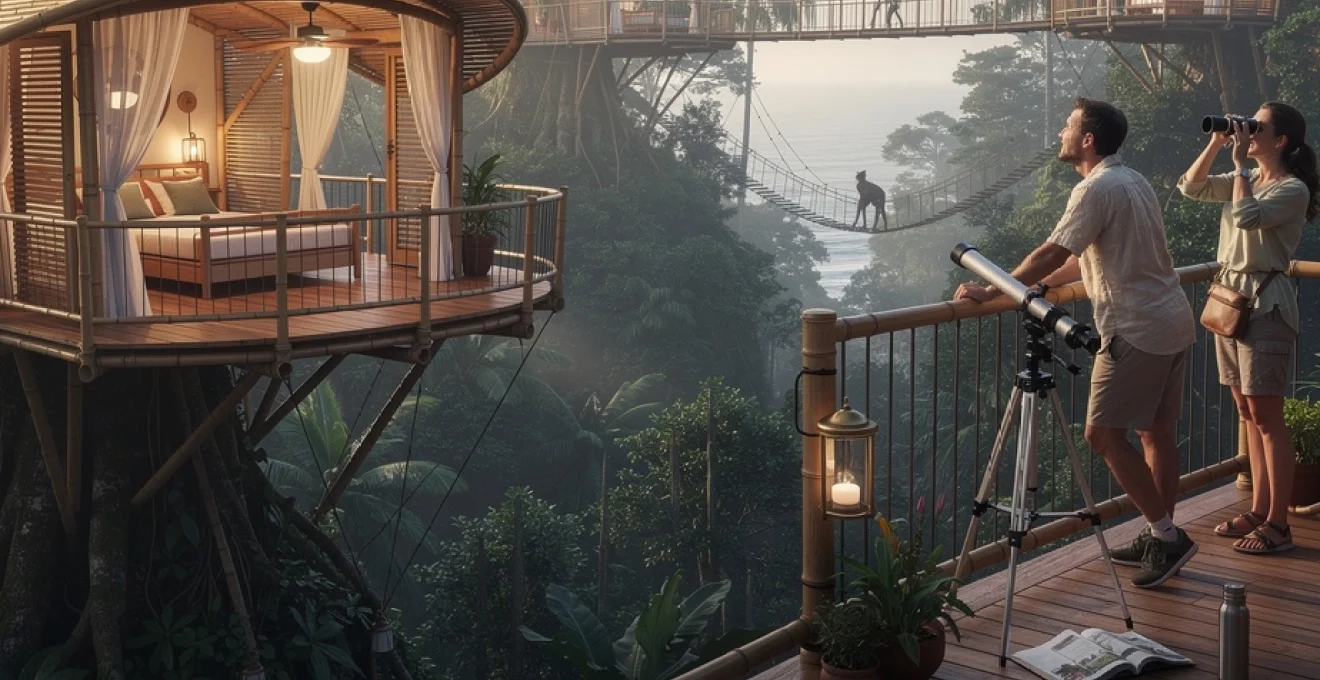
Costa Rica has revolutionised sustainable tourism through its innovative treehouse accommodations, creating a unique fusion of architectural excellence and ecological preservation. These elevated sanctuaries offer travellers an unprecedented opportunity to immerse themselves in the country’s rich biodiversity whilst maintaining minimal environmental impact. The nation’s commitment to conservation, with over 25% of its territory protected, has fostered the development of sophisticated canopy-based lodging that serves both as luxury accommodation and wildlife observation platforms.
The treehouse phenomenon in Costa Rica transcends traditional hospitality concepts, representing a paradigm shift towards regenerative tourism practices. These structures demonstrate how human habitation can coexist harmoniously with pristine ecosystems, offering guests intimate encounters with wildlife that would be impossible from ground-level accommodations. From the misty cloud forests of Monteverde to the primary rainforests of the Osa Peninsula, these elevated retreats provide access to diverse ecological zones whilst supporting local conservation efforts and indigenous communities.
Costa rica’s pioneering canopy architecture: sustainable design principles in rainforest accommodation
The architectural philosophy underlying Costa Rican treehouses represents a masterclass in sustainable design, where biomimetic principles guide every structural decision. These innovative accommodations seamlessly integrate with their natural surroundings, utilising design elements that mirror the forest’s own adaptive strategies. The structures employ vertical zoning techniques that maximise space efficiency whilst minimising ecological disruption, creating multi-level living environments that respond dynamically to changing environmental conditions.
Biomimetic structural engineering: learning from cecropia and guarumo tree adaptations
Costa Rican treehouse architects have extensively studied the structural adaptations of native species, particularly the Cecropia and Guarumo trees, to inform their design methodologies. These pioneer species demonstrate remarkable resilience through their hollow-stemmed construction and flexible branching patterns, characteristics that engineers have translated into human habitation structures. The trees’ natural ability to withstand tropical storms through controlled flexibility has inspired the development of joint systems that allow for controlled movement during high winds, ensuring both structural integrity and occupant safety.
Low-impact foundation systems: stilts, platforms, and root zone preservation techniques
Modern treehouse construction in Costa Rica prioritises root zone preservation through sophisticated foundation systems that eliminate the need for deep excavation. Elevated platform designs distribute structural loads across multiple contact points, minimising soil compaction and preserving critical mycorrhizal networks that support forest health. These foundation systems typically utilise adjustable steel posts or reinforced timber columns that can accommodate natural ground settling whilst maintaining structural stability over decades of operation.
Renewable material integration: bamboo, reclaimed hardwoods, and local timber certification
The material selection process for Costa Rican treehouses emphasises locally sourced, renewable resources that support regional economies whilst reducing transportation-related carbon emissions. Bamboo cultivation has experienced significant growth, with species like Guadua angustifolia providing rapid-growth alternatives to traditional hardwoods. Forest Stewardship Council certified timber ensures that any hardwood components originate from sustainably managed plantations, maintaining the delicate balance between construction needs and forest conservation objectives.
Climate-responsive ventilation: natural airflow patterns and tropical cooling strategies
Sophisticated ventilation systems in Costa Rican treehouses harness natural airflow patterns to maintain comfortable interior temperatures without mechanical cooling systems. Cross-ventilation designs capitalise on thermal stack effects, where heated air naturally rises and creates continuous air circulation throughout the structure. Strategic placement of operable panels and louvers allows guests to fine-tune ventilation according to weather conditions, whilst screened openings provide protection against insects without impeding airflow.
Biodiversity immersion: wildlife corridors and ecological integration in elevated accommodations
The elevated positioning of treehouse accommodations provides unprecedented access to Costa Rica’s stratified forest ecosystems, where different animal communities occupy distinct vertical zones. These structures function as observation platforms that allow guests to witness natural behaviours typically hidden from ground-level observers. The canopy layer, often referred to as the “roof
canopy of the rainforest, becomes the primary stage, where epiphytes, birds, and arboreal mammals interact in a complex web of life.
By situating accommodations within or just below this canopy layer, Costa Rican treehouse stays effectively transform into front-row seats to the rainforest’s daily rhythms. Carefully preserved wildlife corridors are integrated into site planning, allowing animals to move freely across the landscape without encountering barriers such as fences or extensive ground-level construction. For guests, this means waking to howler monkey choruses, spotting toucans at eye level, and sometimes observing sloths navigating branches only a few metres away, all while the forest’s ecological connectivity remains intact.
Monteverde cloud forest reserve: three-tier canopy access and endemic species observation
Within the Monteverde Cloud Forest Reserve, treehouse stays are often designed to provide access to three distinct vertical strata: understory, mid-canopy, and upper canopy. Elevated walkways and suspended platforms allow you to move between these levels much like moving between floors in a building, but here each “floor” hosts unique plant and animal communities. This three-tier access is particularly valuable for observing endemic species such as the resplendent quetzal, emerald toucanet, and various glass frogs that favour specific microhabitats.
The constant mist and cooler temperatures of Monteverde demand specialised architectural responses, from moisture-resistant materials to moss-friendly rooflines that encourage epiphytic growth rather than fighting it. Treehouse designs here often incorporate observation decks oriented towards known feeding trees or fruiting cycles, maximising your chances of wildlife encounters. For birdwatchers and nature photographers, this configuration turns a simple overnight stay into an extended field study, where you can quietly document behaviour patterns without disturbing the forest.
Manuel antonio’s transitional ecosystems: dry forest to coastal rainforest gradients
In Manuel Antonio, treehouse stays occupy one of Costa Rica’s most fascinating ecological transition zones, where dry forest gradually yields to lush coastal rainforest. This gradient creates overlapping habitats that support both Pacific-slope species and rainforest specialists, offering an exceptional range of wildlife within a compact geographic area. Elevated accommodations are often positioned to capture both canopy views and glimpses of the Pacific Ocean, making sunrise and sunset particularly dramatic.
From these vantage points, you can observe troops of white-faced capuchin monkeys using canopy “highways” to travel between feeding sites, while iguanas bask on sunlit branches below. The treehouse’s position above the forest floor reduces direct disturbance of leaf litter communities and sensitive amphibian breeding sites, which are crucial to maintaining ecological balance. For travellers seeking a blend of beach access and rainforest immersion, Manuel Antonio’s treehouse retreats offer a rare combination of coastal relaxation and high-biodiversity canopy experiences.
Tortuguero national park: nocturnal wildlife monitoring from elevated platforms
Tortuguero National Park, often called the “Amazon of Costa Rica,” is dominated by wetlands and canal systems, making elevated structures especially valuable. Treehouse platforms here are typically positioned to overlook lagoons, river channels, or flooded forests, providing exceptional opportunities for nocturnal wildlife observation. When the sun sets, the forest shifts into a different mode, and guests can safely watch as kinkajous, owls, and nocturnal bats take over the canopy.
Red-filtered lighting and acoustic monitoring devices are sometimes integrated into high-end treehouse accommodations in Tortuguero, allowing for low-impact observation of sensitive species. You might listen to frog choruses amplified through subtle soundscapes or use guided spotlighting sessions from viewing decks to search for caimans and night herons. This elevated perspective not only enhances guest experience but also reduces human presence at turtle nesting beaches and delicate riparian zones, where minimal disturbance is critical to conservation efforts.
Osa peninsula primary forest: scarlet macaw flight paths and jaguar territory awareness
The Osa Peninsula, home to some of the last remaining tracts of primary lowland rainforest in Central America, hosts treehouse stays embedded in landscapes that feel almost primeval. Here, elevated cabins are often situated near known scarlet macaw flight paths and fruiting tree clusters, giving guests regular close-range encounters with these iconic birds. The height of the structures aligns with typical macaw flight levels, creating the impression that you’re sharing the same aerial corridor as these brilliantly coloured parrots.
At ground level, the Osa is also part of core jaguar territory, and while direct sightings are rare, treehouse positioning and guided camera-trap networks help raise visitor awareness of big cat conservation. Elevated lodgings reduce human scent and noise profiles in key hunting and movement areas, supporting jaguar behavioural integrity. For travellers interested in truly wild Costa Rica, Osa’s treehouse experiences deliver a potent combination of luxury comfort, raw biodiversity, and a tangible sense of coexistence with apex predators and ancient forests.
Premium treehouse operators: architectural innovation and guest experience excellence
Premium treehouse operators in Costa Rica sit at the intersection of cutting-edge eco-architecture and high-end hospitality, proving that sustainability and comfort can reinforce each other rather than compete. These operators typically work with interdisciplinary teams of architects, biologists, and structural engineers to ensure that designs respect both forest ecology and global safety standards. Rather than offering generic cabins raised on stilts, they create site-specific structures that respond to local topography, wind patterns, and wildlife behaviour.
From a guest perspective, what distinguishes these experiences is the attention to detail: seamless check-in processes, curated wildlife briefings, and personalised itineraries that align with your interests—whether that’s birding, photography, surfing, or wellness retreats. Many premium treehouse stays provide amenities comparable to boutique hotels, including on-site chefs, yoga decks, and spa services, yet maintain a small-scale footprint to avoid mass-tourism impacts. As a result, you can enjoy hot showers, fine local cuisine, and reliable Wi-Fi while still feeling deeply embedded in the rainforest canopy.
Architecturally, standout operators often integrate modular design that allows individual units to be upgraded or replaced without disturbing surrounding trees or soil. Cantilevered balconies, tension-cable supports, and lightweight roofing systems help reduce the amount of material required and preserve natural light penetration to the forest floor. Some lodges also incorporate smart monitoring systems that track energy use, water consumption, and structural performance in real time, making it easier to maintain high standards of safety and sustainability.
For travellers trying to choose between Costa Rica treehouse stays, it can be useful to look beyond glossy images and review an operator’s sustainability credentials. Do they hold recognised eco-certifications, participate in local reforestation initiatives, or employ guides from nearby communities? Transparent communication about building methods, wildlife protocols, and community partnerships is often a reliable indicator of quality. By prioritising operators that meet these criteria, you help reward best practices and encourage continued innovation in the sector.
Permaculture integration: closed-loop systems and regenerative tourism practices
A defining feature of many Costa Rica treehouse stays is their incorporation of permaculture principles, treating the lodge not as an isolated hotel but as a living system. In practice, this means designing accommodations, gardens, water systems, and waste streams so that outputs from one process become inputs for another, creating closed-loop cycles. Just as a healthy forest recycles nutrients through decomposing leaf litter and animal activity, a well-designed eco-lodge aims to recycle resources instead of continually importing and disposing of them.
Food production is a key component of this approach. Many treehouse properties host on-site organic gardens or food forests, supplying kitchens with fresh fruits, herbs, and vegetables. Kitchen scraps are composted and returned to garden beds, while greywater from sinks and showers is often filtered through constructed wetlands and reused for irrigation. The result is a visible “soil-to-table” system that allows you to see, and taste, how regenerative tourism supports local ecosystems and reduces reliance on external supply chains.
Energy systems also benefit from permaculture thinking. Solar panels, micro-hydro turbines on mountain streams, and battery storage often work in tandem to power lighting, fans, and essential appliances. Instead of oversized, centralised grids, many treehouse projects favour modular, right-sized systems that can expand as the property grows. This is similar to planting a forest in stages: start with pioneer species (basic infrastructure), then gradually introduce more complex layers (advanced technologies) as the system stabilises.
Waste management is another area where Costa Rican treehouse stays frequently excel. Biogas digesters can convert organic waste into cooking fuel, while carefully managed composting toilets reduce water consumption and return nutrients safely to the land. By clearly explaining these systems to guests, operators turn everyday activities—using the bathroom, eating dinner, taking a shower—into small acts of participation in a regenerative cycle. If you’ve ever wondered how your holiday could have a net-positive impact, permaculture-based treehouse stays offer a practical, tangible answer.
Safety protocols and engineering standards: structural integrity in tropical climate conditions
Building elevated structures in a tropical country prone to heavy rainfall, high humidity, and occasional seismic activity requires robust engineering standards. Responsible Costa Rican treehouse operators collaborate with licensed structural engineers who design for both static loads (furniture, occupants) and dynamic loads (wind, earthquakes). Steel brackets, hurricane-rated fasteners, and triangulated support systems help distribute forces evenly, much like a spider’s web spreads tension across multiple anchor points.
Regular inspections are crucial in these environments, where wood can swell, metal can corrode, and soil conditions can shift over time. High-quality treehouse lodges implement scheduled maintenance programmes that include checking all connection points, treating exposed timber, and monitoring any minor movement in foundations or support columns. These checks are often carried out before and after the rainy season, when waterlogged soils and strong winds can exert the greatest stress on structures.
Safety protocols extend beyond the building itself to encompass guest movement and emergency preparedness. Guardrails with appropriate height and spacing, non-slip surfaces on stairs and walkways, and clearly marked paths with adequate lighting all help prevent accidents—especially at night or during sudden tropical downpours. Many operators also provide in-room safety briefings, outlining procedures for storms, earthquakes, or medical emergencies, and maintain communication links with nearby clinics or rescue services.
From a traveller’s perspective, one simple way to assess safety is to look for transparency: does the lodge share information about its construction methods and certifications, or is the focus solely on aesthetics? You can also ask whether local building codes have been followed or exceeded, and whether staff receive training in first aid and crisis response. While the sense of adventure is a major appeal of Costa Rica treehouse stays, true peace of mind comes from knowing that behind the scenes, rigorous engineering and safety planning are quietly doing their job.
Booking optimisation: seasonal wildlife patterns, weather considerations, and regional accessibility
Choosing the right moment to book a treehouse stay in Costa Rica can dramatically shape your experience. The country’s climate is broadly divided into a dry season (roughly December to April) and a green season (May to November), but regional variations are significant. For example, the Caribbean side can receive rain throughout the year, while the Pacific coast has more pronounced dry spells. Understanding these patterns helps you align your trip with preferred activities, whether that’s birdwatching, surfing, or simply enjoying clear skies from your canopy deck.
Seasonal wildlife behaviour is another key factor. If your dream is to witness sea turtle nesting in Tortuguero, you’ll want to target the main nesting months (typically July to October, depending on species). Bird enthusiasts might prefer the early months of the year, when many species are breeding and vocal, while whale watching on the Pacific coast peaks during specific migration windows. By matching your booking dates to these biological cycles, you increase the likelihood of memorable wildlife encounters from your treehouse balcony.
Accessibility and travel logistics also play an important role, especially when treehouses are located in remote or mountainous regions. Some of the most secluded properties require 4×4 vehicles, boat transfers, or small regional flights, which can be affected by heavy rains or river levels during the green season. When planning, it’s wise to factor in buffer time for transfers and to confirm transport arrangements directly with the lodge. This approach reduces stress and helps ensure that you arrive in daylight, when navigating forest trails and elevated walkways is simpler and safer.
Finally, considering demand cycles can save money and enhance your sense of seclusion. Peak tourist periods—such as Christmas, New Year, and Easter week—often see higher prices and limited availability at the most sought-after treehouse stays. Shoulder seasons, on the other hand, can offer an appealing balance of favourable weather, active wildlife, and more competitive rates. By booking several months in advance and staying flexible with dates and regions, you give yourself the best chance of securing a Costa Rica treehouse stay that aligns with your interests, budget, and appetite for rainforest adventure.