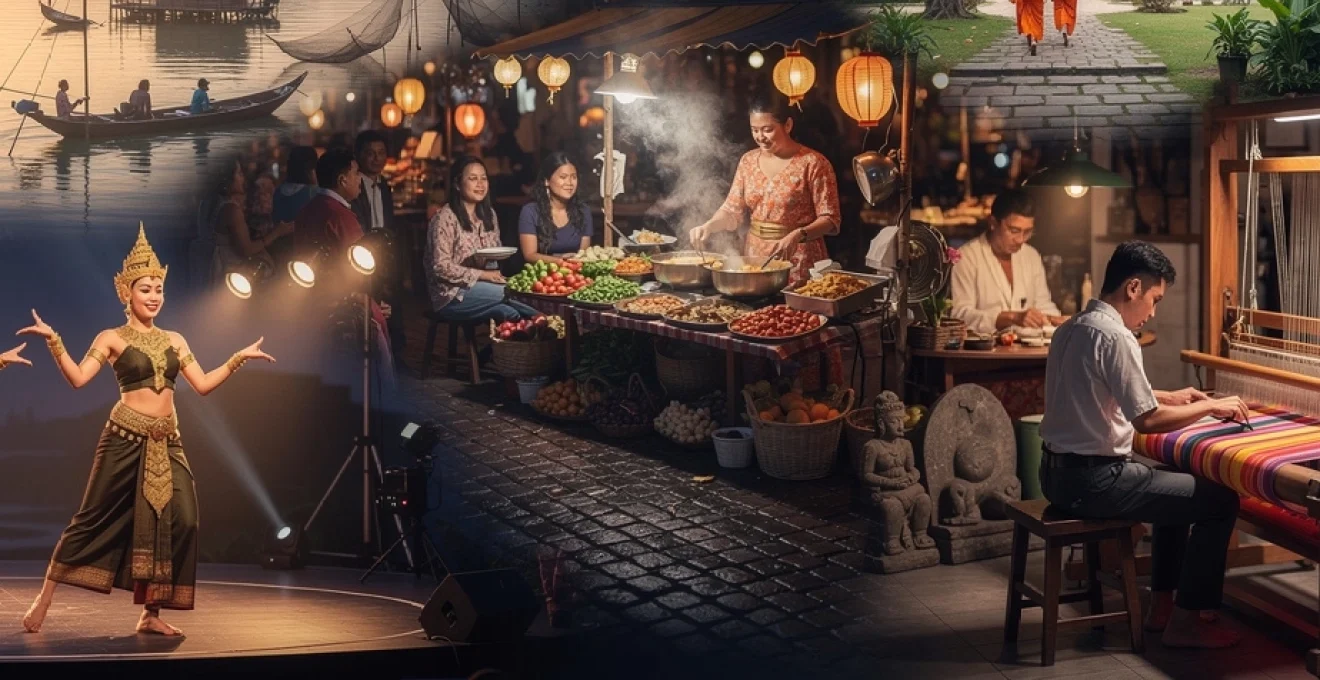
Siem Reap has long been synonymous with Angkor Wat, the magnificent temple complex that draws millions of visitors annually. Yet to define this vibrant Cambodian city solely by its proximity to ancient ruins would be to overlook a thriving cultural ecosystem that has blossomed over the past two decades. Today’s Siem Reap represents a fascinating convergence of traditional Khmer heritage, innovative social enterprises, culinary renaissance, and sustainable urban development. The city has successfully leveraged its position as Southeast Asia’s premier archaeological destination to cultivate a distinctive identity that extends far beyond temple tourism, creating an authentic cultural hub that rewards extended exploration and deeper engagement with Cambodian traditions.
Cultural renaissance: siem reap’s traditional apsara dance performances and phare cambodian circus
The preservation and revitalization of traditional Cambodian performing arts represents one of Siem Reap’s most significant cultural achievements. After the devastating Khmer Rouge period, which systematically targeted artists and intellectuals, the city has become the epicentre for cultural recovery and artistic innovation. This cultural renaissance manifests in venues ranging from intimate theatre spaces to purpose-built performance halls, where centuries-old traditions meet contemporary storytelling techniques.
Apsara theatre and temple club: classical khmer dance heritage
The Apsara dance, a classical form dating back to the Angkorian period, has found renewed prominence in Siem Reap’s cultural landscape. These performances, characterized by intricate hand gestures and elaborate costumes, depict scenes from Hindu mythology and royal court life. Multiple venues across the city offer nightly shows, with the Apsara Theatre providing one of the most authentic experiences. Dancers undergo years of rigorous training to master the precise movements that once graced the courts of Khmer kings. The Temple Club has pioneered a more intimate setting, combining dinner service with educational narratives that contextualize the dances within Cambodia’s broader historical trajectory. What distinguishes these modern presentations is their commitment to authenticity while making the art form accessible to international audiences through thoughtful staging and explanatory programmes.
Phare: the cambodian circus social enterprise model
Phare Ponleu Selpak, commonly known as the Phare Cambodian Circus, represents a groundbreaking social enterprise that merges performing arts with youth development. Founded by former refugee artists in 1994, this organization has transformed the lives of hundreds of young Cambodians through comprehensive training in circus arts, theatre, music, and visual arts. The nightly circus performances in Siem Reap showcase acrobatic excellence combined with narrative storytelling that addresses contemporary Cambodian social issues. Unlike traditional circuses, Phare’s productions incorporate elements of theatre and dance to create culturally resonant performances. The revenue generated directly funds educational programmes in Battambang province, creating a sustainable model that has attracted international recognition. This innovative approach demonstrates how cultural tourism can generate tangible social impact while offering visitors an authentic artistic experience that transcends mere entertainment.
Artisans angkor silk farm: traditional weaving techniques and craft preservation
Located just outside the city centre, Artisans Angkor operates as both a working production facility and educational centre dedicated to preserving Cambodia’s endangered craft traditions. The silk farm offers visitors an unparalleled opportunity to observe the complete silk production process, from sericulture and thread extraction to natural dyeing and traditional loom weaving. This social enterprise employs over 1,000 artisans across multiple workshops, providing vocational training to rural youth and helping revive craft techniques that nearly disappeared during Cambodia’s turbulent recent history. The on-site demonstrations reveal the meticulous nature of traditional Khmer textile production, with some pieces requiring months to complete. What makes Artisans Angkor particularly significant is its commitment to economic sustainability alongside cultural preservation, proving that traditional crafts can provide viable livelihoods in the modern economy.
Shadow puppetry at sovanna phum art association
The ancient art of Sbek Thom (large shadow puppetry) finds one of its few remaining homes at the Sovanna Ph
um Art Association in Siem Reap, where master puppeteers and musicians collaborate to keep this UNESCO-recognised art form alive. Performances typically draw on episodes from the Reamker (the Khmer version of the Ramayana), using intricately carved leather puppets projected onto a backlit screen. As you watch the silhouettes glide across the canvas to the rhythm of traditional pin peat music, you witness a living bridge between Cambodia’s pre-Angkorian spiritual practices and its contemporary cultural identity. For travellers, attending a shadow puppet performance is an intimate way to support endangered arts while gaining deeper insight into the narrative traditions that have shaped Khmer worldviews for centuries.
Culinary tourism infrastructure: from pub street night markets to authentic khmer gastronomy
Siem Reap’s culinary scene has evolved far beyond basic tourist fare, becoming a major reason many visitors choose to extend their stay beyond temple-hopping. The city now offers everything from family-run street stalls and sprawling night markets to refined tasting menus that reinterpret Khmer classics. This layered food ecosystem makes Siem Reap one of Southeast Asia’s most engaging destinations for culinary tourism, particularly for travellers interested in understanding how food intersects with history, religion, and local livelihoods. As you move from Pub Street’s neon-lit alleyways to quieter riverside restaurants and village kitchens, you experience a progressive introduction to Cambodian cuisine that mirrors the city’s broader cultural renaissance.
Prahok and amok: indigenous fermentation and steaming techniques
No exploration of Siem Reap’s food culture is complete without encountering prahok and amok, two dishes that encapsulate Cambodia’s deep relationship with the Tonlé Sap and its agricultural cycles. Prahok, a fermented fish paste often described as Cambodia’s “cheese,” is produced through age-old preservation techniques that allow communities to store protein for the dry season. While its pungent aroma can be challenging at first, prahok forms the flavour foundation for countless stews, stir-fries, and dipping sauces, offering a direct sensory link to traditional village life.
Amok, by contrast, showcases the gentler side of Khmer gastronomy. Typically prepared with freshwater fish, coconut milk, kaffir lime, and kroeung (a fragrant spice paste), it is traditionally steamed in banana leaves until it reaches a custard-like consistency. Many restaurants in Siem Reap now present amok in refined, restaurant-style portions, but the underlying technique remains rooted in domestic kitchens and temple festivals. When you taste a well-balanced amok, you are effectively sampling a culinary narrative of Cambodia’s riverine environment, spice trade routes, and Buddhist ritual offerings, all distilled into a single bowl.
Cambodian cooking class experience at local villages
For travellers who want to move beyond restaurant menus, Siem Reap’s cooking classes offer hands-on immersion into Khmer foodways. Many programmes begin with a guided visit to a local market or the larger Phsar Leu, where you learn to identify herbs like lemongrass and holy basil, seasonal vegetables, and the different grades of rice that underpin Cambodia’s food security. Instructors frequently explain how post-harvest practices, such as rice milling and fish drying, reflect centuries of adaptation to the monsoon climate.
The most rewarding cooking classes often take place in nearby villages, where you prepare dishes in open-air kitchens using charcoal stoves and traditional utensils. Here, you might pound kroeung paste with a mortar and pestle, wrap fish in banana leaves, or grill marinated meats over coconut husk embers. This village-based approach transforms a simple “Cambodian cooking class in Siem Reap” into a deeper cultural exchange, allowing you to ask questions about daily life, seasonal rituals, and family recipes passed down through generations. By the time you sit down to eat, you have not only prepared a meal but also participated in a living tradition that underpins rural livelihoods.
Night market economy: angkor night market and phsar leu market ecosystems
As evening falls, Siem Reap’s night markets come alive, revealing another layer of the city’s culinary and commercial infrastructure. The Angkor Night Market and the Siem Reap Art Center Night Market cater primarily to visitors, offering grilled skewers, noodle dishes, and fresh fruit shakes alongside handicrafts and souvenirs. While tourism-focused, these markets still provide a useful introduction to popular street foods such as num pang (Khmer sandwiches), rice porridge, and fried noodles that sustain local workers and tuk-tuk drivers late into the night.
By contrast, Phsar Leu Thom Tmey, the city’s largest daytime market, functions as a vital hub in Siem Reap’s food supply chain. Here, wholesalers, farmers, and small-scale vendors exchange everything from live fish and herbs to household goods and textiles. Observing these transactions gives you a clearer sense of how the urban economy relies on rural producers, and how price fluctuations in rice or fish can ripple through households. Together, the night markets and Phsar Leu illustrate how Siem Reap’s market ecosystem balances tourist demand with the everyday needs of residents, a dynamic that any responsible visitor should understand.
Farm-to-table movement: marum restaurant and tree alliance training programme
In recent years, Siem Reap has also become a regional leader in socially responsible dining, with several restaurants adopting farm-to-table principles and vocational training models. Marum, part of the Tree Alliance network, exemplifies this shift. The restaurant sources many of its ingredients from local farmers and social enterprises, showcasing seasonal produce in creative interpretations of Cambodian dishes. At the same time, it provides structured hospitality training for marginalised youth, offering them pathways into stable employment in Siem Reap’s growing service sector.
This dual focus on sustainable sourcing and human capital development mirrors a wider trend across the city, where eateries such as SPOONS or Mahob Cuisine increasingly emphasise traceability, organic farming, and reduced food waste. For diners, choosing a farm-to-table restaurant in Siem Reap becomes more than a culinary preference; it is a way to support a circular economy in which local producers, trainees, and independent restaurateurs all benefit. In practical terms, this means asking where your vegetables come from, seeking out establishments with transparent training programmes, and understanding that each meal can contribute to Siem Reap’s long-term resilience.
Tonlé sap lake biosphere reserve: southeast asia’s largest freshwater ecosystem
While Angkor Wat anchors Siem Reap’s historical narrative, the nearby Tonlé Sap Lake underpins its ecological and economic story. Designated as a UNESCO Biosphere Reserve, this vast freshwater system expands and contracts dramatically with the seasons, transforming surrounding landscapes and livelihoods. For visitors, exploring the lake offers a chance to see how hydrology, biodiversity, and human adaptation intersect in real time. It also reveals why Siem Reap is much more than a static museum town: it is intimately connected to a living, breathing ecosystem that continues to shape Cambodia’s future.
Kampong phluk and kompong khleang stilted villages: floating architecture
One of the most striking expressions of life on the Tonlé Sap is the stilted and floating villages of Kampong Phluk and Kompong Khleang. Built on towering wooden stilts, houses here seem to float above the floodplain in the wet season and rise like skeletal structures over dry, cracked earth in the dry months. This amphibious architecture is not merely aesthetic; it is a practical response to water levels that can vary by several metres each year. Homes, schools, and even pagodas are designed to withstand this annual pulse, creating a built environment that moves in harmony with the lake’s rhythms.
Visitors who travel by boat through these villages gain a close-up view of daily routines shaped by the water: nets being mended, fish being smoked, and children paddling to floating classrooms. At Kompong Khleang, one of the largest and least touristic communities, you can observe a more nuanced picture of floating village life near Siem Reap, including the challenges of limited infrastructure and climate uncertainty. Responsible operators increasingly collaborate with local leaders to ensure that tourism revenues support community projects rather than disrupt fragile social structures, a key consideration when you choose which Tonlé Sap tour to book.
Prek toal bird sanctuary: critically endangered species conservation
For birdwatchers and conservation-minded travellers, the Prek Toal Bird Sanctuary on the northwestern edge of the Tonlé Sap represents one of Southeast Asia’s most important wetland reserves. This protected area shelters significant breeding colonies of globally threatened waterbirds, including the greater adjutant stork, spot-billed pelican, and milky stork. Between December and March, when water levels recede, the sanctuary becomes a prime destination for observing these species nesting in seasonally flooded forests, often described as “cathedrals of trees” filled with calls and wingbeats.
Access to Prek Toal is typically organised through licensed eco-tour operators that partner with local communities and conservation NGOs. Revenue from entrance fees and guided tours helps fund ranger patrols, habitat restoration, and environmental education programmes for nearby villages. For visitors, a day at Prek Toal highlights the delicate balance between biodiversity conservation and human use of the lake, raising questions about how Cambodia can protect its natural heritage while still relying heavily on fisheries and agriculture. In many ways, the sanctuary functions as a living classroom where you can see the front lines of climate adaptation and species protection in Cambodia.
Seasonal flood pulse dynamics and fishing community livelihoods
The Tonlé Sap’s defining feature is its seasonal “flood pulse,” a phenomenon in which the flow of the Tonlé Sap River reverses during the monsoon, causing the lake to expand up to five times its dry-season size. This annual transformation brings nutrient-rich sediments that fertilise surrounding floodplains, supporting rice paddies, forests, and one of the world’s most productive inland fisheries. For centuries, fishing communities around Siem Reap have adapted their gear, boat designs, and settlement patterns to this cyclical rise and fall, treating the lake as both a pantry and a spiritual presence.
However, this finely tuned system now faces mounting pressure from upstream hydropower dams, overfishing, and shifting rainfall patterns linked to climate change. Many residents report declining fish catches and greater uncertainty about when the floodwaters will arrive, making it harder to plan planting or migration. When you visit the Tonlé Sap from Siem Reap, you are witnessing a pivotal moment in the lake’s history, one in which traditional knowledge and modern policy must converge to safeguard livelihoods. Understanding these seasonal dynamics and fishing community challenges helps you appreciate why sustainable tourism, fair pricing for boat tours, and support for community-led initiatives are crucial parts of the broader solution.
Urban development trajectory: digital nomad infrastructure and sustainable tourism planning
Back in the city, Siem Reap’s urban evolution reflects its ambition to be more than an overnight stop for temple tours. Over the last decade, investment in infrastructure, hospitality, and digital services has transformed the town into a viable base for long-stay travellers, remote workers, and entrepreneurs. At the same time, authorities and local stakeholders are increasingly aware that unchecked growth could erode the very cultural and environmental assets that make Siem Reap attractive. The result is an ongoing experiment in how a secondary city can position itself as both a digital nomad hub and a model for sustainable tourism in Cambodia.
Coworking spaces: angkorhub and remote work ecosystem growth
As remote work has become more mainstream, Siem Reap has quietly built a supportive ecosystem for location-independent professionals. Spaces like AngkorHUB offer reliable high-speed internet, ergonomic workstations, and community events that help freelancers, NGO workers, and start-up founders build local networks. What might seem like a simple coworking office is, in practice, a microcosm of Siem Reap’s next economic chapter, where knowledge-based industries complement tourism and agriculture.
For digital nomads, the appeal lies in the ability to structure a workday around early-morning temple visits, afternoon Zoom calls, and evening street food explorations. Yet this lifestyle also brings responsibilities: choosing accommodation that respects local neighbourhoods, supporting ethical businesses, and engaging with Khmer culture beyond the expatriate bubble. As more people search for “best coworking spaces in Siem Reap for remote workers,” questions of digital infrastructure, visa policies, and community integration will play an increasingly important role in shaping the city’s development trajectory.
King’s road angkor development project: mixed-use urban expansion
The King’s Road Angkor development, located near the Old Market and the Siem Reap River, illustrates how mixed-use projects are reshaping the city’s urban fabric. Combining restaurants, boutiques, cultural venues, and event spaces, this precinct is designed to attract both tourists and residents, blurring the line between commercial zone and community hub. Its architecture nods to traditional Khmer aesthetics while integrating modern materials and landscaping, a visual metaphor for Siem Reap’s broader attempt to blend heritage and contemporary urban life.
Critically, developments like King’s Road raise important planning questions: how can new commercial centres avoid displacing long-term residents, and how can they contribute to public amenities like green spaces and pedestrian pathways? For visitors, these projects offer convenient access to curated dining and shopping, but they also provide an opportunity to observe how Siem Reap is managing rapid change. If you walk from the riverside gardens into King’s Road and then out towards older shop houses, you can literally trace the layers of the city’s evolution over the past twenty years.
Sustainable tourism certification standards in hospitality sector
Recognising the environmental and social pressures generated by several million annual visitors, many hotels and guesthouses in Siem Reap are pursuing sustainable tourism certification. Programmes aligned with global standards, such as the GSTC (Global Sustainable Tourism Council) criteria, encourage properties to reduce energy and water consumption, manage waste responsibly, and engage with local suppliers. Some establishments have implemented solar water heating, greywater recycling, and plastic-free initiatives, while others support staff development and community projects in nearby villages.
For travellers, choosing eco-certified accommodation in Siem Reap is one of the most practical ways to reduce their footprint. It is worth asking hotels about their sustainability policies, staff training, and sourcing practices rather than relying solely on marketing claims. Over time, consistent demand for verified sustainable options can help shift the broader hospitality sector towards more responsible models, ensuring that Siem Reap’s growth remains aligned with the long-term protection of Angkor, the Tonlé Sap, and the city’s cultural assets.
Spiritual tourism beyond angkor: banteay srei district pagodas and buddhist monastery homestays
While Angkor Wat and Bayon dominate most temple itineraries, Siem Reap province also hosts a quieter world of living Buddhist practice that extends far beyond the archaeological park. In the rural Banteay Srei district, for example, active pagodas and small monasteries offer insight into how contemporary Cambodians integrate Buddhism into daily life. Here, monks lead chanting sessions, villagers bring offerings during full-moon ceremonies, and children attend informal classes on ethics and reading after school.
Some monasteries and community groups have begun to organise simple homestay experiences, allowing visitors to stay overnight in nearby villages and participate in morning alms rounds or meditation sessions. These are not luxury retreats but modest, respectful encounters with everyday spirituality around Siem Reap. You might help prepare vegetarian meals for the monks, learn basic Pali chants, or simply sit quietly in the shade of a Bodhi tree while listening to temple bells. For travellers seeking a deeper understanding of Khmer values—gratitude, impermanence, generosity—such experiences often prove as transformative as any sunrise at Angkor Wat.
Adventure tourism offerings: kulen mountain national park and kbal spean archaeological trekking routes
For those who equate Siem Reap primarily with stone temples and museum visits, the surrounding landscapes offer an invigorating surprise. Within a couple of hours’ drive, you can swap the flat plains of Angkor for forested hills, waterfalls, and jungle trails that reveal a more rugged side of Cambodia. Adventure tourism here remains relatively low-impact compared with more developed regions, giving you the sense of discovering routes that still belong primarily to local pilgrims and farmers rather than mass tour buses.
Phnom Kulen National Park, considered a sacred mountain in Khmer cosmology, is a prime example. Travellers hike through dense forest to reach viewpoints, cascades, and ancient rock carvings, including the famed “River of a Thousand Lingas,” where the riverbed itself is etched with symbolic phallic motifs and divine figures. Bathing in the waterfalls is both a physical refreshment and, for many local visitors, a spiritual act believed to bring blessings. As you trek, you pass shrines, reclining Buddha statues, and remnants of early Angkorian settlements, reminding you that even in adventure tourism, cultural and religious histories are never far away.
Further along the Kulen foothills lies Kbal Spean, sometimes called the “Valley of a Thousand Lingas,” where a moderate trek leads you to another stretch of sacred riverbed carvings. The trail winds through mixed deciduous forest, alive with birds and insects, before arriving at sandstone outcrops carved with Vishnu, Brahma, and other deities. Standing here, listening to the water rush over centuries-old reliefs, you can sense how seamlessly Angkorian civilisation wove spirituality into the natural landscape. For travellers, these archaeological trekking routes near Siem Reap offer a powerful counterpoint to the grand monuments of Angkor: they are smaller in scale, but they invite a more intimate, reflective engagement with both nature and history.