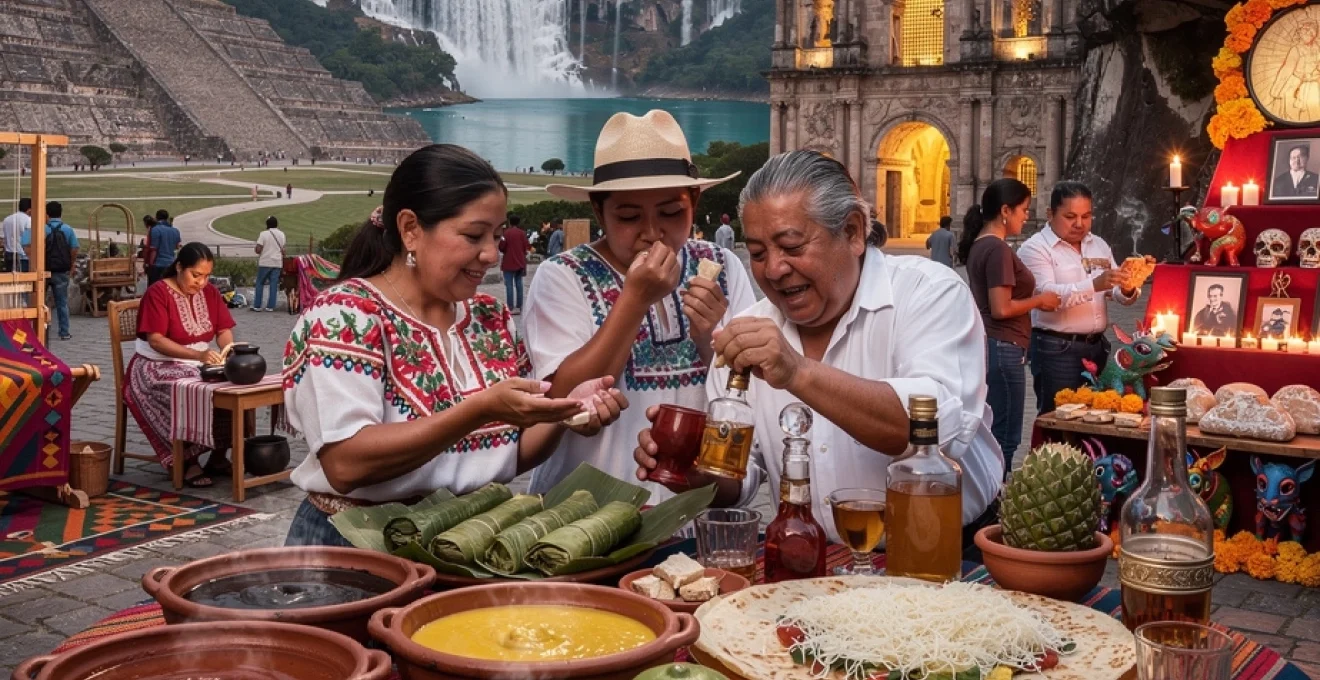
Nestled in the mountainous heartland of southern Mexico, Oaxaca represents a living testament to indigenous resilience, culinary sophistication, and artistic expression that has flourished uninterrupted for over three millennia. This remarkable state encompasses far more than picturesque colonial architecture and vibrant markets—it embodies a cultural ecosystem where Zapotec and Mixtec traditions continue shaping daily life, where seventeen distinct indigenous groups preserve linguistic and cultural identities, and where gastronomy reaches heights of complexity that rival any cuisine on Earth. The valley surrounding Oaxaca City serves as an epicenter of pre-Columbian heritage, artisan craftsmanship, and culinary innovation that transforms casual visitors into devoted admirers. Whether you’re drawn to ancient archaeological sites perched atop sacred mountains, traditional cooking techniques unchanged since before Spanish contact, or artisan villages where master craftspeople employ methods passed down through countless generations, Oaxaca delivers an immersive cultural experience unmatched anywhere in the Americas.
Oaxaca’s Pre-Columbian heritage and archaeological treasures at monte albán
Monte Albán commands attention from its strategic position atop a flattened mountain overlooking three valleys, serving as the political and ceremonial capital of the Zapotec civilization for over thirteen centuries. Founded around 500 BCE, this urban center housed an estimated 25,000 residents at its peak, functioning as the most important city in Mesoamerica during the Classic period. The archaeological zone sprawls across approximately two square kilometers, featuring meticulously engineered pyramids, residential compounds, astronomical observatories, and elite burial tombs that reveal sophisticated understanding of mathematics, astronomy, and urban planning. Walking through the Great Plaza, you encounter architectural precision that demonstrates the Zapotec people’s mastery over their environment and their profound connection to cosmological cycles.
Zapotec civilization remnants and ancient ball courts
The ball court at Monte Albán represents one of Mesoamerica’s most distinctive sporting and ritual spaces, where players engaged in competitions carrying religious, political, and cosmological significance. These I-shaped courts facilitated a game played with a solid rubber ball that participants maneuvered using hips, elbows, and knees—never hands or feet. The symbolic importance extended far beyond athletic competition, often serving as ritualized reenactments of cosmic battles between light and darkness, order and chaos. Carved stone panels surrounding the court depict captives and sacrificial scenes, suggesting that high-stakes contests occasionally concluded with sacrificial offerings to deities governing agricultural fertility and cosmic balance.
Mitla’s geometric mosaics and underground burial chambers
Located approximately forty-four kilometers from Oaxaca City, Mitla showcases architectural artistry distinct from Monte Albán’s monumental pyramid complexes. The site’s name derives from the Nahuatl word “Mictlán,” meaning “place of the dead,” reflecting its primary function as a sacred burial ground for Zapotec nobility and high priests. What distinguishes Mitla are the extraordinary geometric mosaics adorning palace facades—intricate fretwork patterns created from thousands of individually cut stones fitted together without mortar. These remarkable designs feature fourteen distinct mosaic patterns, each requiring exceptional mathematical precision and aesthetic sensibility. Underground burial chambers accessible through narrow passages contain cruciform tombs where elite members of Zapotec society were interred with precious offerings including jade ornaments, ceramic vessels, and gold jewelry.
Hierve el agua’s petrified waterfall formations
Hierve el Agua presents one of Mexico’s most unusual natural phenomena—mineral-laden springs cascading over cliff edges, depositing calcium carbonate and other minerals that create formations resembling frozen waterfalls. These petrified cascades extend approximately fifty meters down cliff faces, their white and ochre colorations contrasting dramatically against surrounding mountain vegetation. The site includes natural infinity pools perched at cliff edges, where you can bathe in mineral-rich waters while contemplating valley vistas stretching toward distant horizons. Pre-Columbian inhabitants engineered sophisticated irrigation systems channeling spring waters to terraced agricultural plots, demonstrating hydraulic knowledge that sustained communities in this semi-arid environment. Archaeological evidence suggests the site held ceremonial importance related to water worship and agricultural rituals performed to ensure adequate rainfall for maize cultivation.
Yagul archaeological site and rock shelter paintings
Less visited than Monte Albán or Mitla yet no less fascinating, Yagul rises from the Tlacolula Valley as a fortified hilltop city that once guarded vital trade routes. Occupied from the Late Pre-Classic through the Post-Classic period, this Zapotec center features defensive walls, palatial residences, and one of the largest ball courts in the Oaxaca region. From the upper terraces, you can look out across patchwork fields and imagine caravans of traders carrying cacao, obsidian, and textiles along the same routes thousands of years ago. Its relatively low visitor numbers make Yagul ideal if you want to experience Oaxaca’s pre-Columbian heritage without crowds.
Below the main structures, rock shelters preserve some of the most important early agricultural evidence in the Americas. These caves and overhangs contain pictographs and archaeological layers where early domesticated maize, beans, and squash have been documented, supporting the theory that Oaxaca’s valleys were a cradle of agriculture more than 8,000 years ago. The faded red and black paintings—simple figures, symbols, and animal forms—offer a rare, intimate glimpse into the spiritual and everyday worlds of early inhabitants. For travelers interested in archaeology and cultural evolution, combining Monte Albán, Mitla, and Yagul in a single itinerary creates a powerful narrative arc from early farming villages to complex city-states.
Traditional oaxacan gastronomy and the seven moles classification
Oaxacan cuisine is often described as Mexico’s most intricate, and nowhere is this more evident than in its legendary moles. While people frequently refer to the “seven moles of Oaxaca,” the reality on the ground is much richer: every family, community, and region has its own variations, often guarded as treasured secrets. Still, the classic classification—mole negro, coloradito, mole rojo, mole amarillo, mole verde, chichilo, and manchamanteles—provides a framework for understanding this complex culinary landscape. Think of it less as a rigid list and more as a color wheel of flavors, where cooks blend chiles, spices, seeds, and herbs like painters mixing pigment on a palette.
For visitors, exploring these sauces is one of the most rewarding ways to connect with traditional Oaxacan gastronomy. You might taste a deep, bittersweet mole negro at a family-run restaurant one day, then encounter a lighter, herbaceous mole verde at a country market the next. Each plate reflects decisions about toasting, grinding, and simmering ingredients that have been refined over centuries. If you’re planning a food-focused trip, consider scheduling at least one market visit, one home-style comedor, and one cooking class—this combination lets you see how the same “seven moles classification” translates into dozens of distinct expressions.
Mole negro’s chilhuacle chilli and hoja santa preparations
Mole negro is often considered the pinnacle of Oaxacan sauce-making, a culinary achievement that can require more than 30 ingredients and several days of work. At its heart lies the rare chilhuacle negro chile, a small, dark pod cultivated primarily in the Cañada region of Oaxaca. Its deep, fruity aroma and mild heat contribute the sauce’s characteristic smoky complexity, which balances roasted tomatoes, toasted nuts and seeds, and a carefully controlled amount of Oaxacan chocolate. Because chilhuacle harvests can be inconsistent and climate-sensitive, many cooks now blend it with more accessible varieties like mulato or ancho, but the traditional flavor profile remains unmistakable.
Another key player in mole negro is hoja santa, a large, heart-shaped leaf with an anise and pepper fragrance that some compare to tarragon crossed with eucalyptus. In classic preparations, fresh hoja santa is charred lightly on a comal or simmered in broth before being ground into the sauce, contributing both herbal brightness and subtle bitterness. When you sit down to a plate of mole negro—usually served over turkey or chicken with sesame seeds scattered on top—you’re tasting a sauce that is as much ritual as recipe. If you want to appreciate its full depth, ask where the chiles come from and how long the sauce has been resting; like a good stew, mole negro often tastes better the day after it’s made.
Tlayudas with quesillo oaxaqueño at mercado 20 de noviembre
No exploration of traditional Oaxacan food would be complete without sampling a freshly grilled tlayuda, sometimes referred to as the “Oaxacan pizza.” These oversized tortillas are made from corn masa that has been pressed thinner and cooked longer than standard tortillas, yielding a base that is crisp at the edges yet still pliable. They are typically spread with refried beans, smeared with pork lard for richness, and topped with shredded cabbage or lettuce, salsa, and your choice of meat—tasajo (marinated beef), cecina (salted pork), or chorizo are classics. The star binding it all together is quesillo oaxaqueño, the region’s famed string cheese, which melts into luxurious strands over the hot charcoal.
Mercado 20 de Noviembre in Oaxaca City is arguably the best place to experience tlayudas in their natural habitat. In the “pasillo de humo” (smoke corridor), grill stands line up side by side, filling the air with the irresistible scent of searing meat and toasting tortillas. You choose your cuts at the butcher counter, have them cooked over mesquite coals, and then watch as vendors assemble your tlayuda to order. For a truly local experience, pair it with a glass of agua de horchata con tuna (rice drink with cactus fruit) or a cold beer, and don’t be shy about asking for house-made salsas—some are mild, others fiery, but all reveal the layered flavors that define Oaxacan street food.
Chapulines toasted with sal de gusano and lime
For the adventurous eater, chapulines—seasoned grasshoppers—are an iconic Oaxacan snack that encapsulates the region’s resourcefulness and respect for local ecosystems. Far from being a novelty, these crunchy insects have been part of the highland diet for centuries, providing a sustainable source of protein and minerals. Vendors typically toast them on a clay comal with garlic, chilies, and a squeeze of lime, finishing with a dusting of sal de gusano, a savory salt blended with dried agave larvae and chili. The result? A tangy, umami-rich bite that pairs surprisingly well with mezcal.
You’ll find towering baskets of chapulines in markets like Benito Juárez and Tlacolula, sorted by size and flavor profile. Some are small and delicate, ideal for sprinkling over tlayudas or guacamole; others are larger and bolder, better suited for snacking by the handful. If you’re hesitant, start with a few on top of a memela or folded into a warm tortilla—this softens the psychological leap. Beyond the novelty factor, embracing chapulines offers a window into how traditional Oaxacan food systems make intelligent use of local biodiversity, long before the modern “edible insects” trend reached global headlines.
Mezcal artesanal production in santiago matatlán palenques
In Oaxaca, agave is more than a plant—it is a cultural companion, shaping landscapes, rituals, and livelihoods. Nowhere is this more evident than in Santiago Matatlán, often called the “world capital of mezcal,” located about an hour from Oaxaca City. Dotted around the town are small, family-run palenques where mezcal artesanal is produced using methods that predate industrial distillation by centuries. Visiting one of these distilleries allows you to follow the entire process, from spiky agave fields to the smoky still, gaining appreciation for why mezcal is considered a spiritual cousin to wine rather than a simple spirit.
The journey begins with mature agave—often espadín, but also wild varieties such as tobalá, madrecuixe, or tepeztate—which can take between 7 and 30 years to reach harvest. The hearts (piñas) are slow-roasted in conical earthen pits lined with hot stones and covered with agave fibers and earth, infusing them with distinctive smokiness. After crushing the cooked agave with a stone wheel pulled by a horse or mule, the sweet fibers ferment naturally in open wooden vats before being double-distilled in copper or clay stills. When you sit down for a guided tasting, notice how each variety reflects not just the species but also the microclimate, soil, and decisions of the maestro mezcalero. Sipping slowly, with small tastes and plenty of water, you’ll understand why mezcal is traditionally enjoyed “para conversar” (for conversation), not for shots.
Tamales oaxaqueños wrapped in banana leaves with mole amarillo
While tamales are a staple across Mexico, Oaxacan versions stand out for their size, flavors, and distinctive banana leaf wrapping. The masa, made from nixtamalized corn, is often enriched with lard or vegetable shortening and whipped until light and airy—a process that can take 30 minutes or more by hand. Generous spoonfuls of mole amarillo, a bright, slightly tangy sauce made with yellow chilies, tomatoes, and aromatic herbs like hierba santa, are then folded into the dough, sometimes along with vegetables or chicken. Wrapped snugly in banana leaves and steamed, the tamales emerge fragrant and tender, with a subtle herbal note from the leaves themselves.
You’ll encounter these tamales oaxaqueños at breakfast stalls, evening street corners, and especially during festivals and family celebrations. For travelers, they are a practical and delicious way to experience traditional Oaxacan gastronomy on the go—self-contained, portable, and deeply satisfying. If you’re visiting during Day of the Dead or Christmas, pay attention to how fillings and moles change according to the season and occasion. Asking vendors about their family recipes often sparks stories about grandparents, village fiestas, and the communal work involved in preparing hundreds of tamales at once, giving you a richer sense of how food, ritual, and community intertwine.
Indigenous craft traditions and artisan villages
Beyond its celebrated cuisine, Oaxaca is equally renowned for its artisan villages, each specializing in particular crafts that reflect both indigenous heritage and contemporary creativity. These communities, often just 30–60 minutes from Oaxaca City, maintain techniques that have been honed over generations—sometimes centuries. Visiting them is like stepping into living workshops where history is still in motion. Instead of seeing artifacts behind glass, you watch raw wool become intricate rugs, rough clay transform into shimmering black pottery, or a block of wood evolve into a fantastical creature before your eyes.
Planning a day or two to explore these villages gives you more than just the chance to purchase unique souvenirs. You gain insight into how indigenous families integrate artistry with agriculture, ceremonies, and daily life. Many workshops are family-run, with grandparents, parents, and children all participating in different aspects of production. By buying directly from artisans, you help sustain local economies and support craft traditions that might otherwise be threatened by mass-produced imitations. And, as a bonus, you return home with pieces that carry stories—objects that remind you not only of Oaxaca’s beauty but of the hands that shaped it.
Teotitlán del valle’s zapotec wool rug weaving techniques
Teotitlán del Valle, nestled at the foothills of the Sierra Juárez, is synonymous with Zapotec wool rugs and textiles. Here, nearly every street reveals looms in motion, dyed skeins drying in courtyards, and walls adorned with geometric designs inspired by Mitla’s mosaics, traditional symbols, or even modern art. Historically, Zapotec weavers worked with cotton and backstrap looms; wool and pedal looms arrived with the Spanish in the 16th century. Today, many families still card, spin, and dye their own wool using natural pigments—cochineal for deep reds, indigo for blues, marigold and pericón for yellows—creating a palette that mirrors Oaxaca’s earth and sky.
When you enter a family workshop, you’re often invited to see each step, from hand-spinning yarn to the rhythmic choreography of feet and hands at the pedal loom. The process is remarkably analog: no digital patterns, just memory and experience guiding complex motifs into being. Ask a weaver about a particular symbol and you may learn it represents rain, mountains, fertility, or the balance between life and death. If you’re considering a purchase, it’s worth asking how the dyes were made; naturally dyed pieces tend to age gracefully and retain a unique depth of color. In supporting these artisans, you’re contributing to the survival of Zapotec language, cosmology, and an entire ecosystem of traditional knowledge.
San bartolo coyotepec’s barro negro pottery and burnishing methods
South of Oaxaca City, the village of San Bartolo Coyotepec has built its reputation on barro negro, a striking black pottery that seems almost metallic in its sheen. While the local clay has been used for centuries to produce utilitarian vessels, the glossy finish that made barro negro world-famous emerged in the 1950s, when artisan Doña Rosa Real discovered that polishing pieces before firing transformed their color and texture. Today, potters shape everything from traditional jugs and incense burners to contemporary sculptures, but the fundamental technique remains rooted in hand-building and simple, wood-fired kilns.
The burnishing process, which creates that mirror-like surface, involves patiently rubbing the semi-dry clay with a smooth quartz or river stone. This compresses the surface particles and aligns them, much like brushing velvet in a single direction, so that light reflects evenly after firing. Watching an artisan burnish a piece is almost meditative—each circular motion deliberate, each curve of the vessel memorized by touch. Because this finish slightly reduces the functional strength of the pottery, many barro negro pieces today are decorative rather than utilitarian. When choosing one to take home, consider both the design and the thickness; finely made pieces feel surprisingly light in the hand, a testament to the potter’s control over clay and fire.
Santo tomás jalieza’s backstrap loom cotton textiles
If you’re drawn to fine weaving and wearable art, Santo Tomás Jalieza is essential. This small community specializes in cotton textiles made on the backstrap loom, a pre-Hispanic technology in which the weaver’s body literally becomes part of the loom. One end of the warp is tied to a fixed point—a post or tree—while the other is attached to a strap around the weaver’s waist. By leaning forward or back, the artisan controls tension, allowing for intricate designs that would challenge even modern machines. Belts, table runners, bags, and cushion covers from Jalieza are renowned for their tight weave and detailed brocading.
Unlike pedal looms, which tend to be stationary and larger, backstrap looms are portable, making them ideally suited to domestic spaces and seasonal rhythms of rural life. Many designs incorporate ancient motifs—diamonds, zigzags, stylized animals—that encode stories or protective symbols. As you examine a belt or runner, you’re effectively reading a visual language passed from mother to daughter over generations. Prices here are often modest compared to the labor involved, so if a piece speaks to you, purchasing directly from the weaver ensures fair compensation. You might even be invited to sit down and try the loom yourself, gaining a visceral appreciation for the concentration and physical stamina this art requires.
Arrazola’s alebrijes wood carving and copal tree sculptures
West of Oaxaca City, in the village of San Antonio Arrazola, another kind of magic takes shape in the form of alebrijes—brightly painted wooden creatures that fuse elements of real and imaginary animals. While fantastical papier-mâché figures of the same name originated in Mexico City, Oaxacan artisans adapted the concept using local copal wood, creating a distinct regional expression. Carvers begin with green branches or trunks, roughing out basic forms with machetes and chisels before finer knives and sandpaper refine details. As the wood dries, it naturally cracks, but experienced artisans know how to anticipate and work with these changes, sometimes incorporating them into the design.
Once carved, pieces are coated and hand-painted with astonishingly intricate patterns—dots, lines, and geometric motifs that can take days or weeks to complete. Colors range from traditional earth tones to electric neons, often reflecting both indigenous symbolism and contemporary aesthetics. When visiting a workshop, don’t hesitate to ask who carved and who painted each piece; in many families, different members specialize in each step. If sustainability matters to you, look for studios that source copal responsibly or participate in reforestation programs, as demand for wood has increased sharply with the global popularity of alebrijes. Bringing one home is like bringing a fragment of Oaxacan imagination to your shelf—part guardian, part conversation starter.
Day of the dead celebrations and altar-making rituals
Every late October and early November, Oaxaca transforms into a luminous tapestry of marigolds, candles, and memory as communities prepare for Día de los Muertos (Day of the Dead). Unlike somber commemorations elsewhere, this festival blends reverence with joy, welcoming the spirits of departed loved ones back to the world of the living. Streets fill with sand tapestries (tapetes de arena), comparsa parades, and music that continues late into the night, while homes and cemeteries glow with candlelight. For culture lovers, experiencing Day of the Dead in Oaxaca is like stepping into a living anthropology lesson, where pre-Hispanic views of the afterlife coexist with Catholic traditions.
At the heart of these celebrations are ofrendas, elaborate altars set up in homes, businesses, and public spaces. These multi-tiered structures are adorned with photos of the deceased, papel picado (cut paper banners), sugar skulls, copal incense, and offerings of the foods and drinks they loved in life—often including mole, tamales, chocolate, and mezcal. Marigold petals are carefully arranged to form pathways believed to guide returning souls, their bright color and distinct scent acting like a spiritual GPS. If you’re invited into a family home to see an altar, remember that you’re being welcomed into a deeply personal space; a simple expression of gratitude and a genuine question about the person being honored can open moving conversations about grief, continuity, and love.
Colonial architecture and santo domingo de guzmán complex
While indigenous heritage defines Oaxaca’s soul, its colonial architecture provides the stage on which contemporary life unfolds. Nowhere is this more striking than around the Santo Domingo de Guzmán complex, a baroque masterpiece whose stone facades glow golden at sunset. Built by Dominican friars between the 16th and 18th centuries, the church and former monastery dominate the northern end of Oaxaca’s historic center, a UNESCO World Heritage site. Walking through the surrounding streets—paved with volcanic stone and lined with pastel facades—you feel how Spanish urban planning was superimposed on older indigenous routes, creating a layered city where plazas, markets, and religious buildings all interact.
From the outside, Santo Domingo impresses with its twin bell towers and richly carved portal, but it’s inside that the full exuberance of New Spanish baroque reveals itself. For travelers interested in architecture and religious art, the complex offers a case study in how European aesthetics were adapted to local materials, labor, and sensibilities. It also serves as a contemplative counterpoint to Oaxaca’s bustling markets and festivals—step through the heavy wooden doors, and the city’s noise drops away, replaced by echoes, candlelight, and gilded surfaces.
Baroque gilded altarpieces and churrigueresque ornamentation
Entering Santo Domingo’s main nave, your gaze is immediately drawn upward to an explosion of gold leaf, stucco, and carved figures that seem to defy gravity. The main altarpiece and side chapels feature churrigueresque ornamentation—a highly decorative style characterized by elaborate scrollwork, twisted columns, and an almost sculptural use of light and shadow. More than simple decoration, these altars functioned as didactic tools in a largely illiterate society, their saints, angels, and biblical scenes narrating Christian stories for indigenous and mestizo congregations.
As you move closer, details emerge: tiny cherubs peeking from foliage, saints holding symbolic attributes, inscriptions in Latin and Spanish. The effect is both overwhelming and carefully calculated, designed to impress upon viewers the power and wealth of the Church. Yet local artisans also left subtle marks—a facial feature here, a floral motif there—that hint at indigenous aesthetics woven into imported iconography. If you’re sensitive to sensory overload, consider visiting early in the morning when the church is quieter and the softer light makes it easier to appreciate the craftsmanship without distraction.
Ethnobotanical garden’s indigenous plant species collections
Behind the former monastery buildings, the Jardín Etnobotánico de Oaxaca (Ethnobotanical Garden) offers a different but equally revealing window into the region’s history. Created in the 1990s under the guidance of artist Francisco Toledo and local botanists, this meticulously designed space showcases hundreds of plant species native to Oaxaca, arranged not by strict taxonomy but by their ecological and cultural relationships. Walking through its pathways, you encounter towering cacti, medicinal herbs, dye plants, and food crops that have sustained indigenous communities for millennia. It’s like an open-air textbook on the intimate interplay between people and landscape.
Guided tours—required for entry—explain how specific plants figure into traditional medicine, cuisine, textiles, and rituals. You might see the agaves used for mezcal alongside the trees whose bark colors wool in Teotitlán, or stands of heirloom maize next to the medicinal shrubs elders still use for teas and poultices. For food and culture lovers, this garden connects many threads explored elsewhere in the city, from market ingredients to artisan materials. It’s one thing to sip mezcal or admire a naturally dyed rug; it’s another to stand next to the living plants that make those traditions possible and hear how climate change and land use pressures are affecting them today.
Museo de las culturas de oaxaca’s pre-hispanic gold artefacts
Housed within the former monastery complex, the Museo de las Culturas de Oaxaca (Museum of Oaxacan Cultures) is one of Mexico’s most important regional museums. Its galleries trace the region’s history from early human occupation through the colonial era and into modern times, but the undisputed highlight is the collection from Tomb 7 at Monte Albán. Discovered in 1932, this burial chamber contained an extraordinary cache of Mixtec gold, silver, jade, and turquoise objects—breastplates, pectorals, earspools, and intricate jewelry that attest to both the wealth and the metallurgical sophistication of pre-Hispanic elites. Standing before these pieces, you see how Mixtec artists transformed precious metals into miniature sculptures, with repoussé and filigree techniques rivaling those of Europe or Asia.
Beyond Tomb 7, the museum’s ceramics, codex facsimiles, and stone carvings help contextualize sites like Monte Albán, Mitla, and Yagul that you may have already visited. Exhibits on colonial Oaxaca show how indigenous and European worlds collided, negotiated, and gradually produced new identities, languages, and artistic forms. Plan at least two hours to explore, and consider combining your visit with time in the church and garden for a comprehensive look at how beliefs, plants, and power structures have intertwined over centuries. For anyone serious about understanding why Oaxaca is a must for culture and food lovers, this museum is essential—it provides the historical backbone for everything you taste and see on the streets outside.
Guelaguetza festival and regional dance performances
Every July, Oaxaca’s cultural calendar reaches a crescendo with the Guelaguetza, a festival that brings together dance troupes, musicians, and community delegations from across the state. Held on the hillsides overlooking the city in a purpose-built amphitheater, the event takes its name from a Zapotec word meaning “reciprocal exchange” or “offering.” At its core, Guelaguetza celebrates the idea that communities support one another through shared labor, gifts, and rituals—a principle that still underpins social life in many Oaxacan villages. As performers showcase traditional dances in full regional dress, they also distribute local products—bread, fruit, sweets—to the audience, symbolizing this ethos of mutual giving.
Each region presents its own repertoire: the Sierra Norte might perform graceful line dances accompanied by brass bands, while the Isthmus of Tehuantepec presents swirling skirts and powerful female figures in embroidered huipiles. One of the most anticipated segments is the Jarabe del Valle, the Valley region’s hallmark dance, which concludes with a jubilant shower of gifts. If you’re planning a trip around the Guelaguetza, it’s wise to book accommodations and tickets months in advance, as demand is high both from Mexican visitors and international travelers. Beyond the main performances, the city hosts parallel events—food fairs, artisan markets, street concerts—that turn the entire week into a living showcase of Oaxacan identity.
For those who can’t attend in July, many cultural centers and community groups in Oaxaca City present scaled-down versions of regional dances throughout the year, especially on weekends and during other festivals. Watching these performances in more intimate venues can be just as rewarding, allowing you to appreciate costume details, musical instruments, and the sheer physicality of the dancers up close. Whether in the grand amphitheater or a small plaza, Guelaguetza-inspired events drive home a simple truth: in Oaxaca, culture isn’t confined to museums or special occasions. It is danced, cooked, woven, and shared every day—inviting you not only to observe, but to participate, taste, and carry a piece of that spirit with you long after you leave.