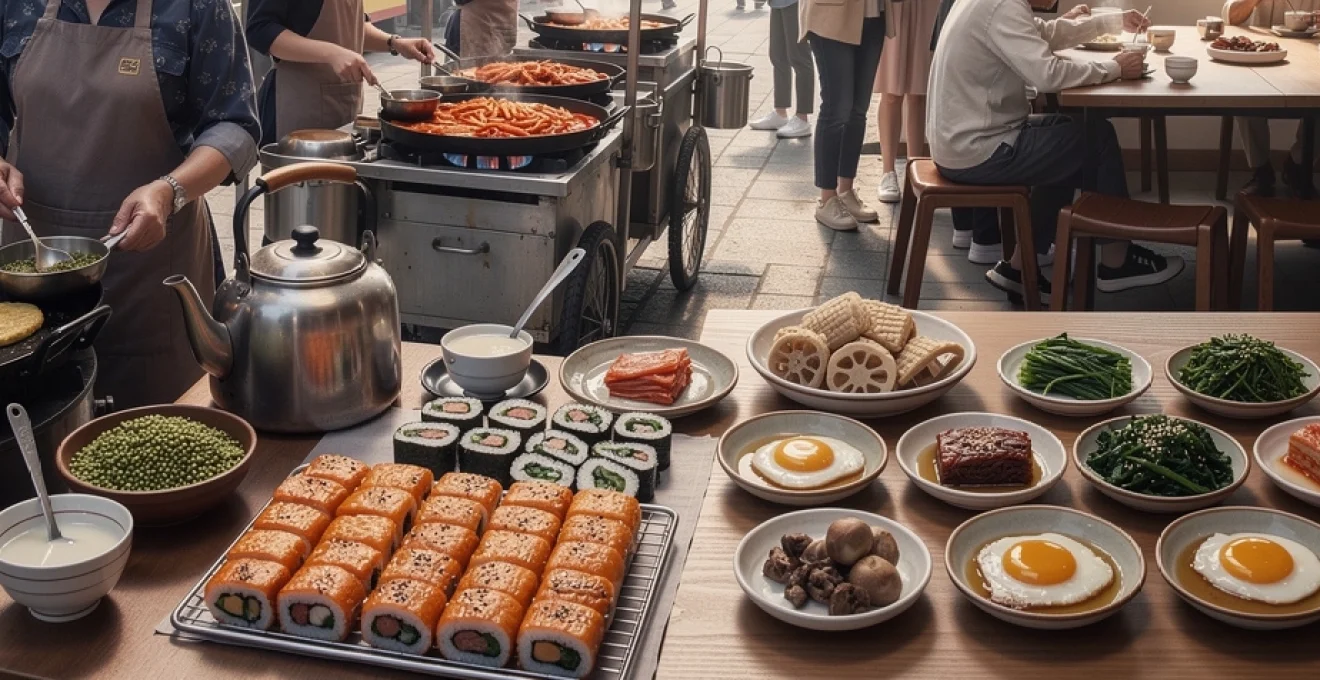
Seoul’s culinary landscape operates on a rhythm that mirrors the city’s relentless energy—a 24-hour gastronomic marathon where centuries-old recipes coexist with innovative interpretations. From the moment dawn breaks over Gwangjang Market’s sizzling griddles to the late-night pojangmacha tents filling Jongno’s alleyways with the aroma of grilled pork and fermented rice wine, the Korean capital offers an unparalleled immersion into one of Asia’s most sophisticated food cultures. With over 120,000 registered restaurants and an estimated 30,000 street food vendors operating across the city, Seoul presents both overwhelming choice and extraordinary opportunity for the determined food explorer. This comprehensive guide maps a single day’s culinary journey through the city’s most authentic eating experiences, revealing the techniques, traditions, and flavours that define Korean cuisine at its most genuine.
Dawn breakfast at gwangjang market: bindaetteok and mayak gimbap
Gwangjang Market awakens before most of Seoul stirs, with vendors arriving as early as 4:30 AM to prepare the day’s offerings. This century-old marketplace, established in 1905 as Korea’s first permanent market, remains the city’s most authentic destination for traditional breakfast foods. The market’s northern section specialises in cooked foods, where approximately 200 small stalls compete for the attention of early-morning diners seeking bindaetteok (mung bean pancakes) and mayak gimbap (mini seaweed rice rolls). Recent surveys indicate that Gwangjang Market serves over 50,000 visitors daily, with breakfast hours accounting for roughly 20% of that traffic.
Nokdu bindaetteok preparation techniques at Century-Old stalls
The bindaetteok stalls at Gwangjang Market employ preparation methods refined over multiple generations. The process begins with whole mung beans (nokdu) soaked for 8-12 hours, then stone-ground with minimal water to create a coarse batter that retains textural integrity. Traditional practitioners maintain a batter consistency that flows slowly from a ladle, with a solids-to-liquid ratio of approximately 3:1. The mixture incorporates julienned vegetables—typically mung bean sprouts, kimchi, and green onions—along with small pieces of pork belly or octopus for umami depth.
The cooking technique requires cast-iron griddles maintained at 190-200°C, hot enough to create immediate sear but controlled enough to cook the thick pancake through without burning. Experienced vendors pour roughly 150ml of batter per pancake, spreading it into circles 15-18cm in diameter. The first side cooks for approximately 4 minutes until deeply golden and crisp, then flips for another 3 minutes. What distinguishes exceptional bindaetteok is the contrast between the crackling exterior and the creamy, bean-forward interior that remains slightly soft at the centre. The finished pancake should release a nutty, almost popcorn-like aroma from the toasted mung bean proteins.
Mayak gimbap’s sesame Oil-Based addictive flavour profile
The term « mayak » translates directly to « drug, » a playful reference to the addictive quality of these miniature gimbap rolls. Unlike standard gimbap with multiple fillings, mayak gimbap contains only pickled radish (danmuji), carrot, and spinach, rolled tightly in seasoned rice and seaweed then cut into bite-sized pieces roughly 2cm thick. The addictive quality derives almost entirely from the rice seasoning—a carefully balanced mixture of sesame oil, salt, and sometimes a touch of sugar.
Vendors at Gwangjang Market use short-grain rice cooked to a moisture content that allows individual grains to remain distinct while still cohering when compressed. The rice receives its seasoning while still warm (around 65°C), allowing the sesame oil to penetrate between grains. The ratio typically sits at approximately 2 tablespoons of sesame oil per cup of cooked rice, with salt added to taste. The sesame oil itself matters tremendously—freshly pressed, toasted sesame oil contains volatile aromatic compounds that dissip
ate quickly if the rice cools too much. When you dip the finished mayak gimbap into the classic sauce of soy, vinegar, sesame seeds, and sliced green chilli, the sesame oil in the rice acts like an amplifier, carrying the salty, tangy, and mildly spicy notes across your palate. This is why a seemingly simple roll becomes so hard to stop eating—each bite delivers a calibrated balance of fat, salt, and acid that keeps your brain asking for one more piece.
Navigating the pojangmacha alleyways and ordering etiquette
As the morning crowd builds, the narrow pojangmacha alleyways inside and around Gwangjang Market come to life. These tented stalls, with plastic flaps and low stools, can be intimidating at first glance, but the etiquette is straightforward once you know what to expect. Most vendors display their main dishes on handwritten signs in Korean, though many also keep laminated photo menus handy for visitors. It is perfectly acceptable to point at the dish you want or gesture to the food being eaten at the next table if you are unsure of the name.
Seats are usually first-come, first-served; you simply slip onto an empty stool and make eye contact with the ajumma (older woman) running the stall. There is no pressure to order a huge spread, but it is considered polite to choose at least one cooked dish per person if the stall provides side dishes and tea. Payment is typically made at the end of the meal, either in cash or by card—most Seoul pojangmacha now accept local cards and even some foreign ones. If you are moving between stalls for a mini food crawl, try to settle the bill promptly before leaving rather than lingering once your plates are empty.
Pairing breakfast with makgeolli from traditional rice wine vendors
For many locals, a hearty breakfast at Gwangjang Market traditionally includes a bowl of warm bindaetteok alongside a chilled cup of makgeolli, Korea’s lightly sparkling rice wine. While pairing alcohol with breakfast may feel unusual to some visitors, in Korean food culture makgeolli is considered a natural partner to flour- and rice-based dishes, thanks to its lactic tang and gentle sweetness. Traditional vendors still produce makgeolli using nuruk (a fermentation starter) and steamed rice, allowing wild yeasts and lactic acid bacteria to transform the grains over several days. The result is a milky, slightly effervescent drink with an alcohol content of 6–8%, lower than most wines or spirits.
When you order makgeolli at the market, it is often served in metal bowls rather than glasses, a custom that dates back to farming villages where bowls were more practical than fragile cups. You typically receive a shared kettle or plastic bottle and pour for your companions; pouring for yourself can be seen as a sign that you are drinking alone, so it is friendlier to exchange pours. Concerned about drinking early? You can always request a smaller portion or share a single serve between two people, but even a few sips will show you why this fermented rice wine has been cherished for centuries as the ideal counterpart to hot, crispy pancakes.
Mid-morning street food circuit: myeongdong and insadong districts
By late morning, as Gwangjang’s breakfast rush begins to subside, the streets of Myeongdong and Insadong transform into open-air food courts. These districts are among the best places in Seoul to sample iconic Korean street food in a compact, walkable area. Myeongdong is famous for its dense concentration of carts lined along cosmetics shops and fashion boutiques, while Insadong leans more traditional, with vendors selling snacks that pair well with tea and antiques browsing. Planning a loose circuit between these neighbourhoods lets you taste everything from hotteok and tteokbokki to egg bread and fish-shaped pastries within a few hours.
Hotteok variations: ssiat hotteok versus cream-filled modern interpretations
Hotteok, the beloved Korean stuffed pancake, is one of the most rewarding street foods to eat fresh off the griddle. Traditional hotteok is filled with brown sugar, cinnamon, and crushed nuts or seeds, which melt into a bubbling syrup as the dough cooks. In Busan, vendors popularised ssiat hotteok, a version generously packed with sunflower seeds, pumpkin seeds, and pine nuts; this seed-filled style has since spread to Seoul, where you can find it in both Myeongdong and Insadong. The seeds add crunch and a roasted flavour that balances the sweetness, making it feel more like a granola-stuffed doughnut than a simple pancake.
Modern Seoul street vendors have also embraced cream-filled hotteok, offering variations packed with custard, matcha cream, or even cheese. These interpretations often use a slightly lighter dough with more yeast and milk to produce an airier crumb that can support softer fillings. From an engineering standpoint, vendors control griddle temperature and cooking time to ensure the exterior crisps without the cream leaking—usually around 180–190°C for 3–4 minutes per side. If you are torn between styles, consider starting with classic ssiat hotteok to understand the traditional flavour profile, then experiment with a cream-filled version as a dessert round later in your Seoul street food day.
Tteokbokki from sindang-dong’s original mabokrim recipe
For tteokbokki enthusiasts, a pilgrimage to Sindang-dong—often called the birthplace of modern spicy rice cakes—is essential. The original Mabokrim tteokbokki stalls popularised the gochujang-based sauce that now defines this dish nationwide. Unlike the sweeter, simplified versions found in some tourist-heavy areas, Sindang-dong’s classic recipe builds depth by simmering anchovy and kelp stock with fermented gochujang, gochugaru (chilli flakes), soy sauce, and sugar. The rice cakes themselves are cylindrical and chewy, made from non-glutinous rice flour steamed and extruded into dense logs that can withstand extended simmering without breaking down.
What sets this « original » tteokbokki apart is the layering of ingredients in a single pan—sliced eomuk (fish cakes), boiled eggs, ramen noodles, and cabbage are all added in stages so that each component absorbs the sauce at a different rate. This approach creates a gradient of texture, from the soft, sauce-soaked cabbage to the bouncy rice cakes at the centre. When you order, you often receive a pan set over a portable burner at your table, allowing the dish to continue bubbling as you eat. If you are sensitive to spice but still want to experience authentic tteokbokki in Seoul, you can ask vendors for a « wenjogeuro » (less spicy) version, though in Sindang-dong many people consider a bit of chilli heat part of the tradition.
Gyeran-ppang and bungeoppang: fish-shaped pastry thermal engineering
As you walk through Myeongdong or Insadong, the aroma of freshly baked gyeran-ppang (egg bread) and bungeoppang (fish-shaped pastries) is almost impossible to resist. Despite their playful shapes, these snacks are small feats of thermal engineering. Gyeran-ppang is made by pouring a thick, slightly sweet batter into oblong moulds, then cracking a whole egg on top before baking. Vendors must balance top and bottom heat carefully so the egg sets while the bread remains moist—too much direct heat and the yolk overcooks before the crumb forms, too little and the centre stays raw. Many stalls use dual-plate griddles with independent temperature control, keeping the bottom plate hotter (around 190–200°C) and the top slightly cooler.
Bungeoppang, by contrast, uses fish-shaped metal moulds that clamp shut around a filling of sweet red bean paste, custard, or even pizza cheese. Here, even heat distribution across the mould is critical to achieving the signature crisp exterior without burning the thin tail section. Vendors preheat the moulds thoroughly and rotate them during cooking, much like a waffle iron, to avoid hotspots. The batter-to-filling ratio also matters: a typical bungeoppang contains about 60% batter to 40% filling by volume, ensuring the structural integrity of the « fish » while still delivering a generous core. For the best texture, look for stalls with a queue; a constant turnover means you are more likely to receive a pastry straight from the mould, with a crackling shell and steaming interior.
Authentic korean table d’hôte: hanjeongsik at balwoo gongyang
After a busy morning of walking and snacking, lunch is the perfect time to slow down with a structured meal that showcases the breadth of Korean cuisine. Hanjeongsik, often translated as Korean table d’hôte, is a multi-course spread where rice, soup, and numerous banchan (side dishes) arrive together or in carefully timed flights. Balwoo Gongyang, located near Jogyesa Temple in central Seoul, elevates this tradition through Buddhist temple cuisine, offering a refined, plant-based interpretation that highlights seasonal produce and fermentation. For visitors seeking an in-depth experience of authentic Korean food culture in a single sitting, this is one of the city’s most instructive meals.
Temple cuisine’s seasonal banchan configuration and buddhist culinary philosophy
Buddhist temple cuisine in Korea follows a culinary philosophy rooted in balance, mindfulness, and non-violence. At Balwoo Gongyang, this translates to menus that exclude meat, fish, and pungent alliums such as garlic and onions, believed to overstimulate the senses. Instead, chefs rely on seasonal vegetables, grains, legumes, nuts, and fermented condiments to construct complex flavours. The banchan configuration changes monthly, aligned with the lunar calendar and market availability, so a spring menu might emphasise wild greens and mountain herbs, while winter leans into root vegetables and preserved items.
Rather than overwhelming the palate, each dish is designed to highlight a single main ingredient—spinach blanched and dressed simply with sesame, radish slow-braised in soy, or lotus root sliced and glazed with rice syrup. You are encouraged to eat slowly, appreciating the textures and temperatures: crisp, raw salads next to warm stews and room-temperature pickles. This mindful approach mirrors the structure of a well-composed tasting menu, but with an emphasis on nourishment and mental clarity. For travellers accustomed to heavy restaurant lunches, temple-style hanjeongsik offers an alternative: a meal that leaves you comfortably full yet energised for further exploration of Seoul.
Fermentation science behind jang: doenjang, ganjang, and gochujang
At the heart of Korean temple cuisine—and indeed most Korean cooking—are the three foundational jang: doenjang (fermented soybean paste), ganjang (soy sauce), and gochujang (fermented chilli paste). These seasonings are produced through a controlled fermentation process that can last months or even years. It begins with meju, bricks of boiled and mashed soybeans that are shaped, dried, and inoculated with naturally occurring moulds and bacteria. Hung in well-ventilated spaces, meju ferments and dries over winter before being submerged in brine the following spring. Over time, proteins break down into amino acids, generating the savoury depth we perceive as umami.
The liquid portion of this long fermentation becomes ganjang, while the solids evolve into earthy, intensely flavoured doenjang. Gochujang incorporates additional ingredients—glutinous rice, chilli powder, and sometimes malted barley—to create a thick paste with both heat and subtle sweetness. At Balwoo Gongyang, many of the jang used in the kitchen are aged in onggi earthenware jars on the rooftop, where temperature fluctuations and micro-oxygen exchange through the clay fine-tune the final flavour. If you are interested in the science of fermentation, pay close attention to how even small amounts of these condiments transform simple ingredients; a teaspoon of aged doenjang in soup can add as much depth as hours of simmering bones.
Bap and juk: pressure-cooked rice versus slow-simmered porridge textures
No hanjeongsik is complete without bap (steamed rice), but temple cuisine also frequently features juk (rice porridge), especially at breakfast or as a gentle course within a longer meal. In many Seoul restaurants, bap is prepared in commercial pressure cookers that reach higher temperatures than boiling water, producing glossy grains with a slightly sticky texture. At Balwoo Gongyang, multi-grain blends are common, combining white rice with barley, millet, or black rice to increase nutritional diversity and add subtle variations in bite. Each grain absorbs water at a different rate, so chefs test soak times and cooking durations to ensure uniform doneness.
Juk, by contrast, is made by simmering rice in a larger volume of water or stock over low heat until the grains partially disintegrate, thickening the liquid. The ratio often starts around 1:6 (rice to liquid) and can be adjusted depending on the desired consistency—thicker for pumpkin or red bean porridges, thinner for medicinal ginseng juk. From a textural perspective, bap provides structure within a meal, acting as a neutral base for strongly flavoured banchan, while juk functions more like a soothing sauce or soup. If your Seoul itinerary includes early flights or late nights, including at least one meal with juk is a gentle way to reset your digestion while still experiencing authentic Korean comfort food.
Namul preparation: blanching temperatures and seasoning ratios
Namul—lightly seasoned vegetable dishes—may look simple, but their preparation demands precision. The key technique is blanching, where vegetables are briefly boiled then shocked in cold water to set colour and control texture. Spinach, for example, is typically blanched for just 30–40 seconds in water at a rolling boil (around 100°C), then immediately cooled to prevent overcooking. Firmer vegetables such as fernbrake (gosari) or bean sprouts require longer times and, in some cases, pre-soaking to remove bitterness or toughness. Over-blanching not only dulls colour but also leads to waterlogged namul that cannot properly absorb seasoning.
Seasoning ratios for namul at high-end Seoul restaurants tend to be remarkably consistent, though adjusted by taste and ingredient. A classic base might use 1 teaspoon of sesame oil and 1/4 teaspoon of salt per 50g of blanched vegetable, sometimes with a pinch of minced garlic (or its temple cuisine alternatives such as ginger) and a sprinkle of toasted sesame seeds. Because namul are served at room temperature, flavours continue to develop as the oil and salt redistribute through the fibres, much like a marinade. As you eat hanjeongsik, try tasting each namul on its own before combining it with rice; you will notice how the balance of oil, salt, and vegetal sweetness shifts from one dish to another, offering a quiet masterclass in Korean seasoning.
Afternoon café culture: samcheong-dong’s hanok tea houses and specialty coffee
After lunch, the sloping streets of Samcheong-dong and neighbouring Bukchon Hanok Village offer an ideal setting for a slower-paced exploration of Seoul’s café culture. Here, renovated hanok (traditional Korean houses) sit alongside minimalist third-wave coffee bars, creating a unique blend of old and new. This is where you can move from a bowl of injeolmi-covered bingsu to a pour-over made with single-origin Korean coffee, then finish with a pot of traditional herbal tea—all within a few hundred metres. For many visitors, this afternoon interlude becomes a highlight of their « day of eating your way through Seoul, » offering both caffeine and calm.
Injeolmi bingsu at sulbing: shaved ice crystallisation methods
Injeolmi bingsu, a variation of Korea’s famous shaved ice dessert, combines ultra-fine milk ice with chewy rice cakes and roasted soybean powder. Chains like Sulbing have perfected the texture of the ice using specialised machines that freeze and shave milk-based blocks at controlled temperatures. Unlike coarse, crunchy Western snow cones, Korean bingsu aims for flakes as fine as fresh powder snow. This requires the ice to be maintained just below its melting point, around −5 to −7°C, so that the crystals separate cleanly rather than clumping. The result is a texture that melts almost instantly on the tongue, carrying toppings evenly through each spoonful.
In a classic injeolmi bingsu, cubes of chewy rice cake are buried within the shaved ice and dusted generously with kinako-like soybean powder. Sweetened condensed milk is usually drizzled over the top, adding creamy richness that seeps down as the ice begins to soften. If you want to avoid a watery finish, a helpful strategy is to eat from the sides inward, folding the toppings through the ice rather than letting them sit on top. You can also request extra condensed milk on the side—a common local hack—to refresh the flavour halfway through. Sharing is advisable; portions at Sulbing and similar cafés can serve two or even three people comfortably.
Single-origin korean coffee beans from gangwon-do roasters
While Korea imports much of its coffee, a small but growing number of roasters are working with beans grown domestically in experimental farms, particularly in the warmer southern regions and greenhouses. More commonly, however, when you see « Korean coffee » featured in Samcheong-dong cafés, it refers to beans roasted by local micro-roasteries, many of which are based in Gangwon-do, a province known for its clean air and mountain water. These roasters often prioritise traceability and light-to-medium roast profiles, emphasising acidity and origin-specific characteristics rather than heavy caramelisation.
In speciality cafés, you can usually choose between pour-over methods like V60, Kalita, or Aeropress, each affecting extraction and mouthfeel. Curious how different brewing techniques influence flavour? Order the same single-origin coffee brewed two ways and compare: a V60 might highlight floral notes and brightness, while an immersion brew brings out body and sweetness. Many baristas in Seoul have competition-level training, and they are generally happy to discuss grind size, water temperature, and recommended resting times post-roast if you show interest. This makes an afternoon coffee stop not just a caffeine break, but also an educational moment within your culinary tour of Seoul.
Traditional yuja-cha and omija-cha: citrus and five-flavour berry infusions
If you prefer to limit caffeine in the afternoon, Samcheong-dong’s hanok tea houses offer an extensive range of traditional Korean infusions. Yuja-cha, made with preserved yuja (often called yuzu in Japan, though it is a distinct citrus), combines finely sliced peel and pulp with honey to create a marmalade-like base. A spoonful stirred into hot water yields a fragrant, sweet-tart drink rich in vitamin C—popular in Korea as a home remedy for colds. Because the citrus peels are candied rather than boiled, the essential oils remain bright and aromatic, comparable to a fresh lemon-ginger tea with deeper complexity.
Omija-cha is brewed from dried omija, or « five-flavour berries, » named for their reputed combination of sweet, sour, salty, bitter, and pungent tastes. When steeped in hot or cold water, the berries release a vivid ruby colour and a layered flavour that shifts with brewing time and temperature. A short, cool steep emphasises fruity sweetness and acidity, while a longer, hotter infusion draws out tannins and herbal notes. Many tea houses serve omija-cha chilled in summer, sometimes with pine nuts floating on top. Tasting yuja-cha and omija-cha side by side provides a window into how Korean tea culture uses infusions not just for pleasure but also for balance and wellbeing.
Evening korean barbecue: mapo-gu’s gogigui restaurants and hanwoo beef
As evening approaches, the focus of your food journey naturally shifts from snacks and desserts to protein-rich mains. In Seoul, that often means one thing: gogigui, or Korean barbecue. The Mapo-gu district, located west of the city centre, is famed for its concentration of barbecue restaurants specialising in pork belly, beef short ribs, and especially hanwoo—Korea’s prized native cattle breed. A well-planned dinner here offers not only some of the best meat in the city but also a deep dive into the rituals and techniques that make Korean barbecue such a distinctive dining experience.
Hanwoo grading system: 1++ marbling standards and cuts selection
Hanwoo beef is graded by the Korean government on a scale that considers marbling, meat colour, fat colour, texture, and maturity. The highest grade, 1++, denotes exceptional intramuscular fat with fine, evenly distributed marbling similar to high-end wagyu. For barbecue, this translates into slices that render quickly over high heat, bathing the meat in its own fat and producing a tender, almost buttery bite. Lower grades such as 1 or 2 can still be excellent, often with a slightly firmer texture that some diners prefer. Price differences can be significant—1++ hanwoo may cost two to three times more than imported beef—so it is worth considering your budget and appetite when choosing.
Common hanwoo cuts for Mapo-gu barbecue include chadolbaegi (thinly sliced brisket), deungsim (sirloin), and galbisal (boneless short rib). If you are uncertain where to start, many restaurants offer mixed platters showcasing several cuts, allowing you to compare tenderness and flavour. A practical tip: begin with leaner cuts and progress to fattier ones, as the richness of high-marbled beef can fatigue your palate quickly. This sequence also keeps the grill from becoming overly greasy early in the meal, which helps with temperature control and avoids flare-ups.
Charcoal versus gas grills: heat distribution and maillard reaction control
One of the key decisions in any Seoul barbecue restaurant is the type of grill used. Traditional spots in Mapo-gu often favour sutral, or real charcoal, which imparts a subtle smokiness and can reach higher peak temperatures than gas. Charcoal, however, requires more skill to manage; staff will typically adjust or replace charcoal baskets to maintain an even heat zone, allowing you to sear thicker cuts without burning them. The goal is to keep the grill surface around 230–260°C, hot enough to trigger the Maillard reaction—the complex series of browning reactions that create roasted, nutty aromas—without carbonising the exterior.
Gas grills, on the other hand, offer more consistent temperature control and less smoke, which some diners appreciate for comfort. Many modern restaurants use infrared gas burners or combination systems that mimic the benefits of charcoal. Whatever the fuel source, you will notice that servers frequently turn and cut the meat for you, especially with premium hanwoo. This is not mere formality; it is a way of controlling sear and carryover cooking so each slice reaches the table at its optimum doneness. If you enjoy cooking your own meat, you can certainly take a more active role, but following the staff’s guidance at least for the first round can be an eye-opening lesson in Korean barbecue technique.
Ssam assembly: perilla leaves, lettuce wraps, and ssamjang composition
Once the meat is grilled, the fun of Korean barbecue lies in assembling ssam—bite-sized wraps combining various elements into a single mouthful. The base is usually a fresh leaf: green or red lettuce, hearty cabbage, or aromatic perilla with its slightly minty, anise-like notes. On top of this, you place a piece of meat, perhaps a slice of grilled garlic or chilli, a dab of ssamjang, and maybe a spoonful of rice. The art is in choosing proportions that complement rather than overwhelm the beef. Too much ssamjang and you lose the nuance of 1++ hanwoo; too little and the wrap can taste flat.
Ssamjang itself is a carefully balanced paste made from doenjang and gochujang mixed with sesame oil, garlic, sugar, and sometimes chopped onion or nuts. A typical ratio might be 2 parts doenjang to 1 part gochujang, adjusted to taste, yielding a savoury, slightly spicy condiment with enough salt to season the meat and vegetables at once. As you experiment with different ssam combinations, pay attention to how perilla leaves alter the flavour compared to lettuce, or how adding a few strands of raw scallion salad introduces sharpness. Think of each wrap as a small, customisable sandwich—by the end of the meal, you will likely have discovered your personal « perfect bite. »
Banchan accompaniments: kimchi varieties and pickled vegetable fermentation stages
Alongside the meat and ssam components, Mapo-gu barbecue tables typically overflow with banchan, many of which are fermented. Kimchi, of course, is the star, but there are numerous varieties beyond the classic napa cabbage. You might encounter kkakdugi (cubed radish kimchi), oi-sobagi (stuffed cucumber kimchi), or even white kimchi without chilli, each at a different stage of fermentation. Fresher kimchi, eaten within a week of salting and seasoning, tastes crisp and lightly sour, ideal for cutting through rich pork belly. More mature kimchi, aged for several months, develops pronounced acidity and funk, which pairs well with fatty hanwoo cuts and grilled offal.
Pickled vegetables that are not fully fermented—such as quick-pickled onions in soy sauce or lightly brined radish slices—play a complementary role by offering brightness without the complexity of long-aged kimchi. From a microbiological perspective, these sides are living foods, containing lactic acid bacteria that continue to evolve in the restaurant fridge. That is why kimchi flavour can vary subtly even within the same establishment over time. As you eat, consider alternating between different banchan with each bite of meat; this rotation keeps your palate refreshed and allows you to appreciate how Korean barbecue relies on an ecosystem of flavours rather than meat alone.
Late-night pojangmacha experience: jongno’s tent bars and anju pairings
After a leisurely barbecue dinner, you might think your Seoul food journey is complete for the day—but the city truly comes into its own after dark. In Jongno, clusters of pojangmacha (street-side tent bars) glow orange and red against the night, drawing salary workers, students, and night owls for one last round of drinks and anju (drinking snacks). These informal spaces offer a different side of Korean food culture: louder, more spontaneous, and deeply social. If you have ever wondered how locals unwind after long workdays, a late-night pojangmacha visit provides an authentic glimpse.
Soju distillation process and regional brand comparisons
No exploration of Seoul’s nightlife is complete without encountering soju, Korea’s most famous spirit. Historically, soju was distilled from rice in small batches, but modern mass-market brands often use neutral spirits derived from grains or sweet potatoes, diluted to around 16–20% ABV and sweetened lightly. The base alcohol is produced via continuous distillation, then blended with water and minor additives to achieve a smooth, relatively neutral profile designed for easy drinking with food. Recently, however, there has been a renaissance of jangsu soju—traditional, higher-proof varieties distilled from rice and aged in stainless steel or earthenware tanks, echoing pre-industrial methods.
Regional brands reflect local preferences: in Seoul, you will commonly see Chamisul and Chum-Churum on pojangmacha tables, while in the south, brands like Good Day or Hallasan dominate. Artisanal distilleries are also gaining attention, producing small-batch soju with distinct rice varieties and longer ageing, resulting in more aromatic, complex spirits. If you are new to soju, starting with mainstream green-bottle brands at a tent bar is perfectly fine; the point here is conviviality, not connoisseurship. Curious about the differences? Order one classic bottle and one premium craft soju to share with your group and taste them side by side—you will likely notice sharper grain notes and a warmer finish in the latter.
Anju selection: jokbal, dakgalbi, and budae-jjigae flavour profiles
Pojangmacha menus are built around anju, dishes designed to be eaten with alcohol. Jokbal, braised pig’s trotters, arrives sliced and arranged on a platter, its glossy skin and gelatin-rich meat flavoured with soy sauce, ginger, and star anise. The texture is simultaneously firm and yielding, especially when wrapped in lettuce with raw garlic and ssamjang. Dakgalbi, spicy stir-fried chicken with rice cakes and cabbage, is cooked at the table in a wide pan, the gochujang-based sauce thickening as it caramelises around the edges. It is easy to keep nibbling between sips of soju, the chilli heat encouraging another drink and vice versa.
Budae-jjigae, or « army stew, » reflects a more modern chapter in Korean food history, combining kimchi, Spam, sausages, baked beans, and ramen noodles in a single bubbling pot. Despite its humble origins, a well-balanced budae-jjigae delivers a surprisingly complex flavour profile: smokiness from processed meats, tang from fermented kimchi, and savoury depth from anchovy or beef stock. In Jongno tent bars, you will often see groups sharing one large pot, fishing out noodles and sausage chunks between toasts. Ordering a mix of anju styles—gelatinous jokbal, chewy dakgalbi, soup-based budae-jjigae—gives your table a range of textures and flavours to match the evolving energy of the night.
Pojangmacha social dynamics and seoul’s night-time food economy
Beyond the food and drink, what makes a late-night pojangmacha visit unforgettable is the social atmosphere. Plastic tables are squeezed close together, so you are always within earshot of neighbouring groups, and it is not uncommon for strangers to exchange toasts or share a side dish. The ritual of pouring soju—always with two hands when serving elders or superiors, and turning your head slightly away when drinking in front of them—reflects broader hierarchies in Korean society, yet the informal tent setting also softens these lines. You will see office workers still in suits, students in hoodies, and tourists all sharing the same plastic stools.
Economically, pojangmacha play a vital role in Seoul’s night-time food ecosystem, providing affordable, flexible spaces where vendors can operate with lower overheads than brick-and-mortar bars. While some older-style tents have disappeared due to redevelopment, new formats—semi-permanent stalls, licensed « street food zones, » and retro-themed indoor pojangmacha—continue the tradition in updated forms. For the visitor, ending your day here ties together many threads of Korean culinary culture: fermentation and spice in the anju, grain-based distillation in the soju, and a communal approach to eating that stretches from dawn bindaetteok at Gwangjang Market to the final clink of glasses in Jongno’s glowing tents.