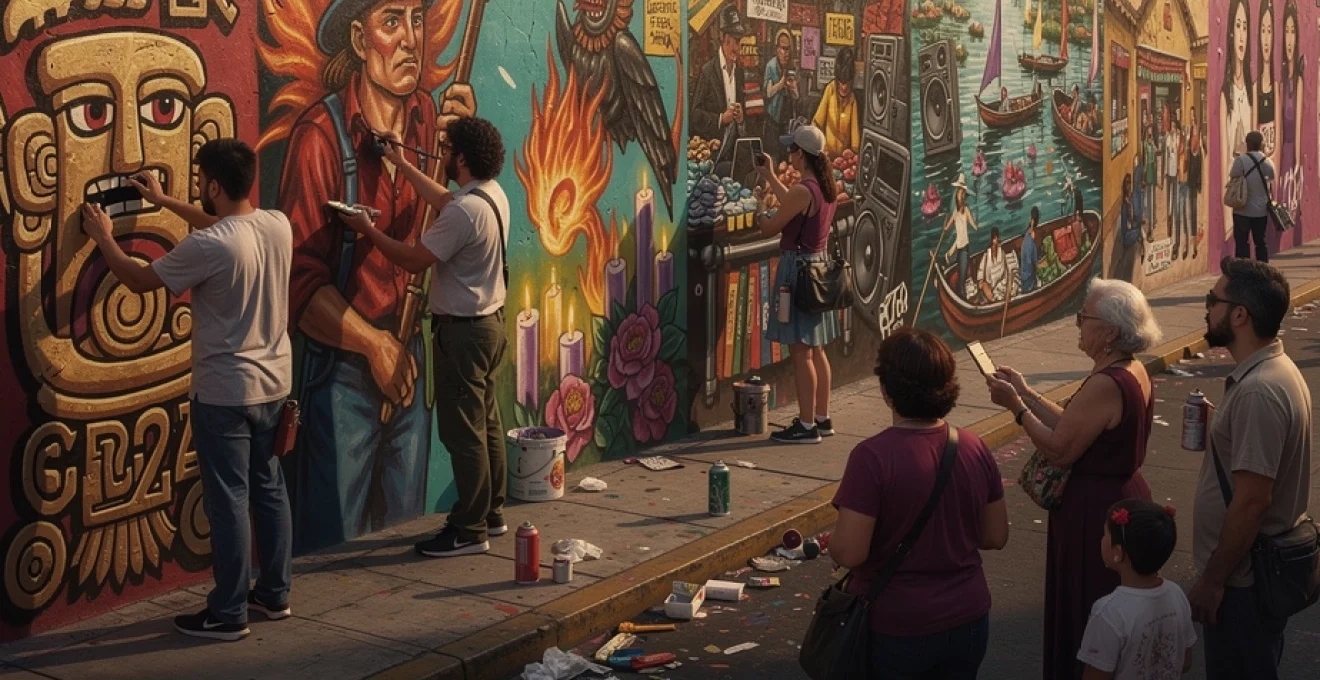
Mexico City’s walls tell stories that stretch across millennia, where ancient Aztec symbols dance alongside contemporary political statements in a vibrant tapestry of urban expression. The capital’s street art scene represents far more than decorative murals or rebellious graffiti – it serves as a living archive of Mexican cultural identity, resistance, and social transformation. From the historic centre’s colonial facades to the sprawling periphery neighbourhoods, artists have transformed the urban landscape into an open-air museum that speaks to millions of daily commuters and visitors alike.
This visual revolution didn’t emerge in a vacuum. Mexico City’s street art movement builds upon centuries of mural traditions, indigenous pictographic systems, and post-revolutionary artistic programmes that democratised art by placing it directly in public spaces. Today’s urban artists continue this legacy whilst addressing contemporary issues ranging from femicide to gentrification, creating a complex dialogue between past and present that defines the city’s cultural DNA.
Pre-columbian visual narratives and contemporary muralism in CDMX
The relationship between Mexico City’s ancient visual traditions and modern street art reveals itself most dramatically in how contemporary artists interpret and reimagine pre-Columbian iconography. Archaeological discoveries throughout the capital continue to unearth codices, stone carvings, and architectural decorations that directly influence today’s urban art movements. The visual language of Tenochtitlan hasn’t disappeared – it has evolved, adapted, and found new expression on concrete walls and metro station corridors.
Aztec codex symbolism in modern street art iconography
Contemporary muralists frequently incorporate Aztec pictographic elements into their compositions, transforming ancient symbols into powerful statements about modern Mexican identity. The feathered serpent Quetzalcoatl appears regularly in Roma Norte murals, whilst jaguar warriors emerge from spray-painted jungle scenes in unexpected urban contexts. These aren’t mere decorative choices – they represent conscious efforts to reconnect with indigenous heritage in a city where colonial and modern architecture often obscures pre-Hispanic foundations.
Artists working in neighbourhoods like Doctores and Santa María la Ribera have developed sophisticated techniques for integrating Aztec calendar symbols with contemporary political messaging. The sun stone’s circular design frequently serves as a framework for depicting modern social struggles, creating visual continuity between ancient cosmology and current activism. This approach demonstrates how street art functions as cultural archaeology, excavating buried histories and making them visible to contemporary audiences.
Diego rivera’s legacy integration in urban wall paintings
Rivera’s influence on Mexico City’s street art extends far beyond simple aesthetic imitation. Modern muralists have absorbed his compositional techniques – particularly his ability to layer multiple historical periods within single scenes – whilst updating his revolutionary messaging for contemporary struggles. You can observe this evolution most clearly in neighbourhoods like Tepito, where local artists employ Rivera’s crowd-composition methods to depict modern street vendors, musicians, and community organisers.
The master muralist’s approach to depicting industrial labour has found new relevance in areas like Azcapotzalco, where contemporary artists document the experiences of factory workers, domestic employees, and informal economy participants. These modern interpretations maintain Rivera’s commitment to representing working-class dignity whilst addressing issues he never encountered, such as migration patterns driven by economic globalisation and climate change.
Tenochtitlan archaeological motifs in roma norte graffiti
Roma Norte’s gentrification has sparked a particularly interesting dialogue between archaeological preservation and contemporary artistic expression. As construction projects regularly uncover Aztec remains, local street artists have responded by incorporating these discoveries into their work, creating unofficial archaeological documentation alongside official excavation reports. Water imagery – reflecting Tenochtitlan’s lake-based urban design – appears frequently in stencils and wheat-paste installations throughout the neighbourhood.
The chinampas (floating gardens) that once fed the Aztec capital have inspired numerous environmental art installations that critique modern Mexico City’s water crisis. Artists use traditional blue and green colour palettes associated with Tlaloc, the rain god, to create contemporary commentary on climate change and urban sustainability challenges.
José clemente orozco influence on doctores neighbourhood murals
Orozco
Orozco’s legacy surfaces most clearly in the darker, more confrontational murals of Doctores, a neighbourhood long associated with social struggle and urban marginality. Here, street artists echo his jagged lines and expressionist distortions to portray scenes of police brutality, overcrowded housing, and medical inequality, often painted just steps away from hospitals and courthouses. The colour palette shifts toward reds, blacks, and ashy greys, mirroring Orozco’s own preoccupation with violence and human suffering. Instead of glorifying revolution, many of these pieces question who actually benefits from political change, a theme Orozco explored relentlessly in his own work.
Several large-scale walls near Metro Hospital General and along Eje Central deconstruct official national myths in a way that feels distinctly Orozquian. Religious and patriotic symbols appear fractured or engulfed in flames, surrounded by anonymous faces twisted in pain or resistance. These compositions resist easy reading: rather than offering uplifting messages, they force passers-by to confront uncomfortable realities about corruption, insecurity, and systemic neglect. In this way, Doctores murals maintain Orozco’s role as the movement’s uncompromising critic, proving that street art in Mexico City can be as challenging and self-reflective as any gallery installation.
Barrio-specific street art movements across mexico city districts
While the roots of Mexico City street art lie in shared histories and national narratives, each barrio has shaped the movement in its own distinctive way. Local demographics, economic conditions, and architectural forms all influence what appears on the walls, creating a patchwork of micro-scenes across the metropolis. Understanding these barrio-specific movements helps you read not just the artwork, but the neighbourhoods themselves. A mural in Tepito communicates something quite different from a piece in Santa Fe, even if both reference the same national symbols.
Rather than a single, unified « CDMX style, » the city offers overlapping visual dialects that respond to hyper-local concerns. Some districts lean toward hip-hop aesthetics and tattoo-inspired line work, while others embrace minimalist stencils or large-format photo wheat-pastes. As you move between them, you can literally see how class, race, migration, and urban planning shape cultural identity on the street. The result is a living atlas where every wall contributes a small chapter to Mexico City’s complex social story.
Tepito market area underground hip-hop culture expressions
Tepito, often labelled « el barrio bravo, » has developed one of the most distinctive street art scenes in Mexico City, rooted deeply in underground hip-hop culture. Here, graffiti crews blend classic lettering styles with imagery from lucha libre, street markets, and neighbourhood saints, creating a visual language that celebrates resilience in the face of heavy policing and persistent stigma. Boomboxes, microphones, and breakdancing figures appear alongside portraits of vendors and informal workers, asserting pride in a community frequently misrepresented by mainstream media.
Walls near the enormous open-air market function almost like mixtape covers or hand-painted flyers for an ongoing street cypher. Artists integrate lyrics, rap verses, and fragments of corridos tumbados into their pieces, turning the barrio’s façades into a kind of public playlist. Some collectives organise legal and semi-legal « pintas » tied to local hip-hop festivals, where DJs, MCs, and graffiti writers collaborate in shared spaces. For visitors, walking through Tepito’s decorated alleys offers an introduction to a parallel cultural ecosystem where identity and survival are negotiated with spray paint, beats, and clever wordplay.
Coyoacán colonial architecture integration with contemporary stencils
In Coyoacán, the street art scene plays a subtler game, weaving itself around colonial courtyards, cobblestone streets, and tiled façades. Instead of overwhelming the architecture, many artists adopt small-scale stencils, paste-ups, and hand-drawn interventions that slip into the district’s visual rhythms. Silhouetted coyotes, hummingbirds, and pre-Hispanic glyphs appear on corners and doorways, often rendered in a limited palette that respects the existing ochres and blues of the built environment. The effect feels more like marginalia in an old manuscript than a full-page illustration.
Contemporary artists also respond to Coyoacán’s association with Frida Kahlo and Diego Rivera, but usually in ironic or reflective ways rather than straightforward hero worship. Miniature stencils might depict Frida taking a selfie, or Rivera wearing noise-cancelling headphones while painting, gently questioning how global tourism packages Mexican identity. At the same time, you find powerful feminist and queer street art reclaiming the district from purely nostalgic narratives. These small, carefully placed works invite you to slow down, look closely at the walls, and think about how historical icons are consumed, commodified, and reinterpreted in everyday life.
Xochimilco chinampas cultural preservation through public art
Xochimilco’s canals and chinampas provide a dramatically different canvas for urban art, where boats, docks, and market stalls become mobile or semi-permanent murals. Local collectives use bright acrylic paints and hand-lettered typography on trajineras (the traditional flat-bottomed boats) to celebrate indigenous agricultural practices and Nahua identity. Instead of static walls, the artwork glides across the water, turning each canal journey into a floating gallery of slogans about land rights, water protection, and cultural survival. The message is clear: Xochimilco is not just a tourist attraction; it is a living agricultural system under threat.
Along the canal banks, larger murals depict chinamperos at work, maize deities, and scenes of communal harvest, often paired with statistics about water contamination or urban encroachment. Environmental NGOs sometimes collaborate with local artists to create didactic pieces explaining how chinampas function as natural water filters and biodiversity hotspots. For school groups and visitors, these visual explanations work like illustrated textbooks, making complex ecological concepts intuitive. In a city where rapid urbanisation often obscures traditional knowledge, Xochimilco’s public art insists that sustainability is not a trend but an ancestral practice.
Santa fe corporate district gentrification resistance murals
Santa Fe, with its gleaming office towers and gated developments, might seem like the last place to find critical street art. Yet in the interstices—underpasses, service roads, and the edges of working-class barrios that predate the district’s corporate boom—murals address gentrification, displacement, and economic inequality head-on. Artists juxtapose glass skyscrapers with crumbling tenements, or depict construction cranes as skeletal monsters devouring modest homes. The imagery can feel almost like an X-ray of the urban landscape, revealing power structures beneath the polished surface.
Many of these pieces emerge from alliances between local residents and activist groups resisting forced evictions or exploitative development schemes. Slogans like « La ciudad también es nuestra » (« The city is ours too ») appear beside portraits of domestic workers, security guards, and delivery drivers—the invisible labour underpinning Santa Fe’s corporate success. Unlike more celebratory murals in tourist zones, these works often avoid bright, festive colours, opting instead for stark black-and-white or limited palettes that echo protest posters. For commuters driving past at high speed, they act as brief but potent reminders that urban modernity comes with hidden social costs.
Centro histórico building facade restoration art projects
In the Centro Histórico, where heritage regulations are strict and building façades are heavily protected, street art has taken a more institutional turn through restoration-focused art projects. Instead of painting directly over historic stone or tile, artists collaborate with architects, conservationists, and local authorities to create removable panels, scaffolding wraps, or trompe-l’oeil pieces that dialogue with the underlying architecture. During façade repairs, it is increasingly common to see temporary canvases printed or painted with reimagined versions of the buildings behind them, sometimes inserting contemporary figures into colonial or Porfirian scenes.
These projects blur the line between preservation and innovation. On one hand, they respect the legal framework designed to protect Mexico City’s architectural heritage; on the other, they use that heritage as a springboard for discussing who gets represented in the urban centre. Indigenous women vendors, street musicians, and informal workers appear in updated versions of historic cityscapes, reclaiming a visual space long dominated by viceroys, businessmen, and clergy. For pedestrians, this kind of street art restoration offers a double lesson: you learn to appreciate the craft of old façades while also asking whose stories those façades have traditionally excluded.
Indigenous language preservation through urban visual culture
One of the most striking developments in recent years has been the use of street art to promote and preserve indigenous languages in Mexico City. Murals in Nahuatl, Otomí, Mixe, and other tongues now appear in districts such as Iztapalapa, Tláhuac, and the Centro, often accompanied by Spanish translations or phonetic guides. These pieces function a bit like public language lessons, inviting you to sound out unfamiliar words and recognise that Mexico’s linguistic diversity did not vanish with urbanisation. In some cases, QR codes link to audio recordings by native speakers, turning a static wall into an interactive classroom.
For many indigenous migrants and their descendants living in CDMX, seeing their languages proudly displayed in public space is a powerful affirmation of identity. It counters long histories of discrimination, where speaking an indigenous language was stigmatised in schools, workplaces, and public institutions. Artists and activist collectives frame this linguistic street art as a form of « graphic revitalisation »: by normalising written indigenous languages in everyday environments, they help ensure that young people encounter them beyond the home or ceremonial settings. In a city of more than 20 million, a single painted phrase in Nahuatl—« Tlen timoittaz? » (« What will you see? »)—can spark countless quiet acts of recognition and curiosity.
Femicide memorial art and social justice muralism
Mexico City’s walls have also become crucial sites for grieving, denouncing, and resisting gender-based violence, especially femicide. In neighbourhoods from Ecatepec’s periphery to central avenues like Reforma, you encounter murals featuring the faces and names of murdered women, often painted in vivid purples and greens—the colours of Latin American feminist movements. These public memorials reclaim spaces where women have been attacked or disappeared, asserting that the city must not move on as if nothing happened. They transform bare concrete into collective altars, combining portraiture with candles, flowers, and handwritten messages from family members.
Unlike more neutral heritage murals, these works are rarely « finished » in a traditional sense. New names are added, slogans updated, and details retouched after marches or vigils, making each wall an evolving record of ongoing violence and resistance. Phrases such as « Ni una menos » and « Vivas nos queremos » appear alongside statistical data, hotline numbers, and legal demands, turning memorials into activist billboards. For many women and queer people, encountering these pieces during daily commutes provides both a painful reminder and a sense of shared struggle. It is urban art functioning as both wound and bandage: exposing systemic trauma while also stitching together networks of solidarity across the city.
International street artists’ interpretations of mexican cultural symbols
As Mexico City’s reputation as a global street art capital has grown, international artists have flocked to neighbourhoods like Roma, Juárez, and Doctores to leave their mark. Their large-format murals often feature iconic Mexican symbols—calaveras, luchadores, Frida Kahlo, Aztec glyphs—filtered through distinct stylistic lenses from Berlin, São Paulo, or Melbourne. Sometimes these collaborations yield rich cross-cultural dialogues, where foreign artists work closely with local crews to ensure respectful, informed representations. At their best, such pieces resemble jazz improvisations: familiar motifs are taken in unexpected directions without losing their original rhythm.
However, international interpretations also raise important questions about cultural appropriation and superficial exoticism. When a visiting artist paints a sugar skull without acknowledging its roots in Día de Muertos ritual practice, the result can feel like a postcard rather than a meaningful engagement. Local curators and festivals have responded by prioritising projects that involve research, community workshops, or shared authorship, rather than quick « mural drops » designed purely for social media. As you walk the city, you can start to distinguish between pieces that treat Mexican culture as a costume and those that treat it as a conversation. The difference often lies in the details: a Nahuatl phrase correctly written, a local historical event referenced, or a neighbourhood elder depicted with evident care.
Government-sanctioned mural programmes versus guerrilla art practices
The tension between official mural programmes and guerrilla street art has defined Mexico City’s visual landscape since the post-revolutionary period, and it continues today in new forms. Municipal governments, cultural institutions, and private developers regularly commission large-scale murals to beautify underpasses, metro stations, and housing complexes. These projects often come with budgets, lifts, and permits, allowing artists to work safely at monumental scales and receive fair compensation. The resulting pieces can be technically impressive and widely visible, integrating historical themes or social messages into urban planning.
Yet many artists and residents argue that such institutional projects risk sanitising street art, stripping it of the spontaneity and critical bite that made it powerful in the first place. Unauthorised tags, stickers, and quick throw-ups still proliferate in alleyways and on neglected façades, asserting a right to the city that does not depend on approval from above. This guerrilla layer operates like a running commentary on official narratives: a polished government-sponsored mural might celebrate urban renewal, while around the corner a hastily sprayed sentence denounces rising rents or police violence. For anyone trying to understand cultural identity in Mexico City through its walls, it is essential to read both registers. The sanctioned and the unsanctioned are less enemies than interlocking forces, constantly negotiating who gets to speak—and who gets to be seen—in the ever-changing gallery of the streets.