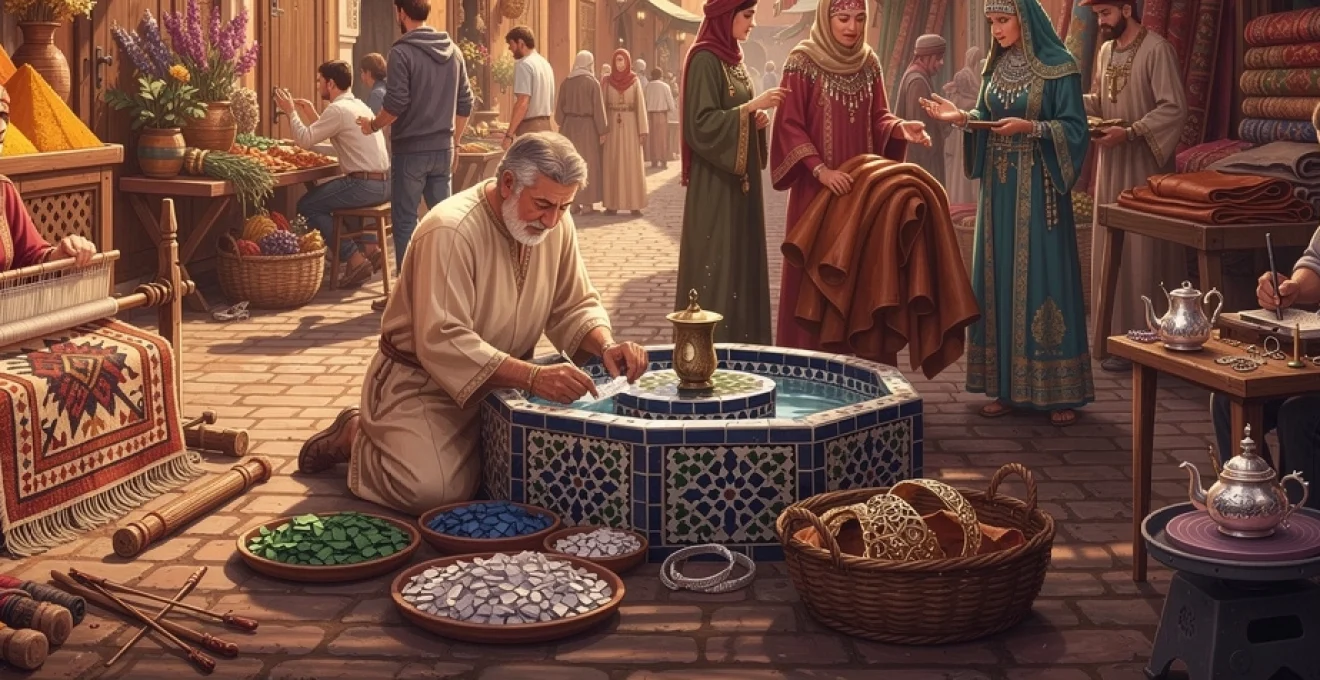
The vibrant souks of Marrakech represent far more than mere marketplaces; they embody the living essence of Moroccan culture, where centuries-old traditions continue to flourish amidst the bustling commerce of daily life. Within these labyrinthine corridors of the medina, artisans perpetuate ancestral crafts whilst merchants conduct business using time-honoured practices that bridge the ancient and modern worlds. Every transaction, every handcrafted item, and every interaction reflects the deep cultural tapestry that makes Marrakech’s souks a UNESCO World Heritage site of immense anthropological significance.
The sensory immersion experienced within these historic markets reveals how deeply embedded culture remains in the everyday rhythms of Moroccan society. From the rhythmic hammering of metalworkers to the melodic calls of spice vendors, each sound contributes to a symphony of cultural preservation that has endured for nearly a millennium. This extraordinary blend of commerce and culture creates an environment where visitors don’t merely observe tradition – they participate in its ongoing evolution.
Traditional craftsmanship heritage in marrakech’s historic souks
The artisanal traditions preserved within Marrakech’s souks represent an unbroken chain of knowledge transfer that spans generations, making these markets living museums of Moroccan craftsmanship. Master artisans continue to employ techniques that date back to the Almoravid dynasty, when Marrakech first emerged as a major trading hub. The preservation of these skills demonstrates remarkable cultural resilience, as traditional methods persist despite the pressures of modernisation and mass production.
Each craft quarter within the souks maintains its distinct identity through specialised techniques and materials that reflect Morocco’s diverse regional influences. Maâlems (master craftsmen) work alongside apprentices in workshops that have operated from the same locations for centuries, creating an educational ecosystem where practical knowledge combines with cultural wisdom. This master-apprentice system ensures that not only technical skills are transmitted, but also the cultural values and social practices that define Moroccan artisanal heritage.
Berber carpet weaving techniques at souk des tapis
Within the carpet souk, Berber weaving traditions reveal the sophisticated mathematical and artistic knowledge embedded in indigenous Moroccan culture. Berber women employ complex geometric patterns that encode tribal histories, geographical references, and spiritual beliefs into each textile. These patterns, known as tameghrast, serve as both decorative elements and cultural archives, preserving information about clan affiliations and regional identities through visual symbolism.
The weaving process itself demonstrates remarkable technical mastery, with artisans creating intricate designs without written patterns or external guides. Traditional looms, constructed from cedar wood and operated entirely by hand, produce carpets with knot densities that can exceed 400 knots per square inch. This level of precision requires years of training and reflects the profound respect for craftsmanship that characterises Berber cultural values.
Zellige tile production methods in souk el attarine
The ancient art of zellige production exemplifies the mathematical sophistication underlying Moroccan decorative arts. Craftsmen extract clay from specific quarries near Salé, utilising geological knowledge passed down through generations to identify optimal material composition. The clay undergoes multiple firing processes that transform it into the distinctive terracotta base essential for authentic zellige production.
Master ferranis (tile cutters) demonstrate extraordinary skill in shaping individual tiles using traditional tools called menqach. Each geometric shape requires precise hand movements that achieve mathematical accuracy without measuring instruments. This remarkable precision enables the creation of complex tessellated patterns that follow strict Islamic geometric principles, reflecting the deep integration of mathematical knowledge and artistic expression in Moroccan culture.
Leather tanning traditions at souk el kebir
The leather tanning quarter maintains one of the world’s oldest industrial processes, utilising techniques that predate the Islamic conquest of North Africa. Traditional tanneries employ natural materials including pigeon droppings, quicklime, and tree bark to transform raw hides into supple leather. This organic approach produces distinctive textures and colours whilst
producing hides that are both durable and breathable in Marrakech’s dry climate. The souk’s workshops still rely on manual labour for every stage, from soaking and dehairing to dyeing with natural pigments derived from henna, pomegranate peel, and indigo. The strong olfactory presence of the tanneries may surprise visitors, yet this environment encapsulates centuries of accumulated technical expertise. Watching artisans knead skins underfoot or stretch them across wooden frames reveals how intimately human bodies remain involved in this pre‑industrial production cycle.
Leather goods sold in Souk el Kebir – from finely stitched babouches to robust travel bags – bear visible traces of this handmade process. Slight variations in colour, texture, and stitching patterns testify to their artisanal origin, distinguishing them from mass‑produced items found elsewhere. For travellers interested in ethical shopping in Marrakech’s souks, understanding these tanning traditions provides a valuable framework for recognising genuine craftsmanship and supporting workshops that maintain traditional, low‑impact methods.
Silver filigree artistry in souk des bijoutiers
In Souk des Bijoutiers, the delicate art of silver filigree showcases an entirely different facet of Marrakech’s craft heritage. Here, Jewish and Amazigh influences converge in intricate jewellery pieces composed of hair‑thin silver threads soldered into lace‑like patterns. Master jewellers work at small benches under modest lamps, manipulating wire coils with tweezers and micro‑tools to form spirals, rosettes, and geometric motifs that echo wider Islamic decorative traditions.
The technical demands of filigree production require deep metallurgical knowledge: artisans must understand alloy composition, melting points, and cooling rates to maintain both ductility and structural integrity. Many workshops still use 800–925 grade silver, often hallmarked in tiny stamps that attest to authenticity. When you examine a ring or pendant in this Marrakech jewellery souk, you are effectively reading a micro‑archive of regional aesthetics – from Tiznit‑style Amazigh fibula designs to Fez‑inspired arabesques – condensed into a wearable object.
For visitors seeking meaningful souvenirs from Marrakech’s historic markets, Souk des Bijoutiers offers an opportunity to engage with artisans as cultural historians as much as merchants. Asking about the origin of a pattern or the symbolism of a particular stone often opens conversations about marriage customs, dowry practices, and regional identities. In this sense, purchasing jewellery here becomes less a commercial exchange and more an ethnographic encounter embedded in silver.
Ceramic pottery crafting at souk el khemis
Souk el Khemis, situated towards the city’s northern perimeter, functions as a key distribution point for Moroccan ceramics arriving from Fez, Safi, and local kilns around Marrakech. Potters here continue to shape vessels using kick wheels and hand‑building techniques that predate mechanised production by centuries. Clay bodies are prepared through laborious wedging and ageing processes that improve plasticity, while glazes rely on mineral formulas refined over generations to achieve iconic cobalt blues, emerald greens, and honey ambers.
The production sequence – throwing, trimming, sun‑drying, biscuit firing, glazing, and final firing – can span several weeks for a single batch of bowls or tagines. Artisans in Marrakech’s pottery souks often combine regional motifs: Safi’s fluid floral scrolls may appear beside geometric banding more typical of Fez, reflecting the city’s role as a crossroads of ceramic traditions. Minute imperfections, such as slight glaze runs or asymmetrical lips, signal handmade origin and distinguish these pieces from factory‑perfect exports.
From an anthropological perspective, ceramic objects in Souk el Khemis function as everyday archives of Moroccan domestic life. The depth of a couscous bowl or the thickness of a tagine lid reveals accumulated knowledge about cooking techniques, fuel types, and social dining habits. When you bring a piece of Marrakech pottery home, you are not only acquiring decorative tableware; you are importing a distilled fragment of the city’s material culture and its relationship with food, heat, and hospitality.
Cultural immersion through medina quarter navigation
Navigating the medina surrounding Marrakech’s souks offers cultural insights that extend far beyond shopping. The spatial organisation of neighbourhoods, the orientation of alleyways, and the distribution of communal facilities all reflect Islamic urban planning principles and local social structures. As you move between quarters, you are effectively traversing layers of history encoded in bricks, arches, and doorways.
Rather than viewing these districts as a confusing maze, we can read them as a three‑dimensional manuscript documenting how Marrakech’s inhabitants have balanced privacy, commerce, and community for nearly a thousand years. Understanding this spatial logic transforms a simple walk between souks into a form of cultural immersion in everyday Moroccan life.
Derb dabachi traditional architecture and layout
Derb Dabachi, one of the main arteries leading from Jemaa el‑Fna into the deeper souks, illustrates the hybrid character of Marrakech’s medina architecture. Residential derbs (lanes) branch off from this semi‑commercial spine, each ending in quiet cul‑de‑sacs where inward‑facing houses cluster around shared courtyards. High, almost windowless exterior walls ensure privacy and thermal comfort, while carved wooden doors and metal knockers encode social information about status and family lineage.
The gradual transition from public to private space in Derb Dabachi – from the bustle of street vendors to the hushed intimacy of side alleys – embodies a key principle of traditional Moroccan urbanism. Small mosques, msids (Qur’anic schools), and communal ovens punctuate the route, anchoring daily routines of prayer, education, and food preparation. As you walk through this corridor towards Marrakech’s central souks, you are not simply approaching a marketplace; you are moving through a living social infrastructure designed to support interdependent neighbourhood life.
Architecturally, Derb Dabachi offers a textbook example of passive climatic design in North African cities. Narrow streets provide shade and channel airflow, while projecting upper storeys create intermittent canopies known as sabat. Observing how locals instinctively gravitate towards these cooler zones during peak heat provides an immediate, embodied lesson in environmental adaptation – one that urban planners increasingly revisit in contemporary climate resilience discussions.
Rahba kedima spice market cultural significance
Rahba Kedima, the historic spice square, functions as both a commercial hub and a repository of traditional medical and ritual knowledge. Here, vendors display pyramids of saffron, cumin, and paprika alongside jars of dried rosebuds, nigella seeds, and mysterious resins used in household remedies and protective rituals. Herbalists, often referred to as attar, advise customers on blends for digestive complaints, insomnia, or spiritual protection, drawing on a syncretic pharmacopeia that combines Amazigh, Arab, and Andalusian influences.
This market’s role extends well beyond supplying ingredients for Moroccan cuisine. Many products at Rahba Kedima support life‑cycle rituals: henna for weddings, oud and amber for perfuming homes at religious festivals, and special incense mixtures burned to mark births or ward off the evil eye. In this way, the square acts as a physical interface between formal Islam, folk beliefs, and daily domestic practice in Marrakech’s medina.
For visitors seeking authentic cultural immersion in Marrakech’s souks, spending time in Rahba Kedima offers a rare opportunity to observe how knowledge circulates outside institutional settings. Conversations between vendors and local women, for instance, often blend discussions of recipes, ailments, and upcoming religious holidays. By listening in – respectfully and discreetly – you gain insight into how culture is continually negotiated at the intersection of health, ritual, and commerce.
Kissaria covered market historical context
The Kissaria, Marrakech’s historic covered market, once served as the medina’s most regulated and prestigious commercial zone. Traditionally reserved for high‑value textiles and luxury goods, it operated under strict guild supervision and municipal oversight. Wooden shutters and heavy doors allowed the entire complex to be locked at night, reflecting both the value of the merchandise and the communal responsibility for its security.
Architecturally, the Kissaria’s wooden roofing and latticework filtered daylight while shielding traders from rain and sun, creating a stable environment ideal for evaluating fine fabrics and intricate embroidery. The regular plotting of stalls along narrow central aisles demonstrates a higher degree of planning than the more organically evolved souk lanes. This ordered grid mirrored the hierarchical nature of trade in historic Marrakech, where certain lineages and guilds controlled access to specific commodities.
Although modern consumer goods have infiltrated parts of the Kissaria, its spatial logic still hints at the era when caravan merchants would have stored silk, brocade, and precious imports under its protective canopy. For researchers interested in the history of North African trade networks, walking through this covered market is akin to stepping into an archival document, where stall dimensions, door mechanisms, and even floor wear patterns recount stories of centuries of transactions.
Criée berbère auction system anthropology
The Criée Berbère, historically used as an auction space for carpets and other valuable goods, offers another window into the ethnography of Marrakech’s commerce. Rather than fixed prices, transactions here were mediated by an auctioneer who balanced the interests of rural Amazigh sellers and urban buyers. The performative dimension of calling bids, reading body language, and invoking notions of fairness or honour reveals how economic exchange in Moroccan souks is inseparable from social negotiation.
In anthropological terms, the Criée Berbère exemplifies what scholars call an “embedded market” – one where trade is governed as much by kinship ties, reputation, and customary law as by supply and demand. Even today, vestiges of the auction system persist in the way some merchants in Marrakech’s carpet souks stage sales, unrolling carpets in theatrical succession while offering tea and storytelling. The social drama is as important as the final price.
For travellers, understanding this auction tradition helps explain why bargaining in Marrakech often feels closer to a ritualised dialogue than a simple discount negotiation. When you participate in such exchanges, you are stepping into a cultural script that has been rehearsed and refined since the days when caravans from the High Atlas and Sahara converged on the city’s markets to trade wool, textiles, and livestock.
Ethnographic trading practices and merchant customs
The everyday behaviour of merchants in Marrakech’s souks provides a rich field for ethnographic observation. Far from being anonymous retailers, many vendors occupy clearly defined roles within kin networks, craft guilds, and neighbourhood associations. Stalls often pass from parent to child, meaning that some families have traded from the same location for three or more generations. This continuity shapes both commercial ethics and customer relationships.
Social scientists have long noted that trust in these markets is built less on written contracts than on reputation, reciprocal favours, and shared religious norms. A merchant’s reliability is measured over years of interactions: honouring verbal agreements, extending informal credit to regulars, and contributing to communal charity during Ramadan or local crises. When you witness a shopkeeper allowing a neighbour to leave with goods unpaid, you are observing a micro‑example of this trust‑based economic system.
Another distinctive feature of trading practices in Marrakech’s historic markets is the performative hospitality extended to potential customers. Offering tea, engaging in light humour, and asking about your home country are not merely sales tactics; they are expressions of a cultural ideal that values generosity and human connection. Yet these gestures also serve practical functions, allowing merchants to assess your budget, preferences, and bargaining style before serious price discussion begins.
Time, too, operates differently in the souks. Whereas many modern retail environments prioritise speed and efficiency, Marrakech’s markets often favour prolonged interaction. It is not unusual for a carpet negotiation to last over an hour, punctuated by pauses for tea or stories about tribal symbols woven into the design. For visitors accustomed to quick transactions, this slower rhythm may initially feel inefficient; however, it reflects a worldview in which commerce, conversation, and social bonding are deeply interwoven.
Islamic cultural manifestations in daily commerce
Islamic values shape almost every aspect of daily commerce in Marrakech’s souks, from opening hours to pricing practices. Shopkeepers often begin the day with a quiet invocation of baraka (blessing), hoping that the “first sale” will set a positive tone. Many will accept a slightly lower margin on that early transaction, believing it will attract further prosperity. This belief illustrates how spiritual and economic logics intertwine in Moroccan market culture.
The rhythm of trade also follows the five daily prayers. During the call to prayer, some merchants close their shutters briefly or delegate the stall to a relative while they visit a nearby mosque. Even those who remain open often lower their voices or pause negotiations momentarily out of respect. For an observant visitor, noting these subtle shifts in sound and movement provides an embodied sense of how Islam structures time in the medina.
Ethical injunctions derived from Islamic teachings inform commercial behaviour as well. Religious scholars have long condemned fraud, excessive interest, and deceptive weights or measures. While no market is entirely free of unethical practices, many Marrakech traders explicitly reference these prohibitions when explaining why they avoid certain behaviours. Phrases such as “I cannot lie; God is watching” surface in bargaining dialogues, serving both as moral reminders and persuasive rhetoric.
Charitable giving, or zakat, also manifests in visible ways around the souks. During Ramadan, you may see merchants setting aside portions of foodstuffs or small sums of money for distribution to the poor. Some organise collective iftar meals for workers and neighbours. These practices reinforce social cohesion and highlight how, in Marrakech’s markets, commerce is not a purely individual pursuit but part of a wider moral economy informed by Islamic principles.
Linguistic diversity and multilingual bargaining dynamics
One of the most striking aspects of bargaining in Marrakech’s souks is its multilingual character. In a single transaction, you may hear snippets of Moroccan Arabic, Amazigh (Berber) languages, French, English, and even Spanish or Italian. This polyglot environment has evolved over centuries of caravan trade, colonial influence, and contemporary tourism, turning merchants into adept linguistic mediators.
From an anthropological standpoint, language choice in negotiations is rarely random. Sellers often begin in Darija with locals, switch to French with Maghreb or West African visitors, and deploy English or other European languages when addressing tourists. Each code carries different connotations of familiarity, formality, and perceived purchasing power. As you listen to bargaining exchanges in Marrakech’s historic markets, you are effectively overhearing a continuous exercise in cross‑cultural communication.
Darija arabic negotiation terminology
Moroccan Arabic, or Darija, provides the core vocabulary for price negotiation in Marrakech’s souks. Key terms such as thaman (price), ghali (expensive), and rkhis (cheap) recur in almost every exchange. Phrases like shnu akher thaman? (“What is your last price?”) or dir lina thaman mzyan (“Give us a good price”) encapsulate the polite insistence typical of local bargaining culture.
Understanding even a handful of these expressions can transform your experience in the markets. When you respond with bzaf ʿliya (“It’s too much for me”) rather than simply saying “too expensive” in English, you signal a willingness to engage on local terms. Merchants often respond positively to such efforts, softening their stance or offering small discounts as a gesture of appreciation. In this way, language becomes not only a tool for securing better prices but also a bridge into everyday Moroccan sociability.
Darija’s rich repertoire of proverbs and idioms also colours negotiations. A shopkeeper might laughingly say, ma tdkhlsh l‑souq b‑qlb bared (“Don’t enter the market with a cold heart”) to encourage more spirited bargaining, or invoke the idea that “the client is a guest of God” to frame hospitality obligations. These sayings function like shorthand cultural scripts, reminding all parties that commerce in Marrakech’s souks is meant to be lively but ultimately fair.
Tamazight berber commercial expressions
Alongside Darija, various Tamazight (Berber) dialects – including Tachelhit, Tamazight, and Tarifit – circulate widely among traders who trace their roots to the Atlas Mountains or Souss region. While these languages may be less visible to foreign visitors, you will often hear them in side conversations between stallholders or when rural sellers bring goods such as carpets, argan oil, or dried herbs to market.
Commercial expressions in Tamazight emphasise trust, kinship, and reciprocity. Phrases equivalent to “pay what you can” or “we will settle later” reflect longstanding practices of deferred payment and mutual support within tribal networks. For Amazigh merchants operating in Marrakech’s historic markets, switching into Tamazight during negotiations with fellow villagers can signal solidarity and shared origin, even while the main transaction with a tourist unfolds in French or English.
For linguistically curious travellers, learning a simple greeting such as azul (“hello” in many Tamazight varieties) can open doors to deeper interactions. While you may not conduct a full negotiation in the language, this small effort acknowledges the indigenous cultural substratum that underpins much of the artisanal production sold in the souks, particularly Berber carpets and jewellery.
French colonial trade language legacy
French, introduced during the colonial period and retained as a language of administration and education, continues to play a pivotal role in Marrakech’s commercial life. Many price negotiations between Moroccans from different regions unfold partially in French, especially when discussing technical specifications, measurements, or international shipping. Terms like facture (invoice), garantie (warranty), and réduction (discount) appear frequently in higher‑value transactions.
This colonial language legacy also shapes how merchants interact with visitors from Europe and West Africa. Using French allows them to tap into a shared postcolonial linguistic space, sometimes smoothing over cultural differences through familiar vocabulary. For some travellers, hearing French in Marrakech’s souks can feel like a bridge between North Africa and Europe; for others, it highlights the layered history of power relations embedded in everyday speech.
From a practical standpoint, if you speak some French, you may find that complex discussions about shipping carpets, customising furniture, or verifying silver purity proceed more easily in this language than in English. At the same time, being aware of the historical weight French carries in Morocco can deepen your understanding of why certain interactions in the souk carry an undertone of formality or negotiation over status.
Tourist-merchant polyglot communication strategies
Perhaps the most fascinating linguistic phenomenon in Marrakech’s souks is the creative polyglot communication that emerges between merchants and international visitors. Many traders pick up functional phrases in multiple languages – “good price,” “handmade,” “look only, no problem” – and deploy them strategically based on a quick guess of your origin. This linguistic agility is less about fluency and more about crafting a welcoming, persuasive atmosphere.
Code‑switching – alternating between languages within a single sentence – becomes a subtle tool for shaping social distance. A vendor might begin in English to establish contact, switch to French when discussing numbers with a Belgian customer, then drop in a few words of Spanish or Italian for humour. These shifts help manage both the emotional tone of the interaction and the perceived expertise or bargaining power of each party.
As a visitor, you can participate actively in this polyglot dance. Indicating which language you prefer, or even mixing languages yourself, signals flexibility and openness to engagement. It also reminds us that in the souks of Marrakech, language is not merely a neutral medium for conveying prices; it is a dynamic cultural resource through which identities are negotiated, relationships formed, and the city’s rich multicultural history continues to be spoken into everyday life.