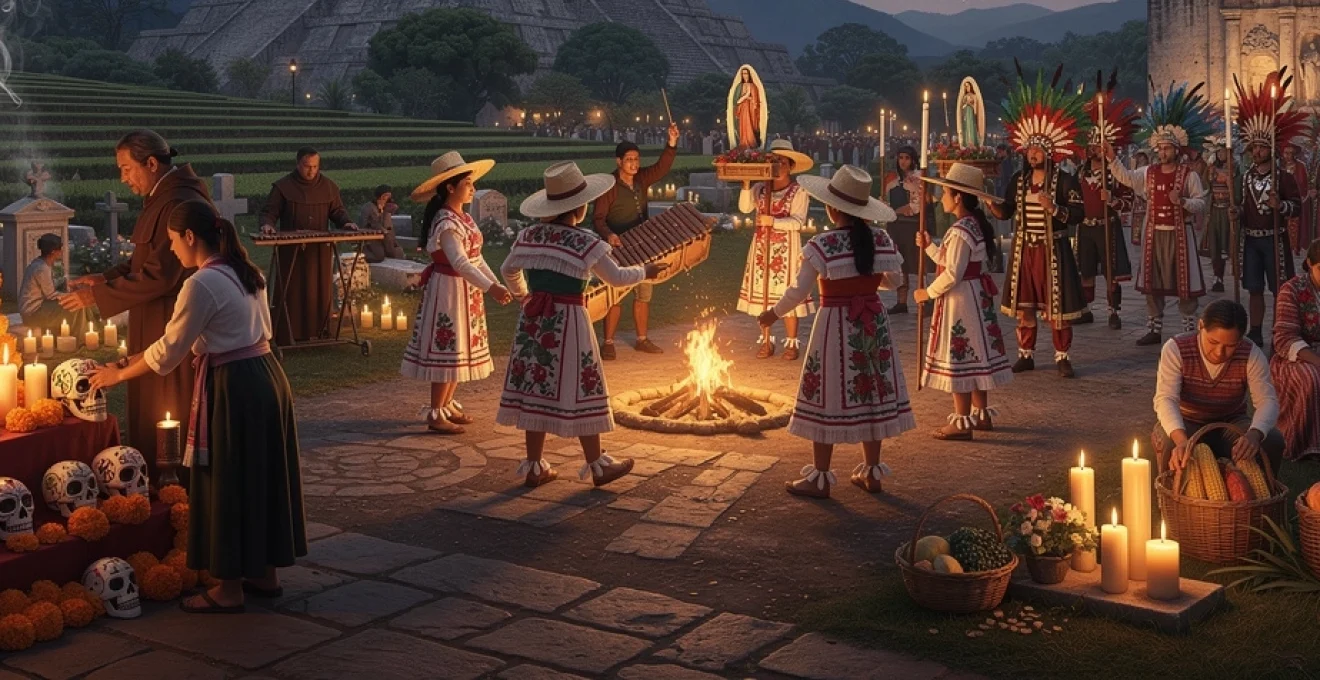
Mexico’s cultural landscape represents one of the world’s most complex tapestries of human tradition, where ancient indigenous wisdom seamlessly interweaves with colonial Catholic influences to create a vibrant contemporary society. This remarkable synthesis has evolved over five centuries, producing distinctive celebrations, belief systems, and social practices that continue to define Mexican identity today. The country’s festivities serve as living museums, preserving ancestral knowledge whilst adapting to modern realities, making Mexico a fascinating case study in cultural continuity and transformation.
From the bustling streets of Mexico City during Día de los Muertos to the remote mountain villages of Oaxaca where ancient Zapotec rituals persist, Mexican traditions demonstrate an extraordinary capacity for cultural resilience. These celebrations transcend mere entertainment, functioning as essential mechanisms for community cohesion, spiritual expression, and cultural transmission across generations.
Pre-columbian cultural foundations and their contemporary mexican manifestations
The sophisticated civilisations that flourished across Mesoamerica established profound cultural foundations that continue to influence modern Mexican society. These ancient peoples developed complex calendar systems, astronomical observations, and spiritual practices that remain embedded within contemporary Mexican celebrations, often disguised beneath layers of Catholic symbolism yet retaining their essential character and purpose.
Understanding these pre-Columbian foundations proves essential for comprehending how Mexican culture maintains its distinctive character despite centuries of external influence. The persistence of indigenous worldviews demonstrates remarkable cultural tenacity, with communities preserving ancient knowledge through oral traditions, ceremonial practices, and seasonal observances that connect modern Mexicans to their ancestral heritage.
Aztec ritualistic calendar systems in modern day of the dead celebrations
The Aztec tonalpohualli calendar system, with its intricate 260-day sacred cycle, established temporal frameworks that continue influencing contemporary Mexican celebrations. Día de los Muertos exemplifies this continuity, occurring during the ninth month of the Aztec calendar when the goddess Mictecacihuatl presided over death festivities. Modern celebrations retain the Aztec understanding of death as a natural transition rather than an endpoint, maintaining the belief that deceased souls return to commune with the living.
Contemporary altar preparations mirror ancient Aztec offerings to Mictlantecuhtli and Mictecacihuatl, with families creating elaborate ofrendas featuring marigolds, candles, and favourite foods of the departed. The four-day celebration period reflects ancient Aztec temporal divisions, with specific days dedicated to different categories of deceased souls, maintaining the sophisticated categorisation system that distinguished between various forms of death and afterlife destinations.
Maya cosmological beliefs influencing chiapas regional festival cycles
Maya cosmological concepts profoundly shape festival timing and symbolism throughout Chiapas and the Yucatan Peninsula. The Maya understanding of cyclical time, where past, present, and future interconnect through recurring patterns, influences how communities organise their ceremonial calendars. Traditional festivals align with astronomical events, agricultural cycles, and sacred geography, maintaining ancient connections between human activity and cosmic rhythms.
The cargo system practised in many Maya communities represents a direct continuation of pre-Columbian hierarchical organisation, where community members assume ceremonial responsibilities that rotate according to traditional patterns. These systems ensure that ancient knowledge transmission continues whilst distributing the financial and organisational burdens of festival organisation across the community, maintaining social cohesion and cultural continuity.
Olmec symbolism integration in veracruz contemporary religious practices
Olmec civilisation, often considered Mesoamerica’s « mother culture, » established symbolic frameworks that persist in Veracruz religious practices. The Olmec emphasis on duality, transformation, and shamanic practices continues manifesting in contemporary celebrations where Catholic saints assume characteristics of ancient deities. The iconic Olmec were-jaguar imagery appears transformed into modern festival masks and dance costumes, maintaining the symbolic power of transformation between human and animal realms.
The Olmec veneration of natural forces finds expression in modern Veracruz festivals celebrating patron saints associated with specific geographical features, weather patterns, and agricultural cycles. These celebrations maintain the ancient understanding of landscape as
The Olmec veneration of natural forces finds expression in modern Veracruz festivals celebrating patron saints associated with specific geographical features, weather patterns, and agricultural cycles. These celebrations maintain the ancient understanding of landscape as a living, sacred entity whose favour must be courted through ceremony, music, and offerings. Processions to rivers, springs, and hilltop chapels echo earlier pilgrimages to Olmec ceremonial centres, even when participants now carry images of Catholic saints rather than carved stone deities. In this way, contemporary religious life in Veracruz becomes a palimpsest, where Catholic devotion overlays but never fully erases much older ritual relationships with the environment.
Zapotec agricultural ceremonies shaping oaxacan harvest traditions
Zapotec communities in Oaxaca have preserved some of the most visible continuities between pre-Columbian agricultural rites and modern harvest traditions. Ancient Zapotec rituals honoured deities of rain, maize, and fertility through offerings, dances, and communal feasts timed to the sowing and harvesting cycles. Today, village celebrations marking the milpa (maize field) cycle still follow these seasonal rhythms, even when framed as fiestas for Catholic saints such as San Isidro Labrador, patron of farmers.
During planting and harvest festivals, Zapotec families bring the first ears of corn to local churches or community altars, symbolically returning a portion of the bounty to the divine. Traditional dances, including the Danza de la Pluma, incorporate references to rain, lightning, and mountains, reflecting a worldview in which agricultural success depends on harmonious relations with natural forces. These ceremonies do more than ensure good crops; they reinforce collective responsibility for land stewardship and transmit practical ecological knowledge, such as appropriate planting dates and water management strategies, from one generation to the next.
Catholic syncretism and indigenous spiritual hybridisation processes
The arrival of Catholicism in the 16th century did not simply replace existing indigenous religions; rather, it initiated a complex and ongoing process of spiritual hybridisation. Missionaries introduced new theological concepts, liturgical calendars, and devotional practices, but local communities selectively adopted and reinterpreted these elements through their own cosmologies. The result is a distinctive Mexican Catholicism in which saints, virgins, and Christ figures often carry attributes of pre-Hispanic deities, and church festivals follow rhythms established long before the conquest.
This syncretism is not static. As social and economic conditions change, so too do the meanings attached to hybrid rituals and symbols. Yet the underlying pattern remains consistent: indigenous communities appropriate Catholic forms as vehicles for preserving older relationships with the land, ancestors, and sacred time. Recognising this dynamic helps us understand why festivities in Mexico feel at once deeply Christian and unmistakably pre-Columbian in their emotional tone and visual language.
Guadalupan devotion merging tonantzin worship in central mexico
The cult of the Virgin of Guadalupe offers perhaps the most powerful example of Catholic–indigenous fusion in Mexico. According to tradition, the Virgin appeared in 1531 to Juan Diego, an Indigenous man, on Tepeyac Hill—site of an earlier temple to the mother goddess Tonantzin. For Nahua and other central Mexican peoples, Tonantzin embodied earth, fertility, and maternal protection; these attributes seamlessly transferred to Guadalupe, who quickly became both a Marian figure and a continuation of the ancient earth mother.
Modern pilgrimages to the Basilica of Guadalupe in Mexico City mirror pre-Hispanic processions to sacred mountains and springs. Devotees arrive on foot, by bicycle, or even on their knees, bearing candles, flowers, and ex-votos that symbolise personal petitions and thanks. The iconography of Guadalupe—standing on a crescent moon, surrounded by rays of light—resonates with earlier solar and lunar symbolism, allowing indigenous and mestizo believers to see in her both the Christian Mother of God and a local protector tied to the Mexican land itself. Through Guadalupan devotion, national identity, family piety, and ancestral reverence converge in a single, potent image.
Santiago apostle transformation into indigenous warrior deities
Another vivid case of syncretism can be found in the figure of Santiago Apóstol (Saint James the Apostle). In Spanish tradition, Santiago Matamoros appears as a mounted warrior who miraculously aided Christian armies against Muslim forces. In Mesoamerica, this militant saint was rapidly equated with existing warrior and storm deities, including Tlaloc and various local rain gods associated with thunder, lightning, and martial power.
In many Indigenous communities, Santiago’s feast day includes equestrian processions, mock battles, and dances where costumed riders embody both Christian knights and pre-Hispanic warrior spirits. These performances dramatise cosmic struggles between order and chaos, rain and drought, much as earlier rituals had done. By reimagining Santiago as a defender of the community and bringer of rain, local populations appropriated a colonial symbol and redirected it towards their own cosmological and agricultural concerns, turning a foreign saint into a protector embedded in Indigenous landscapes.
Baroque colonial architecture incorporating mesoamerican iconography
Mexican religious syncretism manifests not only in rituals but also in stone. Colonial churches and monasteries, particularly from the 17th and 18th centuries, often feature Baroque façades adorned with motifs that would have been instantly recognisable to Indigenous artisans. Serpents, maize plants, jaguars, and stylised rain clouds appear alongside cherubs and Latin inscriptions, creating a visual dialogue between European theology and Mesoamerican symbolism.
This architectural blending functioned as a kind of “stone catechism” that allowed Indigenous converts to read their own sacred narratives into Christian spaces. For example, facades in Puebla and Oaxaca incorporate sunbursts and stepped patterns reminiscent of pre-Hispanic temples, subtly suggesting continuity between old and new sacred orders. When we step into these churches today, we are entering buildings that are not purely European imports but negotiated spaces, where Indigenous worldviews were literally carved into the walls of Catholic power.
Franciscan mission integration of native ceremonial elements
Early Franciscan missionaries understood that successful evangelisation required engaging with, rather than simply suppressing, Indigenous ceremonial life. In many regions, they allowed or even encouraged the incorporation of native musical instruments, languages, and choreographies into Christian liturgy. Processions for Corpus Christi, Holy Week, and patron saint days thus came to include drums, flutes, and dances that closely resembled pre-conquest rituals, now directed toward new sacred figures.
Over time, these mission-era compromises crystallised into enduring local traditions. In places like Michoacán and the Sierra Gorda, communities still perform dances of the “old men,” feathered warriors, or animal figures during Catholic feasts, preserving embodied memories of pre-Hispanic cosmologies. This integration turned missions into laboratories of cultural hybridisation, where Indigenous peoples could outwardly adopt Christianity while inwardly maintaining core elements of their spiritual and social organisation.
Regional festival typologies and their socioeconomic functions
Across Mexico, festivals are not merely cultural curiosities; they play concrete economic and social roles in daily life. Each region has developed its own typology of celebrations—religious fiestas, civic commemorations, agricultural ferias, and urban cultural festivals—that structure the calendar year and local economies. Many small towns depend on annual patron saint festivals and harvest fairs to attract visitors, generate income, and reinforce social networks through shared labour and hospitality.
On a practical level, preparations for a major fiesta can mobilise entire communities for weeks. Families contribute food, music, decorations, and labour, creating reciprocal obligations that strengthen kinship ties. Informal vendors, artisans, and musicians rely on these events as vital sources of seasonal income. In tourist destinations from Oaxaca to Quintana Roo, regional festivals have also become key drivers of cultural tourism, inviting visitors to experience “authentic” Mexican traditions while supporting local businesses—though not without tensions around commodification and cultural control.
Traditional mexican culinary anthropology and ritual food symbolism
Food is one of the most tangible ways that beliefs and traditions shape Mexican life. Dishes are rarely just about sustenance; they carry layered symbolic meanings and are closely tied to the ritual calendar. Anthropologists often describe Mexican festive cuisine as an edible archive, preserving Indigenous ingredients like maize, cacao, and chile alongside European imports such as wheat, pork, and dairy. Each holiday brings its own repertoire of ceremonial foods that communicate values of memory, reciprocity, and community.
Consider pan de muerto during Día de los Muertos, its bone-shaped decorations and sugar coating recalling both mortality and sweetness of life, or the Rosca de Reyes on Epiphany, whose hidden figurine of the Christ Child creates obligations for future gatherings on Candlemas. Regional dishes such as mole poblano, pozole, or tamales also have ritual histories, once linked to offerings for gods and now served at baptisms, weddings, and national holidays. By preparing and sharing these foods, families enact stories about origins, sacrifice, and belonging, turning the kitchen into a key site of cultural transmission.
Contemporary mexican identity formation through cultural patrimony preservation
In the 21st century, debates over what it means to be Mexican increasingly revolve around questions of cultural patrimony and heritage preservation. Festivals, crafts, languages, and ritual practices that were once dismissed as “folk” or “backward” are now recognised as strategic resources for building inclusive national identity and supporting Indigenous rights. This shift is reflected in both international recognition and domestic policy, which treat Mexico’s living traditions as assets to be safeguarded rather than obstacles to modernisation.
However, heritage preservation is not a neutral process. Decisions about which practices to protect, how to present them, and who controls their representation can empower some groups while marginalising others. When a ritual dance or festival is designated as “patrimony,” it often becomes more visible to tourists and media, but it may also be standardised or removed from its original community context. Understanding these dynamics helps us see how contemporary Mexican identity is negotiated through both celebration and contestation of cultural traditions.
UNESCO intangible heritage recognition of mexican traditional practices
Mexico has been particularly active in seeking UNESCO recognition for its intangible cultural heritage, using this platform to highlight practices ranging from traditional cuisine to Indigenous festivals. Día de los Muertos, Mariachi music, the Indigenous festival of the Pirekua song from Michoacán, and the ritual ceremony of the Voladores are among the traditions inscribed on UNESCO’s Representative List. This international acknowledgement reinforces national pride and encourages funding and research directed toward these practices.
Yet UNESCO recognition also introduces new pressures. Communities may feel compelled to “perform authenticity” for outside audiences, maintaining older forms of a ritual even when local participants wish to adapt it. At the same time, global exposure can help younger generations revalue traditions that might otherwise seem old-fashioned. In this sense, UNESCO functions like a double-edged sword: it can protect Mexican cultural expressions while subtly reshaping them to fit international expectations of what “traditional culture” should look like.
Government cultural policy impact on indigenous community festivals
Within Mexico, federal and state cultural policies have a direct impact on how Indigenous community festivals are organised and perceived. Agencies such as the National Institute of Fine Arts and the National Institute of Indigenous Peoples provide grants, logistical support, and platforms for showcasing local traditions. This support can be crucial for small communities facing economic pressures, helping to finance musicians, costumes, and infrastructure needed to sustain large-scale celebrations.
However, when government funding enters the picture, questions arise: who sets the agenda for a festival, local elders or cultural officials? What happens when authorities encourage certain elements—colourful dances, handicrafts—while discouraging others that seem politically sensitive or difficult to manage? In some cases, official sponsorship has helped revitalise nearly forgotten traditions; in others, it has led to the simplification of complex rituals into stage-ready “cultural shows.” Navigating this relationship requires ongoing dialogue to ensure that communities retain real control over their own cultural expressions.
Tourism industry commercialisation of authentic mexican celebrations
The tourism industry plays a powerful role in shaping how Mexican festivities, beliefs, and traditions are experienced and understood. Iconic celebrations like Día de los Muertos in Oaxaca and Michoacán, or the Guelaguetza festival, now attract thousands of visitors each year, generating significant economic benefits for hotels, restaurants, and artisans. For many families, income from these high season events can represent a substantial portion of their yearly earnings.
At the same time, commercialisation poses risks. When parades, altars, or dances are scheduled for tourist convenience, or when souvenir versions of sacred objects flood markets, the line between devotion and spectacle can blur. Communities must constantly negotiate how much to adapt to outside demand without losing the emotional depth and spiritual intent of their rituals. As travellers, we can support more sustainable cultural tourism by seeking community-led experiences, respecting sacred spaces, and remembering that we are guests in ceremonies that, first and foremost, belong to the people who created them.
Digital age documentation and transmission of mexican folk traditions
The digital age has opened new pathways for documenting and sharing Mexican folk traditions, radically changing how they circulate within and beyond communities. Social media platforms now fill with images of altars, processions, and traditional dress during major fiestas, allowing people in the Mexican diaspora—or even in neighbouring villages—to witness events they cannot attend in person. Young creators produce videos, podcasts, and blogs explaining the meaning of rituals in accessible language, ensuring that knowledge once confined to oral transmission now has multiple archival forms.
Yet, as with tourism and heritage recognition, digital visibility brings challenges. Viral images can reduce complex ceremonies to colourful backdrops, encouraging superficial consumption rather than deep understanding. There are also concerns over who controls digital representations and whether communities consent to global sharing of what were once intimate practices. The most promising initiatives are those where local participants themselves use digital tools to document their traditions on their own terms, combining ancestral voices with contemporary technologies.
Mexican diaspora cultural continuity and transnational tradition adaptation
Beyond Mexico’s borders, millions of people of Mexican origin maintain and reinvent their cultural practices in new environments. In cities from Los Angeles to Chicago, Madrid to Vancouver, Mexican communities organise Día de los Muertos altars, Independence Day parades, and posadas during Advent, adapting them to local regulations, climates, and multicultural neighbourhoods. These transnational celebrations help second- and third-generation migrants stay connected to their heritage while also signalling their presence and contributions within host societies.
Interestingly, diaspora contexts often intensify certain traditions. A Day of the Dead altar in a US school or community centre might feature explanatory panels and workshops that make explicit the symbolism of marigolds, sugar skulls, and photographs—elements that in Mexico are taken for granted. In this way, migration can act like a prism, refracting and clarifying aspects of Mexican culture even as practices evolve. Ultimately, the ability of festivities, beliefs, and traditions to travel and transform across borders underlines their central role in shaping Mexican life, not as fixed relics of the past, but as living, adaptive frameworks for making meaning in a changing world.