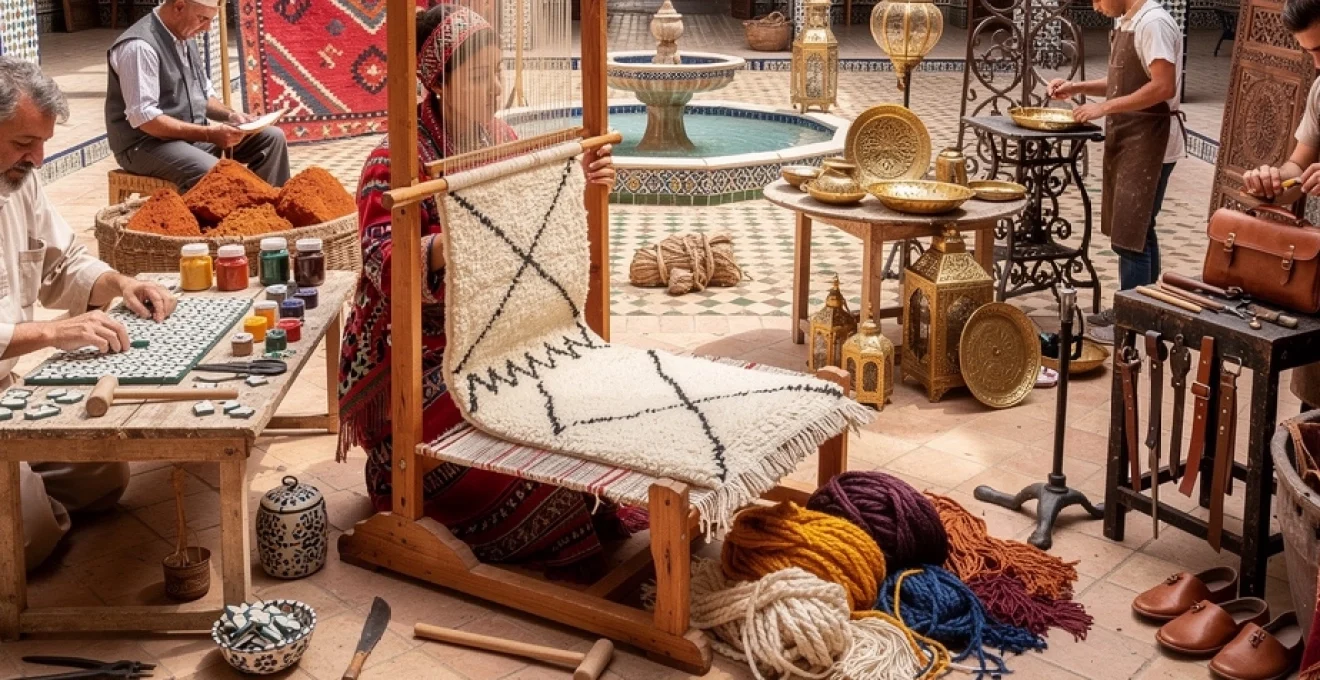
Morocco stands as one of the world’s most remarkable repositories of artisanal heritage, where ancient techniques continue to thrive in the hands of master craftsmen whose skills have been refined over millennia. This North African kingdom preserves a living tradition that spans from the intricate geometric patterns of zellige tilework to the robust weaving techniques of Berber communities nestled in the Atlas Mountains. Each piece created represents not merely an object, but a tangible connection to Morocco’s rich cultural tapestry, where Berber, Arab, Andalusian, and Islamic influences converge to create something uniquely Moroccan. The commitment to preserving these traditional methods while adapting to contemporary demands demonstrates how cultural authenticity can flourish in our globalised world, contributing approximately 7% to Morocco’s national GDP whilst maintaining the integrity of techniques passed down through countless generations.
Traditional zellige tilework: mastering the ancient art of fez ceramic craftsmanship
The ancient art of zellige represents perhaps Morocco’s most sophisticated ceramic tradition, a craft that transforms humble clay into luminous geometric masterpieces that have adorned palaces, mosques, and fountains for over a thousand years. This meticulous process begins in the clay-rich valleys surrounding Fez, where artisans have perfected techniques that remain virtually unchanged since the 10th century. The word « zellige » derives from the Arabic verb « zalaja, » meaning « to slide, » referring to the polished surface that characterises these exquisite tiles. What sets Moroccan zellige apart from other ceramic traditions is not only its distinctive lustrous finish but also the extraordinary precision required to create the countless geometric patterns that seem to flow endlessly across architectural surfaces.
The creation of authentic zellige demands exceptional skill and patience, as each tile must be hand-cut and individually shaped by master craftsmen known as qadous. These artisans spend years developing the sensitivity required to judge clay consistency, firing temperatures, and the subtle variations in colour that make each batch unique. The traditional firing process takes place in wood-burning kilns where temperatures reach 900°C, creating the characteristic surface tension that gives zellige its mirror-like quality. Modern attempts to mechanise this process have consistently failed to replicate the depth of colour and lustrous finish achieved through traditional methods, proving that some aspects of Moroccan craftsmanship cannot be industrialised without losing their essential character.
Hand-cut geometric tessellation techniques in tetouan and meknes workshops
The workshops of Tetouan and Meknes have developed distinct approaches to geometric tessellation that reflect regional preferences whilst maintaining the core principles of Islamic geometric art. In Tetouan, artisans specialise in creating complex star-and-polygon patterns known as khatam, which require extraordinary mathematical precision to achieve perfect tessellation without gaps or overlaps. These patterns often incorporate up to sixteen different tile shapes, each cut by hand using traditional tools that have remained unchanged for centuries. The master craftsmen, or maâlem, possess an intuitive understanding of geometric relationships that allows them to create seemingly infinite patterns from a finite set of basic shapes.
Meknes workshops, influenced by the city’s imperial heritage, tend to favour more elaborate polychromatic designs that incorporate the full spectrum of traditional zellige colours. The tessellation process here involves careful planning and precise execution, as even the slightest deviation in angle or dimension can disrupt the entire pattern. Artisans use traditional measuring tools including wooden rulers and metal dividers, relying on their trained eye rather than modern measuring devices. This approach ensures that each installation maintains the subtle irregularities that give handmade zellige its distinctive character, qualities that machine-made tiles simply cannot replicate.
Natural clay sourcing from salé quarries and mineral glazing processes
The exceptional quality of Moroccan zellige begins with the distinctive clay sourced from quarries near Salé, approximately 20 kilometres from Fez. This clay, formed over millions of years from sedimentary deposits, possesses unique properties that make it ideal for ceramic production. The mineral composition includes high levels of silica and alumina, which contribute to the characteristic strength and workability of the fired tiles. Traditional extraction methods involve hand
extraction with simple tools, preserving the natural structure of the clay and minimising impurities that could compromise the firing.
Once transported to Fez and surrounding workshops, the clay is soaked, kneaded, and filtered to remove stones and organic matter, a process that can take several days. Artisans then shape the tiles by hand or using wooden moulds, allowing them to dry slowly in the open air to prevent cracking. The mineral glazing process is equally demanding: traditional glazes are prepared from ground quartz, feldspar, and metallic oxides such as copper for green, cobalt for blue, iron for brown, and manganese for black. These natural minerals give Moroccan zellige its deep, variable tones that shift subtly with the light, unlike synthetic pigments which often appear flat and uniform.
Before firing, each tile is dipped or brushed with glaze and carefully stacked in the kiln so that heat circulates evenly. The firing curve is controlled by experience rather than digital sensors, with master fire-keepers judging the temperature by the colour of the flames and the sound of the tiles as they expand. This organic, hands-on control is what allows tiny variations in hue and sheen, giving each batch a distinctive character while maintaining visual coherence across large surfaces. For architects and designers seeking authentic Moroccan tilework, understanding this mineral glazing process is key to appreciating why no two traditional zellige installations are ever exactly the same.
Master maâlem training systems and apprenticeship hierarchies in fez medina
Behind every perfectly set zellige panel in Fez medina lies a rigorous training system that can span more than a decade. The hierarchy traditionally begins with the sbiaâ, young apprentices who handle basic tasks such as clay preparation, cleaning, and carrying materials. Over time, they progress to tâleb status, where they learn to cut simple geometric shapes and assist in laying basic patterns under close supervision. Only a handful will eventually attain the rank of maâlem, the master craftsman responsible for design, proportion, and final execution.
This apprenticeship model is largely oral and demonstrative: there are no formal textbooks, only patterns memorised through repetition and daily practice. A maâlem may require an apprentice to repeat the same cut hundreds of times until the angle, thickness, and finish are consistently accurate. Much like a classical music conservatory, progression is measured not by time spent but by demonstrated mastery of increasingly complex tasks. In recent years, vocational schools in Fez have begun to document patterns and methods, yet the core of zellige training remains rooted in this intimate workshop relationship between master and pupil.
Interestingly, the hierarchy also extends to specialisations within the craft. Some masters focus on cutting (qattâa), others on installation and layout, while a few are renowned designers capable of creating new compositions that still respect classical Islamic geometry rules. This layered system ensures that knowledge is not centralised in a single individual but distributed across a network of practitioners. For visitors walking through Fez medina, the sound of chisels striking glazed tile is the audible sign that this living school of Moroccan craftsmanship is still very much in session.
Contemporary applications of zellige in hassan ii mosque and royal palace restorations
Moroccan zellige reached new levels of visibility in the late 20th century with monumental projects such as the Hassan II Mosque in Casablanca. Completed in 1993, this vast complex brought together thousands of artisans from across the country, many of them specialists from Fez, Tetouan, and Meknes. Zellige panels cloak vast prayer halls, courtyards, and ablution fountains, demonstrating how traditional techniques can scale up to contemporary architectural challenges without losing their handcrafted essence. For many artisans, participating in this project was equivalent to contributing to a national manuscript written in clay and glaze.
Royal palace restorations and new state buildings continue to rely on traditional zellige for both structural and symbolic reasons. In Rabat and Marrakech, restoration campaigns have focused on repairing damaged tilework by commissioning pieces from the same regional workshops that supplied the original installations. This approach not only preserves visual cohesion but also sustains the economic ecosystem of artisans, clay suppliers, and glaze makers. Contemporary architects are also incorporating zellige into minimalist interiors and modern façades, using monochrome palettes or enlarged motifs to create a dialogue between heritage and clean-lined design.
For designers and homeowners around the world, these high-profile projects offer a blueprint for integrating authentic Moroccan tilework into modern spaces. Whether used as a subtle border, a feature wall, or an outdoor fountain, zellige introduces a tactile, light-catching surface that ages gracefully over time. In an era of mass-produced finishes, the slightly irregular joints and varied glazes of hand-cut tiles act almost like a signature, reminding us that a human hand has touched every piece.
Berber carpet weaving heritage: preserving middle atlas tribal techniques
If zellige represents Morocco’s mastery of geometry in clay, Berber carpets embody its tactile, woven memory. In the Middle Atlas and High Atlas, Amazigh communities have been weaving rugs for millennia, long before they became global design icons. Traditionally, these textiles served practical purposes—insulating tent floors, warming stone houses, and marking rites of passage—while also encoding tribal symbols related to fertility, protection, and cosmic order. Each region, from Beni Ourain to Azilal, has its own weaving language, and experienced eyes can often identify the origin of a rug at a glance.
What makes Moroccan carpet weaving so remarkable is the way ancestral techniques coexist with contemporary design sensibilities. Urban designers may reinterpret motifs, adjust colour palettes, or change proportions, yet the core processes—hand-spun wool, warp and weft tension, and symbolic patterning—remain intact. As you step into a rural weaving cooperative or a small village home, you are witnessing a living archive: looms set up in courtyards, bundles of raw wool drying in the sun, and women sharing stories as they knot each line. In a world obsessed with speed, the slow rhythm of loom work offers a powerful reminder that time itself is a key ingredient in authentic Moroccan craftsmanship.
High atlas beni ourain wool processing and natural dyeing methods
The celebrated Beni Ourain rugs, with their creamy backgrounds and dark geometric lines, begin their journey in the high-altitude pastures of the Middle and High Atlas. Here, semi-nomadic shepherds raise hardy sheep breeds whose dense, high-lanolin wool is naturally resistant to cold and moisture. After shearing, the wool is washed in mountain streams or communal basins, using minimal detergents to preserve its softness and sheen. Once dried, it is carded and spun by hand or with simple spinning wheels, creating the thick yarns that give Beni Ourain carpets their plush, almost cloud-like texture.
Natural dyeing methods vary from region to region, but they share a reliance on locally available plants and minerals. Walnut husks yield deep browns, pomegranate rind offers soft yellows, madder root gives earthy reds, and indigo plants provide rich blues. Dyers often work intuitively, adjusting quantities and boiling times according to the season and quality of water, much like a chef tasting and correcting a sauce. The result is a palette that feels deeply grounded in the landscape—colours that are never harsh or synthetic, but instead echo the tones of rock, soil, and sky.
For homeowners and designers seeking sustainable interiors, understanding these wool processing and dyeing techniques is crucial. Naturally dyed rugs not only age beautifully, developing a gentle patina over decades, they also avoid the environmental impacts associated with synthetic dyes and mass production. When you run your hand across a Beni Ourain rug, you are touching fibres that have moved from mountain pasture to loom through a chain of human care, rather than a factory conveyor belt.
Azilal and boucherouite symbolic pattern integration in modern designs
While Beni Ourain rugs are often praised for their restrained palette, Azilal and Boucherouite carpets celebrate colour and improvisation. Azilal rugs, woven in the central High Atlas, typically combine natural wool tones with bursts of red, blue, green, and orange. Their patterns feature diamonds, zigzags, and abstract figures that reference fertility, protection against the evil eye, and important life events. Boucherouite rugs, by contrast, emerged from economic necessity: when wool became scarce or expensive, weavers began recycling cotton, nylon, and fabric scraps into vibrant, shaggy textiles.
What is fascinating is how these once purely functional village pieces have been embraced by contemporary designers worldwide. The asymmetry and apparent spontaneity of Azilal and Boucherouite motifs resonate with modern tastes for expressive, one-of-a-kind objects. Yet behind every playful colour block lies a symbolic system; a diamond might stand for a woman’s body, a comb motif for protection, a cross for balance between the four directions. Modern Moroccan brands now collaborate with village weavers to adapt these motifs to current interiors, perhaps softening colour contrasts or scaling patterns for smaller urban spaces.
For those curating a modern home, integrating an Azilal or Boucherouite rug is like hanging an abstract painting on the floor. It introduces movement, narrative, and a sense of lived experience. The key is to respect the original language of the motifs rather than treating them as random decoration. When you know that a certain symbol is meant to guard a threshold or bless a marriage, your carpet becomes more than a design object—it becomes a quiet companion in daily life.
Traditional loom construction and warp-weft tension mechanics
At the technical heart of Berber carpet weaving lies the loom, often a simple yet ingenious structure made from local wood and rope. In many Middle Atlas homes, vertical looms are assembled directly against a wall, with the warp threads stretched from a top beam to a bottom roll. The correct tension is crucial: too tight, and the weaver struggles to pass the weft; too loose, and the rug will warp or buckle over time. Adjusting this tension is both a science and an art, refined through countless hours of practice.
The weaving process can be compared to composing music measure by measure. The warp threads act like the staff lines, fixed and parallel, while the weft threads are the notes, inserted rhythmically to build up the pattern. Weavers use simple wooden beaters to compact each row, checking regularly that the width and density remain consistent. In pile rugs, knots are tied around pairs of warp threads, then cut and trimmed, creating the soft surface that gives Moroccan carpets their signature feel.
Understanding warp-weft mechanics helps explain why genuine handwoven rugs drape and age differently from machine-made ones. A handwoven piece has tiny, almost imperceptible variations that allow it to adjust to different floors and temperatures, much like a hand-tailored jacket fits the body better than an off-the-rack garment. For collectors and interior designers, learning to read the back of a rug—the knot count, tension, and alignment—is an invaluable skill when evaluating authenticity and quality.
Cooperative economics in khemisset and midelt weaving communities
In regions such as Khemisset and Midelt, weaving has evolved from an individual household activity into a cornerstone of local cooperative economies. Faced with fluctuating wool prices and middlemen who once captured most of the profit, many women have joined cooperatives that pool resources, negotiate fairer prices, and coordinate access to national and international markets. These organisations often provide shared looms, dyeing facilities, and training in design, quality control, and basic accounting.
The impact extends beyond income. Cooperative structures allow women to gain financial independence, participate in community decision-making, and invest in their children’s education. Some cooperatives work directly with ethical brands and social enterprises, ensuring that traditional patterns are respected while product dimensions and colour palettes meet contemporary market expectations. This co-creation model can be challenging—how do you adapt heritage without diluting it?—but it has proven to be one of the most promising paths for sustaining Berber weaving traditions in a globalised economy.
For conscious buyers, seeking out rugs labelled with cooperative provenance or fair-trade certification is a practical way to support this ecosystem. When you purchase a handwoven piece from Khemisset or Midelt, you are not only enhancing your interior; you are also contributing to a circular economy where skills are valued, stories are preserved, and entire communities can thrive.
Metalwork mastery: fez brass engraving and marrakech ironwork traditions
Metalwork is another pillar of Moroccan craftsmanship, adding shimmer and structure to interiors and cityscapes alike. In Fez, brass and copper artisans create engraved trays, teapots, and basins whose surfaces read like illuminated manuscripts in metal. Each piece begins as a flat disk hammered into shape, then annealed in coal fires to soften the alloy before further forming. Once the basic form is complete, engravers draw patterns freehand or using light guidelines, then incise them with steel chisels, striking gently with wooden mallets to control depth and rhythm.
The motifs often echo those seen in zellige and textiles—stars, interlacing bands, and calligraphic inscriptions—creating a visual continuity across materials. The engraving process can take days or even weeks for large ceremonial trays, with the artisan working in concentric circles so that the design remains balanced. In an age of laser etching, why does hand engraving still matter? Because each microscopic variation in line thickness and depth catches light differently, giving the object a living, almost breathing surface that machines cannot replicate.
In Marrakech and other southern cities, ironwork traditions focus more on architectural elements: window grilles, balcony railings, lantern frames, and intricate gates. Blacksmiths heat iron bars in charcoal forges, then bend and twist them into scrolls, spirals, and geometric shapes using anvils and hand tools. You can think of these pieces as three-dimensional drawings in space; the negative shapes they create are just as important as the iron lines themselves. Once installed, these grilles filter sunlight into patterned shadows that move across floors and walls throughout the day.
Contemporary designers are increasingly commissioning custom brass lighting, iron headboards, and sculptural furniture that blend traditional techniques with modern silhouettes. The challenge lies in maintaining the integrity of handwork while adapting to new functions and environments, such as outdoor terraces or minimalist hotel lobbies. For those planning a project that references Moroccan design, collaborating directly with Fez or Marrakech metal workshops can result in bespoke pieces that act as both functional objects and works of art.
Leatherwork excellence: chouara tannery methods and moroccan maroquinerie
Few images are as closely associated with Moroccan craftsmanship as the colourful dye pits of Fez’s Chouara tannery. Operating since at least the 11th century, this open-air complex continues to process goat, sheep, and cow hides using methods that predate industrial chemistry. Fresh hides are first soaked to remove hair and fat, then treated with a mixture of lime and pigeon droppings—the latter providing natural enzymes that soften the leather. After thorough washing, the hides are transferred to round stone vats filled with natural dyes based on saffron, poppy, indigo, and pomegranate rind.
The tanners wade into these vats barefoot, kneading the hides by hand and foot to ensure even penetration of colour, a labour-intensive process that demands both strength and experience. Once dried on surrounding rooftops, the leather is supple, richly coloured, and lightly scented with the plants used in the tanning solutions. This traditional method produces what European traders once called “Morocco leather,” prized for centuries in bookbinding and luxury goods. Although modern tanneries elsewhere have adopted chrome-based processes for speed, Chouara’s continued reliance on natural materials has found new relevance in discussions about sustainable and ethical production.
In the surrounding souks of Fez and in Marrakech’s leather districts, this raw material is transformed into bags, slippers (babouches), belts, and poufs by specialised leatherworkers. Patterns are cut using wooden or metal templates, then assembled with hand-stitching or traditional saddlery techniques that prioritise durability. Decorative elements such as embroidery, perforation, and metal inlays add texture and visual interest. Much like a well-made pair of shoes, quality Moroccan leather goods develop a personal patina over time, darkening and softening in response to the wearer’s habits.
For travellers and buyers, paying attention to the origin of the leather and the quality of finishing is essential. High-end Moroccan maroquinerie workshops increasingly provide transparency about their supply chains and working conditions, responding to global demand for ethical fashion. Investing in a hand-stitched bag or pouf from such a workshop is not only a style choice, but also a way of supporting an entire network of tanners, dyers, cutters, and seamstresses whose livelihoods depend on this age-old craft.
Woodcarving artistry: cedar of lebanon techniques in essaouira and tetouan
Woodwork brings warmth and fragrance to Moroccan interiors, with cedar and thuya woods playing starring roles. In Tetouan and the northern regions, artisans favour Cedar of Lebanon and Atlas cedar for doors, ceilings, and furniture. This wood is not only naturally resistant to insects and humidity, it also releases a subtle, resinous aroma that lingers in carved rooms and wardrobes. Carvers begin by selecting planks based on grain direction and knot placement, then rough out designs with chisels and mallets before refining them with finer tools.
The patterns carved into cedar often mirror those seen in plaster and metal: interlaced stars, arabesques, and Kufic-style inscriptions. Ceilings in historic houses may display a remarkable combination of carving and polychrome painting, known as zouaq, where pigments and gold leaf highlight relief details. This combination turns structural elements into literal works of art overhead. In contemporary settings, the same techniques are applied to headboards, cabinet doors, and wall panels, allowing even minimalist interiors to benefit from a touch of layered Moroccan ornament.
Essaouira, on the Atlantic coast, is renowned for its work with thuya burl, a richly figured wood harvested from the roots of the thuya tree. Local artisans slice, assemble, and inlay this material into boxes, tables, and chessboards, sometimes combining it with lemon wood, ebony, or mother-of-pearl. The swirling patterns in thuya resemble aerial maps or marbled paper, giving each finished piece a sense of depth and movement. Careful sanding and oiling bring out a deep, almost glassy sheen, transforming functional objects into tactile sculptures.
For those who appreciate sustainable design, it is worth asking about sourcing practices, as overharvesting has put pressure on some thuya forests. Responsible workshops now work with replanting initiatives and legal quotas, ensuring that the forest can continue to provide livelihood and inspiration for generations. Choosing certified or transparently sourced cedar and thuya pieces is one more way that we, as consumers, can participate in the preservation of Moroccan craftsmanship and its natural foundations.
Contemporary preservation initiatives: unesco recognition and artisan economic sustainability
As globalisation and mass production reshape consumer habits, the question arises: how can Morocco’s ancestral crafts remain economically viable without losing their soul? One part of the answer lies in international recognition. Several Moroccan medinas, including Fez, Marrakech, and Tetouan, are listed as UNESCO World Heritage Sites, a status that highlights their architectural and artisanal significance. This visibility attracts cultural tourism and funding for restoration, indirectly supporting the craftspeople who maintain zellige, carved plaster, and traditional woodwork within these urban fabrics.
Beyond architecture, specific elements of Moroccan intangible heritage—such as Malhun poetry or Gnawa music—have also been recognised by UNESCO, reinforcing the idea that craftsmanship does not exist in isolation but as part of a broader cultural ecosystem. National programmes like the Moroccan Crafts Strategy 2030 aim to modernise workshop infrastructure, provide design and business training, and facilitate export channels, all while safeguarding traditional know-how. According to recent government data, the craft sector employs over a million people and contributes around 7% to national GDP, a testament to its continued relevance in the digital age.
However, economic sustainability is not guaranteed. Many young Moroccans are drawn to urban service jobs, and some traditional trades risk losing their next generation of practitioners. To address this, new models are emerging: design residencies that pair international creatives with local artisans; e-commerce platforms that sell directly from workshops to global customers; and incubators that help artisan-led brands develop coherent collections and marketing strategies. These initiatives seek to ensure that artisans are not just anonymous suppliers, but recognised creators with a voice in how their work is presented and valued.
For you as a visitor, architect, or collector, supporting this living heritage can take many forms. Choosing hand-crafted objects over generic souvenirs, asking about the story behind a piece, or collaborating respectfully with artisans on bespoke projects are all tangible actions. In doing so, you become part of the same chain of transmission that has carried Moroccan craftsmanship from Neolithic pots and Berber looms to today’s zellige-clad mosques and contemporary interiors. Every carved door, woven rug, and engraved tray is more than a decorative detail; it is a fragment of Morocco’s ongoing story, waiting to be read, used, and passed on.