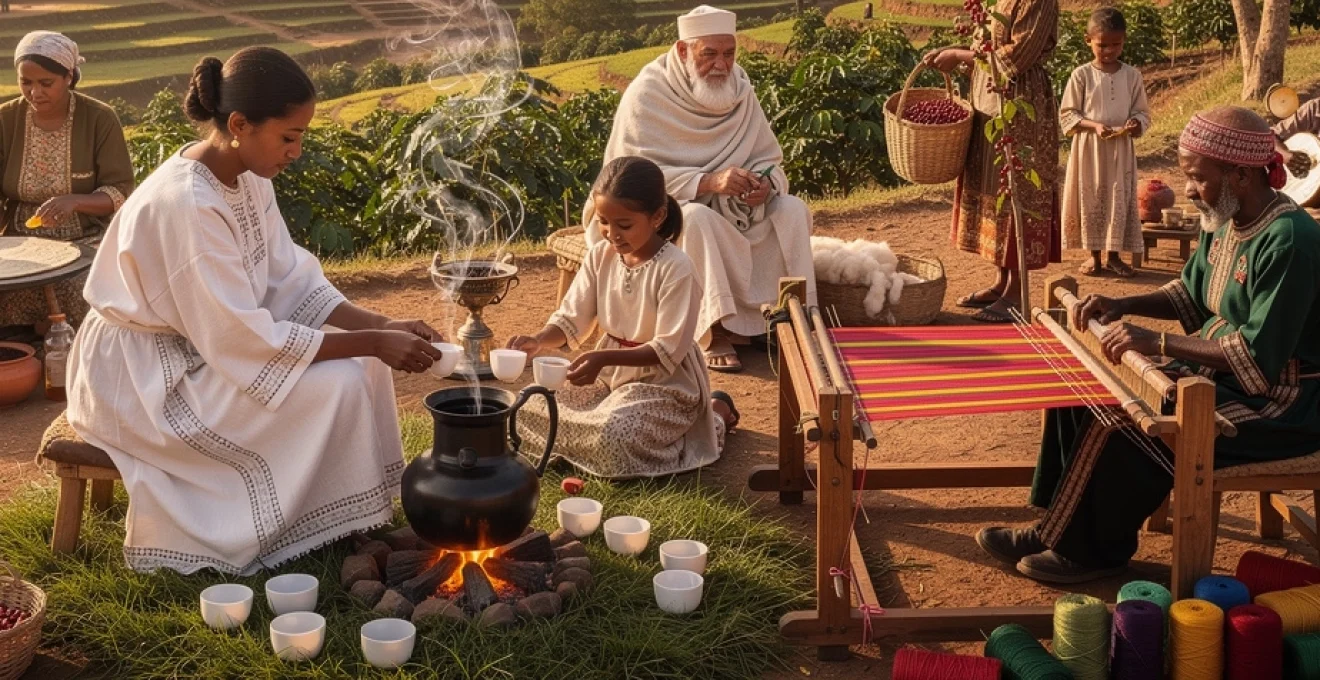
Ethiopia’s cultural tapestry represents one of Africa’s most enduring and vibrant traditions, where ancient practices seamlessly blend with contemporary life. From the highlands of Simien to the valleys of the Omo River, traditional customs continue to shape daily existence across this diverse nation. The country’s remarkable ability to preserve its heritage while adapting to modern realities offers a fascinating glimpse into how culture evolves without losing its essence.
With over 80 ethnic groups and more than 100 languages, Ethiopia’s cultural landscape reflects a complexity that has developed over millennia. These traditions aren’t merely historical artifacts displayed in museums; they are living practices that influence everything from morning coffee ceremonies to evening storytelling sessions. The integration of ancient wisdom with contemporary needs demonstrates how traditional knowledge systems remain relevant in today’s world.
Ancient coffee ceremony protocols and spiritual significance in ethiopian orthodox communities
The Ethiopian coffee ceremony stands as perhaps the most recognizable cultural practice that bridges sacred and secular life. This elaborate ritual, which can take several hours to complete, represents far more than simple beverage preparation. It embodies community bonding, spiritual reflection, and the preservation of ancient knowledge passed down through generations.
The ceremony follows strict protocols that have remained largely unchanged for centuries. The process begins with the washing of green coffee beans, followed by roasting them over an open flame until they release their aromatic oils. The roasted beans are then ground by hand using a mortar and pestle, creating a rhythmic sound that announces the ceremony’s progression to the surrounding community.
Buna preparation rituals in amhara regional coffee houses
In Amhara regional coffee houses, the preparation of buna follows time-honoured protocols that reflect the area’s Orthodox Christian heritage. The hostess, typically an elder woman, begins by spreading fresh grass and flowers on the floor, creating a sacred space that symbolises renewal and growth. This practice connects the ceremony to Ethiopia’s agricultural roots and the seasonal cycles that govern rural life.
The coffee beans undergo a careful roasting process that requires precise timing and attention. The hostess walks through the assembled group, allowing each person to inhale the rich aroma of the freshly roasted beans. This sharing of the scent serves both practical and spiritual purposes, ensuring the quality of the beans while creating a collective sensory experience that bonds participants together.
Frankincense burning techniques during ceremonial coffee services
The burning of frankincense during coffee ceremonies adds a profound spiritual dimension to the gathering. The aromatic resin, locally known as itan, is carefully placed on burning charcoal, releasing fragrant smoke that purifies the space and elevates the ceremony beyond mere hospitality. This practice connects Ethiopian coffee culture to ancient religious traditions that predate Christianity in the region.
The timing of frankincense burning follows specific protocols that vary between Orthodox communities and Muslim households. In Orthodox Christian settings, the incense often accompanies prayers or blessings, while in Muslim communities, it may be used to welcome guests and create an atmosphere of peace and contemplation. These subtle differences demonstrate how traditional practices adapt to diverse religious contexts while maintaining their essential character.
Gender-specific roles in traditional sidamo coffee cultivation practices
Coffee cultivation in the Sidamo region follows gender-specific traditions that have evolved over centuries to maximise efficiency and preserve cultural knowledge. Women typically handle the harvesting of coffee cherries, a task that requires careful selection and timing to ensure optimal flavour development. Their expertise in identifying perfectly ripe cherries has been passed down through maternal lineages, creating a specialised knowledge system that modern agricultural science now recognises as highly sophisticated.
Men traditionally focus on the processing and preparation of coffee beans for market, including the crucial steps of washing, drying, and sorting. This division of labour reflects practical considerations about physical demands and social customs, but it also ensures that both genders maintain intimate knowledge of different aspects of coffee production. The system creates multiple points of quality control while preserving traditional skills that might otherwise be lost to mechanisation.
Sacred timing protocols for Three-Round coffee ceremonies
The three-round structure of Ethiopian coffee ceremonies follows sacred timing protocols that reflect deep spiritual beliefs about blessing and transformation. The first round, called a
em>abol, is considered the strongest and most potent. The second, tona, is slightly milder, and the third, baraka, literally means « blessing », symbolising completion and communal grace.
In many Ethiopian Orthodox communities, timing each round of coffee aligns loosely with the rhythm of the day and, in rural areas, with prayer times and work cycles. The first round often follows a main meal or a liturgical service, when people are gathered and receptive to reflection. The second round invites more relaxed conversation and storytelling, while the third becomes a quiet moment for closure, reconciliation, or making important family decisions. By stretching the ceremony across these three distinct phases, the community slows down together, creating shared time that counters the fast pace of modern life.
While there is no mechanical clock measuring each phase, experienced hostesses intuitively control the pacing through roasting, grinding, brewing, and serving. This intuitive timing is itself a form of cultural knowledge, passed down by observation rather than instruction. For visitors, learning to sit through all three rounds—rather than leaving after the first cup—signals respect for Ethiopian coffee traditions and an openness to the deeper social and spiritual layers of everyday hospitality.
Indigenous textile production methods across ethiopian highland regions
Just as coffee ceremonies weave people together, textile traditions in Ethiopia literally and symbolically hold communities in a shared fabric of identity. Across the highland regions, indigenous textile production remains a cornerstone of cultural expression and local economies. From cotton planting to hand-spinning and weaving, many families continue to rely on skills that have changed little over centuries, even as they adapt to new markets and urban demand.
Textiles in Ethiopia are not simply clothing. They mark life stages, religious affiliation, regional identity, and social status. A gabi wrapped around the shoulders during a chilly highland morning or a finely embroidered habesha kemis worn at a wedding communicates as much as spoken language. As we explore distinct highland traditions—from Gamo to Tigray and Gondar—you can see how indigenous textile production methods remain deeply tied to land, labour, and ritual.
Dorze cotton weaving techniques in gamo highlands
In the Gamo highlands, especially among the Dorze people, weaving is both an economic mainstay and an art form. Traditionally, men operate the looms while women take on spinning and cotton preparation, creating a gendered collaboration that mirrors the Sidamo coffee production dynamic. Dorze weavers are renowned for their tight, durable cotton cloth, which can be transformed into blankets, shawls, and garments that last for years despite daily use.
The weaving process begins long before a thread touches the loom. Cotton is carded, spun into fine yarn, and then carefully warped to create even tension along the loom. Dorze looms are often set up in small, dimly lit workshops or within family compounds, where the rhythmic clacking can be heard throughout the day. Design choices—such as bold stripes or subtle geometric borders—are calculated row by row, much like basket patterns, ensuring that motifs align correctly when the cloth is cut and sewn.
In recent decades, Dorze textiles have found markets far beyond their home region, appearing in Addis Ababa boutiques and even international fair-trade shops. Yet the core techniques remain grounded in local knowledge: how to adjust tension in the rainy season, how to work with locally grown cotton, and how to maintain quality under rising demand. This combination of tradition and market awareness helps preserve Dorze weaving as a viable livelihood.
Traditional shemane dress construction in tigray province
In Tigray province, the term shemane refers to both the weaver and the wider craft tradition. While recent conflicts have affected many artisan communities in northern Ethiopia, the underlying techniques and cultural logic of dress construction remain deeply rooted. Tigrayan shemane garments are known for their restrained elegance, often featuring narrow bands of colour along edges and cuffs, with the rest of the fabric left a luminous white.
Dress construction usually begins with planning how many panels of woven cloth will be needed for a finished garment. Because traditional looms produce relatively narrow widths, a single dress might require several panels to be hand-stitched together with invisible seams. This modular construction allows tailors to adapt to different body shapes and ceremonial needs, whether for everyday wear, weddings, or religious festivals. The final silhouette, especially for women’s dresses, tends to be long and flowing, designed to move gracefully during walking, dancing, or worship.
Despite modern sewing machines and imported fabrics, many families still commission at least one fully traditional outfit from local shemane, especially for major life events. For you as a visitor or researcher, understanding how every seam and border is intentionally planned adds another layer of appreciation to what might otherwise look like a simple white dress. Each garment tells a story about region, faith, and resilience.
Habesha kemis embroidery patterns in gondar workshops
Gondar, once an imperial capital, has long been a centre for refined textile decoration. Here, the habesha kemis reaches its most ornate form, with intricate embroidery known as tibeb decorating hems, cuffs, and necklines. Many workshops in and around Gondar specialise in these patterns, some using hand-guided machines while others maintain purely manual embroidery techniques that can take weeks for a single dress.
Tibeb motifs often draw on religious symbolism, local flora, and historical heraldry. Crosses, stepped diamonds, stylised flowers, and even abstracted representations of church architecture appear as repeating bands or central medallions. Planning a pattern is a bit like composing music: the artisan must balance repetition and variation so that the eye travels smoothly around the garment. Colour choices—deep golds, emerald greens, and rich reds on a white background—echo the visual language of church murals and illuminated manuscripts.
Many contemporary workshops in Gondar now produce designs tailored for urban buyers and the Ethiopian diaspora, experimenting with shorter hemlines or more minimalist borders. Yet the underlying grammar of tibeb remains recognisable. When you see a habesha kemis hanging in a shop window in Addis Ababa, there is a good chance its embroidery carries the signature style of a Gondar workshop, connecting city life back to this historic highland centre.
Natural dye extraction methods using local plant species
Though industrial dyes are common today, many Ethiopian highland communities still maintain knowledge of natural dye extraction using local plants, roots, and minerals. This knowledge functions much like a living chemistry textbook, built through centuries of trial and error. For weavers and spinners, understanding which plants yield stable colours—and how to fix those colours to fibre—is crucial to producing long-lasting textiles.
Common sources include leaves and bark for greens and browns, roots and flowers for yellows and reds, and iron-rich muds or rusted tools for deeper blacks. The process often begins with collecting plant material at specific times of year, when pigment concentrations are highest. These materials are then boiled to release colour into the water, before yarn or fabric is added. Mordants—such as ash, alum, or even certain plant ashes—help the dye bind to the fibre, ensuring it will not wash out quickly.
Natural dyeing is as much art as science. Two dyers using the same plant species can still produce slightly different hues, depending on water quality, temperature, and timing. That variability, however, is part of the appeal. Just as Ethiopian coffee ceremonies embrace subtle differences between households, natural dye traditions celebrate shades that are recognisably local, carrying the « fingerprint » of a specific valley or village.
Hand-spinning wool processing in simien mountain communities
In the Simien Mountains, where temperatures can drop sharply at night, wool garments and blankets are essential. Here, hand-spinning and wool processing form the quiet backbone of highland life, often taking place in the margins of the day—between herding, cooking, and childcare. Women, in particular, carry forward spinning skills that enable families to transform raw fleece into warm, durable textiles.
The process usually begins with shearing sheep at the end of the dry season. The fleece is then washed, dried, and carefully teased apart to remove plant matter and tangles. Using simple drop spindles or improvised spinning tools, spinners twist the cleaned fibres into yarn with a consistent thickness. Achieving this consistency is not trivial; it requires years of practice and a sense of touch as refined as that of a musician tuning an instrument.
Once spun, the wool can be woven into blankets, cloaks, or mixed with cotton to create hybrid fabrics suitable for both warmth and breathability. For many Simien communities, the ability to produce warm textiles at home reduces dependence on purchased goods and allows households to trade surplus items in local markets. When you see a shepherd wrapped in a thick, dark gabi on a mountain path, you are looking at the end result of a long chain of skilled, often invisible labour.
Festival celebrations and ceremonial food preparation traditions
Ethiopian festivals offer some of the most vivid expressions of how tradition is woven into everyday life. Religious calendars—Ethiopian Orthodox, Muslim, and others—shape not only public holidays but also household routines around fasting and feasting. Food preparation for these festivals is never just about taste. It encodes history, belief, and community cooperation in recipes and rituals passed down through generations.
Major celebrations such as Timkat, Enkutatash, Meskel, and Genna each have distinctive culinary signatures. The way injera is fermented, how honey wine is brewed, or which spices are chosen for doro wat tell you as much about Ethiopian culture as any monument or museum. By looking closely at these ceremonial food traditions, you can better understand how families and neighbourhoods reaffirm their bonds, year after year.
Timkat orthodox baptism feast preparation rituals
Timkat, the Ethiopian Orthodox celebration of Epiphany, commemorates the baptism of Christ and is one of the most elaborate festivals of the year. In the days leading up to Timkat, households begin preparations that blend spiritual discipline and culinary anticipation. Many people complete a period of fasting before the feast, abstaining from animal products and rich foods. This creates a dramatic contrast once the restrictions are lifted and festive meals are shared.
Food preparation for Timkat often begins well in advance. Families soak and grind teff for injera, prepare spice blends, and arrange for the purchase or slaughter of chickens and, in some cases, sheep. Neighbours may share tasks, such as grinding spices at local mills or baking large batches of injera on shared griddles. The atmosphere is one of structured busyness, with each family member knowing their role—from the grandmother overseeing stew consistency to the younger relatives washing vegetables and setting out serving dishes.
On the day of the feast, after the long liturgical services and processions with the tabot (replica of the Ark of the Covenant), families gather to break their fast. The first bites of rich, spicy stews after a period of abstinence feel almost sacramental, reinforcing the link between physical nourishment and spiritual renewal. For visitors, accepting an invitation to a Timkat meal is a chance to experience how theology, hospitality, and culinary skill come together in one of Ethiopia’s most important celebrations.
Enkutatash new year honey wine brewing techniques
Enkutatash, the Ethiopian New Year, falls in September, just as the rainy season ends and yellow adey abeba flowers bloom across the highlands. It is a time of renewal, gift-giving, and shared optimism. Central to many Enkutatash celebrations is tej, Ethiopia’s traditional honey wine. Brewing tej at home remains a cherished skill in both rural and urban households, even as commercial versions become more widely available.
Traditional tej brewing relies on three main ingredients: honey, water, and the leaves or stems of the gesho shrub, which functions somewhat like hops in beer production. The honey is diluted with clean water in large clay or glass vessels, then gesho is added to initiate and control fermentation. Over several days or weeks—depending on temperature and desired strength—the mixture slowly transforms, developing a complex flavour that balances sweetness, acidity, and a subtle bitterness.
Timing is crucial. Brew too early, and the tej may lose its peak flavour before New Year’s Day. Brew too late, and the drink may be underdeveloped. Experienced brewers rely less on thermometers or hydrometers and more on sensory cues: the sound of bubbles, the aroma at the vessel’s mouth, and the slight change in colour as fermentation progresses. Serving homemade tej at Enkutatash is both a mark of hospitality and a symbol of abundance at the start of a new year.
Meskel cross festival injera fermentation processes
Meskel, the Feast of the Finding of the True Cross, is celebrated near the end of September and includes large public bonfires, called demera, along with communal meals. Injera, the sour, spongy flatbread that anchors Ethiopian cuisine, plays a central role in Meskel feasts. While injera is eaten year-round, the scale and care of production around Meskel highlight its cultural importance.
Injera fermentation begins with a starter known as ersho, saved from a previous batch. Teff flour is mixed with water and left to ferment, sometimes for several days, depending on climate. For festival occasions, many households increase their production, meaning the rhythm of mixing, resting, and baking has to be carefully planned. The analogy often used is that of raising a child: the batter must be watched, fed with new flour, and protected from extremes of heat or cold to develop the right level of sourness and bubbling activity.
During Meskel, women often coordinate schedules so that large, round injera can be baked in succession on shared or neighbouring griddles. Perfect injera for a festival meal must have a soft, flexible texture and a surface covered with tiny holes, called eyes, which absorb the flavourful sauces served on top. Achieving this requires fine control of fermentation time and batter thickness. For many urban Ethiopians juggling modern jobs with traditional expectations, maintaining such standards during major festivals is both a point of pride and a practical challenge.
Genna christmas doro wat spice blend compositions
Genna, the Ethiopian Orthodox Christmas celebrated in early January, is another key moment when food rituals take centre stage. The star of many Genna tables is doro wat, a slow-cooked chicken stew rich with onions, clarified butter, and a powerful spice blend known as berbere. Preparing authentic doro wat is an exercise in patience and precision—much like weaving or basketry, every step builds on the previous one.
The base of doro wat begins with kilograms of onions, finely chopped and cooked down over low heat until they almost dissolve. To this, cooks add niter kibbeh (spiced clarified butter) and generous amounts of berbere. While packaged berbere is widely available, many families still prefer to make or customise their own blend. Typical components include dried chilli peppers, garlic, ginger, fenugreek, basil, rue, black cumin, and coriander seeds, all roasted and ground to release their full aroma.
For Genna, households may adjust the spice blend to suit the preferences of children, elders, or guests unaccustomed to high levels of heat. The final stew, garnished with hard-boiled eggs, is served on large injera platters for everyone to share. Sitting around a Genna table, tearing injera with your hands and scooping up bites of doro wat, you participate in a centuries-old culinary tradition that connects families across time and place.
Traditional medicine practices and herbal knowledge systems
Beyond food and textiles, Ethiopia’s traditional medicine practices reveal another layer of indigenous knowledge woven into daily life. In many rural communities—and even in parts of Addis Ababa—people still consult traditional healers, bone-setters, and herbalists alongside or instead of modern clinics. These systems are not random folk remedies; they are structured bodies of knowledge, often linked to particular families, religious institutions, or ethnic groups.
Herbal medicine in Ethiopia draws on an astonishing range of plant species found in highland forests, lowland savannas, and home gardens. Leaves, roots, bark, and resins may be dried, powdered, boiled, or burned, depending on the condition being treated. For example, certain bitters are used to aid digestion, while aromatic leaves might be inhaled as steam to relieve respiratory issues. Much like the careful counting used in weaving patterns, precise dosage and preparation methods are critical, learned through apprenticeship rather than written manuals.
Spiritual dimensions often accompany physical treatments. Orthodox priests may bless holy water (tsebel) believed to have healing properties, while Muslim healers might recite Quranic verses over herbal mixtures. This blending of faith and pharmacology can be hard for outsiders to categorise, but for local communities it reflects a holistic view of health, where body, mind, and spirit are inseparable. At the same time, there is growing collaboration between researchers and traditional practitioners, seeking to document useful remedies while respecting intellectual property and cultural sensitivity.
Indigenous architecture and settlement patterns in rural communities
The way people build their homes and organise their villages in Ethiopia is itself a form of cultural expression. Indigenous architecture across rural regions responds to climate, topography, and social structure, using locally available materials such as stone, timber, mud, and thatch. From the towering « beehive » houses of the Dorze to the stone-built compounds of Tigray, each structure encodes generations of experimentation with form and function.
In many highland areas, circular houses with thatched roofs—often called tukul—remain common. Their round shape helps them withstand strong winds and distribute structural stress evenly, much like the spiralled strength of coiled baskets. Inside, space is often divided into zones for sleeping, storage, and livestock, reflecting the close integration of human and animal life in agrarian economies. Walls made of wattle and daub or dry stone provide insulation against the sharp diurnal temperature swings typical of high elevations.
Settlement patterns frequently cluster around water sources, churches, or mosques, with paths radiating toward fields and grazing lands. This layout supports both daily labour and communal gathering, ensuring that neighbours are within easy walking distance for mutual aid. In some regions, terraced hillsides are crowned with small hamlets, their stone retaining walls echoing the ancient engineering skills visible in Ethiopia’s historic sites. As modern materials like corrugated iron roofing become more common, many communities face the challenge of balancing durability and cost with the desire to preserve traditional aesthetics and building knowledge.
Oral tradition preservation through storytelling and musical heritage
Finally, the threads of Ethiopian culture are perhaps most vividly felt in its oral traditions—stories, proverbs, songs, and musical performances that knit generations together. In both rural villages and urban neighbourhoods, evenings often end with shared narratives, whether around a charcoal brazier or during a coffee ceremony’s final round. These storytelling sessions transmit history, ethical lessons, and local humour without ever needing a printed page.
Musical heritage plays a central role in this process. Instruments like the krar (lyre), masenqo (one-string fiddle), and kebero (drum) accompany songs that range from praise for saints and heroes to commentary on contemporary politics. The structure of many songs is call-and-response, inviting active participation rather than passive listening. This interactive format, much like a communal meal, reinforces the idea that culture is something we create together, not consume alone.
Griots, priests, village elders, and professional azmari performers act as living archives, recalling genealogies, historic battles, and moral parables with remarkable precision. In recent years, radio, television, and online platforms have begun to document and broadcast these performances, helping to preserve them in the face of urbanisation and migration. Yet the heart of Ethiopia’s oral tradition remains in live, face-to-face encounters—moments when words, melody, and shared memory intertwine, weaving tradition into the fabric of everyday life.