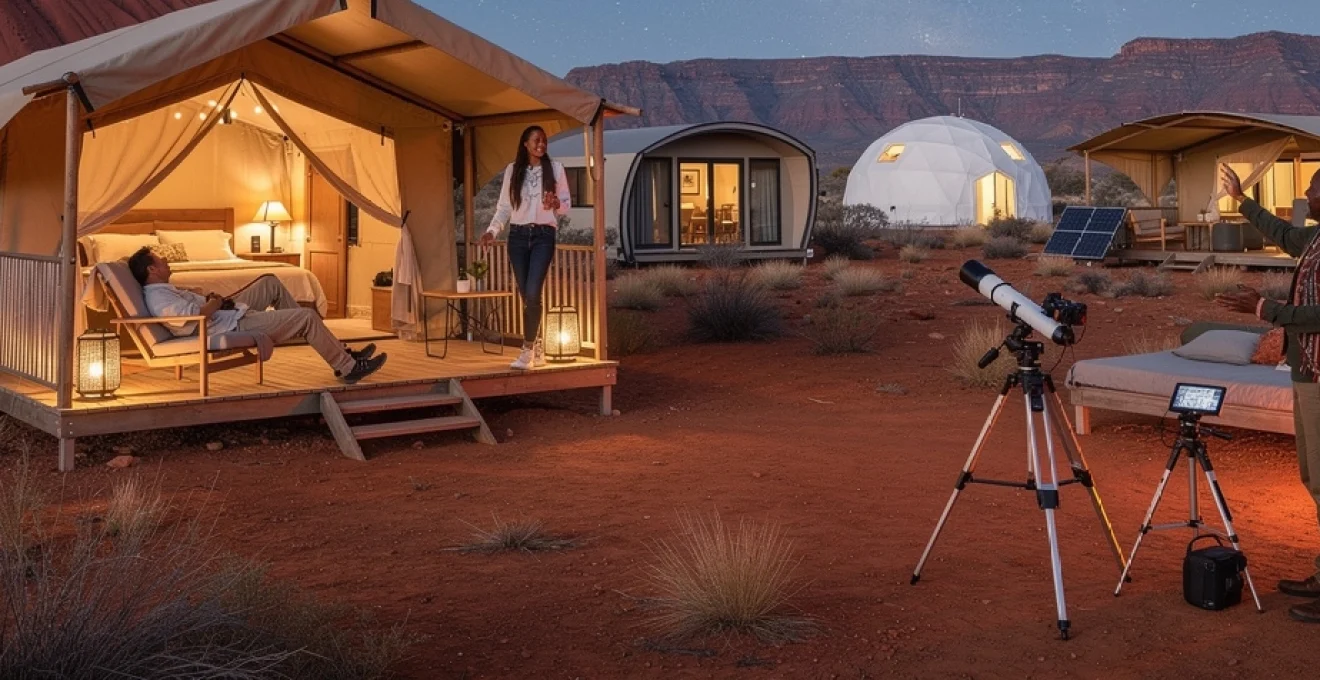
The Australian Outback represents one of Earth’s most extraordinary landscapes for astronomical observation and immersive wilderness experiences. With vast expanses of red earth stretching beyond the horizon, minimal light pollution, and some of the clearest atmospheric conditions on the planet, this remote territory offers unparalleled opportunities for travellers seeking authentic engagement with nature. The emergence of luxury glamping has transformed how visitors experience these remote regions, combining the raw beauty of Australia’s arid interior with sophisticated accommodation that honours both comfort and environmental stewardship. From the iconic red monolith of Uluru to the ancient gorges of the Flinders Ranges, glamping destinations now provide access to landscapes that were once accessible only to the most dedicated adventurers.
This shift towards glamorous camping has democratised outback tourism without compromising the integrity of the wilderness experience. Contemporary travellers no longer face the binary choice between rugged swag camping and distant town-based accommodation. Instead, they can sleep beneath canvas within metres of protected landscapes, wake to kangaroos grazing outside their tent, and witness astronomical phenomena that urban dwellers never encounter. The sophistication of modern glamping infrastructure has evolved considerably, incorporating renewable energy systems, water conservation technologies, and architectural designs that minimise environmental impact whilst maximising guest comfort and connection to place.
Defining glamping infrastructure and accommodation typologies in remote australian territories
The terminology surrounding luxury camping can be confusing, as the glamping sector encompasses a diverse range of accommodation styles adapted to Australia’s challenging outback conditions. Understanding these typologies helps travellers select experiences that match their comfort expectations and adventure aspirations. The infrastructure required to deliver consistent quality in remote locations presents unique engineering and logistical challenges that distinguish outback glamping from its European or North American counterparts.
Safari-style canvas tents with ensuite amenities in the northern territory
Safari tents represent the most iconic glamping typology across Australia’s Red Centre and Top End regions. These structures typically feature heavy-duty canvas walls mounted on raised timber platforms, creating a buffer between guests and the red earth whilst allowing natural ventilation. The canvas material provides superior temperature regulation compared to synthetic alternatives, remaining cooler during scorching days and retaining warmth during surprisingly cold desert nights. Modern safari tents in premium locations like Longitude 131° incorporate floor-to-ceiling glass panels that frame views of Uluru, creating an architectural dialogue between shelter and landscape that would be impossible with traditional camping equipment.
The inclusion of ensuite bathrooms distinguishes contemporary glamping from traditional camping experiences. These facilities typically feature composting toilets, low-flow showerheads, and greywater systems that minimise environmental impact. At properties such as Kings Canyon Wilderness Lodge, separate bathroom tents connect to sleeping quarters via covered walkways, maintaining the authentic camping aesthetic whilst delivering hotel-standard amenities. The engineering required to deliver hot water in locations without mains connections involves sophisticated solar thermal systems or on-demand gas heaters, representing significant infrastructure investment that justifies the premium pricing these properties command.
Permanent Eco-Pods and geodesic dome structures in south australia’s flinders ranges
Beyond canvas safari tents, the Australian glamping sector has embraced more permanent structures designed for longevity in harsh outback conditions. Eco-pods constructed from recycled materials and sustainable timber offer enhanced durability against the extreme temperature fluctuations and occasional severe weather events that characterise inland Australia. These semi-permanent structures often incorporate superior insulation, allowing for more efficient climate control through reverse-cycle air conditioning systems powered by solar arrays.
Geodesic domes and bubble tents represent the most architecturally distinctive glamping typology, offering 360-degree views of the surrounding landscape and unobstructed stargazing opportunities. Bubble Tent Australia pioneered this accommodation style, positioning transparent inflatable structures overlooking the Capertee Valley west of Sydney. These structures create an immersive astronomical experience, with guests literally sleeping beneath the stars whilst protected from the elements. The transparency also allows for passive solar heating during cooler months, reducing energy requirements. However, the lack of privacy and potential for condensation represents design compromises that don’t suit all travellers.
Luxury swag setups versus fixed glamping pavilions in the red centre
The traditional Australian swag—essentially
The traditional Australian swag—essentially a robust canvas bedroll with integrated mattress and bedding—remains a defining feature of Outback camping culture. In luxury glamping contexts, “deluxe swags” elevate this heritage object with high-thread-count linen, plush pillows, and often a protective fly or minimal overhead shelter. Guests at high-end lodges in the Red Centre may sleep directly under the Milky Way with nothing but a swag between them and the night air, creating a visceral sense of connection to Country that no fixed pavilion can quite replicate. For many travellers, this hybrid of comfort and exposure delivers the most memorable stargazing experience of their trip.
By contrast, fixed glamping pavilions function more like boutique hotel suites transplanted into the desert. Solid walls, insulated roofing, and integrated climate control systems protect guests from hot winds, dust storms, and temperature swings that can exceed 30°C between day and night. Architecturally, these pavilions often echo the low-slung homesteads of remote stations, with wide verandas and deep eaves designed to capture breezes and shade the interior. When you compare luxury swags versus pavilions in the Red Centre, the choice often comes down to how much exposure you want to the elements versus how important full hotel-style comfort is to your Outback holiday.
Off-grid solar power systems and water harvesting technologies for remote sites
Delivering reliable power in remote glamping sites requires a sophisticated approach to off-grid energy. Most premium Outback glamping retreats now rely on hybrid solar systems combining photovoltaic panels, battery storage, and backup generators. Large roof-mounted or ground-mounted solar arrays capture abundant desert sunshine, while lithium or advanced lead-acid batteries smooth out supply across cloudy days and overnight. In many properties, diesel generators have shifted from being the primary source of power to a last-resort backup, significantly reducing noise, emissions, and fuel transport needs across long distances.
Water management is equally critical in arid and semi-arid environments where annual rainfall can be less than 250 mm. Rainwater harvesting tanks, fed from pavilion roofs and communal buildings, supplement bore water or trucked-in supplies. Greywater from showers and basins is often treated on-site and reused for irrigation of native landscaping, reducing the overall draw on scarce groundwater resources. Some forward-thinking operators install low-flow fixtures, dual-flush toilets, and timed showers to subtly encourage conservation without compromising guest comfort. For travellers, understanding these systems adds an extra layer of appreciation—your hot shower and cool drink in the middle of nowhere are the result of careful, sustainable design rather than chance.
Premier glamping destinations across australia’s arid and Semi-Arid regions
Not all Outback glamping is created equal. While simple bell tents with shared facilities have their place, a handful of flagship properties set the benchmark for luxury camping in Australia’s arid zones. These destinations combine architectural innovation, environmental sensitivity, and curated guest experiences that respond to the unique character of each landscape. Whether you are drawn to the spiritual aura of Uluru, the rugged escarpments of the Flinders Ranges, or the coastal desert meeting Ningaloo Reef, there is a glamping retreat designed around that specific sense of place.
When comparing premier glamping in the Australian Outback, it is helpful to consider not only tent typology and amenities but also site context and included activities. Some properties prioritise immersive walks and guided nature experiences; others emphasise fine dining, spa treatments, or marine encounters. Asking yourself what kind of Outback story you want to be part of—adventure-led, wellness-focused, culture-rich, or astronomy-driven—will help you choose between these marquee destinations.
Longitude 131° at Uluru-Kata tjuta national park
Longitude 131° is often cited as the pinnacle of luxury glamping in the Australian desert, seamlessly merging five-star service with a low-impact camp design. Sixteen tented pavilions are oriented to capture uninterrupted views of Uluru, with floor-to-ceiling glass and private balconies allowing you to watch the rock’s colour changes from sunrise to moonrise. Inside, custom furniture and curated Indigenous artwork create an interior narrative that links contemporary design with Anangu culture. The Luxury Tent category offers around 63 m² of combined indoor and outdoor living space, including day beds, fireplaces, and generous ensuite bathrooms with rain showers.
Beyond the impressive accommodation, Longitude 131° distinguishes itself through its all-inclusive experiences and interpretive guiding. Guests can undertake guided Uluru base walks, sunset viewings of Kata Tjuta, and visits to significant cultural sites, all included within most packages. Nightly dining at Table 131°—a multi-course degustation served under a canopy of stars—has become something of an institution in its own right, showcasing native ingredients and fine Australian wines. For travellers seeking a premium Uluru glamping experience that balances privacy, comfort, and cultural engagement, Longitude 131° sets a very high bar.
Ikara safari camp in wilpena pound, flinders ranges
In South Australia’s Flinders Ranges, Ikara Safari Camp offers a different style of Outback glamping anchored in rugged mountain scenery and geological time. Fifteen safari-style tents sit within Wilpena Pound Resort, the only accommodation located inside Ikara-Flinders Ranges National Park. Each tent includes a private deck, queen or twin bedding, and an ensuite bathroom, blending essential comforts with an immersive bush backdrop. At night, the towering rock walls of the Pound frame a sky alive with stars, making this an attractive base for both hikers and dark sky enthusiasts.
Ikara’s strength lies in its connection to Adnyamathanha culture and the extraordinary geology of the region. Visitors can book 4WD tours with Aboriginal guides, explore ancient rock art sites, or take scenic flights over the natural amphitheatre of Wilpena Pound. Guided walks introduce guests to hardy native flora and fauna that have adapted to this semi-arid environment. Compared to ultra-luxury lodges, Ikara offers a more accessible price point while still delivering an authentic glamping experience in one of Australia’s most historically and culturally layered landscapes.
Karijini eco retreat in western australia’s pilbara region
Karijini Eco Retreat brings glamping infrastructure into one of Western Australia’s most dramatic national parks. Located within Karijini National Park in the Pilbara, this eco-certified property offers a range of accommodation from unpowered campsites to deluxe eco-tents with ensuites. The glamping tents are semi-permanent structures with canvas walls and steel frames, designed to withstand the intense heat, occasional storms, and red dust that define the region. Natural ventilation, shade structures, and ceiling fans are used in preference to heavy mechanical air-conditioning to reduce energy demand in a remote location.
What makes Karijini Eco Retreat exceptional is its proximity to world-class gorge systems and swimming holes. From your tent door, you are within easy reach of walks into Weano, Hancock, and Dales Gorges, where narrow chasms, fern-lined pools, and waterfalls contrast sharply with the arid plateau above. The retreat’s open-air restaurant and bar allow you to dine beneath the stars after a day of canyoning or photography. For travellers looking for glamping in a remote desert environment with a strong focus on hiking, geology, and adventure, Karijini delivers a compelling blend of comfort and raw wilderness.
Sal salis ningaloo reef on the cape range peninsula
Sal Salis arguably offers one of Australia’s most unique glamping experiences, where the arid coastal dunes of Cape Range National Park meet the coral gardens of Ningaloo Reef. The eco-luxe wilderness tents are set just behind the beach, elevated on platforms to reduce impact on fragile dune systems and to capture sea breezes. Each tent features an ensuite bathroom with composting toilet, handmade timber bed, and solar-powered lighting. The design deliberately omits air-conditioning and Wi-Fi to encourage guests to tune into natural rhythms—sea breezes by day, cool desert air by night, and an astonishing canopy of stars overhead.
Marine wildlife encounters are the primary drawcard here. From March to September, Sal Salis becomes a base for ethical whale shark tours, while later in the year humpback whales, manta rays, and nesting turtles take centre stage. Guided snorkelling, kayaking along the reef, and walks into the nearby gorges of Cape Range provide a full program of activities for guests. If you have ever wondered what it is like to wake to the sound of waves, spend the day swimming with megafauna, and then return to a candlelit, linen-draped tent in the desert, Sal Salis answers that question emphatically.
Fleming’s outback accommodation in rawnsley park station
On the southern edge of the Flinders Ranges, Rawnsley Park Station has evolved from a working sheep property into a diversified tourism enterprise, and Fleming’s Outback Accommodation represents its glamping-forward offering. Here, luxury eco-villas and high-end cabins draw design cues from glamping typologies—expansive decks, floor-to-ceiling glazing, and open-plan interiors that blur indoor and outdoor living. Many units are oriented to capture sunrise over Rawnsley Bluff or sunset across the plains, offering a constant visual dialogue with the surrounding ranges.
While not canvas-based tents in the strict sense, these accommodations are built to rigorous sustainability standards, including energy-efficient construction, rainwater harvesting, and discreet integration into the station landscape. Guests can join guided walks, mountain bike trails, or scenic flights over Wilpena Pound and the broader Flinders Ranges. Evenings often revolve around local food and wine, with the clear skies inviting informal stargazing from private decks. For travellers who appreciate the idea of glamping in the Australian Outback but prefer more solid walls and full kitchen facilities, Rawnsley Park’s premium units provide an appealing compromise.
Astronomical tourism and dark sky preservation in outback glamping experiences
One of the most compelling reasons to choose glamping in the Australian Outback is the quality of its night skies. Away from coastal cities and regional centres, light pollution drops dramatically, revealing a sky so bright with stars that many first-time visitors assume there must be a nearby town they cannot see. This burgeoning interest in “astro-tourism” has encouraged glamping operators to position themselves as gateways to the cosmos, integrating stargazing platforms, on-site telescopes, and astronomy guides into their offerings. The result is a tourism niche where luxury tents, dark sky reserves, and celestial storytelling intersect.
However, maintaining pristine night skies is not automatic. As more infrastructure appears in remote regions, careful planning is required to ensure that artificial light does not erode the very asset guests come to experience. Many leading glamping sites now adopt international dark sky best practices, from shielding outdoor lights to adjusting colour temperatures. If you have ever switched off all lights at a desert camp and watched the Milky Way emerge like a backlit river overhead, you will understand why these measures matter.
Bortle scale classifications and light pollution mitigation strategies
The quality of a night sky is often described using the Bortle scale, which ranges from Class 1 (the darkest, most pristine skies) to Class 9 (inner-city conditions). Large stretches of the Australian Outback—particularly in central and western regions—achieve Bortle Class 1 or 2 ratings, meaning the Milky Way casts a faint shadow and zodiacal light is visible. For astro-photographers and serious skywatchers, glamping under Bortle Class 1 skies is akin to having court-side seats at a championship match: you are as close as possible to the action. These conditions are a major drawcard for destinations marketing “stargazing glamping” experiences.
To preserve these dark skies, operators employ a suite of light pollution mitigation strategies. Outdoor lights are often fully shielded and directed downward, with motion sensors ensuring they operate only when needed. Warm-colour LEDs (typically below 3000K) are preferred to limit blue-spectrum emissions that scatter readily in the atmosphere. Camps may institute “red light only” policies around viewing platforms after a certain hour to protect night vision. Guests can contribute by closing blinds when interior lights are on and using headlamps with red filters while moving around at night. Together, these measures help keep Outback glamping sites aligned with the principles of dark sky tourism.
Astrophotography equipment and telescope access at remote glamping sites
For visitors keen to capture the Milky Way core or deep-sky objects, the equipment question often looms large. Do you need to bring a full astrophotography kit to the Outback, or can you travel light and rely on what is available on-site? Many premium glamping properties now maintain their own telescopes—ranging from 8-inch Dobsonian reflectors to more advanced GoTo mounts—to support guided stargazing sessions. Some also supply binoculars and star charts so that guests can continue exploring the sky in their own time, long after the formal tour has ended.
If you are planning serious astrophotography under Outback skies, a DSLR or mirrorless camera with a fast wide-angle lens (such as 14–24 mm at f/2.8 or better) mounted on a sturdy tripod will suffice for most wide-field Milky Way images. Intervalometers, portable star trackers, and spare batteries are helpful given long exposures and limited charging options after dark. Several operators are beginning to partner with astrophotography guides to offer specialist workshops, where guests learn how to compose, focus, and process images captured directly from their tent deck. Think of it as a pop-up observatory that just happens to come with crisp linen and a hot outdoor bath.
Guided stargazing tours with aboriginal celestial navigation storytelling
While telescopes and cameras add a technical dimension to Outback stargazing, Indigenous knowledge systems provide cultural depth that cannot be replicated by hardware alone. Across Australia, Aboriginal communities have used the night sky for navigation, seasonal calendars, and moral instruction for tens of thousands of years. Increasingly, glamping operators collaborate with Traditional Owners and Indigenous guides to integrate this celestial heritage into their night-time programming. A guided stargazing tour that weaves together Western constellations and Aboriginal sky stories offers a richer, more grounded understanding of the cosmos above the desert.
These experiences might include learning about the Emu in the Sky, a dark constellation traced not by stars but by the dust lanes of the Milky Way, or hearing how specific stars signal the time to harvest certain bush foods. Some tours explain how songlines—song-based navigation routes—are linked to celestial markers that guide long-distance travel. When you hear these stories under the same sky that inspired them, the Outback night ceases to be a generic backdrop and becomes an active cultural landscape. For many guests, these evenings prove as transformative as their first glimpse of Uluru or their most luxurious meal.
Southern hemisphere constellations and milky way core visibility windows
For travellers from the Northern Hemisphere, one of the biggest surprises when glamping in the Australian Outback is how unfamiliar the sky appears. Iconic southern constellations like the Southern Cross (Crux), Carina, and Centaurus dominate the view, while staples such as the Big Dipper are either invisible or very low on the horizon. The core of the Milky Way is particularly prominent during the Southern Hemisphere winter, arching across the sky from roughly April to September. Plan your Outback glamping trip within this window if photographing or simply admiring the galactic centre is a priority.
Beyond constellations, southern skies also showcase the Large and Small Magellanic Clouds—satellite galaxies visible to the naked eye from dark locations. These fuzzy patches of light are rarely seen from urban environments, making them a highlight for first-time visitors to dark sky glamping sites. Operators may provide seasonal sky maps in each tent or include a brief “what’s up tonight” overview during dinner service. By aligning your visit with new moon phases and clear-season weather patterns, you can maximise your chances of seeing the Milky Way as a dense, textured band rather than a faint smear.
Integrating indigenous cultural immersion with luxury outback accommodation
As Outback glamping matures, there is growing recognition that luxury should not be measured solely in thread counts and degustation menus, but also in the depth of cultural engagement on offer. Many high-end operators now work in partnership with Traditional Owners through joint ventures, lease agreements, or structured consultation processes that shape how their properties operate. This can influence everything from the siting of tents—avoiding sacred or sensitive areas—to the design of interpretive trails and the stories told around communal campfires. When done respectfully, glamping becomes a platform for Indigenous cultural immersion that benefits both guests and local communities.
Practical expressions of this integration include guided walks led by Indigenous rangers, bush tucker tastings that showcase native ingredients, and on-site galleries or installations featuring local artists. Some properties invite Elders to conduct Welcome to Country ceremonies for new arrivals, framing the stay within a broader context of custodianship and respect. For travellers, participating in these activities is more than a box-ticking exercise; it offers an opportunity to understand how Country is read, cared for, and celebrated by the people who have lived with it for millennia. When you sit under a vast Outback sky listening to an Elder recount creation stories tied to specific stars, the concept of “place-based luxury” takes on a profound new meaning.
Seasonal considerations and climate adaptation for outback glamping operations
Operating glamping accommodation in the Australian Outback requires careful adaptation to extreme and highly variable climatic conditions. Daytime summer temperatures in central and northern regions can exceed 40°C, while winter nights frequently drop below freezing, especially in inland deserts and elevated ranges. Many properties respond by defining a core operating season—often from April to October—when conditions are more comfortable for guests and staff. Outside these windows, some retreats close entirely or limit offerings to more solidly built villas with robust insulation and climate control.
For travellers planning luxury camping in arid and semi-arid regions, timing your visit can dramatically influence your experience. Shoulder seasons such as late autumn (April–May) and early spring (September–October) typically offer the best balance of mild temperatures, reduced insect activity, and clear skies for stargazing. In the tropical north, the dry season (roughly May–October) is favoured for Top End glamping, as tracks remain open and humidity is lower. Operators mitigate climatic extremes using passive design strategies—such as orienting tents to capture prevailing breezes, adding shade structures, and incorporating high ceilings—as well as active measures like evaporative cooling, efficient reverse-cycle systems, and heated blankets for winter nights.
Sustainable tourism practices and environmental impact management in fragile ecosystems
Luxury glamping in remote Outback environments inevitably raises questions about environmental footprint. How can we deliver high-end experiences in fragile ecosystems without degrading the very landscapes that attract visitors? Leading operators address this challenge through a combination of design, operations, and visitor education. Tents and eco-pods are often constructed on raised platforms to minimise soil disturbance and allow native vegetation to continue growing underneath. Modular or demountable structures mean sites can, in theory, be restored to near-original condition if operations cease, a key consideration on leased conservation or Indigenous lands.
Waste management, supply chains, and carbon emissions are other critical dimensions of sustainable Outback tourism. Many glamping sites implement comprehensive recycling and composting systems, source local produce to reduce food miles, and invest in renewable energy infrastructure to offset diesel use. Some participate in accredited eco-certification programs, undertaking independent audits of their environmental performance. Guests are increasingly part of this equation: properties may encourage slower travel (such as linking glamping stays with rail journeys like The Ghan), provide refillable water bottles instead of single-use plastics, and share transparent information about conservation initiatives they support. In this way, glamping in the Australian Outback evolves beyond a simple “luxury in the bush” narrative into a model for how high-value, low-impact tourism can help fund and champion the protection of Australia’s wildest skies and landscapes.