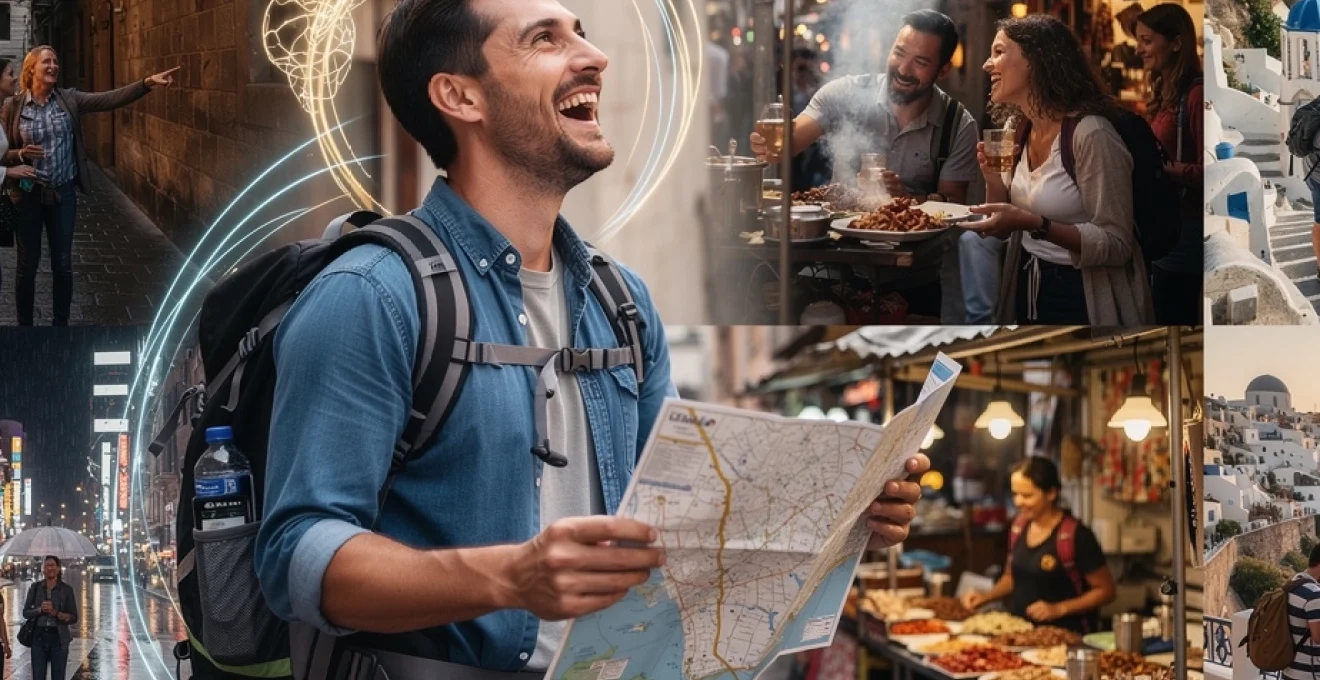
Travel has an extraordinary ability to create lasting memories, yet the most cherished recollections rarely stem from meticulously planned itineraries or heavily researched attractions. Instead, the moments that etch themselves most deeply into our consciousness are often the unexpected encounters, spontaneous discoveries, and serendipitous experiences that unfold when we least anticipate them. These unplanned instances possess a unique psychological and emotional resonance that transforms ordinary journeys into extraordinary adventures.
The phenomenon of spontaneous travel memories challenges conventional wisdom about trip planning and destination research. While structured itineraries certainly have their place in travel organisation, the magic often happens in the spaces between scheduled activities—during that wrong turn that leads to a hidden café, the conversation with a stranger that opens doors to local experiences, or the impromptu decision to explore an unfamiliar neighbourhood. Understanding why these unstructured moments create such powerful memories can revolutionise how you approach your next adventure.
Psychological mechanisms behind spontaneous travel experiences and memory formation
The human brain processes unexpected experiences differently than planned activities, creating stronger neural pathways that enhance memory retention and emotional connection. When you encounter something unplanned during travel, your mind shifts into heightened awareness mode, engaging multiple cognitive systems simultaneously to process and store the new information.
Dopamine release patterns during unstructured travel encounters
Spontaneous travel experiences trigger unique dopamine release patterns that differ significantly from planned activities. When you stumble upon an unexpected sight, sound, or experience, your brain releases a burst of dopamine—the neurotransmitter associated with pleasure and reward. This chemical response is more intense when the experience is unpredictable, as uncertainty amplifies the reward system’s activation.
Research in neuroscience demonstrates that unpredictable rewards generate stronger dopamine responses than expected ones. During unplanned travel moments, this heightened dopamine activity creates what psychologists term « flashbulb memories »—vivid, detailed recollections that remain accessible for decades. The unpredictability factor makes these experiences feel more significant and memorable than their planned counterparts.
Cognitive load theory applications in spontaneous destination discovery
Cognitive load theory explains why unplanned travel experiences often feel more engaging and memorable than structured activities. When you navigate unfamiliar territory without predetermined expectations, your brain allocates more processing power to environmental awareness and sensory input. This increased cognitive engagement enhances memory formation through what researchers call « elaborative encoding. »
The mental effort required to process unexpected information creates stronger memory traces. Unlike following a guidebook’s recommendations, spontaneous exploration demands continuous decision-making, problem-solving, and environmental assessment. These cognitive demands, while sometimes challenging, result in richer, more detailed memories that integrate emotional, sensory, and contextual information more effectively.
Episodic memory encoding advantages of unplanned travel moments
Episodic memory, which stores personal experiences and their contexts, functions optimally when encoding novel, emotionally significant events. Unplanned travel moments excel at creating these conditions naturally. The surprise element, combined with the need for immediate adaptation, activates the hippocampus—the brain region crucial for episodic memory formation—more intensively than routine, expected experiences.
These spontaneous encounters often involve multiple sensory modalities simultaneously: the visual impact of an unexpected vista, the sounds of local life, the aromas of unfamiliar foods, and the tactile experience of new environments. This multi-sensory encoding creates robust memory networks with numerous retrieval pathways, making these experiences easier to recall and more emotionally resonant over time.
Peak-end rule psychology in spontaneous travel experience recall
The peak-end rule, a psychological principle discovered by Nobel laureate Daniel Kahneman, explains why unplanned travel moments often dominate our memory of entire trips. According to this rule, people judge experiences largely based on their peak emotional moment and how they ended, rather than the average of all moments or the total duration.
Spontaneous experiences frequently become the peak moments of travel because they involve surprise, novelty, and often challenge. These elements create intense emotional states that the brain prioritises for long-term storage. Additionally, unplanned discoveries often carry forward into the trip’s conclusion, as you find
forward to share the story, revisit the place, or adapt the rest of your journey around that discovery. When this happens, the unplanned moment not only becomes a peak but also colours the « end » of the experience, aligning perfectly with the peak-end rule. In practice, this means that even if much of your trip followed a strict schedule, your overall memory of the holiday may be dominated by a handful of spontaneous, emotionally intense events that define how you feel about the entire journey.
Understanding this psychological pattern helps explain why travellers often return home raving about a random street performance or an improvised detour, rather than the main attractions they thought would be the highlight. When you leave intentional space in your itinerary for the unexpected, you increase the chances that these peak moments will naturally arise. Over time, these emotionally charged « peaks » become the stories you tell repeatedly, reinforcing their dominance in your travel memory network and shaping how you recall the trip as a whole.
Serendipitous discovery frameworks in popular tourist destinations
Although spontaneity may sound like the opposite of planning, you can intentionally design conditions that make serendipitous discovery more likely. Think of it as creating a flexible framework rather than a rigid schedule: you choose an area, a broad time window, and a general theme, then allow the details to unfold organically. This approach works especially well in popular tourist destinations, where the main attractions are well-known but the real charm often lies in the side streets and small local businesses.
By applying simple discovery frameworks—such as wandering radiuses, time-boxed explorations, or « follow-the-local » strategies—you can safely step off the beaten path while maintaining a sense of orientation. Instead of racing from one checklist item to another, you give yourself permission to follow curiosity, respond to chance encounters, and adapt your day in real time. The result is a series of unplanned travel moments that feel personal, authentic, and distinctly yours, even in heavily visited cities.
Hidden gem identification strategies in barcelona’s gothic quarter
Barcelona’s Gothic Quarter offers an ideal environment for unstructured exploration, with its maze-like alleys, medieval courtyards, and layered history. To discover hidden gems in this area, a useful strategy is to set a loose geographic boundary—perhaps between the Cathedral of Barcelona and Plaça Reial—then commit to turning down streets that appear less busy or lack obvious tourist signage. This simple rule increases your exposure to unexpected cafés, artisan workshops, and small plazas where local life unfolds away from the main flow.
You can also use time-based frameworks, such as dedicating one hour to « aimless » walking with no specific destination in mind. During this period, allow your choices to be guided by sensory cues: the sound of live music, the aroma of baking bread, or the sight of locals congregating. Ask yourself: where do the chairs face inward rather than outward, suggesting a place for neighbours rather than tourists? By following these subtle indicators, you are more likely to find authentic tapas bars, family-run bookstores, or tucked-away cloisters that become unforgettable highlights of your Barcelona travel memories.
Spontaneous cultural immersion opportunities in tokyo’s shibuya district
Shibuya is often associated with neon lights and the famous crossing, but its side streets contain countless opportunities for spontaneous cultural immersion. Instead of limiting your visit to major landmarks, try adopting a « vertical exploration » strategy: when you see an intriguing sign or narrow staircase, follow it up or down rather than staying at street level. Many of Tokyo’s most characterful bars, tiny jazz clubs, and speciality shops are hidden on upper floors or in semi-basement spaces you might otherwise overlook.
Another effective tactic for unplanned cultural experiences in Shibuya is to anchor your wanderings around everyday activities rather than attractions. Visit a supermarket, stationery store, or arcade and simply observe how locals interact with the space. You might strike up a conversation about a particular snack, ask for a recommendation on where to eat, or join a line outside a ramen shop with no English menu. These unscripted moments of curiosity and interaction often reveal more about contemporary Japanese life than formal tours, and they generate rich, story-worthy memories of your time in Tokyo.
Unplanned culinary adventures in bangkok’s street food networks
Bangkok’s street food scene is legendary, and it provides a near-perfect setting for spontaneous travel experiences centred on taste, smell, and social interaction. Rather than following a pre-made list of « must-try » stalls, you can apply a simple rule: eat where the locals queue. Look for carts or shophouses busy with office workers, families, or taxi drivers, especially at peak meal times, and allow these informal crowds to guide your choices. This method not only increases the likelihood of finding high-quality, safe food but also introduces you to dishes you might never have searched for by name.
An additional framework for unplanned culinary adventures is the « progressive dinner » approach. Choose a single street or neighbourhood—such as Yaowarat in Chinatown or the area around Victory Monument—and commit to sampling one small item at multiple stalls rather than having a full meal in one place. Start with a snack, follow with a soup, then try a grilled skewer or dessert, letting your senses and curiosity dictate the sequence. This modular style of eating naturally creates space for conversation with vendors, accidental detours, and surprising flavour combinations that become some of your most vivid Bangkok travel memories.
Off-the-beaten-path exploration techniques in santorini’s lesser-known villages
Santorini is famous for its photogenic caldera views and crowded sunsets, but its lesser-known villages offer a quieter canvas for spontaneous exploration. To escape the predictable routes of Oia and Fira, consider basing yourself in or dedicating a day to villages like Pyrgos, Megalochori, or Emporio. Instead of following a fixed walking tour, you might adopt a « church spire compass » strategy: visually identify a chapel or church on a hill, then find your own path towards it using stairs, alleyways, and donkey paths, adjusting whenever a side street catches your interest.
Another technique is to schedule « unscheduled hours » during the golden afternoon light, when daily life in these villages is most visible. Sit in a central square with a coffee, watch who comes and goes, and note where locals drift when they leave the main plaza. Do they disappear down a side lane, gather at a small kafeneio, or walk towards nearby vineyards? By quietly following these patterns and remaining open to conversation, you invite unplanned encounters—an invitation into a yard to taste homemade wine, a recommendation for a sunset spot without crowds, or a chance to see a workshop or family-owned bakery that rarely appears in guidebooks.
Digital detox travel methodologies and authentic experience creation
Paradoxically, the devices designed to help us travel more efficiently can also make our journeys feel less vivid and memorable. Constant navigation apps, social media updates, and real-time reviews reduce uncertainty but also remove many of the conditions that foster memorable unplanned travel moments. A digital detox approach to travel does not necessarily mean abandoning technology entirely; rather, it involves setting intentional boundaries so that screens support rather than dominate your experience.
By reducing smartphone dependency and reintroducing analogue tools like paper maps or handwritten notes, you increase your exposure to the very unpredictability that strengthens memory formation. You also free cognitive resources previously consumed by notifications and comparisons, allowing more attention for local sights, sounds, and people. In this sense, digital detox methodologies are not simply about « switching off » but about switching your awareness from a curated online feed to the unfiltered reality of the place you are visiting.
Smartphone dependency reduction protocols for enhanced travel awareness
To make room for more spontaneous travel experiences, you can adopt practical smartphone reduction protocols tailored to your comfort level. One effective method is the « scheduled check-in » rule: instead of keeping your phone constantly accessible, you designate specific times—perhaps morning, midday, and evening—for navigation, messaging, and research. Outside these windows, your phone stays in airplane mode or in your bag, turning from a reflexive habit into a deliberate tool.
Another protocol involves pre-downloading essential information such as offline maps, accommodation details, and key phrases, then resisting the urge to look up every question the moment it arises. Ask yourself: could I find the answer by asking a local, reading a sign, or simply experimenting? Treat the absence of instant digital information not as an inconvenience but as an invitation to interact with your surroundings. Over time, this shift in behaviour increases your situational awareness and creates more opportunities for the kind of unplanned encounters that become standout travel memories.
Analogue navigation techniques using traditional maps and local guidance
Using a physical map or schematic city plan might feel old-fashioned, but it offers psychological advantages for memory and engagement. When you navigate by paper, you must construct a mental model of the area rather than relying on a GPS dot, which strengthens spatial memory and encourages more active observation. The small « errors » that come with analogue navigation—a missed turn, an unexpected courtyard, a street that looks more interesting than the one you had planned—often lead directly to serendipitous discoveries.
Complementing maps with local guidance multiplies this effect. Instead of depending solely on digital reviews, you might ask a barista where they would take a visiting friend, or ask a shopkeeper to mark their favourite places on your map. This process not only yields customised recommendations but also initiates person-to-person interactions that digital tools cannot replicate. Each time you fold and unfold the map, adjust your route, or reinterpret someone’s directions, you create a dynamic, story-rich experience that embeds itself more deeply in memory than silently following a blue arrow on a screen.
Social media abstinence strategies during peak travel moments
One of the most powerful ways to enhance the emotional intensity of unplanned travel moments is to delay—or temporarily avoid—sharing them on social media. Posting in real time divides your attention between the present experience and an imagined audience, which can dilute the rawness of the moment. To counter this, you might adopt a « capture now, share later » rule: take a quick photo if you like, then put your phone away and fully re-immerse yourself, saving editing and posting for the evening or even after you return home.
Another strategy is to declare specific zones or time periods as « off-grid, » especially during experiences that are likely to become peak memories, such as a spontaneous hike, a local festival, or an impromptu invitation from residents. By consciously choosing to stay offline, you allow your sensory and emotional systems to operate without the pressure of documentation. The analogy is like listening to live music without recording it: knowing there is no replay encourages you to pay closer attention, creating richer, more enduring travel memories.
Mindfulness-based travel approaches for heightened sensory engagement
Mindfulness practices align naturally with travel, especially when your goal is to create memorable unplanned moments. By training yourself to notice small details—the texture of cobblestones, the rhythm of a foreign language, the interplay of light and shadow in a market—you increase the amount of information available for memory encoding. Simple techniques, such as taking three slow breaths when you arrive in a new place or deliberately naming three things you can see, hear, and smell, help anchor you in the present instead of in future plans or past regrets.
You can also experiment with « single-focus » walks, during which you temporarily prioritise one sense or theme: perhaps you pay particular attention to doorways, public art, or the sounds of a neighbourhood at dawn. This mindful curiosity turns even an ordinary street into a field of discovery, where unexpected scenes and interactions stand out more sharply. Over time, these practices cultivate an inner stance of openness and receptivity, making you more likely to recognise and appreciate the unplanned experiences that transform a standard trip into an unforgettable journey.
Conversational travel dynamics and local community integration strategies
Unplanned travel memories often emerge from conversations you did not expect to have—with a fellow passenger on a train, a street vendor, or a host who goes beyond the usual formalities. These encounters function as gateways into local life, providing context and nuance that guidebooks cannot imitate. When you view conversation itself as a form of exploration, every interaction becomes a potential route to new experiences, insider tips, and invitations.
To foster these dynamics, it helps to adopt a « question-forward » mindset. Instead of asking only transactional questions (such as prices or directions), you might inquire about personal favourites, seasonal traditions, or local changes over time. Even a few well-chosen phrases in the local language can signal respect and openness, encouraging people to share more than the standard tourist script. Over time, such interactions can lead to shared meals, unexpected detours, or introductions to friends and family—all of which generate precisely the kind of rich, emotionally charged episodes that remain vivid in your travel memory.
Strategically choosing environments that facilitate natural conversation also matters. Staying in guesthouses, smaller hotels, or homestays, joining communal tables, or participating in local classes or workshops increases the probability of meaningful exchanges. You might think of it like increasing your « surface area » for connection: the more situations you enter where conversation is normal, the more likely it is that a single chance meeting will reshape your day. In this way, conversational travel is not random; it is an intentional stance that invites serendipity while respecting the rhythms and boundaries of the communities you visit.
Risk assessment frameworks for safe spontaneous travel decision-making
While embracing spontaneity can greatly enrich your journeys, it should never mean ignoring personal safety or local norms. Effective spontaneous travel involves continuous, low-level risk assessment—an internal checklist that runs quietly in the background as you decide whether to follow a new acquaintance to a different bar, take a side road, or stay out later than planned. Rather than eliminating impulsive choices, a sound risk framework helps you distinguish between healthy adventure and unnecessary danger.
One practical approach is to use a simple three-factor assessment whenever a new opportunity arises: environment, people, and exit options. Ask yourself: does the physical environment feel reasonably safe and well-lit; do the people involved give consistent, respectful signals; and do you have a clear way to leave or change your mind if needed? If two of these three factors feel uncertain, it is usually wiser to decline or modify the plan. Trusting intuition is also crucial; if something feels off, you lose nothing by stepping back and much by overriding your instincts.
Building redundancy into your spontaneous plans further reduces risk. Share your general whereabouts and intentions with a trusted person, carry basic safety items, and keep digital copies of key documents accessible offline. For solo travellers, pre-arranging check-in messages at set times can provide additional security without constraining your ability to improvise within those windows. In this way, you create a safety net that allows you to follow intriguing possibilities—such as joining a group you just met for a local festival—while maintaining a responsible buffer against foreseeable problems.
Cultural authenticity metrics in unstructured travel experiences versus planned itineraries
Many travellers seek « authentic » experiences, yet this term can be surprisingly difficult to define. One useful way to compare structured and unstructured travel is to consider a few simple authenticity metrics: the degree of local participation, the level of unpredictability, and the depth of personal engagement. Planned itineraries, especially in heavily touristed areas, often score high on efficiency and comfort but lower on these authenticity indicators. They deliver what they promise, but they rarely deviate from a script refined for visitors rather than residents.
Unstructured travel, by contrast, tends to involve higher local participation—markets where most customers are residents, festivals designed primarily for the community, or cafés where staff recognise regulars. It also carries a higher level of unpredictability, from schedule changes to unscripted performances, which aligns with the psychological mechanisms that create stronger travel memories. Personal engagement is typically deeper as well, since you are less shielded by intermediaries and more likely to negotiate, ask questions, or navigate minor misunderstandings directly.
This does not mean that planned activities lack value; guided tours, museums, and pre-booked experiences can provide important historical and cultural context. However, when you deliberately blend structured elements with open, unscheduled time, you allow both modes to complement each other. The planned components supply orientation and foundational knowledge, while the unplanned intervals yield lived, unscripted snapshots of everyday culture. Together, they produce a richer tapestry of travel memories, in which the most treasured threads are often those you never could have woven by design.