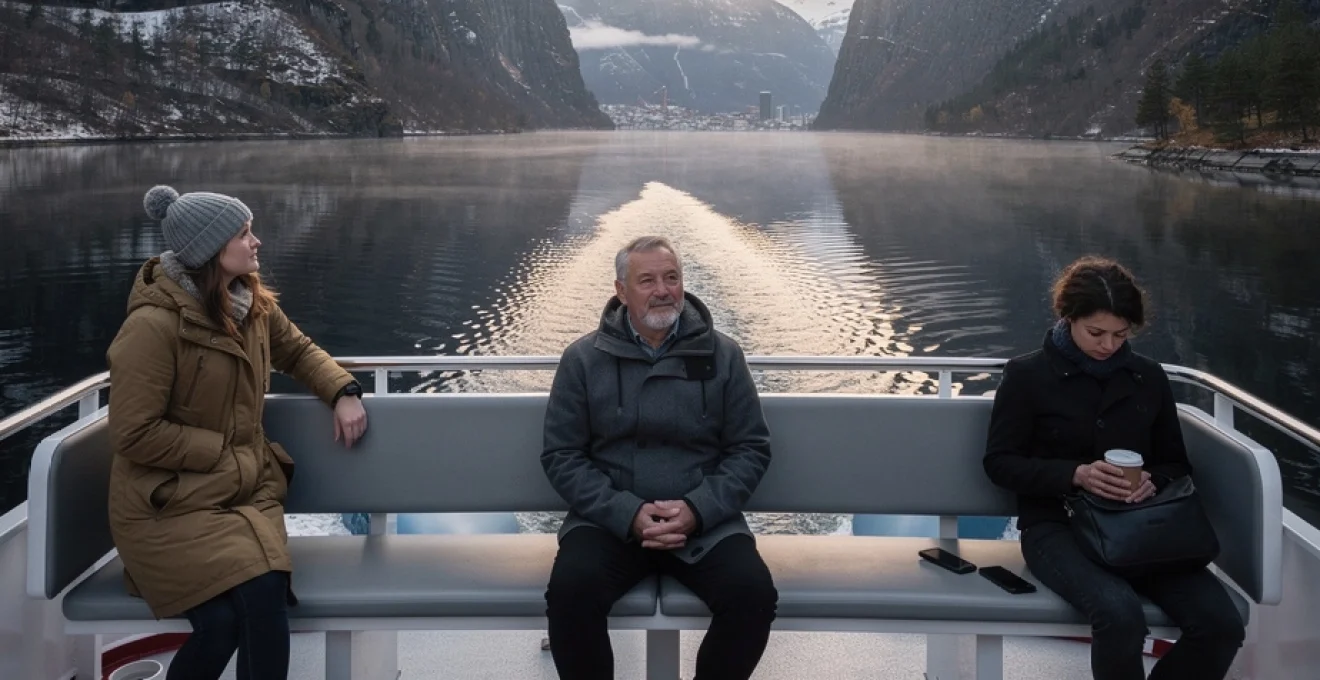
In an age where noise has become the default soundtrack of modern existence, a journey aboard Norway’s legendary Coastal Express ferries offers something increasingly rare: profound, authentic silence. This isn’t merely the absence of sound, but rather a presence of quietude so complete that it transforms the experience of travel itself. Across the fjords and archipelagos of Norway’s dramatic coastline, hybrid-electric vessels glide through waters framed by vertical cliffs, carrying passengers through landscapes where silence isn’t just noticed—it’s felt. From Bergen to Kirkenes, these maritime routes have quietly become laboratories for understanding what we lose in our noise-saturated world, and what we gain when we reclaim the stillness that once defined human experience. The Norwegian approach to ferry travel reveals that silence isn’t simply pleasant; it’s restorative, psychologically significant, and increasingly precious in our contemporary lives.
The aurlandsfjord crossing: where norwegian ferry culture embraces stillness
Norwegian ferry culture represents something fundamentally different from maritime transportation elsewhere in the world. While most ferry services prioritise speed, efficiency, and entertainment systems to distract passengers from the journey itself, Norway’s approach centres on integration with the natural environment. The Coastal Express, celebrating 130 years of service in 2023, has evolved from a practical lifeline connecting isolated communities into a floating testament to the value of contemplative travel. These vessels navigate 2,500 nautical miles along some of Europe’s most spectacular coastlines, stopping at 34 ports where the rhythm of life remains largely unchanged despite technological advancement.
The engineering behind these modern ferries reflects a distinctly Norwegian philosophy. Hybrid-electric propulsion systems weren’t adopted solely for environmental reasons—though Norway’s commitment to sustainability certainly played a role. The technology fundamentally transforms the acoustic experience aboard these vessels. Traditional diesel engines generate constant mechanical rumble that passengers learn to ignore, creating a baseline of noise pollution that masks the natural soundscape. Electric propulsion, by contrast, produces minimal vibration and virtually no engine roar, allowing the subtle sounds of wind, water, and wildlife to emerge. This technological choice represents a cultural statement: the journey matters as much as the destination, and silence enhances rather than diminishes the experience.
During the four-hour silent fjord cruise departing from Rådhusbrygga in Oslo, passengers discover that quietude reveals details otherwise obscured. The gentle lapping of waves against the hull becomes audible. Seabirds calling across the water can be heard from considerable distances. Even the exhalations of fellow passengers take on a contemplative quality, as mobile phones remain pocketed and conversations naturally soften to match the environment. This isn’t enforced silence—no signs demand quiet—but rather an organic response to surroundings that invite reflection rather than distraction. Children, often restless during urban sightseeing, settle into observation, their attention captured by the slowly changing scenery visible through expansive windows designed to maximise visual connection with the landscape.
Acoustic ecology and the norwegian fjordscape soundscape
The emerging field of acoustic ecology examines how sound environments affect both human wellbeing and ecosystem health. Norway’s fjords provide ideal conditions for studying these relationships, as they represent some of the quietest accessible environments in modern Europe. Acoustic ecologists measure sound in decibels, but also analyse frequency ranges, temporal patterns, and the relationship between natural and anthropogenic (human-generated) sounds. The Norwegian fjordscape offers a masterclass in what researchers call a « hi-fi soundscape »—an environment where individual sounds remain distinct and clear rather than blending into indistinguishable noise.
Decibel measurements aboard hurtigruten and regional ferry services
Comparative measurements reveal striking differences between traditional ferry services and Norway’s electric-hybrid fleet. Conventional diesel ferries typically register 75-85 decibels in passenger areas during operation—roughly equivalent to heavy traffic or a busy restaurant. These sound levels aren’t dangerous for short exposures, but they require passengers to raise their voices for conversation and prevent appreciation of subtle environmental sounds. By contrast, Norway’s newer electric ferries maintain passenger area sound levels of 45-55 decibels during electric operation, comparable to a quiet library or suburban neighbourhood. This 20-30 decibel reduction represents a profound shift in acoustic experience, as decibel scales are logar
ithmic, meaning that even modest numerical changes correspond to substantial perceived differences. A 10-decibel reduction is generally experienced as halving the loudness; the 20-30 decibel drop between conventional and electric-hybrid ferries therefore feels like moving from the inside of a bus to a quiet reading room. On the Norwegian Coastal Express, many passengers remark that they « notice the silence » most acutely when stepping back onto a busy quay, where harbour machinery, road traffic, and urban life suddenly reassert themselves. Onboard, the reduced mechanical background allows a richer tapestry of natural sound to emerge: a distant foghorn, the slap of waves against rock, or the faint crackle of ice in winter. Noise hasn’t just been reduced; it has been curated, revealing how sound quality can redefine what it means to travel by sea.
Natural sound absorption properties of sognefjord’s vertical rock faces
Norway’s fjords are not just visually dramatic; they are also acoustically unique. The steep, often near-vertical rock walls of Sognefjord and its branches like Aurlandsfjord function as natural sound absorbers and deflectors. Instead of reflecting noise in the chaotic way that concrete high-rises do, these geological formations diffuse and scatter sound energy over vast surfaces. Low-frequency engine hum that would normally carry for kilometres in open water is significantly dampened, while discrete natural sounds—like waterfalls or the wingbeats of seabirds—retain their clarity.
Acoustic researchers sometimes compare fjords to vast, open-air concert halls with irregular walls that prevent harsh echoes. In Sognefjord, the combination of deep water, soft vegetated slopes in places, and rugged rock faces reduces the kind of reverberant buildup common in harbours bounded by metal and glass. The result is an acoustic environment where quiet moments remain truly quiet, and a single gull call can travel astonishing distances without being swallowed by background roar. For passengers on a ferry gliding past places like Flåm or Undredal, this means that the landscape is not just something to look at; it becomes something you can listen to.
Seasonal conditions further shape this natural acoustic insulation. In winter, when snow clings to ledges and forests, it adds another layer of sound absorption, softening even the gentle slap of waves against the hull. In late spring and summer, waterfalls released by melting snow punctuate the quiet with a continuous, soothing broadband hiss. This interplay between rock, water, and weather helps explain why silence in a Norwegian fjord feels different from silence on an open sea: it is sculpted by the terrain itself, like light filtered through stained glass.
Hydroacoustic silence beneath norway’s electric-hybrid ferry fleet
The transformation of Norway’s ferry systems is not only audible above the surface; it reaches deep into the underwater acoustic environment. Traditional marine diesel engines and propellers generate intense low-frequency noise that travels long distances underwater, contributing to what scientists call « acoustic smog » for marine life. Electric-hybrid ferries, by contrast, can operate for extended periods at low or near-zero emissions, dramatically reducing underwater noise levels. Hydroacoustic measurements taken in several Norwegian fjords show reductions of up to 50 percent in certain frequency bands when electric mode is engaged.
This quieter underwater soundscape has significant implications for marine mammals and fish species that rely on sound for navigation, hunting, and communication. Harbour porpoises, which are common along the Norwegian coast, use high-frequency clicks that can be masked by broadband propeller noise. With reduced mechanical interference, their effective communication range increases, much as our own ability to converse improves when a loud air conditioner is turned off. For cod and herring, both economically important species, lower chronic noise exposure appears to reduce stress responses, supporting healthier behaviour in spawning and feeding grounds.
For you as a passenger, this hydroacoustic silence is largely invisible but subtly influential. When the vessel switches into electric mode as it glides into a narrow fjord or approaches a small port, the tonal character of the ship changes. Vibrations through the deck diminish, the hull feels less « alive » with mechanical energy, and the connection between boat and water becomes more fluid and gentle. It is a bit like swapping a diesel locomotive for a modern electric train: the movement remains, but the noise signature fades, leaving space for awareness and reflection.
Comparative analysis: urban noise pollution versus fjord ambient sound levels
To understand why a silent ferry cruise can feel so transformative, it helps to compare typical urban noise levels with those found in a fjord environment. In many European cities, average daytime sound levels on main streets hover around 65-75 decibels, with peaks easily surpassing 85 during rush hour. Indoors, open-plan offices often register 55-65 decibels, sustained over many hours. This constant low-level bombardment of sound taxes our nervous system, even when we think we’ve tuned it out, contributing to fatigue, reduced concentration, and elevated stress hormones.
By contrast, ambient sound measurements taken in remote sections of Geirangerfjord or Aurlandsfjord on calm days can fall as low as 30-35 decibels—quieter than many bedrooms at night. Even when a ferry passes through, the sound profile is dominated not by engines but by wind, waves, and the occasional human voice. The transition from a city soundscape to a fjord soundscape is thus more than a change of scenery; it is a physiological shift. Studies in environmental psychology suggest that moving from 70-decibel environments to sub-40-decibel spaces can reduce heart rate and blood pressure within minutes.
You might feel this change most clearly during the first hour at sea. The mental « buzz » of the city takes time to subside, much like your eyes adjusting when you step into a dimly lit room. After a while, you begin to notice sounds you would normally ignore: the swirl of wake against rock, or the distant rumble of an avalanche in spring. The ferry becomes less like public transport and more like a moving retreat centre, carrying you from one acoustic reality to another. In this sense, Norwegian fjords offer a form of sonic reset that many of us rarely experience in daily life.
Contemplative travel psychology on scandinavian maritime routes
Silence on a Norwegian ferry is not an empty backdrop; it actively shapes how we think and feel during the journey. Contemporary travel psychology has begun to explore how slow, quiet environments influence attention, mood, and memory formation. Unlike air travel, which compresses time and sensory experience into a sealed, noisy tube, maritime routes between Bergen, Trondheim, Tromsø, and Kirkenes stretch time and gently loosen our usual cognitive patterns. You are neither fully at home nor fully arrived; you are suspended in an in-between space where contemplation naturally arises.
Scandinavian maritime culture has embraced this liminal quality rather than trying to eliminate it. Instead of filling ships with constant announcements, blaring televisions, and aggressive entertainment, many Norwegian ferries opt for understated design: panoramic windows, soft lighting, and quiet lounges where conversation competes only with the rustle of pages or the clink of cups. In such settings, silence becomes both a shared social norm and a psychological tool, inviting passengers to notice their thoughts, their surroundings, and the subtle emotional shifts that occur when external stimuli recede. What happens to our minds when the usual background noise falls away?
Mindfulness triggers in extended visual horizons across geirangerfjord
One answer comes from the concept of « mindfulness triggers »—elements in our environment that naturally draw us into present-moment awareness. In Geirangerfjord, a UNESCO World Heritage site visited by some Coastal Express itineraries, these triggers abound. The extended visual horizons, with towering cliffs plunging into narrow channels, waterfalls hanging like silver threads, and small farms clinging improbably to steep slopes, create a visual field that is both vast and detailed. When combined with a quiet soundscape, this panorama encourages a kind of effortless mindfulness. You find yourself simply watching, breathing, and noticing, without needing an app or a guided meditation.
Psychologists studying restorative environments point out that expansive views engage what is known as « soft fascination »—attention that is gently held without requiring effort. On deck, wrapped against the wind as the ship rounds a headland near the Seven Sisters waterfall, you may realise you have been quietly observing for 20 minutes without checking your phone. The slow motion of the ferry, at times no faster than a brisk cycling pace, amplifies this effect. Unlike a car racing along a highway, the ship’s movement allows your eyes and mind to track changes in the landscape without strain, supporting a contemplative, almost meditative state.
An apt analogy is reading a long, well-written novel compared to scrolling social media feeds. The ferry journey, like the novel, offers continuity and depth; the scenery unfolds at a human pace, giving you time to form emotional connections to what you see. Silence is what keeps this narrative intact, preventing it from being chopped into fragments by intrusive announcements or background music. In this way, Geirangerfjord and similar routes become not just tourist attractions, but moving classrooms for learning how to pay attention again.
Dopamine detoxification through device-free ferry journeys
Another psychological dimension of silent ferry travel involves our relationship with digital devices. Modern life often keeps us in a state of high-frequency stimulation, with constant notifications and rapid content shifts that spike and crash our dopamine levels. A multi-day voyage along the Norwegian coast offers an organic form of « dopamine detox, » especially if you choose to keep your phone in airplane mode for long stretches. With patchy mobile coverage in some fjord regions and the natural incentive to look out the window instead of at a screen, it becomes easier to disengage from the endless scroll.
Researchers on digital wellbeing suggest that such breaks can recalibrate our reward systems, making simpler experiences feel meaningful again. Onboard, this might translate to genuine enjoyment of a cup of coffee on deck, the pleasure of reading an entire chapter without interruption, or the unexpected satisfaction of doing nothing but watching clouds move along a ridge. The low-stimulus environment of a quiet ferry acts like a fast from constant information, allowing your nervous system to downshift. You may notice, after a day or two, that your urge to check messages every few minutes has softened.
Of course, you still have the choice to stay online; ferries increasingly offer Wi‑Fi and charging points. But many travellers report that the surrounding silence acts as a gentle social pressure to remain present. It can feel jarring to watch loud videos in a lounge where others are quietly gazing at the sea, a bit like talking on speakerphone in a library. This shared respect for the soundscape encourages what we might call « intentional connectivity »: you go online for specific reasons, then return to the calm of the journey. Over time, such patterns can inspire you to bring similar device-free intervals into your everyday commute or leisure time.
The solitude paradox: shared silence among strangers on public transport
There is a paradox at the heart of Norwegian ferry travel: you are often surrounded by people, yet the experience feels deeply solitary in a nourishing way. Sociologists have long noted that public transport can produce both crowding and loneliness, especially when environments are noisy and anonymous. Silent ferries flip this dynamic. In a lounge where voices are low and the main sound is the sea, being together with strangers in quiet can actually foster a sense of subtle connection. You share glances at a passing lighthouse, or stand side by side on deck watching the midnight sun, without needing to speak.
This phenomenon reveals something about how humans relate in low-noise spaces. Without the need to compete with loudspeakers or engine rumble, small social cues become more legible: a nod, a smile, or a gentle shift to make room at the railing. Silence lowers the barrier to these micro-interactions, much like a well-designed library reading room feels welcoming rather than isolating. You remain free to retreat into your own thoughts, yet you also feel part of an unspoken community of travellers experiencing the same landscape. It is solitude, but not isolation.
For some, this shared silence may initially feel unfamiliar, especially if you’re used to environments where quiet is associated with awkwardness or boredom. Yet many passengers find that, by the end of a long coastal leg, they have developed brief but meaningful connections: a conversation sparked over a chart on the wall, or a shared thermos of coffee on a cold deck. The silence did not prevent these interactions; it framed them, giving them weight and contrast. In this way, public maritime transport along the Norwegian coast demonstrates that quiet spaces need not be anti-social; they can support a more subtle, attentive form of social life.
Attention restoration theory applied to norwegian coastal navigation
Attention Restoration Theory (ART), developed by environmental psychologists Rachel and Stephen Kaplan, proposes that natural environments help replenish our ability to focus after periods of mental fatigue. According to ART, restorative settings share four key qualities: being away, extent, fascination, and compatibility. Norwegian coastal navigation embodies all four with remarkable precision, especially when experienced on a quiet, slow-moving ferry. You are literally « away » from your everyday context, immersed in a landscape of vast « extent » that stretches beyond the horizon, filled with gentle « fascination » in the form of shifting light, waves, and weather.
Silence plays a crucial role in enhancing the fourth quality: compatibility. An environment is compatible when it supports rather than opposes your desire for rest and reflection. A noisy ferry with constant announcements and entertainment screens would undermine this compatibility, dragging your attention back into a state of vigilance. A silent or low-noise vessel, by contrast, aligns with your intention to unwind, offering no unnecessary demands on your cognitive resources. You can let your thoughts wander, return, and wander again, in sync with the ferry’s passage through narrow straits and open sounds.
Empirical research supports the idea that even brief exposure to water-based natural environments can improve cognitive performance, especially on tasks requiring sustained attention. Imagine stepping off a seven-hour Oslo fjord and city tour that includes a quiet cruise segment; instead of arriving mentally drained, you may feel strangely refreshed, as if you had taken a long walk in the woods. For travellers whose daily lives involve dense schedules and screen-based work, this kind of attention restoration may be one of the most valuable, if least advertised, benefits of Norwegian ferry travel.
Silent spaces as cultural heritage in nordic transportation design
Silence in Norwegian ferry travel is not a happy accident; it reflects deeper cultural values that run through Nordic transportation design. Across trains, buses, and boats, there is a noticeable tendency toward understated interiors, minimal announcements, and the respectful assumption that passengers appreciate calm. This design language treats quiet not as mere absence but as a shared cultural good, akin to clean air or public parks. In this sense, silent spaces are a form of intangible heritage, passed down through design choices, operational norms, and unwritten social expectations.
Historic vessels on the Coastal Express route demonstrate how these values have evolved. Early 20th-century ships already included quiet lounges and reading rooms, recognizing that long voyages called for contemplative spaces. Modern equivalents translate this ethos into acoustic insulation, vibration-damping materials, and layout decisions that separate the noisiest functional areas from passenger zones. Even the choice to avoid constant background music is intentional. By leaving the soundscape « clean, » designers allow the sea and weather to set the auditory mood, reinforcing the connection between travel and place.
When we think about preserving cultural heritage, we usually picture buildings, artefacts, or traditional crafts. Yet the Norwegian example invites us to consider the heritage of experience: what it feels like to sit in a warm, wood-panelled lounge watching snow fall outside, with only the hush of conversation and the creak of the ship for company. Protecting this heritage means resisting pressures to fill every silence with commercial messages or entertainment. It also suggests that other countries, when upgrading their own transport networks, might look north for inspiration on how to design vehicles and terminals that respect passengers’ need for quiet as part of the travel experience.
Environmental philosophy: friluftsliv and the maritime silence experience
Behind Norway’s embrace of quiet, nature-focused travel lies a broader environmental philosophy known as friluftsliv—literally « open-air life. » Coined in the 19th century and popularised by thinkers, educators, and mountaineers, friluftsliv emphasises simple, non-motorised, often quiet immersion in nature as a path to wellbeing and environmental awareness. While we might associate it with hiking, skiing, or cabin life, friluftsliv also finds expression on the water. A silent ferry cruise, though technically motorised, can align closely with this philosophy when designed to minimise noise, pollution, and distraction.
Friluftsliv differs from more commercialised notions of outdoor recreation that prioritise speed, adrenaline, or spectacle. It values slowness, modest comfort, and direct sensory engagement with wind, water, and weather. When you stand on the deck of a hybrid-electric ferry under the midnight sun, listening more than talking, you are practicing a kind of contemporary maritime friluftsliv. The ship becomes a moving platform from which to experience the elements, rather than a bubble separating you from them. Silence is the medium that allows this connection to form, as it would on a quiet ski tour or a day spent fishing from a small boat.
Arne næss’s deep ecology principles manifested in ferry travel
Norwegian philosopher Arne Næss, founder of the deep ecology movement, argued for an environmental ethic based on intrinsic value rather than utility. Nature, in his view, is not just a resource for human use but a community of beings with their own right to flourish. Several of Næss’s principles resonate with the way Norway has reimagined its ferry systems. Reducing underwater noise to protect marine life, cutting emissions through electric propulsion, and designing routes that encourage reverence rather than mere consumption of scenery all reflect a deep ecological sensibility.
On a practical level, you can see this in how certain fjords limit the size and number of visiting ships, or in the push for zero-emission vessels in UNESCO-listed areas. These policies are not only about air quality or climate targets; they also safeguard the acoustic and visual integrity of the landscape, treating silence and darkness as ecological resources. Næss himself was a passionate mountaineer who built a hut high above Sognefjord, where he practiced a deliberately simple life. One could imagine him approving of a ferry where passengers sit quietly watching distant peaks he once climbed, not as mere spectators but as participants in a shared, living environment.
Deep ecology also encourages us to examine our internal attitudes. When we board a silent ferry, do we see the fjord as an entertainment product, or as a place with its own rhythms and needs? Choosing to speak softly on deck, to avoid loud music on a balcony cabin, or to support operators that invest in low-noise technology are all small ways of embodying a deep ecological ethic. Much like voting, each individual action seems minor; collectively, they help define what kind of maritime culture we hand on to future generations.
The norwegian right to roam and accessible quietude on public waterways
Another pillar of Norway’s environmental culture is allemannsretten, the « right to roam, » which gives everyone legal access to uncultivated land and, by extension, to much of the country’s coastline and waterways. This principle democratises access to nature and, importantly, to its silence. While luxury cruises exist, many of the quietest and most beautiful fjord routes are served by public ferries and reasonably priced Coastal Express cabins. The ability to step aboard in a small port and be carried through world-class scenery is not reserved for an elite; it is woven into the fabric of everyday Norwegian life.
From an acoustic perspective, this accessibility matters because it spreads the benefits of quietude across society. Silence is no longer a privilege limited to remote cabin owners or expensive wellness retreats; it becomes part of the public commons. A student traveling home from university, a family visiting grandparents in a coastal village, and an international visitor exploring the coast all share the same hushed lounges and open decks. In doing so, they participate in a living example of how public infrastructure can deliver not only transport, but also psychological and environmental wellbeing.
This right to roam extends conceptually to waterborne travel even when legal frameworks differ. When you take a ferry across Aurlandsfjord or Oslofjord, you are benefiting from policy decisions that prioritise access over exclusivity. The presence of silent or low-noise vessels ensures that this access does not degrade the very qualities—peace, beauty, ecological richness—that make these places worth visiting. It is a reminder that true accessibility includes not just physical entry, but also the preservation of the experience once you arrive.
Seasonal variations: midnight sun silence versus winter darkness acoustics
Silence on the Norwegian coast is not static; it changes with the seasons in ways that are both poetic and measurable. In summer, especially above the Arctic Circle, the midnight sun bathes the sea in continuous light, but the soundscape remains subdued. Bird colonies may be active, and distant waves murmur against rocks, yet the absence of full darkness tends to dampen some of the nocturnal activity common at lower latitudes. On a late-night leg between Tromsø and Skjervøy, you might stand on deck in golden light, hearing little more than the soft rush of the ship’s wake and the occasional cry of a gull.
Winter brings a very different acoustic character. With long periods of darkness, lower tourist traffic, and snow blanketing both shore and deck, the coast can feel almost otherworldly in its quiet. The insulation provided by snow and ice absorbs high-frequency sounds, leaving a deeper, more muted palette: the crunch of boots on a frozen pier, the muted thump of ice floes nudging the hull, the distant rumble of a snowplough in a sleeping village. On still nights, sound can carry far over cold air and water, so a single dog barking on shore or the low horn of a distant vessel may seem unusually present.
For travellers, these seasonal shifts offer distinct ways to experience maritime silence. Summer’s bright, gentle soundscape pairs well with long hours on deck, slow photography, and lingering conversations over coffee. Winter’s darker, denser quiet invites introspection: reading by a window while snowflakes streak past, or stepping out briefly into the biting air just to feel the contrast between indoor hush and outdoor stillness. In both cases, silence is not emptiness but a dynamic partner to light, temperature, and weather—a reminder that the beauty of quiet is inseparable from the cycles of the natural world.
Practical applications: integrating silence principles into modern travel habits
Experiencing silence on a Norwegian ferry can be more than a memorable travel episode; it can serve as a template for how you approach movement and rest in everyday life. The principles at work—low noise, slow pace, visual connection to nature, and respectful social norms—are surprisingly portable. You may not have daily access to Geirangerfjord, but you can still apply lessons from Norwegian maritime travel to commutes, business trips, and holidays elsewhere.
One starting point is intentional sound design in your own journeys. When booking transport, you might prioritise quieter options: choosing early or late trains over flights for regional trips, seeking out electric buses or ferries where available, or selecting seating areas away from speakers and engines. Onboard, you can curate your personal soundscape by using noise-reducing headphones not just to add music, but sometimes to enjoy silence, or by replacing loud entertainment with an audiobook or nothing at all. These small decisions mimic the Norwegian choice to favour electric propulsion and calm interiors, giving your nervous system brief but valuable pockets of rest.
You can also bring a touch of fjord-like attention to your visual environment. On any journey with a window—train, tram, even a city bus—you might experiment with a « no screens for 30 minutes » rule, simply watching the world pass by. If you live near water, consider occasional local « mini-crossings »: short, quiet trips by commuter ferry, kayak rental, or even a walk along a harbour, framed as micro-retreats rather than mere transit. The goal is not to romanticise every commute, but to rediscover how movement through space can double as time for reflection when noise and distraction are kept in check.
Finally, think about how you contribute to the shared soundscape wherever you travel. The unspoken social contract on many Norwegian ferries—soft voices, minimal intrusive sound, respect for others’ quiet—is something you can help foster in other contexts. That might mean lowering your voice on a train, using headphones instead of speakers in public, or choosing not to make that loud work call in a small waiting room. These gestures may feel minor, but they echo the larger Norwegian commitment to designing systems that protect silence as a common resource. If enough of us adopt similar habits, the beauty of maritime quietude need not remain confined to the fjords; it can begin to influence how we move and meet in the noisy world beyond.