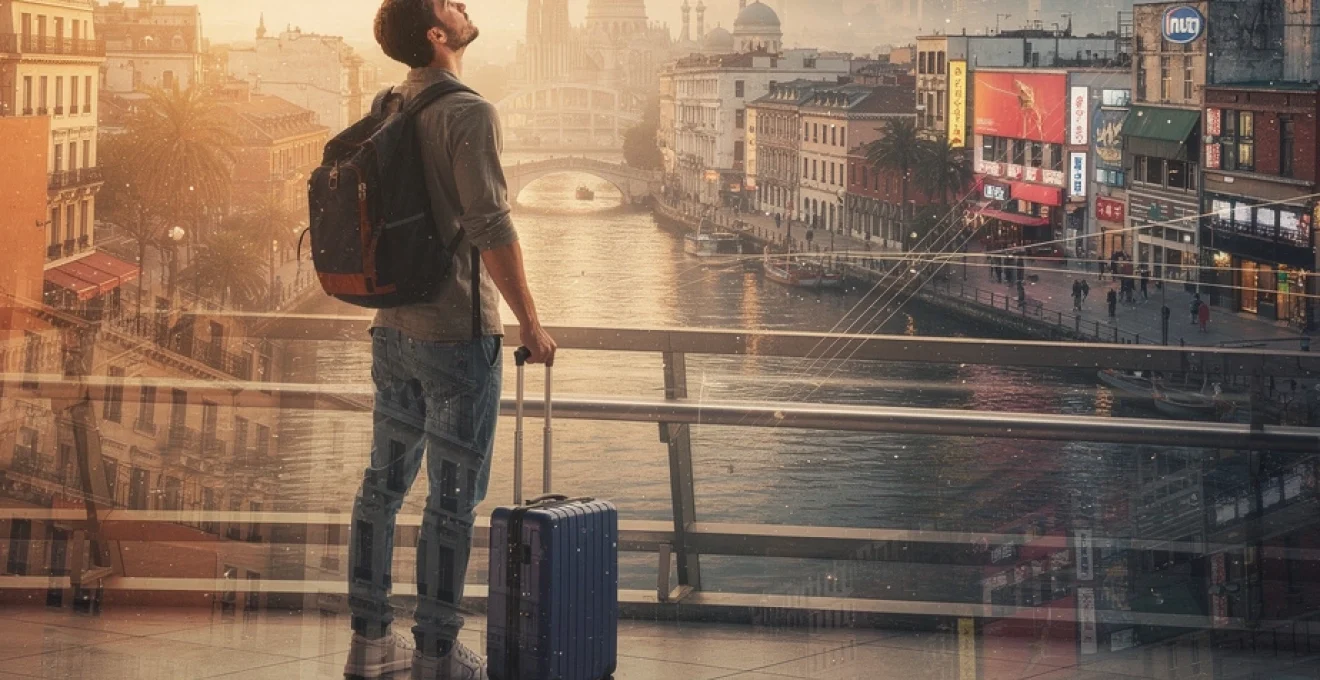
There exists a peculiar intensity to the moment when you finally set foot in a destination that has occupied your imagination for years. The anticipation builds layer upon layer—through photographs studied, documentaries absorbed, stories heard, and countless hours spent mentally rehearsing the experience. When that longed-for arrival finally materialises, you’re confronted with something altogether more complex than simple satisfaction. This convergence of expectation and reality creates a psychological phenomenon that travellers describe as simultaneously euphoric, disorienting, and deeply transformative. Understanding this experience requires examining the intricate interplay between mental preparation, sensory overload, and the inevitable reconciliation between the city you imagined and the one that actually exists.
Psychological anticipation and Pre-Arrival emotional architecture
The human mind constructs elaborate mental models of places we’ve never visited, building what psychologists term « destination schemas »—comprehensive frameworks comprising visual expectations, emotional associations, and behavioural predictions. When you’ve dreamt of visiting Paris, Tokyo, or Istanbul for years, your brain hasn’t been idle; it’s been actively constructing a detailed simulation of what that experience will entail. This mental architecture becomes more elaborate with each travel documentary watched, each photograph examined, and each traveller’s tale absorbed.
Cognitive dissonance between imagined and physical urban landscapes
The gap between imagination and reality often produces cognitive dissonance—a psychological discomfort arising when new information contradicts existing beliefs. When you arrive in Prague expecting centuries-old cobblestones bathed in golden light, the presence of modern advertising, tourist crowds, and unexpected construction work creates friction with your pre-formed mental image. Research in travel psychology suggests that this dissonance can manifest in various ways: some travellers experience disappointment, others feel heightened curiosity, whilst many undergo a rapid recalibration of expectations. The intensity of this dissonance correlates directly with the rigidity of pre-visit expectations and the duration of anticipation.
Neurological response patterns during Long-Held travel goal achievement
Neuroscientific studies reveal that achieving long-held goals triggers significant dopamine releases in the brain’s reward centres. When you finally arrive in that dream destination, your neural chemistry undergoes measurable changes. The anticipation phase itself produces dopamine, creating pleasure in the planning and waiting. Upon arrival, a secondary surge occurs, but interestingly, this peak often proves less intense than expected—a phenomenon known as « arrival deflation. » Your brain has been rehearsing this moment so thoroughly that the actual experience can feel oddly familiar rather than novel, potentially dampening the neurological reward response you anticipated.
The role of visual media in constructing Pre-Visit destination schemas
Contemporary travellers construct their destination expectations through an unprecedented volume of visual media. Instagram feeds, travel blogs, YouTube vlogs, and Pinterest boards create hyper-curated representations of cities that emphasise photogenic moments whilst obscuring mundane realities. When you’ve absorbed hundreds of images of Santorini’s white-washed buildings against azure seas, your brain develops specific visual templates. The challenge emerges when physical reality includes elements systematically excluded from curated media: scaffolding on iconic buildings, overflowing rubbish bins during peak season, or the sheer physical exhaustion of navigating hilly terrain in Mediterranean heat.
Temporal investment and emotional intensity correlation in dream destinations
The duration of anticipation directly influences the emotional intensity of arrival. Someone who decided last month to visit Barcelona experiences fundamentally different arrival emotions compared to someone who’s dreamt of that moment for fifteen years. Longer anticipation periods create deeper emotional investment, more elaborate mental models, and consequently, more complex arrival experiences. This temporal factor also influences memory formation—destinations anticipated for years become more deeply encoded in long-term memory, their importance magnified by the waiting period itself. The journey becomes interwoven with personal identity, marking specific life chapters and representing deferred dreams finally realised.
Sensory immersion upon first contact with iconic urban environments
The initial sensory encounter with a long-anticipated city overwhelms in ways that photographs and videos cannot prepare you for. Visual media transmits only sight and sound, leaving your other senses entirely unprepared for the olfactory, tactile, and even gust
atory shock of actually being there. The smell of a city, the feel of its pavements under your shoes, the way the air sits on your skin at dusk—these are elements no algorithm can fully render in advance. The feeling of arriving in a city you’ve dreamed about for years is intensified precisely because your senses are suddenly asked to process, in real time, an environment you’ve only ever engaged with in two dimensions. This is where the experience shifts from theoretical to embodied, and where memory starts laying down tracks that will outlast the trip itself.
Olfactory recognition and memory activation in cities like paris and marrakech
Smell is often the first sense to puncture the membrane between fantasy and reality when you reach a long-imagined destination. In places like Paris, it might be the layered notes of espresso, exhaust fumes, and fresh bread that form a distinctive olfactory signature; in Marrakech, it could be dust, spices, leather, and orange blossom carried through the medina. Neuroscientists have shown that the olfactory bulb is closely linked to the brain regions responsible for emotion and memory, which is why a single scent can trigger a cascade of associations more powerful than any photograph.
When you’ve spent years dreaming about a city, these scent-driven associations can feel eerily like recognition rather than discovery. You may catch the smell of rain on warm stone and feel as though you have been here before, even if you’ve just stepped out of the airport. This phenomenon resembles déjà vu and is often your brain rapidly cross-referencing real stimuli with imagined or dreamt versions of the place. To harness this, you can consciously pause on arrival, breathe deeply, and anchor these smells to specific emotional states—calm, curiosity, gratitude—so that future recollection of the city becomes richer and more nuanced.
Acoustic signatures of dream destinations: venice, tokyo, and new york
Every city you’ve dreamed about has an acoustic fingerprint that rarely matches the muted, compressed audio of videos and films. Venice, which you may have imagined as silent and romantic, reveals a soundtrack of lapping water, boat engines, footsteps over bridges, and the echo of rolling suitcases on stone. Tokyo surrounds you with layered audio strata: melodic train announcements, vending machines beeping, snippets of J‑pop from shopfronts, and the low hum of conversation filtering through sliding doors. New York, whose soundscape might already live in your mind from movies, still surprises with micro-details—the distant siren, the rush of steam, the overlapping street vendors’ calls.
These acoustic signatures influence how safe, excited, or overwhelmed you feel in those first hours. Urban sound studies suggest that complex but predictable soundscapes can increase a sense of belonging, whereas chaotic, unfamiliar noise patterns heighten stress responses. When you finally arrive in your dream city, paying deliberate attention to sound—closing your eyes for a moment in a square or at a canal—can help your brain map the urban environment more quickly. You’re not just hearing a city; you’re learning its rhythm, like picking up the tempo and key of a song you’ve wanted to play for years.
Visual overload management when encountering rome’s colosseum or barcelona’s sagrada família
Iconic landmarks often act as emotional “peak points” in the journey to a dream destination, but they can also trigger visual overload. After years of seeing the Colosseum on screens and in textbooks, standing before its sheer scale and weathered stone can feel like stepping into a high‑definition version of your own imagination. The Sagrada Família, with its impossible volumes, colours, and organic forms, is similarly overwhelming; your eyes struggle to choose a focal point, scanning frantically between stained glass, sculpted facades, and looping tour groups. This is the cognitive equivalent of opening too many browser tabs at once—your visual processing system maxes out.
Psychologists call this “attentional saturation,” and it often leads to that strange, flat feeling where you know something is impressive but can’t quite feel it. One practical way to manage visual overload when you finally reach these places is to segment the experience intentionally. Instead of trying to take everything in at once, choose a narrow element to attend to for a few minutes: the texture of a single column, the way light falls through a specific window, or the wear pattern on centuries-old stone steps. Like zooming in on a tiny section of a huge painting, this selective focus calms the nervous system and allows the magnitude of the site to register more meaningfully.
Tactile engagement with historic surfaces and urban textures
Touch is the quiet, often overlooked sense in dream destination experiences, yet it can be one of the most grounding. Running your fingers along the cool marble of a Florentine church, feeling the polished dips of a staircase in Lisbon, or noticing the rough plaster of a riad wall in Fez connects you physically to the human history embedded in these places. These textures carry stories of weather, use, repair, and neglect—layers of time that your eyes can’t fully decode from a distance. When you have imagined a city for years, this tactile connection can serve as proof to your nervous system that the experience is real and not another projection on a screen.
From a psychological perspective, tactile engagement increases “embodied presence”—the sense of actually being in a scene rather than observing it. It’s similar to the difference between reading about the ocean and diving into the water. To deepen the feeling of arriving in a city you’ve dreamed about for years, look for small, lawful opportunities to touch your environment: resting a hand on a centuries-old balustrade, tracing the carved inscription on a doorway, or feeling the texture of local textiles at a market. These actions may seem trivial, but they create dense sensory memories that make the destination feel personally claimed rather than passively consumed.
Reality versus expectation: managing the dream-reality gap
Once the initial sensory wave has passed, many travellers confront a less romantic aspect of long-awaited travel: the gap between their perfectly curated expectations and the complicated reality of a living city. Crowds, commercialisation, weather, and logistical friction can collide with the purity of your long-held fantasy. This “dream-reality gap” doesn’t mean your destination has failed you; it reflects the simple fact that no place can live up to years of selective visual media and idealised storytelling. How you navigate this gap often determines whether your dream trip becomes a cherished milestone or a quiet disappointment.
Post-arrival adjustment period in hyped destinations like dubai and santorini
Highly marketed cities such as Dubai and Santorini tend to produce particularly intense post-arrival adjustment periods. You may arrive expecting seamless luxury or uninterrupted beauty and instead encounter construction zones, traffic, queuing systems, and the logistical realities of mass tourism. Research into “destination image” suggests that the first 24–48 hours are crucial: during this window, travellers unconsciously renegotiate their internal story of the place. This period can feel emotionally turbulent as the mind updates its mental file from “fantasy city” to “real city with real problems.”
One practical strategy is to treat these early days as an orientation phase rather than the climax of your trip. Instead of trying to match every scene to an image you saw online, allow yourself to be a cautious ethnographer: noticing what surprises you, what contradicts the marketing narrative, and what aspects of the city you hadn’t anticipated at all. Ask yourself: what would this destination feel like if I had never seen a single photo of it? By framing the adjustment period as data-gathering rather than failure, you transform disappointment into curiosity and keep the overall experience of travel to your dream city emotionally sustainable.
Cognitive reframing techniques for romanticised cities including prague and kyoto
Cities like Prague and Kyoto are often framed in almost mythic terms—timeless, untouched, eternally picturesque. When you encounter souvenir shops, chain cafés, or rush-hour congestion in these “storybook” places, the dissonance can feel personal, as if the city has betrayed the version you carried in your mind. Cognitive reframing offers a set of tools for transforming this sense of loss into a deeper, more mature appreciation. Instead of asking, “Why isn’t this city as perfect as I imagined?” you might ask, “What does its imperfection reveal about its real life and resilience?”
One useful reframing technique is to view each disruption—a scaffolding-covered facade, a crowded tram, a closed temple—as evidence that the city is alive and evolving, not frozen for your consumption. Imagine your dream destination as a person you’ve idealised from afar; meeting them in real life inevitably reveals quirks, flaws, and contradictions. Yet it’s often these complexities that make relationships meaningful. By deliberately seeking out less “postcard-perfect” neighbourhoods, local markets, and everyday spaces, you give yourself a chance to fall in love with Prague or Kyoto as they exist now, rather than clinging to a museum-piece fantasy.
The impact of social media curation on jerusalem and istanbul expectations
For places layered with history and politics like Jerusalem and Istanbul, social media curation can significantly distort expectations. Algorithms tend to prioritise visually dramatic, emotionally uncomplicated content: golden-hour domes, lantern-lit bazaars, tranquil courtyards. What you rarely see in your feed are the checkpoints, demonstrations, everyday tensions, or the sheer normality of commuters, schoolchildren, and office workers going about their lives. When you’ve dreamed about these cities primarily through filtered grids, the first encounter with their complexity can be jarring.
Studies on “Instagrammable travel” suggest that travellers who rely heavily on curated content are more likely to experience dissatisfaction when confronted with non-photogenic realities. To counter this, it helps to diversify your pre-trip information sources: long-form journalism, memoirs, documentary films, and conversations with people who have lived there can create a more nuanced mental model. Once on the ground, giving yourself time to sit in non-iconic spaces—a neighbourhood café in Istanbul, a residential street in West Jerusalem—can soften the sharp edges of expectation. You gradually shift from hunting for perfect shots to engaging with imperfect, but far richer, lived reality.
Landmark recognition and symbolic fulfilment moments
Among all the experiences in a dream destination, there is often one crystallised instant you’ve been carrying for years: turning the corner to see the Eiffel Tower emerge, stepping out of a Tokyo station into Shibuya Crossing, or glimpsing Table Mountain at the end of a Cape Town street. Psychologists sometimes refer to these as “symbolic fulfilment moments”—points where a single visual aligns so precisely with your internal narrative that it feels like a scene change in a film. In that second, your past self (the one who longed and planned) and your present self (the one who finally arrived) seem to meet.
These moments tend to be disproportionately represented in your long-term memory because they compress years of desire, effort, and identity-building into one frame. Think of them as the “cover images” for your relationship with a city. Knowing this, you can design for them in a way that maximises impact while minimising pressure. Rather than racing straight to the most famous viewpoint during peak hours, you might choose a quieter time of day or a slightly unconventional vantage point. By protecting a little intimacy around that first true sighting, you give your psyche the best chance to register the emotional weight of finally standing in the place you once only visited in dreams.
Cultural integration and authentic urban exploration beyond tourist circuits
Once the initial high of landmark recognition fades, a deeper question often emerges: how do you move from being a visitor ticking off a list to someone genuinely engaging with the life of the city? For many travellers, the feeling of arriving in a city you’ve dreamed about for years includes a subtle fear that you’ll only ever skim the surface. Authentic urban exploration is less about secret addresses and more about how you inhabit everyday spaces. It means replacing some of your “must see” urgency with a willingness to follow the city’s own tempo.
Practically, this might involve simple behaviours: shopping in a neighbourhood supermarket, using public transport instead of taxis, or returning to the same café several times so that staff begin to recognise you. Urban sociology research shows that repeated micro-interactions—ordering coffee, asking for directions, greeting neighbours—are what create a sense of belonging in any city, even over a short stay. Instead of asking, “What should I see next?” you can start asking, “What would I do here if I actually lived in this neighbourhood?” That mental shift often transforms your dream city from a backdrop into a place you’re temporarily woven into.
Language, even at a basic level, plays a powerful role in this integration. Learning how to say simple phrases—hello, thank you, excuse me, this is delicious—in the local language signals respect and opens doors to more organic encounters. It’s akin to switching from being a spectator at a play to joining the chorus for a few lines. In cities you’ve idealised for years, these small acts of participation can be profoundly moving; you’re no longer just consuming the city, you’re co-creating tiny pieces of its daily story.
Long-term memory formation and the permanence of dream destination experiences
Long after your flight home, the psychological architecture of your dream trip continues to evolve. Memory research indicates that we don’t store experiences as fixed recordings; instead, we reconstruct them each time we recall them, often polishing certain scenes and letting others fade. The feeling of arriving in a city you’ve dreamed about for years becomes, over time, less about exact details and more about a narrative you tell yourself: about patience, achievement, identity, and the kind of life you are trying to lead. That narrative can shape future decisions—from where you choose to work to how you prioritise time and money for travel.
Interestingly, destinations you anticipated for many years often occupy a “core memory” status in the brain. They become reference points against which later trips are unconsciously compared: Was arriving in this new place as powerful as stepping into that first city I dreamed of? Did it change me as much? Knowing this, it can be helpful to actively curate your recollections. After returning, you might journal not only what you saw, but how your expectations shifted, what surprised you, and how you changed over the course of the journey. This reflective practice turns your dream destination from a one-time event into an ongoing source of insight.
Ultimately, the permanence of dream destination experiences lies not just in spectacular landmarks, but in small, vivid moments that crystallise your relationship with the city: the exact shade of evening light on a side street, the warmth of a stranger’s help when you were lost, the sound of church bells or call to prayer drifting through your open window. These fragments fuse into a private mythology of place. Years later, a random smell, a song, or a photograph may reawaken them with surprising force, reminding you that part of you is still walking those streets. In that sense, arriving in a city you’ve dreamed about for years is never fully over; it continues, quietly, every time your memory opens the door and lets you step back inside.