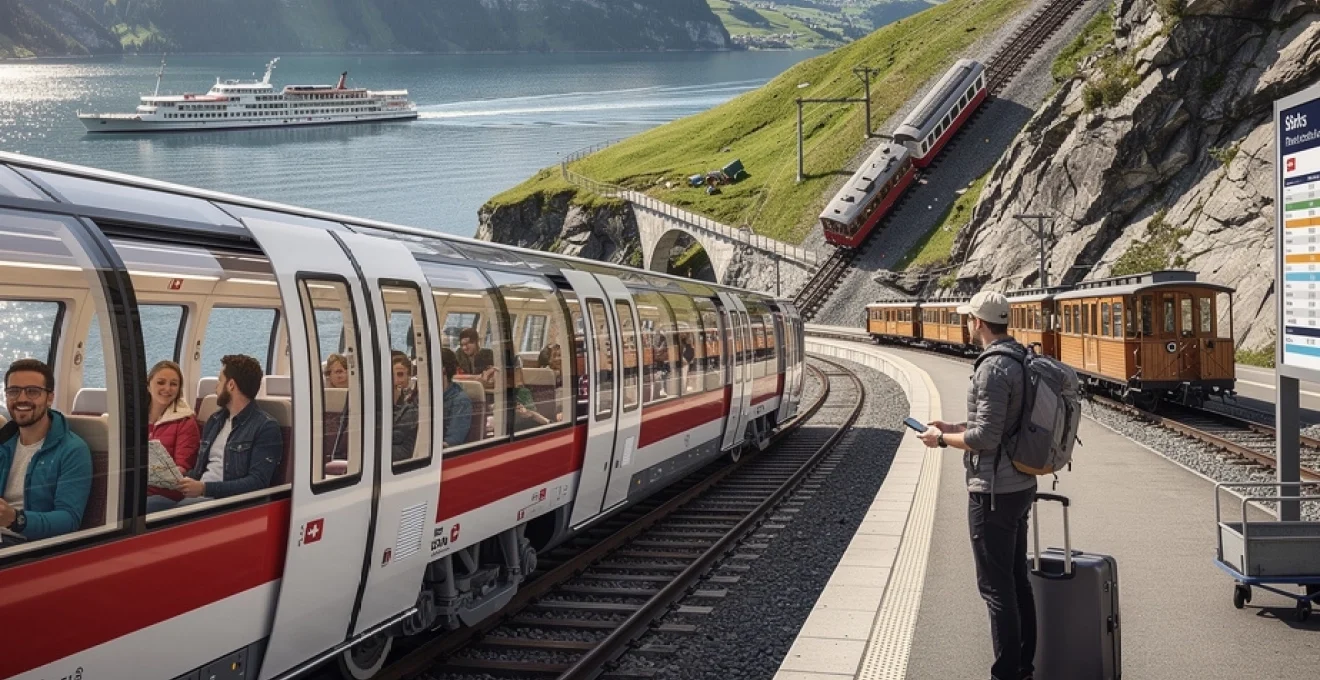
Switzerland’s railway network represents one of Europe’s most sophisticated and scenic transportation systems, connecting alpine villages, cosmopolitan cities, and mountain peaks with clockwork precision. With over 5,000 kilometres of track weaving through dramatic landscapes, the Swiss Federal Railways (SBB) and its partner operators deliver an experience that transcends mere transportation. Whether you’re gazing at the Matterhorn from a panoramic carriage or ascending to Europe’s highest railway station, travelling by train in Switzerland transforms the journey itself into the destination. The integration of trains, boats, and mountain railways creates seamless connections that allow you to maximise your time whilst minimising logistical complications.
For first-time visitors and seasoned travellers alike, navigating Switzerland’s extensive rail options requires strategic planning. From selecting the appropriate travel pass to securing reservations on the country’s most coveted scenic routes, every decision influences both your budget and the quality of your experience. The Swiss commitment to sustainable tourism means that rail travel offers not only comfort and convenience but also environmental responsibility—trains are powered primarily by renewable hydroelectric energy, making them an exceptionally eco-friendly choice for exploring this magnificent country.
Swiss travel pass vs regional rail passes: selecting the optimal ticket strategy
The ticket strategy you adopt fundamentally shapes your Swiss railway experience. With multiple pass options available, understanding the nuances between nationwide coverage and regional alternatives ensures you’re neither overpaying nor missing out on valuable benefits. The decision hinges on factors including your itinerary length, geographical focus, and whether you plan to visit museums and use mountain transport.
Swiss travel pass consecutive day coverage and panoramic route access
The Swiss Travel Pass remains the gold standard for comprehensive rail travel across Switzerland. Available in consecutive durations of 3, 4, 6, 8, or 15 days, this pass grants unlimited travel on the entire SBB network, including regional trains, premium intercity connections, and most lake steamers. Crucially, the pass includes free travel on panoramic routes that would otherwise require supplements—the Bernina Express and GoldenPass Line become accessible without additional reservation fees beyond the nominal seat booking charge, typically around 10-13 CHF.
Beyond railway access, the Swiss Travel Pass unlocks over 500 museums and exhibitions throughout the country, from Zurich’s Kunsthaus to Geneva’s International Red Cross Museum. This cultural dimension adds substantial value if you’re planning urban explorations alongside alpine adventures. The pass also provides 50% discounts on most mountain railways and cable cars, including popular ascents like the Jungfrau Railway and Schilthorn cable car. For travellers aged 16-25, the Swiss Travel Pass Youth offers a 15% discount, whilst children under 16 travel free when accompanied by at least one parent holding a valid pass—a remarkably generous family benefit.
Recent pricing for second-class consecutive passes starts at approximately 232 CHF for three days, scaling to 485 CHF for 15 days. First-class upgrades add roughly 60% to these base rates but deliver superior comfort, less crowding during peak seasons, and access to quieter carriages—worthwhile considerations for longer journeys like the eight-hour Glacier Express traverse.
Half fare card economics for extended itineraries beyond seven days
For journeys exceeding one week or itineraries with significant stationary periods, the Half Fare Card presents compelling economics. Priced at 120 CHF for one month, this card reduces all train, bus, and boat fares by 50%, alongside similar discounts on mountain transport. The mathematics become favourable when you calculate that just 240 CHF of full-price travel (easily accumulated through two or three major scenic routes plus local connections) achieves break-even.
The Half Fare Card particularly suits travellers establishing a base in one region whilst taking day trips, or those combining extensive rail travel with hiking and stationary alpine experiences. Unlike the Swiss Travel Pass, you’ll purchase individual tickets for each journey, but the SBB Mobile app streamlines this process remarkably. The card also benefits residents and frequent visitors who return to Switzerland multiple times, as it remains valid for a full month regardless of actual travel days used.
Regional pass comparison: bernese oberland, graubün
Regional pass comparison: bernese oberland, graubünden, and ticino options
If your Switzerland by train itinerary is concentrated in a single region, a local rail pass can deliver exceptional value. These products layer on top of the national network and are designed for travellers who want to explore one area in depth rather than criss-cross the whole country. In many cases, a regional pass combined with a Half Fare Card or point-to-point tickets for arrival and departure days undercuts the cost of a nationwide Swiss Travel Pass whilst still covering almost all of your journeys.
The Bernese Oberland Regional Pass is ideal if you plan to base yourself around Interlaken, Grindelwald, Wengen, Mürren or Adelboden. Typically valid from 3 to 10 days during the main season, it includes unlimited travel on most trains, buses, boats and many mountain railways in the Jungfrau region, with discounts on big-ticket excursions such as Jungfraujoch and Schilthorn. If you envisage several mountain trips plus lake cruises on Thun and Brienz, this pass can quickly pay for itself.
Further east, the Graubünden Pass targets lovers of the Engadine, Davos, St. Moritz and the Albula valley. Available in consecutive and flexible-day versions, it offers unlimited travel on the Rhaetian Railway network, including the standard Bernina and Albula routes, and many postbus connections. Because the Bernina and Glacier Express scenic trains use the same tracks, you can often replicate those world-famous journeys on regional services without paying panoramic train supplements, a smart tactic for budget-conscious rail enthusiasts.
In the south, the Ticino Ticket and other local offers focus on the Mediterranean-flavoured canton around Lugano, Locarno and Bellinzona. The Ticino Ticket, usually provided free to hotel guests in participating properties, includes regional trains, postbuses and selected lake boats, making spontaneous day trips to the Verzasca Valley or across Lake Lugano delightfully simple. When you combine these regional products with a carefully chosen national pass or Half Fare Card, you can fine‑tune your spend so you are paying for exactly the coverage you need—no more, no less.
Swiss transfer ticket for airport-to-accommodation direct routing
For travellers whose plans revolve around a single resort rather than a multi-stop rail tour, the Swiss Transfer Ticket concept (now effectively replaced by point-to-point saver fares and combined offers) historically filled a specific niche: economical return travel from the airport or border to one destination. While the product itself has been phased out in its classic form, the underlying strategy remains relevant. If you are flying into Zurich or Geneva and heading straight to Zermatt, St. Moritz or Interlaken for a week, you may be best served by purchasing discounted advance tickets for those long legs and using local options once in resort.
Today, SBB’s Supersaver tickets and Saver Day Pass have, in practice, taken over the role of the old Transfer Ticket. Supersaver tickets tie you to specific trains on a set route but can reduce costs significantly if you book early and travel off‑peak. The Saver Day Pass functions like a one‑day Swiss Travel Pass, offering unlimited travel on most of the network for a fixed price, which is lowest when purchased well in advance. If your only heavy travel days are your arrival and departure, two Saver Day Passes can be a highly efficient solution.
Another approach mirrors the transfer logic by pairing a Half Fare Card with standard point‑to‑point tickets, halving the cost of those expensive airport–resort journeys. You then rely on regional passes or occasional full‑fare tickets for short movements once settled. This model works particularly well for skiers and hikers who expect to spend most days on the mountain rather than traversing Switzerland by train. As with all Swiss ticketing, running the numbers on your specific dates and routes is key; what made sense for a friend’s summer itinerary may not be the optimal ticket strategy for your winter escape.
Iconic panoramic routes: glacier express, bernina express, and GoldenPass line reservations
Glacier express Chur-to-Zermatt booking windows and seat selection protocol
The Glacier Express is the flagship of Switzerland’s panoramic trains, tracing an eight-hour line between Zermatt and St. Moritz via Chur, Andermatt and the Oberalp Pass. Unlike standard intercity services, this is a fully reserved product: you must hold both a valid ticket or rail pass and a seat reservation. Reservations typically open around 92 days before departure, and on popular dates—especially in July, August, and the festive season—it is wise to secure your seat as soon as bookings are released.
When planning Switzerland by train, many travellers focus on the full end‑to‑end ride, but the Chur–Zermatt section is arguably the most dramatic, covering highlights such as the Rhine Gorge and the ascent to the Oberalp. You can book for this segment alone, reducing journey time while still enjoying the signature experience. Seat selection follows a clear protocol: you choose your travel class (2nd, 1st or Excellence Class) and, where possible, indicate a seating preference. Southbound towards Zermatt, the right‑hand side typically offers better views of the Rhine Gorge; northbound, that advantage flips.
Rail passes such as the Swiss Travel Pass or Eurail cover the base fare on the Glacier Express, but you must still pay a separate reservation fee, which ranges from around 39 to 49 CHF in high season for 2nd class, more for Excellence Class. Because carriages are designed with huge panoramic windows, every seat has superb views, but couples often prefer seats facing each other across a table. If you are prone to motion sickness, selecting a forward‑facing seat can make the long journey more comfortable. Think of the reservation as a theatre ticket for an all‑day performance—the earlier you book, the better your chances of securing your ideal spot.
Bernina express UNESCO heritage routing through albula and bernina passes
The Bernina Express offers a different style of spectacle: a four‑hour journey from Chur or St. Moritz to Tirano in Italy, crossing the Albula and Bernina passes on a route inscribed as a UNESCO World Heritage Site. Here, the drama lies in engineering as much as scenery. Helical tunnels, stone viaducts like the iconic Landwasser bridge, and tight mountain curves allow the train to climb without rack‑and‑pinion technology, a feat that was revolutionary when the line opened in the early 20th century.
Reservations are recommended year‑round and become essential in high season, yet the booking conditions are slightly more flexible than on the Glacier Express. Because regular regional trains share the same tracks, you can replicate the Bernina Express route without panoramic carriages or mandatory supplements simply by boarding an ordinary service. This is a clever workaround if you want the freedom to hop on and off at scenic stops or to photograph with open windows, which is not possible on sealed panoramic cars.
From a planning perspective, decide early whether you prioritise the classic tourist experience—with commentary, catering and curated views—or the flexibility and lower cost of regional services. Both deliver the same mountain panoramas and the magical contrast of glaciers giving way to palm trees as you descend into Tirano. If you hold a Swiss Travel Pass, the base journey is covered; you only pay the small Bernina Express reservation if you opt for the branded panoramic train. Either way, building the Albula–Bernina section into your Switzerland by train itinerary ensures you experience one of the world’s great railway achievements.
Goldenpass belle époque carriages and Montreux-Zweisimmen classic segment
Where the Glacier and Bernina routes celebrate raw alpine engineering, the GoldenPass Line leans into romance and nostalgia. Running between Montreux and Interlaken via Zweisimmen, it stitches together vineyard‑lined shores on Lake Geneva, pastoral valleys and chocolate‑box chalets. The most atmospheric section is undoubtedly the Montreux–Zweisimmen leg operated by MOB, where you can choose the exquisite Belle Époque carriages that recall the glamour of the 1930s.
These vintage‑inspired coaches feature velvet‑upholstered armchairs, brass details and wood panelling, creating an atmosphere closer to a movie set than a commuter train. Rail passes cover the fare, and while reservations are recommended—especially for 1st class—they are not always mandatory outside peak dates. If your heart is set on the Belle Époque experience, do check schedules carefully: only certain departures each day use these carriages, and others are operated by modern panoramic stock labelled “MOB Panoramic”.
For photographers, seating strategy matters. Travelling uphill from Montreux, the left‑hand side offers commanding views over Lake Geneva and the terraced vineyards of Lavaux, while later sections into the Simmental reveal rolling meadows framed by jagged peaks. If your Switzerland by train schedule is tight, you can ride only the Montreux–Zweisimmen segment and still capture the essence of the GoldenPass Line. Think of this journey as the “fine dining” of scenic trains: shorter than the Glacier Express, but rich in flavour and atmosphere.
Gotthard panorama express lake lucerne steamer integration
The Gotthard Panorama Express combines two quintessential Swiss experiences in a single itinerary: an historic lake steamer on Lake Lucerne and a rail journey over the old Gotthard mountain line between Flüelen and Lugano. On the lake segment, paddle steamers and classic motor vessels glide past forested hillsides and rugged cliffs, stopping at tiny villages that seem frozen in time. This is slow travel at its most refined, and an elegant way to leave Lucerne if you are heading south.
In Flüelen, passengers transfer directly from boat to train—often with coordinated timetables that minimise waiting time. Instead of racing through the modern base tunnel, the Gotthard Panorama Express climbs over the original high route, spiralling through helical tunnels and crossing stone bridges with ever-changing views of the Reuss Valley. Commentary and large windows underscore the heritage character of the journey, which feels like travelling through a living museum of Swiss railway history.
Reservations are recommended for the panoramic train segment, and a modest supplement applies even if you hold a Swiss Travel Pass, which otherwise covers the underlying fare and the boat. Because the service typically operates from spring to autumn and not every day in shoulder seasons, it is vital to check dates before you anchor your itinerary around it. If you are looking to connect central Switzerland with Ticino in a way that turns a simple transfer into a highlight, the Gotthard Panorama Express is one of the most rewarding options in the country.
Strategic route planning: interlaken, lucerne, and zermatt hub connectivity
Interlaken ost station as gateway to jungfraujoch and schilthorn rack railways
Interlaken Ost functions as the primary rail gateway to the Jungfrau Region, acting almost like a switchboard where multiple mountain railways converge. From here, narrow‑gauge trains radiate towards Lauterbrunnen and Grindelwald, giving access to Wengen, Mürren, Kleine Scheidegg, Jungfraujoch and the Schilthorn. If your Switzerland by train itinerary includes iconic peaks like the Eiger or Jungfrau, you will almost certainly pass through Interlaken Ost, often more than once.
Connections are generally timed to Swiss standards of precision, with only a few minutes’ transfer between trains. That means route planning is less about whether you can get somewhere and more about in which order you string excursions together to avoid backtracking and overcrowded departures. For example, many travellers head straight to Jungfraujoch on the first clear morning, then schedule Schilthorn or Schynige Platte on subsequent days, using Interlaken Ost as the hub for all three.
Because mountain excursions are weather‑dependent and expensive, maintaining flexibility is crucial. It is often wise to pre‑book only the legs that genuinely require reservations, such as certain Jungfraujoch time slots in peak season, and then fill remaining days with spontaneous trips made easy by your pass. Interlaken’s central location between Lakes Thun and Brienz also allows you to weave in boat cruises and valley walks, turning the town into a base where multiple strands of your rail journey come together.
Lucerne railway station transfer points for mount pilatus and rigi cogwheel lines
Lucerne’s compact main station makes it another ideal hub for mountain excursions, especially to Mount Pilatus and Mount Rigi. Trains to Arth‑Goldau for the classic Rigi ascent depart directly from the main concourse, while suburban services to Alpnachstad for Pilatus leave from adjacent platforms. Because the station sits directly opposite the lakefront, transferring between trains, boats and city trams is a matter of minutes rather than an endurance test.
For Rigi, you can choose between two approaches: train to Arth‑Goldau followed by the historic cogwheel railway to Rigi Kulm, or boat from Lucerne to Vitznau and then the alternative cogwheel line to the summit. Both deliver spectacular views, and many travellers opt for a circular route—ascending one side and descending the other—to maximise variety. Your Swiss Travel Pass or regional ticket typically covers the lake steamer in full and provides a discount on the mountain railway, a combination that showcases the integration of Switzerland’s transport modes.
Mount Pilatus, by contrast, is best tackled as the so‑called “Golden Round Trip,” combining lake steamer, the world’s steepest cogwheel railway, and cable cars back to Kriens with a short bus link to central Lucerne. Because all of these elements interlock at Lucerne station, it becomes very simple to adapt plans on the fly if weather or crowds suggest reversing your route or shifting your departure time. When you base yourself here for two or three nights, you gain the freedom to chase clear skies rather than fixed bookings—a subtle but powerful way to enhance your mountain experience.
Zermatt gornergrat bahn and matterhorn glacier paradise cable car coordination
Zermatt operates on a different scale: a car‑free resort at the end of a narrow valley, reached by shuttle trains from Visp and Täsch. Once you arrive, the hub‑and‑spoke concept compresses into a walkable village where key mountain lifts cluster within a few hundred metres of the railway station. The Gornergrat Bahn departs directly opposite the main platforms, while electric buses and signposted paths lead to the Matterhorn Glacier Paradise cable car base at the edge of town.
Because both Gornergrat and Matterhorn Glacier Paradise offer world‑class viewpoints, the challenge is not access but sequencing and timing. On clear days, sunrise or early morning often yields the best light on the Matterhorn and fewer crowds, making an early Gornergrat departure attractive. You might then spend the afternoon on the cable car system to Trockener Steg and Klein Matterhorn, where snow sports are often possible even in summer and the altitude exceeds 3,800 metres.
Ticketing can be optimised through combination passes sold locally, which bundle several lifts and sometimes include discounts with a Swiss Travel Pass or Half Fare Card. Because mountain weather can change rapidly, keeping an eye on live webcams and forecast boards in and around Zermatt station helps you decide where to go first. In a well‑planned Switzerland by train itinerary, Zermatt becomes less a one‑off excursion and more a multi‑day alpine base from which you launch carefully timed summit visits.
SBB mobile app navigation and real-time journey management
The SBB Mobile app is the digital backbone of modern Swiss rail travel, functioning as timetable, ticket office, journey planner and disruption monitor in one. Once installed, it allows you to search connections across the entire public transport network—trains, trams, buses, boats and many mountain railways—using simple station names or even map locations. Journey results display platform numbers, transfer times and real‑time delay information, which is invaluable when you are making tight connections in busy hubs like Zurich or Bern.
From a ticketing perspective, the app supports mobile Swiss Travel Passes, Half Fare Cards and point‑to‑point tickets, meaning you can often travel with nothing more than your phone and passport. For holders of discount products, the app automatically calculates reduced fares once you register your card, saving time and eliminating guesswork at ticket machines. Features like “travelcards and tickets for friends” let you purchase on behalf of family members, a handy option if you are the designated organiser in your group.
Perhaps the most powerful aspect of SBB Mobile for a Switzerland by train itinerary is its real‑time journey management. Miss your connection? The app automatically suggests alternative routes. Weather closes a mountain pass or disrupts a panoramic train, as occasionally happens in winter? Push notifications and updated connection suggestions help you re‑route without panic. Think of it as a local expert in your pocket: you still decide where to go, but the app continually optimises how you get there under the prevailing conditions.
Mountain railway engineering: jungfrau railway, gornergrat bahn, and pilatus cogwheel systems
Jungfrau railway rack-and-pinion gradient technology to jungfraujoch station 3,454m
The Jungfrau Railway is a monument to early 20th‑century engineering ambition, climbing from Kleine Scheidegg to Jungfraujoch at 3,454 metres—Europe’s highest railway station. Conventional adhesion would be hopelessly inadequate on such gradients, so the line employs rack‑and‑pinion technology, where toothed wheels on the train engage with a fixed rack rail between the running rails. This system provides the extra traction needed to climb steep slopes safely in all weather conditions.
Much of the route runs in a tunnel carved through the Eiger and Mönch, with intermediate panorama windows cut into the rock face to offer glimpses of the surrounding glaciers. Electrified from the outset and powered today by renewable energy, the Jungfrau Railway feels simultaneously historic and modern. Trains operate on a carefully controlled timetable to manage both power demand and visitor flow at the summit complex, where observation decks, ice caves and scientific installations cluster atop the saddle between two four‑thousand‑metre peaks.
For travellers, understanding the engineering is not essential, but it does deepen appreciation. When you feel the train grip and surge up a sharp incline, you are experiencing a system that has been refined over more than 100 years. Tickets are expensive, but once you factor in the construction challenges at such altitude, the investment becomes easier to justify. On a Switzerland by train journey that includes Jungfraujoch, you are not just visiting a viewpoint—you are riding a pioneering piece of mountain railway history.
Gornergrat bahn abt system and matterhorn viewing platform alignment
The Gornergrat Bahn, which climbs from Zermatt to 3,089 metres, is another masterpiece of rack railway design, this time using the Abt system. Instead of a single central rack bar, the Abt configuration employs two or three offset rack bars, allowing at least one tooth on each pinion wheel to remain engaged at all times. This reduces shock loads, enhances safety and enables smoother running at higher speeds than earlier rack designs.
As the train ascends, the Matterhorn gradually reveals itself, and the line has been laid out with this unfolding panorama in mind. Intermediate stations like Riffelalp and Rotenboden offer immediate access to hiking trails and photography spots such as Riffelsee, where the mountain’s pyramid shape often reflects in still waters. At the summit station, platforms and terraces have been aligned to deliver unobstructed views not just of the Matterhorn but of a whole amphitheatre of glaciers and 4,000‑metre peaks.
From a practical standpoint, the Gornergrat Bahn operates roughly every 24 minutes in peak season, using modern rolling stock designed to cope with both heavy tourist loads and harsh winter conditions. Swiss Travel Pass and Half Fare Card discounts apply, but even at reduced rates this is a premium excursion. Viewing it through the lens of engineering, however, helps explain the cost: maintaining a rack railway exposed to ice, snow and extreme temperature swings is a constant challenge, and every smooth, reliable ascent is the result of meticulous behind‑the‑scenes work.
Pilatus railway 48% gradient world record and locher rack mechanism
The Pilatus Railway holds a world record that seems almost implausible until you ride it: a maximum gradient of 48%, making it the steepest cogwheel railway on the planet. Traditional rack systems would struggle at such an angle, so engineer Eduard Locher developed a unique lateral rack mechanism. Instead of a vertical toothed bar between the rails, the Pilatus line uses horizontal racks on either side, engaged by cogwheels mounted vertically on the train. This arrangement prevents the train from lifting off the rails on extreme gradients and offers excellent resistance to lateral forces.
The route from Alpnachstad to Pilatus Kulm covers only about 4.6 kilometres, but the ascent feels almost like an elevator ride through alpine meadows and rocky outcrops. Trains move slowly and deliberately, giving you time to absorb both the engineering novelty and the views over Lake Lucerne far below. At the top, a network of short trails and viewing platforms make it easy to appreciate just how improbable the line’s trajectory is when you trace it down the mountainside.
Because the Pilatus Railway is a seasonal operation—usually running from May to November depending on snow conditions—integrating it into a Switzerland by train itinerary requires a little date checking. When it is open, pairing it with lake steamers and cable cars on the Golden Round Trip creates a memorable loop that showcases three very different mountain transport technologies in a single day.
Schynige platte nostalgia route historic rolling stock preservation
Not all engineering marvels are about breaking records; some lie in preserving the past. The Schynige Platte Railway, climbing from Wilderswil near Interlaken to a flower‑filled ridge with classic Eiger–Mönch–Jungfrau views, is a living museum of early electric rack railway practice. Many of its carriages are over a century old, lovingly restored and still operating in their original cream and green livery. Wooden benches, opening windows and conductor‑operated doors evoke an era when mountain travel was slower, more contemplative and arguably more charming.
The line uses a traditional rack‑and‑pinion system and modest speeds, typically taking around an hour to cover the short distance to the top. Along the way, you pass pastures, stone bridges and forests with frequent glimpses of Lake Thun and Lake Brienz. Because the journey is relatively short and the destination includes an alpine garden and easy walking trails, it is particularly suited to travellers who want a gentler mountain experience without extreme altitude or crowds.
From an enthusiast’s perspective, Schynige Platte illustrates how Switzerland balances progress with heritage. While high‑speed tunnels and modern panoramic trains grab headlines, these historic lines remind us of the country’s long relationship with mountain railways. Building a ride on Schynige Platte into your Switzerland by train plans is like adding a sepia‑toned photograph to a digital album: it enriches the narrative with texture and context.
Luggage forwarding services and station locker infrastructure across swiss federal railways network
One of the unsung advantages of travelling Switzerland by train is how easy it is to manage luggage, even on complex itineraries. SBB and partner railways offer a range of forwarding services that allow you to send bags ahead between major stations or directly to many hotels. The standard luggage service typically delivers bags by the next day, while fast luggage options can often move your suitcase from one hub to another on the same day if you drop it off early enough. Fees are reasonable considering the convenience—especially if you are navigating multiple changes or mountain excursions where dragging suitcases would be impractical.
For independent travellers who prefer full control, most medium and large stations are equipped with self‑service lockers in various sizes. These are invaluable when you have a few hours between trains and want to explore a city unencumbered. Zurich, Geneva, Lucerne, Interlaken and Zermatt all have extensive locker banks, with clear instructions in multiple languages and payment via coins or cards. In smaller stations, staffed luggage counters may substitute for lockers, offering manual check‑in for a flat daily rate.
Strategically combining forwarding and lockers can transform how you structure your days. For example, you might send your main suitcase from Zurich to Interlaken while keeping a small daypack, then stop off in Bern for an afternoon without worrying about storage. Or you could forward luggage to a mountain resort and travel there via a scenic detour on the GoldenPass Line, knowing your bags will catch up with you later. In a country where trains connect almost everywhere you might want to go, these support services are the final piece that makes a truly seamless rail journey possible.