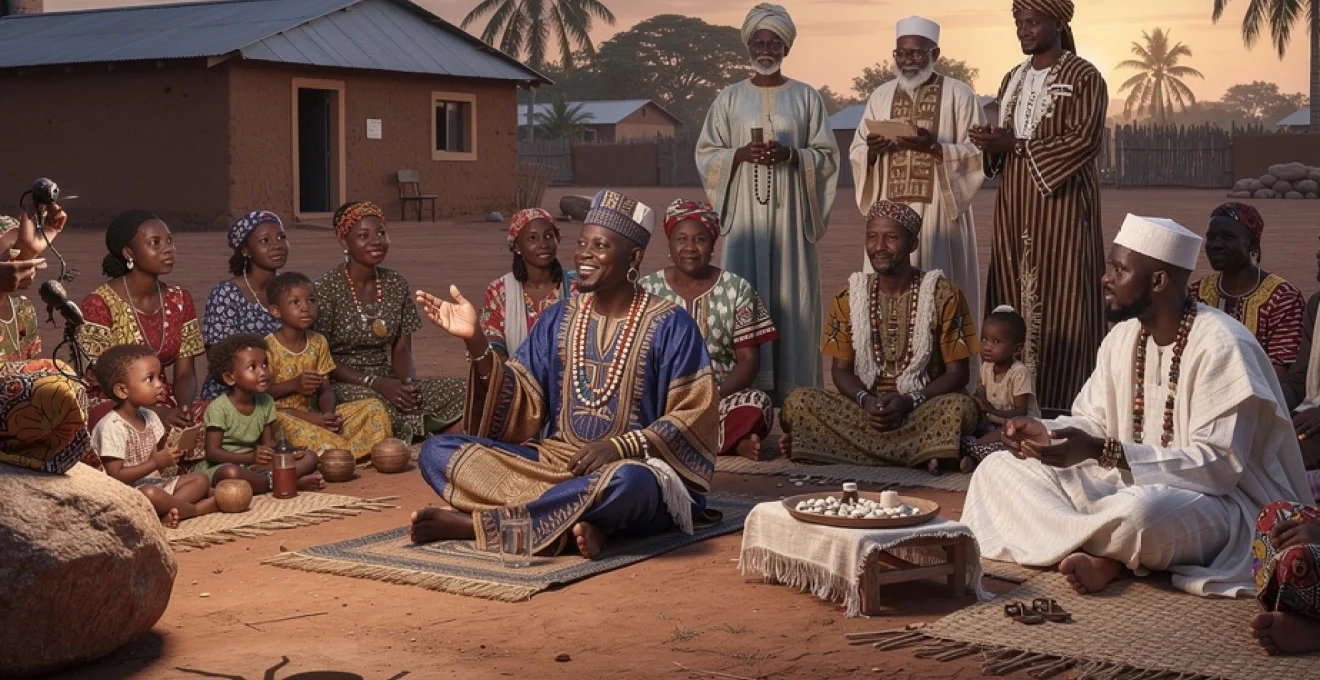
The rhythmic beat of drums echoes through village squares as evening shadows lengthen, signalling the commencement of another timeless ritual. Across West Africa, storytelling traditions serve as the invisible threads that weave communities together, creating intricate tapestries of shared identity, cultural values, and collective memory. These oral narratives transcend mere entertainment, functioning as sophisticated systems of social organisation, moral instruction, and cultural preservation that have sustained entire civilisations for millennia.
From the griots of Mali to the Anansi storytellers of Ghana, these narrative traditions operate as living repositories of community knowledge, encoding everything from historical chronicles to spiritual beliefs within their elaborate frameworks. The power of these stories lies not merely in their content but in their capacity to forge unbreakable bonds between generations, establishing clear social hierarchies whilst simultaneously preserving the linguistic diversity that defines West African cultural landscapes.
Oral narrative frameworks and community identity formation in west african societies
West African storytelling traditions function as sophisticated mechanisms for community identity formation, operating through complex narrative frameworks that encode social structures, moral philosophies, and cultural values. These oral traditions establish what anthropologists term « narrative communities » – groups bound together by shared stories that define membership, belonging, and collective purpose. The transmission of these narratives creates a sense of continuity that spans generations, connecting contemporary communities to their ancestral heritage through carefully preserved oral texts.
The framework of community identity formation through storytelling operates on multiple levels simultaneously. At the foundational level, creation myths and origin stories establish the cosmological worldview that underpins social organisation. These narratives explain not only how the world came into being but also how specific communities fit within the broader cosmic order. For instance, many West African societies possess elaborate genealogical narratives that trace community lineages back to founding ancestors, establishing legitimacy and social hierarchy through storytelling.
Community storytelling sessions function as performative spaces where social bonds are continuously renewed and reinforced. The act of gathering to listen collectively creates shared experiences that strengthen community cohesion. These sessions often follow established protocols that reflect social hierarchies – who speaks when, where different community members sit, and how participation is regulated all contribute to the reinforcement of community structure through narrative practice.
Griot hereditary systems and social stratification among the mandinka
The griot tradition among the Mandinka people represents one of West Africa’s most sophisticated examples of hereditary storytelling systems, where narrative authority is passed down through specific bloodlines across generations. These professional storytellers occupy a unique position within Mandinka society, serving simultaneously as historians, praise singers, and cultural mediators. The griot caste system demonstrates how storytelling traditions can both reflect and actively maintain social stratification within communities.
Mandinka griot families maintain extensive oral archives that chronicle the genealogies of ruling families, historical events, and cultural precedents stretching back centuries. This knowledge inheritance creates a parallel power structure within Mandinka communities, where griots possess considerable influence through their control over historical narrative and social memory. The relationship between griots and the nobility exemplifies how storytelling traditions can create symbiotic relationships that reinforce existing power structures.
Anansi trickster cycles and akan moral philosophy integration
The Anansi trickster tales of the Akan people demonstrate how storytelling traditions embed complex moral philosophies within entertaining narrative frameworks. These stories feature a cunning spider character whose adventures encode sophisticated ethical teachings about wisdom, resourcefulness, and social responsibility. The integration of moral philosophy within trickster narratives creates a pedagogical system that teaches community values through engaging storytelling.
Akan communities use Anansi stories as vehicles for transmitting cultural wisdom across age groups, with each tale containing multiple layers of meaning that can be interpreted differently depending on the listener’s maturity and social position. The trickster archetype allows for the exploration of complex moral ambiguities whilst maintaining the entertainment value that ensures cultural transmission. These narratives often challenge conventional wisdom, encouraging critical thinking whilst reinforcing core community values.
Yoruba ifá divination stories and orisha pantheon cultural transmission
The Yoruba Ifá system demonstrates how storytelling traditions can integrate spiritual practices with community identity formation through elaborate narrative
corpus. Ifá divination verses, known as odù, function as sacred narrative blueprints that guide both individual decisions and collective norms. Each odù contains dozens of stories about the orisha (deities) and exemplary ancestors, illustrating consequences of specific choices, the nature of destiny (ayanmo), and the ethics of balanced living. When a babalawo (Ifá priest) performs divination, he is not only interpreting a client’s situation but also selecting and performing stories that align that person’s life with the wider Yoruba moral universe.
Through these Ifá narratives, knowledge of the orisha pantheon, ritual etiquette, and community expectations is transmitted in a highly structured way. The stories specify how humans should relate to deities like Ogun (iron and technology), Oshun (love and rivers), or Shango (thunder and justice), thereby shaping everything from conflict resolution to occupational identity. In diaspora communities across Brazil, Cuba, and the United States, the same narrative system underpins Candomblé, Santería, and Orisha worship, showing how storytelling traditions can sustain a coherent cultural identity even when communities are geographically dispersed and politically marginalised.
Hausa praise poetry traditions and islamic syncretism patterns
Among the Hausa of northern Nigeria and Niger, storytelling traditions are deeply intertwined with Islamic scholarship and courtly culture, especially through praise poetry known as waka or kirari. Court poets and itinerant bards compose elaborate verses celebrating emirs, Islamic scholars, and military heroes, embedding local histories within broader Islamic cosmologies. These poems often trace leaders’ genealogies back to legendary Islamic figures, blending pre-Islamic heroic motifs with Quranic references in ways that legitimate contemporary power structures.
The syncretism visible in Hausa praise poetry shows how West African communities negotiate multiple identity layers—ethnic, regional, and religious—through narrative. Poets may invoke Allah and the Prophet Muhammad alongside pre-Islamic symbols of bravery, fertility, or kingship, creating a narrative bridge between indigenous norms and global Islam. Public performances at festivals, naming ceremonies, and political rallies transform these poems into communal rituals, reinforcing a shared sense of belonging to both the Hausa nation and the wider Muslim ummah.
Linguistic preservation mechanisms through traditional storytelling practices
Storytelling in West Africa is not only about preserving memories and morals; it is also a powerful mechanism for linguistic preservation. In multilingual societies where colonial languages like English and French dominate formal education and administration, oral narratives help keep indigenous languages vibrant in everyday life. Complex proverbs, idioms, and poetic forms woven into folktales demand a deep command of local languages, encouraging younger generations to master vocabulary, grammar, and rhetorical style that they might not encounter in schools.
We can think of these oral traditions as living dictionaries and grammars. Each performance rehearses distinctive sounds, tones, and expressions, reducing the risk that languages will be reduced to simplified, “domesticated” forms under pressure from global media. In communities where literacy rates remain uneven, storytelling also ensures that cultural knowledge is not locked behind written texts in foreign languages but remains accessible in the tongues that people dream and think in. This has become increasingly important as linguists estimate that up to 40 percent of the world’s languages may be endangered in the coming century.
Wolof oral literature and senegalese national identity construction
In Senegal, Wolof oral literature has played a central role in shaping both ethnic identity and emerging notions of Senegalese nationhood. Griots and poets performing in Wolof produce epic narratives, love songs, and political commentary that circulate in markets, radio broadcasts, and urban youth culture. Through these stories, Wolof becomes a language not only of the home and village, but also of public debate and national consciousness, subtly counterbalancing the dominance of French in government and education.
Modern performers often rework traditional forms such as taasu (rapid-fire poetic recitation) and praise singing into contemporary genres, including rap and spoken word. This creative continuity allows younger Senegalese to access ancestral histories and moral codes in forms that resonate with their daily realities in Dakar, Thiès, or the diaspora. At the same time, references to shared historical figures, such as resistance leaders Lat Dior or religious guides from Sufi orders, help articulate a broader Senegalese identity that incorporates multiple ethnic groups while still affirming the prestige of Wolof language and culture.
Bambara epic traditions and mali empire historical memory
The Bambara-speaking regions of Mali preserve extensive epic traditions that maintain living memory of the Mali Empire and other historical polities. Performers narrate the exploits of legendary figures—such as Biton Coulibaly or Sunjata Keita in closely related Mandé epics—using Bambara as a vehicle for highly stylised, formulaic verse. These epics function as historical archives, preserving details of battles, migrations, and political alliances that might otherwise be absent from written records produced under colonial rule.
By telling and retelling these stories, Bambara communities continually negotiate how they relate to the past and to modern Malian statehood. Listeners learn not only about royal lineages and grand victories but also about social contracts between rulers and subjects, obligations between age grades, and expectations of courage and generosity. In rural and urban settings alike, epic performances thus contribute to a shared historical consciousness, giving contemporary Malians narrative tools to interpret current political upheavals through the lens of earlier cycles of rise, decline, and renewal.
Ewe folklore documentation and togo-ghana cross-border cultural continuity
The Ewe people, whose communities straddle the modern borders of Ghana, Togo, and Benin, illustrate how storytelling sustains cultural continuity across political frontiers. Ewe folktales, songs, and dirges are rich with themes of migration, exile, and return, reflecting historical movements that predate colonial boundary-making. Grandparents tell children stories of ancestral homelands and journeys, effectively mapping a cultural geography that does not fully align with contemporary nation-state borders.
In recent decades, Ewe scholars, teachers, and community activists have begun systematically documenting these oral traditions in both written and digital forms. School clubs collect folktales from elders, while local radio stations broadcast story hours in Ewe, ensuring that younger generations hear their language in creative, high-status contexts. This documentation effort serves a dual purpose: preserving endangered narrative forms and reinforcing a sense of shared Ewe identity that transcends the Ghana–Togo border. For Ewe communities, storytelling becomes a quiet act of cultural diplomacy, reminding listeners that their ties to one another are older and deeper than colonial-era lines on a map.
Ritualistic storytelling contexts and social cohesion dynamics
In many West African societies, storytelling is inseparable from ritual, taking place in carefully structured settings that reinforce social cohesion. Night-time gatherings around the fire, initiation ceremonies, harvest festivals, and funerary rites all provide ritual frameworks within which stories are performed. These contexts shape not only what can be told but also who may speak, who must listen, and how audiences are expected to respond, turning narrative into a form of social choreography.
For example, initiation schools among the Mandé, Fula, or various forest communities often include periods where novices are secluded and taught secret histories or origin myths reserved for those who have proven their maturity. Elsewhere, masquerade performances among Yoruba or Igbo communities weave myths of deities and ancestors into dances and dramatizations, blurring the line between storytelling and spiritual presence. In each case, stories do more than convey information; they create temporary communities within the larger society, bound by shared knowledge and a sense of collective transformation.
These ritual storytelling spaces also function as safety valves for social tension. Satirical songs and comic tales told during festivals can criticise chiefs, elders, or social norms under the protective cover of tradition, allowing grievances to be aired without direct confrontation. Much like a carefully tuned drum ensemble, where each instrument must find its place in the rhythm, these ritual narratives help individuals and factions re-synchronise with the wider community after periods of conflict or change. Without such structured spaces for narrative negotiation, many communities would find it far harder to maintain long-term unity.
Gender-specific narrative roles and community power structures
Storytelling in West Africa is often divided along gender lines, with distinct narrative genres and performance spaces associated with women and men. These gender-specific roles both reflect and shape community power structures. Male griots, praise singers, and Islamic scholars may dominate formal public storytelling, especially in royal courts, mosques, or political rallies. Yet in many households and informal gatherings, women are the primary custodians of folktales, lullabies, work songs, and ritual laments that transmit core values to children.
Women’s storytelling is particularly influential in the domestic sphere, where they use narratives to socialise children into expectations about respect, responsibility, and kinship obligations. A grandmother recounting a tale of a disobedient child or an irresponsible hunter can subtly address real conflicts without naming names, guiding behaviour through allegory rather than direct rebuke. In some cultures, women also compose and perform ululations, wedding songs, and funeral dirges that publicly comment on marriages, political events, or family disputes, thereby exercising soft power over community reputations.
At the same time, male-dominated narrative roles—such as Mandinka or Wolof griots, Yoruba babalawo, or Hausa praise poets—grant men formal authority over public memory and prestige. By deciding which achievements to celebrate and which failures to forget, these male storytellers can bolster certain lineages, leaders, or policies. However, the boundaries are not fixed. In contemporary Nigeria, Ghana, and Senegal, women poets, novelists, and digital creators increasingly draw on traditional storytelling to critique patriarchy, reinterpret origin myths, and claim new spaces of authority. This evolving gender dynamic shows how narrative roles can be both a mirror of existing power structures and a lever for gradual social change.
Contemporary digital adaptation of traditional west african storytelling methods
As smartphones, social media, and streaming platforms spread across West Africa, traditional storytelling methods are undergoing rapid digital adaptation. What once required a physical gathering in a village square can now occur in WhatsApp groups, YouTube channels, or live Instagram sessions. Far from erasing oral traditions, these technologies often amplify them, allowing storytellers to reach audiences across cities, regions, and diasporas while maintaining key elements like call-and-response, proverbs, and local languages.
Digital storytellers in Nigeria and Ghana, for instance, are creating animated versions of Anansi tales or Yoruba myths, complete with subtitles and multilingual voiceovers. Podcasters interview elders about historical events, while TikTok creators summarise long epics into serialised, bite-sized videos that still retain core moral lessons. For younger audiences used to global entertainment, these innovations serve as an accessible entry point into their own narrative heritage. Yet they also raise important questions: how do we preserve the intimacy and communal negotiation of meaning that occurs in face-to-face storytelling when the audience is scattered and silent behind screens?
Some communities are responding by combining on-the-ground rituals with online documentation. Festivals are live-streamed; griot performances are recorded and archived; collaborative digital archives invite users to upload family stories in Wolof, Bambara, or Ewe. These hybrid practices treat digital tools as new drums—technologies for sending messages farther and faster—while insisting that the rhythm of community remains anchored in shared values and living relationships. For educators, activists, and cultural workers, this presents a practical opportunity: by integrating traditional stories into school curricula, apps, or community media projects, they can support both language revitalisation and cultural pride in a rapidly globalising environment.
Cross-cultural narrative exchange patterns among west african ethnic groups
West Africa has long been a crossroads of trade, migration, and religious exchange, and its storytelling traditions clearly reflect this history of interaction. Tales, songs, and epics travel along with traders, pilgrims, and migrants, often being adapted to fit new linguistic and cultural settings. It is common to find similar plots—such as the clever hare, the ungrateful crocodile, or the faithful wife—appearing in Ashanti, Mandé, Fulani, and Hausa repertoires, each with local names, idioms, and moral emphases.
This cross-cultural borrowing creates what we might call a regional “narrative marketplace,” where communities exchange stories much as they exchange goods in the famous markets of Kumasi or Kano. Islamic influences carried through trans-Saharan trade routes have introduced Quranic stories and prophetic legends into many oral traditions, which are then blended with indigenous motifs. Likewise, coastal interactions with European traders and missionaries brought new narrative elements that have been selectively incorporated into folktales, sometimes as cautionary tales about greed, betrayal, or the dangers of forgetting one’s roots.
Rather than diluting local cultures, these exchanges often strengthen them by providing new metaphors and plot structures that can be used to articulate local concerns. A Fulani storyteller might borrow an Anansi-style trickster plot to comment on cattle raiding, or a Yoruba playwright might weave Hausa praise forms into a drama about interethnic marriage. In this way, cross-cultural narrative exchange contributes to a broader West African identity that coexists with strong local loyalties.
For researchers, educators, and community leaders, paying attention to these shared narrative patterns can offer practical insights into conflict resolution and regional integration. When different groups recognise themselves in each other’s stories, it becomes easier to negotiate borders, share resources, and imagine a common future. Ultimately, storytelling traditions in West Africa do more than define separate communities—they also provide the shared narrative threads from which a more interconnected regional fabric can be woven.