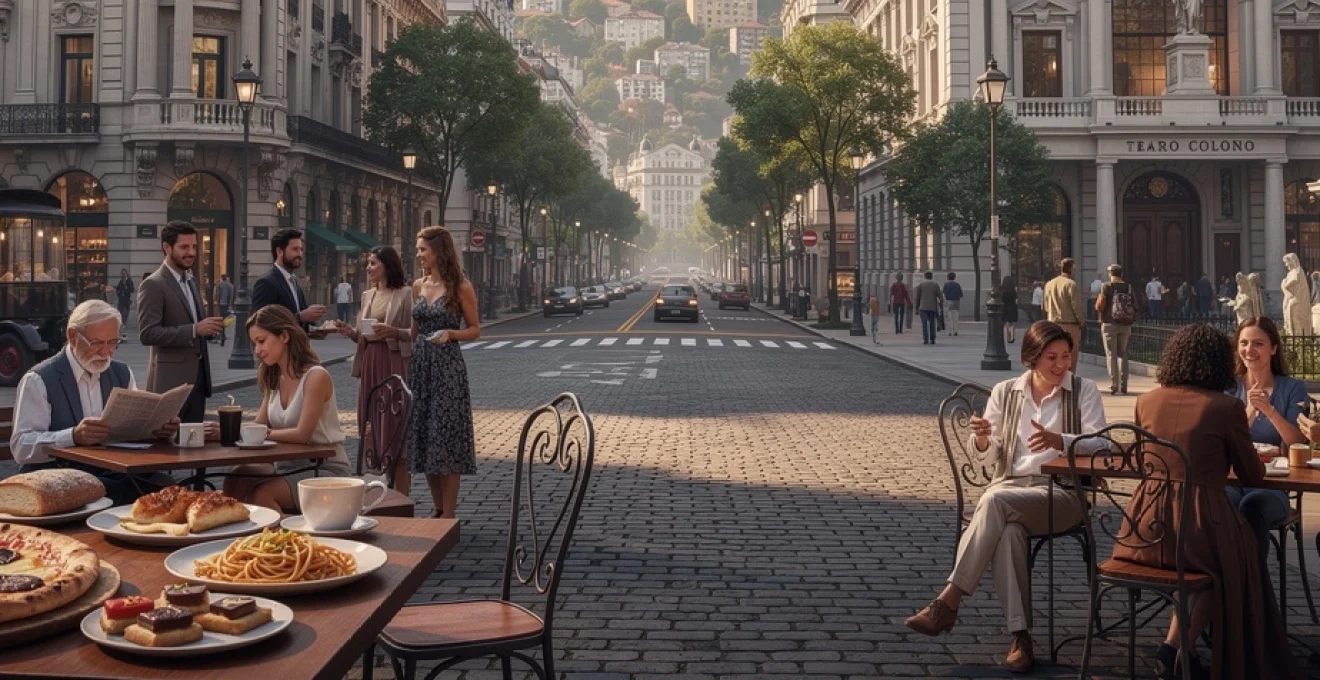
When you wander through the wide boulevards of Buenos Aires, past grand belle époque buildings and into bustling cafés where espresso culture thrives, you might momentarily forget you’re in South America. The Argentine capital presents a fascinating paradox: a Latin American metropolis with an undeniably European soul. This unique character stems from a historical phenomenon that transformed the city between the late 19th and early 20th centuries, when millions of European immigrants—primarily from Italy, Spain, and France—reshaped its cultural, architectural, and social landscape. Today, Buenos Aires stands as perhaps the most striking example of European transplantation in the Americas, where Old World sensibilities merged with New World energy to create something entirely distinctive.
The question of whether Buenos Aires deserves the title of South America’s most European city isn’t merely academic. It touches on fundamental questions about cultural identity, urban development, and the lasting legacy of immigration patterns that fundamentally altered the continent’s demographic composition. With approximately 60% of its population claiming European ancestry, Buenos Aires offers a living laboratory for understanding how architectural traditions, culinary practices, linguistic patterns, and social customs can persist across oceans and generations.
Architectural heritage: parisian boulevards and haussmannian influences in buenos aires
The architectural landscape of Buenos Aires tells the story of a city deliberately fashioned to mirror European grandeur. During Argentina’s golden age in the late 19th and early 20th centuries—when the nation ranked among the world’s wealthiest—civic leaders embarked on an ambitious campaign to transform Buenos Aires into the « Paris of South America. » This wasn’t mere wishful thinking; it was a comprehensive urban planning initiative that imported not just architectural styles, but entire design philosophies from Europe’s great capitals.
The visual similarity between Buenos Aires and Paris is no accident. Argentine architects and urban planners explicitly studied Baron Haussmann’s transformative work in Paris, adopting his principles of wide boulevards, uniform building heights, and grand public spaces. The result is a cityscape where belle époque aesthetics dominate entire neighbourhoods, creating an architectural continuity that European cities themselves often lost to wartime destruction and modernist redevelopment.
Avenida de mayo and its direct homage to gran vía and Champs-Élysées
Inaugurated in 1894, Avenida de Mayo represents Buenos Aires’ most explicit tribute to European boulevard culture. Stretching 1.5 kilometres from the Casa Rosada presidential palace to the National Congress, this magnificent avenue was conceived as Argentina’s answer to Madrid’s Gran Vía and Paris’s Champs-Élysées. The street’s generous width, stately buildings with ornate façades, and café-lined pavements create an atmosphere that wouldn’t feel out of place in Madrid or Barcelona.
Walking along Avenida de Mayo, you encounter architectural eclecticism that mirrors European capitals: Art Nouveau flourishes alongside neoclassical grandeur, while Spanish Renaissance Revival structures stand beside French Beaux-Arts buildings. The avenue’s cultural significance extends beyond aesthetics—it has served as the traditional route for political demonstrations and celebrations, much like the boulevards it emulates served in European cities as stages for public life.
Palacio barolo: dante’s divine comedy materialised in art nouveau architecture
Among Buenos Aires’ architectural treasures, the Palacio Barolo stands as perhaps the most ambitious and symbolically rich. Completed in 1923 by Italian architect Mario Palanti, this 22-storey building was specifically designed as an architectural interpretation of Dante’s Divine Comedy. The structure’s three sections represent Hell, Purgatory, and Heaven, with the building’s total height of 100 metres corresponding to the 100 cantos of Dante’s masterwork.
The Palacio Barolo exemplifies how European cultural and intellectual traditions were transplanted to Buenos Aires. Its lighthouse beacon, originally intended to mirror a twin structure planned for Montevideo, was designed so that the two lights would be mutually visible across the Río de la Plata—a romantic notion of connection that encapsulates the idealism of the era. Today, the building serves as both functional office space and cultural monument, with guided tours exploring its esoteric symbolism and breathtaking
views over the city. From its intricate ironwork to its allegorical sculptures, every detail reinforces the sense that Buenos Aires is not just inspired by Europe, but actively dialogues with its literary and artistic canon.
Recoleta cemetery: the argentine père lachaise with neoclassical mausoleums
If there is one place that encapsulates Buenos Aires’ European identity, it is the Recoleta Cemetery. Often compared to Père Lachaise in Paris or Staglieno in Genoa, this necropolis is a labyrinth of neoclassical mausoleums, Gothic chapels, and Art Deco tombs, where Argentina’s political and cultural elites are laid to rest. Marble angels, wrought-iron gates, and stained-glass windows transform the cemetery into an open-air museum of European funerary art.
The influence of French and Italian architects is particularly evident in the symmetry of its narrow alleys and the sophisticated sculptural programs that adorn family vaults. As you walk through Recoleta, you are as likely to pause to admire a statue inspired by Bernini as you are to reflect on the country’s history at the grave of Eva Perón. For visitors, the cemetery offers a rare opportunity: to read Argentina’s national story through a distinctly European visual vocabulary.
What makes Recoleta especially striking is how it condenses, within a few city blocks, the aspirations of a society that once saw itself as an extension of Europe. Just as a family photo album reveals past ambitions and anxieties, these mausoleums speak of a Buenos Aires elite eager to project refinement, stability, and lineage. In this way, the cemetery functions not only as a place of mourning, but also as a monument to the city’s long-standing desire to be perceived as a European capital in the Southern Hemisphere.
Teatro colón: comparing acoustics and design with la scala and palais garnier
Any discussion of European influence in Buenos Aires would be incomplete without the Teatro Colón. Inaugurated in 1908 after nearly two decades of construction, this opera house has been consistently ranked among the world’s best, often mentioned in the same breath as La Scala in Milan and the Palais Garnier in Paris. Its horseshoe-shaped auditorium, modelled on European opera houses, is renowned for acoustics so precise that even a whispered line from the stage can reach the last row.
The interior decor combines Italian and French influences: marble columns imported from Europe, Venetian mosaics, and a grand chandelier reminiscent of Parisian theatres. Architects Francesco Tamburini, Vittorio Meano, and Jules Dormal—an Italian-Argentine-French succession—embodied the cosmopolitan nature of Buenos Aires at the time. As you step into the Colón, crimson velvet seats, gilded stucco, and ceiling frescoes evoke the opulence of Belle Époque Europe transplanted wholesale to the Río de la Plata.
For travellers used to European opera houses, the experience at Teatro Colón feels at once familiar and unique. You might attend a performance of Verdi or Puccini surrounded by a predominantly local audience, yet the rituals—from the dress code to the intermission conversations in the marble foyers—mirror those of Milan or Vienna. This close alignment of cultural practice and architectural setting powerfully reinforces the impression that Buenos Aires is, culturally speaking, as much an Old World city as a New World one.
Demographic composition: italian and spanish immigration waves (1880-1930)
The architectural and cultural parallels between Buenos Aires and European cities are rooted in a demographic history as dramatic as any novel. Between 1880 and 1930, Argentina received one of the largest per-capita influxes of European immigrants in the world. Historians estimate that nearly 6 million Europeans arrived in the country during this period, many of whom settled in Buenos Aires and its surrounding areas, turning the port city into a dense mosaic of Italian, Spanish, French, German, and Eastern European communities.
This immigration wave fundamentally reshaped the city’s social fabric. By the early 20th century, it was common for entire neighbourhoods to be dominated by a single national community, each maintaining its own associations, mutual aid societies, newspapers, and cultural clubs. When you walk through Buenos Aires today and hear Italian surnames, see Spanish cultural centres, or notice bakeries with unmistakably European names, you are witnessing the long tail of this demographic transformation.
Understanding this population shift is key if we want to answer whether Buenos Aires is truly the most European city in South America. Unlike other capitals where European influence often remained confined to elites, in Buenos Aires it penetrated all social strata. Dockworkers, artisans, shopkeepers, and professionals alike carried European customs into daily life, blending them with local traditions to create the modern porteño identity.
Genoese and calabrian settlers in la boca and barracas neighbourhoods
Nowhere is the Italian imprint on Buenos Aires more visible than in La Boca and Barracas. Starting in the late 19th century, tens of thousands of immigrants from Genoa, Calabria, and other Italian regions settled along the southern docks, drawn by jobs in shipping, meat-packing, and light industry. La Boca’s iconic corrugated-iron houses, painted in bright colours with leftover ship paint, are the visual legacy of this working-class Italian community.
The Genoese in particular left their mark not only on architecture, but also on the local accent, gestures, and even football culture. The famous Boca Juniors club began as a neighbourhood team founded by sons of Italian immigrants, and its passionate fan base reflects the Mediterranean intensity often associated with Italian tifosi. Walking through La Boca today, listening to street musicians playing tango and Italian songs, you can almost imagine yourself in a port district of Genoa in the early 1900s.
Barracas, slightly further from the river, absorbed another wave of Italians, including many from Calabria. Here, small workshops, family groceries, and social clubs became hubs of community life. Over time, these Italian enclaves mixed with other groups, but their influence persists in local patron saints’ festivals, traditional dishes, and the characteristic rhythm of spoken Spanish. If you pay attention to the surnames on shop signs or the family stories shared in cafés, the continuity with southern Italy becomes impossible to ignore.
Galician and basque communities shaping porteño cultural identity
While Italians represented the largest immigrant group, Spanish communities—especially Galician and Basque—played an equally decisive role in shaping Buenos Aires’ European character. From the late 19th century onwards, Galicians arrived in large numbers, often working in service jobs: running grocery stores (almacenes), cafés, and small businesses that became the backbone of everyday life. So prominent were they that, for decades, gallego became a colloquial term for any Spaniard in Argentina.
Basque immigrants, meanwhile, were strongly represented in commerce, banking, and rural activities, but they also left their mark on the city through cultural associations and social clubs. Institutions like the Laurak Bat and Centro Vasco Francés not only preserved Basque language and traditions, but also integrated these elements into the broader porteño identity. Their festivals, dances, and cuisine—think bacalao al pil-pil or Basque-style pintxos—helped embed Iberian customs in Buenos Aires’ social calendar.
These Spanish communities contributed to making Buenos Aires feel like an extension of Madrid or Bilbao. The popularity of Spanish bodegones (traditional taverns), the persistence of certain idioms in Rioplatense Spanish, and the city’s enthusiasm for Spanish literature and theatre all trace back to these migration waves. When you sit in an old Buenos Aires café and order a tostado or a glass of Spanish-style red wine, you are participating in habits forged in the intimate contact between Iberian migrants and their adopted city.
French influence in palermo chico and barrio norte urban planning
Compared to Italians and Spaniards, the French community in Buenos Aires was smaller in absolute numbers, yet its cultural and urban influence was disproportionately large. Nowhere is this more evident than in Palermo Chico and Barrio Norte, affluent districts whose planning and architecture were explicitly modelled on Parisian precedents. Wide, tree-lined avenues, elegant mansions with mansard roofs, and ornate façades inspired by the French Second Empire style give these areas a distinctly Parisian air.
In the early 20th century, Argentina’s elite deliberately hired French architects and landscapers to design both private residences and public spaces. The result is a neighbourhood layout reminiscent of Paris’s 16th arrondissement, with embassies, palaces, and apartment buildings aligned along carefully planned streets. Parks and squares—such as Plaza Francia—were conceived as formal green spaces where social life unfolded much as it did along the Seine or in the Tuileries.
Walking through Palermo Chico today, you might pass a Haussmann-style building, a French lycée, and a patisserie offering croissants and macarons within the space of a few blocks. This continuity of visual and cultural cues explains why so many visitors describe Buenos Aires as feeling more like a European capital than a typical Latin American metropolis. For travellers interested in urban history, these districts offer a textbook example of how European city-making principles were transplanted and adapted across the Atlantic.
Jewish immigration from eastern europe to villa crespo and once districts
Another crucial, often underappreciated, layer of European influence in Buenos Aires came from Eastern European Jewish communities. From the late 19th century onwards, Jews fleeing pogroms and persecution in Russia, Poland, and other parts of Eastern Europe found refuge in Argentina. Many settled in the Once and Villa Crespo districts, transforming these neighbourhoods into vibrant centres of Jewish religious, commercial, and cultural life.
Once, in particular, became known for its textile shops, kosher restaurants, and synagogues, echoing the markets and shtetls of Eastern Europe in a new urban context. Yiddish theatre, Jewish newspapers, and cultural associations flourished, adding another European strand to Buenos Aires’ already complex identity. Villa Crespo, historically more working-class, developed a strong Jewish presence alongside Italian and Spanish residents, creating a multicultural fabric that persists to this day.
For visitors, the legacy of this immigration wave is visible in street names, Jewish schools, and cultural institutions scattered through the area. Stepping into a traditional bakery in Once and buying a knish or jalá bread, you encounter flavours brought directly from Eastern Europe. This Jewish presence broadens our understanding of what « European » means in Buenos Aires, reminding us that the city’s European soul is not limited to Latin or Franco-Italian influences, but also includes Central and Eastern European traditions.
Gastronomic landscape: european culinary traditions in porteño cuisine
Food is often the most immediate way we experience a city’s cultural history, and Buenos Aires is no exception. The gastronomic landscape here reads like a map of European immigration: Italian, Spanish, and French culinary traditions coexist with local ingredients and techniques, creating a distinctive porteño cuisine. When you sit down for a meal in Buenos Aires, you are not choosing between European and Argentine food; you are tasting a fusion that has evolved over more than a century.
What makes the city’s food scene so compelling is how everyday dishes bear the imprint of Old World recipes adapted to New World realities. Think of milanesas (breaded cutlets) inspired by Milan’s cotoletta, or fugazzeta, a cheese-stuffed version of Genoese focaccia, now considered quintessentially porteño. Even the classic asado, often cited as the most Argentine of meals, is frequently accompanied by European-style salads, breads, and desserts that complete the picture.
For travellers asking whether Buenos Aires is the most European city in South America, exploring its food culture offers some of the clearest evidence. From neighbourhood bodegones to refined patisseries, you constantly encounter flavours and rituals that echo Italy, Spain, and France, yet feel anchored in local routines and rhythms.
Italian trattorias: from banchero pizzeria to cuartito’s fugazza con queso
Italian immigrants transformed Buenos Aires into one of the great pizza and pasta capitals of the world. Historic establishments like Banchero—founded in La Boca in the 1930s by a Genoese family—claim to have invented fugazza con queso, the thick, cheese-laden onion pizza that has become a local institution. These pizzerias and trattorias adapted Italian recipes to Argentine tastes, creating a unique hybrid: doughs are thicker, cheese is more abundant, and toppings reflect local preferences.
El Cuartito, another iconic pizzeria founded in 1934, is famous for its generous portions and nostalgic décor filled with football memorabilia and tango posters. Eating a slice of fugazzeta here feels like taking part in a ritual that blends Neapolitan pizza culture with Buenos Aires’ working-class history. Just as you might associate a specific trattoria with a Roman neighbourhood, many porteños link particular pizzerias to their own life stories and family traditions.
Beyond pizza, countless neighbourhood restaurants serve fresh pasta, ñoquis (gnocchi), and sorrentinos (a local ravioli variant), often on special days such as the 29th of each month—a tradition with roots in Italian superstition about prosperity. For visitors, following this « gnocchi day » custom or sampling thick-crust Argentine pizza is an accessible way to experience how deeply Italian culinary practices are woven into daily life in Buenos Aires.
Spanish bodegones and galician pulperías: casa españa and el imparcial
If Italian restaurants dominate the fast-casual spectrum, Spanish bodegones and Galician-style pulperías embody the soul of traditional dining in Buenos Aires. Places like El Imparcial, often cited as one of the oldest Spanish restaurants in the city, offer classic dishes such as paella, callos a la madrileña, and tortilla española. Wooden furniture, tiled walls, and black-and-white photos create an atmosphere that could just as easily belong to a century-old tavern in Madrid or A Coruña.
Institutions connected to Spanish cultural centres, such as Casa España or Galician clubs, reinforce this sense of continuity. Here, menus feature pulpo a la gallega (Galician-style octopus), cod dishes, and hearty stews that speak directly to the culinary memory of Iberian immigrants. These bodegones are not just restaurants; they are social spaces where generations of Spaniards and their descendants have gathered to celebrate weddings, watch football matches, or simply share a bottle of wine.
For the curious traveller, seeking out a traditional bodegón in neighbourhoods like San Telmo, Congreso, or Balvanera offers a vivid sense of Buenos Aires’ Spanish roots. You might find yourself surrounded by older patrons speaking with a hint of Galician accent, waiters recommending house specialties with unmistakable pride, and a general ambiance that blurs the line between South America and the Iberian Peninsula.
French patisseries: café tortoni and confitería del molino heritage
French influence in Buenos Aires is perhaps most deliciously evident in its patisserie culture. Since the late 19th century, confiterías—elegant pastry shops inspired by Parisian cafés—have been key spaces of urban life. Café Tortoni, founded in 1858, is the best-known example: its stained glass, wooden panelling, and marble tables recall the grand cafés of Boulevard Saint-Germain, while its menu features croissants, éclairs, and masas finas (fine pastries) firmly rooted in French tradition.
Confitería del Molino, recently restored after decades of closure, adds another layer to this heritage. Located near Congress, its Art Nouveau dome and elaborate façade reflect the same European architectural ambitions seen in nearby government buildings. Inside, pastry counters laden with facturas (pastries with French and Central European origins), cakes, and chocolates bring to mind a Parisian pâtisserie adapted to local tastes and ingredients.
Sitting in one of these historic cafés, you quickly realise that coffee culture in Buenos Aires is less about quick caffeine hits and more about lingering conversation, much like in Europe. Whether you order a cortado (espresso with a splash of milk) and a medialuna or a more elaborate dessert, you are participating in a ritual that owes as much to Paris and Vienna as it does to local invention. This everyday blend of European café customs and Argentine sociability is one of the clearest signs of the city’s hybrid identity.
Urban planning paradigms: baron haussmann’s principles in porteño development
Beyond individual buildings and neighbourhoods, Buenos Aires’ overall urban structure reveals how deeply it drew from European city-planning models. In the late 19th century, as Argentina’s economy boomed thanks to agricultural exports, city leaders consciously embraced the principles popularised by Baron Haussmann in Paris: wide boulevards cutting through older districts, monumental vistas, and a strong emphasis on public parks and squares. The goal was clear—to project Buenos Aires as a modern, orderly, and prosperous capital on par with its European counterparts.
Avenida de Mayo, Diagonal Norte, and Diagonal Sur are prime examples of these interventions. Rather than allowing the colonial grid to determine all future growth, planners introduced diagonal avenues to improve circulation, create sightlines towards important civic buildings, and showcase architectural grandeur. The resulting urban fabric feels more like a European capital than the tight, colonial layouts seen in many Latin American cities, where narrow streets and smaller squares still dominate.
Parks and green spaces played an equally crucial role. The design of the Bosques de Palermo (Palermo Woods), with its lakes, walking paths, and landscaped gardens, drew inspiration from European models such as the Bois de Boulogne in Paris or London’s Hyde Park. Urbanists understood that, just as in Europe, grand public spaces were necessary not only for hygiene and recreation, but also for fostering a sense of civic identity. When you stroll through these parks, watching families picnic or friends share mate, you experience a form of public life shaped by European ideals, yet distinctly adapted to Argentine rhythms and climate.
Linguistic patterns: lunfardo dialect and Italian-Spanish hybridisation
Architecture and food tell one side of the story, but language reveals another, more intimate layer of European influence in Buenos Aires. The local variant of Spanish, known as Rioplatense Spanish, already stands out within Latin America for its distinctive use of voseo (using vos instead of tú) and its intonation, which many listeners describe as reminiscent of Italian. This melodic, sing-song prosody is no coincidence; it evolved in a context where millions of Italian immigrants were learning and speaking Spanish, often mixing the two languages in daily conversation.
Lunfardo, a slang that emerged in the late 19th and early 20th centuries among working-class porteños, takes this hybridisation even further. Originally associated with the port, prisons, and marginalised communities, Lunfardo incorporated vocabulary from Italian dialects, French, Portuguese, and even Eastern European languages. Words like laburo (work, from Italian lavoro), mina (woman), or tacho (bin) illustrate how Italian terms slipped into everyday speech, gradually becoming part of the broader linguistic landscape.
Today, Lunfardo is not confined to the margins; it is celebrated in tango lyrics, theatre, cinema, and popular music, serving as a linguistic emblem of Buenos Aires’ mixed heritage. When you listen to classic tangos by Carlos Gardel or modern porteño rock bands, you hear a language shaped as much by the docks of Genoa and the streets of Naples as by Castilian Spanish. This unique combination makes Buenos Aires sound different from other Spanish-speaking capitals—another argument in favour of its claim to being South America’s most European city.
Comparative analysis: buenos aires versus são paulo, montevideo, and santiago de chile
So, is Buenos Aires truly the most European city in South America? To answer this, it helps to compare it with other major capitals shaped by European immigration, such as São Paulo, Montevideo, and Santiago de Chile. Each of these cities bears clear marks of European influence in architecture, demographics, and culture, yet the intensity and visibility of this heritage vary in meaningful ways. By examining these differences, we can better appreciate what makes Buenos Aires stand out.
São Paulo, for instance, received even larger numbers of Italian, Japanese, and Portuguese immigrants than Buenos Aires and has become a global powerhouse with a cosmopolitan skyline. Italian communities in neighbourhoods like Bixiga and the strong presence of Portuguese culture give São Paulo a distinct European flavour. However, the city’s rapid vertical growth and sprawling urbanisation have produced a more heterogeneous architectural landscape, where glass towers overshadow many historic European-style buildings, diluting the sense of walking through an Old World city.
Montevideo, just across the Río de la Plata, offers perhaps the closest counterpart to Buenos Aires in terms of European feel. With its neoclassical architecture, waterfront promenades, and strong Italian and Spanish heritage, Uruguay’s capital can sometimes feel like a quieter, more relaxed version of its larger neighbour. Yet its smaller scale and lower density mean that the « European city » experience is more intermittent; you might pass through strongly European-looking areas near the old city or along the Rambla, then quickly shift into more modern or suburban environments.
Santiago de Chile, meanwhile, showcases European influence in specific districts—such as Lastarria, Providencia, or the Paris-Londres passage—but maintains a stronger Andean and modern Latin American character overall. The city’s urban form, shaped by both earthquakes and rapid 20th-century growth, favours modernist and contemporary architecture over the continuous Belle Époque fabric seen in central Buenos Aires. While you certainly encounter European-inspired buildings and cafés, they tend to be isolated enclaves rather than the dominant tone of the city.
When you place Buenos Aires within this regional context, a pattern emerges. Other South American cities have European elements, but Buenos Aires presents a uniquely cohesive tapestry where European architecture, demographics, language, and daily customs converge across large swathes of the urban space. Walking from Recoleta to San Telmo, through Avenida de Mayo and Palermo, you experience an almost uninterrupted sequence of European references, from Haussmannian boulevards to Italian-style cafés and Spanish bodegones. This dense layering of influences, sustained over generations, is what most strongly supports Buenos Aires’ claim to being the most European city in South America—while still, undeniably, remaining unmistakably Argentine.