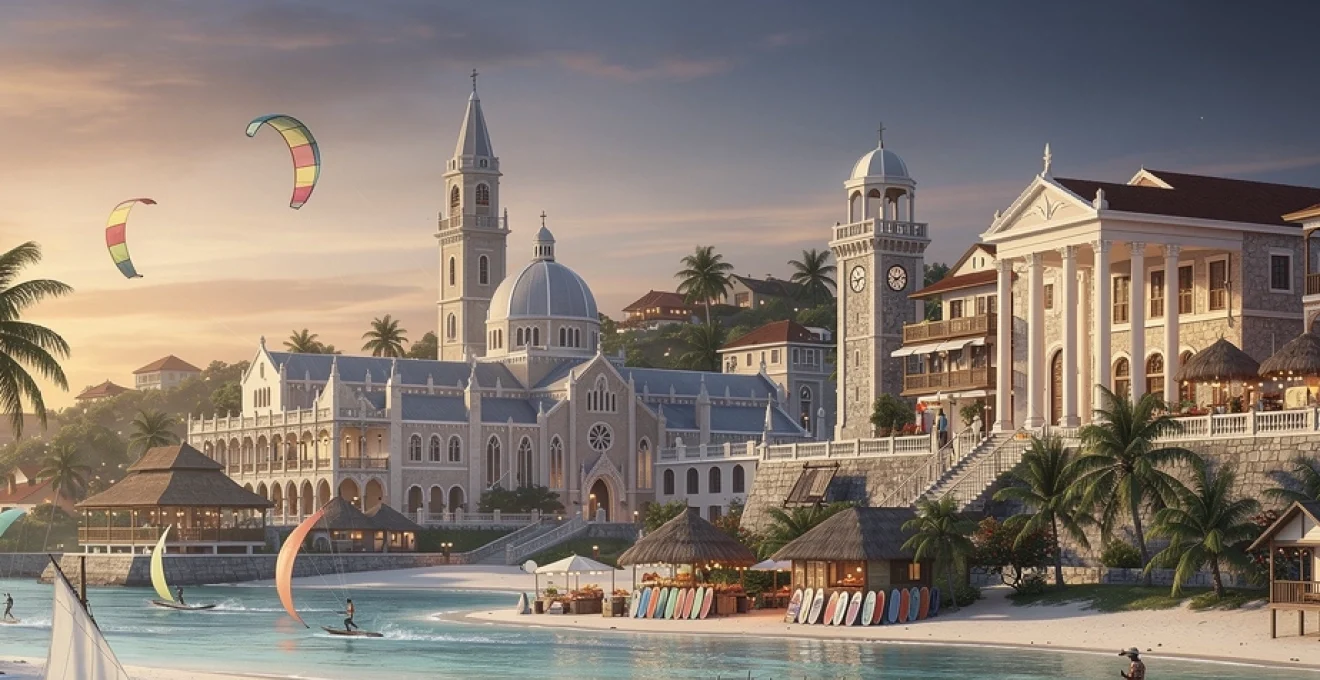
The Zanzibar archipelago emerges from the turquoise waters of the Indian Ocean as a testament to centuries of cultural convergence and natural splendour. This East African paradise, located just 25 kilometres from mainland Tanzania, represents far more than a tropical getaway destination. Here, pristine coral beaches meet ancient trading posts, where the aromatic legacy of the spice trade intertwines with vibrant Swahili traditions that have flourished for over a millennium.
What sets Zanzibar apart from other Indian Ocean destinations is its remarkable preservation of historical authenticity alongside world-class tourism infrastructure. The archipelago’s unique positioning as a crossroads between Africa, Arabia, Persia, and India has created a cultural tapestry unlike anywhere else on Earth. From the UNESCO World Heritage streets of Stone Town to the kitesurfing havens of the eastern coastline, Zanzibar offers an extraordinary blend of experiences that cater to history enthusiasts, adventure seekers, and luxury travellers alike.
Zanzibar’s premier coastal destinations and marine tourism infrastructure
Zanzibar’s coastline spans over 1,600 kilometres, encompassing diverse marine environments that support both world-class tourism facilities and critical conservation programmes. The archipelago’s beaches are characterised by their distinctive coral sand formations, created by centuries of wave action on extensive coral reef systems. These coastal areas now attract over 500,000 international visitors annually, contributing approximately £420 million to Tanzania’s tourism economy.
Nungwi beach resort complexes and northern coastline development
The northern coastline of Unguja island has evolved into Zanzibar’s most sophisticated tourism hub, anchored by Nungwi Beach’s expansive resort developments. This 3-kilometre stretch of pristine coastline benefits from minimal tidal variation, allowing for consistent swimming and water sports activities throughout the day. The area now hosts over 40 accommodation facilities ranging from boutique properties to large-scale resort complexes, employing more than 2,500 local residents.
Nungwi’s marine infrastructure includes three major diving centres that provide access to over 25 dive sites within a 20-minute boat journey. The Mnarani Natural Aquarium operates as both a tourist attraction and sea turtle rehabilitation facility, successfully releasing over 150 hawksbill and green turtles back into the wild since its establishment. The beach’s northern positioning offers protection from prevailing monsoon winds, creating optimal conditions for dhow sailing and deep-sea fishing expeditions.
Kendwa beach sunset tourism and dhow sailing operations
Adjacent to Nungwi, Kendwa Beach has established itself as Zanzibar’s premier sunset viewing destination, hosting regular full moon parties that attract visitors from across East Africa. The beach’s western orientation provides unobstructed views of the Indian Ocean horizon, creating spectacular sunset displays that have become integral to Zanzibar’s tourism marketing. Local dhow operators conduct traditional sailing excursions using vessels constructed with centuries-old techniques passed down through maritime families.
The traditional dhow construction industry centred around Kendwa employs approximately 80 craftsmen who maintain skills in working with locally sourced coconut timber and imported teak. These vessels, ranging from small fishing boats to 15-metre passenger craft, represent living examples of Swahili maritime heritage while serving modern tourism demands.
Paje beach kitesurfing centers and wind sports facilities
The southeastern coastline at Paje has transformed into East Africa’s premier kitesurfing destination, benefiting from consistent trade winds that blow at 15-25 knots for over 300 days annually. The expansive tidal flats create ideal learning conditions for beginners while providing challenging freestyle areas for advanced practitioners. Five professional kitesurfing schools operate along the 4-kilometre beach stretch, offering instruction in English, French, German, and Italian.
Paje’s wind sports infrastructure includes equipment rental facilities, repair workshops, and specialised accommodation designed for kitesurfing enthusiasts. The International Kiteboarding Organisation has recognised Paje as one of the world’s top ten kitesurfing locations, contributing to a 35% increase in sports tourism
growth over the past five years. Beyond kitesurfing, Paje has also developed stand-up paddleboarding routes through nearby mangrove channels and guided lagoon kayaking tours, diversifying the local marine tourism offer. Many operators participate in beach-clean initiatives and reef protection schemes, integrating environmental education into their lessons so that you not only enjoy the wind, but also understand how to protect the delicate lagoon ecosystem.
Jambiani village seaweed farming cultural tourism integration
South of Paje, Jambiani retains the atmosphere of a traditional Swahili fishing village while gradually integrating community-based tourism initiatives. At low tide, the lagoon transforms into a patchwork of seaweed farms managed primarily by women, who cultivate Eucheuma and Kappaphycus varieties for export to the cosmetics and food industries. In recent years, structured seaweed farming tours have emerged, allowing visitors to walk the tidal flats with local farmers, observe harvesting techniques, and learn how global supply chains begin in this shallow lagoon.
This model of cultural tourism integration generates supplementary income for over 400 households without displacing traditional livelihoods. Many guesthouses in Jambiani now collaborate directly with women’s cooperatives, offering workshops where you can make seaweed soap, scrubs, and natural beauty products. The experience feels less like a staged performance and more like being invited into a working community—much like visiting a family-run vineyard rather than a large industrial winery. For travellers seeking authentic cultural immersion, staying in small, family-operated lodges in Jambiani provides a valuable window into daily life on Zanzibar’s southeast coast.
Matemwe beach boutique accommodation and marine conservation areas
On the northeast coast, Matemwe has positioned itself as Zanzibar’s leading destination for boutique, low-density accommodation linked to high-value marine experiences. Overlooking the protected Mnemba Atoll Marine Conservation Area, the village hosts a cluster of upscale lodges and eco-boutique hotels that limit room numbers to preserve the coastline’s tranquillity. This approach has helped Matemwe avoid the overdevelopment seen in some global beach destinations, ensuring that you still find long, quiet stretches of coral sand framed by swaying palms.
Matemwe’s proximity to Mnemba Atoll makes it a strategic base for diving and snorkelling excursions within one of the Indian Ocean’s most biodiverse reef systems. Local operators work with conservation NGOs to implement strict visitor caps, no-touch policies, and mooring buoys that protect fragile coral structures from anchor damage. Several lodges contribute a portion of their revenue to reef monitoring and turtle protection programmes, effectively turning each guest stay into a micro-investment in marine conservation. If you are looking for a place where luxury tourism and responsible travel genuinely intersect, Matemwe’s boutique properties and marine conservation projects offer a compelling model.
Stone town UNESCO world heritage archaeological and architectural significance
Stone Town, Zanzibar’s historic core, earned UNESCO World Heritage status in 2000 for its outstanding example of a Swahili coastal trading town. Its urban fabric reflects more than 1,000 years of intercultural exchange between African, Arab, Persian, Indian, and European communities. Narrow alleyways lined with coral rag houses, intricately carved wooden doors, and shaded inner courtyards form a unique architectural landscape that has changed remarkably little since the 19th century.
Archaeological surveys beneath Stone Town’s modern streets have uncovered layers of settlement dating back to at least the 11th century, including ceramics from China and Persia that testify to early long-distance trade networks. As you wander through the maze-like lanes, you essentially walk over a living archaeological site where each façade, balcony, and doorway acts as a primary historical document. Preservation efforts led by the Zanzibar Stone Town Conservation and Development Authority seek to balance the demands of contemporary tourism with the urgent need to stabilise aging structures built from porous coral stone.
Omani sultan palace complex and 19th century persian gulf trade routes
In the 19th century, Stone Town became the political capital of the Omani Sultanate, which controlled vast territories along the East African coast and across the Persian Gulf. The sultans constructed an extensive palace complex along the waterfront, including the Beit el-Sahel (Sultan’s Palace) and Beit al-Ajaib (House of Wonders). These buildings formed the administrative centre of an empire whose wealth flowed from cloves, ivory, and slaves exported through maritime trade routes linking Zanzibar with Muscat, Bombay, and Istanbul.
Today, the Sultan’s Palace Museum showcases this period through preserved state rooms, personal artefacts, and archival photographs that document royal ceremonies and diplomatic visits. Interpretation panels trace how monsoon winds enabled predictable seasonal voyages between East Africa and the Persian Gulf, effectively functioning like scheduled air routes do today. For visitors with an interest in maritime history, walking the former palace seafront—now a public promenade—helps you visualise the dhows and steamships that once crowded the harbour, turning Stone Town into one of the Indian Ocean’s busiest ports.
Anglican cathedral slave market memorial and abolition history documentation
Beneath the vaulted ceiling of Stone Town’s Anglican Cathedral lies one of Zanzibar’s most poignant historical sites: the former slave market. From the late 18th to the mid-19th century, tens of thousands of enslaved people captured from inland Africa were brought here, traded, and then shipped across the Indian Ocean. The cathedral, built in the 1870s by British missionaries, was intentionally constructed on the slave market grounds as a symbolic statement against the trade.
The Slave Market Memorial includes preserved underground holding chambers where captives were shackled in cramped, airless conditions—spaces that often leave visitors in reflective silence. Exhibitions within the adjacent museum document the legal and diplomatic processes that led to the abolition of the slave trade in the region, highlighting treaties, missionary activism, and local resistance. For travellers seeking to understand Zanzibar’s complex history in an honest way, this site offers essential context, reminding us that the island’s idyllic beaches coexist with a past marked by human suffering and eventual social reform.
House of wonders zanzibar museum maritime technology exhibitions
The House of Wonders, once the tallest and most technologically advanced building on the East African coast, symbolised Zanzibar’s 19th-century embrace of modernity. It was the first structure in the region to feature electric lighting and an elevator, combining Swahili design elements with cast-iron columns and wide verandas typical of colonial architecture. Although the building has suffered structural damage in recent years, conservation efforts are underway to restore it as the flagship of the new Zanzibar Museum.
Plans for the museum include extensive maritime technology exhibitions that trace the evolution of Indian Ocean seafaring, from dugout canoes and sewn-plank dhows to modern motorised vessels. Scale models, archival charts, and interactive displays will explain how sailors interpreted stars, currents, and monsoon patterns long before GPS. For younger visitors, this can transform a seemingly abstract concept—navigating by the heavens—into something as relatable as following a navigation app on a smartphone. Once fully reopened, the House of Wonders is expected to become a cornerstone attraction for anyone interested in how Zanzibar’s maritime heritage shaped global trade.
Forodhani gardens night market culinary heritage preservation
Just in front of the House of Wonders, Forodhani Gardens overlook the harbour and serve as Stone Town’s primary public gathering space. Each evening, the park transforms into a vibrant night market where dozens of food stalls showcase Zanzibar’s culinary heritage. Here you can sample freshly grilled seafood, octopus skewers, and the famous “Zanzibar pizza”—a stuffed, pan-fried flatbread that reflects Indian, Arab, and European influences all at once.
In recent years, local authorities and heritage organisations have recognised Forodhani’s role as an informal culinary heritage preservation site. Training programmes now support vendors in maintaining traditional recipes while adopting modern hygiene standards that meet international expectations. For visitors, the market functions almost like an open-air tasting menu of Swahili cuisine: you might alternate between sugarcane juice pressed before your eyes and coconut-laden cassava cakes, all while listening to taarab music drifting from nearby radios. If you are unsure where to start, joining a guided food tour can help you navigate the stalls and understand the stories behind each dish.
Spice tour agricultural heritage and plantation tourism economics
Zanzibar’s identity as the “Spice Island” remains central to both its agricultural heritage and its modern tourism economy. At their 19th-century peak, clove plantations on Unguja produced over 90% of the world’s supply, anchoring a monoculture that tied local livelihoods to fluctuating global prices. Although spice exports now account for a smaller share of Tanzania’s GDP, cloves, cinnamon, nutmeg, and cardamom still provide crucial income for rural households across the archipelago.
Today, spice tours have transformed working plantations into immersive outdoor classrooms where you can see how tropical crops grow, from vanilla vines to pepper creepers. Guides often begin by inviting you to guess a spice using only smell or touch, turning the experience into a sensory quiz that feels more like a game than a lesson. Beyond the entertainment, these tours explain how value is added at each stage—from cultivation and drying to packaging and export—helping you understand why a small bag of hand-processed vanilla commands a premium price. For many visitors, this is the moment when Zanzibar’s market aromas finally acquire clear origins and stories.
Economically, plantation tourism has become a strategic tool for diversifying rural incomes and reducing vulnerability to climate shocks. According to local authorities, some farms now earn up to 40% of their revenue from tours, tastings, and on-site product sales, rather than from raw spice exports alone. This shift allows farmers to invest in better drying facilities, organic certification, and climate-resilient crop varieties. When you purchase spices directly from these plantations, your spending supports shorter supply chains and helps maintain traditional agroforestry systems that also protect soil and biodiversity—much like choosing shade-grown coffee over industrial alternatives.
Indian ocean marine biodiversity and coral reef conservation programmes
The waters surrounding Zanzibar form part of the Western Indian Ocean’s coral reef belt, one of the planet’s most biologically rich marine regions. Fringing reefs, barrier reefs, and patch reefs provide habitat for more than 500 recorded fish species, including parrotfish, angelfish, and reef sharks, as well as five species of marine turtles. For divers and snorkellers, sites like Mnemba Atoll, Menai Bay, and Tumbatu Island offer underwater landscapes of hard and soft corals that rival those of the Red Sea or Great Barrier Reef.
However, this marine biodiversity faces mounting pressure from climate change, overfishing, and unregulated tourism in some areas. Coral bleaching events linked to rising sea temperatures have affected sections of Zanzibar’s reefs, while destructive fishing practices like dynamite fishing—now largely curtailed—have left lasting scars. In response, a network of marine conservation programmes has emerged, combining government-designated marine protected areas with community-managed no-take zones. These initiatives function a bit like savings accounts for the ocean: by limiting extraction in key areas, they allow fish populations and coral cover to recover, then “pay dividends” in the form of spillover into surrounding fishing grounds.
For travellers, participating in reef-friendly tourism starts with choosing dive centres certified by recognised bodies such as PADI or SSI that actively follow reef protection guidelines. Many operators in Zanzibar now brief guests on buoyancy control, no-touch policies, and the importance of reef-safe sunscreen before entering the water. Citizen science projects invite experienced divers to log coral health and fish sightings using mobile apps, contributing data for long-term monitoring. If you prefer to stay on the surface, glass-bottom boat tours and guided snorkel trips offer lower-impact ways to appreciate marine life—especially when run by operators who respect wildlife viewing distances and avoid feeding fish.
Swahili cultural immersion and traditional dhow construction workshops
Beyond beaches and reefs, Zanzibar offers rich opportunities for Swahili cultural immersion that help you connect with the island on a deeper level. Language classes in basic Kiswahili phrases, traditional cooking courses, and visits to local households allow you to move beyond the typical tourist circuit. Learning how to prepare dishes such as pilau rice, octopus curry, or coconut beans under the guidance of home cooks can feel like unlocking a new side of Zanzibar that hotel buffets rarely reveal. These experiences also channel income directly into neighbourhoods that might otherwise see little benefit from large-scale tourism.
One of the most distinctive forms of cultural heritage you can encounter is the island’s long tradition of dhow construction. In coastal communities like Nungwi, generations of boatbuilders have refined techniques for shaping hulls from coconut and mvule timber, fastening planks with hand-forged nails, and sealing seams using natural fibres and resins. Workshops and guided visits now give you the chance to observe each stage of the process—from tracing hull lines in the sand to raising the triangular lateen sail that has carried traders across the Indian Ocean for centuries.
Some initiatives go further, offering short participatory sessions where you can try your hand at sanding, rope splicing, or simple carpentry under the supervision of master builders. Engaging with these craftspeople feels a bit like stepping behind the scenes of a living museum, where tools and techniques are not relics in glass cases but instruments still used daily. As you watch a dhow take shape on the beach, framed by the same ocean it will soon traverse, you begin to understand how deeply maritime skills, Swahili identity, and Zanzibar’s tourism future are intertwined. For travellers seeking more than just a postcard-perfect sunset, these cultural immersion and dhow construction experiences provide some of the island’s most rewarding and memorable encounters.