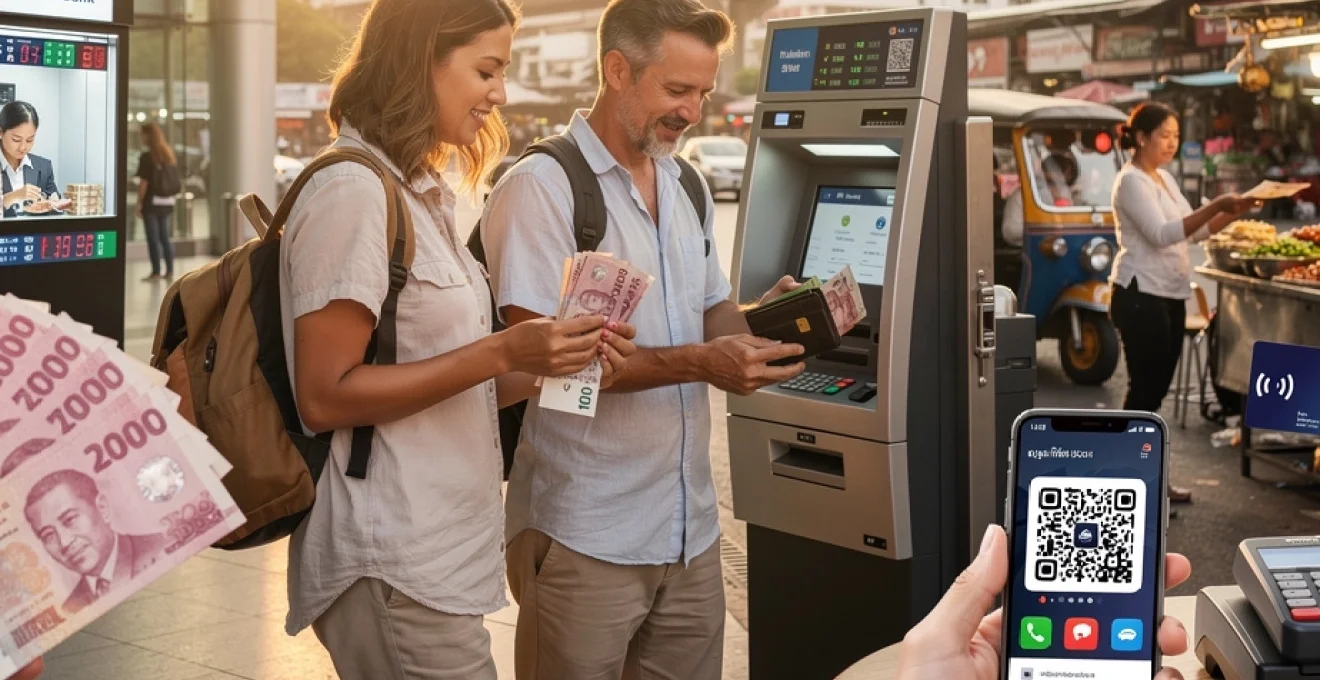
Navigating financial transactions in Thailand requires more than just packing your credit cards and hoping for the best. The Land of Smiles operates on a unique blend of cutting-edge digital payment systems and traditional cash-based commerce, creating a landscape that can confuse even seasoned travellers. From the bustling streets of Bangkok where mobile wallets reign supreme to the remote beaches of Koh Lanta where cash remains king, understanding your payment options becomes essential for a smooth visit. Exchange rates fluctuate daily, ATM fees can quickly erode your travel budget, and knowing which cards work where can mean the difference between convenience and frustration. Whether you’re planning to shop in modern malls, explore weekend markets, or venture into Thailand’s stunning rural regions, mastering the financial practicalities ensures you’ll spend more time enjoying your journey and less time worrying about money.
Thai baht currency exchange rates and conversion strategies
The Thai baht (THB) stands as one of Southeast Asia’s most actively traded currencies, with exchange rates that respond to global economic conditions, tourism trends, and regional geopolitical factors. As of 2024, the baht has demonstrated relative stability against major currencies, though travellers should expect fluctuations of 2-5% within short timeframes. Understanding where and how you exchange your currency can significantly impact your purchasing power, with differences between the best and worst exchange options sometimes exceeding 10% of your total amount.
Superrich thailand vs bank exchange counters: rate comparison analysis
SuperRich Thailand has earned its reputation as the gold standard for currency exchange among both tourists and expatriates. With branches distinguished by their orange and green colour schemes (representing two separate companies with shared origins), SuperRich consistently offers rates 3-5% superior to commercial bank counters. On a typical transaction of £1,000, this translates to approximately 1,500-2,500 baht additional purchasing power compared to exchanging at your hotel or a standard bank branch.
Bank exchange counters, whilst convenient and trustworthy, generally provide less competitive rates due to higher operational costs and conservative rate-setting policies. Major Thai banks such as Bangkok Bank, Kasikornbank, and Siam Commercial Bank maintain exchange services at branches throughout tourist areas, but their rates typically lag 2-4% behind specialist money changers. The advantage lies in their widespread availability and established security protocols, making them suitable when convenience outweighs optimal rates.
Suvarnabhumi and don mueang airport currency exchange facilities
Thailand’s two primary Bangkok airports present starkly different currency exchange landscapes. Suvarnabhumi Airport, the country’s main international gateway, houses multiple exchange operators including SuperRich branches on the basement level near the Airport Rail Link entrance. These airport SuperRich locations offer rates nearly identical to their city centre counterparts, a rarity in global aviation hubs where exchange services typically impose premium charges.
Don Mueang Airport, serving primarily low-cost carriers and domestic routes, provides more limited options with generally inferior rates. The exchange counters in the arrivals hall often show spreads 5-7% wider than optimal city rates. For travellers arriving at Don Mueang, exchanging only enough cash for immediate transport needs—approximately 500-1,000 baht—and seeking better rates once settled proves more economical. Recent data indicates that airport exchange services collectively process over 12 million transactions annually, with average amounts ranging from 10,000 to 50,000 baht per exchange.
Vasu exchange and local money changers in bangkok’s pratunam district
The Pratunam area, nestled between Bangkok’s shopping districts and the Ratchaprarop commercial zone, hosts a concentration of competitive money changers that rival SuperRich in rate quality. Vasu Exchange, situated on Ratchaprarop Road, has cultivated a loyal following through consistently excellent rates and efficient service. This establishment and its neighbours benefit from lower rental costs compared to prime tourist locations, allowing them to offer superior exchange margins whilst maintaining profitability.
Local money changers in this district operate within tightly regulated frameworks established by the Bank of Thailand, requiring proper licensing and regular auditing. During peak tourist seasons, these exchangers process transactions worth millions of baht daily,
but not all counters are equal. Smaller booths may post slightly less competitive rates or impose higher minimum transaction amounts, so comparing two or three rates before committing remains sensible. You should also carry your passport, as Thai regulations require official identification for currency exchange, particularly for amounts above 20,000 baht. When exchanging larger sums, asking whether the rate improves for higher tiers can sometimes unlock a marginally better deal. In practice, combining a small initial airport exchange with a larger transaction at Vasu Exchange or a comparable Pratunam money changer yields an optimal blend of convenience and value.
Real-time thb exchange rate monitoring tools and applications
Given the Thai baht’s daily fluctuations, using real-time exchange rate tools helps you decide when and where to convert your money. Popular apps such as XE Currency, Wise, and Revolut provide live mid-market rates, historical charts, and alerts that notify you when the baht moves beyond your chosen threshold. Treat the in-app mid-market rate as a benchmark: the closer a money changer’s rate is to this reference, the better the deal. Many travellers check these apps just before approaching an exchange counter, ensuring the posted rate aligns with current market conditions and avoiding outdated or opportunistic pricing.
For those managing larger travel budgets or long-term stays, setting automatic alerts can save hundreds or even thousands of baht over time. You might, for example, receive a notification when the baht weakens by more than 2% against your home currency and time your major exchanges accordingly. While no tool can predict short-term volatility with certainty, these apps act like a financial weather forecast, helping you avoid exchanging during storms of unfavourable rates. By combining digital monitoring with on-the-ground rate checks at SuperRich or Vasu Exchange, you gain a strategic edge in preserving your travel funds.
ATM withdrawal procedures and fee structures across thai banks
Withdrawing cash from Thai ATMs is straightforward, but the combination of local fees, your home bank charges, and currency conversion policies can make a big difference to your actual cost per baht. Most international cards work reliably in Thailand, yet each bank sets its own ATM service fees for foreign-issued cards, typically added as a flat charge per transaction. Understanding how these systems operate allows you to withdraw money efficiently and avoid paying more than necessary. Think of each withdrawal as a small financial transaction negotiation between your bank, the Thai bank, and the card network.
Bangkok bank, kasikornbank, and scb atm foreign card charges
Bangkok Bank, Kasikornbank (KBank), and Siam Commercial Bank (SCB) form the backbone of the country’s ATM network, particularly in urban centres and tourist hotspots. As of 2024, most major Thai banks levy a foreign card fee in the range of 200-250 baht per withdrawal, regardless of whether you withdraw 2,000 or 20,000 baht. This fixed fee structure means that fewer, larger withdrawals usually work out cheaper than frequent small ones. You should also be aware that your home bank may apply an additional foreign ATM fee and a separate foreign transaction fee on top of the Thai bank’s charge.
From a practical standpoint, it helps to identify which bank’s ATMs consistently accept your card without errors and provide clear English-language prompts. Bangkok Bank and SCB are widely praised for reliable international card acceptance, while Kasikornbank offers an extensive presence in shopping centres and convenience store clusters. Where possible, you might favour ATM operators whose fees are on the lower end of the national range or that have transparent on-screen disclosure before you confirm a transaction. Always check the fee summary before pressing “OK”—once accepted, the local charge cannot be reversed.
Daily withdrawal limits for international visa and mastercard users
Daily withdrawal limits for international Visa and Mastercard users in Thailand involve two constraints: the limit set by the Thai ATM operator and the limit imposed by your home bank. Many Thai ATMs cap single transactions at 20,000-30,000 baht, although some machines in bank branches may allow up to 40,000 baht. If your bank at home restricts daily ATM withdrawals to the equivalent of, say, 500 USD or EUR, this will override any higher Thai limit. Before departure, contacting your bank to confirm and, if necessary, temporarily increase these limits can spare you inconvenient cash shortages.
What if you need a large amount of baht for a property deposit, motorbike purchase, or extended hotel stay? In such scenarios, you might spread withdrawals over several days or request an in-branch cash advance using your debit or credit card, often at slightly different fee structures. Some travellers also use multi-currency accounts such as Wise or Revolut to stage larger transfers into baht and then withdraw locally, leveraging better foreign exchange rates. Regardless of method, planning around limits and fees turns what might feel like an opaque system into a predictable part of your travel budget.
Krungsri and siam commercial bank atm network coverage
Krungsri (Bank of Ayudhya) and Siam Commercial Bank operate some of the most visible ATM networks in tourist areas such as Sukhumvit, Silom, Phuket, Chiang Mai, and major islands. You will often find their machines clustered in shopping malls, BTS and MRT stations, and near popular hotels, making cash access convenient around the clock. Krungsri’s yellow ATMs and SCB’s distinctive purple machines both support English menus and accept most international Visa, Mastercard, and often UnionPay cards. Their geographical reach is particularly valuable when travelling between urban hubs and secondary cities, where smaller banks may have limited presence.
In more remote destinations, ATMs may be concentrated in town centres or near ferry piers, so you should withdraw enough cash before heading to quiet beaches or islands. SCB frequently appears in lifestyle malls and transit hubs, while Krungsri enjoys strong coverage in petrol stations and retail chains. Network maintenance standards are generally high, but occasional outages or cash shortages can occur during holiday periods such as Songkran and New Year. As a precaution, having a secondary card or a backup digital wallet ensures you are not stranded if a particular bank’s ATM network experiences temporary issues.
Dynamic currency conversion (dcc) rejection protocols at thai atms
Dynamic Currency Conversion (DCC) is a service that offers to charge your withdrawal or purchase in your home currency instead of Thai baht, often at a poor exchange rate. At Thai ATMs, this typically appears as a screen asking whether you want to be charged in your home currency (for example, EUR or GBP) with a “guaranteed rate.” While it may sound reassuring, DCC usually adds a hidden markup of 3-7% on top of standard card network rates. To avoid this, you should always choose to be charged in Thai baht and decline any option that converts the amount into your home currency on the spot.
If an ATM does not clearly present a “Without conversion” or “Charge in THB” option, cancelling the transaction and trying another machine is often the safest move. Remember that your own bank or card issuer will handle the currency conversion at regulated network rates, which are typically much closer to the mid-market rate you see on apps like XE or Wise. Thinking of DCC as an unnecessary middleman helps clarify why rejecting it saves money. By consciously selecting Thai baht whenever prompted, you retain control over the exchange rate applied to your withdrawals.
Credit card acceptance and payment processing in thailand
Credit cards are widely accepted in Thailand’s urban centres, particularly in hotels, large restaurants, shopping malls, and international retail chains. Visa and Mastercard enjoy the broadest acceptance, with American Express, JCB, and UnionPay supported in many but not all establishments. However, smaller businesses and budget venues may either impose a minimum spend for card payments or offer a cash discount. As a rule of thumb, using cards for higher-value purchases and reserving cash for local transport, markets, and small eateries balances convenience and cost.
Merchant service providers: 2c2p, omise, and gb prime pay integration
Behind the scenes, Thai merchants increasingly rely on payment gateways such as 2C2P, Omise, and GB Prime Pay to process both in-person and online transactions. These merchant service providers connect point-of-sale terminals, e-commerce websites, and mobile apps to the Visa, Mastercard, and local banking networks. For travellers, this integration translates into smoother card payments, faster authorisations, and improved reliability across a wide range of merchants. You are more likely to encounter successful transactions and fewer declined payments in outlets using modern gateways compared to legacy or standalone terminals.
As Thailand’s digital economy expands, these providers also enable recurring billing for hotel bookings, tour operators, and subscription-style services such as co-working spaces. Fraud detection algorithms, tokenisation, and PCI-DSS compliance form part of their security infrastructure, reducing the risk that your card details are compromised during transactions. While you may never see the logos of 2C2P, Omise, or GB Prime Pay at the checkout counter, their presence under the hood supports the growing reliability of card payments in Thailand. This invisible layer of technology is akin to a well-engineered road network—rarely noticed when it works, but critical to a smooth journey.
Contactless payment adoption in central world and terminal 21 shopping centres
Major shopping centres such as CentralWorld and Terminal 21 in Bangkok have embraced contactless payments, reflecting a broader shift towards tap-to-pay technology across Thailand. Most large retailers, supermarkets, and branded restaurants within these malls accept contactless Visa, Mastercard, and often Apple Pay or Google Pay, provided your card issuer supports them. Using contactless payments not only speeds up transactions but can also reduce the need to carry large amounts of cash in busy environments. For many visitors, a single contactless credit or debit card becomes the primary payment tool for shopping, dining, and entertainment in these complexes.
That said, some smaller kiosks or independent vendors within the same malls may still prefer cash or QR-based payments linked to local banking apps. You should also verify whether your card retains its contactless functionality abroad, as a few issuers disable this feature outside the home region for security reasons. When tap-to-pay works, it feels almost frictionless—much like using a transit card at multiple train stations with a single, swift gesture. By combining contactless payments in malls with cash for markets and street food, you adapt to Thailand’s hybrid payment ecosystem without overcomplicating your financial routine.
Foreign transaction fees from major card issuers in thai baht purchases
Even when you are charged directly in Thai baht, many card issuers add a foreign transaction fee of around 2-3% on international purchases. This fee applies to both physical card payments and online transactions processed by non-domestic acquirers. Over a two-week trip, a traveller spending the equivalent of 40,000 baht on their card might quietly lose more than 1,000 baht to such surcharges. To mitigate this, you can consider travel-focused credit cards or fintech cards that advertise 0% foreign transaction fees for overseas purchases in local currency.
Before travelling, checking your card’s fee schedule is essential; the information is often buried in the fine print of your account agreement or on your bank’s website. If your primary card charges high foreign fees, designating it for emergencies and using a fee-free alternative as your everyday payment method can yield substantial savings. Remember, you should still decline DCC at the point of sale and choose to pay in baht, even with a specialist travel card, to benefit from the card network’s more favourable exchange rate. Managing both local conversion choices and issuer-level fees ensures your card spending in Thailand remains efficient and predictable.
Digital wallet and mobile banking solutions for tourists
Thailand’s rapid adoption of digital payments means that mobile banking and digital wallets now play a central role in everyday transactions. For local residents, QR code payments, app-based transfers, and online banking have become as common as cash, especially in cities. Tourists, however, face a more complex landscape, as many Thai banking apps require local ID or phone numbers. Despite these barriers, several international solutions and workarounds allow visitors to harness the benefits of digital payments without opening a Thai bank account.
Promptpay qr code payment system accessibility for foreign visitors
PromptPay, Thailand’s national QR code payment system, underpins a large share of cashless transactions, from street-side coffee carts to government services. Merchants display a static QR code linked to their bank account, enabling customers to scan and pay instantly via Thai banking apps. At present, most foreign visitors cannot pay directly through PromptPay without a Thai bank account, though regional initiatives are gradually linking PromptPay to neighbouring countries’ systems. Trials with Singapore’s PayNow and Malaysia’s DuitNow indicate a future in which cross-border QR payments become commonplace.
Some international banking apps and fintechs have begun to experiment with reading or interoperating with Thai QR codes, but coverage remains patchy in 2024. For now, tourists generally rely on cards or cash, while PromptPay remains a behind-the-scenes infrastructure. If you are staying long-term and obtain a local bank account, you will find PromptPay transformative—much like moving from cheques to instant online transfers. Until then, awareness of the system helps you understand why some vendors seem surprised when you cannot scan a QR code to pay, and why cash still plays an important bridging role.
Wise (transferwise) multi-currency account for thai baht transactions
The Wise (formerly TransferWise) multi-currency account offers a powerful solution for managing Thai baht as a tourist or digital nomad. With Wise, you can hold and convert dozens of currencies at close to the mid-market rate, typically with transparent fees that undercut traditional banks. After loading your account via bank transfer or card from your home country, you convert into THB within the app and then spend locally using the Wise debit card. This approach often results in a better effective rate than direct foreign card spending, especially when your usual bank adds markup and foreign transaction fees.
Wise also allows you to monitor exchange rates and set rate alerts, aligning with a more strategic approach to funding your Thai expenses. For longer stays, freelancers and remote workers may use Wise to receive income in multiple currencies and then convert selectively when the baht is favourable. The ability to withdraw cash at Thai ATMs using the Wise card—subject to Wise’s own withdrawal limits and small fees after free allowances—adds flexibility. In practice, Wise functions as a portable, app-based travel bank, giving you visibility and control over every step of the currency conversion process.
Revolut and n26 card usage in phuket and chiang mai establishments
Revolut and N26, popular European fintech banks, have gained traction among travellers seeking low-cost international spending in destinations like Phuket and Chiang Mai. Both providers offer debit cards that typically apply interbank or close-to-interbank rates on foreign transactions, often without additional foreign transaction fees up to certain monthly caps. In tourist-heavy areas, these cards work seamlessly in hotels, restaurants, and large shops, functioning just like any standard Visa or Mastercard. Contactless support and in-app notifications further enhance security, allowing you to spot suspicious transactions in real time.
However, it is important to note that Thai ATM operators still charge their own withdrawal fees when you use Revolut or N26 cards, even if the fintech itself does not add extra costs. As with other cards, you should always choose to be charged in Thai baht and reject any DCC offers. Both apps allow you to freeze your card, adjust security settings, and track spending by category, giving you a granular view of your Thai travel budget. By combining these digital bank cards with a modest reserve of cash, you can navigate even mixed-payment environments—from trendy Nimman cafés in Chiang Mai to beachfront bars in Phuket—without friction.
Cash-only venues and regions requiring physical baht notes
Despite the impressive rise of digital payments and card acceptance, many parts of Thailand still operate primarily on physical cash. Cash-only venues are especially common among street vendors, small guesthouses, and independent service providers who prefer the immediacy and anonymity of banknotes. Understanding where cash is essential helps you plan withdrawals and avoid awkward moments at the till. As a general rule, the more informal or rural the setting, the higher the likelihood that Thai baht notes will be your only viable payment method.
Chatuchak weekend market and street food vendor payment practices
Chatuchak Weekend Market, one of the world’s largest outdoor markets, epitomises Bangkok’s cash-centric commerce. While some permanent shops and trendy stalls may accept cards or QR payments, the majority of vendors still rely on cash for speed and simplicity. Given the market’s dense crowds and narrow aisles, relying on card terminals would slow transactions to a crawl. You can expect to pay in cash for clothing, souvenirs, accessories, plants, and most food and drink items throughout the complex.
The same applies to the city’s famed street food vendors along Sukhumvit, Yaowarat (Chinatown), and Ratchada Train Market. Even when a vendor displays QR codes for PromptPay, these typically cater to local customers, leaving tourists with cash as the default option. Carrying a mix of small denominations—20, 50, and 100 baht notes—smooths purchases and avoids difficulties when vendors lack change for larger bills. In high-traffic markets, keeping your cash in a money belt or front pocket wallet also adds a layer of security while you enjoy the culinary and retail chaos.
Rural destinations: pai, koh lanta, and koh tao banking limitations
In rural and island destinations such as Pai, Koh Lanta, and Koh Tao, the physical banking infrastructure can be limited, with only a handful of ATMs or bank branches serving entire communities. During peak holiday periods or long weekends, machines may run out of cash, leaving travellers scrambling for alternatives. Some guesthouses and dive shops accept cards, but they might charge a 3-5% surcharge to offset merchant fees. Consequently, arriving with enough cash to cover several days of accommodation, food, and activities reduces your exposure to local banking constraints.
Moreover, network interruptions or power cuts—which are relatively rare but not unheard of—can temporarily disable card terminals and ATMs. Think of these areas as semi-off-grid in financial terms, where your ability to pay hinges more on what is in your wallet than on digital systems. Before heading to Pai from Chiang Mai, or to Koh Lanta and Koh Tao from the mainland, using city ATMs or exchange counters to obtain extra baht is wise. By treating major cities as your “financial hubs” and outlying destinations as “cash zones,” you ensure that scenic remoteness does not translate into payment stress.
Temple donations and tuk-tuk fares cash transaction requirements
Temples and local transport are two areas where cash remains almost universally required. Most Thai temples, including well-known sites such as Wat Pho and Wat Phra That Doi Suthep, collect entrance fees and donations via simple cash boxes or staffed counters with no card facilities. Donation boxes for incense, candles, and merit-making ceremonies typically accept coins and small notes only. Having a stash of 20 and 50 baht notes makes these cultural interactions smoother and avoids overpaying because the attendant cannot break a large bill.
Similarly, tuk-tuk drivers, motorcycle taxis, and many local songthaews (shared pick-up truck taxis) operate exclusively on cash fares. Negotiating a tuk-tuk ride in Bangkok, Ayutthaya, or Chiang Mai almost always ends with a cash handover, agreed in advance. While app-based ride services such as Grab and Bolt are expanding, they do not cover all regions or transport types. Keeping a modest daily budget in cash specifically earmarked for local transport and temple visits ensures you can participate fully in these quintessential Thai experiences without scrambling for an ATM at the last minute.
Anti-fraud measures and secure money handling in thai urban centres
Thailand’s major cities are generally safe for visitors, yet the combination of crowded public spaces and heavy tourist traffic creates opportunities for petty crime and financial fraud. Protecting your money involves both physical precautions and an understanding of the most common scams targeting foreign visitors. Urban centres such as Bangkok, Pattaya, and Phuket have invested in CCTV coverage and increased police presence in tourist zones, but personal vigilance remains your first line of defence. With a few simple habits, you can minimise risk while still enjoying the country’s dynamic urban life.
Counterfeit baht detection techniques for 500 and 1,000 note denominations
Counterfeit Thai baht is relatively rare, but when it does appear, it most often affects the higher denominations of 500 and 1,000 baht. Learning basic detection techniques helps you spot suspicious notes quickly, especially when receiving change after large purchases. Genuine Thai banknotes incorporate multiple security features, including watermarks, security threads, colour-shifting ink, and raised print. When you hold a 1,000 baht note up to the light, you should see a clear watermark portrait of the King and a solid security thread running from top to bottom.
Running your fingers across the note, particularly over the denomination numerals and text, should reveal a slightly rough, tactile feel due to intaglio printing. Tilting the note should cause colour-shifting elements and holographic stripes to change tone, while microprinting around the edges remains crisp rather than blurry. If a note feels unusually smooth, flimsy, or waxy, or if colours appear washed out, you may wish to politely request a different bill, especially in high-cash environments like night markets. Treat counterfeit detection as you would checking the brakes on a rental scooter: a quick, routine check that can prevent larger problems down the road.
Rfid-blocking wallets for sukhumvit and silom district crowded areas
Crowded nightlife and shopping districts such as Sukhumvit and Silom can be hotspots for pickpocketing and, to a lesser extent, contactless card skimming. While actual RFID-based theft is less common than some headlines suggest, using an RFID-blocking wallet or card sleeve adds a low-cost layer of protection. These accessories prevent unsolicited wireless scans of your contactless cards, particularly in packed BTS trains, night markets, or festival crowds. Combined with basic precautions such as keeping your wallet in a front pocket or cross-body bag, they significantly reduce your vulnerability.
In addition to physical safeguards, many modern banks and fintechs allow you to disable contactless payments, overseas transactions, or ATM withdrawals directly from their apps. For example, you might keep overseas usage turned off by default and only enable it when you need to pay or withdraw cash in Thailand. Viewing your cards as keys to your financial house, you would not leave all the doors and windows open at once; instead, you open specific entry points only when required. Regularly checking your transaction history and setting up real-time alerts further ensures that any suspicious activity is detected and addressed rapidly.
Travel money cards: caxton fx and fairfx security protocols
Travel money cards such as Caxton FX and FairFX provide another secure option for spending in Thailand, particularly for travellers from the UK and Europe. These prepaid cards allow you to load funds in advance, lock in exchange rates, and spend in Thai baht without exposing your main bank account. From a security perspective, they function as a controlled spending wallet: if the card is lost or compromised, the damage is limited to the balance on the card rather than your entire current account. Both providers implement chip-and-PIN security, 3D Secure for online purchases, and fraud monitoring systems comparable to those of major banks.
Many travel cards also offer in-app controls that let you freeze the card instantly, view recent transactions, and contact support channels in case of suspected fraud. You can keep a relatively small amount loaded for daily use and top up as needed, reducing the incentive for criminals to target your card. While ATM fees and exchange rate margins may still apply, especially outside pre-loaded currencies, the combination of budget control and enhanced security makes these products attractive for risk-conscious travellers. By integrating a travel money card into your payment toolkit alongside a primary credit card and a backup debit card, you create redundancy and resilience in the way you handle money across Thailand.