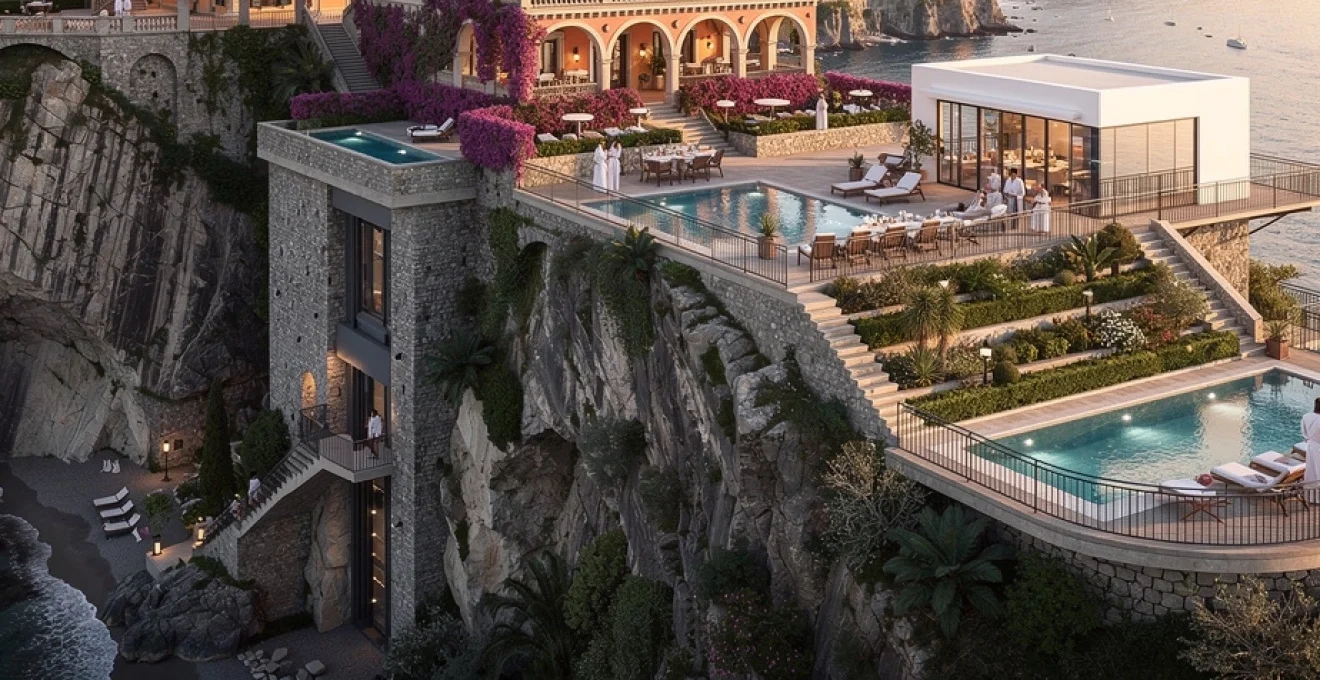
Perched dramatically between azure Mediterranean waters and vertiginous limestone cliffs, the Amalfi Coast’s architectural treasures represent centuries of ingenious human adaptation to one of Europe’s most challenging and spectacular landscapes. These clifftop accommodations, ranging from converted medieval monasteries to contemporary luxury estates, offer you more than mere rooms with a view—they provide intimate encounters with history, engineering marvels, and nature’s grandeur. The UNESCO-protected coastline stretches approximately 50 kilometres along southern Italy’s Sorrentine Peninsula, where hotels, villas, and boutique retreats cling to precipitous slopes with audacious confidence, seemingly defying gravity itself.
Architectural heritage and cliffside construction techniques of amalfi coast accommodations
The distinctive vertical architecture that defines the Amalfi Coast’s character stems from centuries of maritime tradition and topographical necessity. When space is limited and terrain forbids conventional expansion, builders throughout history have looked upward and outward, creating dwellings that cascade down cliffsides in theatrical arrangements. The traditional construction methods employed in these structures have evolved over a millennium, blending Roman engineering principles with medieval innovation and modern conservation techniques. Today’s cliffside hotels represent living museums of architectural evolution, where you can witness construction techniques spanning from the 11th century to contemporary sustainable design.
Understanding these architectural marvels requires appreciating the geological foundations upon which they rest. The Lattari Mountains, composed primarily of limestone and dolomitic limestone, provide the dramatic backdrop and structural foundation for these gravity-defying properties. The porous nature of this rock formation creates both challenges and opportunities for builders, requiring sophisticated drainage systems whilst offering natural ventilation and thermal regulation properties that modern engineers continue to admire.
Medieval tower conversions: torre dello ziro and saracen watchtower restorations
Throughout the medieval period, Saracen raids from North Africa prompted coastal communities to construct elaborate defensive networks of watchtowers. These torri saracene now serve as distinctive architectural features within luxury accommodations, their thick stone walls and commanding positions offering unparalleled panoramic vistas. The Torre dello Ziro, positioned between Amalfi and Atrani, exemplifies this transformation from military outpost to romantic retreat. The conversion process typically involves reinforcing original masonry, installing modern amenities within centuries-old walls, and creating accessible pathways where once only sentries trod.
The structural integrity of these tower conversions depends upon respecting original load-bearing configurations whilst meeting contemporary safety standards. Architects working with these historical structures must navigate complex regulations whilst preserving authenticity. The result? Accommodation spaces where you can sleep within walls that once protected entire communities, experiencing history as a tangible, living presence rather than distant abstraction.
Terraced stone masonry: traditional Dry-Wall construction methods
The terrazzamenti—agricultural terraces carved into mountainsides over centuries—demonstrate extraordinary engineering foresight that continues informing modern construction. These dry-stone walls, built without mortar using carefully selected and positioned stones, create stability through precise weight distribution and interlocking techniques. The construction method allows for natural drainage whilst preventing erosion, a principle that contemporary cliffside hotels employ when creating gardens, pathways, and structural foundations.
Traditional masons, known as muratori, possessed knowledge passed through generations regarding stone selection, placement angles, and structural geometry. This expertise becomes increasingly valuable as UNESCO preservation standards require maintaining authentic construction techniques during restoration projects. When you walk through terraced gardens of properties like Monastero Santa Rosa, you’re experiencing functional art that has sustained itself for centuries through intelligent design rather than modern materials.
Cantilever engineering: balcony and infinity pool structural integration
Modern infinity pools seemingly suspended above the Tyrrhenian Sea represent engineering achievements that would astonish medieval builders. These gravity-defying features utilise cantilever principles, where structural members project horizontally into space, supported only at one end. The engineering calculations required for such installations become particularly complex when factoring in seismic activity, wind loads, and the weight of water—a cubic metre weighing approximately 1,000 kilograms.
The most impressive examples employ post-tensioned
tendons anchored deep into the rock, distributing loads back into the cliff rather than relying solely on visible supports. In the Amalfi Coast’s most ambitious cliffside hotels, pool edges are carefully aligned with the natural horizon line so that water visually merges with the Tyrrhenian Sea below. Engineers use 3D modelling, ground-penetrating radar, and long-term monitoring systems to track any structural movement over time, particularly important in an area with seismic risk. For you as a guest, the result feels effortless—a seamless ribbon of water floating above open space—yet behind that illusion lies the same level of calculation you would find in a modern bridge or stadium.
Balconies and terraces hanging above sheer drops employ similar cantilever strategies, often reinforced by hidden steel frames embedded into historical masonry. Where possible, architects reuse existing rock outcrops and stone ledges as natural supports, reducing the amount of intrusive new structure required. Waterproof membranes, flexible joints, and corrosion-resistant materials all help these cliffside extensions withstand salt-laden winds and seasonal storms. Think of each balcony not just as an outdoor room, but as a finely tuned instrument balancing load, wind, and movement, allowing you to sip an espresso hundreds of metres above the waves in complete safety.
UNESCO world heritage site building regulations and preservation standards
Because the Amalfi Coast is designated a UNESCO World Heritage Site, every cliffside hotel project must navigate strict planning regulations and preservation standards. New construction is limited, meaning most luxury accommodations emerge from adaptive reuse of existing palazzi, monasteries, and farmhouses rather than from ground-up development. Local authorities work with conservation architects to ensure that interventions remain reversible wherever possible, allowing future generations to remove or alter modern additions without damaging original fabric. This regulatory framework helps maintain the authentic skyline of terraced villages rather than allowing high-rise resorts or intrusive concrete volumes.
Environmental impact assessments are mandatory for any significant structural work on the cliffs, particularly when excavation or rock cutting is involved. Drainage systems must be designed to prevent runoff from destabilising historic terraces or accelerating coastal erosion, while lighting plans are scrutinised to minimise light pollution along this sensitive marine ecosystem. For you as a traveller, these UNESCO-driven constraints explain why Amalfi Coast properties retain such strong sense of place: contemporary comforts are integrated discreetly, leaving vaulted ceilings, stone staircases, and terracotta roofs visually dominant. When you choose a cliffside stay here, you are effectively booking a room in a living cultural landscape, not just a generic luxury hotel.
Luxury cliffside hotels in positano: le sirenuse to il san pietro di positano
Positano is often the image that comes to mind when people imagine cliffside stays along Italy’s Amalfi Coast: a vertical village of pastel façades tumbling towards the sea. Its most celebrated hotels have capitalised on this dramatic topography, carving suites, terraces, and restaurants into every possible level of the hillside. Many of these properties began life as patrician residences or summer villas, later transformed into boutique hotels that blend heritage charm with contemporary luxury. As you move from Le Sirenuse in the town centre to Il San Pietro clinging to the outer cliffs, you experience not just changing views but different interpretations of what a cliffside retreat can be.
These luxury cliffside hotels in Positano excel at turning limited horizontal space into layered vertical experiences. Rooftop pools overlook mid-level restaurants, which in turn sit above spa complexes hollowed from the rock. Narrow corridors and stepped pathways become part of the narrative, reminding you that here, movement is almost always diagonal rather than straight. If you are comparing Amalfi Coast accommodations with sea views, Positano offers some of the most photogenic perspectives in the Mediterranean, complemented by high-touch service and Michelin-level dining.
Le sirenuse: 18th-century palazzo with tyrrhenian sea panoramas
Le Sirenuse occupies an 18th-century palazzo once used as a family summer home, positioned almost theatrically above Positano’s main beach. Its cliffside setting allows nearly every suite to frame the Tyrrhenian Sea and the town’s cascading houses through arched windows and Juliet balconies. Interiors combine antique furniture, hand-painted tiles, and contemporary art, creating the feeling that you are staying in a cultivated private residence rather than a conventional hotel. For travellers seeking a romantic cliffside stay in Italy, Le Sirenuse often tops the list thanks to its intimate scale and cinematic location.
The hotel’s terraced layout makes strategic use of elevation changes to create distinct atmospheres on each level. Pool decks sit above the bustle of the town yet below room balconies, forming a quiet middle zone where you can relax while still feeling immersed in Positano’s amphitheatre-like setting. The on-site restaurant and bar open onto outdoor spaces that seem to float above the bay, particularly enchanting at sunset when the surrounding cliffs catch the last light. If you plan to explore the Amalfi Coast by boat, the hotel can arrange private charters departing directly from the beach below, allowing you to see the palazzo’s full cliffside profile from the water—a perspective that underscores just how ingeniously it is anchored into the rock.
Il san pietro di positano: private beach access via Cliff-Cut elevator
Perched alone on a rocky promontory just outside Positano, Il San Pietro di Positano offers one of the coast’s most dramatic cliffside locations. The hotel is literally carved into the cliff face, with levels descending from reception down towards the sea, each platform revealing new vantage points over the vertical coastline. Perhaps its most remarkable feature is the private beach, accessible by an elevator shaft tunneled straight through the rock. This ingenious solution means you can move from a hilltop terrace to a secluded cove in under a minute, an almost surreal experience in such rugged terrain.
The elevator is more than a novelty; it symbolises the intersection of engineering and hospitality that defines Amalfi Coast cliffside properties. At sea level, guests find a small marina, sunbathing platforms, and a casual restaurant, all shielded from public access by the surrounding rock walls. Higher up, terraces are sculpted into the cliff to hold tennis courts, gardens, and outdoor lounges, each carefully cantilevered to preserve natural rock formations. If you value privacy as much as panoramic views, Il San Pietro’s isolated position and multi-level design provide the sense of a self-contained coastal world, yet Positano remains a short shuttle ride away.
Casa angelina: minimalist white architecture on praiano promontory
Midway between Positano and Amalfi, Casa Angelina in Praiano represents a more contemporary take on cliffside design. Its bright white façades and pared-back interiors contrast intentionally with the region’s traditional ochres and terracottas, highlighting light and space rather than ornament. Built into a steep promontory, the hotel descends in layers of glass-fronted rooms and terraces, each capturing unbroken sea views and sunsets over Capri. For travellers interested in modern cliffside architecture in Italy, Casa Angelina demonstrates how minimalist design can coexist with a historic landscape without visually overpowering it.
Several suites and loft-style rooms are located even closer to the sea, reached by a long external staircase that winds through the cliffs—a reminder that in Praiano, vertical movement is part of daily life. The hotel’s aesthetic extends to its cliff-edge pool, where clean lines and pale materials allow the changing colours of sky and water to take centre stage. Because Praiano is quieter than Positano, evenings at Casa Angelina feel particularly serene, with little more than the sound of waves breaking on the rocks far below. If you prefer a refined, design-focused base for exploring the Amalfi Coast, this cliffside retreat offers a striking alternative to more traditional palazzi.
Villa treville: exclusive cliffside estate with franco zeffirelli heritage
Once the private home of famed director Franco Zeffirelli, Villa Treville occupies an exceptionally lush cliffside estate just east of Positano. The property sprawls across multiple terraces connected by stone paths, stairways, and pergola-covered walkways, giving it the feel of a secluded village suspended above the sea. Suites are distributed through several villas, each with unique décor inspired by Zeffirelli’s artistic circle and travels. Staying here feels less like booking a hotel room and more like being a guest at an aristocratic Mediterranean residence frozen in a particularly glamorous moment in time.
Gardens cascade down the cliff, with citrus groves, vegetable plots, and flowering borders framing views of Positano’s iconic skyline in the distance. Private decks and small plunge pools are carved into rock outcrops, providing intimate vantage points where you can read, dine, or simply watch the play of light across the water. At sea level, a discreet jetty allows for boat arrivals and departures, reinforcing the sense that this is an enclave best approached from the water. For those seeking an exclusive cliffside estate on the Amalfi Coast—perhaps for a special occasion or private gathering—Villa Treville’s layered topography and cinematic history make it especially compelling.
Ravello’s elevated terraces: villa cimbrone and monastery hotel conversions
High above the main coastal road, Ravello occupies a natural balcony more than 300 metres above the sea, giving its hotels a different kind of cliffside perspective. Instead of sitting directly on the edge of coastal precipices, many Ravello properties command sweeping vistas from a plateau, their gardens and terraces reaching towards the void. This elevated position has long attracted artists, musicians, and writers looking for tranquillity paired with far-reaching views. When you choose a Ravello base for your Amalfi Coast stay, you trade immediate beach access for a more contemplative, almost otherworldly outlook over terraced valleys and the Tyrrhenian Sea.
The village’s architectural fabric includes aristocratic villas, medieval churches, and former monasteries, many now converted into refined hotels. Because space is less constrained here than in Positano, gardens become protagonists, spreading out across multiple levels with belvederes, pergolas, and shaded cloisters. The experience of a cliffside stay in Ravello is therefore as much about wandering through historic landscapes as it is about the rooms themselves. For travellers who appreciate slower rhythms and cooler evening temperatures, this hilltop town offers a distinctive alternative to the busier seaside hubs.
Villa cimbrone gardens: terrace of infinity viewing platform design
Villa Cimbrone, now partly operating as a hotel, is celebrated worldwide for its gardens and the famed Terrace of Infinity (Terrazza dell’Infinito). This narrow stone platform extends towards the edge of the cliff, lined with marble busts that silhouette dramatically against the sky. From here, the drop to the sea is so sheer that the coastline below seems almost abstract, like a painted backdrop rather than a physical landscape. For many visitors, standing on this terrace is the defining visual experience of the Amalfi Coast, capturing the region’s combination of human artistry and raw geology.
Behind the apparent simplicity of the Terrace of Infinity lies careful structural engineering. The platform relies on thick supporting walls keyed into the cliff and reinforced over time to counteract weathering and minor seismic activity. Drainage channels discreetly integrated into the paving help prevent water from undermining the stonework, while strategic planting above stabilises the soil. Walking through Villa Cimbrone’s gardens towards this terrace, you pass pergolas, rose beds, and shaded viewpoints that gradually build anticipation. It’s an example of landscape design orchestrated like a symphony, with the climactic “movement” delivered at the literal edge of the cliff.
Belmond hotel caruso: 11th-century palazzo perched 350 metres above sea level
Belmond Hotel Caruso occupies an 11th-century palazzo at one of Ravello’s highest points, around 350 metres above sea level. Its position means that from many rooms and terraces, you look not only over the coastline but also across to other mountain ridges, creating a sense of being suspended between sea and sky. The hotel’s most iconic feature is its infinity pool, set at the garden’s uppermost edge so that its waterline appears to blend seamlessly with the horizon. From this vantage point, the terraces, villages, and roads below shrink into miniature, giving you the impression of surveying an elaborate model rather than a real landscape.
The palazzo’s interior spaces retain vaulted ceilings, stone arches, and fresco fragments, while modern interventions stay mostly invisible, tucked behind historical fabric. Gardens step down in a series of lawns, citrus groves, and flower borders, punctuated by belvederes that frame different segments of the coastline. Because of its elevation, the Caruso benefits from cooling evening breezes even at the height of summer, making its cliffside terraces particularly pleasant for alfresco dining. For travellers planning a longer Amalfi Coast itinerary, a few nights here can provide a welcome change of pace from the more crowded waterfront towns, without sacrificing the region’s signature views.
Monastero santa rosa: Convent-to-Luxury resort transformation on conca dei marini cliffs
Monastero Santa Rosa, set on the cliffs of Conca dei Marini between Amalfi and Praiano, exemplifies the sensitive conversion of a 17th-century convent into a luxury hotel. The original complex was built vertically, with terraced gardens descending towards the sea and monastic cells arranged along cloistered corridors. In transforming it into a resort, architects preserved this essential layout, turning former cells into suites and maintaining the austere exterior while softening interiors with contemporary comfort. From many angles, the building still resembles a fortified religious house, its pale walls rising directly from the rock high above the water.
The terraced gardens are among the most remarkable on the Amalfi Coast, cascading down in a series of stone-framed levels linked by stairways and narrow paths. At the lowest substantial terrace sits an infinity pool perched so close to the cliff edge that it appears to hover above open space, a modern counterpoint to the centuries-old architecture behind it. Herbal beds and citrus trees reference the convent’s medicinal and culinary traditions, blending historical narratives with present-day wellness themes. If you are interested in staying within a former monastery on the Amalfi Coast, Monastero Santa Rosa offers an immersive experience where silence, seclusion, and cliffside views converge.
Boutique cliffside retreats: furore fjord to praiano hidden gems
Beyond the headline-making luxury properties, the Amalfi Coast shelters numerous small boutique hotels and guesthouses tucked into lesser-known corners of the cliffs. These retreats often occupy restored fishermen’s houses, small farmsteads, or family villas, many reached only by staircases or narrow lanes inaccessible to cars. Furore, for example, is famous for its dramatic fjord-like inlet and scattered houses clinging improbably to the rock, while Praiano offers a quieter, more residential feel than neighbouring Positano. Choosing one of these smaller cliffside stays can give you a more intimate relationship with the landscape and local community.
Because space is at a premium, boutique properties tend to emphasise clever use of terraces and roof spaces rather than expansive interior areas. Breakfast may be served on a tiny balcony overlooking a ravine, while sun loungers are tucked into corners of shared rooftop gardens. What they lack in formal facilities—large spas, multiple restaurants—they often make up for in direct, personal service and authentic atmosphere. If you are comfortable with steps, inclined lifts, and occasionally challenging access routes, these hidden gems can feel like your own private perch above the Mediterranean, far from the busiest tourist flows.
Panoramic dining experiences: Michelin-Starred restaurants with vertical drop views
Dining is an integral part of the cliffside experience along the Amalfi Coast, and many of the region’s finest restaurants are positioned to maximise sea and sunset views. Several hold Michelin stars, combining culinary innovation with terraces that seem to hover above sheer drops. In Positano and Ravello especially, restaurants take advantage of existing palazzo roofs and balconies to create open-air dining platforms, often protected by pergolas or retractable canopies. The result is a multi-sensory experience where flavours, fragrances, and views interact—imagine tasting local lemon-infused dishes while looking out over the very groves where the fruit was grown.
From a design perspective, these cliffside dining terraces must balance romance with safety and practicality. Railings are engineered to withstand strong coastal winds without obstructing sightlines, floor surfaces are chosen for slip resistance, and lighting is calibrated to avoid glare that would detract from nighttime vistas. Many restaurants offer “view tables” along the perimeter that sell out quickly, so reserving well in advance is wise if you want the full vertical-drop panorama. For travellers planning a food-focused Amalfi Coast itinerary, seeking out these panoramic dining experiences can be as memorable as the hotels themselves, turning each meal into another opportunity to engage with the dramatic geography.
Geological formation and coastal erosion management for cliffside properties
The very cliffs that make Amalfi Coast hotels so spectacular are the product of complex geological processes, primarily involving uplifted limestone shaped by water and wind over millions of years. Steep slopes, fractured rock, and limited soil depth create a fragile equilibrium, one that must be carefully managed to ensure both safety and long-term preservation. Hotter summers and more intense rainfall events—trends documented across the Mediterranean in recent decades—can increase the risk of rockfalls and landslides if drainage and vegetation are not properly maintained. Understanding how these natural forces interact helps explain why responsible cliffside development here is as much about geology as it is about architecture.
Local authorities and property owners employ a range of erosion-control measures to protect both buildings and roads. Rock-bolt systems and steel mesh netting are often installed on unstable sections of cliff, particularly above the main coastal highway and around larger structures. Terraced agriculture, long a defining feature of the landscape, also plays a vital role by stabilising slopes through retaining walls and deep-rooted plants. Hotels and villas must maintain drainage channels, cisterns, and soakaways to prevent uncontrolled runoff from undermining these terraces during heavy storms.
For travellers, visible signs of these protective systems might include discrete rockfall barriers along paths, gabion walls supporting garden edges, or recently rebuilt stone terraces after winter damage. While such interventions may appear purely functional, they represent an ongoing commitment to living with the landscape rather than attempting to dominate it. When you choose a cliffside stay along Italy’s Amalfi Coast, you are participating in a longstanding dialogue between human settlement and a powerful coastal environment—one in which safety, sustainability, and scenic beauty must constantly be brought into balance.