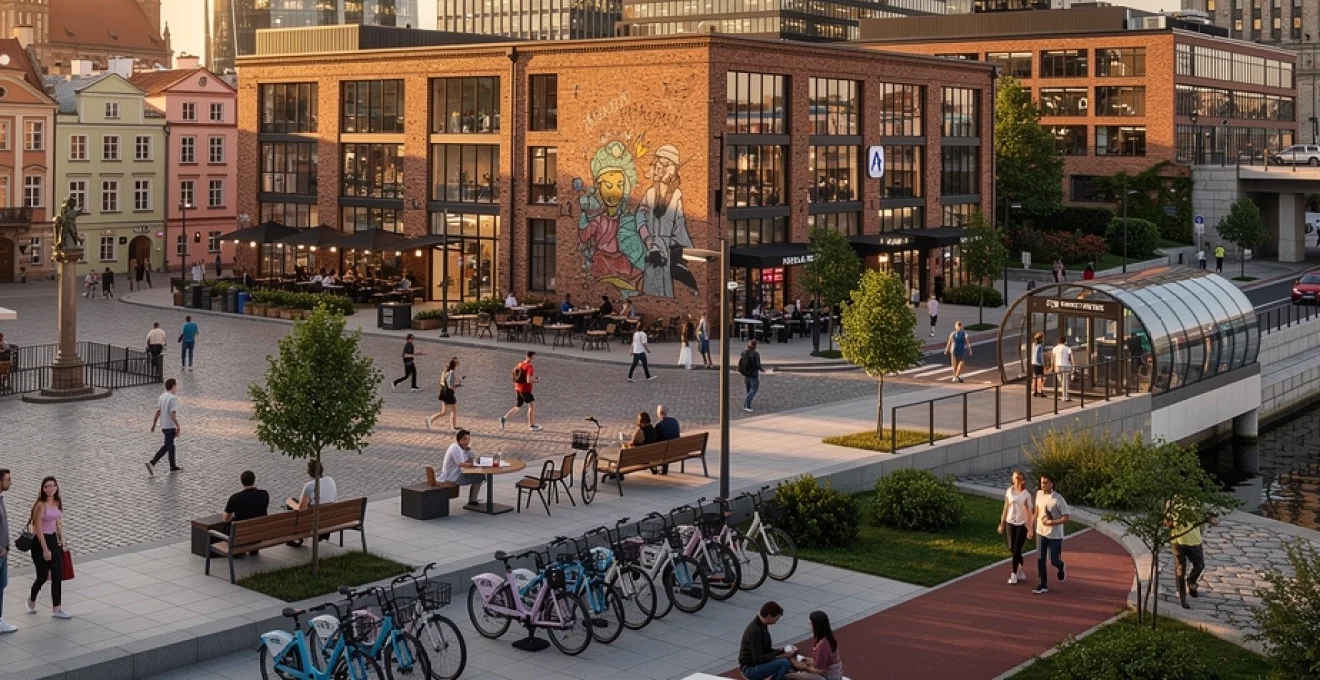
What comes to mind when you think of Warsaw? For many, the image of grey Soviet-era architecture still lingers, a visual echo of Cold War narratives. Yet today’s reality couldn’t be more different. The Polish capital has undergone one of the most remarkable urban transformations in modern European history, emerging from the shadows of communist planning and wartime destruction to become a vibrant, forward-thinking metropolis. With its gleaming skyline now rivalling London and Frankfurt, Warsaw stands as a testament to what visionary urban planning, political will, and societal determination can achieve. This transformation isn’t merely cosmetic—it represents a fundamental reimagining of what a 21st-century European capital can be, balancing historical preservation with ambitious modernisation across infrastructure, technology, culture, and environmental sustainability.
Post-1989 urban regeneration: from communist grey to contemporary architecture
The fall of communism in 1989 marked a pivotal turning point for Warsaw’s urban landscape. The city inherited a patchwork of damaged pre-war structures, hastily constructed Soviet-era blocks, and vast concrete expanses that prioritised vehicles over people. What followed was not an overnight transformation but a methodical, generation-spanning commitment to rebuilding Warsaw’s identity. Unlike many cities that pursued development in electoral cycles, Warsaw’s planners thought in terms of decades, establishing a coherent vision that successive administrations have largely maintained.
The regeneration strategy focused on several key principles: restoring historical character where possible, introducing contemporary architecture that respected urban context, and gradually reclaiming public space from car-centric planning. This approach required unprecedented political courage, particularly in minimising the « not in my backyard » opposition that often derails major urban projects elsewhere. The result is a city that feels increasingly cosmopolitan whilst retaining its unique identity—a delicate balance that few European capitals have achieved so successfully in such a compressed timeframe.
Reconstructing the old town: UNESCO world heritage site restoration project
Warsaw’s Old Town represents perhaps the most extraordinary feat of urban reconstruction in modern history. After Nazi forces systematically destroyed 85% of the city during the 1944 Warsaw Uprising, the meticulous rebuilding of the historic centre became a powerful symbol of Polish resilience. Using Canaletto’s 18th-century paintings, architectural drawings, and photographs, craftsmen painstakingly recreated the Old Town’s medieval street pattern, baroque facades, and Renaissance market square. This wasn’t mere nostalgia—it was an assertion of cultural continuity in the face of attempted erasure.
The UNESCO recognition in 1980 acknowledged this reconstruction as an exceptional example of near-total reconstruction of historic architecture. Today, the Old Town serves multiple functions: it remains a residential neighbourhood, a tourist destination attracting millions annually, and a living reminder of Warsaw’s capacity for reinvention. The colourful townhouses, cobblestone squares, and Gothic architecture create an atmosphere that belies their relatively recent construction, demonstrating how historical authenticity can coexist with modern urban function.
Warsaw spire and złota 44: skyline transformation through High-Rise development
The transformation of Warsaw’s skyline tells the story of its economic ascent. The Warsaw Spire, completed in 2016, rises 220 metres and houses prestigious international tenants, whilst Złota 44—designed by renowned architect Daniel Libeskind—brought luxury residential living to unprecedented heights. These developments represent more than architectural ambition; they symbolise Warsaw’s emergence as a serious competitor for international investment and talent.
However, the crown jewel of this vertical expansion is undoubtedly Varso Tower, which claims the title of the European Union’s tallest building at 310 metres. Designed by Foster + Partners, this architectural landmark features an observation deck that opened in autumn 2025, offering spectacular panoramic views across the transformed cityscape. The building incorporates sustainable technologies and smart building systems that position Warsaw at the forefront of green high-rise development. What’s particularly striking is how these new towers have gradually diminished the visual dominance of Stalin’s Palace of Culture and Science, subtly rewriting the city’s architectural narrative without erasing its complex history.
Powiśle district adaptive reuse: industrial heritage to creative quarter
The Powi
śle district, once a zone of warehouses, power infrastructure and neglected riverfront, has become one of the clearest examples of Warsaw’s adaptive reuse strategy. Rather than wiping the slate clean, planners and developers chose to repurpose industrial buildings into cultural venues, eateries, boutique hotels and offices. Former power plant structures have been transformed into Elektrownia Powiśle, a mixed-use complex that blends gastronomy, retail, co‑working spaces and loft-style apartments. The result is a creative quarter that feels authentic rather than manufactured, where preserved brick facades and steel beams sit comfortably alongside glass pavilions and landscaped courtyards.
This approach to urban regeneration offers a model for other European cities grappling with post-industrial sites. By layering new functions onto existing fabric—an approach also visible in New York’s post-industrial creative districts—Powiśle demonstrates how heritage becomes an economic asset rather than a constraint. For residents and visitors, the district offers a 15‑minute city experience: cultural institutions, universities, Vistula boulevards and city centre within walking or cycling distance. Crucially, Powiśle’s transformation has reconnected Warsaw with its river, turning what was once a back-of-house service zone into one of the capital’s most desirable neighbourhoods.
Plac defilad revitalisation: redefining the palace of culture and science surroundings
At the literal and symbolic heart of Warsaw sits Plac Defilad, the vast square surrounding the Palace of Culture and Science. For decades, this windswept expanse of concrete embodied the city’s uneasy relationship with its communist past: an over-scaled parade ground dominated by Stalinist architecture and surface car parks. Instead of demolishing the Palace, city authorities chose a more subtle, long-term strategy—changing the context around it. Skyscrapers like Varso Tower and Warsaw Spire have gradually rebalanced the skyline, while new cultural and public spaces at ground level are softening the square’s authoritarian geometry.
The most visible catalyst in this reimagining is the new Museum of Modern Art in Warsaw, opened in 2024 and designed by Thomas Phifer and Partners. Its clean white volumes, generous lobby and sculptural staircase introduce a human scale and strong cultural program to the area. The adjacent TR Warszawa theatre, now under construction, will further anchor Plac Defilad as a cultural district rather than a mere transport interchange. Public realm projects—new trees, seating, fountains and restored pre‑war street grids—are progressively transforming the space into a welcoming urban living room. In effect, Warsaw is turning a former symbol of domination into a platform for dialogue, creativity and civic life.
Tech hub emergence: central and eastern europe’s silicon valley aspirations
Warsaw’s physical makeover has gone hand in hand with an economic transformation that increasingly positions the city as a tech and innovation hub for Central and Eastern Europe. With a population of over 2.3 million in the wider metropolitan area, a strong academic base and competitive operating costs, the Polish capital has become fertile ground for software development, fintech and e‑commerce. As remote work and digital services have accelerated globally, Warsaw has capitalised on its strategic location between Western Europe and the Baltics, attracting both global tech giants and ambitious local startups.
Can Warsaw really become a kind of “Silicon Valley of the Vistula”? While comparisons to California can be overstated, the ingredients are clearly there: abundant engineering talent, improving quality of life, and a supportive policy framework backed by EU funds. The city’s tech ecosystem now spans everything from early‑stage accelerators and coworking spaces to corporate R&D centres and unicorn‑status companies. This digital layer adds a new dimension to Warsaw’s reinvention, complementing its physical regeneration with a knowledge‑driven economy.
Google campus warsaw and microsoft development centre: global tech giants’ investment
One of the clearest signals of Warsaw’s rising profile in the digital economy was the opening of Campus Warsaw (now Google for Startups Campus) in 2015. Housed in a refurbished vodka factory in Praga, the campus provides co‑working spaces, mentoring, and access to international networks for Polish and regional startups. Beyond the bricks and mortar, Google’s presence has helped put Warsaw on the map for investors scouting Central and Eastern Europe’s tech scene. Regular events, hackathons and training programmes have fostered a culture of experimentation and cross‑border collaboration.
Microsoft has followed a similar trajectory, expanding its Warsaw development and innovation operations as part of a multibillion‑euro investment in cloud infrastructure in Poland. The Microsoft Development Center in Warsaw focuses on advanced projects in cybersecurity, AI and cloud solutions, drawing on Poland’s long‑standing strengths in mathematics and computer science. These anchor investments by global players have a multiplier effect: they encourage local universities to adapt curricula, attract highly skilled professionals from across the region, and inspire employees to spin out their own ventures. For organisations considering where to base development teams in Europe, Warsaw now routinely appears alongside Berlin, Prague and Vienna.
Mbank and allegro: homegrown fintech and e-commerce unicorn success stories
Global brands are only part of the story. Warsaw’s credibility as a tech hub is also built on homegrown success stories that have scaled across Europe. mBank, one of Poland’s leading financial institutions, was an early pioneer in digital banking and continues to use Warsaw as a laboratory for mobile‑first financial services. Its user‑friendly app ecosystem and data‑driven approach have influenced how retail banking is delivered across the region, proving that innovation in financial technology does not have to originate in London or Frankfurt.
Meanwhile, e‑commerce giant Allegro, headquartered in the Warsaw metropolitan area, has grown from an online auction site into one of Europe’s largest marketplaces, with tens of millions of users. Its 2020 IPO on the Warsaw Stock Exchange was one of the biggest in Europe that year, underscoring both the company’s scale and the maturity of Poland’s capital markets. These and other Polish champions—such as CD Projekt in gaming—demonstrate that Warsaw is not just a back‑office location but a place where global digital brands can be born and thrive. For entrepreneurs, this creates valuable role models and a talent pool with direct experience of hyper‑growth.
Startup ecosystem infrastructure: hub:raum, reaktor, and campus warsaw coworking spaces
Beneath the headline‑grabbing unicorns lies a dense layer of startup infrastructure that makes Warsaw an attractive city to launch a business. Innovation hubs like hub:raum (backed by Deutsche Telekom), Reaktor, and various coworking spaces linked to Google for Startups provide early‑stage founders with affordable offices, mentoring, and access to corporate partners. These spaces function as community anchors, where meetups, pitch nights and coding workshops lower the barriers to entry for aspiring entrepreneurs.
From the outside, a coworking space might look like any other open‑plan office. In practice, it operates more like an ecosystem nursery, where informal introductions and shared experiences help young companies avoid common pitfalls. Warsaw’s advantage lies in the mix of local and international actors in these environments: you’re as likely to meet a Polish engineer returning from London as a Ukrainian designer or a Scandinavian investor scouting deals. For anyone considering launching or scaling a startup in Central Europe, spending a few weeks embedded in these Warsaw communities can be an efficient way to test the waters.
EU digital innovation hub status: securing €400 million technology funding
Public policy has also played a crucial role in reinforcing Warsaw’s tech ambitions. As part of the EU’s Digital Europe Programme and related initiatives, the city has benefited from designation as a key Digital Innovation Hub within Poland’s national network. This status has helped channel hundreds of millions of euros—often cited around the €400 million mark—into technology infrastructure, research programmes and SME digitalisation projects. For local companies, this translates into access to grants, testbeds and expert support that might otherwise be out of reach.
These funds are not just about buying hardware or writing software; they are about building capacity. Think of it as upgrading an entire urban operating system rather than installing a single app. Support ranges from AI and cybersecurity competence centres to industry‑specific pilots in areas like smart manufacturing and e‑health. For Warsaw, being at the core of this network reinforces its role as a platform city—one that enables digital transformation far beyond its administrative boundaries. For investors and corporate partners, it signals long‑term stability and policy alignment with broader EU digital strategies.
Transportation infrastructure modernisation: metro expansion and smart mobility solutions
Mobility has been one of the clearest arenas where Warsaw has broken with its car‑centric past. While some Western European cities are still debating their first metro lines, Warsaw has quietly built and expanded a modern underground network, tram system and integrated ticketing. This shift from traffic‑dominated arterials to public‑transport‑first planning underpins much of the city’s livability gains. It also supports the 15‑minute city concept, where daily needs—from work and education to leisure—can be met without lengthy commutes.
What does this look like on the ground for residents and visitors? Shorter travel times across the river, cleaner air, and a public realm that feels increasingly human in scale. The city’s approach has been pragmatic: combine large‑scale investments in rail and metro with flexible, tech‑driven solutions like bike‑sharing and real‑time journey planning. Taken together, these measures are turning Warsaw into one of Europe’s most interesting case studies in transport modernisation.
M2 metro line extension: connecting praga district and warsaw chopin airport
The M2 metro line, running east–west, has been transformative for how people experience Warsaw’s geography. Initially opened in 2015 and extended in stages through 2019 and beyond, it bridged the long‑standing divide between the historic left bank and the traditionally under‑invested Praga district. Stations like Nowy Świat–Uniwersytet and Centrum Nauki Kopernik have catalysed development in adjacent areas, while Praga stations have made it far easier for residents to access jobs and services in the city centre. Ridership numbers have consistently exceeded forecasts, validating the decision to push ahead despite the engineering challenge of tunnelling under the Vistula.
Looking forward, city plans envisage further extensions that will improve connections to Warsaw Chopin Airport and growing suburban zones. While exact alignments and timelines continue to evolve, the strategic objective is clear: make rail and metro the backbone of metropolitan mobility. For businesses choosing where to locate offices, proximity to M2 has become a key factor, much like Crossrail stations in London or RER hubs in Paris. For urban planners elsewhere wondering whether ambitious metro projects are worth the disruption, Warsaw offers a compelling, very practical answer.
Veturilo bike-sharing system: 7,000 bicycles across 400 docking stations
Complementing heavy infrastructure investments, Warsaw has embraced lighter, flexible mobility options through its Veturilo bike‑sharing system. Launched in 2012 and expanded over time, Veturilo now offers around 7,000 bicycles at roughly 400 docking stations spread across the city. The system integrates with public transport zones and ticketing, allowing residents to combine metro or tram journeys with a short bike ride at either end. In everyday terms, this means you can step off a train at Śródmieście and be at the Vistula boulevards or your office in minutes, without ever needing a car.
Beyond convenience, the popularity of bike‑sharing has provided political cover for more assertive cycling infrastructure—protected lanes, traffic‑calmed streets and improved intersections. It’s a classic example of how small behavioural nudges can lead to structural change: once people experience the freedom of city cycling, demand for safer routes tends to follow. For other European capitals, Warsaw’s Veturilo system illustrates how a relatively modest investment can unlock a broader shift toward sustainable, low‑carbon mobility, especially when paired with clear communication and user‑friendly apps.
S2 southern bypass and expressway network: regional connectivity enhancement
While inner‑city policy has rightly focused on reducing car dependency, Warsaw has also invested heavily in regional road connectivity. The S2 Southern Bypass, completed in key sections in the early 2020s, diverts transit traffic away from the centre and improves east–west freight flows. Together with other expressways (S7, S8 and planned links to the future Central Communication Port—CPK), the S2 forms part of a broader ring road strategy that integrates Warsaw more tightly into European transport corridors.
From a sustainability perspective, building new roads can seem counter‑intuitive. Yet in Warsaw’s case, the logic is to separate long‑distance logistics from local urban movement, freeing surface streets for buses, trams, cyclists and pedestrians. In effect, the expressway network acts like a high‑capacity outer circuit, while public transport and active modes dominate the inner circuits. For businesses dependent on just‑in‑time deliveries or regional client visits, this dual system offers both efficiency and predictability. For city residents, it translates into fewer heavy trucks in historic neighbourhoods and a clearer path to reclaiming central spaces for people.
Cultural renaissance: museum quarter development and creative industries growth
As Warsaw rebuilt its physical infrastructure and diversified its economy, culture emerged as a powerful engine of identity and soft power. Instead of treating museums and theatres as isolated institutions, the city has fostered clusters and cultural corridors that encourage exploration and cross‑pollination. New flagship venues sit alongside grassroots initiatives in former factories and tenement houses, creating a multi‑layered cultural offer that reflects Warsaw’s complex history.
This cultural renaissance is not only about commemoration, although memory remains central. It is also about positioning Warsaw as a European capital where contemporary art, design, music and gastronomy thrive. For visitors, this means you can move in a single afternoon from a deeply immersive Holocaust exhibition to a design market in a converted warehouse, and then to a concert in a world‑class stadium. For the city, the creative industries contribute both to GDP and to international perception—often acting as the first point of contact for tourists and investors alike.
POLIN museum of the history of polish jews: award-winning holocaust commemoration
Opened in 2014 on the site of the former Warsaw Ghetto, the POLIN Museum of the History of Polish Jews has quickly become one of Europe’s most acclaimed cultural institutions. Its striking building, designed by Lahdelma & Mahlamäki Architects, combines a glass façade with a dramatic, canyon‑like interior that symbolises the rupture and continuity of Jewish life in Poland. The core exhibition traces a thousand years of history, from medieval settlements through the golden age of the Polish–Lithuanian Commonwealth, the catastrophe of the Holocaust, and post‑war complexities.
Rather than presenting history as a static series of artefacts, POLIN uses multimedia, interactive installations and personal testimonies to foster empathy and critical reflection. It has received numerous awards, including the 2016 European Museum of the Year. For Warsaw, POLIN is more than a museum—it is a platform for dialogue about identity, tolerance and the responsibilities of remembrance. Visitors leave with a deeper understanding of how profoundly Jewish culture shaped Warsaw, and how the city is engaging with that legacy today.
Warsaw rising museum multimedia experience: interactive historical narratives
No account of Warsaw’s cultural transformation would be complete without the Warsaw Rising Museum, dedicated to the 1944 uprising against Nazi occupation. Opened in 2004 in a former tram power station, the museum was one of the city’s first major forays into immersive, multimedia exhibition design. Soundscapes, reconstructed streetscapes, archival footage and interactive displays place visitors at the centre of events, making history visceral rather than abstract. For many Poles, it has become a key site of intergenerational conversation about sacrifice, resistance and the cost of freedom.
The museum’s success also signalled to planners and policymakers that cultural institutions could be engines of urban regeneration. Its presence helped catalyse improvements in the surrounding Wola district, attracting cafes, offices and residential developments. In this sense, the Warsaw Rising Museum functions as both a guardian of memory and a pioneer of new urban narratives, showing how cities can honour trauma without being defined solely by it.
National stadium multipurpose venue: from UEFA euro 2012 to entertainment complex
The construction of the National Stadium (PGE Narodowy) for UEFA Euro 2012 was another turning point in Warsaw’s modern identity. Built on the site of the old 10th‑Anniversary Stadium on the right bank of the Vistula, the new arena features a distinctive red‑and‑white façade inspired by the Polish flag. With a capacity of around 58,000 seats and a retractable roof, it was designed from the outset as a multipurpose venue capable of hosting football matches, athletics events, concerts, trade fairs and conferences.
Since the tournament, the stadium has become an integral part of Warsaw’s events landscape, attracting international acts and large‑scale gatherings that might previously have bypassed the city. Its location—well connected by metro, rail and the Vistula boulevards—helps draw footfall to Praga and surrounding districts. From an urban development perspective, the National Stadium shows how sports infrastructure can be integrated into a broader city‑making strategy rather than standing isolated on the periphery.
Soho factory and praga district: independent gallery networks and artist studios
On the eastern side of the river, the transformation of Praga offers a more grassroots counterpoint to high‑profile museums and stadiums. Once associated mainly with dilapidated tenements and post‑industrial decay, Praga has become a laboratory for bottom‑up cultural regeneration. At the heart of this shift lies Soho Factory, a former munitions and motorcycle production site turned creative complex. Today it houses design studios, independent galleries, theatres, restaurants and loft apartments, all arranged around a series of courtyards that retain traces of the site’s industrial past.
Soho Factory is part of a wider network of artist‑run spaces, cultural centres and small businesses that give Praga its distinctive energy. While gentrification pressures are real—and often debated—the district demonstrates how relatively low‑cost spaces can nurture experimentation and creative risk‑taking. For visitors, wandering through Praga’s streets, courtyards and murals offers a very different reading of Warsaw than the corporate towers of the business district. For policymakers, the challenge is to support this creative ecosystem without erasing the social diversity that made it possible in the first place.
Green urban planning: vistula boulevards and ecological corridor implementation
As climate resilience has climbed the urban agenda worldwide, Warsaw has increasingly framed its development through a green lens. Nearly half of the city’s area is now classified as green space, making it one of Europe’s greener capitals—a fact recognised in rankings such as Forbes’ “European Cities of the Future.” Yet raw numbers only tell part of the story. The real transformation lies in how these green areas have been connected into corridors and multifunctional landscapes that manage water, mitigate heat islands and improve quality of life.
Instead of treating parks, riverbanks and forests as separate amenities, planners are stitching them together into an ecological network that supports biodiversity and recreation alike. For residents, this means more opportunities for everyday contact with nature, whether via a lunchtime walk along the Vistula boulevards or a weekend bike trip to a national park. For businesses and investors, it signals that Warsaw is serious about long‑term sustainability—a factor increasingly central to location decisions and ESG strategies.
Vistula river boulevards promenade: 15-kilometre waterfront recreational space
The revitalisation of the Vistula riverfront is perhaps the most visible expression of Warsaw’s green turn. Once dominated by industrial uses, flood embankments and informal paths, the left bank has been transformed into a continuous sequence of boulevards stretching roughly 15 kilometres. These promenades combine wide pedestrian walkways, cycling routes, playgrounds, outdoor gyms, floating cafés and event spaces, all designed to withstand periodic flooding. On summer evenings and weekends, the area buzzes with runners, families, students and tourists, turning the river into a shared living room for the city.
On the opposite bank, more natural, sandy stretches and riparian vegetation have been preserved, offering habitats for birds and other wildlife within sight of the skyline. This deliberate contrast—urbanised boulevards on one side, quasi‑wild landscapes on the other—creates a unique urban ecology. It also doubles as a climate adaptation measure: floodable terraces, permeable surfaces and rain gardens help manage stormwater and reduce the impact of extreme weather. For other river cities asking how to reconcile recreation, biodiversity and flood safety, Warsaw’s Vistula boulevards provide a compelling template.
Kampinos national park integration: biosphere reserve urban interface management
Few European capitals are as closely linked to a major protected area as Warsaw is to Kampinos National Park, a UNESCO biosphere reserve located just to the northwest of the city. Forests, wetlands and sand dunes provide a stark contrast to the urban core, yet are accessible by public transport and cycling routes. Managing this urban–nature interface poses complex challenges: how to facilitate recreation without degrading habitats, how to prevent sprawl from nibbling away at protected zones, and how to maintain ecological corridors for wildlife.
Warsaw’s spatial planning strategies increasingly treat Kampinos as a strategic environmental partner rather than a scenic backdrop. Green wedges and buffer zones are designed to maintain connectivity between the park and inner‑city green spaces, while strict development controls limit new construction in sensitive areas. Educational initiatives and eco‑tourism projects help residents understand the park’s role in air purification, climate regulation and biodiversity. In effect, Kampinos functions as a natural lung and climate shield for Warsaw, underscoring the value of integrating large‑scale ecosystems into metropolitan planning.
District heating system decarbonisation: coal-to-gas transition strategy
Beyond visible parks and promenades, much of Warsaw’s environmental progress lies in less glamorous infrastructure, notably its extensive district heating system. Historically reliant on coal, this network supplies heat and hot water to a large majority of residential and commercial buildings—an inheritance from the communist era that could have become a liability in a decarbonising Europe. Instead, Warsaw has turned it into an opportunity by gradually transitioning from coal to cleaner fuels such as natural gas and increasing the share of renewables and waste heat.
This coal‑to‑gas strategy is a stepping stone toward deeper decarbonisation, with ongoing projects exploring biomass, geothermal sources and large‑scale heat pumps. Upgrading pipelines, metering and control systems improves efficiency, reducing both emissions and costs for end users. You can think of it as retrofitting the city’s central heating “circulatory system” while it’s still running—complex, but essential for meeting EU climate targets by 2050. For other post‑socialist cities with similar legacy networks, Warsaw’s experience offers practical insights into sequencing investments and aligning them with broader energy policy.
Foreign direct investment and economic liberalisation: financial services hub positioning
Underpinning Warsaw’s physical, digital and cultural transformation has been a broader process of economic liberalisation and integration into global markets. Since the early 1990s, the city has attracted rising levels of foreign direct investment (FDI), particularly in financial services, business process outsourcing and advanced manufacturing. Its combination of EU membership, relatively low operating costs, skilled workforce and improving quality of life has made it a natural choice for regional headquarters and shared services centres.
Over time, this has shifted Warsaw’s profile from a low‑cost back office to a more sophisticated financial and corporate hub. International banks, insurers and consultancies have expanded their presence, bringing high‑value jobs and expertise. For policymakers, the challenge has been to balance openness to global capital with nurturing domestic firms and ensuring that growth remains inclusive. For investors, Warsaw’s evolution signals increasing depth, liquidity and stability—key ingredients of a mature European capital.
Warsaw stock exchange consolidation: CEE’s largest capital market platform
The Warsaw Stock Exchange (WSE) has played a central role in cementing the city’s status as a regional financial hub. Established in 1991, it has grown into the largest capital market in Central and Eastern Europe by market capitalisation and number of listed companies. The WSE has attracted not only Polish firms but also cross‑listings and IPOs from neighbouring countries, serving as a gateway for international investors seeking exposure to the region. Its infrastructure includes markets for equities, derivatives, bonds and alternative investments, supported by modern trading and clearing systems.
The Allegro IPO and other high‑profile listings have demonstrated that Warsaw can handle large transactions and complex deals, strengthening investor confidence. Strategic initiatives—such as integrating with regional exchanges and promoting sustainable finance products—aim to keep the WSE competitive in a rapidly evolving financial landscape. For companies in Central and Eastern Europe weighing where to list, Warsaw offers a compelling mix of local expertise and international access, often with lower costs than Western European venues.
Shared services centre concentration: 250 business process outsourcing operations
Another pillar of Warsaw’s economic success has been the growth of shared services centres (SSCs) and business process outsourcing (BPO) operations. The city now hosts an estimated 250 such centres, employing tens of thousands of people in finance, HR, IT support, analytics and other functions. Global firms from sectors as diverse as pharmaceuticals, automotive and consumer goods have chosen Warsaw as a base for regional or even global service hubs, drawn by talent availability and language skills.
While SSCs were once associated mainly with routine back‑office tasks, the trend in Warsaw has been toward higher‑value roles, including data science, R&D and strategic planning support. This upgrading reflects both the maturation of the local labour market and corporate strategies to consolidate expertise in fewer, more capable locations. For the city, the concentration of such centres creates resilient demand for office space, public transport and international schools—further reinforcing its metropolitan character. For professionals, it offers diverse career paths without necessarily having to relocate to Western Europe.
Special economic zones framework: tax incentives attracting multinational corporations
To anchor this investment and steer it toward priority sectors, Poland has long used special economic zones (SEZs) and, more recently, the Polish Investment Zone framework. While many SEZs are located outside the capital, Warsaw benefits indirectly by hosting corporate headquarters, R&D facilities and service units that coordinate zone‑based manufacturing or logistics. Incentives such as corporate income tax relief, support for new jobs and streamlined administrative processes have encouraged multinational corporations to commit to long‑term projects in and around the metropolitan region.
Critics sometimes question whether such incentives distort competition, but in a landscape where cities across Europe are vying for the same investments, they are often a decisive factor. Warsaw’s advantage lies in coupling these fiscal tools with real, on‑the‑ground assets: a deep talent pool, improving infrastructure, and a quality of life that continues to rise. As the city looks ahead to the coming decades—with EU presidency rotations, green transitions and digital revolutions on the horizon—its reinvention from grey, war‑scarred capital to dynamic European metropolis appears not only remarkable, but ongoing.