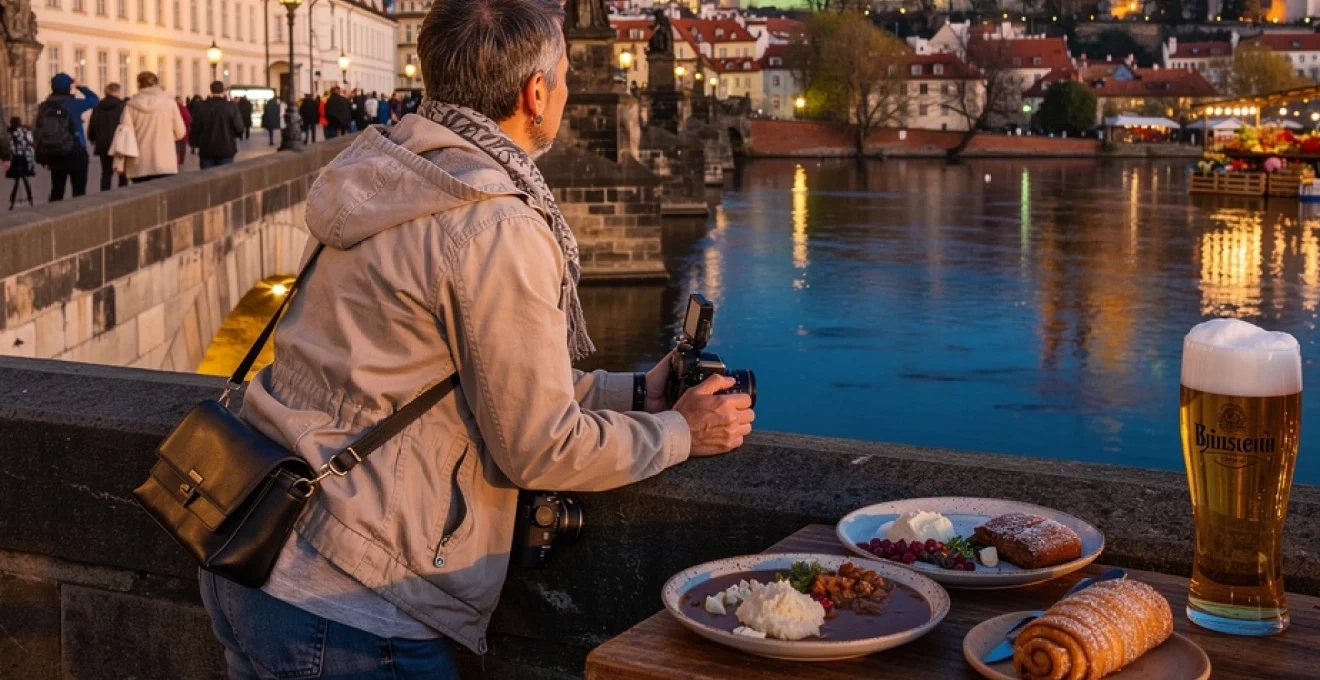
Prague possesses an almost mystical ability to transport visitors into a living fairytale, where centuries-old cobblestones echo with footsteps of emperors, artists, and dreamers who have walked these streets before. As twilight descends upon the City of a Hundred Spires, the golden hour transforms the already magnificent architecture into something truly transcendent. The interplay of fading daylight and emerging streetlights creates a photographer’s paradise, whilst the aromatic symphony of traditional Czech cuisine wafts through narrow medieval alleys, beckoning travellers to experience authentic local culture.
This enchanting Central European capital offers countless opportunities for cultural immersion, from spontaneous conversations with locals in centuries-old beer halls to discovering hidden courtyards that reveal stories spanning a millennium. The magic of Prague lies not merely in its UNESCO World Heritage sites, though these certainly provide a stunning backdrop, but rather in the unexpected moments that unfold when you allow yourself to wander without agenda, embracing the serendipitous encounters that define authentic travel experiences.
Prague’s golden hour photography at charles bridge and lesser town
The golden hour in Prague transforms the already spectacular cityscape into a photographer’s dream, particularly around the iconic Charles Bridge and the picturesque Lesser Town district. This magical time, occurring roughly one hour before sunset, bathes the baroque and gothic architecture in warm, honeyed light that seems to emanate from within the ancient stones themselves. Professional photographers and enthusiastic amateurs alike gather along the Vltava River’s banks, positioning themselves to capture the perfect interplay between natural illumination and Prague’s architectural marvels.
The Charles Bridge, dating back to the 14th century, becomes a particularly compelling subject during golden hour. Its thirty baroque statues cast dramatic shadows whilst the bridge’s gothic towers frame the distant Prague Castle in ethereal light. The pedestrian-only nature of this historic crossing allows photographers to move freely, experimenting with different angles and perspectives without the distraction of vehicular traffic. Street performers and local artists add human elements to compositions, creating dynamic scenes that capture both the architectural grandeur and the living culture of contemporary Prague.
Capturing the magic hour light reflections on vltava river
The Vltava River serves as Prague’s natural mirror during golden hour, reflecting the illuminated facades of waterfront buildings in shimmering, ever-changing patterns. Professional photographers recommend positioning yourself along the riverbanks approximately thirty minutes before sunset to witness the gradual transformation of light. The river’s gentle current creates subtle movement in reflections, adding dynamic elements to static architectural compositions whilst maintaining the serene atmosphere that defines Prague’s evening ambiance.
Optimal vantage points include Kampa Island’s southern tip, where unobstructed views of the Charles Bridge and Prague Castle create spectacular reflection opportunities. The island’s parkland provides stable ground for tripod work, essential for capturing sharp images during the diminishing light conditions. Advanced photographers often employ neutral density filters to achieve longer exposures, creating silky water effects that enhance the dreamlike quality of Prague’s riverside architecture.
Architectural photography techniques for baroque and gothic facades
Prague’s architectural diversity demands versatile photographic approaches, particularly when dealing with the intricate details of baroque facades and the soaring lines of gothic structures. The city’s building styles span nearly a millennium, from Romanesque foundations to art nouveau flourishes, each requiring specific technical considerations. During golden hour, the warm light enhances the textural qualities of stone and brick, revealing architectural details that remain hidden during harsh midday illumination.
Gothic structures like St. Vitus Cathedral benefit from dramatic upward angles that emphasise their vertical aspirations, whilst baroque buildings respond well to compositions that capture their ornate decorative elements. The interplay between light and shadow becomes crucial during this time, as the angled sunlight creates natural spotlighting effects on architectural features. Telephoto lenses prove particularly valuable for isolating specific architectural elements against Prague’s complex urban backdrop, allowing photographers to create focused compositions that highlight individual building characteristics.
Street photography opportunities in kampa island district
Kampa Island presents exceptional street photography opportunities, combining Prague’s architectural splendour with authentic local life in a pedestrian-friendly environment. This charming district, often called « Prague’s Venice »
for its network of narrow canals, intimate courtyards and low-slung houses that seem to lean in toward one another, quietly observing the flow of daily life. During golden hour, the stone walls along the water glow softly, and reflections of pastel façades ripple across the canal’s surface. This is where you are most likely to capture those unscripted moments that define powerful travel photography: a local walking their dog, a couple sharing a quiet conversation on a bench, or an artist closing up their tiny gallery for the night.
To make the most of street photography in Kampa, travel light and keep your camera ready with a versatile focal length in the 35–50mm range. This allows you to react quickly when an interesting scene unfolds, without drawing too much attention to yourself. Instead of “hunting” for photos, try “fishing”: choose a photogenic backdrop, such as a textured wall or a lantern-lit alley, and wait for life to pass through your frame. You’ll be surprised how often serendipity rewards your patience in this part of Prague.
Night photography settings for prague castle illumination
As the last hues of sunset fade, Prague Castle emerges in full illumination, floating above the city like a glowing crown. Capturing this iconic view at night requires a shift from handheld spontaneity to deliberate technique. From the banks of the Vltava or from viewpoints such as Letná Park, you can frame the castle with the river and bridges in the foreground, creating layered compositions that tell the story of the city’s evolution from medieval stronghold to modern capital.
For night photography of Prague Castle, a tripod becomes almost essential. Start with settings around ISO 100–400, an aperture of f/8–f/11 for sharpness, and a shutter speed ranging from 5 to 20 seconds, depending on ambient light and how much movement you want in the water or passing traffic. Use your camera’s self-timer or a remote release to avoid vibrations, and disable image stabilisation when mounted on a tripod. Shooting in RAW gives you more latitude to balance the warm castle lights with the cooler night sky during post-processing, helping you recreate the subtle atmosphere you experienced in person.
Culinary immersion through traditional czech gastropubs and beer halls
No evening in Prague feels complete without surrendering to the city’s rich culinary heritage, best experienced in its traditional gastropubs and historic beer halls. These establishments are more than simple places to eat and drink; they are living museums of Czech culture, where recipes are passed down through generations and the art of conversation still flourishes over frothy mugs of beer. Stepping into one of these spaces, you immediately understand why food and drink are central to the Czech way of life.
In recent years, Prague’s dining scene has evolved, blending classic dishes with contemporary techniques, yet the heart of Czech cuisine remains comfortingly rustic. Robust stews, slow-cooked meats and dumplings are designed to warm you from the inside out, especially during the colder months when evening temperatures can dip close to freezing. For travellers, these traditional meals become anchors in the travel day, grounding you in local rhythms after hours spent wandering through museums and medieval streets. Isn’t it remarkable how a single bowl of soup or plate of goulash can capture the essence of a destination more vividly than any guidebook?
Authentic goulash and svíčková na smetaně at u fleku brewery
Among Prague’s legendary beer halls, U Fleků occupies a special place in local lore. Established in 1499, this brewery-restaurant has been serving guests for over five centuries, making it one of the oldest continuously operating breweries in Central Europe. Wooden beams, long communal tables and the murmur of multilingual conversations create a convivial atmosphere that encourages solo travellers and groups alike to feel instantly at home. Live accordion music often drifts through the halls, adding an old-world soundtrack to your evening.
When it comes to ordering, two dishes deserve particular attention: hearty Czech goulash and svíčková na smetaně, a marinated beef sirloin served in a creamy vegetable sauce. The goulash at U Fleků is typically rich and paprika-forward, served with bread or potato dumplings that soak up every drop of the sauce. Svíčková, by contrast, offers a slightly more delicate flavour profile, often garnished with cranberry compote and a slice of lemon with whipped cream—a combination that might sound unusual until you taste how the sweetness and acidity complement the savoury meat. Pairing these dishes with U Fleků’s dark lager, brewed on-site, turns dinner into a full immersion in Czech gastronomic history.
Pilsner urquell tasting experience in historic wenceslas square
Just a short walk from the Old Town, Wenceslas Square provides a different perspective on Prague’s layered history. Once a medieval horse market and later the stage for major political events, today it blends grand architecture with modern shops, cafés and beer bars. For beer enthusiasts, this is an ideal place to deepen your understanding of the Czech Republic’s most famous export: Pilsner Urquell. While the beer originates from the city of Plzeň, Prague offers countless venues where you can taste it at its best.
Many bars around Wenceslas Square specialise in what locals call the “perfect pour,” serving Pilsner Urquell in traditional tank beer form, unpasteurised and drawn from copper tanks rather than kegs. This method maintains a fresher, creamier texture and a more nuanced hop aroma, especially when served at the recommended 5–7°C. Ask the bartender about different pouring styles—hladinka (smooth with a thick head), šnyt (smaller beer with more foam) or mlíko (almost entirely foam)—to experience how texture influences flavour. As you sip under the glow of neon lights and historic façades, you can’t help but feel part of Prague’s living beer culture, rather than simply an observer.
Local market exploration at havelské tržiště for seasonal produce
If beer halls reveal Prague’s convivial side, local markets like Havelské Tržiště hint at the city’s everyday rhythms. Nestled between the Old Town Square and Wenceslas Square, this historic market dates back to the 13th century and still operates daily, offering a mix of fresh produce, flowers, handmade crafts and local snacks. Visiting in the late afternoon or early evening lets you see vendors winding down for the day while the surrounding streets begin to light up, creating a gentle transition between Prague’s daytime and nighttime personas.
Seasonal produce at Havelské Tržiště changes throughout the year: crisp apples and plums in autumn, wild mushrooms and root vegetables in colder months, berries and cherries as summer approaches. Even if you’re staying in a hotel rather than an apartment with a kitchen, picking up fresh fruit or small treats gives you a direct connection to regional agriculture. Beyond the food itself, the market offers a chance to practice simple Czech phrases, compare local prices and observe what residents are actually buying. In a world dominated by supermarkets, these traditional markets function like open-air history books, each stall a page filled with colours, smells and stories.
Traditional trdelník street food culture in old town square
As evening deepens and lights flicker on around Old Town Square, the scent of caramelised sugar begins to drift through the air. Follow it, and you’ll almost certainly end up at a stall selling trdelník, the spiral pastry sometimes known as “chimney cake.” While variations of this dessert can be found across Central Europe, Prague has embraced trdelník as one of its signature street foods, particularly around the Old Town and Charles Bridge. Watching it being made is half the pleasure: strips of sweet yeast dough are wrapped around metal or wooden rollers, coated in sugar and cinnamon, and slowly rotated over open flames until they turn golden.
Once the pastry is baked, vendors often dust it with additional sugar or fill it with ice cream, chocolate, or even savoury ingredients for more adventurous combinations. Purists might argue that the simplest version—warm, crisp on the outside and tender within—best showcases the dough’s subtle flavour and the satisfying crunch of its caramelised crust. Enjoying trdelník in Old Town Square, perhaps with the Astronomical Clock chiming nearby, becomes one of those quintessential Prague experiences you remember long after the taste has faded. It’s a reminder that sometimes, the smallest indulgences become the most vivid travel memories.
Historical narrative discovery through unesco world heritage sites
Beyond its postcard-perfect vistas, Prague functions as a vast open-air archive of European history, much of it preserved within its UNESCO-listed Historic Centre. Rather than approaching these famous sites as isolated attractions, you can think of them as chapters in a continuous story, each one revealing how religion, politics, trade and culture have intersected in this city for over a thousand years. The beauty of exploring these places in the evening is that crowds thin out, leaving more room for reflection and deeper engagement with the stories inscribed into the stones.
The core of the UNESCO area stretches from Prague Castle down through Lesser Town and across Charles Bridge into the Old Town and New Town. Within this relatively compact zone, you encounter everything from Romanesque rotundas to Gothic cathedrals, Renaissance palaces and Baroque churches. Each style reflects a particular moment in the city’s development, whether under Holy Roman Emperors, Habsburg rulers or during more recent struggles for independence. Walking these streets at dusk, you feel history not as a dry list of dates, but as a layered presence—much like reading a novel where previous chapters subtly influence every new scene.
To uncover the historical narratives woven into Prague’s UNESCO sites, consider focusing on three anchor points: Prague Castle, Charles Bridge and Old Town Square. Prague Castle, one of the largest castle complexes in the world, has served as the seat of Czech rulers and presidents for centuries. Its courtyards and St. Vitus Cathedral tell stories of coronations, sieges and religious transformations. Charles Bridge, lined with statues of saints added between the 17th and 18th centuries, functions like an open-air gallery of baroque religious art, each sculpture reflecting the spiritual concerns of its era.
Old Town Square, by contrast, has long been the civic heart of Prague, bearing witness to everything from medieval executions to modern independence rallies. The Astronomical Clock, first installed in 1410, is more than just a tourist spectacle; its intricate mechanisms symbolise medieval understandings of time, astronomy and the human place within the cosmos. As you watch it strike the hour in the fading light, you may find yourself asking: how many generations before you stood in this very spot, gazing up with similar wonder? In that moment, travel becomes a bridge—not unlike Charles Bridge itself—linking your personal journey with the broader human story.
Cultural immersion techniques for solo travellers in central europe
Solo travel in Central Europe, and in Prague in particular, offers a rare opportunity to craft your own narrative without compromise. Yet genuine cultural immersion requires more than just checking famous landmarks off a list; it invites you to participate in the everyday life of the destination, even if only briefly. How do you do this in a way that feels authentic rather than forced? The answer lies in small, intentional choices that open doors to unscripted encounters.
One effective technique is to build regular “anchors” into your day: a favourite café where you return each morning, a bench along the Vltava where you watch the sunset, or a local bakery where the staff begin to recognise you. These repeated interactions transform you from a passing stranger into a familiar face, making it easier to exchange a few words, a smile or even recommendations for lesser-known spots. In Prague, neighbourhoods like Vinohrady, Holešovice or Karlín offer more residential atmospheres than the historic centre, giving you a glimpse of how locals actually live, work and unwind.
Language can feel like a barrier, but in practice it often becomes a bridge. Learning a handful of Czech phrases—prosím (please), děkuji (thank you), dobrý večer (good evening)—signals respect and curiosity, even if your pronunciation is imperfect. Many Prague residents, especially younger generations, speak at least some English, yet your attempt at Czech frequently softens interactions and invites patience. Think of language as a camera lens: the more you adjust it toward the local perspective, the sharper and more nuanced your understanding becomes.
Another powerful immersion strategy for solo travellers is to participate in small group experiences that emphasise learning rather than mere entertainment. In Prague, this might mean joining a guided walking tour that focuses on architecture, taking a cooking class to learn how to prepare traditional dishes, or attending a classical concert in a historic venue like the Municipal House. These activities create natural opportunities to connect with both locals and other travellers, without the pressure of forced socialising. Over time, these connections accumulate, turning what could have been a solitary trip into a mosaic of shared moments.
Finally, give yourself permission to wander without a fixed agenda, especially in the evening when the city’s pace slows and its personality shifts. Leave space in your itinerary for conversations that last longer than expected, for detours down intriguing side streets, or for spontaneous decisions like stepping into a theatre because you heard music through an open door. Solo travel can sometimes feel like writing a story in real time; by embracing uncertainty, you allow the plot to twist in ways you could never have planned from home.
Spontaneous travel moments that define authentic destination experiences
When you think back on your most meaningful journeys, do you remember the exact opening hours of a museum, or do you recall the unexpected conversation you had while sheltering from the rain in a doorway? In Prague, as in many great cities, it is often the spontaneous moments—the ones that refuse to be scheduled—that carve the deepest grooves in your memory. An evening that begins with a simple plan to photograph Charles Bridge at sunset might end with you sharing stories over beer with locals, or finding yourself mesmerised by a street musician whose name you’ll never know.
One of the most liberating aspects of travel is how it encourages you to say “yes” more often than you might at home. Yes to joining a small group you just met for dinner, yes to taking a different tram line just to see where it leads, yes to exploring a courtyard simply because the light looked interesting. These micro-decisions accumulate like brushstrokes on a canvas, gradually revealing a picture of the destination that is uniquely yours. In Prague, where history and modern life constantly intersect, such decisions might lead you to stumble upon a neighbourhood festival, an impromptu jazz performance, or a viewpoint you never saw on Instagram.
Of course, spontaneity does not mean abandoning common sense. Keeping basic safety practices in mind—staying aware of your surroundings, letting someone know roughly where you’ll be, and trusting your instincts when a situation doesn’t feel right—allows you to relax into unplanned experiences with confidence. Think of it like using a tripod for night photography: once your camera is stable, you’re free to experiment creatively with composition and exposure. Similarly, when your practical bases are covered, you can lean into serendipity without unnecessary worry.
Ultimately, it was a series of such unplanned moments that turned my own evening in Prague into a powerful reminder of why I love to travel. Getting lost in the side streets of Lesser Town led me to a hidden courtyard café where an elderly couple shared stories of the city before the Velvet Revolution. A decision to linger on a bench by the Vltava resulted in a sky that exploded into shades of orange and pink I could never have predicted. Later, drawn by the distant sound of laughter, I found myself in a small beer hall, toasting with strangers who, for a few hours, felt like old friends.
These are the experiences that no itinerary can guarantee yet every traveller secretly hopes for. They remind us that travel is not just about seeing famous places, but about allowing those places to change us in subtle, lasting ways. As Prague’s church bells chimed and the city lights shimmered on the river, I realised that what keeps drawing me back to the road is not just the promise of new sights, but the possibility of new versions of myself emerging with every journey. And on that evening in Prague, under a sky embroidered with spires and stars, that possibility felt very real indeed.