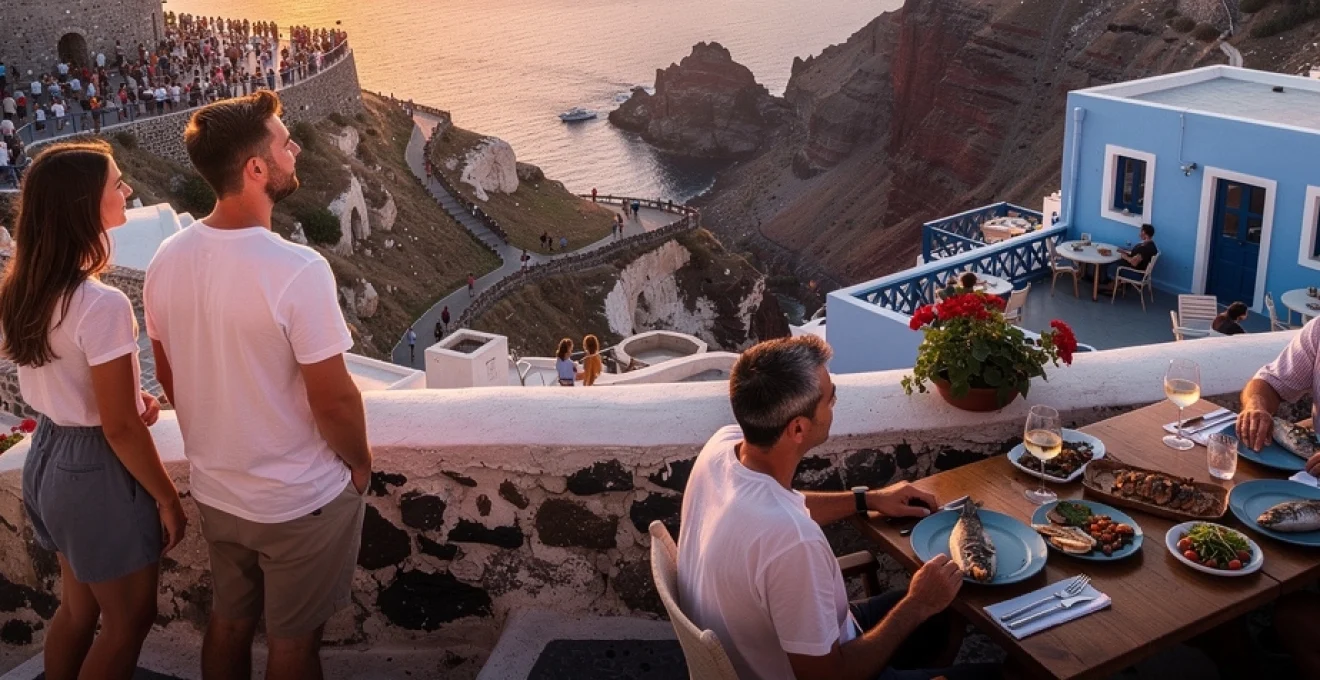
Santorini’s reputation as a sunset destination has reached almost mythical proportions. Millions of travellers descend upon this volcanic Greek island annually, many with a singular goal: capturing that perfect photograph from Oia Castle as the sun melts into the Aegean Sea. Yet what happens when the crowds, the queues, and the sheer impossibility of securing a viewing spot force you to abandon this carefully planned ritual? For many visitors, missing the iconic Oia sunset becomes the catalyst for discovering a more authentic and ultimately more rewarding Santorini experience. The overcrowding phenomenon that has transformed this picturesque village into a daily theatrical performance has inadvertently created opportunities for travellers willing to explore beyond the well-trodden path.
The irony of modern travel manifests most clearly in destinations like Santorini, where the pursuit of solitude and natural beauty leads thousands to congregate in the exact same spot at the exact same time. This collective behaviour patterns what tourism researchers call « attraction concentration, » where the visibility of a destination through social media platforms creates self-reinforcing visitation patterns. Understanding this dynamic becomes essential for travellers seeking genuine experiences rather than photographic reproductions of experiences others have had.
The oia castle viewing platform overcrowding phenomenon
The western edge of Oia village has transformed into what can only be described as a nightly pilgrimage site. Between May and October, the marble steps leading to Oia Castle and the surrounding caldera-edge pathways become packed with humanity approximately 90 minutes before sunset. This is not an exaggeration borne of traveller hyperbole—official estimates suggest that during peak summer months, between 3,000 and 5,000 people converge on viewing areas that were designed to accommodate perhaps a tenth of that number.
The viewing experience has evolved into something resembling a competitive sport. Serious photographers arrive with tripods and camera equipment up to two hours early, staking claims to prime positions along the narrow pathways. Tour groups disembark from coaches at designated intervals, their guides wielding selfie sticks like marshals directing traffic. Independent travellers navigate the increasingly dense crowds, searching for any gap that might offer an unobstructed sightline toward the horizon. What was once a contemplative natural phenomenon has become a test of patience, planning, and physical positioning.
Tourist density patterns at sunset peak hours in oia village
Analysis of visitor flow patterns reveals predictable surges that transform Oia from a functioning village into an open-air concert venue. Between 18:00 and 20:30 during summer months, pedestrian traffic increases by approximately 400% compared to morning hours. The narrow pathways—many only 1.5 to 2 metres wide—become congested to the point where movement in either direction becomes difficult. Local residents have reported that completing simple errands during these hours can take three times longer than during off-peak periods.
The demographic composition of these crowds reflects global tourism trends. Research conducted in 2023 indicated that approximately 60% of visitors to Oia during sunset hours are aged between 25 and 40, with social media documentation as a primary motivation. The remaining 40% includes older travellers on Mediterranean cruises, honeymooning couples, and a smaller percentage of photography enthusiasts pursuing professional-grade imagery. This convergence of motivations creates a peculiar atmosphere where the documentation of the experience often supersedes the experience itself.
Positioning challenges along the marble steps and caldera edge
The physical geography of Oia presents inherent limitations that no amount of tourism infrastructure can overcome. The village clings to the caldera rim along a relatively narrow strip of land, with the most photographically desirable locations concentrated in a 400-metre stretch between the main church domes and Oia Castle. Within this corridor, perhaps only 50 to 75 positions offer truly unobstructed views combining architectural elements with the sunset horizon.
The marble steps leading down from the main pathway toward lower terraces become particularly contested real estate. These steps, worn smooth by centuries of use and now polished by millions of tourist footfalls, offer varied elevation perspectives that can incorporate the iconic blue-domed churches into sunset compositions. However,
conflicts quickly arise when late arrivals attempt to squeeze into already saturated spaces, often resulting in tension, blocked stairways, and obstructed views. Safety becomes a secondary concern as people lean over railings, perch on ledges, or stand on tiptoe on uneven steps simply to raise their camera above the sea of screens. For some travellers, this physical discomfort marks the tipping point—prompting the spontaneous decision to abandon Oia Castle altogether and look elsewhere for a calmer sunset in Santorini.
Photography equipment limitations in crowded viewing conditions
From a technical standpoint, crowded conditions at Oia Castle impose real constraints on both amateur and professional photographers. Tripods, which are essential for low-light landscape photography and capturing the full colour transition of a Santorini sunset, are often impractical or outright prohibited in the densest sections of the viewing platform. Even when you manage to set one up, constant jostling from the crowd can introduce camera shake that negates the stabilising benefits of your equipment.
Lens choice is also compromised. In theory, a versatile zoom lens between 18–135mm allows you to frame both tight details of whitewashed domes and wide vistas of the caldera. In practice, your ability to step back, reframe, or adjust your shooting angle is severely limited when you are wedged shoulder-to-shoulder along a marble step. Many travellers report returning home with near-identical images: a narrow slice of horizon, partially blocked by other visitors’ phones, with little of the architectural context that makes Santorini photography so compelling.
Lighting conditions introduce an additional challenge. As the sun drops closer to the horizon, high dynamic range scenes demand careful metering and sometimes multiple exposures to retain both highlight detail in the sky and shadow detail in the village. In a crowded environment, you have little time or space to bracket shots, adjust filters, or experiment with creative compositions. Instead of a deliberate photographic process, the experience can begin to feel like a race against the countdown of the setting sun.
The santorini instagram effect on sunset tourism behaviour
The overcrowding at Oia Castle is not an isolated phenomenon; it is a textbook example of what researchers now call the « Instagram effect. » Highly shareable images—often shot from the same handful of vantage points—circulate widely on social media, creating a feedback loop in which each photo inspires yet more visitors to seek out the exact same view. In Santorini, this has led to an almost ritualised behaviour pattern: arrive in Oia, walk toward the castle, and wait for the sunset you have already seen hundreds of times on your screen.
This pursuit of a pre-visualised image subtly shifts the purpose of travel. Rather than exploring Santorini’s villages with curiosity, many of us unconsciously follow a script written by algorithms and influencer content. You can see this in the way crowds move: people rush past quiet, atmospheric side streets in Oia in order to join the line of tripods facing west. Ironically, in trying to recreate a « unique » Instagrammable moment, we end up participating in a mass-produced experience.
Yet the Instagram effect has an unintended upside. When the pressure of social validation becomes too great—when you realise that securing the perfect spot is impossible or simply not enjoyable—it can push you to abandon the script. This is often the turning point at which travellers leave Oia Castle behind and discover that a missed sunset in Santorini can open the door to quieter villages, alternative vantage points, and encounters that no algorithm could have predicted.
Discovering pyrgos village as an alternative vantage point
For those willing to look beyond Oia, Pyrgos offers a radically different way to experience sunset in Santorini. Located inland on a gentle hill in the centre of the island, this former capital retains a distinctly local character, with whitewashed houses arranged in concentric circles around a fortified core. While Pyrgos lacks the cliffside drama of Oia, it compensates with panoramic 360-degree views that reveal the full geography of the island—caldera, plains, and distant villages included.
Arriving in Pyrgos about an hour before sunset, you are far more likely to encounter residents chatting in the square than crowds jostling for a railing. The pace is slower, the conversations quieter, and the sense of space immediately noticeable. Instead of joining a dense line of photographers all aiming at the same composition, you are free to wander, explore different levels of the village, and decide for yourself what « the perfect sunset view in Santorini » actually looks like for you.
The venetian castle ruins panoramic perspective
At the top of Pyrgos lies the ruins of a Venetian castle, part of a series of fortified settlements built across the Cyclades during the medieval period. While little remains of the original structure beyond crumbling walls and narrow passages, the elevated platform they occupy provides one of the most extensive viewpoints on the island. From here, you do not just see the sun disappearing into the sea—you witness the entire caldera basin gradually shifting through shades of gold, amber, and violet.
This vantage point offers a more « holistic » sunset in Santorini. You can trace the curve of the caldera rim from Akrotiri in the south to Oia in the north, observe the pattern of villages clinging to the cliffs, and watch lights gradually flicker on as the sky darkens. The sensation is less like attending a performance at a single stage and more like watching the entire island become part of the show. Since visitor numbers are significantly lower than in Oia, you are also free to move around, experiment with different compositions, and perhaps even sit down on a stone ledge simply to watch without photographing at all.
The castle ruins themselves add texture to your images. Rough stone walls, narrow alleys, and unexpected openings in the fortifications create natural frames for the distant sunset. Instead of jostling to keep strangers out of your shot, you can consciously incorporate the village’s architecture into your storytelling, capturing a sense of place that goes beyond the standard caldera silhouette.
Elevation advantages of prophet elias monastery at 567 metres
Just a short drive from Pyrgos, the Monastery of Prophet Elias occupies the highest point on Santorini at 567 metres above sea level. From this elevation, the island reveals itself in its entirety, resembling a crescent-shaped fragment of land cradling the caldera waters. For travellers who missed the Oia sunset, reaching this summit before golden hour can feel like trading a single famous viewpoint for an all-encompassing geographic overview.
The monastery grounds themselves are modest but atmospheric, with stone buildings, small chapels, and a sense of seclusion that contrasts sharply with the commercial buzz of Oia. When the air is clear—a frequent occurrence thanks to Santorini’s relatively low humidity—you can see not only the nearby islands of Therasia and Nea Kameni, but also distant landmasses on the horizon. The sun’s path becomes easier to anticipate; you are high enough to watch its trajectory without the distortions introduced by cliff edges and building silhouettes.
From a photography perspective, this elevation offers unique opportunities. Wide-angle lenses truly shine here, capturing sweeping views that connect vineyards, villages, and volcanic formations in a single frame. Long lenses allow you to isolate Oia or Fira in the distance, bathed in late-afternoon light, without being trapped within their crowds. For many visitors, this is where the idea of a « better experience » in Santorini begins to take tangible shape: the island stops being a checklist of famous spots and becomes a coherent landscape you can read and interpret.
Unobstructed sightlines across the aegean caldera basin
One of the most underrated aspects of leaving Oia for places like Pyrgos and Prophet Elias is the quality of the sightlines. In Oia, even the best vantage points involve some degree of obstruction—rooftops, railings, other viewers. Centrally located high points, by contrast, provide clean, uninterrupted lines across the caldera basin and the Aegean Sea. There is no need to angle your camera between shoulders or tilt upward to avoid a cluster of smartphones intruding into the frame.
This clarity changes not just your photographs, but also your experience of time. Without the anxiety of losing your spot or having your view blocked at the decisive moment, you can pay attention to the slower elements of the sunset: the subtle cooling of the air, the way shadows lengthen across vineyards, or the shift from warm to cool tones in the sky. In a sense, you reclaim the sunset as a process rather than a single climactic instant.
For travellers interested in landscape photography, these unobstructed sightlines allow more deliberate techniques: capturing time-lapse sequences, experimenting with neutral density filters to smooth the water’s surface, or composing multi-layered images that lead the eye from foreground terraces to distant islands. And for those without a camera, they simply create the conditions for what many of us secretly seek in Santorini—an unhurried, undisturbed moment with the horizon.
Spontaneous exploration of fira to oia hiking trail after sunset
Missing the Oia sunset often frees up something just as valuable as a viewing spot: your evening schedule. Instead of spending hours locked in place on a staircase, you may find yourself with enough daylight left to start walking part of the famous Fira to Oia hiking trail. This 10–12 kilometre route traces the caldera rim between the two towns and is usually recommended as a daytime activity, but walking a segment of it during blue hour offers a very different, almost cinematic experience.
Imagine this alternative: instead of joining the exodus of sunset crowds funnelling through Oia’s narrow lanes, you step onto the trail as the last light fades from the sky. The path gradually empties, replaced by a few locals and occasional fellow travellers moving in the opposite flow of traffic. The caldera below darkens to a muted blue, village lights sparkle along the rim, and the air cools to a comfortable temperature for walking. You are still in Santorini, but the island feels unexpectedly spacious.
From a practical perspective, you do not need to commit to the entire trail to benefit from this shift in perspective. Even a 30–60 minute walk between Fira and Imerovigli, or between Imerovigli and one of the smaller settlements, can introduce you to vantage points and composition possibilities that no bus tour will pause to show you. Just be sure to carry a small torch or use your phone’s light, as some sections become dim after dark, and wear supportive footwear rather than the flip-flops many people wear around Oia.
Authentic taverna experience at metaxi mas in exo gonia
Perhaps the most memorable consequence of missing a sunset in Santorini is where you might end up instead. For many travellers, that « somewhere else » turns out to be a village taverna far from the caldera crowds—places like Metaxi Mas in Exo Gonia. Perched on a quiet hillside overlooking the vineyards and the eastern side of the island, this restaurant has earned a loyal following among residents and repeat visitors who prize atmosphere and flavour over dramatic views.
Arriving here around the time you would otherwise be queuing at Oia Castle changes the rhythm of your evening entirely. Instead of guarding a small patch of marble step, you are greeted, seated, and offered water or local wine while the sky gently darkens. Conversations at neighbouring tables drift between Greek and other languages, but the overall tone is convivial rather than rushed. You begin to understand that « authentic Santorini » is not just about finding unspoiled landscapes—it is also about giving yourself enough time and space to connect with the island’s food culture and hospitality.
Traditional cycladic cuisine beyond tourist-centric menus
One of the clearest signs that you have left the main tourist zones is the menu. Instead of endless variations of the same Greek salad and grilled souvlaki designed for high turnover, tavernas like Metaxi Mas showcase dishes rooted in Cycladic and Cretan traditions. You might encounter baked fava purée made from local yellow split peas, caper salads, or slow-cooked lamb with aromatic herbs that reflect centuries of adaptation to a dry, volcanic landscape.
In this context, missing a sunset in Santorini becomes less of a loss and more of a trade: panoramic vistas for culinary depth. You have the time to ask about ingredients, to learn which vegetables come from nearby fields, and to discover how limited water resources have influenced the island’s cooking techniques. Portions are often designed for sharing, which encourages a more communal style of eating—an experience that contrasts with the individualistic focus of capturing the « perfect » solitary sunset photograph.
Because these tavernas rely less on transient foot traffic, they also tend to maintain consistent quality throughout the season. There is no need to rush diners through their meal to accommodate the next wave of sunset watchers. As you linger over baked white aubergine, tomato keftedes, or octopus in vinegar, you may realise that the memory you will carry home from Santorini is not the exact colour of the sky at 20:27, but the feeling of being unhurried and well-fed in a village where everyday life continues around you.
Local wine varietals from santorini’s volcanic terroir
No discussion of an alternative Santorini evening would be complete without mentioning wine. The island’s volcanic soils and harsh winds have produced a distinctive viticultural landscape, where vines grow close to the ground in basket-shaped formations known as kouloura. This unique method protects grapes from the strong Meltemi winds and intense summer sun, concentrating flavours in a way that has attracted increasing international attention in recent years.
In a taverna like Metaxi Mas, you have the opportunity to taste local varietals—particularly Assyrtiko, Athiri, and Aidani—in a setting where staff can actually explain their origins. Rather than ordering a generic « house white, » you might be encouraged to try a single-vineyard Assyrtiko that reflects the minerality of a specific slope, or a sweet Vinsanto dessert wine made from sun-dried grapes. These wines pair naturally with the island’s seafood, cheeses, and vegetable dishes, elevating what might otherwise be a standard meal into a sensory exploration of the volcanic terroir.
For travellers who missed the Oia sunset, this kind of guided tasting can feel like a consolation prize that unexpectedly outshines the original goal. You do not simply drink wine; you start to recognise how Santorini’s geology and climate shape its agriculture, architecture, and daily life. In many ways, this deeper understanding of place is the essence of meaningful travel—something that no photograph, however spectacular, can fully capture.
Engaging with santorini residents outside peak tourism zones
Leaving the caldera ridge for villages like Exo Gonia also changes the nature of your human interactions. In Oia at sunset, locals are usually working at full capacity—managing crowds, serving drinks, directing traffic, and rarely having time for extended conversation. In quieter settlements, the pressure eases. Tavern owners, servers, and even neighbouring diners are more inclined to share recommendations, stories, or opinions about how tourism has transformed the island.
These conversations can be surprisingly candid. You might hear about the challenges of seasonal employment, the impact of rising property prices on younger residents, or the relief felt when cruise-ship caps reduced daily arrivals. You may also receive suggestions for lesser-known hikes, family-run wineries, or small chapels with excellent sunrise views that never appear on mainstream itineraries. In effect, by missing one heavily promoted sunset, you open the door to personal micro-itineraries crafted by people who actually live in Santorini year-round.
Engaging with residents in this way also helps recalibrate expectations. Instead of seeing Santorini as a stage designed solely for visitor enjoyment, you begin to perceive it as a complex community negotiating the opportunities and strains of global attention. This shift in perspective can be as transformative as any scenic viewpoint, prompting you to make more considered choices about where you spend your time and money for the remainder of your stay.
Reframing travel expectations through serendipitous itinerary deviations
Missing a sunset in Santorini may initially feel like a failure of planning or timing. Yet, as many seasoned travellers can attest, these small disruptions often mark the beginning of more meaningful experiences. When you are no longer chasing a rigid checklist of must-see moments, you regain the flexibility to respond to what the island actually offers at a given moment—whether that is a quiet path, an unexpected conversation, or a table with a view of twinkling village lights instead of the horizon itself.
Psychologists who study tourism behaviour suggest that satisfaction is strongly linked to a sense of agency and discovery. When you follow a heavily scripted itinerary—arrive here, stand there, take this photo—you may technically « do everything right » yet feel oddly detached. In contrast, when you adapt on the fly, choosing a new village to explore or a different hiking route after the sunset plan falls through, you become an active participant in your trip rather than a passive observer. Santorini rewards this adaptability with layers of experience that are invisible from the main viewpoints.
It can help to think of your time on the island less as a series of targets and more as an evolving story. In any good narrative, unexpected obstacles lead to character growth and new directions. Missing the Oia sunset might be the plot twist that redirects you from a crowded staircase to a hilltop monastery, a local taverna, or a quiet lane in Pyrgos. The photos you bring home may be less instantly recognisable on social media, but they will likely be more personal, and the memories attached to them more vivid.
Practical strategies for avoiding overtourism hotspots in santorini
Understanding how and why Oia becomes so congested at sunset is only half the equation; the other half lies in planning your days to minimise frustration and maximise genuine connection. The goal is not to avoid popular sites altogether—after all, places like Akrotiri, Red Beach, and Skaros Rock are famous for good reason—but to experience them at times and in ways that reduce your exposure to the most intense waves of tourism. With a bit of forethought, you can enjoy Santorini’s celebrated highlights while still carving out space for quieter discoveries.
A useful mental model is to think of the island in terms of temporal rather than purely spatial crowding. Many visitors arrive on similar ferry and cruise schedules, eat at similar times, and converge on the same viewpoints before and after sunset. By deliberately shifting your own routine—waking earlier, dining slightly later, or exploring inland while others flock to the caldera—you essentially step sideways out of the busiest flows. This approach does not require extreme effort; often, a difference of 60–90 minutes is enough to transform your experience.
Timing visits to akrotiri archaeological site and red beach
The archaeological site of Akrotiri, sometimes referred to as the « Greek Pompeii, » is one of Santorini’s most important cultural attractions. At peak hours, particularly between 10:00 and 14:00 when tour buses arrive, the covered excavation halls can become crowded, making it difficult to linger at specific frescoes or architectural features. If you aim to visit early—shortly after opening—or later in the afternoon, you will encounter fewer groups and enjoy a more contemplative atmosphere in which to imagine the Minoan port town that once thrived here.
Red Beach, located nearby, presents its own crowd-management considerations. Access involves a short but uneven path, and the narrow strip of sand can feel quickly overwhelmed once midday swimmers arrive. To experience the dramatic contrast of red cliffs, black pebbles, and turquoise water without the crush, consider visiting either early in the morning or in the late afternoon, when temperatures are milder and photographic conditions more favourable. Alternatively, incorporating Red Beach into a boat tour allows you to appreciate its geology from the sea without competing for limited space onshore.
By aligning your Akrotiri and Red Beach visits with these off-peak windows, you not only reduce the stress of navigating crowds but also preserve energy for less-trafficked activities later in the day. In effect, you trade one overly structured sunset experience in Santorini for several well-timed, low-friction encounters with the island’s history and landscape.
Exploring megalochori and emporio traditional settlements
While Oia and Fira absorb the majority of Santorini’s visitor traffic, villages like Megalochori and Emporio offer a quieter window into traditional Cycladic life. Narrow alleyways, stone archways, and hidden courtyards invite slow exploration, and the absence of major sunset viewpoints means these settlements rarely experience the same intensity of crowding. If you are looking to balance your time between iconic and less-known destinations, dedicating a half-day to each village can be particularly rewarding.
Megalochori, located near several prominent wineries, combines neoclassical mansions with modest whitewashed homes and small, shaded squares. You might begin your day here with a late breakfast, wander through streets where bougainvillaea spills over doorways, and then continue to nearby vineyards for tastings that deepen your understanding of Santorini’s volcanic terroir. Because the village is not anchored to a specific sunset-viewing ritual, its rhythm feels more aligned with local routines—shops open and close based on community needs rather than bus schedules.
Further south, Emporio reveals a labyrinthine medieval core known as Kasteli, where tightly packed houses and enclosed passages once protected residents from pirate raids. Exploring this compact fortress settlement is like stepping into a three-dimensional map designed for wandering rather than linear sightseeing. Here, too, the absence of massed sunset watchers means you are more likely to photograph empty lanes, intricately carved doorways, and small chapels than raised selfie sticks. For travellers recalibrating after a missed Oia sunset, these villages demonstrate that some of Santorini’s most photogenic corners are also its least publicised.
Morning light photography at skaros rock formation
If sunset at Oia has become the most heavily marketed golden hour on the island, sunrise at Skaros Rock is its underappreciated counterpart. Located near Imerovigli, this imposing rock promontory was once home to a fortified settlement and still offers remarkable views of the caldera. Yet at dawn, visitor numbers are typically a fraction of those found at Oia in the evening, making it an ideal setting for travellers seeking both solitude and striking images.
From a photographic standpoint, morning light at Skaros has several advantages. The sun rises behind the island, illuminating the whitewashed buildings of Imerovigli and Firostefani with soft, directional light while leaving the caldera in gentle shadow. This creates layered compositions with rich tonal contrast, especially if you include the rock formation itself as a dark silhouette in the foreground. Because the air is generally cooler and clearer in the early hours, distant islands appear crisper, and atmospheric haze is reduced—ideal conditions for detail-rich landscape shots.
Practically, accessing Skaros Rock early requires little more than an alarm clock, a bottle of water, and sensible shoes. The path down from Imerovigli involves steps and uneven terrain, but without the pressure of crowds, you can set your own pace. As you watch the first ferries cut across the caldera far below, you may find yourself reflecting on how different this experience feels from the crowded Oia sunset you originally imagined. In trading the most famous spectacle for a quieter counterpart, you have effectively rewritten your Santorini story—one in which missing a single sunset became the gateway to a better, more balanced experience of the island as a whole.