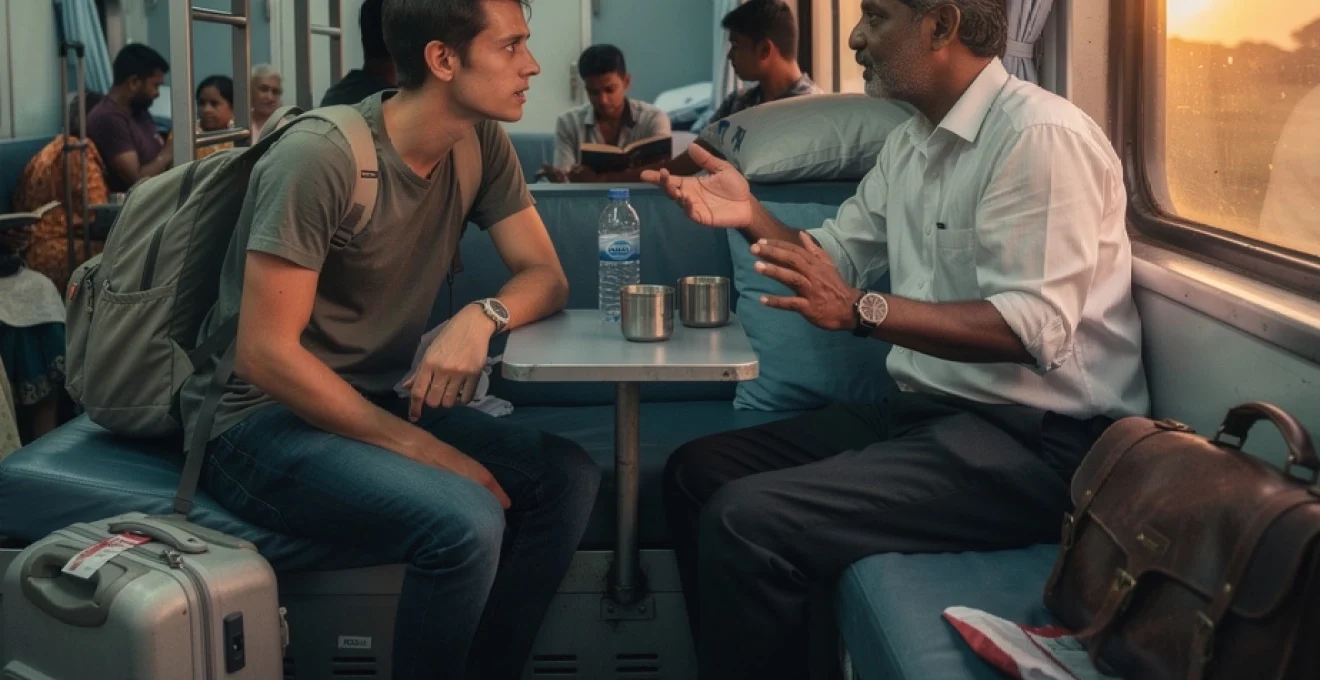
Railway journeys across India possess an extraordinary ability to transform strangers into temporary confidants, creating moments of profound human connection that transcend cultural boundaries and social hierarchies. The rhythmic clatter of wheels against tracks becomes the soundtrack to conversations that reveal universal truths about ambition, family, identity, and belonging. These encounters, often unplanned and fleeting, can leave lasting impressions that reshape our understanding of both ourselves and the world around us.
The magic of Indian railway travel lies not merely in its ability to transport passengers across vast distances, but in its capacity to strip away the pretences and barriers that typically separate us from meaningful dialogue with strangers. Within the confined space of a railway compartment, passengers from diverse backgrounds find themselves sharing not just physical space but stories, meals, and perspectives that might otherwise remain unexplored. Such encounters remind us that beneath the surface differences of language, region, and circumstance, we share common hopes, fears, and dreams.
Setting the scene: mumbai to delhi rajdhani express journey context
The Rajdhani Express services represent the premium tier of Indian railway travel, connecting major metropolitan centres with air-conditioned comfort and streamlined efficiency. These trains attract a diverse mix of passengers: business executives rushing between meetings, families visiting relatives across state boundaries, students travelling to universities, and occasional tourists seeking to experience India’s most celebrated railway route. The Mumbai to Delhi corridor, stretching approximately 1,400 kilometres, serves as a vital artery connecting India’s commercial capital with its political heart.
During peak travel seasons, securing reservations on these premium services becomes increasingly challenging, leading to the phenomenon of RAC (Reservation Against Cancellation) bookings. This system, unique to Indian Railways, allows passengers to board trains even when confirmed berths remain unavailable, resulting in shared seating arrangements that inadvertently foster social interaction. What initially appears as an inconvenience often transforms into an opportunity for meaningful human connection, as passengers navigate the delicate social dynamics of shared space with grace and mutual respect.
Second-class AC compartment social dynamics during Long-Distance travel
The second-class air-conditioned compartments aboard Rajdhani Express trains create a unique social microcosm where India’s emerging middle class converges. These spaces typically accommodate passengers from similar socioeconomic backgrounds, facilitating conversations that might not occur in more stratified settings. The controlled environment, with comfortable seating and regulated temperature, encourages passengers to relax their guard and engage more openly with fellow travellers.
Extended journey durations naturally break down initial reserve between passengers, as shared meals, communal charging points, and limited entertainment options create numerous interaction opportunities. The absence of external distractions forces passengers to look inward and connect with those immediately around them, often resulting in conversations that range from superficial pleasantries to deeply personal revelations about career aspirations, family dynamics, and philosophical worldviews.
Cultural Cross-Pollination opportunities in indian railway systems
Indian Railways serves as perhaps the most democratic forum for cultural exchange in contemporary India, bringing together passengers from diverse linguistic, religious, and regional backgrounds within confined spaces. These journeys offer rare opportunities to encounter perspectives that might otherwise remain isolated within specific geographical or social bubbles. Conversations flow seamlessly between languages, with passengers often switching between Hindi, English, and regional dialects to accommodate different comfort levels and express nuanced concepts.
The sharing of food during these journeys serves as a particularly powerful catalyst for cultural exchange, with passengers proudly offering regional specialities and explaining local customs. These culinary exchanges often lead to broader discussions about regional differences in lifestyle, traditional practices, and contemporary challenges facing different parts of the country. Such interactions contribute to a more nuanced understanding of India’s remarkable diversity and the common threads that bind its various communities together.
Psychological openness during extended transit periods
Extended travel periods create unique psychological conditions that encourage introspection and openness to new experiences. The temporary suspension of normal routines and responsibilities allows passengers to approach conversations with reduced inhibitions and increased curiosity about fellow travellers. This phenomenon, often observed in various forms of long-distance travel, becomes particularly pronounced in the intimate setting of railway compartments where passengers cannot easily escape or avoid interaction.
The liminal nature of railway journeys creates a sense of being between destinations, both literally and metaphorically,
in which usual social roles feel temporarily suspended. Freed from the expectations of colleagues, family members, and neighbours, many passengers find themselves disclosing thoughts they might never voice in their everyday environments. In this neutral space, where anonymity is balanced by physical proximity, trust can develop faster than in regular social settings. It is within this psychological window that an ordinary train conversation in India can quietly evolve into something unforgettable.
Regional diversity representation on major railway corridors
Long-distance routes such as the Mumbai to Delhi Rajdhani serve as moving cross-sections of India’s regional diversity. In a single coach, you are likely to find Maharashtrian office workers, Gujarati traders, Rajasthani families, Punjabi students, and professionals from the Hindi heartland, all sharing the same air-conditioned space. Each carries with them distinct food habits, clothing styles, and conversational rhythms, turning the compartment into a compact representation of the subcontinent’s plurality.
On such routes, the flow of conversation itself mirrors the flow of the train across state borders. As the landscape shifts from coastal plains to arid stretches and then to the outskirts of the national capital, topics of discussion also move: from Mumbai’s real estate pressures to Rajasthan’s water scarcity, from agrarian concerns in Madhya Pradesh to Delhi’s congested politics. This layered mix of regional voices ensures that a single journey can offer a richer understanding of India’s social fabric than many weeks spent in a single city.
For travellers keen on understanding Indian culture in depth, these major railway corridors become living classrooms. You hear firsthand how festivals are celebrated differently in each region, how regional languages colour humour, and how local economies shape people’s aspirations. In this sense, a Mumbai to Delhi Rajdhani journey is far more than transit; it is a curated, if unplanned, seminar on Indian diversity.
The unexpected conversationalist: character analysis and background
It was on one such Mumbai to Delhi Rajdhani journey that I met the fellow passenger whose words would remain with me long after we parted at New Delhi station. He boarded hurriedly at Borivali, a small suitcase in one hand, a well-worn laptop bag slung over his shoulder, and an expression that suggested he was accustomed to cutting things fine. At first glance, he seemed like any other mid-level professional criss-crossing India’s railway network: neatly dressed, slightly tired, and already reaching instinctively for his phone.
Yet, as the train glided past the suburban sprawl and settled into its long-haul rhythm, small details began to reveal more about him. The way he carefully placed his mobile face down during meals, the quiet courtesy with which he helped an elderly passenger adjust her luggage, and the measured patience he showed when the attendant delayed our tea—these were subtle indicators of someone whose life experience had both hardened and softened him in equal measure. It was this man, unremarkable at first sight, who would become the unexpected conversationalist of my journey.
Socioeconomic indicators through passenger appearance and behaviour
In the microcosm of a second-class AC coach, socioeconomic clues often reveal themselves through a blend of appearance, possessions, and behaviour. My co-passenger’s neatly ironed but slightly frayed shirt sleeves suggested a careful balancing of budgets: enough to maintain professional respectability, but not extravagant. His phone was not the latest flagship model, yet he used it with the efficiency of someone who depends on it as a portable office. His watch, a mid-range Indian brand rather than a luxury import, further situated him within India’s aspirational middle class.
Behavioural cues amplified these visual hints. He declined the paid onboard Wi-Fi, preferring to tether from his phone when necessary, and he chose the vegetarian meal option, remarking that it was not for religious reasons but for predictability on trains. When he spoke to the attendant, his Hindi was polite but firm, reflecting both awareness of his rights as a paying customer and empathy for overworked staff. Together, these traits painted a picture of a man negotiating the pressures of upward mobility in modern India with quiet pragmatism.
Socioeconomic indicators on Indian trains are rarely about flashy displays; they tend to reside in everyday decisions about food, technology, and interaction. Watching how a passenger handles small irritations—a delayed meal, a faulty charging socket, a crying child—often offers more insight into their lived reality than any direct question about income or occupation. In my co-passenger’s case, his calm responses to minor inconveniences hinted at someone who had learned to adapt without complaint, a valuable skill in a rapidly changing but unevenly developed economy.
Regional accent patterns and linguistic markers in Hindi-English code-switching
It was his speech, more than his clothing or gadgets, that truly began to map his background. His Hindi carried the soft edges of Western Uttar Pradesh, with certain consonants rounded and a particular musicality to his intonation. Yet when he shifted into English, especially for work-related topics, his accent flattened into the pan-Indian corporate cadence that has emerged in call centres and IT parks across the country. This fluid movement between registers—colloquial Hindi, formal Hindi, and functional English—was itself a testament to the linguistic adaptability demanded by modern Indian life.
Our conversation unfolded in a natural code-switching pattern familiar to many urban Indians. We would start in Hindi while discussing food options or fellow passengers, then slip into English for terms like “quarterly results,” “compliance,” or “data privacy,” before drifting back to Hindi when we touched on family, childhood, or politics. This bilingual dance was not a performance but a practical tool: each language carried specific cultural weight and emotional texture, and he instinctively chose the one best suited to the subject at hand.
For anyone trying to understand Indian social reality, paying attention to such linguistic markers on long-distance trains can be incredibly revealing. The choice of pronouns, the use of English idioms embedded in Hindi sentences, or the switch to a regional phrase for emphasis all signal complex identities in motion. In my co-passenger’s case, the comfort with which he navigated Hindi-English code-switching suggested both higher education and regular exposure to pan-Indian networks, even though he still identified strongly with his small-town roots.
Generational perspectives on modern india’s development trajectory
As twilight settled over the fields outside, our conversation deepened, moving from small talk to broader reflections on India’s development since the early 1990s. My co-passenger belonged to what we might call the “liberalisation generation”: born in the 1980s, coming of age just as India’s economy opened up, and entering the workforce in the early 2000s. He spoke with a mix of pride and ambivalence about the transformation he had witnessed. On the one hand, he acknowledged that his own career in a mid-tier tech firm would have been unimaginable for his father, who had spent decades in a small government office.
On the other hand, he was acutely aware of the unevenness of this progress. “For people like us,” he said, gesturing vaguely across the compartment, “the new India is real. But if you travel just thirty kilometres outside my town, you will see another India entirely.” He described classmates who had excelled academically but been forced to abandon higher education due to financial constraints, and relatives who had migrated to cities only to be trapped in precarious, informal jobs. His view of modern India’s development trajectory was therefore neither uncritically optimistic nor cynically negative; it was grounded in the everyday contradictions he had observed.
What struck me was how different his generational perspective was from that of many older passengers I had encountered on previous journeys. Where his parents’ generation often framed national progress through the lens of scarcity overcome—rationing, shortages, and the pride of incremental improvements—he measured it through access to opportunities, quality of infrastructure, and the fairness of systems. Trains, for him, were not just romantic symbols of nation-building; they were practical indicators of whether development was keeping pace with expectation.
Educational background revealed through conversation topics
Over dinner, as steel trays slid into place on the folding tables, his educational background began to emerge less through explicit biography and more through the nature of his questions. He asked about data protection regulations in Europe, about the future of remote work, and about whether artificial intelligence would truly replace mid-level service jobs. These were not the idle curiosities of someone superficially acquainted with global trends; they reflected a structured engagement with case studies, articles, and perhaps management seminars.
When I asked about his own studies, he modestly mentioned a degree in computer science from a regional engineering college, followed later by a part-time MBA completed through weekend classes and night study. Yet the way he framed debates—balancing pros and cons, referencing statistics he had read in business newspapers, and occasionally citing examples from Chinese or Southeast Asian economies—revealed the depth of his self-education beyond formal credentials. Education, for him, was not a closed chapter but an ongoing process woven into his daily commute, work life, and even this train journey.
This pattern is increasingly common among India’s urban and semi-urban professionals: formal degrees provide entry into the labour market, but the real differentiation comes from continuous, self-directed learning. On long journeys, when the usual pressure of deadlines lifts, conversations often become extensions of this informal curriculum. Trains thus function not only as physical connectors between cities but also as intellectual corridors where ideas and information circulate as freely as tea and snacks.
Philosophical exchange: core themes and universal truths discussed
As the Rajdhani powered through the night, our discussion gradually moved away from specific policies and career choices towards the larger questions that often surface during long-distance travel. What does it mean to live a “successful” life in a country where millions still struggle for basics? How do you balance personal ambition with responsibility towards family and community? These were not abstract questions for my co-passenger; they were dilemmas he had been quietly wrestling with for years.
He shared how he had once contemplated emigrating, like several of his batchmates who had gone to the US or Europe. The higher salary and better infrastructure were undeniably tempting. Yet each time he considered it seriously, he would think of his ageing parents, his younger sister still studying, and the thin emotional threads that tied him to his hometown. “If all of us who can leave, leave,” he asked, “who will stay to fix things here?” It was a question that lingered in the air long after he had finished speaking.
We found ourselves circling three core themes that night. The first was the universality of uncertainty: whether in London or Lucknow, few people truly felt in control of their futures. The second was the quiet heroism of ordinary compromise—the way most lives are built, not on grand decisions, but on daily choices to show up, support others, and keep going despite setbacks. The third was the surprising clarity that can emerge when you are physically in transit. Much like a moving train offers glimpses into many different lives without fully entering any of them, these conversations allowed us to view our own trajectories from a slight distance, seeing patterns that are harder to notice when we are stationary.
What made this exchange memorable was not that we discovered entirely new philosophies, but that familiar truths resurfaced with fresh urgency in the confined, gently rocking space of a second-class AC coach. We realised, perhaps more sharply than before, that while the specifics of our backgrounds differed, our underlying questions about meaning, responsibility, and belonging were remarkably similar. In that sense, the train itself became a metaphor for shared humanity: many compartments, many destinations, but a single track carrying us forward.
Cultural intersection points: british and indian worldview comparisons
As the night deepened and other passengers began to settle into their berths, our conversation turned explicitly to the contrasts and connections between British and Indian worldviews. The Rajdhani, linking a former colonial port city to the national capital, felt like an apt setting for this dialogue. From my vantage point, shaped by years in the UK, individual autonomy and institutional trust often formed the backbone of how life was organised. For him, community networks and adaptive resilience were the dominant coordinates.
We compared everything from how families make decisions about careers to how people respond when systems fail. Where I was used to planning around relatively predictable services—public transport, healthcare, utilities—he described the Indian habit of building “Plan B, C, and D” into almost every important decision. Far from resenting this, he saw it as a form of collective intelligence developed in response to structural unpredictability. Our exchange did not aim to declare one worldview superior to the other; instead, it highlighted how each had evolved to answer specific historical and social challenges.
Colonial legacy impact on contemporary social structures
It was impossible to discuss British and Indian perspectives without touching on the colonial legacy that still shapes many of India’s institutions. As the train thundered past dimly lit stations built in the early 20th century, we noted how the very railway network we were travelling on had been a tool of colonial extraction before becoming a symbol of national integration. My co-passenger pointed out, half-wryly, that his entire professional life ran on systems inherited from or influenced by that period: the civil services, the legal framework, the English-language education system.
Yet his assessment of colonial impact was nuanced rather than one-dimensional. He acknowledged that English had become a powerful bridge language in India, enabling people from different regions to work together and giving many access to global job markets. At the same time, he was keenly aware that the prestige attached to English and to English-medium schooling often reproduced social hierarchies, marginalising those educated in regional languages. “It is like a ladder,” he said. “Useful for climbing, but someone decides who gets to stand on which rung.”
From my side, I shared how debates about empire and historical responsibility were playing out in the UK: museum exhibits questioned, statues contested, school curricula slowly revised. We both agreed that railways were a fitting symbol of this shared yet unequal history—a technology introduced for colonial interests that had since been appropriated, reimagined, and infused with new meanings by independent India. Sitting in a modern AC compartment, discussing data privacy while passing century-old signal boxes, we were literally surrounded by these layered legacies.
Western individualism versus indian collectivist family systems
Perhaps the most animated part of our conversation revolved around the tension between Western individualism and Indian collectivist family systems. When I described the expectation of moving out of the parental home in one’s late teens or early twenties in Britain, he was genuinely surprised. For him, the notion of a young adult renting an apartment alone, without economic necessity, felt almost alien. “What do your parents do with all the empty rooms?” he laughed, before growing more reflective about the emotional and financial interdependence that defined his own household.
He explained that his salary was not simply “his” income; it was part of a family budget that covered his parents’ medical bills, his sister’s education, and occasional support for cousins facing emergencies. In return, he received childcare help from relatives, shared housing costs, and the comfort of a built-in support network. To him, Western style independence sometimes looked like isolation dressed up as freedom. To me, Indian collectivism occasionally resembled obligation packaged as duty. The truth, we realised, lay somewhere in between, varying by context and personality.
This comparison raised an intriguing question: can long-distance train journeys act as temporary experiments in alternative ways of being? In the compartment, we were individuals, free to share or withhold as we pleased, yet we also formed a fleeting community—passing water bottles, watching each other’s bags, sharing snacks. The Rajdhani, in that sense, functioned as a neutral laboratory where Western and Indian assumptions about self and family could be examined without either side feeling fully on home turf.
Economic mobility narratives in post-liberalisation india
As dawn approached and the sky lightened to a pale grey outside our window, the conversation settled on economic mobility in post-liberalisation India. My co-passenger’s own story was a textbook example of what development reports like to highlight: a first-generation graduate from a small town, now managing a team in a metropolitan office, travelling by Rajdhani instead of unreserved coaches. He spoke of the psychological shift this mobility had brought—not just better material comfort, but a sense of entitlement to public services, respectful treatment, and professional recognition.
Yet he was also honest about the fragility of this new status. A major illness in the family, a prolonged spell of unemployment, or a policy shock could quickly push households like his back into financial precarity. “We are not middle class like in Europe,” he remarked. “We are middle class for as long as nothing goes too badly wrong.” This candid assessment contrasted sharply with official narratives that often present the “new Indian middle class” as a stable, homogenous category.
We compared these stories with British experiences of class and mobility, where the markers are often more subtle—accents, schools attended, cultural references—yet no less powerful. In India, he noted, economic mobility is frequently visible in the most practical ways: moving from sleeper class to AC, from bus to budget airline, from rented accommodation to a modest flat on the city outskirts. The train, once again, served as both a literal and symbolic vehicle for these transitions.
Lasting impact: psychological transformation through chance encounters
When the train finally began to slow on the approach to New Delhi, the fluorescent lights flickered fully on and the spell of the night’s conversation began to break. Passengers stirred, checked their phones, folded blankets, and reached for luggage. My co-passenger and I exchanged only a few final words—practicalities about onward connections, a brief wish for each other’s safe journeys. There was no exchange of business cards, no promise to stay in touch on social media. Yet the psychological impact of our conversation continued to unfurl long after we stepped onto the crowded platform.
In the days that followed, I noticed small but significant shifts in my thinking. I found myself reassessing what I had previously taken for granted about “emerging markets,” “developing countries,” or even “global talent.” These abstract phrases, so common in policy documents and corporate strategy decks, now carried the textured reality of one man’s choices, compromises, and quiet resilience. The train journey had turned a set of anonymous demographic trends into a vivid, personal narrative.
Such encounters highlight one of the subtle psychological transformations that long-distance train travel in India can facilitate. By bringing us face to face with individuals whose lives are shaped by different constraints yet animated by similar hopes, they soften the boundaries of our mental categories. We become less quick to judge, more inclined to ask: what invisible structures are shaping this person’s options, just as mine are shaped by others? In this way, a single conversation with a stranger can act like a small but powerful lens, refracting our view of an entire society.
Reflective analysis: why this railway conversation transcended ordinary travel experiences
Looking back, I often ask myself why this particular conversation on an Indian train stayed with me when so many others have faded into the blur of frequent travel. Part of the answer lies in timing: both of us were at transitional moments in our lives, uncertain about next steps yet keenly aware of the stakes involved. The liminal space of the Rajdhani—neither home nor office, neither fully private nor completely public—gave us permission to articulate doubts and aspirations that might have felt out of place elsewhere.
Another reason was the delicate balance between similarity and difference. We shared enough common ground—education, professional responsibilities, multilingualism—to build quick rapport, yet our social contexts and cultural reference points were distinct enough to generate genuine curiosity. This combination created what psychologists might call optimal distance: close enough to empathise, far enough to learn. In that sense, the train compartment functioned like an ideal seminar room, without anyone formally designing it as such.
Finally, the conversation transcended ordinary travel experiences because it refused the usual script of fleeting encounters. Instead of staying at the level of “Where are you from?” and “What do you do?”, we gradually moved towards “Why do you do it?” and “What kind of life do you ultimately want?” These are questions that many of us carry quietly, rarely voicing them even to close friends. On a moving train in India, with the landscape rushing past and the destination still hours away, we found the rare courage to say them out loud.
In a world increasingly dominated by rushed flights, noise-cancelling headphones, and algorithmically curated echo chambers, Indian railway journeys still offer something profoundly human: the chance that a stranger will, for a few hours, hold up a mirror in which you can see your own life more clearly. That night on the Mumbai to Delhi Rajdhani, my co-passenger unknowingly did exactly that. Long after the journey ended, his questions—and the quiet conviction with which he faced his own constraints—continue to travel with me, a reminder that some of the most meaningful conversations arise not from careful planning, but from the simple fact of sharing a seat on a train.